A Siege of Paper and Dust: How One Man Used the Law to Dismantle a Suburban Empire
CHAPTER 1: THE WEIGHT OF THE ROAD
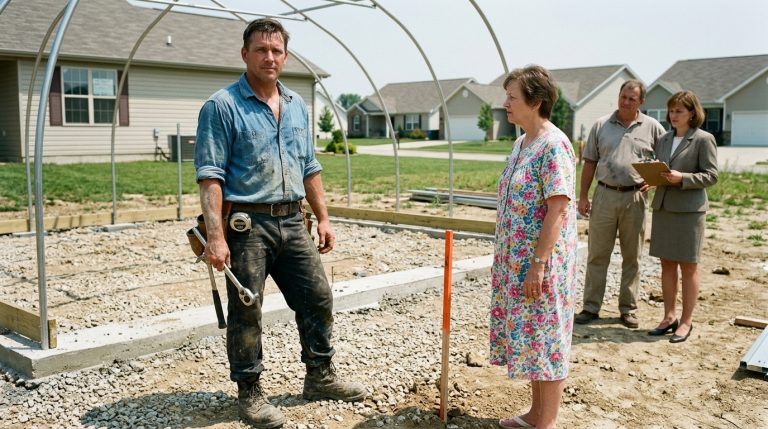
The heat didn’t shimmer; it pressed down, heavy and thick with the scent of sun-baked prairie grass. I stood by the hood of my truck, watching the dust settle over the pile of gravel that had effectively erased my life’s work. Twenty tons. It was an expensive way to say “keep out.”
Karen was still talking. Her voice was a rhythmic, abrasive grating—something about aesthetics and the “preservation of property values.” She didn’t look at the land I’d spent two decades building; she looked at her clipboard, her manicure tapping a frantic, impatient rhythm against the plastic.
“Mr. Warren,” she said, her tone dripping with the saccharine condescension of someone who lived in a world of identical beige walls. “The board considers this a necessary intervention. If you wish to propose an alternative access point, there is a standard form you’ll need to submit.”
I didn’t answer immediately. I looked past her to the tracks left by the dump truck. They were deep, wide, and clearly traced a path back into the pristine, artificial order of Oak Hollow. The dust was still settling in the tread marks. This wasn’t a city-sanctioned project; it was a private act of war, and she was already wearing the look of a victor.
My hand rested on the cool metal of my truck’s fender. The urge to act—to find the driver, to clear the gravel by hand, to shout—was a sharp, physical itch in my palms. I forced it down. In the Army, we didn’t waste ammunition on a target that was already trapped in the crosshairs of a superior system.
“Karen,” I said, my voice barely rising above the hum of cicadas.
She paused, her expression sharpening with self-importance. “Yes?”
“You’ve blocked a deed easement. This road doesn’t belong to your HOA, and it isn’t part of your aesthetic covenant.” I kept my eyes fixed on the gravel. “You have until 5:00 today to move this.”
She laughed. It was a sharp, thin sound that had no business being heard out here in the quiet of the post oaks. “Your threats are as empty as your pasture, Mr. Warren. This is our property now.”
She turned, her polyester dress rustling as she walked back toward her white SUV. She didn’t look back. She didn’t have to. She was confident that her binder of rules was the highest law in the land.
As her vehicle crunched away, the silence of the prairie rushed back in, but it felt different now. The gravel pile didn’t look like a barrier anymore; it looked like a structural defect in her foundation. I pulled my phone from my pocket and switched to the camera. The first step wasn’t anger; it was the cold, clinical documentation of the mistake she had just made.
Then, I looked at the edge of the drainage ditch nearby. The silt was already beginning to wash downhill toward the creek. I zoomed in, clicking the shutter, capturing the evidence that would eventually ensure this pile of rock cost her far more than the price of the gravel.
CHAPTER 2: THE PAPER TRAIL
The hum of Karen’s SUV engine faded into the relentless drone of the Texas mid-afternoon, leaving me standing in the sudden, oppressive quiet of the county road. The gravel pile didn’t look like simple construction debris anymore. In the harsh, vertical light of 2:00 p.m., the individual shards of limestone, sharp and jagged, looked like broken teeth.
I didn’t move for a long minute. My boots were rooted in the soft, dry shoulder of the county road, and the heat rising off the asphalt was enough to make the horizon ripple. Karen’s departure wasn’t a retreat; it was an act of tactical withdrawal after a successful first strike. She hadn’t just dumped rocks; she had effectively cordoned off my thirty acres, turning my property into a private penal colony where the only warden was her.
I reached down and picked up a single stone, turning it over in my calloused palm. It was cheap, low-grade road base—the kind of stuff you buy in bulk when you don’t care about the foundation, only the appearance of a blockade. The grit from the stone left a white, chalky residue on my skin.
I looked back toward the entrance of Oak Hollow. The subdivision was a masterpiece of manufactured serenity: manicured lawns, identical beige stucco, and the kind of silence that usually suggested a neighborhood where people were too busy maintaining the facade to actually live. I had purchased my thirty acres of post oak and prairie to escape that exact brand of suffocation, but the blockade reminded me that no fence is ever high enough to keep out the petty, corrosive reach of someone who loves control more than air.
I walked to the tailgate of my F250 and lowered it with a metallic clack that sounded unusually loud in the still air. I didn’t need to shout, and I didn’t need to track down the dump truck driver. That would be playing her game—a raw, messy, and ultimately pointless collision of temperaments. The tactical approach, the one I had refined over twenty-two years in the Corps, demanded something else. It demanded a structural analysis of her power.
I pulled my laptop from the cab, the screen flickering to life with a glare that forced me to squint. I tethered it to my phone, the connection icon pulsing like a steady heartbeat. I wasn’t just checking emails or drafting a nasty reply. I was opening the digital gates to the county’s public record portal.
For the next hour, I didn’t look up. The sun tracked across the sky, baking the interior of the truck, but I barely felt the sweat trickling down my spine. I was digging into the bureaucratic veins of Oak Hollow. I pulled up the official HOA bylaws, the covenants, and the meeting minutes from the last five years. It was dense, dry, soul-crushing reading—the kind of document designed to discourage anyone who dared to question the status quo.
But for me, it was a map. I cross-referenced the property lines, the platted boundaries, and the specific wording of the deed easement that granted me access. It was all there, buried in the legal jargon: my property was an independent territory, a jagged puzzle piece outside their neat, beige borders. She had no jurisdiction, no legal standing to impose aesthetic standards, and certainly no right to block a deeded right of way.
The realization sat in my stomach, not as a source of rage, but as a cold, sharp piece of leverage. She was operating on a fantasy—a self-constructed kingdom where the rules were whatever she decided they were at that morning’s meeting.
I reached the section of the minutes that detailed the architectural review committee’s procedures. My finger paused on the screen. The signatures on the latest amendments were familiar—Karen Peterson, and two names I’d never seen before, likely placeholders for her handpicked circle.
I saved the files, my movements mechanical and precise. As the sun began to dip toward the horizon, casting long, bruised-purple shadows across the gravel mountain, I felt a strange sense of clarity. The gravel was the first move in a game she thought she was winning, but she had failed to realize that every time she reached out to assert control, she was leaving a paper trail. And in a world governed by statutes and deeds, a paper trail is exactly how you hang someone.
I closed the laptop and sat back against the tailgate. The heat was finally breaking, replaced by a cooling breeze that rustled the tops of the post oaks on my land. I had the start of my response. It wouldn’t be a shouting match; it would be a cold, formal delivery of the reality she had spent years trying to ignore.
The first step was the cease and desist. It had to be perfect. It had to be stripped of all emotion, written with the icy, unyielding precision of a man who knew exactly what the law said about his land. I would file it, certify it, and wait.
As I sat there, I noticed a flash of movement at the edge of the Oak Hollow entrance—a white SUV, parked just out of sight behind the community clubhouse. She was still watching. She wanted to see if I’d snap. She wanted to see if I’d do something stupid.
I turned my back to the subdivision and started the engine. The Ford rumbled to life, the vibrations rattling the frame. I wouldn’t give her the satisfaction of a temper tantrum. I would give her a document that would become the foundation of her undoing.
CHAPTER 3: THE MAP OF THE ROT
The air in the county records office was heavy, stagnant, and tasted faintly of ozone and ancient dust. It was the smell of a machine that had been running for a century, grinding down lives and property claims into manageable, filed stacks. I stepped through the double glass doors, the heels of my boots clicking rhythmically on the linoleum, a sound that seemed too sharp for the muted, beige environment of the clerk’s office.
I walked to the counter, where a woman with glasses balanced on the tip of her nose peered at me over a massive ledger. She didn’t look like a gatekeeper of anything important, but in this office, she controlled the keys to the kingdom.
“I need access to the historical records for the Oak Hollow subdivision,” I said, keeping my voice level, stripped of the fatigue that had been gnawing at me since the blockade started. “Specifically, the original filings for the architectural review committee amendments.”
She looked at me, then at the clock on the wall, which showed twenty minutes until closing. “We’re closing up soon, sir. You’ll need to put in a request form.”
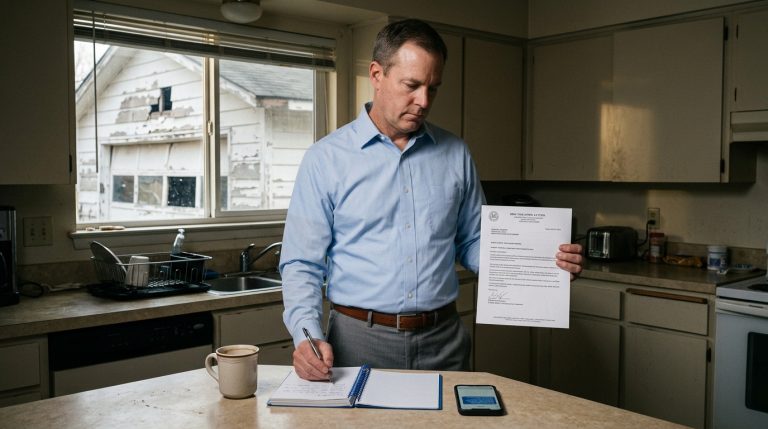
I reached into my breast pocket and pulled out the crisp, formal document I’d prepared the night before—a copy of the request for public records, formatted with the exact citations required by the Texas Government Code. I placed it on the counter with a quiet thud. The weight of it seemed to surprise her.
“I have a formal request filed,” I said. “And I have the time.”
She sighed, a long, weary sound, but she picked up the document. As she read, her posture shifted. The boredom leaked out of her, replaced by a momentary, guarded alertness. She looked at me again, searching for the usual signs of a frustrated homeowner—the shouting, the red face, the desperation. She didn’t find them. I just stood there, waiting, as still as the stacks of paper surrounding us.
“Fine,” she muttered, sliding a key toward me. “The terminal for the digitized filings is in the back. You have fifteen minutes.”
The back room was a labyrinth of rows of filing cabinets that looked like steel sentinels. I found the terminal—a clunky, beige-cased machine that looked like it hadn’t been updated since the 90s. I started with the ARC approvals, scrolling through hundreds of scanned pages. The screen flickered, throwing a sickly green light onto my hands.
It was a sea of banality: paint color changes, mailbox replacements, driveway material requests. Then, I hit the most recent file—the one Karen had sent me. I pulled up the scan of the document she’d claimed authorized the “beautification” of the access road.
I leaned in, my eyes scanning the fine print. That was when I saw it—the discrepancy. The permit number in the upper right-hand corner was formatted in a way that defied the county’s standard chronological sequence. It was a phantom, an anomaly in the machine. But more importantly, the signature line was missing the secondary countersignature required by the county’s own bylaws for common area alterations. It was a forgery, a clumsy bit of amateur theatre performed on an official stage.
I sat back, the breath hitching in my chest. She wasn’t just breaking rules; she was manufacturing them out of thin air. She had likely been doing this for years, relying on the fact that no one ever looked past the surface-level authority of her clipboard.
My eyes moved to the list of committee members. There was Karen Peterson, of course, and beneath her, two names I’d traced back to the local planning commission—a bridge-playing crony and a municipal clerk. The mole George had mentioned wasn’t a rumor; it was a structural component of her influence. She had eyes inside the department, an early-warning system that let her clear the path for her petty tyrannies before anyone else even realized a change was coming.
I felt a cold thrill of satisfaction. This wasn’t just a winnable fight; it was a dismantling.
I spent the next ten minutes printing every page that linked the planning commission employees to the HOA board. I packed the paper into my bag, the weight of it feeling like a weapon in my hand. As I walked back to the front desk, the clerk looked at me, her expression unreadable. She knew what I was looking for, and in this office, silence was the most expensive commodity.
“Found what you needed?” she asked, her voice barely a whisper.
“Everything,” I replied, meeting her gaze.
I stepped out into the evening air. The parking lot was empty, the heat of the day finally bleeding away into a cool, sharp dusk. The gravel pile was still sitting there in my mind, a jagged scar on the landscape, but the map of the rot underneath it was now in my hands. I walked to my truck, my pace steady and deliberate. Karen thought she had built a fortress of rules. She hadn’t realized that if you build a fortress on a lie, you’re not the one standing in it—you’re the one standing under it when it eventually collapses.
I cranked the engine, the roar of the diesel echoing against the blank, grey walls of the county building. I didn’t head for home. I headed for the public library, where I had a meeting with a folder labeled ‘Maxwell’ and the quiet, persistent work of building a coalition. The rot was exposed; now it was time to let the rest of the neighborhood see the cracks.
CHAPTER 4: THE FRAGILITY OF COMPLIANCE
The porch light flickered with a rhythmic, irritating buzz, casting long, twitching shadows across the faded off-white paint of the door. I knocked twice, the sound dull and heavy against the hollow wood. A moment later, the lock clicked—a sequence of tumblers turning with agonizing slowness—and George Maxwell appeared in the sliver of light.
He didn’t open the door wide. He kept the security chain engaged, his eyes wide and darting toward the street before settling on my face. He looked aged, the skin around his eyes drawn tight with a exhaustion that sleep couldn’t fix.
“Mr. Warren,” he whispered, his voice trembling. “You shouldn’t be here. She’s… she’s been patrolling the street more often since the gravel went down.”
“I have the proof, George,” I said, my voice low. I held up the bag containing the prints from the county office. “The permit she showed me for the road blockade? It’s a forgery. And the people she has on the commission? They’re on the papers. I can see the connections now. She isn’t just a neighbor on a power trip; she’s orchestrating a system to keep everyone here in the dark.”
George hesitated, his hand gripping the edge of the door until his knuckles went white. He glanced back into the dim hallway of his home, where the silhouette of a woman—his wife, presumably—waited in the shadows. Finally, he unlatched the chain. The door groaned as he pulled it open just enough for me to slip inside.
The house smelled of damp carpet and old, over-steepened tea. It was a space designed for invisibility; every knick-knack was placed with careful, practiced symmetry, every surface dusted to a sterile, fearful shine. George led me into the kitchen, a cramped space where a single yellowed newspaper sat on the table next to a stack of envelopes, all marked with the HOA’s logo.
“Sit,” he said, pulling out a chair. He didn’t offer coffee. He looked at the bag I’d placed on the table as if it were a bomb. “You don’t understand, Jack. She has a way of making it personal. It’s not just about the money. It’s about the feeling that you’re being watched, every hour of the day. When I painted the door crimson, she didn’t just fine me. She sent a letter claiming the color ‘psychologically disrupted the visual harmony of the community’ and threatened to have the city condemn the house for ‘aesthetic instability.'”
He leaned in, his face inches from mine. “She made us think we were losing our minds. My wife stopped going to the grocery store because she was afraid of running into Karen. Every time the doorbell rings, my heart stops. You see gravel on a road. I see a warning.”
I pulled the documents out and spread them across the table. I pointed to the permit forgery, the missing countersignature, and the names of the planning commission employees tied to the board’s secret amendments. I didn’t frame it as a rescue; I framed it as an exposure.
“She’s been using the rules as a wall, George,” I said, my voice steady, anchoring the room. “But a wall is only effective if people are afraid to look behind it. Look at these names. She doesn’t have the legal authority she claims. She’s essentially running an extortion racket using public systems she’s managed to infiltrate. If we take this to the county, if we show them the pattern—not just one fine, but fifty—the whole thing collapses.”
George stared at the documents, his fingers tracing the forged permit number. I saw the struggle in his eyes—the instinct to flee, to keep his head down, warring with the raw, festering indignation of a man who had lost too much to a bully.
“She has friends in the planning commission,” George reminded me, his voice a whisper. “You said so yourself.”
“And those friends have jobs to lose,” I countered. “As soon as this gets to the district attorney’s office, the commission will cut her loose to save their own skin. She’s a liability, George. And right now, she’s too arrogant to see that she’s standing on a trapdoor of her own making.”
The silence in the kitchen was thick, punctuated only by the nervous, rapid-fire ticking of a wall clock that seemed to be measuring our time away. George looked at his wife, who had moved into the doorway, her arms wrapped tightly around herself. She wasn’t looking at the papers; she was looking at me, her eyes searching for a flaw in my confidence.
“If we help you,” she said, her voice brittle, “what happens to us?”
“We stay quiet,” I said, looking from her to George. “We keep documenting. We gather the files from the other neighbors who are just as fed up as you are. We don’t go to her. We go over her, directly to the agencies she’s been subverting. When the hammer falls, she won’t even know where the hit is coming from until it’s already landed.”
George looked down at the forged document one last time, then back at me. He took a long, shaky breath, and for the first time since I’d arrived, his shoulders dropped just a fraction of an inch.
“I have a box,” he said quietly, standing up and moving toward a closet in the hall. “She didn’t just fine us. She kept a record of everything. I kept copies of every single letter, every threat, every ‘violation.’ I thought… I thought one day, it would be enough to prove she was insane.”
He returned with a heavy cardboard box, the bottom taped over with layers of aged, yellowing adhesive. He set it on the table between us. It was a physical record of five years of systematic torment.
“It’s all here,” George said.
I opened the box, the smell of stale air and paper rising up. It was a goldmine of evidence—the smoking gun of a thousand tiny, paper-cut cruelties. I looked at George. The fear was still there, flickering in his eyes, but it was being eclipsed by something else. A flicker of resolve.
“Keep this safe,” I said. “This is the end of the line for her.”
I stepped back out into the night, the weight of the new files in my bag shifting against my side. The subdivision was still quiet, the beige houses huddled together like sheep in the dark. But as I walked to my truck, I realized the atmosphere had shifted. I wasn’t just a man fighting for his road anymore. I was the architect of an evacuation, and the foundation of Karen’s empire was already starting to crumble.
CHAPTER 5: THE LEGAL ARCHITECT
The rain began as a tentative tapping against the roof of the F250, but within minutes, it had escalated into a full-scale Texas deluge. The world outside the windows turned into a blurred gray smear. I sat in the driver’s seat, the engine idling with a low, rhythmic thrum, watching the water cascade off the windshield in thick, distorted sheets.
My phone, mounted on the dash, lit up. The screen displayed Dave’s name. I answered, the Bluetooth connection crackling with static.
“Jack,” his voice was crisp, cutting through the sound of the rain. “I’ve been going over the files you sent—the forgery, the commission links, the pattern of harassment. We have enough to move, but the timing is tight. The regional office of the Department of Transportation just updated their schedule. They’re moving their inspection window up by forty-eight hours.”
“They’re ahead of schedule,” I said, leaning my forehead against the cool glass of the side window.
“They are, which means we have to be ready to feed them the evidence before Karen even realizes they’re on the roster,” Dave replied. “If she knows they’re coming, she’ll try to ‘clean up’ the scene. She’ll move the gravel, claim it was a landscaping error, and try to bury the paper trail. We need the evidence of the original state—the obstruction, the lack of permits—to be the first thing they see when they roll up.”
I gripped the steering wheel, my knuckles whitening. “She’s not going to just let them walk in, Dave. She thinks this is her sovereign soil.”
“That’s exactly what I’m counting on,” Dave said, his tone shifting into the calculated cadence of a litigator. “She’s going to double down. She’s going to try to block the inspectors, cite her covenants, and show them her little forged documents. That’s the moment we trigger the federal non-compliance protocol. I need you to be the eyes on the ground. When the inspector pulls up, I need you to feed me the confirmation. Once I have that, I trigger the DOT enforcement division.”
“What about the mole in the planning commission?” I asked, looking toward the dark outline of the Oak Hollow community center visible through the rain.
“I’m handling that. I’ve already contacted an acquaintance in the D.A.’s office who has a very specific interest in municipal corruption. Let’s just say that once the federal spotlight hits, anyone attached to her board is going to be running for cover, not helping her file permits.”
“Understood,” I said.
The call ended, leaving me in the silence of the cab. I looked down at the box of documents George had given me. It felt heavy—a burden of truth that had been kept in the dark for five years. I turned the ignition, the engine’s rumble deepening as I shifted into drive.
I didn’t head home. I drove toward the edge of the Oak Hollow perimeter, finding a spot on the shoulder of the county road where the gravel pile sat, slick and dark under the downpour. It was a miserable sight—a monument to pettiness currently being washed into the storm drain.
I checked the dashboard clock. Two in the morning. I was tired, my eyes gritty from days of staring at screens and squinting through legal documents, but the adrenaline kept the fatigue at arm’s length. I watched the entrance to the subdivision. It was a ghost town, a labyrinth of beige boxes standing in the rain, unaware that their entire way of life was about to be dismantled by the very rules they had used to harass each other.
A set of headlights cut through the gloom, turning into the subdivision entrance. I ducked lower, watching as a white SUV—Karen’s—crept toward the community clubhouse. She was probably doing her own late-night patrol, checking to make sure her little kingdom remained compliant, unaware that the walls were already paper-thin.
I realized then that this wasn’t just a battle for my road. It was a confrontation between two distinct types of power: her power, which was rooted in the fragility of consensus and intimidation, and my power, which was rooted in the cold, unyielding reality of federal statute. She thought she was the architect of her world, but she had been building with wet sand.
I felt the weight of the phone in my pocket. Tomorrow, the inspectors would arrive, and the sand would finally start to wash away. I turned the truck around, the tires splashing through the deep puddles, and headed for the only place where I could get a few hours of sleep before the storm truly broke. The trap was set; all I had to do now was hold my position and wait for the signal.
CHAPTER 6: THE SILENT MAJORITY
The community center smelled of floor wax and the faint, lingering scent of industrial cleaning agents. It was a space built for bland consensus, the kind of room that usually housed bridge clubs and knitting circles, not the quiet, simmering rebellion I was trying to spark. I stood in the back, the cardboard box of evidence sitting on the folding table like a dormant engine.
Outside, the wind whipped against the siding, a persistent, rattling noise that filled the pauses in the room’s heavy, pregnant silence.
There were only three people present: George Maxwell, Frank the CPA, and a woman I recognized as the widow from my initial research. The other four families who had promised to attend—the ones who had been harassed, fined, and bullied—were absent. Their empty chairs, arranged in a semi-circle, seemed to stare at us, mocking the idea that we could ever form a coalition against a woman like Karen.
“They aren’t coming,” Frank said, his voice stripped of his usual professional polish. He was twisting a gold wedding band around his finger, his eyes fixed on the door. “I talked to the young couple, the ones who were fined for the plastic slide. They said they couldn’t risk it. Karen’s been making the rounds all afternoon. She’s been going door-to-door, telling everyone that if they associate with the ‘instigators,’ the board will trigger a mandatory property review. She’s threatening their equity, Jack.”
I didn’t answer. I looked at the empty chairs, the space between them representing the massive, crushing weight of fear. Karen wasn’t just using the law anymore; she was weaponizing the neighbors’ own financial survival against them.
“She’s terrified,” I said, my voice cutting through the hum of the overhead lights. “She knows the inspection is coming. She’s playing the last card she has—isolation. If she can make everyone else feel alone, they’ll fall in line.”
“It’s working,” the widow added, her hands clasped tightly in her lap. She looked older than she had a week ago, her face drained of color. “She told me that if I participate in this, she’ll file a formal nuisance complaint about my garden. She’ll force me to pay for the ‘restoration’ of the common area my hydrangeas supposedly intrude upon. I don’t have the money to fight her, Jack. None of us do.”
I felt the tension rising in my throat—the frustration of seeing the truth get swallowed by the simple, brutal arithmetic of neighborhood politics. But this wasn’t the time for sympathy. This was the time for the leverage I had spent the last forty-eight hours cultivating.
“She can’t evict you, and she can’t seize your house,” I said, stepping toward the center of the room. “The legal standing of those threats is non-existent. She’s bluffing. She’s banking on you not knowing what a document is worth when it’s presented to a judge.”
I reached into my bag and pulled out the copies of the planning commission records—the names, the signatures, the forged permit numbers. I laid them out on the table.
“Look at this. This isn’t just about a garden or a plastic slide. This is about the fact that your board president is committing felony-level fraud. As soon as the federal inspectors arrive, her ability to file a nuisance complaint will be the least of her worries. The commission will be under scrutiny. The D.A. will be reviewing every single fine she’s ever levied. She won’t be able to look at your hydrangeas; she’ll be too busy answering to a federal investigator.”
Frank leaned in, his eyes scanning the documents. He was a CPA; he understood the difference between a threat and a liability. He ran a finger along the signature on the forged permit. “This is actionable,” he murmured. “If this gets to the state auditor, the entire HOA bank account could be frozen. She wouldn’t even have the money to hire a lawyer to fight these ‘nuisance complaints’.”
“Exactly,” I said. “She’s buying time with your fear. Don’t give it to her.”
The room remained heavy, but the air felt less like a vacuum. The widow looked at the paper, then back at me. There was still fear in her eyes, but it was accompanied by a burgeoning, dangerous anger.
“What do we do?” she asked.
“We don’t protest,” I said. “We don’t march. We wait. I’ve already established contact with the federal inspectors. I have a direct line to the people who are coming to dismantle this. When they pull into the subdivision, all I need is for you to be ready to tell the truth. Not a rebellion, not a shouting match. Just the truth of what she’s done, documented in these files. She can’t intimidate a federal agent, and she certainly can’t threaten someone who has already gone on the record.”
I looked at the empty chairs again. It wasn’t the victory I wanted, but it was enough. The crack in the facade was there.
“Go home,” I told them. “Stay off the radar. Don’t respond to her letters. Don’t sign anything. Tomorrow, when the inspector’s truck turns the corner, you’ll see that the rules you were so afraid of were never yours to follow—they were a cage she built to keep herself in power.”
As they packed up their belongings, I stayed behind, gathering the documents. The silence of the community center felt different now. It was no longer the silence of surrender; it was the silence of a structure waiting for the final, critical hit. I walked to the door, the rain outside having slowed to a rhythmic, steady drizzle. The subdivision lay before me in the dark, and for the first time, I didn’t see a fortress of beige walls. I saw a minefield, and I had the map.
CHAPTER 7: THE CRUMBLING FAADE
The morning air hit me like a physical blow—cold, humid, and vibrating with the low-frequency drone of heavy engines. I stood on the concrete step of the community center, the box of evidence still pressed under my arm, as a phalanx of official-looking vehicles fanned out across the gravel-covered lot.
Karen was already there. She stood by the folding table, the “Peterson Park” sign leaning crookedly against her legs. She was caught in a moment of absolute, frozen hubris—a powdered donut in one hand, her clipboard in the other, her face caught in a mask of triumph that curdled into confusion as the first vehicle, a dark sedan bearing the federal shield of the Department of Transportation, slowed to a crawl in front of her.
She didn’t move. She couldn’t. The world she had curated, the pristine, beige-tinted bubble where she was the supreme arbiter of taste and law, was being systematically punctured by the presence of vehicles that didn’t know or care about her HOA bylaws.
I didn’t run. I didn’t shout. I simply walked toward the gravel pile, my boots crunching on the wet, loose stone. The agents emerged from the vehicles with a measured, disciplined pace. They weren’t looking at Karen; they were looking at the earth, the storm drains, and the physical obstruction that defined this piece of the landscape.
“Ma’am,” the woman in the lead suit said—Agent Harris, I realized from Dave’s description. Her voice was flat, devoid of the emotional static that defined Karen’s usual interactions. “Are you Karen Peterson, president of the Oak Hollow Homeowners Association?”
Karen blinked, her eyes darting between the agent and the other two vehicles pulling up behind her—a state environmental truck and a local county enforcement cruiser. She tried to puff her chest out, but the motion looked tired, almost brittle.
“This is private property,” Karen said, her voice wavering, lacking the authoritative bite I’d grown to hate. “We are in the middle of a community improvement project. I need to see your credentials and the authorization for this trespass.”
The agent didn’t flinch. She opened a folder, the pages flapping in the wind, and held it out. “We have a federal mandate, Ms. Peterson. We are here to investigate a violation of the Rural Electrification and Access Act regarding the federal right-of-way you have obstructed. Your covenants are irrelevant to this jurisdiction.”
I reached the edge of the gravel, close enough to see the frantic, terrified pulse in Karen’s neck. She looked toward the subdivision, hoping for the support of her neighbors, but the beige streets were empty. The curtains in the houses across the way were tight, the community hiding from the very authority they had been told was a scare tactic.
“You don’t understand,” Karen stammered, her voice dropping to a panicked, desperate pitch. “This is… this is a mistake. I have the ARC approval forms. I have the board minutes!”
“We have copies of those as well,” Agent Harris said, her eyes scanning the forged signature on the document I’d seen in the county records. “Including the ones that were never filed with the county. We’re currently reviewing them for evidence of fraud.”
The clipboard slipped from Karen’s hand, clattering against the loose gravel. It was a small, sharp sound that seemed to signal the final collapse of her authority. She looked small now, her floral pantsuit soaked by the mist of the rain, the “Peterson Park” sign sagging in the mud behind her.
I set the cardboard box down on the dry patch of concrete near the entrance. I didn’t speak. I didn’t need to. I watched as the environmental agents began to take soil samples, their tools digging into the ground right where the gravel met the edge of the storm drain.
“I’m going to need you to step back, Ms. Peterson,” the agent commanded. “We are beginning the remediation process. You will be held personally liable for the costs of removing this material and restoring the easement to its original state.”
Karen’s gaze landed on me for the first time. Her face wasn’t angry anymore; it was vacant, a portrait of a woman who had spent five years running a race against a clock she’d never checked. She looked at me, her eyes searching for a crack in my composure, but I only looked back with the steady, detached gaze of a man who had built a better machine.
She turned away, stumbling over the gravel, and retreated toward her SUV. She didn’t look back again. She was no longer the president of anything. She was just a woman walking toward a quiet, inevitable ending.
The rain picked up, washing away the last traces of the dust and the pretense. The agents continued their work, the sound of the gravel being cleared becoming the steady, rhythmic heartbeat of a new reality. My access road was being reclaimed, one shovel-full at a time, and for the first time in months, the future didn’t feel like a blockade—it felt like an open map.
CHAPTER 8: THE DUST SETTLES
The rain had pulled back to a light, persistent mist, turning the ground into a rich, dark tapestry of mud and churned-up prairie soil. I walked from the cab of my F250 toward the entrance of the easement. The gravel was gone. Where there had been a mountain of spite, there was now only a deep, tire-tracked scar leading directly into the heart of my property.
The silence that followed the heavy equipment’s departure was profound. It wasn’t the artificial, performative silence of Oak Hollow, but the deep, resonant stillness of land that was finally, unequivocally, back under my control.
Karen was gone. I’d seen her white SUV pass the community center gate an hour ago, headed out toward the county road with the window rolled up, her face a pale, unrecognizable blur. She was moving on to a world that didn’t know the name Peterson, or perhaps to a small apartment where the HOA rules couldn’t reach her. The collapse of her “Peterson Park” hadn’t just taken her pride; it had dismantled the fragile, fraudulent architecture of her entire reality.
I stepped onto the easement, my boots sinking slightly into the mud. It was raw and torn, but it was mine.
Behind me, at the edge of the Oak Hollow development, George Maxwell stood on the sidewalk. He looked different—his posture was no longer that of a man expecting a blow. He was watching the site of the former blockade with a look of profound, quiet disbelief. He caught my eye, and for a moment, neither of us said a word. We just nodded. He turned and walked back toward his house—the one with the brilliant, cobalt-blue door that had become a silent, defiant testament to his own survival.
The process of legal closure had been swifter than I’d expected, fueled by the sheer weight of the evidence we’d dumped into the federal pipeline. By late afternoon, the legal team had forwarded the final consent decree to the homeowners. The HOA was reeling under the sudden influx of audits, their insurance rates skyrocketing, and the board itself was in the middle of a messy, public dissolution.
I walked further onto the property, the mud giving way to the thick, coarse grass of the prairie. I found the spot where I had been standing when I first confronted Karen—the place where the gravel pile had effectively turned my life into a stalemate.
I knelt down, pulling a small, battered shovel from the back of my truck, and began to work on the edge of the road, clearing the drainage ditch that had been choked by the runoff. It was manual, back-breaking labor, but it was exactly the kind of work I had spent my life doing. There was a rhythm to it: clear, stack, smooth, repeat. It was an act of restoration, a way to signal to the land that the siege was over.
As the light began to fade, turning the sky into a bruised mixture of gold and indigo, I heard footsteps behind me. It was Frank, the CPA. He stood on the edge of the access road, his hands tucked into his coat pockets.
“The bank account is frozen,” he said, his voice calm, the stress of the previous week finally absent. “The auditors found the missing money—the ‘improvement funds’ that Karen had been siphoning into that phantom shell account. It’s a mess, Jack. But it’s an honest mess. We know what we’re dealing with now.”
“What happens to the HOA?” I asked, wiping a smudge of mud from my forehead.
“We dissolve it,” Frank replied, looking out over my thirty acres. “Or at least, we strip it down to the absolute bare minimum—streetlights and trash pickup. No more ‘aesthetic committees.’ No more ‘Peterson Parks.’ We’re going to let people paint their doors whatever color they want.”
I stood up, the shovel heavy in my hand. The restoration was complete. The easement was clear, the drainage was functioning, and the shadow of the HOA had been permanently lifted.
I looked at my property—the post oaks swaying gently in the evening wind, the prairie stretching out into the darkness. I thought back to the cardboard box in my truck, the thousands of pages of threats and petty intimidation that had nearly cost us our peace. I had fought the fight with logic and documentation, treating the law as a structural beam that I could use to bear the weight of my own defense.
“It’s a good place, Jack,” George added, appearing beside Frank. He smiled, a genuine, easy expression that reached his eyes. “You kept it yours.”
“We all kept it,” I corrected him.
They walked back toward the subdivision, their voices fading into the quiet of the twilight. I stayed behind for a few minutes, listening to the wind and the rustle of the prairie grass. I reached down and picked up one of the few remaining shards of gray rock that the cleanup crew had missed. I tossed it into the tall grass, a final, inconsequential act of erasure.
The road ahead was open. I turned back toward my workshop—a structure that was finally mine to finish, standing on ground that was finally mine to walk. The system had worked, but it had worked because I hadn’t let it become my master. I had treated the law as a tool, and in the end, it was the only thing I needed.
I climbed into the truck, the cabin feeling quiet and settled. As I started the engine, I didn’t look back at Oak Hollow. I put the truck in gear and drove up the easement, the tires finding purchase on the solid, unbroken earth. It was a long road, but for the first time, I was the one driving, and the way forward was as clear as the night sky.