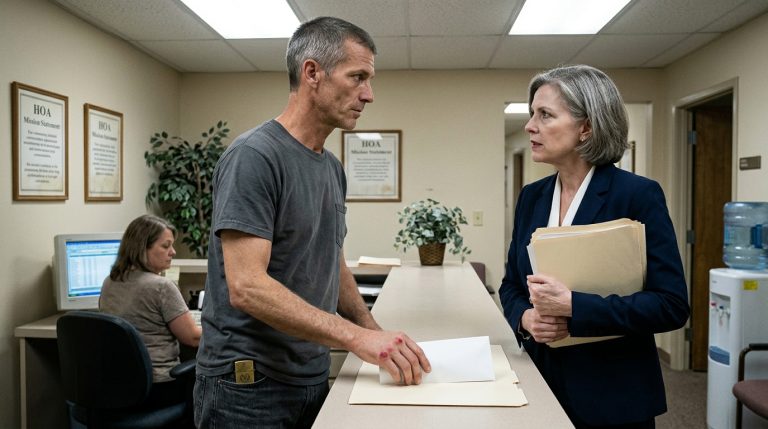
The Chemistry of Retribution: How a Quiet Widower Systematically Dismantled a Suburban Tyrant’s Empire Using Her Own Rules
CHAPTER 1: THE SCORCHED EARTH
The dew-soaked grass of the front lawn felt cold against the rubber soles of my boots, but the heat radiating from the dead hedge line was entirely psychological. Fifty arborvitaes, ten years of patient growth nurtured alongside Sarah’s memory, stood as stiff, sepia-toned skeletons. The morning air was thick with a synthetic, biting reek that coated the inside of my nostrils—a heavy, oily signature I hadn’t smelled since my third tour in the engineering corps. Defoliant. Not the generic garden-center spray meant to discourage rogue dandelions, but a heavy-duty industrial formula designed to strip life down to the bedrock and keep it dead.
I didn’t blink as I stared across the property line toward the manicured perfection of Karen’s turf, her smart-porch light glowing with smug, automated insulation against the dawn. My pulse didn’t spike; it flattened, settling into the familiar, cold cadence of a tactical assessment. Twenty years of military discipline had taught me one absolute truth about hostile terrain: never react to the insult, calculate the logistics.
My hand descended to the pocket of my jeans, my fingers closing around the cold, anodized metal of my pocketknife. The physical evidence was evaporating by the minute as the morning sun began to bake the soil, drawing the volatile chemical compounds upward in shimmering, invisible waves. If I wanted to survive this engagement and dismantle the petty fiefdom Karen had constructed, I couldn’t afford a single emotional miscalculation. Every interaction was a perimeter check; every rule she had weaponized against the elderly and the vulnerable was about to be turned inward against her own defenses.
A sharp, metallic clatter echoed from across the street as the neighborhood garbage truck ground to a halt, breaking the sterile silence of the cul-de-sac. As the pneumatic lift groaned, lifting a neighbor’s bin into the hopper, a glint of sunlight caught the edge of a small, forgotten plastic cap half-buried in the mulch near the base of my ruined hedge line—a bright, incongruous crimson cap that hadn’t been there the night before.
CHAPTER 2: THE CHAIN OF CUSTODY
I did not reach for the cap immediately. In a controlled site assessment, the first rule is to establish perimeter security before securing artifacts. My eyes tracked the distance from the property line to Karen’s immaculate driveway across the asphalt, noting the exact angle of the morning shadow cast by her oversized decorative mailbox. No curtains twitched across the street; the neighborhood was still caught in the sluggish half-sleep before the morning commute, leaving me an unobstructed window to begin the collection phase.
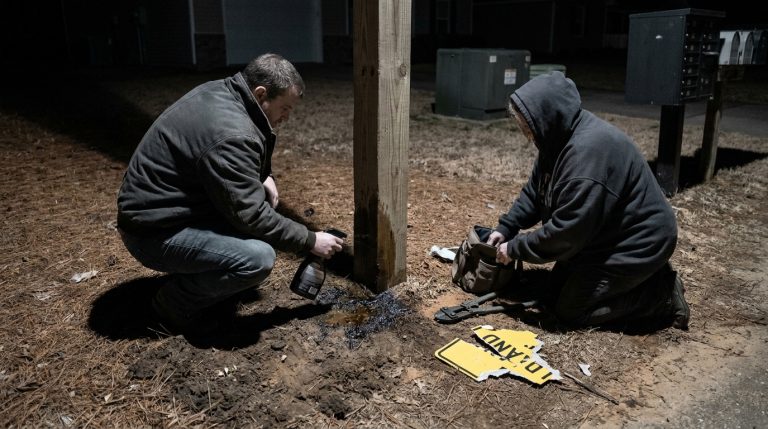
With my gloved hands already protected inside the heavy-duty nitrile skin, I knelt beside the scorched boundary where the emerald wall of arborvitae had stood less than twenty-four hours ago. The soil beneath my knees was no longer damp with morning dew; it was slick with an iridescent, oily film that resisted absorption. I reached into my jacket pocket, extracted a sterile, heavy-duty zip-top evidence bag, and used a clean garden trowel to scoop a precise cross-section of the contaminated earth directly beneath the crimson cap.
The physical weight of the dirt felt heavy, dense with a synthetic toxicity that defied the natural dampness of the earth. I slipped the crimson cap into a separate secondary bag, sealing each unit with meticulous, deliberate pressure to eliminate air pockets. This was not merely about documenting property damage; it was about establishing an unbroken chain of custody that would hold up under the scrutiny of an environmental auditor or a federal inspector. Every movement was slow, measured, and stripped of extraneous emotion, driven purely by the cold mechanical logic of a combat engineer clearing a compromised zone.
My phone vibrated against my thigh, a dull, rhythmic thrum breaking the heavy quiet of the yard. I left it in my pocket, letting the call roll to voicemail while I finished securing the primary grid samples along the one-hundred-foot trench line. When the vibration ceased, I rose slowly, brushing a fleck of sterile silt from my knee, and pulled the device free to inspect the display.
The caller ID flashed a local civilian consultant number belonging to Dex, my old unit’s contact who now lived downstream in the bureaucratic machinery of environmental oversight. I pressed accept and brought the phone to my ear, keeping my eyes fixed on the distant, silent windows of Karen’s house.
“Mark,” Dex’s voice came through instantly, stripped of any casual greeting, sharp and professional. “I ran the preliminary parameters on the compound you described over text. If that soil smells like scorched copper and kills roots down to the taproot within twelve hours, you’re not looking at a consumer-grade weed killer from a hardware store shelf. You’re looking at a high-concentration industrial herbicide. The kind that requires a state-issued commercial applicator license just to look at a catalog.”
“I have the physical sample in my hand right now, Dex,” I replied, my voice low and even, matching the steady cadence of the wind rustling through the dead branches. “And I found a marker at the base of the line. A crimson cap from a commercial-grade pressure sprayer.”
A brief pause hung on the line, the electronic static filled with the distant hum of traffic from the highway three miles away. “Alright, listen to me very carefully,” Dex said, his tone shifting gears into operational advisory mode. “If it’s an industrial restricted-use compound, it leaves a chemical signature—a specific batch tagent that manufacturers use to trace distribution down to the exact commercial vendor. Local cops won’t know how to read the lab sheets, but if you send those samples to a certified toxicology lab with a formal chain of custody, that paper trail leads directly to who signed for the inventory. You need to log every coordinate, every depth measurement, and every control sample from an unaffected part of your yard before the afternoon heat degrades the volatile markers.”
“Already mapped out,” I said, turning my gaze back toward the dark, polished mahogany of my front door where my tactical binder sat waiting on the workbench. “The grid is set. The samples are bagged.”
“Good,” Dex muttered. “Because whoever dropped that chemical didn’t just vandalize a hedge row. They signed their name on a federal environmental violation, and they probably don’t even know it yet.”
The call disconnected with a sharp click, leaving me standing alone in the gray morning light beside the skeletal remains of Sarah’s living memorial. I tucked the sealed evidence bags carefully into a chilled cooler on my workbench, sealing the lid before walking over to my desk to pull up the thick, leather-bound volume of the Oak Haven Estates covenants, conditions, and restrictions. The battle lines were drawn, the perimeter was secured, and the first official document in our war was ready to be drafted.
CHAPTER 3: PLANTING THE FIRST SEED
The workbench light cast a long, surgical shadow across the pages of the Oak Haven Estates covenants. I did not move from the chair immediately after hanging up with Dex. My gaze drifted past the glass of the window toward Mrs. Gable’s front porch across the cul-de-sac. The timid, elderly woman was standing behind her screen door, her fingers nervously pleating the fabric of her apron as she stared across at Karen’s pristine, fortress-like driveway.
In a tactical engagement, intelligence is gathered at the periphery before engaging the core. Martha Gable was the periphery—frightened, isolated, and entirely dependent on the silence enforced by a woman who treated a suburban street like a militarized zone. If I was going to anchor the documentary evidence with human testimony, I needed to cross the asphalt before the neighborhood fully woke up and Karen began her morning patrol on her pastel pink golf cart.
I stood up, letting the wooden chair scrape quietly against the floorboards, and stepped out through the front door. The morning air was crisp, carrying that faint, chemical ghost of the defoliant that still clung to the boundary line. I walked slowly across my lawn, keeping my movements deliberate and non-threatening, avoiding the scorched trench where the soil samples had just been drawn.
Martha saw me coming. The screen door clicked open an inch, then two, as she peered out like a small bird bracing against an impending squall. Her eyes kept darting past me toward Karen’s house, as if the mere act of looking in that direction might summon the HOA president’s clipboard.
“Morning, Martha,” I said, keeping my voice pitched low, steady, and conversational. I stopped two paces short of her bottom step, hands resting naturally in the pockets of my jeans.
“Mark,” she whispered back, her voice trembling as her knuckles whitened against the wooden frame of the door. “I saw you out there earlier with those little plastic bags. The police… or—or is it about what happened to your hedge? Everyone’s saying she’s furious.”
“Karen has nothing to be furious about yet,” I replied evenly, letting a faint, reassuring cadence soften the edge of my military posture. “She thinks a few weeks of silence and a formal letter will make the dead wood disappear. But physical evidence doesn’t lie, Martha. And neither do memories.”
A flicker of raw, suppressed frustration crossed the old woman’s face, warring instantly with decades of ingrained compliance. “She’s a bully, Mark. Ever since they gave her that title, it’s like she owns the air we breathe. Last week she threatened to fine me because my windchime made too much noise when the wind came off the lake. It’s just a little brass tube. My late husband hung it there ten years ago before he passed.”
The parallel struck a quiet, heavy chord behind my ribs, instantly triggering a sharp memory of Sarah pressing the first tiny arborvitae root into the loose, dark soil a decade ago, her hands covered in dirt and her smile wide against the afternoon sun. That memory was a private anchor; I kept my expression locked in cold, objective resolve.
“You don’t have to fight her today, Martha,” I said softly, leaning in just enough to close the tactical distance without causing alarm. “I’m not asking you to stand up at a board meeting or wave a flag. But a bully relies on one specific advantage: the belief that nobody is writing down what they do in the dark. If you remember something—a sound, a vehicle, a specific time when the street lights flickered—don’t keep it in your head. Write it down on a piece of paper. Just for yourself. Give your memory an anchor.”
Martha stared at me, her chest rising and falling in shallow, nervous breaths. The weight of her fear was heavy, but beneath it lay the quiet, smoldering resentment of someone who had watched her home turned into a prison. Slowly, a hesitant resolve settled into her watery eyes. She didn’t make a grand promise; she simply gave a small, jerky nod of her head.
“I have a little green ledger by the kitchen phone,” she murmured, her voice dropping to a conspiratorial whisper. “I write down when the paper delivery is late. I suppose… I suppose I could add a few notes about last night. Around two in the morning. I heard a hissing sound. Like air escaping from a tank.”
“Write it down, Martha,” I said, stepping back to reestablish the perimeter. “Date, time, and what you heard. Let me handle the rest of the math.”
I turned away before she could reply, walking back across the asphalt toward my own driveway. The first seed was planted. The isolation Karen relied on to maintain her micro-dictatorship was beginning to fracture from the edges inward, and the legal framework on my workbench was ready for its next phase of execution.
CHAPTER 4: DECODING THE CODEBOOK
I didn’t turn my head as the heavy brass hinges of Karen’s custom mahogany door whined against the morning quiet. It was a calculated risk. A peripheral glance would register as engagement; a steady, unhurried walk to my front door communicated absolute dismissal. I felt the weight of her stare boring into the space between my shoulder blades, an invisible pressure that demanded submission. I pushed open my door, stepped into the cool, silent interior of the entryway, and let the deadbolt slide home with a heavy, satisfying metallic thud.
The air inside the house was stale, a stark contrast to the sharp, chemical edge of the yard. I walked straight to the kitchen, bypassing the blinking red light of the answering machine, and set the kettle on the stove. The burner ignited with a quiet whoosh, the blue flame providing a small point of focus as I mentally transitioned from the physical battlefield to the bureaucratic one. I poured the boiling water over the grounds in the French press, watching the dark liquid bloom, before carrying the heavy ceramic mug back to the dining room table.
The leather-bound binder of the Oak Haven Estates covenants sat exactly where I had left it, an imposing brick of dense, convoluted legalese designed to intimidate the average homeowner into compliance. It was nearly two hundred pages long, printed in a tight, uniform font that blurred into gray blocks of text. I sat down, placed the mug on a coaster, and opened the binder to the table of contents. I drew three highlighters from my shirt pocket—yellow, pink, and blue—and laid them out in a neat, parallel line.
My military training had primarily focused on physical engineering, but the underlying logic was the same. A bridge was held up by stress points; an organization was held up by procedures. Find the weak procedural link, and the entire structure collapses. I uncapped the yellow highlighter and began the first pass, searching for the rules Karen had explicitly weaponized.
The silence in the house deepened as I read, punctuated only by the scrape of the marker against the thick paper. Section 7, Subsection C: Elimination of potential fire spread vectors. It was there, written in black and white, giving the HOA the authority to mandate the removal of overgrown vegetation. Karen had cited it perfectly. I flipped the page, my eyes scanning the dense paragraphs, searching for the procedural counterbalance. If a rule existed to grant authority, a rule must exist to govern its application.
It took forty-five minutes of deliberate, focused reading before the blue highlighter came into play. Section 12, Subsection A: Enforcement Procedures and Homeowner Notification. I traced the line of text, the blue ink emphasizing the critical failure in Karen’s tactical execution. “…before any enforcement action resulting in a financial penalty or mandated cost to the homeowner may be taken, a formal warning must be issued by a majority vote of the full five-member board, delivered via certified mail…”
I leaned back in the chair, the leather creaking slightly. Karen hadn’t called a board vote. She had sent a single, vaguely worded letter three months ago about “landscape maintenance,” signed only by her, and delivered by regular post. She had acted unilaterally, treating the board as a rubber stamp for her personal vendettas. It was a fatal procedural error born of sheer arrogance.
I took a slow sip of the coffee; it had grown lukewarm and bitter, matching the cold satisfaction settling in my chest. I flipped to the appendices, searching for the specific clauses regarding property damage. This was where the dense legalese usually hid the most crucial protections, buried under layers of sub-clauses and addendums.
My eyes snagged on a paragraph buried deep in Section 18: Environmental and Structural Mitigation. I read it twice, the words seeming to vibrate off the page. “…in the event of a spill, leak, or deliberate introduction of any chemical substance regulated by the state or federal Environmental Protection Agency, the HOA is required to immediately notify the affected homeowner and take all necessary steps to fund and oversee the complete remediation of the affected area utilizing the HOA’s general liability and environmental insurance policies.”
I stopped, the blue highlighter hovering motionless over the page. I wasn’t just looking at a procedural violation anymore; I was looking at a financial anomaly. The wording was specific, designed to protect the HOA from liability, but it also mandated a process. If Karen had intentionally introduced a restricted-use chemical onto my property, she hadn’t just committed vandalism; she had triggered a massive liability clause that the board was legally obligated to report to their insurance carrier.
Why wouldn’t she report it? If she believed she was justified under Section 7C, she would have simply filed the claim and billed me for the deductible. The fact that she was trying to force me to pay for the removal out of pocket, completely bypassing the insurance protocol, didn’t just point to arrogance. It pointed to a desperate need to keep the insurance company, and by extension, outside auditors, completely blind to the HOA’s internal operations.
I stared at the blue line I had drawn, the realization crystallizing into a hard, undeniable truth. The dead hedge wasn’t just a casualty of a petty dispute. It was a thread connected to a much larger, darker knot hidden somewhere within the HOA’s financial records. I closed the binder, the heavy thud echoing in the quiet room. It was time to draft the formal notification. It was time to pull the thread.
CHAPTER 5: THE FORMAL NOTICE
I did not rush the pen. When dealing with a bureaucracy engineered to protect institutional authority, every syllable must be weighed like an explosive charge. The draft of the letter sat squarely in front of me on the dining room table, its margins neat, its tone completely stripped of personal grievance. It was not an angry letter; it was a cold, procedural notification designed to trigger a mandatory legal protocol that Karen could neither veto nor ignore.
I dipped the tip of my pen back into the black ink and continued drafting the formal text, addressing it not to the HOA president individually, but to the entire five-member board of directors by their proper legal titles: George Maxwell, Susan Clark, David Chen, Linda Potts, and Karen Williams.
“Dear Members of the Board,” I wrote, the steady scratch of the nib the only sound in the room. “This letter serves as formal notification pursuant to Section 18G of the Oak Haven Estates Covenants, Conditions, and Restrictions. On the morning of current date, I discovered what appears to be a significant chemical contamination event along my western property line, resulting in the total destruction of a mature arborvitae hedge row and potential soil degradation.”
I detailed the physical evidence—the oily residue, the distinct chemical odor, and the rapid, systematic necrosis of the root systems—without once mentioning Karen by name, nor attributing direct blame. In a formal administrative filing, accusations without physical verification invite litigation; documented conditions invite liability.
Then came the operational core of the document, the tactical lever designed to bypass Karen’s unilateral control. “As a direct precaution and in accordance with standard mitigation protocols for environmental incidents, I have engaged a certified independent laboratory to conduct comprehensive toxicology screenings of the affected soil. Furthermore, as per Section 18G, I am formally requesting that the board immediately initiate protocol for a hazardous material event, provide the contact details of the HOA’s general liability and environmental insurance carriers, and assign an official adjuster to oversee the claim.”
A sudden, sharp creak from the hallway floorboards outside the dining room pulled my gaze upward. I froze, the pen hovering a millimeter above the paper, my eyes tracking the edge of the doorway. Outside, a long, distorted shadow stretched across the hardwood floor of the foyer, cast by the midday sun slicing through the sidelight of the front door. Someone was standing on the porch. For a fraction of a second, the instinct from my deployment days flared—the silent calculation of an intrusion vector.
I didn’t call out. I set the pen down deliberately, stood up from the chair with slow, fluid motion, and walked soundlessly across the room toward the entryway. I paused beside the wall, waiting, letting the silence stretch.
A soft, hesitant knock rapped against the heavy wood of the front door—too light to be Karen’s aggressive, demanding pound, too tentative to be a delivery courier. I reached out, grabbed the cold brass handle, and pulled the door inward.
Standing on the flagstone porch was David Chen, the board secretary. He was dressed in a rumpled corporate polo, his laptop bag clutched tightly against his chest like a shield, his eyes darting nervously toward Karen’s house across the street before locking onto mine.
“Mark,” David whispered, his voice tight with suppressed panic as he shifted his weight from foot to foot. “I need to talk to you. Not over the phone. Inside.”
I stepped back, opening the door wider to let him pass, and locked my gaze on the empty, sunlit street behind him before swinging the heavy wood shut and throwing the deadbolt. The trap was beginning to draw its first real pressure from within the enemy’s own ranks.
CHAPTER 6: CULTIVATING ALLIES
David did not wait for an invitation into the living room; his boots scuffed nervously against the entryway rug as he dropped his laptop bag onto the small wooden bench by the door. His eyes remained fixed on the narrow sliver of the front window, checking the street outside with the desperate paranoia of a man who realized too late that he had crossed a permanent line.
“She’s tracking everything, Mark,” David whispered, his fingers twisting anxiously into the strap of his jacket. “The moment I pulled into your driveway, I saw the curtain twitch at George Maxwell’s house across the street. If Karen finds out I came over here before the emergency board meeting, she will tear my position to pieces.”
I kept my movements measured, walking back from the heavy front door to stand near the dining room table where the draft of the formal notification still lay open under the cool amber light of the desk lamp. In any tactical engagement, an asset operating under high panic is a liability unless their fear is immediately channeled into a structured objective.
“Karen can only tear down what you allow her to touch, David,” I said, my voice steady, dropping an octave to cut through the frantic static of his nerves. I gestured toward the chair opposite the bylaws binder. ” Sit down. Put the laptop on the table. You aren’t here as a conspirator; you’re here as the board secretary ensuring that Section 18G protocols are logged before the liability hits the community’s general ledger.”
David swallowed hard, his Adam’s apple bobbing sharply as he pulled out the wooden chair and sank into it. He unzipped his leather laptop bag with trembling fingers, extracting a thin, gray administrative folder stamped with the Oak Haven Estates letterhead. He slid it across the polished wood toward me without a word.
“Meeting minutes from the last six months,” David murmured, his voice dropping to a gravelly undertone. “Every single motion Karen pushed through without a formal quorum. She didn’t log half of them in the official digital archive; she kept them in a separate physical binder locked in her home office. But I managed to pull export logs of the board communications regarding the recent landscaping contracts. She didn’t just authorize the hedge removal. She bypassed the standard bidding process entirely.”
I opened the folder, my eyes scanning the dense rows of digital timestamps and financial allocations. The numbers were neat, uniform, and entirely irregular. A standard landscape maintenance contract for common area turf management had been inflated by nearly four hundred percent over the past three fiscal quarters, funneled directly through a single commercial vendor: Prestige Lawn Care.
For a brief, cold second, a flash of perceptual doubt pulled at the edges of my focus—was David feeding me a curated narrative to protect himself, or was this the actual structural rot I had been searching for? But the physical metadata on the export logs didn’t lie. The digital fingerprints were stamped with Karen’s administrative login credentials, utilized late at night when the rest of the board was locked out of the system.
“She’s been using Prestige Lawn Care as a financial conduit,” I said quietly, tracing the line of an inflated invoice with the tip of my finger. “The company has the commercial licenses to acquire restricted industrial chemicals, and Karen has the administrative control to approve their inflated invoices without secondary review.”
“And she thinks she’s untouchable because the rest of the board is too exhausted to audit her,” David added, leaning forward, the panic in his eyes finally crystallizing into a cold, shared resolve. “If we bring this to the full board during the special meeting she called, she’ll try to scream us down. She’ll frame it as a personal attack from a disgruntled resident.”
“Let her scream,” I replied, closing the gray folder and sliding it beside the legal notification draft. “A bully on a stage only has power as long as the audience believes the script. When she opens the floor to demand her emergency assessment fee, we won’t argue about the dead hedge. We’ll hand them the insurance claim, the missing quorum votes, and the paper trail of the vendor invoices.”
David let out a long, shaky breath, the tension in his shoulders visibly easing as the weight of the operation shifted from his solitary panic to a structured tactical plan. He nodded slowly, reaching out to close his laptop bag.
“I’ll have George Maxwell and Susan Clark copies of the insurance request waiting on their desks by dawn,” David said, standing up from the chair with a renewed, albeit cautious, firmness in his posture. “She thinks she’s hosting a trial for one person. She has no idea she’s walking into an ambush.”
I watched him retrace his steps to the front door, unlock the deadbolt, and slip out into the morning light without a backward glance. The perimeter was holding, the internal lines were shifting, and the formal trap was locked and loaded for the final escalation.
CHAPTER 7: THE LAB RESULTS
The electronic ping of the incoming PDF attachment cut through the quiet of the room like a struck wire. I did not rush to click the mouse. In any reconnaissance operation, the receipt of raw data requires a controlled environment and a steady pulse. I sat down at the dining room table, adjusted the angle of the desk lamp so its light fell squarely across the glass screen of my laptop, and opened the message sent from the independent toxicology laboratory.
The file was twenty pages of dense, multi-variable analytical data, complete with chromatographic graphs and gas-spectrometry readouts. I bypassed the introductory legal disclaimers and scrolled directly to the summary matrix on page three.
The text leaped off the screen with stark, unyielding clarity. The soil samples extracted from the western property line contained imazapyr concentrations measured at five hundred times the standard commercial forestry threshold. It was not a consumer-grade weed killer purchased from a hardware store shelf; it was a heavy-duty, industrial soil sterilizer designed to strip utility rights-of-way down to bare rock and prevent cellular regeneration for multiple seasons. Beneath the primary compound, the mass-spectrometer had isolated a distinct chemical tagent—a unique batch marker assigned exclusively to restricted commercial distributions intended for municipal and industrial contractors.
A cold, familiar weight settled into the pit of my stomach, instantly dragging up a sharp memory from my engineering deployments overseas—the mandatory hazmat briefings where we tracked toxic spill radiuses and agent signatures on laminated grid maps. The method was precise, calculated, and entirely lethal to anything planted in its path.
My fingers moved deliberately across the trackpad, scrolling further down to verify the control samples taken fifty feet away from the ruined hedge row. The control readings displayed absolute zeros—no baseline contamination, no accidental drift. The devastation of Sarah’s living memorial had been an act of targeted, premeditated chemical warfare executed with surgical precision under the cover of night.
The implications locked into place with the mechanical inevitability of a bolt sliding into a receiver. Karen hadn’t just committed an act of petty neighborhood vandalism; she had crossed the line into felony environmental contamination, utilizing a restricted substance that required a state-licensed commercial vendor to procure. And because the substance was strictly controlled, the purchase order had to exist somewhere within the supply chain of the contractors retained by the community.
I reached out and picked up the gray administrative folder David Chen had delivered hours earlier, flipping directly to the vendor invoicing logs. Prestige Lawn Care. The name stood out in bold type across three separate inflated maintenance invoices authorized unilaterally under Karen’s administrative login credentials during the previous fiscal quarter. The pieces of the puzzle were no longer scattered; they were forming an unbreakable chain of evidence that connected the poisoned soil in my yard directly to the financial books of the HOA.
I did not hesitate. I pulled a pristine manila folder from the desk organizer, slipped the printed laboratory summary sheet, the chain-of-duty custody forms, and the vendor export logs inside, and sealed the flap. The context phase was over. The physical evidence was locked, verified, and legally defensible. The escalation phase was now fully underway, and the trap was primed for the upcoming special meeting where Karen planned to ambush the neighborhood.
CHAPTER 8: THE CLUBHOUSE INSURRECTION
The oak doors of the Oak Haven Estates clubhouse stood slightly ajar, leaking a steady hum of anxious murmurs and stale coffee into the late-afternoon air. I did not rush my approach. Every step across the asphalt parking lot was measured, my leather portfolio tucked securely beneath my arm like a tactical dossier. Bill Sterling was already waiting near the entrance, leaning against a brick pillar with his arms crossed over his chest, his expression a mask of grim, professional resolve. As I drew near, he tipped his chin in a silent, tactical acknowledgment.
“The room is packed,” Bill murmured, his voice low enough to avoid carrying across the open lot. “Karen’s got George Maxwell and Linda Potts flanking her at the front table. She thinks she’s walking into a kangaroo court where she holds the gavel.”
“Let her keep thinking that,” I replied evenly, my gaze fixed on the threshold. “A commander who thinks the perimeter is secure doesn’t check the flanks.”
We pushed through the double doors together, the ambient noise of the room instantly shifting as forty pairs of anxious eyes turned toward the back wall. The clubhouse was standing-room-only, the air thick with tension and the smell of dampened upholstery from the sudden rain gathering outside. At the front of the room, seated behind a long folding table draped in green felt, Karen Williams radiated an aura of theatrical importance. Her pastel pink tracksuit strained against her frame as she banged a small wooden gavel against the tabletop—a completely unnecessary display of authority in a room already holding its breath.
“This special meeting of the Oak Haven Estates Homeowners Association will now come to order,” Karen boomed, her voice dripping with manufactured grievance. “As you all know from my email notification, we are here tonight to address a grave and malicious threat to our community’s financial stability.”
She launched into her prepared monologue, a masterclass in deflection and fear-mongering. She spoke of her tireless, uncompensated volunteer hours maintaining property values, lamenting the litigious nature of modern residents who would use baseless threats to extort a community. She never spoke my name directly, but her eyes flicked continuously toward the back of the room where I stood with Bill.
“This individual,” she continued, her voice rising with dramatic cadence, “in response to a routine, standard safety notice regarding a hazardous dead hedge on their property, has chosen to threaten this board with astronomical legal demands. To protect our reserves, I am proposing an emergency vote tonight on a one-time special assessment of five hundred dollars per household to fund our immediate legal defense.”
A wave of outraged murmurs rippled through the rows of folding chairs. Neighbors exchanged bewildered, angry glances. Five hundred dollars was real money, and the injustice of it hung heavy in the room. Karen raised her gavel to cut off the rising dissent, her face tightening with a smug, triumphant slit.
“Order! If we do not fund this defense, our insurance premiums will skyrocket,” she insisted.
Bill Sterling did not raise his voice; he simply stepped forward into the aisle, his authoritative baritone cutting through the noise like a scalpel.
“Point of information, Madame President.”
Karen glared down from the elevated table, her expression hardening. “This is a board presentation, Mr. Sterling, not an open forum.”
“According to Robert’s Rules of Order, adopted directly into our community bylaws,” Bill retorted smoothly, his posture immovable, “any resident is entitled to a point of clarification before any financial assessment is voted upon. And our question is simple: before this community commits nearly one hundred thousand dollars to a legal defense, will the board please present the documented claim? Not your summary of it—the actual claim itself.”
The room fell dead silent. Every head snapped back toward the front table. Karen hesitated, her mouth parting slightly as the trap closed around her prepared script.
“It’s… it’s a confidential legal matter,” she stammered, the first flicker of genuine panic breaking through her theatrical armor.
“It’s not confidential at all,” I said, stepping out from the shadows of the back wall and walking slowly down the central aisle. The crowd parted naturally, clearing a path like water around a stone. I stopped ten feet from the folding table, my posture straight, my hands resting lightly on the leather portfolio. My name is Mark Davidson. I haven’t threatened a multi-million-dollar lawsuit. I have followed the rules.”
I unlatched the portfolio and slid the documents across the green felt table. “This is a copy of the formal notification I delivered to every board member last week under Section 18G of our bylaws, detailing a chemical contamination event and requesting the initiation of our insurance protocol. Furthermore, Madame President, where is the board-approved certified warning required by Section 12A before any enforcement action can be taken?”
Before Karen could draw breath to shriek a denial, Susan Clark, the treasurer, pushed her microphone forward. Her hands were shaking, but her voice rang out clear and absolute across the room.
“There was no board vote,” Susan declared, staring directly at Karen. “Karen told us it was a minor landscaping issue. We never voted to issue a warning, and she explicitly ordered us to ignore Mr. Davidson’s insurance request.”
The foundation cracked completely. Karen’s face drained of its ruddy color, shifting to a sickly, pasty white as the realization set in that her internal network had completely collapsed. I reached into the portfolio, pulled out the printed laboratory summary sheet, and held it up where the entire room could see.
“The issue isn’t a dead hedge, and the problem isn’t a lawsuit,” I said, my voice carrying a cold, flat finality. “The soil around my property line contains an industrial soil-sterilizing herbicide called imazapyr at five hundred times the legal limit—a restricted substance illegal to possess without a state license. My property was intentionally poisoned. And the person who engineered it is sitting right at this table.”
The room remained frozen for three agonizing seconds before erupting into a deafening roar of absolute fury. The crowd surged to their feet, the chants for her immediate resignation echoing off the clubhouse walls like rolling thunder. Karen scrambled backward, her chair scraping violently against the floorboards as her reign of petty tyranny finally dissolved into the wreckage of her own making.
CHAPTER 9: THE FEDERAL DOSSIER
The conference room of the regional EPA enforcement division smelled of stale instant coffee and damp carpet, a windowless box where administrative order met federal gravity. I sat across a scarred laminate table from Special Agent Frank Miller, a career investigator whose eyes had the tired, cynical look of a man who spent his life ankle-deep in corporate runoff and toxic negligence. He slid a thick, manila case file across the surface, the brass clasp catching the harsh glare of the overhead fluorescent tubes.
“Your dossier was a work of art, Mr. Davidson,” Agent Miller said, his voice flat, professional, and devoid of empty flattery. “Most citizens call our hotline screaming about dead grass or neighbor disputes. You handed us an airtight chain of custody, exact GPS coordinates, certified lab summaries with the batch tagent, and vendor invoice exports matching the municipal purchase records.”
I did not touch the folder immediately. I kept my hands resting flat against my knees, maintaining the steady, deliberate posture of a man tracking an objective through to its final vector. “The tagent matched the commercial distribution network,” I stated, more as a confirmation than a question.
“It did,” Miller nodded, pulling a transparent evidence pouch from his open briefcase. Inside lay a printed manifest sheet bearing the letterhead of Prestige Lawn Care—the exact commercial vendor retained by the Oak Haven Estates HOA. “That tagent sequence is restricted to high-concentration industrial herbicides like Vengeance. Our field agents cross-referenced the distributor’s sales ledger from six months ago. Five gallons of that specific compound were sold directly to Prestige Lawn Care under an emergency maintenance requisition order.”
Miller leaned forward, resting his forearms on the laminate table. “We pulled the owner of Prestige Lawn Care in for questioning yesterday morning. He didn’t even try to stonewall. He folded the moment we mentioned federal pesticide violations. He admitted that Karen Williams contacted him directly, instructed him to acquire the chemical under the HOA’s commercial account, and picked up the sealed container from his warehouse herself, claiming it was for clearing brush in a municipal buffer zone.”
The final structural knot tightened. Karen hadn’t just acted out of petty neighborhood malice; she had exploited the community’s commercial infrastructure as a procurement channel for a restricted chemical weapon, banking on the absolute insulation of her administrative title to keep her hands clean. But in doing so, she had crossed from municipal governance into the jurisdiction of federal environmental law.
“What is the status of the warrant?” I asked, my voice level.
“Signed by a federal magistrate an hour ago,” Miller replied, glancing at the analog clock on the wall. “Local police have already been notified to establish a perimeter. My team and I are heading out to her property right now to execute the search and seizure. We’re looking for a partially used one-gallon jug of Vengeance hidden somewhere in her garage or storage shed.”
I stood up, adjusting the lapels of my blazer, my movements precise and unhurried. “Then I suggest we don’t keep the operation waiting.”
CHAPTER 10: THE FINAL HARVEST
The dark federal sedans pulled up to the curb of Oak Haven Estates with a quiet, synchronized precision that drew immediate attention from across the cul-de-sac. Special Agent Frank Miller stepped out from the lead vehicle, his stride measured and unhurried, flanked by two uniformed officers and local support. I stood on my freshly top-soiled property line, watching the transition alongside Bill Sterling, who held a steaming mug of coffee in one hand. A nursery flatbed truck was idling fifty feet down the road, its bed loaded with ten towering, fifteen-foot emerald arborvitae trees waiting to replace the dead skeletons.
Across the asphalt, Karen Williams’s front door swung open before Miller could even lift his hand to knock. She stood on her flagstone porch draped in a garish turquoise tracksuit, her face instantly contorted by a volatile mixture of shock and righteous indignation.
“What is the meaning of this?” Karen shrieked, her voice carrying sharply over the hum of the idling truck engine. “You have no business here! I am a private citizen, a former board president, and I demand to see a warrant!”
Agent Miller did not raise his voice. He pulled a folded legal document from his breast pocket, unfolded it with deliberate slowness, and held it out. “Special Agent Miller, EPA Criminal Investigation Division, Ms. Williams. We have a federal search and seizure warrant authorized by a federal magistrate. Step aside, please.”
Before she could interject, two agents brushed past her into the cool, shadowed interior of the house while Miller and a local officer headed straight for the detached garage. Karen’s mask of absolute authority crumpled instantly into a desperate, feral panic. She spun around, pointing a trembling finger across the street directly at my chest.
“You!” she screamed, her voice cracking with pure venom. “You did this! You orchestrated this whole conspiracy to destroy me!”
I did not flinch, nor did I step forward. I simply stood my ground, my hands resting at my sides, watching the final unraveling of her empire with the cold, detached clarity of an engineer inspecting a failed structure.
Ten minutes later, Agent Miller emerged from the dark interior of the garage. In his gloved hands, he carried a clear heavy-duty evidence bag containing a one-gallon plastic jug with a bright red warning label. Even from across the street, the bold lettering was unmistakable: Vengeance.
Miller held the bag up under the brilliant morning sunlight. “Ms. Williams, we found this hidden beneath an old canvas tarp directly beside your lawnmower. The batch code matches the chemical signature recovered from your neighbor’s property line, and our vendor records confirm you personally signed out the requisition order. You are under arrest for federal environmental tampering and felony property destruction.”
The fight evaporated from her completely. Her jaw went slack, her shoulders sinking as the heavy steel cuffs clicked shut around her wrists. As the officers guided her toward the rear cruiser door, her eyes locked onto mine one final time—not with fire or threat, but with a hollow, absolute despair. She had built a fortress of petty rules to control an entire neighborhood, only to find that the very system she manipulated had become the mechanism of her own confinement.
The cruiser doors shut with a solid, definitive thud, and the vehicle pulled away down the clean asphalt, carrying her toward a world of state indictments and federal arraignments.
The months that followed brought a quiet, profound restoration to Oak Haven Estates. The independent financial audit, spearheaded by Bill Sterling and supported by a re-energized board, uncovered the full extent of Karen’s systematic embezzlement—thousands of dollars in community dues siphoned into personal luxury purchases and hidden behind fraudulent maintenance line items. Those findings formed the foundation of the state’s additional fraud and embezzlement charges, which ultimately secured a multi-year prison sentence without the possibility of probation.
Back on my property line, the heavy-duty machinery finished smoothing out the final layers of rich, clean topsoil. The nursery workers hoisted the first of the massive, fifteen-foot arborvitae trees into position, lowering its root ball deep into the earth. I stepped down into the trench, my boots sinking into the dark, fertile soil, and helped guide the trunk upright, pressing the damp earth firmly around its base.
The new hedge did not carry the exact memories of the ones Sarah and I had planted a decade ago, but as I stood back and watched the golden afternoon light filter through its dense, vibrant green needles, I realized it represented something far more enduring. It was a living wall, a quiet sanctuary, and a testament to the unyielding truth that order, justice, and peace can always be reclaimed by anyone willing to stand their ground and follow through to the end.