The Ghost of the Phantom: A Cold Reckoning in the Shadow of the Cold War
CHAPTER 1: The Perimeter Breach
The air on the flight line tasted of burnt kerosene and ozone, a sensory memory that triggered a violent, involuntary flutter in Patrick’s chest. He didn’t look at the airman. He looked at the shadows stretching across the tarmac—sharp, jagged lines of darkness that seemed to cut into the concrete.
“Sir, you’re in a restricted area.”
The voice was thin, reedy, vibrating with the brittle arrogance of someone who had never seen the sky turn black with flak. Patrick ignored him, his knuckles white against the head of his cane. The F4 Phantom loomed before him, a predatory shape caught in a permanent dive. It was a machine of steel and cold intent, its cockpit glass clouded like a cataract-filled eye.
“Do you even know where you are?”
The airman, Davis, took another step forward. His boots crunched on the gravel, a rhythmic, abrasive sound that scratched at Patrick’s focus. Patrick didn’t turn. He was busy calculating the distance between the patrol car and the exit, measuring the speed of the wind across the airfield, observing the way the light reflected off the security badge clipped to the kid’s chest. Everything was a threat vector. Everything was a variable in a game that had never truly ended.
“We need to see your ID, Grandpa.”
Patrick slowly shifted his weight. His knees clicked, a dull, physical protest, but his mind remained fluid, scanning for weaknesses. He felt the weight of the leather pouch against his hip, a heavy, dead-weight secret that pulled at his trousers. He knew that if he reached for it, the kid’s eyes would track the movement. He was being observed, categorized, and dismissed.
“This is an active installation,” Davis continued, his voice climbing an octave, losing its composure. “You can’t just wander in here.”
Patrick turned. His eyes were pale blue, stripped of any warmth, reflecting the harsh Texas sun like shards of ice. He didn’t speak. He simply stared, mapping the airman’s dilated pupils and the slight tremor in his hand that reached for the radio. The silence between them grew, dense and suffocating, until it hummed with the potential for violence.
“Dispatch, this is sentry 2,” the airman barked into his shoulder, eyes locked on Patrick with frantic intensity. “We have a code one. Unauthorized civilian. Non-compliant.”
Patrick’s hand went to his wallet, but his gaze remained fixed on the F4. He saw the rivets. He saw the patch of missing paint where the tail code had once been scrubbed. He didn’t see a monument. He saw a weapon that had been scrubbed of its history, a truth disguised as a display.
“See?” Davis said, his voice dripping with condescending relief. “Let’s see it.”
Patrick handed over the driver’s license. Davis glanced at it and scoffed, the sound sharp as a slap. “Patrick Donovan. Great. This gets you into a bar, not a secure facility.”
The airman stepped closer, his shadow falling over Patrick. It was a tactical encroachment, a deliberate attempt to dominate the space. Patrick felt the sudden, irrational urge to move, to strike, to regain the high ground. The world blurred at the edges, the concrete of the park shifting into the scarred runway of a forward operating base. He could hear the low, throaty rumble of engines warming up in the distance.
“You’re lying to a federal officer,” Davis said, pressing his luck, his hand moving to the cuffs on his belt. “You’re coming with us.”
As Davis reached for him, the world tilted. Patrick saw the airman not as a security guard, but as an enemy pilot in the final moments of a dogfight, desperate and cornered. The airman’s hand brushed the leather pouch on Patrick’s belt, and in that fleeting, tactile second, Patrick didn’t just feel the leather. He felt the cold iron of the trigger, the vibration of the cockpit under fire, and the scent of something burning that shouldn’t have been.
He gripped the airman’s wrist. His hand was a vise, forged in a decade of survival.
“Don’t touch that,” Patrick whispered.
The airman’s face drained of color, his bravado replaced by a sudden, jagged terror. The radio hung from his shoulder, chirping with static, but the sound was distant, drowned out by the roar of an engine that had died forty years ago. Patrick wasn’t an old man standing in a park anymore. He was a ghost, and he had just stepped out of the shadow of the machine he had once called home.
The airman’s pulse jumped against Patrick’s thumb, a frantic, irregular beat. It was the rhythm of a man who realized, too late, that he was playing with a legacy he didn’t understand.
CHAPTER 2: The Geometry of Silence
The air in the interrogation room was a sterile, recycled chill that smelled of floor wax and ozone. It was a sharp, clinical contrast to the humid heat of the tarmac, but the tension remained identical. Patrick sat in a hard-backed plastic chair, his hands resting on his knees, his cane leaning against the table like a discarded weapon.
Across from him, Davis sat rigidly, his uniform jacket still crisp, but his eyes were darting toward the observation mirror, then back to Patrick’s hands. The airman was trying to reclaim his authority, puffing his chest, attempting to project the confidence he’d lost under the shadow of the F4 display. But every time his gaze settled on Patrick’s weathered knuckles, he flinched.
“We need to get the statement right, sir,” Davis said, his voice straining for a professional, detached tone. He had a digital recorder between them. Its red light blinked with a hypnotic, rhythmic pulse. “The incident at the park. You refused a lawful order. You were non-compliant with standard security protocols.”
Patrick didn’t look at the recorder. He looked at the observation mirror. He could see the reflection of the room, the sharp angles of the table, and the way the fluorescent lights buzzed, casting long, sickly shadows across the floor. He noticed something then—a minor, almost invisible discrepancy. In the reflection, there was a small, brass-colored key lying on the corner of the table near Davis’s elbow. But when he looked at the table directly, the surface was empty.
His eyes flickered to the observation glass. The key was there, sharp and distinct in the reflection. He looked back at the table. Still empty.
“You’re not listening,” Davis continued, his irritation surfacing again. “You’re just sitting there. You need to provide your full identification and explain your presence.”
Patrick allowed a thin, dry smile to touch his lips. “I’ve given you my license, Airman. You didn’t like it. Do you want me to write it down for you? Or are we going to discuss the real reason you’re so terrified of a man with a cane?”
Davis’s jaw tightened. “I’m not terrified. I’m doing my job.”
“You’re protecting a perimeter,” Patrick said, his voice low, measured, and stripped of all the tremors of age. “But you don’t even know what you’re guarding. You look at that F4 as if it were a tombstone. You’re afraid that if you look at it too long, it might actually speak.”
Davis stood up abruptly, the plastic chair screeching against the tile. “That’s enough. You’re under detention until the Security Forces Commander arrives.”
“He’s already here, isn’t he?” Patrick asked, his gaze never leaving the mirror. He caught a flicker of movement behind the glass—a tall, shadowy figure leaning against the door frame on the other side.
Patrick’s mind raced, calculating the trajectory of the conversation. The airman was a pawn, a blunt instrument being used to force a reaction. But the people behind the glass—the ones who had authorized the “Heritage Park” display—were the ones holding the strings. He reached into his pocket and touched the leather pouch. The stitching was fraying, but it was sturdy. Inside, the folded map with the handwritten coordinates was still there, pressing against his thigh like a live coal.
He had to be careful. If he revealed the pouch too early, they would confiscate it, and with it, the only proof that the crash hadn’t been an accident. He had to lead them into a trap of their own making. He had to convince them that he was just a confused veteran, while simultaneously baiting them into exposing the experimental system that had caused the failure in the first place.
“Sit down, Airman,” Patrick said, his tone softening into a dangerous, grandfatherly cadence. “You’re shaking. It’s unprofessional.”
“I am not shaking!” Davis shouted, his voice cracking. He lunged forward, his hand slamming onto the metal table.
In that moment, Patrick saw the discrepancy again. In the observation mirror, the key on the table had vanished. It hadn’t been moved. It had been pulled back by someone—or something—behind the glass.
“You’re playing a game, Davis,” Patrick murmured, his eyes locked on the airman’s face, watching the minute muscles around his mouth tighten. “But you’re losing. And the men behind that glass? They don’t like losers.”
Davis froze, his face turning an ashen, sickly gray. He looked at the mirror, then at Patrick, his defiance dissolving into genuine, unadulterated dread. The room grew silent, the buzz of the overhead lights becoming deafening. The airman’s arrogance hadn’t just been shattered; it had been dismantled, piece by piece, and laid bare in the sterile, unyielding light of the room.
Patrick sat back, his eyes closing for a fraction of a second as he felt the weight of the pouch. He had set the hook. Now, he just had to wait for the reel to start spinning.
CHAPTER 3: The Weight of Mahogany
The transition from the interrogation room to the wing commander’s office was a study in institutional velocity. Two military policemen—their faces as impassive as granite—escorted Patrick down the sterile, white-walled corridor. There was no conversation. Patrick’s cane tapped against the linoleum, a singular, metronomic beat that seemed to echo further than it should have. He didn’t look at the doors they passed, but he felt the presence of the base behind those partitions: the humming servers, the clatter of keyboards, the pressurized anxiety of people trying to keep secrets buried beneath layers of regulation.
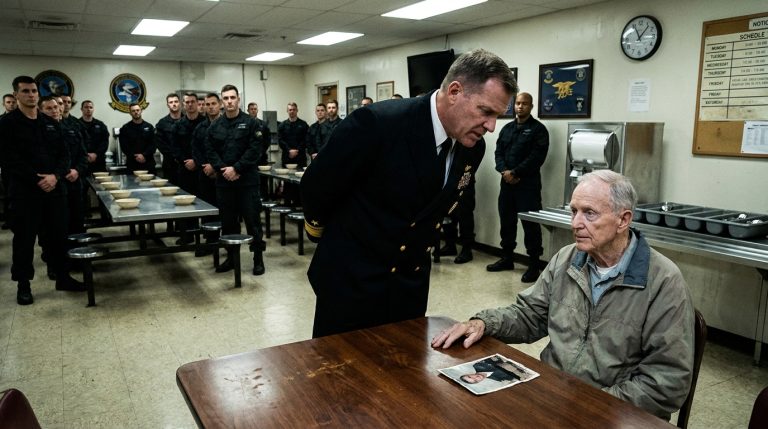
When the heavy oak door of Colonel Matthews’s office opened, the air inside was different. It smelled of old paper, floor wax, and the faint, acidic tang of expensive coffee. Colonel Matthews sat behind a desk of polished mahogany, his posture so rigid it looked painful. Beside him stood Senior Master Sergeant Miller, whose eyes were fixed on a point just above Patrick’s shoulder, refusing to make eye contact.
“Leave us,” Matthews said, his voice clipped.
The MPs retreated, the door latch clicking with a finality that felt like the closing of a vault. Patrick remained standing, his hands resting on his cane. He watched Matthews. He saw the way the Colonel’s finger traced the edge of a leather-bound folio on his desk, a nervous tick masked as contemplation.
“Sit, Colonel,” Matthews said, gesturing to a high-backed leather chair.
Patrick sat. The leather groaned beneath him, a soft, dying sound. “I’m not a colonel anymore, David. And we both know I’m not here to sit.”
Matthews stiffened. He looked at Miller, who stepped forward, placing a single, plain manila folder on the mahogany surface. It wasn’t the folder that caught Patrick’s attention, though. It was the way the light hit the surface of the desk. There was a faint, circular indentation in the varnish, right where a radio handset should have been resting, but the desk was bare.
“We have your driver’s license, Mr. Donovan,” Matthews began, choosing his words with surgical precision. “We have the security reports. We have a very concerned group of young airmen who are currently being debriefed on the sensitivities of public relations.”
“And you have a ghost in Heritage Park,” Patrick finished.
Matthews leaned forward. The shadow of his office lamp cast his face into half-darkness, leaving only his jawline illuminated. “You were seen near the display for forty minutes. You weren’t just visiting. You were measuring. Looking at the rivets. Checking the tail markings.”
“I was looking for my wingman,” Patrick said quietly. The words felt heavy, jagged. As he spoke them, the office around him seemed to warp. The plush carpet faded into the grit of a forward operating strip; the muffled hum of the air conditioning morphed into the high-pitched, terrifying whine of an engine struggling to hold ignition. He felt the cold touch of a flight glove—his own—clutching the leather pouch at his side.
Focus, he told himself. The mahogany. The smell of the coffee. The ink on the Colonel’s fingers.
“Jimmy Riley,” Patrick said, his voice snapping back to the present. “He never made it back. They told us it was flak. They told us the sky just swallowed him up.”
Matthews’s expression didn’t change, but a muscle pulsed in his temple. “That was fifty years ago, Patrick. Records from that era are often… incomplete. Fragmented by the fog of war.”
“It wasn’t flak,” Patrick said, his eyes locking onto the Colonel’s. “I was there. I heard the engine pitch change. It didn’t sound like a strike. It sounded like something tearing itself apart from the inside. Like a cage door being forced off its hinges.”
Miller shifted his weight, his boots squeaking against the hardwood. “Sir, we really should—”
“Quiet, Miller,” Matthews snapped. He stood up and walked to the window, looking out over the flight line where modern, sleek gray fighters were being prepped for sortie. “You’re carrying a pouch, Patrick. Our people noticed it. They said you acted as if it were a holy relic.”
“It’s just a pouch,” Patrick said.
“Is it?” Matthews turned, his eyes narrowed. “Because I’ve been looking at the archives. There’s a discrepancy in the flight manifest from your last mission. A second set of coordinates. Not for the target area, but for a ‘blind zone’—a patch of desert where no Phantom should have been flying.”
Patrick felt a jolt of cold realization. They knew about the blind zone. They hadn’t just been burying a crash; they had been burying the location of an experiment that had gone sideways. He hadn’t just been mourning a friend; he had been holding the key to a breach of protocol so massive it could shatter the wing commander’s career, and perhaps the legacy of the entire squadron.
“If you know about the zone,” Patrick said, his voice barely a whisper, “then you know why I’m here.”
“I know that if those coordinates were made public,” Matthews said, his voice dropping to a low, dangerous growl, “the Air Force would have to answer questions about technology that didn’t technically exist in 1975. And people like me? We’d be the ones holding the bag for the cleanup.”
Patrick stood up, using his cane to steady himself. He felt the phantom weight of the flight stick in his hand, the vibration of the F4 beneath him, the absolute, crushing pressure of a secret that had lasted for half a century. The office felt small, suffocating, a pressurized cabin rapidly losing altitude.
“I’m not here to destroy your career, David,” Patrick said, his voice hardening. “I’m here to find out why Jimmy’s engine failed. I’m here because for forty years, I’ve been the only one who remembered that something else was in the sky with us that day.”
Matthews stared at him, his face a mask of conflict. For a second, the power dynamic in the room shifted. It wasn’t the Commander and the civilian anymore; it was two men standing on the precipice of a truth that could incinerate everything they had built.
“Get out,” Matthews said, his voice flat. “But don’t leave the base. I have people who need to verify those coordinates. And until they do, you are under protective custody. Don’t make me use the handcuffs again.”
Patrick looked at the man he had once mentored. He saw the fear beneath the uniform—not the fear of an enemy, but the fear of the truth itself. He turned and walked toward the door, the sound of his cane against the floorboards acting as a countdown. He had the Colonel’s attention. He had the secret. Now, he just had to survive long enough to see it finished.
CHAPTER 4: The Lockdown Protocol
Patrick didn’t wait for the guards to return. As the emergency siren began its rhythmic, teeth-rattling wail, he moved with a calculated economy of motion toward the office’s secondary egress—a heavy service door he had noted the moment he entered. The air in the room was shifting; the sterile office environment was being rapidly replaced by the mechanical tension of a base entering a state of total lockdown.
“Mr. Donovan, stay where you are!” Miller’s voice was frantic, sounding distant through the thick oak of the door.
Patrick ignored him. He reached the service door, his hand finding the latch. It was heavy, industrial, and bolted. He didn’t panic. Panic was a luxury for those who hadn’t spent their lives calculating the structural integrity of machines and systems. He knew that a facility-wide lockdown wasn’t just meant to keep him in; it was meant to isolate the office from the rest of the base’s communications. Someone was trying to scrub the record, and they were using the emergency alert as a cover.
He twisted the latch. It resisted, then gave way with a sharp, metallic groan of protest. He stepped out into a dimly lit maintenance stairwell, the concrete walls damp with the chill of the base’s climate control. The silence here was absolute, a void in the middle of the sirens’ chaos.
He began his descent, his cane clicking against the steps—a sharp, rhythmic reminder of his own fragility, yet also of his intent. He needed to get to the archives. He knew the decoy map in his pouch would lead them to a dummy site in the desert, but the true coordinates for the crash—the site of the experimental failure—were etched in his memory, a map he had carried behind his eyes for forty years.
He reached the ground floor, but stopped short. The hallway ahead was illuminated by the flashing red strobes of the emergency lights. A pair of Security Forces members stood guard near the archive terminal, their weapons held at the low ready. They weren’t just patrolling; they were positioned to deny access.
Patrick stepped back into the shadows of the stairwell, his breathing steady, rhythmic. He watched them. They were nervous. They checked their watches, their eyes darting to the end of the hall every few seconds. They weren’t looking for an intruder; they were waiting for someone to arrive.
He tapped the leather pouch at his side. He realized then that the decoy secret he had been using as leverage wasn’t just a threat to Matthews—it was a beacon. By holding the coordinates, he had turned himself into the bait.
A sudden, sharp mechanical shudder ran through the building, vibrating the walls. The emergency lights dimmed, then surged back to a harsh, blinding intensity. The Butterfly Detour: the facility’s power grid was being diverted, likely to wipe the digital logs of the flight manifest. They were purging the evidence in real-time.
Patrick knew he couldn’t take the guards. He wasn’t the man he had been in the cockpit, and he wasn’t looking for a confrontation. He needed to be a ghost. He looked up, spotting the overhead utility conduit that ran parallel to the ceiling. It was narrow, cramped, and filled with a tangle of networking cables—the arteries of the base’s data system.
He climbed. His muscles burned, a sharp, searing heat that reminded him of the limitations of his age, but he focused on the sensation, turning the pain into a tool for concentration. He pulled himself into the crawlspace above the ceiling tiles, the dust and the smell of ozone choking him.
He crawled forward, his movements silent, calculated. He bypassed the guards, listening to their muffled, anxious conversation beneath him.
“Orders are to verify the pouch, then contain the target,” one of them said.
“What if he doesn’t have it?”
“The Colonel said he has it. He said it’s a security breach. If we find it, we hand it directly to the Chief.”
Patrick reached a juncture where the conduit opened directly above the archive terminal. He could see the monitor. A screen flickered with a list of encrypted flight files. He watched as a terminal command wiped a folder labeled PHANTOM_GHOST_1975.
He pulled the leather pouch from his belt, opening it with trembling fingers. He took out the map, but he didn’t look at it. He looked at the guards below, their backs turned, their focus on the door.
He didn’t need to fight them. He needed to expose the truth. He reached into his jacket, pulling out a small, metallic flash drive he had taken from the Colonel’s desk during the distraction. He had swapped it with a dummy drive from his own belongings before the MPs had even entered the office.
He tapped the drive against the casing of the conduit, his face set in a grim, hard line. He was going to drop it into the archive terminal’s intake vent. It wasn’t just a data leak; it was an injection of the truth into a system that had been designed to lie for decades.
As he moved to drop the drive, the stairwell door behind him burst open. The sound of boots on concrete was deafening, a rush of movement that forced him to freeze. He wasn’t alone. A figure stood at the threshold, holding a flashlight that cut through the darkness like a blade.
“I know you’re up there, Patrick,” a voice said. It was Miller.
Patrick remained motionless, his hand hovering over the intake vent, the weight of the flash drive heavy, cold, and final. He was caught, the decoy plan had failed, and the real stakes were suddenly, violently clear.
CHAPTER 5: The Archive of Shadows
The light didn’t just illuminate the crawlspace; it seemed to strip away the years, leaving Patrick exposed, his lungs burning from the fine, stagnant dust of the facility’s ceiling. Miller’s silhouette loomed at the stairwell entrance, a dark, immovable shape.
“Drop it, Patrick,” Miller said. His voice wasn’t aggressive; it was weary, the sound of a man who knew exactly what the consequences of this discovery would be. “You don’t want to do this. You’re a legend. Don’t end it like a common thief.”
Patrick didn’t drop the drive. He felt the sharp, cold edge of the metal against his calloused thumb. He realized then that he had miscalculated. He had assumed Miller was just another bureaucrat, a man who followed the path of least resistance. He hadn’t accounted for the fact that Miller, like Matthews, was an architect of the very silence he was trying to break.
“Jimmy wasn’t a thief,” Patrick whispered, his voice raspy from the dust. “He was a pilot. He was a son. And your records killed him twice—once in the air, and once in the archives.”
“Jimmy was a casualty of progress,” Miller replied, stepping closer. The floorboards beneath the ceiling panels groaned. “There are things in the sky you don’t understand. Things we couldn’t let the public see, because the public would have never understood the necessity of the sacrifice.”
Patrick shifted, his back pressing against the rough concrete of the ceiling joist. The sensation of the cramped space triggered a sharp, visceral phantom—the feeling of the F4’s cockpit closing in, the air thinning as the oxygen system failed, the familiar terror of being trapped in a metal tomb. He squeezed his eyes shut for a heartbeat, forcing the memory of the cockpit into the background. He had to be here, now, in the dust and the heat of the archives.
He saw his opening. The cooling vent above the terminal was barely four inches wide. If he could kick the panel, the drive would fall directly into the intake. But Miller was blocking the path, his flashlight a rigid beam of focus.
“Step aside, Miller,” Patrick said, shifting his weight. He felt the joist beneath him crack—a small, sharp sound, like a bone snapping.
Miller froze. He looked up, his flashlight dancing across the dust-filled air. “Patrick, listen to me. If you put that drive into that terminal, you aren’t just revealing an old accident. You’re triggering an automated protocol that will lock down every system on this base—including the medical bays, the flight lines, and the security grid. You’ll be responsible for a disaster that reaches far beyond this room.”
Patrick felt a flicker of doubt. The logic was sound—a classic fail-safe. If the truth were compromised, the system would burn the evidence and anyone standing near it. It was the ultimate, cold-blooded defense mechanism of a military-industrial machine that valued data over human life.
He looked down at the archive terminal. The screen was scrolling through the final lines of the PHANTOM_GHOST_1975 file. He was seconds away from a total system purge.
“You’re lying,” Patrick said, though his own voice sounded hollow in the small, enclosed space. “You just want to save the narrative.”
“I want to save the base,” Miller insisted.
Patrick’s gaze wandered to the edge of the ceiling panel. He noticed a small, hairline fracture in the metal vent—a flaw in the design. He realized that the system wasn’t as perfect as they thought. If he dropped the drive, it wouldn’t just inject the truth; it would collide with the system’s own corrupted logic, potentially creating a bottleneck, a moment of exposure where the truth would be forced onto the primary command monitor—the one in the Colonel’s office, where the Pentagon was still watching.
“I’m sorry, Miller,” Patrick said.
He didn’t drop the drive. He threw it.
The motion was sudden, a snap of his wrist honed by decades of flight. The drive hit the metal edge of the intake, deflected, and ricocheted into the ventilation shaft—not into the terminal, but into the central cooling fan.
The sound was immediate and catastrophic: a high-pitched, grinding shriek of metal on metal. The fan blades shattered, showering the archive room below with sparks. The terminal screens flickered, turned a violent, electric violet, and then, with a long, drawn-out whine, died.
The facility went black.
The emergency lights blinked out, leaving them in absolute, suffocating darkness. The silence that followed was heavier than the noise. Patrick felt the air pressure in the room drop as the climate control systems crashed.
Miller’s flashlight beam swept across the ceiling, erratic and desperate. “What have you done?”
Patrick didn’t answer. He scrambled backward, his hands grasping for the joist, his heart hammering against his ribs. He had broken the loop, but in doing so, he had plunged the entire facility into a darkness that no one could control. He heard Miller start to climb, the heavy thud of his boots hitting the ceiling structure.
He had moments. He had to find the primary maintenance hatch, the one that led to the hangar floor. He was no longer a ghost; he was a catalyst. And as he crawled through the dark, he realized the ultimate truth: the experiment hadn’t been about flight. It had been about control. And now, the machine was failing.
CHAPTER 6: The Final Truth
Patrick didn’t wait for Miller. He dropped from the crawlspace, his boots hitting the cold, industrial concrete of the hangar floor with a jarring impact that vibrated through his knees. The emergency power had failed completely; only the faint, eerie glow of the exit signs illuminated the cavernous space. Towering above him, in the center of the hangar, sat the centerpiece of the base’s history: another F4 Phantom, its skeletal frame exposed for maintenance, looking like the bleached ribs of a leviathan.
He felt the presence behind him—Miller, landing with a heavier, more practiced grace.
“Stop,” Miller commanded. His voice wasn’t an order; it was a plea.
Patrick turned. The darkness didn’t matter. He could see the shape of the man, the outline of his uniform, the slight slope of his shoulders. “You said the machine would lock down, Miller. But you forgot one thing. The machine doesn’t know how to handle a man who was already flying when it was just a blueprint.”
Patrick walked toward the maintenance console of the exposed Phantom. His movements were slow, deliberate. He reached into his pocket and pulled out the leather pouch, but this time, he didn’t guard it. He held it out into the dark. “This wasn’t a good luck charm. It was a data log. Jimmy knew. He knew the engines weren’t failing because of mechanics. He knew they were being overridden by the test system.”
Miller moved into the dim light of an exit sign. He looked older, his face etched with the weariness of a man who had spent decades defending a lie. “It was an experimental guidance system, Patrick. It was designed to anticipate enemy maneuvers, to fly the plane before the pilot could even think. But it didn’t just override the controls. It synchronized with the pilot’s neural responses.”
“It killed him,” Patrick said, his voice rising, cutting through the silence of the hangar. “It didn’t just crash the plane. It locked him into the machine until he became part of the failure.”
“He volunteered,” Miller said, his voice cold, defensive. “They all volunteered.”
“They were lied to.”
Patrick reached the maintenance console and flipped the override switch. It was an old manual backup, a feature from the era of analog reliability. He didn’t need a digital connection. He needed a physical release. He reached inside the cockpit of the stripped Phantom, his hands finding the hidden emergency release he had memorized forty years ago.
He didn’t just want the truth to be seen; he wanted it to be heard.
As he pulled the release, the aircraft’s ancient black-box recorder—a heavy, reinforced steel unit—slid out from its housing. It fell into his hands with a cold, metallic weight. It was the physical proof. The audio log of the last five minutes of Jimmy Riley’s life, recorded not by the Air Force, but by the machine itself.
Miller lunged, but he was too slow. Patrick swung his cane, catching Miller in the chest, a sharp, precise strike that sent the younger man stumbling back. The collision was not the act of a frail old man; it was the synchronized movement of a pilot who knew how to use momentum to his advantage.
“You aren’t taking this,” Patrick said.
“The Colonel will have your head,” Miller gasped, clutching his chest. “You’re destroying a pillar of this command.”
“I’m destroying a graveyard,” Patrick replied.
The hangar doors groaned, a massive, grinding sound as they began to retract. Outside, the morning light was beginning to bleed over the horizon, a soft, pale gray that slowly filled the hangar. The emergency status boards flickered back to life, the base’s computer systems finally rebooting. But the truth was already out. The recorder was in Patrick’s hand, and the evidence was no longer buried in a desert blind zone; it was standing in the middle of the wing commander’s own hangar.
Colonel Matthews appeared at the far end of the hangar, flanked by security forces. He didn’t draw his weapon. He looked at Patrick, then at the black box, then at the shattered remains of the archives. He looked at Miller, who was struggling to stand.
The Colonel walked forward, his footsteps echoing in the massive, quiet space. He stopped five feet from Patrick. There was no fury left in his eyes—only a hollow, defeated exhaustion. He looked at the black box, and for a moment, he reached out as if to take it, then pulled his hand back.
“You’ve cost us everything, Patrick,” Matthews whispered.
“I’ve cost you a shadow, David,” Patrick said, his voice steady. “The light is long overdue.”
Matthews looked around at the airmen gathering at the entrance of the hangar, their faces confused and curious. He realized then that the threat was over. The secret couldn’t be contained; it had already begun to circulate. He signaled his men to stand down.
The denouement was quiet. The security forces faded back, their presence unnecessary. Patrick walked toward the hangar exit, his gait slow, his cane hitting the concrete with a solid, confident sound. He didn’t look back. He didn’t need to see the Colonel’s face to know that the machine had finally stopped.
He stepped out into the crisp morning air. The base was waking up. Engines were beginning to whine to life on the flight line—new, modern, and silent in their efficiency. He stopped at the edge of the tarmac, took the leather pouch from his belt, and opened it. He took out the faded, frayed piece of cord from the inside and tied it around his wrist.
He had fulfilled his promise. He had brought the ghost home.
He walked past the F4 monument one last time. He didn’t stop to salute. He just touched the cold concrete of the pedestal, a small, private gesture of connection. The wind caught his jacket, and for a moment, the sound of it was indistinguishable from the rush of air over a wing. He was tired, but for the first time in forty years, the weight on his chest was gone. He walked toward the main gate, a man who had finally earned his silence.