A Sanctuary of Spring: How a Small Community Reclaimed Its Peace and Found Shared Humanity
CHAPTER 1: The Unwelcome Guest
The sun was relentless, baking the edges of the driveway where I knelt, my hands stained with the grit of a rotted porch board. It was a simple task—repairing the rot, reinforcing the structure—the kind of physical, honest work that helped silence the lingering ghosts of a decade in the Army Corps of Engineers.
Then the shadow fell over me. It was the sharp, clinical shadow of a pristine sedan, followed by the clicking of expensive heels on pavement.
“I don’t care what your little geologist says, Mr. Caldwell.”
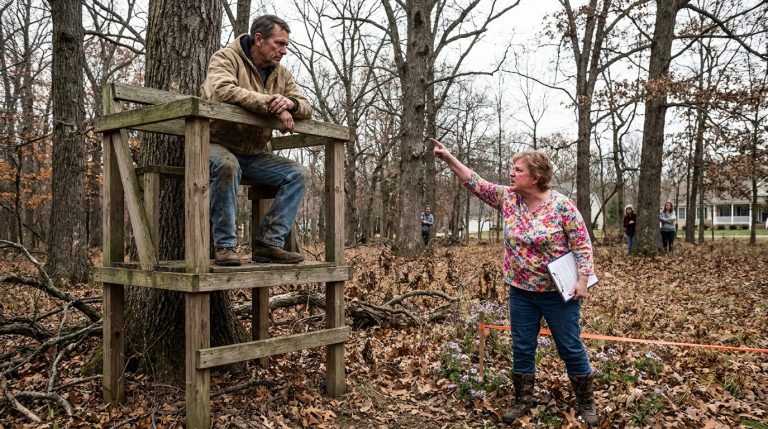
I didn’t look up immediately. I let the rhythm of my hammer dictate the pace of my thoughts. One, two, three. Set the nail. I rose slowly, wiping the sweat from my brow with the back of a calloused hand. Karen stood there, a clipboard clutched to her chest like a shield. She looked like a caricature of suburban authority, her face pulled tight into a mask of righteous indignation that felt more like theater than genuine grievance.
“That is an unapproved man-made water feature,” she continued, her voice echoing with the grating, metallic cadence of someone who had never heard the word ‘no.’ “You will fill it with dirt by Friday, or I will have it filled for you and bill you for the privilege.”
She gestured with a sausage-like, manicured finger toward the back of the property. Beyond the oaks, tucked within a hidden thicket of willows and cattails, lay the heart of our new life: the spring. It was crystal clear, a deep, cobalt vein of the Florida aquifer that had anchored our decision to move here. To her, it was an ‘unregulated body of standing water.’ To me, it was the only place where my son, Leo, finally slept through the night without hearing the phantom sounds of a base at full alert.
I felt that familiar, cold calm slide into place. The same sensation I’d felt before complex demolition projects in hostile terrain. My breathing slowed. I looked past her at the Lexus, its hood still ticking as the engine cooled. It was a vehicle of convenience, of comfort, but it sat there like an invading object, entirely foreign to the soft, shifting textures of the land we had claimed.
“It’s not man-made, Karen,” I said, my voice steady, stripped of the fatigue that usually haunted my afternoons. “It’s a natural artesian spring. There’s a survey in my file that clarifies exactly what it is.”
“The survey is irrelevant,” she snapped, her eyes narrowing as they flicked toward the house, then back to the glistening water. “The aesthetic impact of that… hazard… is a violation of our covenants.”
I stepped off the porch. I didn’t get angry. I looked at the way her jaw flexed, the way the perfume seemed to hang in the air like a chemical fog, obscuring the scent of the nearby magnolias. There was a twitch in her eye, a frantic, underlying tremor that hinted at something deeper than just lawn-height regulations. She wasn’t just enforcing rules; she was desperate to be felt.
“I’ll look into it,” I said, offering a smile that didn’t reach my eyes.
“You’ll fill it,” she corrected, tapping her clipboard. “Friday.”
She turned and marched back to her car, her mumu billowing in the stagnant air. I watched her go, the heat of the day pressing against my neck. As she pulled away, the silence didn’t return. Instead, a new, jagged awareness settled over the property. I looked down at the rot I had been repairing and realized it was the least of my problems. I reached into my pocket, pulling out a small, worn piece of paper—a scrap from the realtor’s covenant book—and felt a strange, cold itch in my palm. My binder, the one I’d promised Sarah would stay empty, felt suddenly heavy in my mind. The peace I had tried so hard to build was being tested, and for the first time in months, I felt the old, sharp impulse to map out the defense.
CHAPTER 2: The Architecture of Evidence
The dust from Karen’s departure hung in the humid air, a microscopic suspension of limestone and ego. I stood in the driveway, the silence of the suburb feeling less like peace and more like a held breath. My fingers tightened around the handle of the three-ring binder. It was a standard, store-bought model—clear plastic sleeve on the front, stiff cardboard spine—but in my grip, it felt like an anchor.
I turned back toward the house. The porch looked different now. The rot I had been fixing felt like a triviality, a symptom of a larger, systemic decay. I walked inside, my boots echoing on the hardwood floors. Sarah was in the kitchen, the soft clatter of silverware against porcelain marking the rhythm of a normal life that was rapidly unraveling. She looked up as I entered, her brow furrowing when she saw the binder.
“Mark?”
I didn’t answer right away. I navigated to my home office, a small room still cluttered with half-unpacked boxes and the detritus of our move. I sat at the desk, the surface cool beneath my palms. I cleared a space, pushing aside a stack of medical bills and a half-read manual on home maintenance. I opened the binder. The rings clicked open with a sound like a chambered round—a sharp, mechanical thwack that triggered a sudden, unwanted surge of memory.
I was back in the desert, sitting in a windowless command hut, the air conditioning hum drowning out the distant, rhythmic thumping of transport helicopters. I saw the stacks of field reports, the color-coded maps of logistical supply lines, the agonizing precision required to keep an engineering unit functional in a landscape that wanted to swallow us whole. I shook the thought away, the smell of burnt coffee replaced by the faint, earthy scent of the spring water still clinging to my work shirt. The civilian world required a different kind of precision.
I grabbed a fresh sheet of paper and a heavy-duty highlighter. At the top of the page, I wrote: Operation Spring Freedom.
“What is that?” Sarah stood in the doorway, her voice soft, hesitant.
“It’s a map,” I said, my voice sounding more like a tactical briefing than a conversation. I didn’t mean to shut her out, but the habit of compartmentalization was an old friend. “She’s not going to stop, Sarah. She’s built an entire identity around these rules. If we fight her with words, we lose. If we fight her with logistics, we hold the line.”
I started by logging the interaction. Date: July 19. Time: 14:48. Subject: Karen. Action: Verbal demand to fill natural artesian feature, threat of unauthorized contractor intervention, escalation to financial extortion. I wrote it all down in neat, block letters. The physical act of documenting the threat felt like cauterizing a wound; it stopped the bleeding of the initial shock and allowed me to focus on the structure of the next move.
I opened the folder the realtor had given us—the thick, dense tome of covenants and restrictions. It was a miserable piece of writing, filled with legalese that managed to be both suffocatingly specific and laughably vague. I began to highlight. Article 4, Section 2: Landscape Alterations. Article 7, Section 5: Structural Maintenance. I looked for the seams in her authority. She was using these articles like scalpels, cutting away at our right to exist on this land. But every system, no matter how rigid, has a point of failure—a place where the rules contradict themselves or where the enforcement relies on a consensus that doesn’t actually exist.
As I worked, the house grew quiet. Outside, the sun began its long, slow descent, casting long, bruised shadows across the lawn. The spring was still out there, gurgling in the dark, and I could feel it—a rhythmic, steady presence that stood in total defiance of the HOA’s manicured, artificial standards.
I stood up and walked to the window. The Lexus was gone, but her presence lingered. I looked down at the binder. It was still thin, still fragile, but it was the start. I wasn’t just defending a hole in the ground anymore. I was defending the soil, the water, and the quiet dignity of a life that didn’t need to be sanctioned by a committee.
I pulled out a file folder from the desk drawer and labeled it COMM LOG: INBOUND/OUTBOUND. I was going to need every receipt, every certified mail slip, and every piece of hostile correspondence she saw fit to send. I was going to turn her bureaucracy into a trap of her own making. My phone buzzed on the desk, a notification from an unknown number. I didn’t pick it up. I knew the cadence of the enemy now. She wasn’t just taking a drive to inspect the neighborhood; she was auditing the terrain, and I had just finished my first set of fortifications.
The sun touched the horizon, turning the sky a deep, bruised violet. I turned back to the desk, my hands steady. The ghost of the desert was gone, replaced by the immediate, gritty reality of the work ahead. I had a lot of reading to do, and by the time she came back, I intended to know her rulebook better than she knew the law.
CHAPTER 3: The Fractured Line
The sun had fully retreated, leaving the neighborhood bathed in the soft, artificial glow of streetlamps that hummed with a monotonous, electric buzz. I stepped off my porch, the air cooling, carrying the faint scent of damp soil and the chemical sweetness of over-pruned hedges. My binder, tucked firmly under my arm, felt like a compass. I wasn’t just walking; I was measuring the distance between my reality and theirs.
Two houses down, Mrs. Gable was in her garden. She was hunched over a row of marigolds, her movements slow, deliberate, and entirely unbothered by the evening chill. As I approached, the light from a neighbor’s porch caught the edge of a ceramic gnome sitting near her walkway. It was chipped, the paint faded to a dull, weathered grey, but it sat there with a stubborn, defiant stillness. It was a small thing—hardly a structural threat to the Harmony Creek aesthetic—but in the context of Karen’s crusade, it looked like a trench marker.
“Good evening, Mrs. Gable,” I said, keeping my voice low, matched to the quiet of the street.
She looked up, her hands dusted with dark, rich earth. Her smile was tired, a faint thing that didn’t quite reach her eyes. “Mr. Caldwell. Out for a walk?”
“Just clearing my head.” I stopped a few feet from her property line. From here, I could see the subtle pattern of the other gnomes—thirteen of them, all positioned along the edge of her yard. It was a chaotic, unmanaged geometry that clearly violated the HOA’s vision of ‘curated landscaping.’
“They’re nice gnomes,” I said.
She let out a dry, rattling laugh. “Karen calls them an architectural assault. She sent a notice last week. Threatened a fine. Said they disrupt the ‘visual flow’ of the street.” She straightened up, her knees popping with the effort. “I’ve lived here twenty years, Mark. I had these gnomes when my husband was alive. I don’t see how they hurt anyone’s property value.”
I looked at the house next to hers—a sterile, beige box with a lawn so perfect it looked like green felt. There was no personality there, no sign of life, just the cold, calculated maintenance of an image. “It’s not about the gnomes, Mrs. Gable. It’s about the control.”
“I know,” she whispered, her gaze drifting toward the street as if she expected the white Lexus to round the corner at any moment. “But I don’t have the stomach for a fight. My heart isn’t what it used to be.”
I felt a surge of something—not anger, but a protective, heavy resolve. The way she held her purse, the way she glanced at the street, it was the same tension I had seen in my wife, the same shadow that followed every resident here. Karen hadn’t just managed a neighborhood; she had instituted a state of low-level, constant fear.
“You don’t have to fight alone,” I said, and the words felt solid, a piece of infrastructure I was building in real-time. I didn’t show her the binder. I didn’t tell her about the DEP or the statutes yet. It was too early for that, too much of a leap. Instead, I leaned against the low wooden fence that separated our properties. “Just keep the notice. Don’t throw it away. Keep every piece of paper she sends you.”
She looked at me, a flicker of something—curiosity, maybe even hope—crossing her features. “Why?”
“Because history is only as real as the records we keep,” I replied.
I left her there, back to her marigolds, and continued down the street toward the Martinez house. I found them in their driveway, the father wrestling with a portable basketball hoop that leaned at a precarious angle. The kids were inside, but the father, a man named Luis, was sweating, his face tight with a quiet, persistent frustration.
“Need a hand?” I asked.
He jumped, his hands slipping from the pole. “Oh. Hey, Mark. Just… trying to keep this thing standing. The base is cracked.”
“HOA notice?”
He sighed, wiping his face with the back of his sleeve. “Three notices in two weeks. They want it gone. They said it’s an ‘eyesore’ and that it’s ‘violating line-of-sight safety protocols.’ My kids have nowhere else to play.” He looked at the hoop, then at me. “It’s just a game, you know? Why does she care so much about a game?”
“Because the game is one she didn’t invent,” I said.
I looked at the hoop. It was a simple, mass-produced thing, but standing there in the middle of a perfectly manicured cul-de-sac, it looked like an act of rebellion. I stayed for twenty minutes, helping him tighten the bolts and wedge a piece of plywood under the cracked base to stabilize it. We didn’t talk about Karen. We talked about the neighborhood, about the trees, about the quiet of the evening.
As I walked back to my own home, the neighborhood felt different. It wasn’t just a collection of houses governed by a book of rules. It was a lattice of human lives, all being slowly, meticulously restricted. The binder back in my office was growing heavier, but for the first time, I felt the weight of the neighborhood pressing in to meet it. I hadn’t solved anything yet—the gnomes were still in danger, the basketball hoop was still a violation—but I had started the process of mapping the resistance. Every conversation, every notice kept, every moment of shared frustration was a data point.
When I stepped back into my office, I didn’t turn on the light. I sat in the darkness, the faint glow of the streetlamp filtering through the blinds, casting stripes of shadow across my desk. I opened the binder to the second tab. I started a new list: Neighborhood Assets. I didn’t write down money or property. I wrote down names. I wrote down stories. I was building a coalition, and in the quiet of the room, I could hear the faint, steady pulse of the spring outside—the heartbeat of the terrain, waiting for the defense to begin.
CHAPTER 4: The Voice of Authority
The desk lamp cast a narrow, focused circle of light onto the binder. My hand hovered over the phone handset, the plastic smooth and cold against my skin. I had the number written on a sticky note—a contact in the water resource management division, Mr. Davies. It felt like I was holding a live wire. Calling the state wasn’t just a grievance procedure; it was an irrevocable escalation. Once the bureaucratic machinery of the state began to churn, I couldn’t simply turn it off if I changed my mind.
I looked at the window. The spring was out there, shrouded in the heavy, humid night. The quiet gurgle I had once found so therapeutic now sounded like a ticking clock. I dialed.
The phone rang four times, a hollow, rhythmic sound that seemed to expand in the small room.
“Water Resource Management, Davies speaking.” His voice was tired, the gravelly tone of a man who spent his days wading through endless, redundant complaints about irrigation permits and culvert drainage.
“Mr. Davies,” I began, my voice steady, stripped of the neighborhood’s petty anxieties. “My name is Mark Caldwell. I’m a resident at Harmony Creek Estates. I’m calling to report an attempt to obstruct and fill a natural artesian spring on private property.”
There was a pause on the other end, a momentary silence that felt like the intake of breath. The ambient noise of his office—the distant clatter of keyboards, the low hum of a printer—seemed to recede.
“An artesian spring?” he asked, his voice losing its exhaustion. It grew sharp, professional, suddenly tethered to the reality of the resource he was sworn to protect. “Give me the address.”
I read it off, my eyes tracking the line in my property survey. “It’s been marked as a natural feature on the original surveyor’s records for forty years, sir. I have a written demand from the homeowners association president to fill it in by Friday.”
He was silent for a long moment, and I could hear the rhythmic click-clack of keys. He was pulling up records, mapping the coordinates in his own system.
“Mr. Caldwell, let me be very clear,” he finally said, and the shift in his tone was profound. It wasn’t the voice of a paper-pusher anymore; it was the voice of a custodian. “Under Florida statute 373, an artesian spring is considered a protected state resource. You are not just a property owner; you are the custodial agent of an aquifer recharge point. If your HOA is demanding you fill that in, they are not just in violation of local covenants. They are requesting you commit a Class One environmental offense.”
A sudden, sharp rush of clarity washed over me. The fear that had been gnawing at the edges of my sanity for days—the worry that I was the one out of line, the one who didn’t understand the rules—vanished. The law wasn’t a set of suggestions Karen could interpret at will; it was a wall, and I had just found the side of it that pointed toward the truth.
“What do I do, sir?” I asked.
“You do not touch that spring,” he replied, his instructions precise. “Document everything. Every letter, every email, every verbal threat. I’m opening a case file on this immediately. I want a copy of that survey and the written demand sent to my office by tomorrow. If they come onto your property, you do not engage. You call local law enforcement and you report a threatened environmental crime. Do you understand?”
“I understand.”
“This is a serious matter, Mr. Caldwell. These springs are the lifeblood of the entire state. We don’t take kindly to people playing around with them.”
We talked for another ten minutes. He gave me his direct email, a case number, and a list of specific statutes to print out and keep on hand. When I hung up, the silence in the room felt different. It wasn’t the oppressive quiet of a house under siege; it was the focused, intense silence of a command center.
I stood up and walked to the window, pulling the blinds back just enough to see the silver glint of the spring in the moonlight. I wasn’t fighting Karen anymore. I was acting in service of the land itself. The fragility of the ecosystem—the way the water bubbled up from the limestone, the way it fed the willows—it all felt tied to the resilience I was starting to see in Mrs. Gable and the Martinez family. They were all small, seemingly powerless things being pushed around by someone who wanted to shape the world to fit her own shallow design.
I turned back to the desk. I opened the binder, pulled out a clean sheet of paper, and wrote PHASE 2: FORTIFICATION. I didn’t feel tired anymore. The fatigue had been replaced by a clean, burning focus. I had the state’s attention, a case number, and a legal baseline that rendered Karen’s covenants irrelevant.
The house was quiet, but I could hear Sarah moving in the living room, the soft rustle of a book, the gentle, rhythmic sound of the ceiling fan. I went to her. She looked up as I entered, her eyes searching my face.
“Everything alright?” she asked.
“For the first time since we moved here,” I said, sitting beside her and taking her hand, “yes. We’re not the ones in trouble, Sarah. We’re just the ones holding the line.”
I felt her grip tighten, the uncertainty in her eyes beginning to clear. The battle wasn’t won, but the shift in the tide was unmistakable. Tomorrow, I would send the documents. Tomorrow, the legal and environmental weight of the state would begin to press back against the petty tyranny of Harmony Creek. And in the thicket, the spring would keep on gurgling, steady and indifferent, a piece of the wild that refused to be paved over.
CHAPTER 5: The Clubhouse Tribunal
The sky had turned a bruised, ugly shade of charcoal by the time I reached the Harmony Creek Community Clubhouse. Thunder rolled across the horizon, a low, tectonic vibration that seemed to match the tension tightening in my chest. I pulled my jacket tight against the first heavy, stinging drops of rain.
The clubhouse was a beige, low-slung building that usually felt like an afterthought, but tonight, it pulsed with a frantic, agitated energy. Cars lined the street—sedans and SUVs haphazardly parked, their headlights cutting through the downpour. As I reached for the handle of the glass door, I saw Mrs. Gable inside, her umbrella dripping a puddle onto the linoleum, her face pale but determined.
When I stepped inside, the noise was the first thing that hit me—a discordant, rising murmur of a hundred voices. Karen was already at the table at the front of the room, flanked by Barry and Janice. She wore a blazer of aggressive, polished purple, and her hands were clasped over a stack of documents like she was holding down the lid of a casket. The room was packed. The air was thick, heavy with the scent of damp wool, cheap coffee, and the metallic tang of ozone from the storm outside.
I walked down the central aisle, the binder tucked under my arm like a shield. Karen’s eyes locked onto me as I approached. Her expression didn’t flicker, but the way she pulled her documents closer was a tell—a micro-adjustment of defense. I didn’t go to the front. I found a seat in the middle of the room, next to the Martinez family. Luis looked at me, his knuckles white as he gripped his knees.
“She’s been talking for ten minutes,” he whispered, his voice jagged. “She’s calling the alliance a ‘coordinated smear campaign.’ She’s even bringing up the basketball hoop as ‘evidence of neighborhood degradation.’”
Karen slammed her hand on the table—not a gavel, but her palm. The sound was a sharp, flat crack. “This special session is to address the repeated and willful violations of the Harmony Creek covenants,” she declared, her voice booming, rehearsed, and utterly devoid of the community she claimed to lead. “Mr. Caldwell, you have been invited to speak, but let it be clear: this is not a forum for your baseless, criminal accusations.”
I stood up. I didn’t rush. I didn’t raise my voice. I allowed the heavy, humid silence of the room to settle, accentuated by a violent crash of thunder that shook the windows in their frames.
“Karen,” I said, addressing her with a calm that felt like a cold blade. “This isn’t a smear campaign. It’s an audit.”
A ripple of nervous, expectant laughter moved through the back of the room. Karen’s face went rigid, a mask of controlled fury.
“You are out of order,” she snapped. “This is a disciplinary hearing.”
“It was a disciplinary hearing,” I countered, taking a step toward the center aisle, “until you turned it into a profit center.” I reached into the binder, pulled out the copy of the business registration I had secured from the state, and held it up so the room could see. “I’m not here to talk about lawn height. I’m here to talk about Creative Community Solutions. And why the HOA has paid them over forty-eight thousand dollars for services that don’t exist.”
The room went deathly quiet. Even the storm outside seemed to fade into a background hum. Barry, the treasurer, turned a shade of grey that looked terminal. He started to sweat, his eyes darting from Karen to the exit. Janice, the secretary, dropped her pen. It clattered against the table, a sound like a gunshot in the vacuum.
Karen’s gaze flickered to the side, searching for an exit, for an ally, for anything other than the hundred pairs of eyes now fixed on her. The purple blazer seemed to lose its sheen, the color draining away as the reality of the room’s shift hit her. She wasn’t the queen anymore; she was a suspect.
“Those are forged,” she hissed, her voice cracking for the first time. “They’re lies. It’s a conspiracy!”
“The state doesn’t forge records, Karen,” I said, my voice steady. “And the Department of Environmental Protection doesn’t accept smears.”
Another crack of lightning lit up the room, turning the windows into white, searing screens. The power flickered, the lights dimming to a sickly yellow, and for a split second, the room was suspended in an impossible, heavy stillness. I saw it then—the tiny, physical tell of her collapse. She didn’t look at the crowd; she looked at the door. Her confidence wasn’t just eroding; it had been hollow all along, and the sound of her own lie hitting the floorboards was finally making her see the truth.
The atmosphere was shifting from defense to mobilization. Mrs. Gable stood up, her hand shaking as she pointed toward the table. “I want to know about my money, Karen. I want to know about my garden.”
The murmur grew into a low, rumbling growl. Karen scrambled to her feet, her chair scraping harshly against the floor. She looked around, realizing that for the first time in her tenure, the fear wasn’t pointing at the residents—it was pointing squarely at her. The clubhouse, a place of beige walls and quiet rules, was now a place of reckoning, and the storm outside was only the beginning of the noise.
CHAPTER 6: The Weight of the Wreckage
The clubhouse felt smaller than it had ten minutes ago. The air was thin, reclaimed by the sudden departure of Karen’s suffocating presence, yet the room remained dense with the wreckage of her authority. I stood in the aisle, the binder still held against my ribs, watching as the remaining members of the board—or what was left of them—stumbled over their own feet. Barry was slumped in his chair, his head buried in his hands, his entire posture one of someone waiting for a hammer to fall. Janice, the secretary, was gone; she had slipped out the side door during the commotion, leaving behind only an open notepad and a scattered pile of pens.
“Mark?”
It was Luis Martinez. He stood beside me, his voice still shaking. He looked at the front of the room, then at the empty doorway through which Karen had fled. “She’s actually gone. She just… left.”
“She’s retreating,” I said, though my own pulse was still hammering against my collar. “She thinks that if she can’t control the room, she doesn’t have to face the consequences.”
I walked toward the front table. The distance felt monumental, each step a negotiation with the sudden, vertigo-inducing quiet. The storm outside had shifted to a steady, rhythmic drumming against the roof, a sound that underscored the abrupt vacancy at the center of the neighborhood’s governance. I reached the table and placed the binder down. The slap of plastic on wood was definitive.
“The meeting isn’t over,” I said, my voice projecting to the back of the room.
The residents turned toward me. They weren’t just curious anymore; they were expectant. They had seen the proof—the invoices, the business registration, the hollow face of a thief. I turned to look at Barry, the treasurer. He looked up, his eyes bloodshot, his glasses sliding down his sweating nose.
“Barry,” I said, not as an accusation, but as a tactical inquiry. “You were the treasurer. You signed the checks. You know exactly where the money went.”
He blinked, his mouth opening and closing like a fish. “I… I just did what she said. She told me it was all above board. She said the landscaping projects were vital for the community’s rating. She—she had the invoices. She had the company contracts.”
“Show me,” I said.
He stood up, trembling, and reached under the table. He pulled out a heavy, black accordion folder, the elastic band snapped and frayed. He pushed it toward me. “It’s all in here. Every payment. Every project request. I didn’t steal anything, Mark. I just… I didn’t ask the right questions.”
I opened the folder. The paper inside was crisp, formal, and terrifyingly efficient. Each invoice was signed by Karen, each service description written with the vague, bureaucratic polish of a master manipulator. It was an architecture of theft, layered and reinforced over years. But as I flipped through the pages, my eyes caught something else—a small, handwritten sticky note attached to a payment for a ‘Spring Maintenance Consultation.’ It was dated just two days ago.
If Caldwell continues to obstruct, increase the site visit fees for the next quarter.
It was a contingency plan. She hadn’t just been stealing; she had been preparing for a long-term campaign of financial attrition. She was ready to bankrupt anyone who stood in her way. I felt a cold, jagged spike of adrenaline. The conflict was far from over; it had just moved into the realm of scorched-earth tactics.
“She wasn’t planning on winning this argument, Luis,” I said, loud enough for those nearby to hear. “She was planning on pricing us out of our own homes.”
A collective, sharp intake of breath moved through the front rows. Mrs. Gable, who had moved up to the podium, reached out and touched the edge of the folder. “We have to show this to everyone,” she said, her voice gathering a hard, brittle strength. “Every single person who pays dues to this association needs to see exactly what she was doing with their grocery money.”
I looked out at the room. The mood had shifted from shock to a grim, unified purpose. They weren’t just bystanders to a neighborhood dispute; they were participants in a recovery operation. The storm rattled the windows, but inside, the clubhouse was solid, anchored by the reality of the evidence spread out on the table.
“We need a new board,” I said. “Tonight. Right now.”
“We don’t have the bylaws for that,” Barry stammered.
“The bylaws were a tool for the tyrant,” I said, turning to him. “If the system is broken, you don’t keep using the broken parts. You rebuild the foundation.”
I took the binder and the black accordion folder and placed them at the center of the table. They were the blueprints for the neighborhood’s future. My hands were finally steady. The adrenaline of the confrontation was fading, replaced by a cold, surgical clarity. We had the evidence, we had the momentum, and for the first time, we had the authority to dictate the terms. Karen was out in the rain, but the structure she had left behind was still standing, and I was going to dismantle it, brick by bureaucratic brick.
CHAPTER 7: The Fragile Mandate
The podium felt like it was anchored in quicksand. I leaned my weight onto it, the metal groaning under the pressure of my palms. Behind me, the room was a sea of shifting bodies, a volatile mix of relief and lingering anxiety. The storm outside had died down to a rhythmic, steady dripping from the clubhouse eaves, but inside, the air remained ionized, charged with the sudden vacuum left by Karen’s flight.
I looked at the petitions. Seventy-eight signatures. A mandate. But looking out at the faces—the Martinez family, Mrs. Gable, the faces of neighbors who had spent months terrified of their own mailboxes—I felt a sudden, sharp tremor of hesitation. We had dismantled the engine of her tyranny, but we were still standing in the ruins of the old world. If we failed to build something better, something transparent, we were just inviting the next version of the same rot.
“We don’t need a dictator,” I said, my voice cutting through the hushed murmurs. “And we don’t need another system built on hidden accounts and vague bylaws.”
I looked over at Barry. He was still sitting at the table, his posture sunken, looking like a man who had finally realized he was the one who had provided the matches for the fire. I walked over to him, picking up the accordion folder. He flinched, but I didn’t offer an accusation. I offered a seat.
“Barry,” I said, my voice low but audible enough for the front rows to catch. “You were the witness to the mechanics of the theft. You’re going to be the witness to the mechanics of the audit. You’re not going to be a board member, and you’re not going to be a treasurer. But you are going to help us reconstruct exactly where every dollar of that forty-eight thousand went.”
He looked up at me, his eyes wide and watery. He seemed surprised that I wasn’t just dragging him into the wreckage. “I… I can do that. I know the accounts. I know how she manipulated the project line items.”
“Good.” I turned back to the room. “The recall of the president is the first step. But the mandate we hold tonight is for restoration. We aren’t just here to vote out a person. We are here to reclaim the community’s right to know what is being done in our name.”
I felt a ghost of a memory—a formal inspection back in the Corps, the sterile precision of an audit, the way that transparency always, invariably, exposed the weakness in any poorly constructed structure. I had been terrified that my move into this neighborhood would be a slow erosion of my own identity, that the military precision I’d carried for decades would become a liability in civilian life. But here, in the beige, humdrum reality of a community clubhouse, it was exactly what was needed.
Mrs. Gable stepped up to the podium. She didn’t look frail anymore; her posture was corrected, her gaze fixed on the room. “We need to appoint a temporary committee,” she said, her voice steady. “One person from each street. No one holds all the power. And every dollar that comes in, every dollar that goes out, gets posted on the clubhouse board every month. No more secrets. No more ‘Creative Community Solutions’.”
The roar of approval was immediate, a sound that felt like the ground shifting into place. It was a chaotic, unpolished, and intensely human response. It wasn’t the cold efficiency of a chain of command; it was the messy, loud, and honest reality of a community finding its own footing.
I watched the votes being tallied. They didn’t use a gavel. They used a simple show of hands. I stepped back from the podium, letting the weight of the moment settle on the people who had actually earned it. My job wasn’t to lead this, not anymore. My job had been to clear the path, to dismantle the barrier, and to hold the ground until they could reach it.
As the ballots were counted, the rain intensified again, a steady, soothing sound against the glass. I found Sarah near the back. She was watching me, her expression unreadable, but when our eyes met, she offered a small, tired smile. I walked to her, and for the first time in months, I felt the phantom weight of the ‘Operation Spring Freedom’ binder vanish.
The immediate tactical threat was neutralized. Karen was gone, the assets were frozen, and the community was already in the process of drafting a new, transparent charter. But as I stood there in the humid, cooling air of the room, I caught a glimpse of the parking lot through the window. A single, white sedan—a different make, a different car—was sitting near the edge of the lot, its lights off, watching.
A cold, familiar alertness snapped back into place. Karen had been a symptom, but the system of control she had exploited was still there, embedded in the very structure of the association. I knew, with a sudden, sinking certainty, that while the battle for the neighborhood was won, the process of healing the damage she had left behind—the fractures in trust, the suspicion that still clung to the residents—was going to be a much longer, much more delicate war. I didn’t say anything to Sarah. I just reached out, took her hand, and held it as the room erupted into the final, defining vote of the night.
CHAPTER 8: The Quiet Gurgle
The transition from the buzzing, electric heat of the clubhouse to the cool, damp embrace of the night air felt like stepping between worlds. I didn’t wait for the final celebratory shouts or the inevitably long-winded planning sessions. I had done my part. The mandate was theirs, and the structure of the new committee was set. I walked home alone, the sound of my boots on the pavement punctuating the silence of the neighborhood.
When I reached the property, the house was dark, but the moonlight—silver and sharp—traced the edges of the oaks. I didn’t go inside. I followed the flagstone path down toward the thicket. The air grew heavy with the scent of wet ferns and the cool, mineral tang of the spring. It was the same water that had bubbled up here for centuries, indifferent to HOAs, embezzlement, or the petty tyrannies of neighborhood presidents.
As I approached the edge of the deck, I saw someone sitting on the bottom step. It was Sarah. She was looking out over the water, her hands resting on her knees. The tension that had defined her posture for months seemed to have bled away.
“They’re calling it a victory,” she said softly, not looking up.
“It’s a restoration,” I replied, sitting beside her. The wood was damp with the evening dew. “Karen wasn’t just a person, Sarah. She was an infection. The neighborhood is starting to remember how to be a community again, but it’s going to take time to scrub the rot out of the bylaws.”
I looked out at the spring. The surface was perfectly still, reflecting the constellations like a dark, polished mirror. I realized then that my fixation on the binder—on the ‘Operation Spring Freedom’—had been a way of coping. I had treated the neighborhood like a combat zone because that was the only language I had left for understanding threat. But standing here, in the quiet, I felt the sharp, rigid corners of my own mind beginning to soften.
“I was afraid,” I admitted, the confession feeling small in the vastness of the woods. “I was afraid that if I stopped fighting, I wouldn’t know who I was anymore. That everything I did would just be… maintenance.”
Sarah turned and looked at me. She reached out and took my hand, her fingers warm against my skin. “You were building a foundation, Mark. Not just for this house, but for us. You had to protect the space where we could finally stop looking over our shoulders.”
I thought about the spring. During the weeks of the conflict, I had seen it as a leverage point, a tactical asset to be defended. But now, in the silence, I could see it for what it truly was. It was a source. It was the place where we came to wash off the dust of the base, the place where Leo had learned to name the dragonflies, and the place where I had finally begun to learn how to exist without a mission.
The Payoff of the struggle wasn’t the recall vote or the forensic audit. It was this: the ability to sit here and listen to the water without calculating risks or anticipating an ambush. The antagonist was gone, her reputation shattered, her influence erased by the very community she had tried to treat like a fiefdom. She had tried to pave over the source, to turn it into a sterile liability, and in doing so, she had revealed exactly who she was. She had been defeated by the weight of her own greed, caught by the simple, undeniable evidence of the truth she thought no one would bother to document.
I reached down and picked up a piece of the flagstone that had been loosened during the scuffle with the landscapers. It was a heavy, irregular shard of rock. I knelt at the edge of the path, digging into the soft earth, and set it firmly back into place. It was a small act of repair, a quiet restoration of order that didn’t require a committee or a lawsuit.
“We’re going to be okay,” I said.
“We already are,” she replied.
The denouement of our ordeal wasn’t a grand statement; it was the slow, steady return to the small things. The gnomes would stay in Mrs. Gable’s garden. The basketball hoop would keep leaning in the Martinez’s driveway. And here, the spring would keep on gurgling, its flow untouched, its cycle persistent.
I looked up at the stars, feeling the cool, rhythmic pulse of the earth beneath us. The war was over. The tyranny of the purple blazer was nothing more than a bad memory. I leaned back against the deck, closing my eyes, and for the first time in twenty years, I didn’t listen for the sound of an alarm. I just listened to the water, the sound of home settling into the darkness, quiet and perfectly, stubbornly free.