The Iron Boundary: A Cold-War Tactical Deconstruction of Suburban Extortion and Corruption
CHAPTER 1: GROUND ZERO SURVEY
The iron pin sat three inches beneath the damp Bermuda grass, buried under fifteen years of thatch, perfectly cold and immovably plumb.
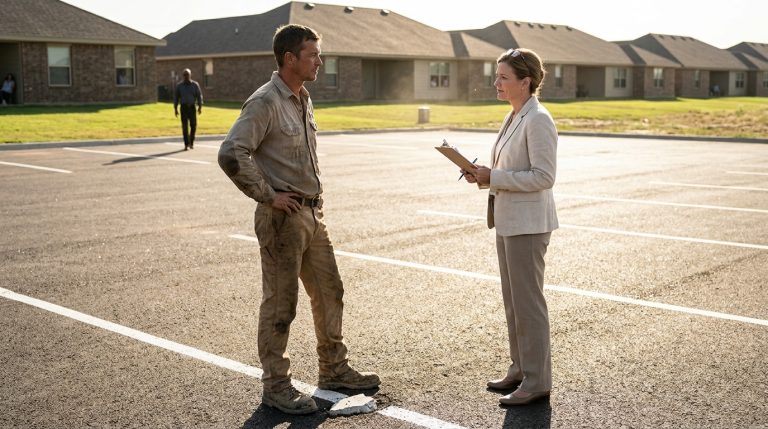
I didn’t look up from the edge of the porch steps. I kept my eyes on the line where the turf met the cedar rail, counting the exact three-inch margin of setback. On the grass stood Karen Miller, her pink sneakers sinking slightly into the morning dew, her clipboard vibrating with the rhythmic, nervous twitch of her right index finger.
“Ten feet, Mr. Thompson,” she said. Her voice hit the air like cheap syrup on cold metal. “Your fence is ten feet onto community greenbelt property. You have thirty days to clear the encroachment, or the association clears it for you. Demolition, haulage, and a non-compliance penalty billed straight to your account.”
I didn’t answer. I took a slow, measured sip from my ceramic mug. The coffee was lukewarm, bitter, and grounded me in the heavy, humid air of 0830 hours.
“Did you hear me?” Her rhinestone-studded frames caught the morning light, glinting like broken glass. She shifted her weight, the pastel tracksuit straining across her chest with a dry, synthetic friction. “This isn’t a negotiation.”
“I heard you, Karen,” I said softly.
I set the mug down on the wooden railing. Beside it lay a vintage, heavy brass Parker ballpoint pen. I didn’t pick it up yet. I reached down, picked up the pen, and aligned it with surgical precision—exactly parallel to the outer seam of my legal pad.
“An official notice will be in your box by noon,” she snapped. The silence was eating at her. She wanted a shout. She wanted a hand on a hip, a raised voice, a frantic plea for an extension—anything she could tag as hostile conduct in her administrative log.
She got nothing. Just the calm, mechanical tracking of my eyes as I measured the distance from her heel to the cedar post.
She turned, her rubber soles squelching against the damp sod as she marched toward the pavement. I watched the sway of her shoulders, noting the slight tilt to her posture—heavy on the left heel, favoring a lower back imbalance.
I walked inside, the screen door clicking shut without a slam. The office was quiet, cooled by the central air, smelling of aged paper and floor wax. In the corner sat the standard military-issue gray steel filing cabinet—four drawers, double-welded seams, brought back from my last posting with the Army Corps of Engineers.
I pulled the top drawer. The rollers groaned, a sharp metallic scrape that settled into a dull lock. I pulled the manila folder tabbed 121 Oak Drive – Survey & Closing.
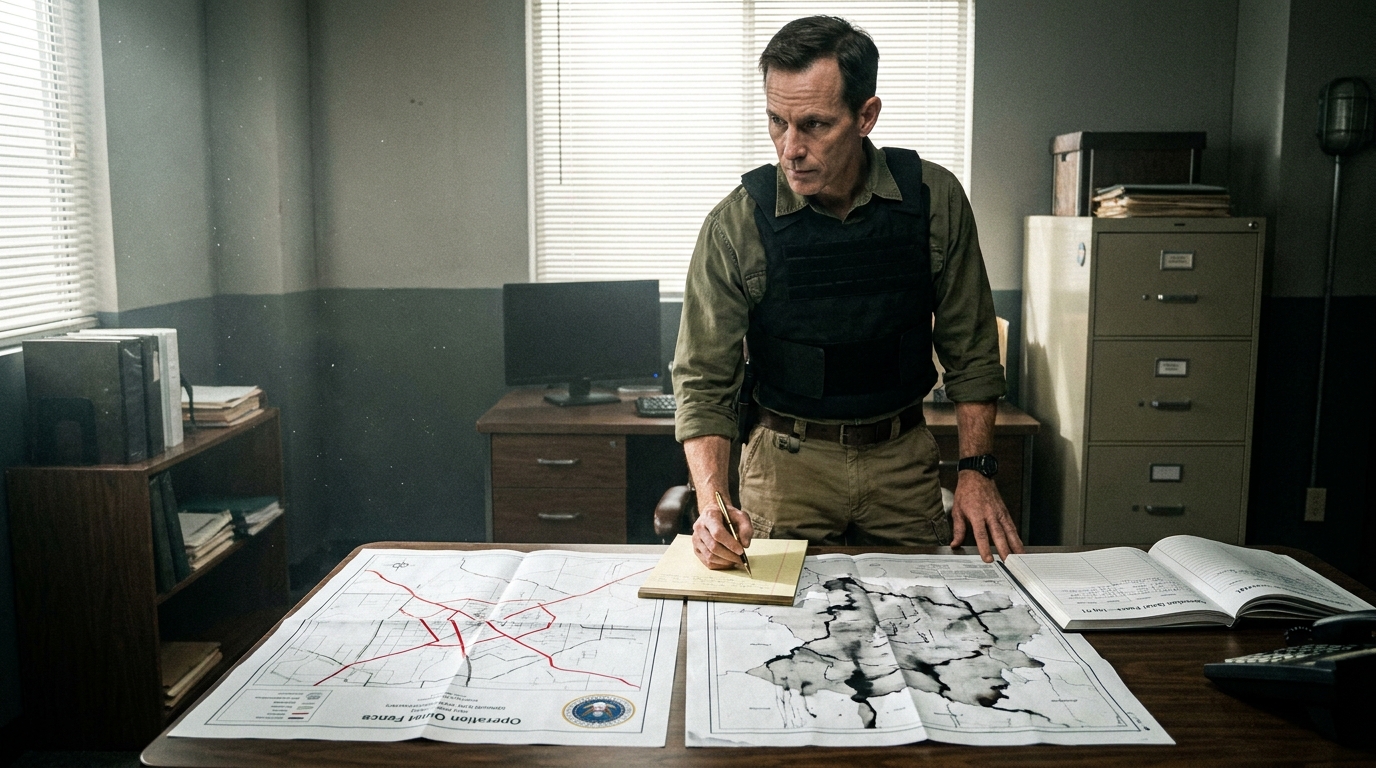
The thick vellum map unfolded across the dark oak desk with a crisp, dry snap. Scale: one inch to twenty feet. Certified stamp: State Surveyor L.R. Henderson, License 582-LS. The red-ink lines were sharp, unequivocal, and backed by county record filings dating back to the subdivision’s 1988 master plot. The cedar fence was explicitly marked—six inches inside the western iron pin boundary.
Karen’s ten-foot claim wasn’t a mistake. It wasn’t a miscalculation of sightlines. It was a deliberate, manufactured intrusion.
The brass pen felt solid in my fingers, heavy and perfectly balanced. I clicked it once. The sharp thwack echoed in the quiet room. At the top of a yellow legal pad, I wrote in block capitals:
OPERATION QUIET FENCE — LOG 01
DATE: 12 MAY | TIME: 0830
SUBJECT: K. MILLER (HOA PRES)
ACTION: VERBAL DEMAND / 10-FOOT ENCROACHMENT CLAIM / THREAT OF DEMOLITION & FINES.
I paused. My thumb pressed against a raised scar on the side of my knuckle, feeling the pale, hardened skin. Outside, the low rumble of a mail truck signaled the arrival of the noon delivery.
I opened the front door just as the aluminum flap on the mailbox snapped shut. Inside lay the white, heavy-bond envelope bearing the embossed crest of the Oakmont Estates Homeowners Association.
I didn’t tear it open. I brought it into the office, laid it flat on the desk, and slid a stainless steel letter opener through the top seam with a clean, whisper-thin slice.
The document inside cited Article 4, Section 2B: Encroachments on Common Elements. The tone was sterile, engineered to induce immediate panic. $100 baseline fine. $50 weekly escalation. Threat of a property lien after thirty days.
Attached was a third-generation photocopy titled Master Community Plat.
I leaned down, micro-focusing on the line weights. The boundaries of Lot 121 were hand-drawn. The ink was uneven, the corners lacked geometric degree annotations, and the greenbelt border bulged into my lot like a water stain on wallpaper. At the bottom right, replacing the surveyor’s seal, was a shaky, hand-scrawled approval: K. Miller, HOA Pres.
She hadn’t just misread a map. She had drawn her own.
My thumb rubbed the brass clip of the Parker pen, feeling the cold brass warm against my skin. The game wasn’t about land. It was about leverage. And Karen Miller had just handed me her first operational failure on twenty-four-pound paper.
CHAPTER 2: THE PAPER FORTRESS
The brass clip of the Parker pen held the heat of my thumb for three seconds before cooling back down to the room’s baseline.
Under the sharp beam of the desk lamp, the photocopy of Karen’s hand-drawn map didn’t get any truer. The black ink lines were soft around the edges, bled into the wood-pulp fiber of cheap paper like a bad tattoo. A real boundary survey doesn’t bleed. It stays sharp, pinned to the earth by grid coordinates, mathematical degrees, and the cold weight of county law.
I picked up the brass pen, clicked it once, and dropped it into my breast pocket. I folded the fraudulent master plat into three equal sections, slid it into a fresh Manila folder, and marked the tab in clean block script: EXHIBIT B — DEFENDANT FABRICATION.
“Mike?” Sarah’s voice came from the hallway, soft, carrying the tight, strained pitch she got whenever something threatened the perimeter. She stood in the doorway, holding a damp dish towel, her knuckles pale against the cotton. “Was that Karen on the lawn?”
“It was,” I said. My voice stayed down in my chest, low and steady. “She wants ten feet.”
“Ten feet?” Her eyes drifted to the front window, where the cedar fence ran straight and true along the greenbelt line. “That’s… that’s nearly to the big oak. Can she do that?”
“No,” I said. I stood up, smoothing the front of my shirt. “She can write a letter. She can stand on the grass. She can’t move the iron.”
I grabbed my truck keys off the tray by the door. The heavy brass keyring clinked against the iron counterweight I kept attached to it.
“Where are you going?”
“County Records,” I said, catching her eye and holding it until her shoulders dropped half an inch. “To buy three hundred dollars worth of truth.”
The Montgomery County Records Vault smelled like stale ozone, cardboard dust, and sixty years of dried binder glue. It sat in the basement of the 1974 courthouse expansion, beneath three feet of reinforced concrete and two sets of locked fire doors.
The clerk behind the counter was a woman named Arlene—sixtyish, wearing half-moon readers on a beaded chain, her thumb permanently stained with purple index ink. She didn’t look up when my boots hit the linoleum.
“Subdivision plats or deed transfers?” she asked, her voice raspy from forty years of air-conditioned dust.
“Both,” I said. “Oakmont Estates. Section 3, Lot 121. And I’ll need the original developer filings for Lot 128.”
Arlene’s eyes flicked over the rims of her glasses. Her thumb rubbed a worn spot on the laminate counter. “Lot 128. The Miller place.”
“That’s the one.”
She didn’t ask questions. She turned, her orthopedic soles squeaking against the tile as she navigated the narrow aisles of metal shelving. Ten minutes later, she returned carrying two oversized, leather-bound plat books. The spines were cracked, exposing grey fabric mesh beneath the black grain.
She laid them flat on the viewing table. “Terminal 4 has the microfiche if you need deed history prior to ninety-two. Anything after is in the bound volumes.”
I pulled the first volume toward me. The pages were thick vellum, heavy enough to resist a quick flip. I turned to Page 114: Oakmont Estates Master Subdivision Plat, Filed November 14, 1988.
The surveyor’s seal was embossed directly into the corner of the vellum—a raised, crisp ring of paper signed by Civil Engineer J.V. Vance. I traced the line representing the western perimeter of Lot 121 with the tip of my brass pen. Two hundred and fifty feet from the oak-lined curb. Right angle turn at ninety degrees, zero minutes, zero seconds. Iron pin set at the intersection.
The fence was marked exactly where it sat today: six inches inside the iron boundary.
Then I flipped to Page 118: Lot 128 — Original Structural Plot.
I froze. My thumb pressed against the heavy paper margin.
The original plot for Karen Miller’s lot showed a standard four-bedroom footprint with a twelve-by-fifteen concrete rear patio. But pasted over the margin of the document was a paper addendum, stamped with a blue ink seal that had bled through to the reverse side. The stamp bore an administrative tracking code: Project Vanguard — Conditional Site Exception.
I leaned in closer, my eyes scanning the fine print beneath the blue stamp. The text noted a setback variance granted in 2019 for an “extended utility pad,” signed off not by the county engineer, but by an interim zoning administrator whose name had been crossed out and re-stamped.
I pulled my cell phone from my pocket, turned off the flash, and took four high-resolution photos of the page, ensuring the embossed county seal and the Project Vanguard stamp were perfectly legible under the fluorescent light.
I looked at the property boundary line between Lot 128 and the adjacent greenbelt. According to the original 1988 master plot, the rear corner of Lot 128 sat exactly four feet from the easement. But on the 2019 site exception overlay, the wall of the structure had been redrawn—pushed outward, closer to the property line.
Frank Miller hadn’t just built a sunroom without a proper permit. He had built it on a foundation that ignored the county’s setback requirements entirely.
I closed the volume. The heavy leather cover slammed shut with a dull, solid thud that echoed through the quiet archive room. Arlene looked up from her desk, her pen pausing mid-air.
“Find what you were looking for?” she asked.
“I found what I needed,” I said. I pulled my wallet out, slid a fifty-dollar bill across the counter, and pointed to the copier in the corner. “I’ll need three certified copies of Page 114 and Page 118. Stamped, sealed, and signed by the recorder.”
Arlene looked at the bill, then at the ledger pages. Her eyes narrowed slightly, but she took the cash and nodded. “Give me ten minutes.”
I stood by the glass counter, my hand resting in my pocket, feeling the cold weight of the brass Parker pen against my knuckles. Karen wanted a war over six inches of cedar rail. She didn’t know I was standing in the armory.
CHAPTER 3: THE RECONNAISSANCE RUN
Two twenties and a ten hit the glass counter with a dry, papery slide.
Arlene didn’t look me in the eye as she pushed the change across. Her ink-stained thumb gave a single, dismissive flick toward the exit. The heavy yellow envelope felt rigid under my forearm, four pounds of legal certainty bound in thick craft paper.
“Keep the receipt flat,” she muttered, turning her back to sort through another stack of leather-bound folios. “If you crease the raised seal, the county recorder won’t acknowledge it in open court.”
“Understood,” I said.
I took the envelope, slipped the change into my pocket, and walked out into the oppressive July humidity. The air on the courthouse steps hit like a hot wet blanket, smelling of asphalt and diesel exhaust. I slid into the cab of my truck, placed the Manila envelope flat on the passenger seat, and set my heavy brass keyring on top to anchor it.
Fifteen minutes later, the tires of my truck crunched onto the gravel of Lot 125, two doors down from my own boundary line.
Bob Peterson was kneeling in his flowerbed, wearing a faded khaki sunhat and heavy leather work gloves. A rusted trowel was clamped in his right fist, slicing through dirt and crabgrass with rhythmic, methodical jabs.
I cut the engine. The metal hood gave a sharp, cooling ping in the afternoon heat. I stepped out, my boots heavy on the packed stone.
“You’re digging too deep on those hydrangeas, Bob,” I said, leaning my elbow against the bed rail of my truck. “You hit the clay layer and the roots rot.”
Bob paused, the trowel buried four inches in the dark soil. He wiped his forehead with the back of a dirt-smeared glove, his squinting eyes taking in the yellow envelope under my arm. A slow, thin smirk spread across his weathered face, deepening the white creases around his eyes.
“I ain’t digging for roots, Mike,” he said, groaning slightly as he stood up, his knees popping like dry twigs. “I’m turning dirt so I have an excuse to watch the street. Saw Karen’s Lexus pull out an hour ago. She had that rigid, chin-up look she gets right before she delivers a summons.”
“She already delivered it,” I said. I pulled my brass Parker pen from my shirt pocket and clicked it once. “Verbally. On my lawn. Ten feet.”
Bob let out a dry, barking laugh that turned into a cough. He spat onto the mulch. “Ten feet! Jesus, Mary, and Joseph. She’s getting bolder. Usually she starts with three feet for an unapproved trellis or four inches on an edging stone. Ten feet is an invasion.”
“She brought a map,” I said, pulling the certified vellum copy out of the yellow envelope just enough to expose the heavy blue recorder’s stamp. “Hand-drawn. Signed by herself.”
Bob walked over to the truck bed, stripping off his leather gloves. His knuckles were swollen with arthritis, but his hands were steady. He looked at the raised seal on the vellum, then looked up at my face. His expression lost its sarcastic edge, hardening into something dark and familiar—the look of a man who recognized an operational briefing when he saw one.
“You went to the basement,” Bob said, his voice dropping an octave.
“I went to the basement,” I confirmed. “The 1988 master plot is clean. My fence is six inches inside the iron pins. But I found something else.”
I unzipped my pocket, pulled out my phone, and opened the high-resolution photo of Page 118. I held the screen out to him.
“Look at the variance overlay,” I said. “Section 128. Signed in 2019.”
Bob leaned in, squinting at the screen. His eyes traced the blue ink stamp. “Project Vanguard,” he read aloud, his brow furrowing until the skin was raw and red. “What the hell is Project Vanguard?”
“I don’t know yet,” I said. “It’s logged as an extended utility pad. But Frank Miller built a four-season room over it.”
Bob took a slow breath, his chest expanding under his faded chambray shirt. He looked down the street toward Karen’s house at the end of the cul-de-sac. The white vinyl siding of her rear addition gleamed in the harsh afternoon light, immaculate, overbuilt, and completely out of scale with the rest of the tract homes.
“Frank didn’t buy those materials through a supplier,” Bob said softly. He reached into his pocket, pulled out a battered metal tin of mints, and popped one into his mouth with a sharp snap of his jaw. “Ten years ago, when the HOA replaced the clubhouse roof, Miller Construction was the only bidder. Forty thousand dollars out of the reserve fund. Six months later, the roof leaked, and Frank bought a new backhoe.”
“Did anyone audit the reserve?” I asked.
“Audit?” Bob laughed again, bitter this time. “Karen controls the ledger. The treasurer, Tom Albright, is a wet paper towel. He signs whatever she puts on his desk because his wife runs an interior design business and Karen feeds her all the HOA remodel referrals. It’s an ecosystem, Mike. A closed loop. You pay your three hundred a month in dues, Frank gets the maintenance contracts, Karen gets the authority, and Albright gets the crumbs.”
I turned my head, scanning the cul-de-sac. The neighborhood was silent except for the distant drone of a lawnmower three streets over. Clean asphalt, manicured lawns, identical beige shutters. On the surface, peace. Beneath it, a predatory financial pipeline extracting quiet obedience from retirees who were too tired to read the bylaws.
“She’s using a manufactured fine schedule to trigger a lien,” I said, my thumb rubbing the smooth brass barrel of the pen. “Why now? Why my lot?”
“Because you’re new,” Bob said flatly. “And you bought outright at closing. No mortgage bank sitting on your title to fight back. If she puts a cloud on your deed, she thinks you’ll pay ten grand in penalties just to keep your record clear. She did it to the Rodriguez family on Lot 112 three years ago over a basketball hoop. They fought for six months, ran up five thousand in legal fees, and finally sold at a loss just to escape her.”
“The Rodriguez family didn’t have the original survey,” I said.
“They didn’t have an engineer’s eye, either,” Bob replied. He tapped his finger against the bed rail of my truck, right next to my brass keyring. “Frank’s sunroom… I watched him pour that pad back in nineteen. He brought in an off-duty cement mixer at six in the morning on a Saturday. No county inspection flags on the front lawn. No safety netting.”
“He bypassed the inspectors,” I said.
“He bypassed everybody,” Bob said. “He told us it was a patio repair. But if that foundation sits on the greenbelt easement…”
“It’s not just an easement violation,” I said, the realization settling into my mind with the cold, heavy precision of an iron pin. “If that structure crosses the line, it’s an unlawful conversion of private property under county code. It invalidates his homeowner’s insurance and makes the structure legally non-existent.”
“Checkmate?” Bob asked, a razor-thin grin returning to his lips.
“Not yet,” I said. I slid the vellum back into the yellow envelope and pulled the brass pen from my pocket. “This is just recon. Before you fire artillery, you map the grid.”
I turned toward my truck door, but Bob caught my sleeve. His leather-calloused fingers gripped the fabric tight.
“Watch your back on this, Mike,” he murmured, his voice dead serious. “Karen isn’t just protecting her pride. That reserve fund… there’s a file she keeps in her home office. I saw it once when I was on the safety committee. A dark green binder labeled Ledger 88-A. She doesn’t let Albright touch it. If you push her into a corner where the county starts digging into those site exceptions, you’re not just threatening her fence claim. You’re threatening her husband’s license.”
“Good,” I said.
I opened the truck door, placed the yellow envelope back on the passenger seat, and cranked the engine. The radio flicked on automatically, broadcasting a low hum of static.
As I backed out of Bob’s driveway, I looked in the rearview mirror. Karen Miller was standing on her front porch, her pastel tracksuit a vivid pink stain against the white siding. She held a black clipboard against her chest like a shield, her eyes locked onto my truck as I drove past.
I didn’t slow down. I didn’t wave. I kept my hands at ten and two on the steering wheel, my right thumb pressing against the cold brass keyring, counting the feet between her porch and my iron pin.
CHAPTER 4: PAPER TRAIL TRAP
My boots hit the gravel of my driveway before the engine fan finished its final, shuddering spin.
The pink rectangle on the front door wasn’t subtle. It was fluorescent, seven-by-eleven cardstock, stuck to the center panel with two cross-strips of heavy blue painter’s tape. As I approached the steps, a sharp, solvent scent hit my nostrils—freshly printed toner, hot from an industrial laser copier.
I didn’t tear it off. I reached into my pocket, pulled out the brass Parker pen, and used the metal clip to lift the bottom corner of the paper away from the wood.
FINAL NOTICE BEFORE ASSESSMENT OF PENALTIES.
ARTICLE 4, SECTION 2B ENCROACHMENT — NON-COMPLIANCE.
CURRENT BALANCE DUE: $100.00 BASE FINE + $50.00 ADMINISTRATIVE PROCESSING.
NOTICE OF INTENT TO RECORD LIEN WITHIN 14 DAYS.
The ink was slightly smudged near the bottom where Karen’s thumb had pressed the page flat against the grain. Below her signature sat a secondary line item printed in smaller type: Remittance payable to The Apex Escrow — HOA Operations Account.
I stared at the name for three seconds. The Apex Escrow. Not the Oakmont Estates General Fund. Not the regional credit union listed on my monthly dues coupon. An off-site escrow routing account.
My thumb pressed against the cold brass barrel of the pen until the clicker engaged with a sharp, dry snap. I peeled the tape free, taking care not to rip the paint, and carried the pink sheet inside.
Sarah was at the kitchen island, a red pen in her hand, staring at a stack of printed household utility bills. Her shoulders were pulled tight toward her ears, her posture locked in the defensive hunch she adopted whenever the monthly budget ran thin. She looked up as the screen door slammed shut, her eyes dropping instantly to the pink cardstock in my hand.
“Another one?” her voice was barely above a whisper.
“Escalation stage,” I said. I laid the paper flat on the granite counter beside her coffee mug. “She’s laying paper trail precedent. Standard procedure before filing a summary lien.”
“Mike, Marge from down the street didn’t even look at me when I was putting out the recycling this morning,” Sarah said. She set her pen down; it rolled across the counter, stopping against a salt shaker. Her index finger began picking at a tiny frayed thread on the hem of her sleeve—fast, repetitive micro-movements she couldn’t control. “She turned her back and walked up her driveway. People are talking. Karen’s telling everyone we’re refusing to abide by the community standards.”
I reached out, placed my palm over her picking fingers, and held them still. Her skin was cold despite the heat outside.
“Let her talk,” I said. My voice was steady, dropped down into the low frequency I used when leading clearing sweeps in Kandahar. “Talk doesn’t stand up in court. Certified plats do.”
“We can’t afford a lawsuit, Mike,” she murmured, looking up at me, her eyes wet around the corners. “We put everything into the down payment. If she puts a lien on the house…”
“She can’t enforce a lien based on a fraudulent boundary,” I said. “A lien requires an unimpeachable debt. The moment she files, she submits her claim to county judicial review. That’s the one place where her hand-drawn map becomes a felony.”
I pulled my phone from my belt holster, unlocked the screen, and opened my email client. I drafted a short, sterile response to the official HOA board address, copying Tom Albright’s personal insurance agency email at the bottom.
Pursuant to my previous correspondence regarding the boundary dispute on Lot 121, I typed, be advised that a state-certified boundary survey is currently underway by a licensed geomatic firm. Any attempt to record an encumbrance or lien prior to the delivery of this official report will be treated as an intentional clouding of title and prosecuted under state slander-of-title statutes.
I didn’t mention Project Vanguard. I didn’t mention the blue stamp in the county basement or the unpermitted sunroom sitting three feet over Frank’s property line. You don’t reveal your primary firing position while the scout is still marking the target.
“What are you doing?” Sarah asked, watching my thumb move across the glass.
“Setting the perimeter,” I said. I hit send. The electronic chime signaled the outgoing transmission. “I’m giving Tom Albright twelve hours to realize his personal assets are on the line if he signs off on Karen’s lien.”
I walked into my home office, set the pink notice inside the gray steel cabinet under EXHIBIT C, and pulled out a fresh sheet of paper. I opened my desk drawer, pulled out my checkbook, and wrote out a check for $2,800 payable to Sterling Geomatics & Land Surveying.
The price was steep—nearly three months of my retirement pension reserve. My fingers tightened around the Parker pen as I signed my name at the bottom, the nib digging deep into the paper. It was an immediate, painful hit to our liquid balance, a tangible cost for a war I hadn’t started.
I folded the check, slid it into a stamped envelope, and addressed it to Dave at Sterling.
The front doorbell chimed. A heavy, single ring that rattled the glass decorative transom above the foyer.
I didn’t rush. I walked out of the office, down the hallway, and opened the solid oak door.
Tom Albright stood on the porch mat. He wasn’t wearing his usual HOA treasurer badge or his sharp business suit. He wore a faded polo shirt, his collar slightly curled at the tips, and a thick sheen of sweat glistened on his receding hairline. His hands were stuffed deep into the pockets of his khakis, his thumbs twitching against the fabric from the inside.
“Mike,” he said, his voice thin, lacking the bureaucratic booming tone he used during the annual budget meetings. “I… I just got your email on my office phone.”
“Tom,” I said, staying inside the threshold, my arm resting against the doorframe to block his line of sight into the house. “You’re off your usual turf.”
Tom looked left, then right, scanning the quiet street like a man checking for oncoming traffic before running a red light. “We need to talk about this survey thing, Mike. Karen’s… she’s very set on this. The board voted on the fine schedule three months ago. It’s in the minutes.”
“The board voted on a fine schedule based on a boundary that doesn’t exist,” I said flatly.
“Look,” Tom took a half-step forward, dropping his voice to a low, desperate rasp. “You don’t understand how this works. If you bring private surveyors out here with tripods and lasers, it creates… it creates visibility. The bank that handles our community improvement loans—The Apex Escrow group—they monitor compliance. If they see a formal title dispute on the books, they freeze our credit line.”
My eyes narrowed slightly. My thumb, resting against the wooden doorframe, pressed into a soft spot in the grain.
“Why would an escrow group freeze a credit line over a fence dispute, Tom?” I asked softly. “Unless that credit line is secured by property the HOA doesn’t actually own?”
Tom’s face went pale, the color draining from his cheeks so fast the broken capillaries on his nose stood out like purple web lines. He swallowed hard, his throat clicking in the quiet afternoon air.
“I… I didn’t say that,” he stammered, stepping back off the mat. “I’m just saying… settle the fine, Mike. Move the fence back five feet. Split the difference. Karen will let it go.”
“I don’t split differences on my own land,” I said.
I took the stamped envelope containing the $2,800 check to Sterling Geomatics and held it up between two fingers so he could read the bold block lettering on the front.
“The survey crew arrives Tuesday morning at eight,” I told him, my tone as cold and hard as an iron pin in frozen ground. “Tell Karen to have her clipboard ready.”
I closed the door without waiting for his answer, the deadbolt clicking home with a heavy, final thud.
CHAPTER 5: THE LEGAL VANGUARD
The distorted circle of the peep-hole held Tom Albright’s retreating form until his sedan door slammed shut, the metallic thud muffled by thirty feet of humid air.
I didn’t step away from the door immediately. I stayed grounded, feeling the slight vibration of his tires rolling over the gravel driveway. The envelope in my hand—bearing the $2,800 survey check—felt crisp between my fingers, its sharp paper corners pressing into my palm.
“He didn’t come to negotiate,” I said to the empty foyer. “He came to assess structural panic.”
I walked back into the office, picked up the brass Parker pen, and clicked it once. On the legal pad, beneath Tom’s name, I drew a thick, precise line connecting The Apex Escrow to Project Vanguard. The ink dried almost instantly under the desk lamp.
Ten minutes later, I was behind the wheel of my truck, heading north on the state highway toward the city center. The dashboard clock read 1415 hours. The engine purred with a steady, mechanical rhythm, the air conditioning blowing a cold, dry stream across my knuckles as I held the wheel at ten and two.
The Veterans Justice Project operated out of a modest, three-story brick building two blocks from the county chancery court. The lobby smelled of floor wax, roasted coffee, and old law reviews.
Jessica Riley was waiting in an office on the second floor. She was younger than I expected—early thirties, sharp blue eyes behind thin wire frames, her hair pulled back into a tight, efficient bun. On her desk sat three stacked folders and an oversized porcelain mug that read Pro Bono / No Mercy.
“Mr. Thompson,” she said, rising to give my hand a single, firm firm grip. Her palm was dry, her pressure deliberate. “Sit. I’ve gone over the digital intake files you uploaded. Your survey scan and the county master plot.”
I sat in the leather chair opposite her, placing my manila folder flat on the polished mahogany surface. I didn’t open it yet.
“You’ve got a standard suburban land grab on the surface,” she began, leaning back and resting her elbows on the armrests. Her thumb lightly stroked the side of her pen—a habit I recognized instantly. “An overzealous HOA board president using administrative fines as a club. But your note mentioned an escrow routing entity.”
“The Apex Escrow,” I said. “Tom Albright dropped the name on my porch an hour ago. He said a formal dispute would freeze their credit line.”
Jessica’s eyes sharpened. She pulled a yellow notepad from under a legal brief and wrote the name down in swift, fluid cursive.
“Oakmont Estates is a non-profit residential corporation,” she said, her voice dropping into a low, analytical tone. “They shouldn’t have an active credit line with a private escrow firm unless they are leveraging community assets or future fee assessments as collateral. Who authorized the escrow account?”
“Karen Miller,” I said. “According to Bob Peterson, she maintains an off-books record. She calls it Ledger 88-A.”
Jessica tapped her pen twice against the desk. Tap. Tap. The sound was crisp, filling the quiet space between us.
“Here is our tactical position, Mr. Thompson,” she said, leaning forward until her forearms rested on the desk. “If we play defense, we wait for her to file the lien, then we petition the chancery court for a quiet title injunction. It takes six months, costs you three thousand in filing fees, and leaves your property in limbo while the court calendar drags.”
“I don’t play defense,” I said softly. My thumb rubbed the pale scar on my knuckle. “What is the offensive line?”
A thin, cold smile touched the corner of Jessica’s mouth.
“We bypass the HOA as a collective shield,” she said, pulling a blank draft template from her desk drawer. “We issue a formal legal notice of personal liability directly to Karen Miller, Tom Albright, and the three remaining board members individually. We serve them by certified courier at their personal residences.”
“Personal liability?”
“Statutory bad faith,” Jessica explained, her fingers flying across her keyboard as she opened a legal template. “When an HOA board member knowingly acts outside the recorded covenants—using a fabricated map instead of the county plat—they lose their corporate immunity. They are no longer acting as ‘The Board.’ They are acting as individuals committing civil fraud and slander of title.”
She turned the computer monitor toward me. The document heading was bold and uncompromising: NOTICE OF INTENT TO SUE FOR INDIVIDUAL TORTIOUS INTERFERENCE AND SLANDER OF TITLE.
“We give them seventy-two hours,” Jessica continued, her voice crisp and uncompromising. “Demand one: immediate withdrawal of the violation notice and cancellation of all fines. Demand two: written confirmation that no lien will be recorded. Demand three: full indemnification for your survey expenses.”
“And if Karen refuses?”
“Then we don’t just sue the association,” Jessica said, her eyes locking onto mine with ruthless clarity. “We file against her personally. We put a lis pendens on Lot 128. If her husband tries to draw down on that Apex Escrow credit line, the bank’s legal department will flag the dispute within ten minutes. They will freeze every account tied to her name.”
I looked at the document on the screen. It was clean, brutal, and mathematically sound. It took the fight out of the abstract administrative realm and landed it squarely on Karen’s personal balance sheet.
“Draft it,” I said. I pulled my checkbook from my jacket pocket, placed it on the desk, and unscrewed the cap of my Parker pen. “What’s the retainer for personal service notices?”
“Five hundred for the filings and courier fees,” Jessica said, watching me sign the check with steady, unhurried strokes. “The Veterans Justice Project covers the billable hours. Consider it a courtesy to a man who knows how to keep his lines straight.”
I slid the check across the polished mahogany. The paper slid smooth, stopping right against the base of her mug.
“Sterling Geomatics hits the lot on Tuesday at zero-eight-hundred,” I told her. “I want those board members served before the first tripod is leveled.”
“They’ll have the papers by Monday afternoon,” Jessica said, picking up the check and slipping it into her top drawer. “Mr. Thompson?”
I paused, my hand on the brass door handle.
“Karen Miller is going to panic when she realizes her personal home is exposed,” Jessica warned, her voice dropping into a quiet, serious register. “Cornered people don’t think strategically. They lash out with whatever tool is closest.”
“I know,” I said, opening the door. “I’m counting on it.”
CHAPTER 6: THE BOUNDARY INTRUSION
The white envelope carrying the draft liability notice remained in my left hand as I opened the door of my truck, the smooth paper stiffness a sharp contrast against the worn leather of the steering wheel.
By zero-seven-forty-five Tuesday morning, the air on Oak Drive was already warm enough to sweat through a cotton work shirt.
A gleaming white heavy-duty Ford F-250 pulled to the curb right on schedule, the blue-and-black logo of Sterling Geomatics & Land Surveying painted across the side doors. Dave stepped out from the driver’s side, wearing high-visibility orange gear, a sun-bleached canvas cap, and a heavy leather tool belt slung across his hip. A second surveyor, a younger man named Marcus, hopped down from the passenger side and immediately unlatched the rear tailgate.
“Mr. Thompson,” Dave called out, his voice a calm, gravelly baritone as he walked toward my porch. His handshake was dry and firm. “Clear morning for sightlines. We brought the total station and the satellite rover.”
“Dave,” I nodded. “The iron pin at the street corner is buried under about two inches of thatch and dirt right near the curb seam. The rear pin sits near the oak.”
“We’ll locate the monuments first, establish our benchmark, and run the line,” Dave said, unholstering a ruggedized tablet encased in a thick rubber housing. “Marcus, set the tripod over the north monument mark.”
Across the cul-de-sac, a front door snapped open.
Karen Miller stepped out onto her porch. She was dressed in her standard pastel pink tracksuit, her arms locked tight across her chest. Her rhinestone-studded glasses caught the glare of the morning sun like twin mirrors. Behind her, Frank Miller appeared in the doorway—a bulky man in a grey work shirt, his hands jammed into his front pockets, his jaw set in a hard, sullen line.
Neither of them spoke, but Karen’s eyes were fixed on the survey crew with an intensity that radiated pure hostility.
Marcus set the heavy aluminum tripod over the front property marker, leveling the legs with practiced, rhythmic snaps of the locking levers. He mounted the total station—a yellow, high-precision optic unit—and zeroed the laser.
Bob Peterson walked across his lawn, holding a mug of black coffee, his boots dragging through the damp grass. He stopped five feet from where I stood by the cedar post, keeping his voice down.
“She tried to call the county sheriff’s non-emergency line twenty minutes ago,” Bob murmured, taking a slow sip from his mug. “Claimed unauthorized commercial activity was disrupting the streetscape. Sheriff’s dispatcher told her a licensed land survey on private property doesn’t require a municipal permit.”
“She’s burning through her options,” I said softly, my thumb resting inside my pocket against the heavy brass Parker pen.
Dave walked down the western boundary, holding a tall prism pole capped with an optical retroreflector. Marcus remained at the total station, peering through the lens and tapping commands into his wireless tablet interface.
Beep. Beep. Ping.
The total station emitted a high-frequency acoustic tone each time the laser acquired the reflector. Dave moved five feet at a time, driving thin wooden stakes tipped with fluorescent orange flags into the turf.
Stake one: six inches inside my cedar fence.
Stake two: six inches inside my cedar fence.
Stake three: six inches inside my cedar fence.
The line of orange flags formed a perfectly straight vector from the front curb to the rear oak, proving beyond a shadow of a doubt that my fence was set entirely within the legal bounds of Lot 121.
“Your fence is clean, Mr. Thompson,” Dave called out, adjusting his cap as he reached the halfway point. “You’ve got five and three-quarter inches of clear clearance all the way down.”
“Thank you, Dave,” I said.
Across the lawn, Karen’s hands clenched into tight fists against her elbows. She took two steps down her porch stairs, her pink sneakers squeaking on the wood, but Frank caught her elbow and yanked her back. His face was flushed red, his eyes locked onto the rear corner of their own property.
Dave didn’t stop at my fence line. Per the scope of the full boundary survey, he continued tracking the perimeter coordinates toward the rear intersection where Lot 121 met Lot 128.
Ping.
Dave stopped. He stared down at his tablet screen, his brow furrowing beneath his cap. He looked up at the rear wall of Karen’s house—specifically, the four-season sunroom addition Frank had built in 2019.
“Marcus,” Dave called back, his tone dropping its casual cadence. “Re-check the rear benchmark angle. Zero out the azimuth and give me a secondary shoot on the corner foundation.”
Marcus adjusted the total station wheel, fine-tuning the crosshairs. Ping. Ping.
Dave walked right up to the concrete footing of the sunroom addition. He knelt down, unslung a small steel measuring tape from his belt, and laid it flat against the outer wall.
“What is it, Dave?” I asked, walking over to the property line.
Dave turned his tablet so I could see the live screen overlay. A red digital line—representing the official county boundary recorded in 1988—ran straight across the screen. Overlaid on top of it was the blue GPS plot of the physical structures currently sitting on the earth.
The rear corner of the sunroom didn’t just sit near the line. The concrete foundation, the framing, and the gutter system protruded across the boundary by three feet, nine inches.
“It’s an encroachment,” Dave said, pointing a calloused finger at the red-and-blue intersection on the glass. “Their addition isn’t just inside the required setback. The foundation footing is physically poured over your property line and extends into the recorded greenbelt easement.”
I looked down at the base of the sunroom wall where Dave was kneeling. Partially concealed beneath a layer of artificial pine mulch was a four-inch black corrugated PVC drain pipe, routed directly out from under the concrete foundation slab and buried shallowly into the turf of the greenbelt.
I leaned down, picked up a loose stick, and cleared away the mulch. The pipe was fitted with a hand-modified pressure valve, labeled in faded white grease pencil with a job code: VANGUARD-SUB-04.
It wasn’t an extended utility pad. It was a subterranean drainage bypass, built into the sunroom foundation to divert unpermitted runoff into the community greenbelt—concealing a structural defect in Frank’s original concrete pour.
“Dave,” I said, my voice dangerously calm as I pulled my phone from my pocket. “Include the PVC discharge pipe and the exact foundation measurements in your certified report.”
“Already logged,” Dave replied, tapping the screen to lock the coordinates into the official state record. “This isn’t an administrative error, Mr. Thompson. This building is legally non-compliant with county building codes.”
Across the yard, Karen Miller’s face went dead white. She looked at the orange flags, then at Dave’s measuring tape resting against her sunroom foundation.
Frank Miller didn’t say a word. He turned, walked back inside his house, and slammed the heavy oak front door so hard the glass pane rattled in its frame.
CHAPTER 7: THE ENCROACHMENT PIVOT
The echo of Frank Miller’s front door slamming shut hung in the hot afternoon air, flat and heavy against the vinyl siding of Lot 128.
I didn’t turn around. I stayed crouched by the corner of the sunroom, looking down at the four-inch black PVC pipe where the white grease pencil mark—VANGUARD-SUB-04—was already smudging under a trickle of muddy runoff water.
Dave unhooked his wireless tablet from its tripod bracket, slid the stylus into its side slot with a sharp plastic click, and tapped the screen twice.
“The official digital record is uploaded to the state database, Mr. Thompson,” Dave said, his voice flat, professional, and devoid of drama. “The physical certified plat with my seal will be printed and ready by sixteen-hundred hours.”
“I’ll pick it up in person,” I said. I stood up slowly, my knee joint giving a dull pop that sounded like dry pine snapping.
Bob Peterson stepped over the boundary line, his eyes fixed on the orange flags sticking out of the turf every five feet. He stopped right beside the black drainage outlet.
“He’s running foundation greywater right into the public easement,” Bob said, nudging the edge of the pipe with the toe of his work boot. “If the county building inspector sees this, they won’t just issue a fix-it ticket. They’ll red-tag the entire addition.”
“Not yet,” I said. I pulled my brass Parker pen from my shirt pocket and clicked it once. “The county inspector is a hammer. You don’t swing a hammer until the wedge is set.”
By seventeen-hundred hours, the state-certified boundary document sat flat on the desk in my home office. It was a heavy, twenty-four-pound sheet of vellum, stamped with Dave’s raised seal and backed by his notarized affidavit. The red shaded triangle at the rear corner of Lot 121 was clear, precise, and indisputable: 3.75 ft structural encroachment / non-compliant footing.
I dialed Jessica Riley’s direct line at the Veterans Justice Project. She picked up on the second ring.
“Riley,” she said.
“The survey is complete,” I told her, my voice low in my chest. “Four-inch pipe hidden in the mulch, three-foot nine-inch foundation intrusion across my property line.”
There was a two-second pause on the line—the sound of a pen sliding across a notepad.
“Three feet nine inches,” Jessica repeated, her tone sharpening into a razor-thin blade. “That’s not a fence dispute anymore, Mr. Thompson. That’s a structural trespass under Section 52 of the state civil code. Did you get the photograph of the pipe mark?”
“High-res, timestamped, and backed by Dave’s GPS log,” I said. “And the pipe is marked with an administrative code: VANGUARD-SUB-04.”
A soft rustle of paper came through the speaker. “I’m updating the demand letter right now. We aren’t just filing a notice of bad faith against the individual board members. We are attaching an official sixty-day notice to cure structural encroachment directly to Karen and Frank Miller.”
“What are the terms?”
“Term one,” Jessica said, her voice dropping into a rhythmic, methodical cadence. “Immediate and total cancellation of all HOA fines and violation notices against Lot 121. Term two: full written withdrawal of the intent to file a lien, signed by the board treasurer. Term three: full reimbursement of your two thousand eight hundred dollar survey expense, plus five hundred dollars in legal costs.”
“And term four?”
“Term four is the anvil,” Jessica replied. “Immediate removal of all encroaching structures from Lot 121. They have sixty days from tomorrow morning to cut that sunroom foundation back to the legal property line or face an ex parte court order for mandatory structural demolition at their sole expense.”
I took a slow breath, my thumb resting on the cool brass clip of the pen.
“Serve it,” I said.
“A licensed process server will deliver five individual packages tomorrow morning at zero-nine-hundred,” Jessica said. “One to Karen, one to Tom Albright, and three to the remaining board members at their workplaces. No administrative shields. No HOA buffer.”
“Understood.”
I hung up the phone, placed it on the oak desk, and stood looking out the rear window of my office.
The sun was dropping below the tree line, casting long, dark shadows across the lawn. In the dimming light, the orange surveyor flags gleamed like tiny signal fires along the fence line.
Down the street, the porch light at Lot 128 flickered on, throwing a harsh yellow beam across Karen’s driveway.
I picked up the heavy brass pen, slid it into my breast pocket, and walked out to the kitchen. Sarah was standing by the stove, stirring a pot of soup. Her posture was still rigid, her chin tucked low, but when she looked up and saw my face, the tension in her throat loosened half a fraction.
“Is it done?” she asked softly.
“The wedge is in,” I said, putting my arm around her shoulder and pulling her close. “Tomorrow morning, the hammer drops.”
Outside, the first evening wind stirred the branches of the big oak tree, rustling the leaves above the fence line—six inches inside my iron pin, clean, quiet, and completely unshakeable.
CHAPTER 8: CRACKS IN THE BOARD
The oak grain under my palm felt cold, holding the late-night chill that settled into the house before dawn.
At zero-nine-fifteen Wednesday morning, the white courier sedan pulled away from Tom Albright’s insurance agency on Main Street. From my truck parked across the avenue, I watched through the tinted glass as the driver walked back to his vehicle, leaving a heavy white cardboard folder lying flat on Albright’s reception desk.
Inside my cab, the radio played a low hum of static. I clicked my Parker pen once, its brass barrel reassuringly heavy against my fingers, and made a single checkmark on my legal pad beside Albright’s name.
Five minutes later, Albright’s office door swung open. He stepped out onto the sidewalk, holding the legal folder by its corner like it was soaked in battery acid. His collar was unbuttoned, his tie askew, and even from thirty yards away, I could see the damp dark patches staining the armpits of his pale blue shirt.
His thumb twitched violently against his thigh as he paced three steps left, turned, and pulled his cell phone from his belt. His jaw moved in fast, jerky snaps as he held the receiver to his ear.
He was calling Karen.
I didn’t engage. I turned the key in the ignition, shifted into drive, and let the truck roll slowly down Main Street toward the municipal park. The wedge was working. When you serve a legal notice that explicitly names an individual’s personal bank account, marital home, and private assets, the corporate buffer vanishes. The herd splits.
By eleven-hundred hours, my cell phone buzzed against the console tray. I didn’t answer on the first ring. I let it vibrate three full cycles before sliding my thumb across the screen.
“Thompson,” I said.
“Mike… Mike, it’s Tom. Tom Albright.” His voice was ragged, breathing fast into the microphone like he’d just taken three flights of stairs. “We… we need to clear something up. Privately. Off the record.”
“There is no off the record, Tom,” I said, keeping my tone at a steady, flat thirty knots. “My attorney drafted that notice. If you’re calling about the demand terms, speak to Ms. Riley.”
“Listen to me!” Tom hissed, his voice dropping into a desperate whisper. “I didn’t draft that violation notice! Karen brought it to my house at eight p.m. six weeks ago and told me it was a routine property boundary audit. She said the board had already cleared it with the legal committee!”
“There is no legal committee, Tom,” I said softly. “There’s a hand-drawn map and a four-inch PVC drain pipe marked VANGUARD-SUB-04 sticking out of her sunroom foundation.”
Silence fell over the line—a heavy, suffocating silence where I could hear the faint click of his fingernail tapping against his phone case.
“She… she told us that site exception was approved by the county,” Albright stammered, his voice cracking on the word county. “She said Miller Construction handled the municipal filing under Project Vanguard. We didn’t look at the site plans, Mike. We just signed the resolution!”
“You signed a resolution that puts a three-foot nine-inch encroachment onto my lot,” I said. “And you signed off on routing community assessment funds into The Apex Escrow.”
“I didn’t know about the escrow routing!” Albright nearly yelled, catching himself mid-shout and dropping back into a frantic raspy whisper. “She handles the master accounts! She brings me the balance summary every quarter and I sign the cover page! Mike, please. I have a kid in college. If you slap a lis pendens on my home, my broker’s license gets suspended automatically!”
“Then call an emergency board meeting,” I told him, every word clipped and hard as steel plate. “Public assembly. Open floor. You read a formal retraction of the violation notice, you cancel the fine schedule, and you sign the check for my two thousand eight hundred dollar survey fee.”
“She won’t agree to a public meeting!” Tom panicked. “She’s the board president—”
“She’s a board member facing individual personal liability for civil fraud,” I cut him off. “You have four other members on that board, Tom. You hold three votes without her. You call the meeting, or Jessica Riley files the chancery court petition at nine a.m. tomorrow.”
I hung up before he could respond.
I laid the phone back on the console. Outside the truck window, the oak trees along the park perimeter rustled in a sudden dry gust of wind, dropping tiny yellow twigs onto the hood.
At fourteen-thirty, a neighborhood-wide email alert pinged on my phone screen. It wasn’t sent from Karen Miller’s personal account. It came from Tom Albright’s business email, sent to every registered homeowner in Oakmont Estates:
NOTICE OF SPECIAL EMERGENCY BOARD ASSEMBLY
LOCATION: OAKMONT COMMUNITY CLUBHOUSE
DATE: THURSDAY, 1900 HOURS
AGENDA: PENDING LEGAL MATTERS & BOUNDARY RESOLUTION.
I looked down at the screen, my thumb lightly tracing the cold brass clip of my Parker pen.
Down at Lot 128, the fortress was cracking. The individual board members were scrambling to buy their way out of Karen’s sinking ship, and they were using the only currency I’d left them: a public surrender.
I shifted the truck into gear, turned the wheel, and drove back toward Lot 121 to brief Sarah. The battle lines were drawn, and for the first time in six weeks, the opposing force was marching straight into my kill zone.
CHAPTER 9: THE TRIBUNAL ASSEMBLY
The metal frame of the folding chair felt icy against my spine as the noise in the Oakmont Estates clubhouse rose to a steady, low rumble.
At eighteen-fifty-five, five minutes before the gavel, there wasn’t a vacant seat left on the linoleum floor. Seventy-eight residents filled the rows, their voices overlapping in sharp, clipped whispers that bounced off the cinderblock walls. On the portable projection screen set up beside the podium, a blank white rectangle glowed, illuminated by the halogen bulb of my laptop projector.
Sarah sat to my right, her hands resting flat on her lap, her index finger still, locked in complete composure. To my left, Bob Peterson leaned back, his boots hooked over the lower rung of his chair, watching the front entry door with the calm, predatory focus of an old artillery observer.
At eighteen-fifty-eight, the side door clicked open.
Tom Albright walked in first, his face gray, holding a thin Manila folder like a shield against his chest. Behind him filed the three other board members—a local dentist, a commercial real estate agent, and a retired school principal. None of them looked at the crowd. They took their seats behind the long folding table at the front of the room, their eyes fixed firmly on the microphones.
Then came Karen Miller.
She didn’t wear her pastel tracksuit. She wore a dark blue blazer with heavy gold-plated buttons, her chin tilted up at an unnatural angle. Her rhinestone-studded glasses caught the glare of the projector beam as she swept past the front row. But as she sat down at the center chair, her right hand trembled—a tiny, involuntary micro-twitch that she tried to hide by locking her fingers tightly around a black leather binder.
Ledger 88-A. The dark green vinyl corner peeked out from the side of her leather folder.
Tom Albright reached out, pulled the gooseneck microphone toward his mouth, and cleared his throat into the capsule with a loud, raspy pop.
“Good… good evening, everyone,” Tom began, his voice thin, vibrating with an uncontrollable frequency. “This special assembly of the Oakmont Estates Homeowners Association is called to order at nineteen-hundred hours. The single item on the docket is the resolution of a pending legal dispute regarding Lot 121 and association governance.”
Karen’s head snapped toward Albright, her jaw tightening until the muscles near her ear twitched. “Tom,” she hissed, her voice cutting through the microphone’s side-bleed. “The executive board handles active litigation in closed session under Bylaw Section—”
“The executive board is facing individual personal liability, Karen,” Tom cut her off, his voice suddenly sharp, carrying through the PA speakers with a raw, desperate edge that made the front row lean forward. “We have an open quorum. Mr. Thompson has the floor.”
A sudden, sharp quiet fell over the room—the kind of silence that happens when a unit drops its weapons before the first shot is fired.
I stood up slowly, my boots quiet against the linoleum. I didn’t take notes to the podium. I carried only my heavy brass Parker pen, clipped neatly into my breast pocket, and a USB flash drive. I slid the drive into my laptop, hit spacebar, and stepped up to the microphone.
Click.
The projector screen flickered. Slide one hit the wall in crisp, six-foot-high resolution: a photo of the bright pink FINAL NOTICE taped to my front door, complete with the $150 fine schedule and the lien threat.
“Six weeks ago,” I said, my voice low, carrying easily through the quiet room without straining the mic, “I was issued this violation notice. I was told my cedar fence encroached ten feet onto community property. I was threatened with daily administrative fines, legal encumbrances, and forced demolition.”
I pressed the remote clicker. Slide two appeared: the crude, third-generation photocopy of Karen’s hand-drawn master plot.
“This was the proof provided by the association president,” I continued, pointing a finger at the wobbly, hand-drawn boundaries and the shaky signature at the bottom. “A map created without a surveyor’s seal, without dimensional degree annotations, and without county record authority.”
A sharp murmur rippled through the fourth row. Marge from down the street leaned over to her husband, her mouth open.
Click.
Slide three filled the screen: the official 1988 Montgomery County Master Subdivision Plat, stamped with the raised seal of Engineer J.V. Vance, showing Lot 121’s boundaries down to the exact hundredth of an inch.
“This is the official record on file in the county vault,” I said, every word clipped and even. “My fence sits six inches inside my iron pins. It has sat there for fifteen years. There is no ten-foot encroachment. There never was.”
Karen slammed her palm against the table, her heavy gold rings making a sharp, metallic clack against the laminate. “This is a procedural violation!” she shouted, her voice shrill, cracking at the register. “Individual property disputes are subject to board administrative discretion under Section 2B! You are out of order, Mr. Thompson!”
“Sit down, Karen!” Bob Peterson’s voice boomed from the third row, heavy and resonant. “Let him show the rest!”
“Let him speak!” a voice shouted from the back. “We pay three hundred a month for this?”
Tom Albright didn’t look at Karen. He pressed his palms flat on the table and leaned into his microphone. “Continue, Mr. Thompson.”
I clicked the remote once more. Slide four hit the screen, and the entire room seemed to hold its collective breath.
It was Dave’s certified geomatic survey map, high-contrast digital overlay. Highlighted in bright, violent red at the rear intersection of Lot 121 and Lot 128 was the three-foot nine-inch triangular intrusion of Karen’s sunroom foundation.
And right beneath it, magnified four hundred percent, was the crisp photograph of the four-inch black PVC drain pipe buried in the mulch, its white grease pencil label clearly legible to every person in the room: VANGUARD-SUB-04.
“This is the reality,” I said, pointing the laser pointer’s green dot directly at the foundation intrusion. “While the association was threatening a lien against my home for a non-existent fence violation, the association president’s own residence was physically trespassing three feet nine inches onto private property—covering an unpermitted, illegal drainage modification routed into the public greenbelt.”
The room didn’t just murmur. It exploded.
Residents stood up in the aisles. Arguments broke out near the refreshment table. Tom Albright banged his plastic pen against his water glass, his face pale as chalk, while the other three board members shrank back into their chairs, visibly trying to detach themselves from the woman sitting at the center of the table.
Karen Miller stood frozen behind her microphone, her mouth opening and closing without making a sound. Her hands gripped the edges of Ledger 88-A so tightly that the green vinyl covers bent under the pressure of her thumbs.
The wedge was fully driven. The shell was cracking. And as I clicked the pen in my pocket, I knew the final strike was only seconds away.
CHAPTER 10: THE VOTE OF NO CONFIDENCE
The high-pitched screech of Tom Albright’s microphone feedback cut through the roar of seventy-eight shouting residents like a razor blade through canvas.
I didn’t move from behind the podium. I stood immovable, my hand resting flat beside the projector, watching Tom’s trembling fingers grip the base of the mic stand. Across the table, Karen Miller’s face had turned a mottled, dark purple, her knuckles bone-white where they dug into the leather edges of Ledger 88-A.
“Order!” Tom shouted, his voice cracking into the capsule. “Order in the room!”
Bob Peterson stayed standing in the third row, his arms crossed over his chest, his gaze locked onto the board members like an artillery officer holding a target line. “Call the motion, Tom!” Bob bellowed over the din. “Call it or we call the county prosecutor ourselves!”
“I… I move,” Tom stammered, standing up so fast his metal folding chair scraped backward across the linoleum with a harsh, jarring screech. “I move for an immediate vote of no confidence in President Karen Miller, and her removal from the board of directors effective instantly.”
“Second!” the dentist on the far end of the table squeaked, his hand shooting into the air before Tom even finished the sentence.
Karen stood up, her chair tumbling backward behind her, hitting the floor with a hollow metallic thud. “You can’t do this!” she shrieked, her voice echoing off the cinderblock walls. “Section 9 allows executive review! The association’s credit facility with The Apex Escrow is tied to my administrative signature! You touch this board, and the whole development goes into default!”
The word hung in the air—default.
I reached into my breast pocket, pulled out my heavy brass Parker pen, and clicked it once. The sharp, mechanical snap quieted the immediate space around the podium.
“The Apex Escrow account isn’t a credit facility, Karen,” I said, my voice carrying clean and cold over the room’s low hum. “It’s an off-balance-sheet routing shell. You used Project Vanguard site exception permits to inflate contractor bids, kick back funds through Miller Construction, and launder the deficit through arbitrary homeowner fines.”
Karen’s eyes snapped to mine, her pupils dilated behind her rhinestone glasses, terror finally punching through her mask of suburban authority. She pulled Ledger 88-A tight against her chest, her body shaking.
“All those in favor of the motion,” Tom said, his voice suddenly steadying into absolute, survival-driven clarity, “raise your hand.”
A forest of arms went up. Every single resident in the folding chairs stood or raised a hand, Bob Peterson’s calloused arm leading the front row. The three other board members raised theirs instantly, isolating Karen where she stood at the center of the platform.
“Motion carries unanimously,” Tom announced, his chest heaving as he looked down at her. “Karen, you are stripped of your presidency and removed from the board. Hand over the association records.”
“No,” she rasped, stepping backward toward the side exit door, her heels clicking rapidly against the tile. “No, you’re all fools. You don’t know what you’ve done.”
“The second motion,” Tom continued, reading straight from the draft document Jessica Riley had provided, “is for the board to accept all settlement terms outlined by Mr. Michael Thompson. Full written retraction of all fines, full reimbursement of the two thousand eight hundred dollar survey fee, and formal enforcement of the sixty-day notice to cure structural encroachment against Lot 128.”
“Second!” the real estate agent on the board called out.
“All in favor?”
The hands shot up again without hesitation.
Karen didn’t wait for the second tally. She spun on her heel, threw open the heavy steel emergency exit door, and fled into the dark parking lot, the door slamming shut behind her with a heavy, pneumatic hiss.
The room didn’t cheer immediately. A heavy, collective exhale washed over the crowd—the sound of a decade of quiet intimidation evaporating in a single evening.
Tom Albright pulled a pre-signed cashier’s check from his Manila folder, his hands still shaking, and walked over to the podium. He laid it on the wood beside my projector. $2,800.00, payable to Michael Thompson, drawn directly from the general operating account.
“It’s over, Mike,” Tom whispered, his eyes hollow with exhaustion. “We’ll mail the formal written apology and the lien release confirmation to your attorney tomorrow morning.”
“Not quite over, Tom,” I said, sliding the check into my breast pocket next to my Parker pen. “She still has fifty-nine days to move that foundation.”
I packed my laptop, pulled the USB drive from the port, and turned to Sarah. She stood up from her chair, a faint, genuine smile softening her face, her hand reaching out to lock her fingers firmly through mine.
As we walked out through the aisle, neighbors who had avoided my gaze for six weeks stepped aside, offering quiet nods of respect. Bob Peterson walked beside us, his heavy boots steady on the asphalt as we hit the cool night air outside.
“She’s cornered now, Mike,” Bob said, looking down the street toward the dark cul-de-sac. “A cornered predator doesn’t go quietly. Frank’s got heavy equipment in that garage.”
“Let him start the engine,” I said, feeling the weight of the cashier’s check against my ribs. “Every hour he spends on my side of the iron pin costs him a thousand dollars in chancery court.”
CHAPTER 11: KINETIC RECLAMATION
The crisp paper of the cashier’s check rested between my thumb and forefinger, holding the cool ambient temperature of the cab as the streetlights of Oak Drive flickered off in the blue dawn.
At zero-seven-thirty on day forty-nine of the sixty-day notice to cure, a flatbed trailer carrying a yellow hydraulic skid-steer rolled past my driveway, its diesel engine rattling the windows of my truck. Behind it followed a commercial truck labeled Apex Demolition & Concrete Cutting.
It wasn’t Frank Miller’s crew. Frank’s license had been suspended by the state contractor board three weeks prior, following a formal fraud audit triggered by Jessica Riley’s chancery court filings.
I stepped onto the front porch, holding a mug of black coffee, my thumb resting over the heavy brass clip of my Parker pen in my shirt pocket. Sarah stood in the doorway behind me, a dark wool shawl pulled over her shoulders, her breathing steady and deep.
A foreman in a hardhat stepped out of the flatbed, carrying a set of rolled blueprints and an official county permit card printed on fluorescent orange stock. He walked to the boundary line, where Dave’s orange surveyor flags still stood straight and plumb in the turf.
He looked at the flags, then at the certified vellum plat clipped to his clipboard, and drew a line across the turf with a chalk wheel—a bright, neon-pink vector running three feet nine inches inside Karen Miller’s sunroom foundation.
Frank Miller emerged from his rear kitchen door. He wore faded jeans and a stretched-out thermal shirt, his face hollow, grey stubble thick along his jawline. He didn’t speak. He stood on his back step, his hands shoved deep into his pockets, his shoulders slumped as if his spine had lost its tension.
Behind the glass pane of the sunroom, Karen’s silhouette appeared for a brief second before she pulled the blinds shut with a sharp, plastic snap.
SCREECH.
The high-pitched, metallic whine of a diamond-tipped masonry saw cut through the morning silence. Thick white concrete dust erupted in a dense plume near the rear corner of Lot 128 as the operator guided the blade along the neon-pink line.
The saw bit into the slab, grinding through four inches of poured aggregate and rebar. The vibration rippled through the earth, a steady, low-frequency hum I could feel through the soles of my work boots fifty feet away.
Bob Peterson walked across the grass, holding his own mug, his eyes narrowed as the hydraulic arm of the skid-steer engaged its breaker attachment.
“They’re taking out the foundation pad first,” Bob said, his voice raspy over the mechanical roar. “If they cut that footing back three feet nine inches, the whole roof tie-in collapses.”
“They’re taking out the pipe, too,” I said.
Through the cloud of concrete dust, the black corrugated PVC pipe—the one marked VANGUARD-SUB-04—was hooked by the teeth of the skid-steer bucket. With a heavy, tearing sound of ripping plastic and wet clay, the bucket pulled backward, yanking twelve feet of illicit drainage line out of the greenbelt soil.
A stream of stagnant water spilled onto the dirt, draining harmlessly away from my property line, into the natural grade where the original 1988 county survey had intended it to go.
THUD. CLATTER.
The hydraulic breaker hammer came down on the corner framing. Wood studs snapped like dry kindling; glass panes shattered inside their aluminum channels, dropping into the rubble pile with a cascading metallic chime.
The three-foot nine-inch encroachment was coming down piece by piece—not through an angry altercation or a shouting match on the lawn, but through the relentless, physical execution of an unyielding legal boundary.
By fourteen-hundred hours, the saw stopped.
The demolition crew hauled away two dump trailers filled with concrete rubble, broken framing, and shattered glass. Where the overbuilt rear corner of Karen’s sunroom had once intruded onto my land, there was now a clean, framed, recessed wall, set back four full feet behind my orange surveyor flags.
The black PVC pipe was gone. The ground had been backfilled with clean topsoil and smoothed flat with a iron rake.
The foreman walked over to my porch, wiping his brow with a dust-stained sleeve. He held out his clipboard.
“Mr. Thompson,” he said. “Encroachments cleared. Site grade restored to original county specs. Sign off on the boundary clearance line here.”
I pulled my Parker pen from my shirt pocket, clicked it once, and signed my name on the line in clear, unhurried script.
“Clean work,” I told him.
As the flatbed pulled away, I walked down the length of my fence line. The six-inch setback between the cedar posts and the iron pins was untouched. The lawn was quiet again, the afternoon air smelling of turned earth and fresh pine framing.
Across the cul-de-sac, a realtor’s stake was driven into the grass of Lot 128. The white board atop it bore a simple red banner: FORECLOSURE / FOR SALE BY COURT TRUSTEE.
Ledger 88-A, The Apex Escrow, and Project Vanguard had been turned over to the county prosecutor’s financial crimes unit three days ago by Tom Albright. Karen and Frank Miller were gone—their assets frozen, their home surrendered to the bank to satisfy the outstanding indemnification judgments.
I reached down, picked up a stray piece of orange surveyor tape from the turf, and tied it neatly around the top of my cedar post.
The perimeter was clear. The line held.
CHAPTER 12: CLEAR BOUNDARIES
The knot in the orange surveyor tape pulled tight under my thumb, the synthetic fibers singing as they bound around the top of the cedar rail.
I smoothed the excess ribbon flat against the grain of the post. The wood was dry, rough under my skin, holding the accumulated heat of the summer sun. Six inches to the west, the iron pin remained flush with the earth, covered by three inches of Bermuda grass—plumb, unyielding, and forever recorded on page 114 of the county ledger.
Across the asphalt, the trustee’s foreclosure sign stood silent in the middle of Lot 128’s lawn. The fresh lime wash over the truncated sunroom wall had dried to a flat, dull chalk white. There were no cars in the driveway. No pink notices on the front porch. The heavy silence of an abandoned command post settled over the property, broken only by the distant hum of a lawnmower three streets over.
I pulled my brass Parker pen from my breast pocket. The metal barrel felt cool against my knuckles. I clicked it once—a sharp, clear sound that didn’t echo, just anchored itself in the quiet afternoon air—and set it down on the porch railing beside a warm mug of black coffee.
Sarah stepped out through the screen door. Her footsteps were light, her shoulders dropped completely back into their natural alignment. She carried a small wooden sanding block and a sheet of 120-grit paper. She didn’t say anything about the Millers, or the board, or the four thousand dollars we’d drawn down from our savings to secure the legal line.
She sat on the top porch step, laid a loose cedar slat across her knees, and began to work the grain with slow, rhythmic strokes. Scritch. Scritch. Scritch. The scent of fresh, aromatic cedar shavings rose through the air, overriding the lingering smell of pulverized concrete and diesel exhaust.
Bob Peterson walked across his driveway, carrying a small galvanized metal bucket filled with weeded dandelions and dry roots. He stopped at the edge of my lawn, right at the corner stake where Dave had set the first boundary marker six weeks ago.
“County prosecutor filed the formal indictment at noon,” Bob said, his voice dropping into a calm, unhurried rumble. “They pulled the full bank records from The Apex Escrow. Turns out Karen and Frank had three separate sub-accounts routing through Project Vanguard contract disbursements. They weren’t just padding repair bids—they were using the association’s reserve fund as a personal credit line to service the mortgage on Lot 128.”
“And Tom Albright?” I asked, looking at the brass pen on the rail.
“Albright signed a deferred prosecution agreement,” Bob replied, unclenching his fist to let a handful of pulled weeds drop into his bucket. “He surrendered his seat on the board, paid a ten-thousand-dollar administrative penalty to the state real estate commission, and turned over the complete physical pages of Ledger 88-A. The interim board met this morning. They appointed a neutral property management firm from the city to handle the books.”
I picked up my coffee mug, took a slow sip, and let the bitter taste settle on my tongue. “What about the bylaws?”
“Scrapped,” Bob said with a dry, thin smile that reached all the way to his eyes. “The interim committee voted to strike Section 2B entirely. No subjective paint shade approvals. No arbitrary property line interpretations. Everything defaults to county survey records. Pure math.”
He looked at the orange tape tied around my cedar post, then down at his own clean flowerbed. He didn’t offer a dramatic handshake or a speech. He just gave a single, firm nod—the silent acknowledgment of two old soldiers who had cleared a defensive sector and secured the perimeter.
“I’m planting winter bulbs on Saturday,” Bob said, turning back toward his driveway. “If you need a post-hole digger, mine’s greased and sitting by the bench.”
“I’ve got my own, Bob,” I said. “Thanks.”
I watched him walk back to his lawn, his boots moving with an easy, unhurried rhythm across the grass.
The sun sank lower, painting the sky in deep shades of amber and indigo. The streetlights along Oak Drive clicked on one by one, their warm yellow beams illuminating the clean asphalt, the manicured lawns, and the straight, unbroken lines of the fences.
I reached down and picked up the brass Parker pen. I didn’t click it. I slid it into my shirt pocket, right over my heart, next to the small pale scar on my knuckle.
Every home is built on land, but peace isn’t defined by the dirt you buy. It’s defined by the lines you draw, the truth you document, and the willingness to stand immovable when the storm comes knocking on your front door.
I turned toward the house. Sarah looked up from her sanding, blowing a thin layer of cedar dust off the smooth wood in her lap. She smiled, held out her hand, and together we walked inside, letting the screen door click shut behind us—quiet, solid, and entirely on our own ground.