The Concrete Ledger: A Calculated Dismantling of Power on Creston Ridge Road
CHAPTER 1: The Unauthorized Landmark
The concrete my grandfather had poured in ’71 was gone, replaced by a black, suffocating carpet of fresh asphalt that seemed to mock the very earth beneath it. I sat in the cab of my truck, the silence of the neighborhood pressing against my ears. There were yellow lines—neat, clinical, and entirely wrong—and a sign that dared to tell me I owed eighty-five bucks a month to park on my own land.
It wasn’t just the theft; it was the arrogance of the execution.
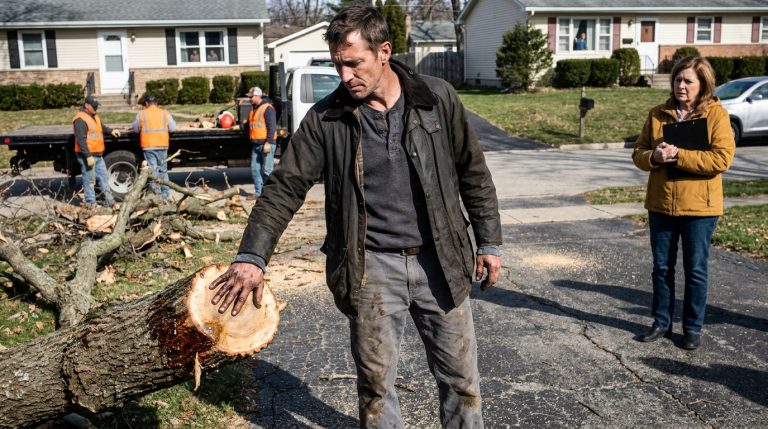
A woman in a linen blazer was already cutting across the lawn, her pace purposeful, rhythmic. She held a clipboard like a weapon of state, her reading glasses perched atop her hair like a crown of thorns. When she reached my window, she didn’t look like a neighbor. She looked like a landlord collecting on a debt I hadn’t signed for.
“This is permitted community parking,” she said, her voice a thin, rehearsed stream of cold honey. Her smile was tight, practiced, and utterly hollow. “You’ll need a valid pass, or you’ll have to leave.”
I didn’t reach for the ignition. I didn’t reach for my wallet. I looked past her shoulder at the asphalt. I could still smell the chemical tang of the tar, a sharp, invasive scent that burned the back of my throat. I had spent years in West Texas working with pressure gauges and steel, learning how to listen to the silent language of structural stress. This lot felt like a hairline fracture in the foundation of everything I owned.
“I own this property,” I said, my voice steady, stripped of the fatigue that had been clinging to my skin since the drive back.
She laughed. It was a short, sharp sound that didn’t reach her eyes. It was the laugh of a woman who had spent years convincing herself that rules were synonymous with reality.
“Mr. Whitfield, that was perhaps true a few years ago,” she replied, tapping her clipboard. “The neighborhood has evolved. We have bylaws, we have efficiency, and we have a very long waiting list for this space.”
I shifted my focus, tracing the edge of the asphalt where it met the uneven grass. I noticed a small, jagged piece of white concrete peeking out from beneath the black tar near the edge of the easement—a forgotten fragment of my grandfather’s handiwork, struggling to remain visible.
“The easement isn’t yours,” I said, ignoring her prattle about waiting lists. “And this asphalt is sitting on top of a county-regulated drainage line.”
Her expression flickered—a momentary sharpening of the jaw—before she smoothed it back into that artificial, polite mask. “I suggest you check your records, Mr. Whitfield. Or perhaps, move your truck before I call the property management team to have it towed.”
I stared at the sign, then back at her. The air was thick, heavy with the heat of the day and the weight of a silence that was rapidly turning into a countdown. I didn’t yell. I didn’t threaten. I just watched her, analyzing the way she clutched the clipboard, the way her eyes darted toward the empty space next to my truck, looking for another potential paying tenant. She was already mentally spending my land’s revenue.
I looked back down at the piece of broken concrete. The missing chunk was gone, likely crushed into the sub-base of the new lot. I realized then that she hadn’t just stolen the space; she had tried to erase the evidence of who laid it.
“You’re standing on my land, Beverly,” I said, my voice dropping an octave, the coldness in it enough to make her step back a fraction.
She turned to leave, tossing a final, chilling note over her shoulder, “The rules are the rules, even for those who forget to read them.”
As she walked away, I saw something that made my chest tighten—a small, blue parking permit sticker stuck crookedly to the back of the sign, partially peeled away, revealing a glimpse of an old, faded county marker beneath it.
CHAPTER 2: The Architecture of the Bluff
I didn’t move. My hand remained gripped on the door handle, the metal slick with heat, as Beverly Cratch’s linen blazer vanished into the distance. She walked with the sharp, rhythmic precision of a woman who had never once doubted her own internal map of the world. Watching her was like watching a predator that had mistaken the perimeter of the enclosure for the entire wilderness.
I swung the door open and stepped out onto the driveway. The asphalt was still soft in the Texas sun, yielding slightly under the weight of my boots. It felt wrong—a counterfeit layer smeared over the honest, stubborn foundation my grandfather had spent two summers agonizing over. I looked down at the spot where I’d seen the sliver of white concrete, but it was buried now, choked by the black, chemical sludge.
The memory hit me with the force of a physical blow. I could almost hear the rattle of the old, rented mixer, the rhythmic thump-thump-slosh of wet cement, and the sound of my grandfather’s voice—gravelly, tired, and deeply satisfied—explaining why a driveway needed to be poured in one continuous, uninterrupted motion. “If you stop, you create a joint,” he’d told me, tapping the wooden form. “And joints are where the ground finds a way to break you.”
Beverly hadn’t just poured a lot; she’d created a permanent, widening crack in the life I’d left behind.
I walked to the rear of the truck, my movements deliberate. The neighborhood was quiet, the kind of stillness that usually meant people were behind closed doors, watching through slats in their blinds. I could feel the invisible gaze of the Creston Ridge residents. They were the silent witnesses to this takeover, the ones who had been convinced that a parking lot was an “improvement.”
I reached for my phone, but stopped. Calling her wouldn’t work. She wasn’t just a neighbor; she was a gatekeeper, and gatekeepers didn’t respond to logic—they responded to leverage. My grandfather had always said you don’t fight a man by hitting him where he’s strong; you hit the support beam he thinks is invisible.
I needed to see the paperwork. Not the polished, certified letters she loved to send, but the raw, unwashed filings at the county office. The discrepancy in the vote count had been a hunch, but the way she had looked at me when I mentioned the drainage easement told me more than her words ever could. She was confident, but she was thin. She was operating on a borrowed timeline, hoping I would stay gone, hoping the debt of eighty-five dollars a month would eventually erode my resolve to fight.
I circled the perimeter of the lot, checking the lines. They were freshly painted, still bright, almost blinding in the afternoon light. I noticed a small drain grate near the center—the point of contention. If the county had never signed off on this, then the drainage infrastructure itself was being utilized commercially without a permit. That was a code violation. It was a potential liability for the entire association.
My phone buzzed—a notification from my property manager. “Beverly Cratch just sent out an email blast regarding the ‘unauthorized vehicle’ on Lot 402. Requests for towing are pending board approval.”
She was moving faster than I’d anticipated. She wasn’t just waiting for me to leave; she was trying to force the neighborhood to do the dirty work of removing me. It was a classic play: paint the victim as the aggressor to rally the collective.
I took a deep breath, the smell of the hot tar mingling with the dry, dusty scent of the Texas plains. I realized then that I wouldn’t be leaving the property. I pulled my laptop bag from the truck bed and walked toward the front door of my grandfather’s house. The key felt heavy in my pocket, cold against my thigh.
Inside, the house felt preserved in amber. The air was stale, smelling of old paper and the faint, lingering scent of my mother’s perfume. I walked through the living room, past the corner where the old recliner had sat, and went straight to the kitchen table. It was the command center. I cleared a space, set my laptop down, and opened it.
The screen flickered to life, the blue light washing over the dust motes dancing in the late afternoon sun. I wasn’t just an absentee owner anymore; I was a tenant in my own history. I began the search, not for a way to negotiate, but for the one document that would unravel the entire board’s legitimacy. I needed the original HOA charter, the one that predated Beverly’s “evolution” of the rules.
If the covenant amendment was procedural garbage, then everything she had built here—the parking, the fees, the authority—was built on a foundation of sand. And I had all night to watch the tide come in.
Gus Hullbrook’s truck pulled into the driveway next door. I saw his silhouette through the kitchen window, the familiar, hunched posture of a man who’d spent forty years reading blueprints. He stepped out, squinted at the new asphalt, and then looked directly at my front door. He didn’t smile. He just tipped his hat and kept walking toward his own porch, his movements slow and measured.
He was watching, too. And in a war of attrition, being watched by the right person was the first step toward victory.
CHAPTER 3: The Ghost in the Filing Cabinet
The cursor blinked with a relentless, mechanical rhythm—a heartbeat of digital indifference. Hours had bled into the night, the only sound the low hum of the laptop’s cooling fan and the occasional settling of the house’s timber frame. I was hunting ghosts, searching for the original Creston Ridge charter that had been digitized and buried years ago.
Beverly had done her homework, but she had assumed no one would ever bother to check the index of the index.
I leaned back, the wooden chair groaning under the weight of my exhaustion. My eyes burned, but the fatigue was different now—sharper, more focused. On the screen, a file path finally opened, revealing a scanned PDF from 1971. It was brittle, the paper yellowed in the digital rendering, showing the original legal structure for the development. I scrolled past the signatures of men long gone, looking for the specific clause regarding drainage easements.
There it was. Clause 4-B: “Easements designated for county drainage infrastructure are restricted from commercial access, modification, or encumbrance without explicit authorization from the Denton County Engineering Department.”
I felt a cold thrill, not of triumph, but of clarity. Beverly hadn’t just skirted the rules; she had ignored a foundational restriction that couldn’t be amended by a simple board vote. It was a structural impossibility, a legal nullity. She had built her kingdom on a foundation that the law clearly stated was not hers to touch.
But as I zoomed in on the document’s seal, a strange inconsistency caught my eye—a V-1 variance. The county officer’s signature on this document was dated two weeks after the original filing was meant to be closed. I opened a separate window to the county’s public record site, cross-referencing the timestamp. It was a minor anomaly, perhaps a clerk’s error, but in the world of high-stakes bureaucracy, tiny errors were rarely just errors. They were often indicators of a workaround.
I saved the file, my movements methodical, and began to map the timeline of the HOA’s “modernization.” If Beverly had pushed the amendment through with only thirty-seven percent of the homeowners, she needed a way to suppress the dissent of the silent majority. I started searching for the meeting minutes from 2019, the year she took the presidency.
The house felt larger, colder. I stood up, my knees popping, and walked to the window. Outside, the neighborhood was a landscape of dark shapes and quiet driveways. Gus’s house was dark, but the porch light was on, casting a long, jaundiced glow across the street. He was the sentinel, the one who had kept the watch for six years while I was away. I wondered if he knew about the 2019 meeting.
I retreated to the kitchen, poured a glass of lukewarm water, and stared at the dark reflection of my own face in the window glass. I wasn’t the same man who had left Texas six years ago. That man had trusted the system to work because he’d played by the rules. The man standing here understood that the system was just a set of tools, and tools could be held by anyone.
I walked back to the laptop and clicked on the file for the 2019 minutes. The language was sterile, bureaucratic, designed to be as boring as possible—a classic strategy to ensure nobody bothered to read it. I began to scour the attendance lists. There were names I recognized, names of families who had lived on Creston Ridge for decades, now marked as ‘absent’ or ‘represented by proxy.’
I noticed a pattern. The proxies weren’t individual authorizations; they were block assignments, signed over to a single, undated document. It was a clean, efficient, and entirely fraudulent way to secure a voting majority. She had created a phantom mandate.
A flash of light from the street pulled my attention away from the screen. A car was cruising slowly down Creston Ridge, its headlights extinguished. It rolled past my house, slowed to a crawl in front of the new asphalt lot, and then accelerated away toward the main road.
I didn’t turn on the porch light. I stood in the darkness, watching the tail-lights fade. The neighborhood wasn’t just a collection of houses; it was a contested zone. Beverly was watching her investment, and she was clearly nervous. She knew the concrete had been laid on a lie, and she was waiting for the first sign that someone had figured out how to dismantle it.
I sat back down, the silence of the room now filled with the weight of what I had found. I wasn’t just planning a legal maneuver; I was planning an excavation.
I looked at the clock on the wall—3:00 AM. I wasn’t tired anymore. I pulled up the contact information for Priscilla Daws, the attorney I had sourced in Fort Worth. I didn’t send an email; I typed out a concise, technical breakdown of what I had uncovered: the drainage easement violation, the defective voting process, and the fraudulent proxy assignments.
I hit send. Then, I closed the laptop. The house was finally quiet, but it was the kind of quiet that precedes a storm. I walked to the front door, unlocked it, and stepped onto the porch. The air was crisp, the heat of the day stripped away, leaving behind a sharp, clean chill.
I looked down at the driveway—at the dark, smooth surface of the asphalt that still held the heat of the sun. It looked like an inkstain on a map. I knew exactly where to cut, where the tension was held, and how to snap the board’s control with a single, precise application of the truth. Tomorrow, I would start the real work. And for the first time in six years, I felt entirely at home.
CHAPTER 4: The Map and the Territory
The Fort Worth skyline was a jagged silhouette against the morning sky, but inside Priscilla Daws’ office, the world was reduced to a mahogany desk, a glass of water, and the sprawling stack of documents I’d brought with me. Priscilla didn’t look like a savior; she looked like an auditor. She sat with her reading glasses slid down the bridge of her nose, her eyes scanning the county records I had pulled the night before with a speed that made me feel like an amateur.
She didn’t speak for the first five minutes. The only sound was the rhythmic shuck-shuck of pages being turned and the distant, muted hum of traffic fifteen stories below. I watched her, my hands resting on my knees, waiting for her to find the flaw in my logic.
Finally, she leaned back, the leather chair protesting with a slow, long creak. She took off her glasses and set them on top of the stack.
“You’re right about the easement,” she said, her voice devoid of any dramatic flair. It was purely clinical. “The county didn’t authorize it, and the HOA board definitely didn’t have the legal standing to override the foundational charter. But you’re wrong about the order of operations.”
I felt my stomach tighten. “How so?”
“You’re trying to win an argument, Mr. Whitfield,” she said, leaning forward until her face was framed by the window’s harsh, morning light. “You’re trying to prove they broke the rules. But the HOA doesn’t care about being right. They care about being established. If you walk in there with a pile of county letters, they’ll just stall. They’ll initiate internal review, drag it out for years, and while they do, they’ll charge you for the legal defense fees they incur to fight you. You see the trap?”
I nodded slowly. It was the same logic I’d used in the oil fields—a process designed to exhaust the resources of anyone who dared to question the status quo.
“So, what’s the move?”
“The move is to stop fighting the HOA and start questioning the management company,” she said. She opened a thin, manila folder that had been sitting on her desk, untouched until now. She slid a single sheet of paper toward me. It was a business registration filing. “Beverly’s cousin, the one managing the parking lot? He didn’t register this company in Denton County. He registered it in a shell office in Austin. And there’s a recurring deposit into that company’s account that originates from the HOA’s central fund. It’s marked as ‘administrative overhead.'”
I looked at the numbers. They were small, almost negligible, but they were consistent—a monthly siphon that had been running since the week the asphalt was poured.
“They’re using the parking fees to subsidize the management company’s operating costs,” I realized, the implication sinking in. “And the management company is charging the HOA a premium for services that don’t exist.”
“It’s a textbook circular scheme,” Priscilla said. “It’s not just a breach of bylaws; it’s a breach of fiduciary duty. If we go to the board with this, we’re not just complaining about a driveway. We’re accusing the treasurer—who happens to be the president’s husband—of direct embezzlement. We don’t go to the board with letters, Mr. Whitfield. We go to them with a forensic accounting report and a notice of intent to sue for criminal liability.”
I looked at the document again. The sense of vindication was secondary to the chilling realization of how far they had gone. They hadn’t just stolen my driveway; they had treated the entire neighborhood as a personal piggy bank.
“Will this stop the lot?” I asked.
“It will make the lot a liability that nobody on that board will want to own,” she replied. “Once the rest of the board realizes they are personally liable for the financial mess Gerald Cratch has been making, they’ll turn on him faster than you can blink. You don’t need to tear up the asphalt yourself. You just need to make the board realize that every day that asphalt stays there, it’s a direct threat to their personal savings.”
She stood up, signaling the end of the meeting. The air in the office felt thinner, charged with the sudden transition from contemplation to action.
“I need you to stay quiet,” she added, her tone hardening. “Don’t mention the embezzlement to your neighbor, don’t mention it to the property manager, and for heaven’s sake, don’t say a word to Beverly. If they catch wind that we’re looking at the books, they’ll scrub the records before we can get a court order. Can you hold that water?”
“I’ve spent six years waiting to get this right, Priscilla,” I said, standing up. “I can wait a few more days.”
As I walked out of the office and into the sterile, white-tiled lobby, the reality of the situation felt heavy, almost suffocating. The sunlight hitting the glass doors outside seemed brighter, more intense. I stepped out onto the street, the noise of the city washing over me. I wasn’t just a homeowner anymore; I was a plaintiff in a war of attrition, and for the first time, I held the high ground.
I reached my truck, but I didn’t get in immediately. I stared at my own reflection in the side mirror, noticing the hard set of my jaw, the way my eyes seemed to have settled into a permanent, analytical squint. The driveway was still there, sitting under the Texas sun, but it was already dead in my mind. It was just a black, temporary scar waiting to be excised.
I drove back toward Creston Ridge, the miles stretching out before me, a familiar, dusty path. The closer I got to the neighborhood, the more the silence of the countryside began to weigh on me. I knew what I had to do. I had to go back into that lion’s den, sit through the next meeting, and smile at the very people who were actively gutting the foundations of my life, all while keeping the secret that would eventually burn their world to the ground.
It was going to be a long week.
CHAPTER 5: The Ledger of Lies
The drive back to Creston Ridge felt less like a commute and more like an infiltration. Every set of headlights that swept across my rearview mirror seemed to linger a second too long; every darkened window in the suburban sprawl felt like a camera lens. Priscilla’s warning echoed in the silence of the truck: They’ll scrub the records if they know we’re looking.
I pulled into the driveway, the tires crunching against the gravel that still bordered the smooth, oppressive blacktop of the parking lot. It was dusk. The neighborhood was in its twilight phase—the time when sprinklers hissed and residents emerged to check their mail. I kept my head down, exiting the truck and walking directly to my front door. I didn’t acknowledge the neighbors. I didn’t look at the lot.
Inside, the house felt like a bunker. I bypassed the kitchen table, which now felt too exposed, and moved to the back office, where the shadows were deeper. I sat on the floor, surrounded by the remnants of the research I’d been conducting: printouts of financial filings, maps of the drainage easements, and the messy, handwritten notes Gus had brought over in his spiral notebook.
My phone vibrated. A text from Gus: “Beverly’s husband, Gerald, was seen at the management office late. He was carrying a stack of blue folders. Didn’t look like he was heading home.”
The realization hit me with a physical jolt. They were already moving to sanitize the trail.
I checked the time. If they were at the office now, they were likely purging the digital logs or destroying the physical paper trail before a subpoena could be served. The plan Priscilla had laid out—the clean, surgical legal strike—was predicated on us having the evidence. If that evidence vanished, we were just two people making accusations against a popular neighborhood president.
I stood up, my pulse drumming in my ears. I couldn’t wait for a court order. I couldn’t wait for Priscilla’s formal filing. I had to see what they were hiding.
I left the house, not through the front, but through the back utility door. I moved along the fence line, my boots silent on the damp earth. The neighborhood was a maze of cedar fences and manicured hedges, but I knew these back alleys better than any of the newer residents. I moved toward the edge of the development, where the office complex shared a perimeter with the subdivision.
The air was heavy, smelling of cut grass and ozone. As I approached the back of the management building, I saw a single, harsh light glowing from a ground-floor office window. A shadow moved across the blinds—Gerald Cratch. He was standing over a shredder, the rhythmic whirr of the machine sounding like a mechanical insect in the quiet night.
I pressed my back against the brick exterior of the building, my breath shallow. My heart felt like a bird trapped in a cage. This was the moment where the rules shifted. I wasn’t just observing anymore; I was actively hunting.
I circled the building, looking for an entry point. The rear utility door was locked, but the HVAC unit nearby was old, its casing rusted and loose. I pulled at the frame, the metal giving way with a sharp, protesting groan. I slipped through the narrow gap into the service corridor.
The interior of the building was sterile, smelling of industrial cleaner and cold coffee. I reached the office corridor, the carpet dampening my footsteps. Every creak of the floorboards sounded like a gunshot in the silence. I stopped in front of the door labeled “Records & Administration.”
The light was still on.
I didn’t knock. I pushed the door open, just a crack, and peered inside. Gerald was there, hunched over a filing cabinet, his tie loosened, his face illuminated by the harsh overhead fluorescent light. He looked tired—not the tired of a man working a job, but the tired of a man holding up a collapsing ceiling.
He had a stack of blue folders on the desk—the exact ones Gus had mentioned. He was methodically pulling papers out, glancing at them, and tossing them into the bin.
I felt a surge of adrenaline, cold and sharp. I had to reach that desk before the last of the evidence was fed into the machine. I considered rushing in, but the risk was too high; if he saw me, he would have time to call Beverly, to warn her, to call the police. I had to be smarter.
I looked down at the wall beside the door. A main power breaker panel.
I reached out, my fingers trembling slightly as I grasped the metal latch. I looked at Gerald one last time. He reached for another folder, unaware of the shadow standing just inches from his reality. I yanked the handle down.
The building plunged into total, suffocating darkness.
The shredder’s hum stopped instantly, replaced by a sudden, frantic cry of frustration from inside the room. I didn’t wait. I stepped into the room, the darkness my only cover, and moved toward the desk. I wasn’t there to fight. I was there to salvage the truth before they wiped it off the face of the earth. My hands found the cold edge of the metal desk, the folders sitting there like a pile of unexploded ordnance. I grabbed them, feeling the weight, the textured paper—the evidence.
I turned and ran back toward the service corridor, the sound of Gerald’s footsteps behind me, frantic and stumbling in the dark. I didn’t look back. I sprinted into the night, the blue folders clutched to my chest, the cold air hitting my face like a reprieve. I was out of the building, across the fence, and back into the shadows of my own backyard before I even dared to stop.
I sat on the back porch, panting, the cold night air burning in my lungs. I opened one of the folders, the dim light from the house spilling out across the page. It wasn’t just embezzlement logs. It was a series of signed agreements between the management company and the HOA board, all dated months before the driveway project was even voted on.
They hadn’t just been stealing money; they had been orchestrating the entire thing from the start.
I looked up at the stars, the sky over Denton County vast and uncaring. I had the smoking gun. But as I sat there, the weight of the folders in my lap, I realized the stakes had changed. I wasn’t just a homeowner fighting for a piece of concrete. I was now a target. They knew someone had been in the office. They knew the evidence was gone.
The neighborhood felt different now. It didn’t feel like home; it felt like a trap waiting to be sprung.
CHAPTER 6: The Weight of the Evidence
I pressed my back against the rough siding of the house, my lungs burning. The blue folders were damp with sweat from my palms. Every rustle of the leaves in the night breeze sounded like a footfall, and the distant, rhythmic chirping of crickets felt like an accusation. I was a thief in my own life, and the walls I had built around my legacy were starting to buckle.
Then, the gate at the side of the yard clicked.
I froze, my hand instinctively closing over the folders. The figure moving through the moonlight was too slow, too deliberate to be Gerald Cratch. I peered around the edge of the porch, my muscles coiled. It was Francis Aldridge, the board member who had stood her ground years ago. She walked with a flashlight in one hand, its beam sweeping the grass at her feet. She wasn’t looking for me—she was walking toward the back door with an air of profound, exhausted defeat.
I stood up, the movement clumsy in my desperation. “Francis?”
She gasped, the flashlight beam jerking wildly before settling on my face. Her eyes were wide, the dark circles beneath them testifying to a long, sleepless night. When she saw the folders in my lap, her expression didn’t shift into surprise; it shifted into a grim, knowing recognition.
“You took them,” she whispered, her voice a hollow rasp.
“I found them,” I corrected, stepping out into the pale moonlight. “They were burning the paper trail, Francis. They aren’t just managing the neighborhood—they’re bleeding it dry.”
She didn’t argue. She didn’t defend them. She simply walked onto the porch and sat down on the edge of the steps, the flashlight rolling into the dirt. “I knew it was off. Every time I asked for a breakdown of the maintenance fees, Beverly would smile and talk about ‘community cohesion.’ She has a way of making you feel like a villain for asking about a dollar.”
“It’s not just a dollar,” I said, opening the folder to the contract with the management company. I showed her the signature—Gerald’s, dated weeks before the asphalt was poured. “It’s a deliberate, systematic fraud. They didn’t just reclassify the driveway; they used the HOA as a vehicle to fund their own pockets.”
She looked at the document, her finger tracing the ink. The anger I expected to see—the righteous, indignant fury—wasn’t there. Instead, there was a quiet, crushing sadness. “I helped her,” she murmured. “Not with this. But I supported her vote on the landscaping, the mailbox updates… I thought she was making things better.”
“We were all fooled,” I said, sitting beside her. The cold, sharp edges of the folders pressed against my legs. “But we have to use this. Priscilla is filing the action, but if the board doesn’t turn against them, Beverly will claim we’re just disgruntled outliers. We need the board, Francis. We need someone who can testify to the internal culture, someone who can verify that the minutes were falsified.”
She looked up at me, her eyes reflecting the moonlight. “If I come forward, they’ll destroy me. They know my finances, they know my history in this neighborhood—they’ll paint me as part of the mess.”
“They’re already doing that, Francis. They’re doing it to all of us.”
A light flickered on across the street—Gus’s porch light. A second later, his front door opened. He stood on his threshold, looking out into the night, his silhouette stark against the interior light. He wasn’t signaling; he was checking. He had seen the movement in my yard.
“They’re watching,” I whispered, the paranoia clawing at my throat. “Gerald knows someone was in the office. If he links this to me, if he realizes what I have, he won’t stop at board meetings. He’ll go to the police and tell them I broke in.”
Francis grabbed my arm, her grip surprisingly strong. “Then you don’t go to the board with this. You go to the county oversight committee. They hold the authority over the HOA’s legal standing. If you can show them that the bylaws were ignored and the management contract was a conflict of interest, they have the power to freeze the association’s accounts. It bypasses Beverly entirely.”
I stared at her, the strategy crystallizing. She was right. The HOA board was a closed loop, but the county was an external lever. If we could freeze the money, we could freeze Beverly.
“I need you to testify,” I said. “Not just for the committee—for the record.”
She stood up, her posture straightening, the exhaustion momentarily forgotten. “I’ll do more than testify. I still have the original notes from the 2019 meeting. I kept them because I didn’t trust her record-keeping. I kept them because I knew, deep down, that the story she was telling wasn’t the one we lived.”
The air between us felt charged, the oppressive stillness broken by the resolve in her voice. I handed her the folder—the most incriminating evidence of the embezzlement. “Keep this safe. I have the rest of the documentation. We meet at Priscilla’s office at 8:00 AM. Don’t tell anyone, not even your husband.”
She nodded, took the folder, and moved back toward the gate. Her departure was as quiet as her arrival.
I stood on the porch, the night air no longer feeling like a trap, but like a perimeter I was finally beginning to control. Gus watched from his porch for another moment before turning back inside and killing the light. I walked back into the kitchen, the laptop waiting on the table. The war wasn’t over, but for the first time, the battlefield was tilted in our favor. I wasn’t just defending my grandfather’s driveway; I was cleaning out the rot that had threatened to infect the entire ridge.
I sat down and started drafting the email to Priscilla, outlining the shift in strategy. Every keystroke felt like a nail in the coffin of Beverly’s reign. The morning was coming, and with it, the beginning of the end.
CHAPTER 7: The Breaking Point
The sun hadn’t yet crested the horizon, but the neighborhood was already waking up to the low, guttural growl of idling diesel engines. I stood on the porch of my grandfather’s house, watching as a flatbed trailer maneuvered into position at the edge of the drainage easement. Wyatt, the demolition contractor I’d hired out of Lewisville, climbed out of his truck. He looked like a man who spent his life dismantling mistakes. He didn’t look at the HOA sign; he looked at the ground, measuring the bite he was about to take out of the landscape.
My jacket pocket felt heavy with the copied logs I’d retrieved from the management office. My pulse was a steady, rhythmic thrum against my ribs—the kind of calm that only comes when the path forward is finally clear of uncertainty.
The neighborhood was stirring. Blinds clicked open. A few residents stepped onto their porches, their faces tight with a mix of curiosity and residual indignation. Beverly Cratch wasn’t visible yet, but I knew she was watching. She always was.
Wyatt gestured to his crew, and the heavy thud of hydraulic supports hitting the pavement echoed down the street. That was when a patrol car rolled slowly around the corner, its lights dim, its presence an unspoken threat. Deputy Forsythe stepped out, his hand resting casually on his duty belt. He scanned the street, his eyes locking onto the excavator, then onto me.
He walked over, his boots crunching loudly on the gravel. “Mr. Whitfield, I’m getting calls about an unauthorized demolition on community property. You care to explain what’s happening here?”
I didn’t flinch. I reached into my pocket and pulled out the file folder. It wasn’t the full proof of embezzlement yet—that was still with Priscilla for the filing—but it contained the county drainage easement mandate and the court-stamped notice of my ownership. I handed it to him, my movements precise and controlled.
“This is not community property, Deputy,” I said, my voice steady, carrying over the rumble of the engine. “This is an illegal encroachment on a county drainage easement, built without a permit and against the express written denial of the county engineering office.”
Forsythe took the folder, his expression skeptical. He began to read, his eyes moving slowly across the pages. The silence around us grew heavy, punctuated only by the idle of the excavator. Beverly appeared at the end of the block then, her linen blazer stark against the morning gray. She was holding her phone up, the screen lit as she filmed, her face a mask of practiced, fragile outrage.
She stormed up to the Deputy, her voice sharp enough to cut through the diesel drone. “Deputy, this is a violation of the HOA covenants! This lot is community access. He has no right to destroy it.”
Forsythe didn’t look up from the papers. He kept reading, his brow furrowed. “Ma’am, these records indicate the county never granted the HOA access to this drainage easement. If that’s true, you don’t have a valid claim here.”
“The board approved it!” she snapped, her confidence beginning to fray at the edges. “It’s a neighborhood improvement. He’s an absentee owner who doesn’t understand the collective good.”
“The collective good doesn’t overwrite county infrastructure law,” I said, my voice cold, devoid of the emotion she was trying to bait out of me. I looked at the Deputy. “The engineering report is in there. Page three. Check the seal.”
Forsythe flipped to the page, his thumb brushing the embossed county stamp. He looked at Beverly, his gaze cooling. “Ms. Cratch, if this property is indeed under county easement and you haven’t received a permit for commercial use, then this lot is a liability. It’s a code violation.”
Beverly’s face drained of color. She looked at the excavator, then at the neighbors who had begun to gather, their faces no longer filled with the blind support she had cultivated. Francis Aldridge stood at the edge of the crowd, her arms crossed, watching Beverly with a look of quiet, devastating clarity.
“Stop it,” Beverly ordered, her voice trembling. “Stop the work immediately.”
I didn’t look at her. I turned to Wyatt. “Start.”
The machine roared to life, a deep, earth-shaking vibration that seemed to rattle the very bones of the house. The massive steel bucket dipped, the teeth of the excavator finding the edge of the asphalt. With a sharp, metallic screech, the blade bit deep, tearing the blacktop from the earth. The sound was a symphony of destruction—a grinding, ripping, beautiful noise.
The smell of hot tar and long-buried, damp earth filled the air.
As the first slab of asphalt was lifted away, revealing the cracked, dusty concrete my grandfather had poured, I felt a sudden, profound sense of release. It wasn’t just about the driveway. It was about the erasure of a lie. The earth beneath was still there—hard, honest, and waiting.
Beverly stood frozen, her phone hanging limply at her side, the recording still running, capturing the sound of her kingdom coming apart, one scoop at a time. The neighbors weren’t shouting anymore; they were watching, some of them with their hands in their pockets, some looking at the ground, but all of them witnessing the physical manifestation of the truth.
I stood beside the Deputy as the work continued. The excavator worked with surgical precision, peeling back the layers of the bluff. Every piece of asphalt removed was a step toward the core, toward the final confrontation that would occur in the HOA hall that night. The structure was breaking, and there was nothing left to hold it together.
CHAPTER 8: The Final Ledger
The HOA meeting room was packed, the air thick with the smell of stale coffee and nervous energy. It was a stark contrast to the chaotic morning at the driveway, but the tension was, if anything, more concentrated. Beverly Cratch stood at the podium, her blazer immaculate, her face a carefully constructed facade of professional indignation. She was mid-sentence, trying to pivot the conversation toward “unauthorized neighborhood vandalism” when Priscilla Daws stood up from the back row.
Priscilla didn’t shout. She didn’t need to. Her presence alone had a way of flattening the room. Beside her, Francis Aldridge stood, clutching the folder containing the 2019 meeting notes—the physical proof of the phantom mandate.
“Ms. Cratch,” Priscilla said, her voice cutting through the hum of the room. “Before you continue your report, perhaps you should address the forensic audit currently sitting on the county prosecutor’s desk.”
The room went deathly silent. Beverly’s hand, which had been resting on the edge of the podium, froze. She looked at Gerald, who was sitting in the front row. He looked like he’d aged a decade in the span of an hour. His eyes were downcast, his shoulders hunched, the posture of a man who had already folded.
“I don’t know what you’re referring to,” Beverly said, but her voice lacked its usual sharp, cutting edge. It sounded thin.
Priscilla walked to the front of the room, laying the folder of financial discrepancies on the table. “I’m referring to the consistent, unexplained diversion of HOA funds into a private shell account registered to your management company. I’m referring to the falsified proxy votes that were never signed by the residents. And I’m referring to the fact that you’ve been running this neighborhood as a private extraction business.”
The revelation didn’t come as a roar, but as a series of low, murmuring realizations from the crowd. People began looking at one another—at Roslin, who had caught the proxy error; at Terrence, who had seen the driveway destroyed; at their neighbors who had been paying eighty-five dollars a month into a vacuum.
Gerald stood up, his voice cracking. “Beverly, stop. It’s over.”
Beverly turned to him, the facade finally fracturing. The “Architect of Order” was gone, replaced by a woman staring at the abyss of her own making. She looked around the room, expecting to find the loyalists, the defenders of her vision, but she found only the cold, hard reality of neighbors who had been lied to, robbed, and manipulated.
Three board members, their faces pale with shock, moved away from the podium, distancing themselves from the Cratch family. The reporter in the corner of the room was recording, not for a community puff-piece, but for the story of a neighborhood that had successfully purged its rot. Beverly tried to speak, her mouth working, but no words came. She looked diminished, the linen blazer suddenly appearing like a costume she no longer had the authority to wear.
She walked out without another word, Gerald following her, the silence in the room as they exited serving as their final verdict.
The resolution wasn’t dramatic in the sense of a grand explosion; it was the quiet, terrifying finality of a system correcting itself. By the next morning, the board had resigned, and the court had officially placed the HOA into receivership. The parking fees were ordered into escrow, to be returned to the residents they had been stolen from. The fake permit sign, once a symbol of the neighborhood’s subjugation, was now sitting in Gus’s garage, a rusted souvenir of a failed coup.
November brought a cold, sharp morning—the kind that freezes the dew on the grass and turns breath into white smoke. A concrete truck idled at the edge of the property, its chute extended toward the freshly leveled earth. This time, there was no hostility. No deputies. Just the low, rhythmic hum of the mixer and the neighbors who had gathered to watch the ground reclaim its history.
Terrence was there, leaning on his cane, a thermos in his hand. Gus was at my side, his eyes scanning the perimeter with the habit of a sentinel, but he was smiling. Francis stood nearby, her shoulders finally relaxed, a sense of peace settling over her features.
“You’re doing it right this time,” Terrence said, nodding at the work crew.
“One continuous pour,” I replied, my voice steady. “No joints.”
The slurry hit the earth—a thick, gray liquid that flowed into the wooden forms, leveling out, smoothing over the scars left by the asphalt. As the crew raked the surface, I walked to the edge of the slab. I reached into my pocket and pulled out a small, metal stamp. My grandfather’s mark.
I knelt, the concrete cold and damp beneath my hand, and pressed the date into the soft, wet surface. November 2026.
After the crew finished, I moved to the south side of the slab, where I’d cleared the ground for the raised beds. I began to plant, the soil dark and rich under my fingernails—the scent of fresh earth and the promise of life that the previous regime had tried to pave over. I didn’t rush. The work was labor, but it was earned labor.
The house behind me stood silent and solid, no longer an object of encroachment, but a home once again. I looked out over the driveway—at the level, gray expanse that stretched toward the road. It wasn’t perfect, and it wasn’t a landmark; it was just a driveway. But it was ours.
As the sun rose higher, warming the air, I felt the final weight lift. The mystery hadn’t been about who could control the neighborhood, but about who possessed the endurance to protect what mattered. I stood up, wiping the dirt from my hands, and walked to the porch. I took a deep breath, the air clean, crisp, and honest. The fight was over. The land was still here, the history was preserved, and for the first time in a long time, the future felt like something I could build, slowly and stubbornly, one day at a time.