Shadows of the Fallen Oaks: The Silent War for Patriot Way
CHAPTER 1: THE CUT LINE
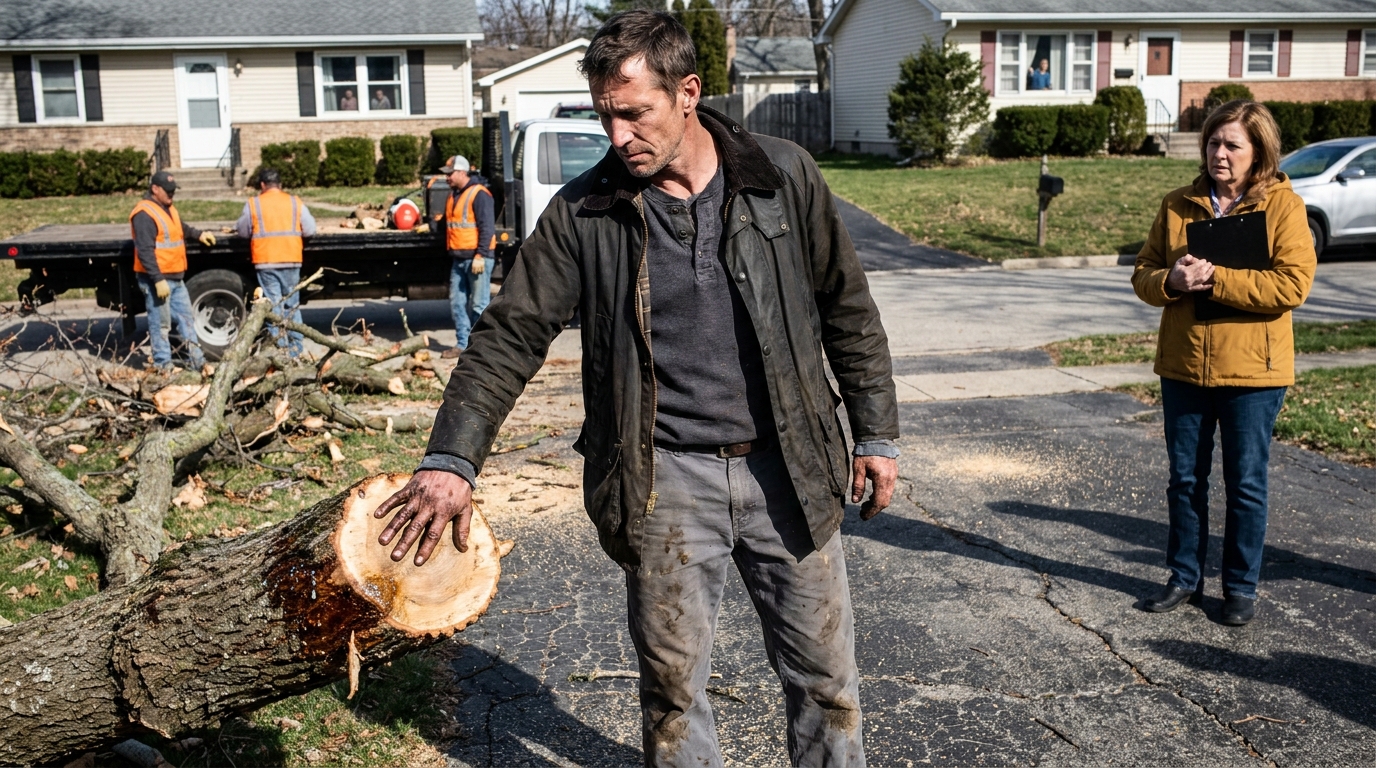
The cut was angled at forty-five degrees, clean through heartwood that had taken ninety-eight years to grow.
Marcus Thorne didn’t step on the grass. He stayed on the cracked asphalt of the driveway, his boots motionless, his eyes measuring the perimeter of the lawn. The air smelled of gasoline, damp earth, and torn green leaves—the heavy, sweet stench of dying oak.
In the center of the yard, three two-ton limbs lay mangled across the lawn, their bark shredded in long, ragged strips. The wood chipper at the curb roared, its diesel engine straining as it pulverized a hundred years of shade into fine, yellow dust.
“Section fourteen, subsection C, paragraph two, Mr. Thorne.”
Karen Peters stepped into his peripheral vision. She held a black plastic clipboard against her stomach like a ballistic shield. Her polyester jacket was the color of dried mustard, unwrinkled despite the humidity.
“I had them brought into compliance,” she said.
Marcus didn’t turn his head. He looked past her, tracing the line of the remaining canopy. The tops of his oaks had been leveled horizontally, flush with the second-story gutters of his house. It wasn’t a trim. It was a decapitation. The branches were jagged, split by dull chains, open to rot and infestation.
“You hired commercial cutters,” Marcus said. His voice was low, flat, carrying no more emotion than a weather report.
“The board approved the remediation at last month’s meeting,” Karen replied. She tapped the clipboard with a manicured nail—a rhythmic, plastic click. “Mr. Henderson in 2B filed a formal complaint about his satellite dish. Mrs. Gable in 4A mentioned her petunias were starved for sunlight. The bylaws give the executive committee full authority to mitigate nuisance flora.”
“These trees were planted in 1918,” Marcus said. His right thumb slid into his pocket, his knuckles brushing the cold, tarnished brass of his great-grandfather’s trench lighter. He didn’t pull it out. He just felt the hard edge of the flint wheel against his skin. “My grandfather sat under that sugar maple before this county had paved roads.”
“History doesn’t override community standards, Mr. Thorne.” Karen took a half-step forward, settling her weight into her heels. She adjusted her reading glasses, letting them hang from a beaded chain around her neck. “The cost of the clearing crew comes to eleven hundred dollars. It will appear on your next monthly assessment. You have thirty days to settle the balance.”
Behind her, one of the men in orange vests hoisted a thick section of maple trunk, dumping it into the bed of the flatbed truck with a dull, metallic thud.
Marcus finally turned his eyes toward her. He didn’t look at her face; he looked at the brass ID tag pinned to her lapel, then at the small blue ink stain on her collar.
“You set foot on deeded dirt without a written notice,” Marcus said softly.
“This is an HOA buffer zone,” she countered instantly. She didn’t flinch, but her grip on the clipboard tightened, the plastic flexing under her fingers. “Read your covenants. You signed them when you bought the deed.”
“I read them,” Marcus said. “I know what’s in them.”
He stepped off the asphalt onto the lawn. His boot sank two inches into the soft, wood-chip-littered soil. He reached out, his bare palm pressing against the raw, white sap bleeding from the stump of the lowest oak limb. The sap was cold and sticky.
“You should have checked the survey lines, Karen.”
“Is that a threat, Mr. Thorne?”
“It’s a measurement,” Marcus said.
He turned his back on her, walking slowly toward his front porch as the wood chipper gave one final, screaming whine and fell silent.
CHAPTER 2: THE PRICE OF LIVING HISTORY
The sticky sap dried into a stiff, dark glaze across the skin of my right hand.
I stayed on the top porch step, my thumb working the flint wheel of the brass lighter in my pocket. Snap. Snap. The small flame sparked, caught, and died as I let the lid drop shut. At the end of Patriot Way, the yellow tail-lights of the compliance crew’s flatbed vanished around the bend, leaving behind the heavy reek of unburnt diesel and shredded leaves.
Before the silence could settle, another engine turned the corner.
It was an old Ford F-350, painted primer-gray, its bed customized with a steel rack holding soil augers, increment borers, and a heavy-duty scope. The side panel bore a faded stenciled logo: Carter Forestry Diagnostics & Valuation.
Ben Carter didn’t pull into the driveway. He parked at the curb, right where the wood chipper had chewed up ninety-eight years of shade.
He climbed out slowly, six-foot-three of lean muscle, worn canvas work pants, and leather boots stained with pine pitch. He wore a faded olive Army fatigue cap pulled low over his eyes. He didn’t say hello. He didn’t ask how I was doing. He walked straight to the stump of the primary sugar maple, dropped to one knee, and ran two calloused fingers over the severed rim.
I stepped off the porch and walked down to the tree line. “You’re late, Ben.”
“Traffic on Forty-Five,” Ben muttered. His voice sounded like gravel being turned in a bucket. He leaned down until his nose was three inches from the raw wood, inhaling deeply. “Dull chain. Fast teeth. They didn’t just top this maple, Marcus. They dragged the bar to tear the cambium layer. Look at these ragged frays on the bark.”
He reached into his vest pocket, pulled out a brass magnifying loupe, and pressed it against the exposed ring structure.
“It’s a hack job,” I said.
“No,” Ben said, his voice dropping an octave. “A hack job is careless. This is functional sabotage. You tear the bark down past the collar like this, the tree can’t seal the wound. The sap drains, fungi set in within forty-eight hours, and the heartwood rots from the top down. Whoever ran that saw knew exactly how to make sure these trees die within eighteen months without looking like they poisoned them.”
He stood up, wiping his thumbs on his thigh. He walked the perimeter of the five stumps, his eyes tracking the canopy lines, taking photographs with a heavy Nikon DSLR strapped to his neck. From a side compartment on his truck, he pulled a long, T-handled steel rod—an increment borer—and pushed it into the trunk of the oldest red oak, twisting it smoothly into the core.
“They claimed it was for a satellite dish,” I said, watching him extract a thin, straw-like core of timber from the tree’s gut. “And a flowerbed.”
Ben scoffed, holding the wooden core up to the morning sun. He counted the tight, dark growth rings under his breath. “Eighty… ninety… ninety-four… ninety-seven. Ninety-seven years of continuous growth. This core is solid heartwood. Healthy as iron until two hours ago.”
He carefully slipped the sample into a clear plastic tube and labeled it with a black marker.
“How bad is the financial hit?” I asked.
Ben walked back to the tailgate of his truck, flipping open a worn leather notebook covered in handwritten charts and mathematical formulas.
“In standard landscaping terms? A nursery sapling costs two hundred bucks,” Ben said, pulling out a solar-powered calculator. “But these aren’t nursery saplings. In legal appraisal, we use the Trunk Formula Method from the Council of Tree and Landscape Appraisers. We calculate the basic square-inch area of the trunk’s cross-section, modify it by species value, location contribution, and pre-damage condition.”
His pencil scratched against the yellow legal pad. The numbers came fast, calculated with the cold precision of an engineer setting demolition charges.
“Red Oak. Five-foot diameter at breast height. Historical provenance on municipal tax maps… location rating maximum because of property boundary shelter…” Ben stopped writing. He tapped the pencil tip against the page, staring at the total.
“Give me the number, Ben.”
“For the three oaks and the two maples? Conservative replacement value, including soil remediation, loss of micro-climate shade, and environmental impact? One point two million.”
The number sat on the hood of the truck between us. The air carried the faint scent of crushed clover from where the heavy tires had rutted the turf.
“One point two,” I repeated.
“And that’s just base appraisal,” Ben added, looking up, his eyes dark under the brim of his cap. “If this goes to court, timber trespass laws in this state carry statutory penalties. If a judge finds they did this deliberately—which they did, given the bark tearing—you’re looking at treble damages. Three times the base.”
“Three point six,” I said.
Ben reached into his pocket, pulled out a small aluminum tag stamped with an identification number, and nailed it into the base of the damaged oak with a single strike of a small mallet.
“I need access to the county land records, Marcus,” Ben said softly, dusting off his hands. “When I was pulling the historical canopy overlays from the 1980 survey, I noticed something strange about your property line on the municipal grid. Your boundary isn’t listed under standard residential subdivision codes. It’s flagged under an old index: Parcel 4-B.”
I frowned. “This lot has been in my family since 1918.”
“I know,” Ben said, stepping toward his cab door. “And that’s why the HOA’s GIS map doesn’t match the county register. Someone’s hiding a boundary shift. I’ll have the formal, notarized report on your desk by six p.m. Don’t touch the limbs on the ground, and don’t let anyone with a broom near this sawdust.”
He pulled out of the driveway, the primer-gray truck rattling down the road, leaving me standing beside the numbered tag gleaming against the raw, bleeding oak.
CHAPTER 3: THE COVENANTS AND THE TRAP
The small aluminum tag Ben nailed into the oak trunk glinted in the late afternoon sun like a fresh shell casing in the grass.
I turned from the lawn and walked up the three porch steps, leaving the sawdust and the bleeding timber behind. Inside, the house was dead silent, smelling faintly of old pine floorboards and the stale roast coffee from six a.m.
I didn’t turn on the kitchen light. I walked straight to the dining room table and dumped the heavy blue binder—the Oak Haven Estates Covenants, Conditions, and Restrictions—onto the oak veneer. The plastic cover slammed against the wood with a sharp crack that echoed down the hallway.
My palm left a faint, tacky smudge of oak sap on the corner of the binder as I flipped it open.
For four hours, the sun moved across the window frame until the room faded into cool gray shadows. I sat with a yellow legal pad, a red felt-tip highlighter, and a cup of lukewarm black coffee that had formed a thin skin across the surface. My thumb slid over the lighter in my pocket, the cold brass casing a steady anchor while my eyes dragged through two hundred pages of fine-print legalese.
Section 14, Subsection C, Paragraph 2—the line Karen had thrown like a grenade on my lawn.
I drew a tight red box around the wording: No homeowner shall permit flora, trees, or structural additions to unreasonably obstruct engineered sightlines for telecommunications or utility access.
Unreasonably. A subjective word. A blank check for anyone holding the clipboard.
I kept turning pages, my nail catching on the paper edges. Section 18. Section 22. Then I hit Article 12, Section 4, tucked into a three-page codicil labeled The Charter Amendment, filed back in 2005.
My thumb stopped flicking the lighter.
Article 12, Section 4: Alterations to Private Deeded Property.
The clause was clear: Any physical alteration, trimming, or removal of timber executed on deeded private property by the Association or its designated agents requires an executed Architectural Review Form signed by the record title holder no less than fourteen business days prior to work initiation, accompanied by a hold-harmless indemnity agreement.
I stared at the black ink.
No Architectural Review Form existed. I had signed no hold-harmless agreement. I hadn’t even been in the state when the board voted. Karen hadn’t just overstepped her authority; she had bypassed her own governing document to execute a commercial strike on my yard.
My phone on the table buzzed once, sliding an inch across the wood.
The screen lit up with an unfamiliar number from the downtown area code. I picked it up on the second ring.
“Thorne,” I said.
“Marcus. David Miller.” The voice was smooth, resonant, and carried the quiet cadence of a man who spent his life destroying corporate boards in federal courtrooms. “Ben Carter sent over his preliminary appraisal. One point two million base. He doesn’t waste time.”
“He’s thorough,” I replied, leaning back in the chair. The leather groaned under my weight. “I’m looking at their bylaws right now, David. They breached Article 12.”
A brief pause came over the line, followed by the soft rustle of paper on Miller’s end. “They entered deeded dirt without a signed release?”
“No release. No architectural review. No fourteen-day written notice.”
“That isn’t a procedural error, Marcus,” Miller said softly. “That’s statutory trespass and willful destruction of property. Under state law, an HOA board loses its corporate liability shield the moment it acts outside its explicit contractual authority. They didn’t act as a board; they acted as uninsured individuals.”
“What about treble damages?”
“If we prove malice? Absolutely,” Miller replied, his tone sharpening. “Three point six million. But here’s where we twist the vise. We don’t file the suit yet. We send a formal demand letter by certified courier tomorrow morning. We attach Ben’s appraisal. We quote Article 12 right back into Karen’s teeth. We give them seventy-two hours to settle for the base appraisal and demand the immediate resignation of the executive committee.”
“She won’t take it,” I said.
“I know she won’t,” Miller said with a low, dry chuckle. “Arrogant people don’t compromise when they think they own the room. She’ll see the letter as a bluff. She’ll double down, issue you a fine for the remaining stumps, and lock herself into the paper trail. We let her build the gallows herself.”
“Send it,” I said.
I hung up, laying the phone flat beside the open binder. The red ink around The Charter Amendment looked almost black in the darkening room.
I picked up my pen, turned to a fresh sheet on the yellow pad, and began writing down the names I needed for the next step: Karen Peters. Glenn Albright. Martha Finch.
The front door lock clicked, and the soft rustle of keys signaled my wife Sarah’s return. Her footsteps stopped dead in the entryway as the sharp, bitter scent of severed oak heartwood hit her from the open windows.
CHAPTER 4: THE AMBUSH AT THE MEETING
Sarah didn’t drop her keys. She stood frozen in the entryway, her trench coat unbuttoned, her eyes locked on the sticky, dark sap smudge I’d left on the corner of the blue binder.
She didn’t speak. She walked to the window, looked out at the mutilated shadows of the sugar maples in the dusk, and then looked back at the yellow pad covered in red highlighter. Her jaw tightened, a micro-tremor running through her lower lip before she pressed her mouth into a hard, pale line. She didn’t ask if I was angry. She reached into her bag, pulled out a notepad, and sat down across from me without taking off her coat.
Fourteen days later, that quiet resolve was sitting beside me in the third row of the Oak Haven Estates clubhouse.
The fluorescent tubes overhead hummed at a low, irritating pitch, casting a sterile glare over forty beige folding chairs. The room smelled of damp carpet, floor wax, and lukewarm coffee burning in a styrofoam urn in the corner.
At the front table sat the board. Karen Peters occupied the center chair, her yellow mustard jacket replaced by a dark navy blazer that looked like armor. To her right sat Glenn Albright, a retired insurance salesman with thick wrists and a permanent scowl. To her left was Martha Finch, the board secretary, her fingers hovering over a worn laptop keyboard like a nervous stenographer.
Karen struck her gavel—a cheap block of varnished oak—against the folding table. Crack.
“We will now move to new business,” Karen announced, her voice booming through the small room. She didn’t look at the crowd. Her eyes stayed fixed on her agenda sheet. “Regarding the ongoing compliance violation at Twelve Patriot Way. The homeowner was served formal notice of tree removal and mandatory stump extraction. To date, no remediation has occurred.”
Glenn leaned toward the microphone, his heavy forearm resting on the table. “The board has voted to levy an immediate fifty-dollar daily fine against Twelve Patriot Way, effective midnight tonight, until the lot is cleared of non-conforming wood debris.”
A quiet ripple ran through the twenty residents seated around us, but nobody spoke. Karen picked up her pen, preparing to mark the motion as passed.
I stood up.
The steel legs of my folding chair scraped against the linoleum with a sharp screech that cut through the low hum of the lights.
“I have a procedural question for the secretary,” I said.
Karen’s pen stopped mid-air. She looked up, her glasses sliding down the bridge of her nose. “Mr. Thorne, this is not an open forum. You are out of order.”
“Section Three, Paragraph Four of the parliamentary guidelines for this association permits a point of inquiry on any active motion involving special assessments,” I replied, my voice calm, even, and loud enough to reach the back wall. “I am asking the secretary to read into the official record the roll-call vote from last month’s executive session.”
Martha’s fingers froze over her keyboard. Her head snapped up, her eyes widening behind thick lenses.
“The vote was unanimous among present members,” Karen snapped, her tone hardening. “The record stands.”
“Read the names, Martha,” I said, ignoring Karen entirely and looking straight at the secretary. “I want the exact roll call recorded in tonight’s minutes. Who moved to contract Compliance Solutions LLC, and who voted yes to send a commercial saw onto private deeded dirt without an Architectural Review Form?”
Martha looked at Karen, then down at her screen. Her hands began to shake slightly, her thumbs twisting her silver wedding ring around her knuckle. “It… the notes state…”
“It’s a simple question,” Glenn interjected, slamming a fleshy palm onto the table. “The board acted as a unified body! We don’t owe you a breakdown of internal deliberations, Thorne!”
“You do when you’re being named individually in a three-point-six-million-dollar timber trespass claim,” I said.
The room went dead silent. The hum of the fluorescent lights suddenly sounded as loud as a chainsaw.
Karen’s face flushed a deep, blotchy crimson. “That is an absurd bluff! You have no legal basis—”
“Ben Carter’s certified appraisal was delivered to your personal address by courier at nine a.m. yesterday,” I continued, taking a step into the center aisle. “Along with a copy of The Charter Amendment from 2005. You signed the delivery receipt yourself, Karen.”
In the second row, an elderly woman—Mrs. Diaz, whose prize-winning rose bushes had been stripped by the HOA two months ago—turned around to look at me, her eyes wide. Beside her, Tom Miller, a contractor whose kid’s cedar swing set was currently under a foreclosure threat from the board, leaned forward, his elbows on his knees.
Karen slammed her gavel down three times in rapid succession. Crack. Crack. Crack. “This meeting is adjourned! The speaker is disruptive and—”
“Look at the screen,” a voice called out from the back.
Rick Valente, a local investigative reporter from Channel 4, stepped out from the shadowy doorway behind the coffee urn. A cameraman followed him, a heavy Sony rig resting on his shoulder, its red recording light blinking steadily in the dim room.
Valente held up a microphone wrapped in a foam wind-muff bearing the station’s logo. “Ms. Peters, Rick Valente, On Your Side News. We’re here following up on public records requests regarding Compliance Solutions LLC. Can you confirm for our viewers whether Frank Peters is a registered officer of that entity?”
Martha closed her laptop with a wet snap and grabbed her purse. Glenn stood up so fast his chair tumbled backward, clattering against the wall.
Karen remained seated, her hands pressed flat against her clipboard, her jaw working as she stared directly into the camera lens. The color had completely drained from her lips.
“No comment,” she whispered, her voice barely audible over the hum of the lights.
I didn’t press further. I turned and walked toward the double doors at the rear of the clubhouse.
As I pushed through the crash bar into the cold night air, the heavy footfalls of six neighbors followed me out into the parking lot. Tom Miller was the first to reach me, his hand extending into the yellow glare of the pole lights, his palm rough and calloused.
“Thorne,” Miller said, his voice low and tight. “My swing set notice came from the same company. What do you need us to pull?”
CHAPTER 5: THE AUDIT AND THE RAID
I gripped Tom Miller’s palm. His skin was rough, pitted with engine grease and hard labor, but his hold was rock-steady.
“Every invoice,” I said, the yellow sodium light overhead casting long, sharp shadows across the wet asphalt. “Every fine notice, every registered letter from the last thirty-six months. Get Mrs. Diaz’s receipts for her rose garden. Tell the others to check their bank drafts.”
“We’ll have it on your porch by morning,” Miller said, his jaw locked.
Seventy-two hours of dead silence stretched into four days of real-time paper warfare.
My garage became the staging area. We laid three folding tables end-to-end beneath two bare fluorescent tubes. Shadows stretched across the concrete floor, and four days of quiet isolation broke when the tires of six neighborhood pickup trucks crunch-stopped on my gravel driveway.
The paper arrived in boxes, milk crates, and grocery bags.
Khloe, the paralegal from down the street, sat at the head table with a high-speed document scanner. The air smelled of ozone, warm ink, and stale pizza crusts.
“Look at this,” Khloe said, her thumb sliding over a stack of rusted-staple receipts. She held up two invoices from Compliance Solutions LLC. “Invoice three-zero-four for tree maintenance at Twelve Patriot Way: four thousand two hundred dollars. Invoice three-zero-five for lot clearing: eleven hundred dollars. Both paid out of the HOA general maintenance fund directly to Frank Peters’ personal checking account.”
I stood over her shoulder, my thumb resting on the cold brass casing of my lighter. Snap. The flint wheel caught, throwing a tiny yellow flicker across the paper before I snapped the lid shut.
“It’s not just overcharging,” I said. “It’s a systematic siphon.”
“It gets worse,” Khloe added, pulling a raw digital text file up on her laptop screen—the unedited notes Martha Finch had tried to scrub from her USB drive. “Here’s Martha’s personal log from the executive session before the saws came out. Quote: Karen stated Thorne’s lot sits on prime access. We press the compliance fines until he liquidates, or we force a foreclosure lien under The Charter Amendment.”
My eyes narrowed. “They weren’t trying to enforce rules. They were trying to force a tax sale.”
“And look at the boundary line tag on the county tax lien draft,” Khloe whispered, pointing her pen at the bottom margin. “It doesn’t say Lot 12. It lists the target property as Parcel 4-B.”
My phone rang against the wooden table. I flipped it open.
“David,” I said.
“The judge just signed the order to compel,” David Miller’s voice came through crisp and sharp. “And she added full statutory attorney fees against the board personally for bad-faith withholding. The process server is entering the clubhouse right now for the emergency board meeting. Turn on Channel Four.”
I walked to the small television mounted in the corner of the garage and hit the power button.
The screen flickered to life. Rick Valente was standing outside the clubhouse doors, his heavy microphone held close to his chin under the pouring rain. Behind him, through the glass double doors, the camera zoomed in on the head table.
Karen Peters sat beneath the glaring lights, flanked by her attorney—a pale man in a gray suit who was furiously whispering into her ear.
The process server—a tall man in a plain black rain jacket—walked straight up the center aisle. He didn’t say a word. He reached into his coat, pulled out a thick white legal packet bound with heavy red tape, and set it flat on the table directly in front of Karen.
The camera zoomed tight on the cover sheet.
IN THE CIRCUIT COURT OF THE FIRST JUDICIAL CIRCUIT
MARCUS THORNE v. KAREN PETERS, INDIVIDUALLY, AND OAK HAVEN ESTATES HOA
ACTION FOR TIMBER TRESPASS, FRAUD, AND STATUTORY TREBLE DAMAGES
CLAIM AMOUNT: $3,742,650.00
Karen’s hands flew to her mouth. On live television, her face drained of all color, turning the sickly gray of wet chalk.
Her attorney snatched the packet, flipped to the signature page, and turned to look directly at the news camera. His mouth opened, but no sound came through the broadcast as Karen slammed her palm onto the table, her gavel sliding off the edge and clattering uselessly against the linoleum floor.
The camera swung to Valente. “Reporting live from Oak Haven, where the HOA president has just been served with a three-point-seven-million-dollar lawsuit amid allegations of corporate fraud…”
In my garage, Tom Miller let out a low, breathy whistle. “Checkmate.”
“Not yet,” I said softly, staring at the television screen.
On the broadcast, Karen stood up, her fingers digging into the edge of the table until her knuckles turned white. She leaned into the open microphone, her voice cutting through the audio feed with a harsh, static whine.
“You think this stops it, Thorne?” she spat into the camera, her composure completely shattered. “You can sue all you want! That ground isn’t yours! Check the township register for The 1918 Grant! Your family never owned that dirt!”
The broadcast cut back to the news desk, but the words hung in the cold garage air like smoke.
CHAPTER 6: THE UNEARTHING OF PARCEL 4B
The static hum from the garage television died as Tom Miller reached up and clicked the dial off.
No one spoke. Outside, the rain drummed against the metal roof in a steady, monotonous rhythm, but inside, the air was dead still. Karen’s parting scream into the news camera had betrayed her final, desperate defense: she believed she could hide behind an old municipal title discrepancy to void my deed.
Forty-eight hours later, David Miller stood beside me in the damp vault of the County Records Bureau.
The room smelled of dry rot, leather bindings, and iron gall ink. A single unshaded bulb hung over a sloped oak table where the chief registrar laid open a ledger three feet wide. Its linen pages were yellowed, stiff, and brittle at the margins.
“She wasn’t entirely wrong,” David whispered, leaning over the page with a magnifying lens. “There was a boundary dispute filed in November of 1918.”
“Read the line, David,” I said. My fingers touched the tarnished brass casing of the trench lighter in my jacket pocket.
David traced a finger along the fading clerk’s script. “The township attempted to re-index the parcel as a commercial right-of-way during the rail expansion. They called it Parcel 4-B. But look at the land board seal below it.”
He tapped a dark red wax seal stamped directly into the corner of the rag paper.
“The federal military land commission issued an absolute, unalienable deed under The 1918 Grant to your great-grandfather as a veteran’s homestead,” David continued, his voice dropping into a cold, lethal quiet. “It explicitly exempted this acreage from municipal zoning, township corporate annexation, and home-owner restrictive covenants in perpetuity.”
“Which means?” I asked.
“Which means the Oak Haven Estates HOA charter never legally attached to this soil,” David said, looking up, a sharp, predatory glint in his eyes. “The subdivision was built around an island of sovereign private property. For thirty years, this board has been collecting assessments, issuing fines, and enforcing bylaws on land they had zero jurisdiction over. The Charter Amendment they passed in 2005? Void ab initio. It’s not just a breach of contract, Marcus. It’s thirty years of municipal fraud.”
The trial never happened.
When David delivered the certified ledger copy alongside the deed verification to the HOA board’s counsel, the defense crumbled in less than an hour. The insurance underwriters refused to pay a single dollar for defense costs, citing intentional fraud. Facing immediate personal asset seizure, Karen Peters signed the master consent judgment.
The settlement was absolute.
The HOA paid out three point seven million dollars in statutory treble damages, drawing from the liquidated personal assets of Karen and her husband, Frank. Every improper fine levied against the neighborhood—Tom Miller’s swing set penalty, Mrs. Diaz’s rose garden citations—was refunded in full with court-ordered interest. The corporate entity known as Oak Haven Estates HOA was legally dissolved by judicial decree.
Six weeks after the saws had stopped, the rain gave way to a crisp, pale morning sun.
Patriot Way was lined with trucks—not commercial cutters, but heavy flatbeds from the state’s primary forestry nursery. A forty-ton crane sat idling at the curb, its diesel rumble steady and low, its boom extended over my front yard.
Ben Carter stood by the flatbed, wearing his olive fatigue cap, supervising four men in work boots as they wrapped heavy canvas slings around the root ball of a thirty-foot mature Red Oak.
Tom Miller, Mrs. Diaz, and two dozen neighbors stood along the sidewalk, watching in quiet reverence as the crane hoisted the massive tree into the air, swinging it slowly over the lawn toward the first scarred stump.
I walked to the edge of the pit we had hand-dug the day before. The soil was black, rich, and cold.
“Rigging’s set, Marcus!” Ben called out, lowering his arm. “Guide her down!”
I reached out, taking hold of the rough, heavy burlap wrapping the root system. Tom Miller stepped up beside me, grabbing the opposite side of the sling. Together, we guided the thirty-foot oak into the center of the earth, its branches casting a wide, dark shadow across the turf.
The crane cables went slack with a metallic clink.
I picked up an iron shovel resting against the dirt mound. The edge bit into the damp earth, and I turned the first heap of soil over the roots, settling the tree into its new home. Tom picked up his own shovel, joining in, followed by Mrs. Diaz, who tossed a handful of fresh soil around the trunk with a small, quiet smile.
At the end of the street, an unmarked moving van pulled out of Karen Peters’ driveway.
Her house sat stripped, a bright yellow FORECLOSURE – COURT ORDERED SALE sign staked into the front lawn. Through the tinted glass of a passing sedan, I saw her face for a brief second—drawn, pale, and completely hollow—before the car turned onto the main road and vanished forever.
I didn’t watch her go.
I set the shovel down against the trunk of the new oak, wiped my hands on my canvas work pants, and pulled the brass trench lighter from my pocket.
I flipped the lid open. Snap. The flame caught instantly, burning bright and steady against the cool morning breeze. I held it for a moment, watching the blue light at the base of the wick, then closed the lid with a sharp, clear click.
The wind rustled through the canopy above, the new leaves catching the sunlight, filling the yard once more with the soft, unbroken sound of living green.