The Echo of the Ridge: A Sniper’s Final Cold Account in the Shadows of War
CHAPTER 1: THE ARRIVAL OF THE SIGNAL
The air inside the prefab hut smelled of recycled exhaust and stale coffee, a scent that had become the background static of Elena’s life. She sat at the narrow workbench, the rifle laid out before her in a series of precise, disciplined parts. Her hands moved with a rhythmic efficiency that bypassed thought. Every click of the bolt, every wipe of the patch, was a movement practiced into muscle memory.
Outside, the wind hammered against the corrugated metal walls of FOB Ridgerest, a relentless, shrieking sound that sought out every gap in the insulation. It was a cold that didn’t just chill; it dismantled. It pushed past thermals and skin, looking for the marrow. Elena ignored it. She was focused on the small, leather-bound notebook resting near the breech.
She didn’t look up when the door creaked open, admitting a swirl of powdered snow and the heavy, muffled presence of Specialist Carter. He stood in the entryway, his gear frosted over, the tactical lights of the base casting his shadow long and jagged across the floor. He hesitated, his eyes flicking from the weapon components to the notebook.
“The wind is picking up, Ward,” he said, his voice stripped of the performative edge the others used. “Briggs is calling a final check on the manifest for the morning run.”
Elena’s fingers didn’t falter. She held a pin up to the light, inspecting it for the slightest sign of wear. “I have the manifest.”
“It’s not just the manifest,” Carter stepped further into the room, his movements hesitant. He glanced at the equipment cage, then back to her. “There’s a shift in the perimeter reports. The night guard logged activity near the eastern blast wall at 0300. You were out there.”
She didn’t answer. She placed the pin into the trigger assembly. The silence in the room stretched, heavy and taut, filled only by the wind’s erratic drumming against the metal. It was a silence that Carter had learned to fear, not because it was hostile, but because it was absolute.
“They think you’re here for the logistics, Elena,” he said, his voice lowering. “But I saw the file. I know the counts.”
Elena finally looked up. Her gray eyes were flat, mirroring the pale, dead light of the dawn filtering through the single, frost-rimmed window. There was no warmth there, only the terrifying clarity of a mirror reflecting a landscape that had already been stripped of its illusions.
“The convoy leaves at 0600,” she said, her voice a low, steady vibration. “The insulin is at the clinic. The route is the route.”
“But the route is a kill box,” Carter countered, stepping forward, his face etched with a sudden, sharp urgency. “If you go out there, you aren’t just escorting a truck. You’re walking into a snare. I found the logbook from the forward scout team. The entries for the sector… they’ve been wiped. Someone is clearing the path, but not for us.”
Elena reached for her scope, her hand steady, her focus shifting back to the machinery of her trade. She didn’t acknowledge the danger; she calculated it, absorbing the information and partitioning it instantly. Behind the curtain of the storm, the ridge wasn’t just a physical landmark anymore. It was a destination she had been calculating for a decade.
“If they want me to walk into it,” she said, her voice chillingly quiet as she tightened the final screw, “then I will make sure the path is prepared.”
A sharp, metallic clatter echoed as she seated the bolt home. The sound was decisive—a final note of intent that hung in the freezing air. Carter opened his mouth to speak, but the words died in his throat. He saw the way she looked at the rifle, not as a tool, but as a scale—a way to finally balance the debt.
The door blew open again, violent and sudden, as the storm intensified, plunging the room into a chaotic swirl of white. Elena didn’t flinch. She picked up the rifle, the metal freezing against her palms, and turned toward the dark, howling expanse outside. The information gap had opened wide, and the next movement would decide if she was the hunter or the prey.
CHAPTER 2: THE PERIMETER BREACH
The door did not merely close; it was claimed by the storm. Elena stepped out into the dark, her movements precise, stripping away the friction of the indoor world for the brutal geometry of the Afghan night. The cold was a physical presence here, a razor-thin layer of frost forming on her exposed cheeks within seconds. She didn’t seek cover. She moved toward the perimeter fence, her boots crunching through the crust of a three-day-old snowfall, the sound sharp and isolated in the howling wind.
She felt the ghost of a rhythm in the air—not the wind, but the specific, fractured static of a radio frequency she had memorized from a decade-old cassette tape. It was an intrusive, rhythmic pulse, a phantom signal that seemed to hum just beneath the roar of the gale. In-out. Pulse. Silence. It was the same cadence she had heard in her kitchen in Flagstaff, the same rhythm that had preceded the knock on the door that had rewritten her life. She stopped at the eastern blast wall, the concrete barrier looming like a tombstone in the dark.
She hadn’t brought a light. She didn’t need one. She possessed the map of this perimeter in the architecture of her own focus. She found the gap in the wire she had scouted during the shift change, a deliberate oversight in the base’s security that she had observed four days ago. It was a detail most would ignore, but to Elena, it was a structural fracture—a weakness she had been waiting to exploit. She slipped through, the wire catching briefly on her tactical vest, and transitioned into the raw, unmapped terrain beyond the wire.
The darkness here was absolute, a void that swallowed the distant, orange glows of the prefab huts. She walked with her rifle cradled in the crook of her arm, her breathing a controlled, steady release of heat into the freezing atmosphere. Every muscle in her body was tuned to the environment, her perception expanded to include the minute shifts in the snow’s density. She was not just walking; she was reading the landscape, checking for the slightest inconsistency in the drifting powder that might indicate a previous intrusion.
She stopped at the crest of a natural depression, kneeling in the drifts. Her gloved fingers brushed the surface of the snow. It was packed too tightly here, the crystallization altered by the pressure of a boot. She hadn’t been the only one on this slope. Someone had been here recently, someone who knew how to move without leaving a trace for the untrained eye. She closed her eyes, letting the sound of the wind wash over her, listening for the deviation—the micro-clatter of metal on stone, the snap of a twig buried beneath the ice.
She heard nothing, yet the feeling of being watched was a prickle at the base of her neck. This was the snare. The convoy route was merely the bait, a wide-open invitation for a unit to blunder into a kill box, but this—this was the real theater of operations. The antagonist hadn’t just predicted her movement; they were dictating it, pulling her out of the base and into the shadow of the ridge. The realization didn’t produce fear. It produced a cold, crystalline clarity. If they wanted her in the kill box, she would ensure she was the one holding the geometry of the engagement.
She rose and continued her ascent, her pace unrelenting. The slope grew steeper, the wind whipping horizontally across the rock face. She reached a cluster of boulders that offered a view of the convoy’s assembly point in the distance, a collection of idling vehicles casting long, erratic beams of light into the dark. They were preparing for the morning. They were preparing to move into a trap, unaware that the predator was already tracking the hunters.
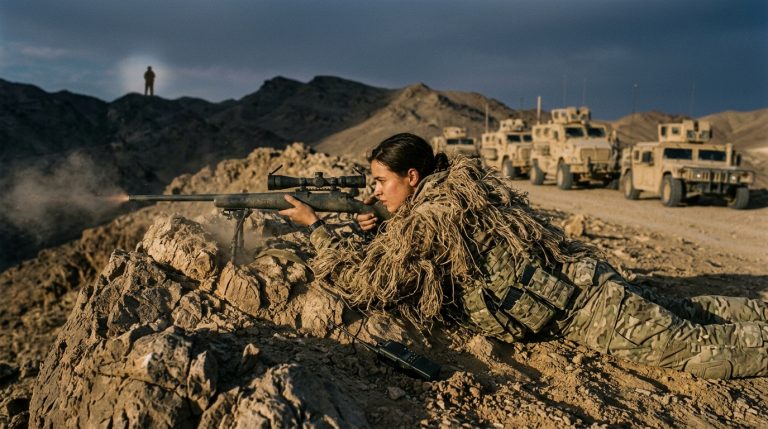
She checked her watch, the luminous dial a ghostly pale green in the night. 0500 hours. The convoy would launch in an hour. She had sixty minutes to establish her own position, to turn the hunter’s geography against them. She adjusted the sling of her M40, the steel cold and biting against her shoulder. The phantom radio static in her mind settled into a low, menacing hum. It was time. She didn’t look back at the base. She turned her gaze to the ridge, where the first faint, unnatural movement of a shadow caught the edge of her sight, a ripple in the wind that didn’t belong to the weather. Someone else was already in position.
The game had shifted. It was no longer a matter of escorting a medical convoy; it was a matter of outlasting an opponent who knew her history, her tactics, and her intent. She moved forward into the dark, a shadow within shadows, merging with the jagged, unforgiving landscape. The ridge awaited, and with it, the truth that had remained locked behind ten years of silence.
CHAPTER 3: THE DECOY AMBUSH
The convoy lineup at the base motorpool was a study in controlled, mechanical routine. Elena watched from the jagged darkness of the upper slope, her position elevated enough to see the entire movement of the assembly but shielded by a natural rock overhang that acted as a windbreak. Below, the yellow beams of headlights sliced through the snow, illuminating the metallic, frozen surface of the road. She saw Briggs moving between the vehicles, his silhouette a dark, heavy presence in the beam of a spotlight.
Specialist Carter was there as well, his movements possessing a lingering tension that she could read even from two hundred meters away. He walked along the side of the lead Humvee, his hand brushing the hood. Elena’s eyes narrowed. As he reached the front left quarter, she saw him pause. He didn’t just walk past; he leaned in, his head tilting as he examined something on the bumper. Even from this distance, through the scope, she could see that the object—a dark, rectangular housing bolted to the frame—didn’t belong. It was a recent addition, something that hadn’t been there during the pre-mission check she had conducted in the equipment bay four hours ago.
A sensor. A remote trigger, or perhaps a beacon.
Her breath hitched, a thin, white plume that vanished instantly into the wind. The mission was a lure, a calculated exposure. By utilizing the convoy as a medical necessity—a hook no commander would refuse—the architect of this trap had guaranteed her presence on the route. They had not just accounted for her tactical skill; they had weaponized her morality. They knew she would take the assignment, and they knew she would take the high ground to oversee the transition.
She turned her gaze back to the ridge. The ripple she had seen moments ago was gone, but the impression of a presence remained. A professional didn’t disappear; they repositioned. Her opponent was playing a game of chess on a board carved out of ice, and every move she made—every step toward the ridge, every calculation of wind and elevation—was a variable they had already considered.
She shifted her rifle slightly, the metal scraping against the stone. She had to break the pattern. If they were feeding her a lure, she would feed them a phantom. She pulled a small piece of dark, reflective fabric from her pocket—a signal mirror she had modified for low-light work—and leaned over the edge of the shelf. With a slow, calculated motion, she caught the light of a flickering base spotlight and redirected it, not toward the ridge where she was, but toward a cluster of boulders forty meters to her left.
She held the reflection for exactly two seconds. It was a gamble, a test of the antagonist’s resolve.
Within the heartbeat of that reflection, the ridge erupted. Not with gunfire, but with the sudden, sharp flash of a thermal scope resetting. The antagonist was watching the point of the reflection. They had taken the bait. Elena didn’t wait. She moved, sliding backward from the ledge and pressing her back against the rock face, her heart rate steady, her focus locking onto the silence that followed. She had verified the threat’s location without revealing her own.
The roar of the engines below signaled the final departure. The Humvees began to roll, their heavy treads crunching through the frozen ruts. Carter climbed into the second vehicle, his movements sluggish, still glancing at the lead vehicle’s bumper with a look of confused apprehension.
Elena followed the convoy’s progress through her scope, her pulse a rhythmic, meditative beat. The lead vehicle passed the first checkpoint. Then the second. The trap was waiting in the chokepoint, a two-kilometer stretch where the walls closed in and the wind became a weapon. As she watched, she felt the weight of the photograph in her inner pocket—the man with her eyes, the life that had been compromised by a betrayal she was only now beginning to map.
She began to move, paralleling the convoy’s path along the ridge line. She didn’t stay on the open ground. She moved through the gullies and the shadowed fissures of the rock, maintaining a constant, predatory oversight. The cold didn’t matter. The fatigue of the climb didn’t matter. All that mattered was the arithmetic of the chokepoint.
She stopped again near a precipice that overlooked the valley floor. Below, the lead Humvee was approaching the narrowest point of the road. She could see the driver’s face, tight and focused, squinting into the driving snow. She checked her rifle once more, the bolt sliding with a satisfying, oily smoothness.
She was no longer just the overwatch; she was the counter-measure. As the lead vehicle hit the threshold of the chokepoint, she didn’t look at the road. She looked at the shadows on the wall ahead, waiting for the flicker, the distortion in the falling snow that would signal the first move. She had been led into a trap, but they had forgotten one essential truth: a trap is only effective if the prey is predictable. Elena Ward was anything but.
CHAPTER 4: THE SILENCE OF THE RIDGE
The chokepoint was a natural architecture of death. Two hundred meters of bottlenecked mountain road, bounded on either side by sheer rock faces that bled ice and shale. Below, the lead Humvee crunched into the center of the trap, its headlights twin, desperate eyes probing the impenetrable white. Elena didn’t breathe. Her finger rested against the trigger guard, a phantom pressure that was as much a part of her anatomy as her own pulse.
She saw the ripple first—the slightest, most unnatural variation in the wind-driven snow on the left-hand wall, fifty meters ahead of the convoy. It was a subtle, almost microscopic deviation, the kind of displacement created by a human body shifting its weight. It was the fifth shooter. The professional.
She began to move her sight line, tracking the point of origin, when the mountain itself betrayed her. A gust, erratic and violent, hammered the ridge, tearing a shelf of brittle, ice-packed shale loose from the peak directly above her. The sound was a jagged, rolling thunder. Elena threw herself backward just as the shelf disintegrated, a cascade of stone and frost raining down where she had been positioned seconds before.
She landed in a slide, her rifle clutched to her chest, her body tumbling through the steep, narrow gully that channeled the wind. She came to a halt twenty feet below her original position, forced into a pocket of exposed, unstable shale that offered zero concealment. She was visible from the valley floor now, a silhouette against the gray stone.
She didn’t panic. She didn’t try to climb back up. She simply rolled into a crouch, her eyes snapping to the road below. The rockfall had echoed through the canyon, and for a moment, the world held its breath. The fifth shooter, however, hadn’t hesitated. A flash of white—a muzzle brake hidden in the snow—peered over the edge of the left-hand ridge. He was hunting the origin of the noise.
Elena pulled her rifle to her shoulder. She was exposed, her breathing ragged from the physical shock, but her mind was a cold, efficient instrument. She adjusted for the drop, the wind pushing the sleet into her eyes. She didn’t have the luxury of settling into a perfect prone position. She used the jagged edge of a frost-covered boulder as a makeshift rest, the metal biting into her shoulder.
In, out. Silence between heartbeats.
The fifth shooter fired. A high-velocity round slammed into the stone three inches from her head, the impact sending a shower of sharp, jagged rock into her face. She felt the hot sting of a laceration across her cheek but didn’t blink. She saw his position—a flickering distortion against the dark rock—and she fired.
The crack of her M40 was lost in the roar of the wind, but the effect was immediate. The flash on the ridge vanished, and the silhouette that had been bracing against the stone collapsed backward, swallowed by the darkness of the mountain wall. Silence returned, deeper and more hollow than before.
Elena didn’t celebrate. She didn’t even acknowledge the hit. She was already scanning the right-hand wall. If the fifth shooter had been the controller, the decoy, then the real strike force was elsewhere. She forced her frozen fingers to operate the bolt. The metallic shick-clack was the only sound she allowed herself.
Below, the convoy had halted. The lead Humvee was idling, its engine a low, rhythmic thrumming in the canyon. She saw Carter scramble out of the second vehicle, his weapon raised, searching the high ground. He looked up, his eyes sweeping the ridge, but the snow-curtain was too thick, the light too failing. He didn’t see her. He saw only the mountain.
She realized then that the trap was deeper than she had calculated. The fifth shooter wasn’t the end of the line; he was a gatekeeper, and his job had been to occupy her, to force her to commit her position while the real threat positioned itself to close the road behind the convoy. She scanned the horizon—the way the clouds were banking against the peaks—and she saw it. A faint, reflected glow in the distance, a point of light that was moving in synchronization with the convoy, but from a parallel track on the far side of the mountain.
They weren’t planning to ambush the convoy in the chokepoint. They were planning to collapse the entire route behind them, sealing the exit and leaving the platoon isolated in the heart of the storm. The realization hit her with the weight of cold lead. Her father’s betrayal hadn’t just been a compromise of coordinates; it had been a masterstroke of environmental entrapment. The logic was the same.
She turned her scope toward the far side of the valley, her heart rate spiking, not with fear, but with the cold, sharp recognition of a cycle she had spent ten years trying to outrun. She needed to reach the radio, to signal the retreat before they were cut off. She rose, her body aching from the slide, and began to traverse the ledge, moving toward the base of the ridge where the terrain plummeted into a narrow, frozen riverbed. The path was treacherous, a suicide run for anyone not trained to read the physics of the mountain, but it was the only way to intercept the platoon before the real trap closed.
She moved, the weight of her rifle a constant, familiar pressure. Every step was a calculation, every movement a negotiation with the ice. The decoy was dead, but the architecture of her failure was still waiting to be dismantled.
CHAPTER 5: THE FIRST THREE
The rock face was an exercise in pure vertical indifference. Elena pressed her forehead against the freezing stone, the cold leaching the remaining warmth from her skin, and listened. Below, the wind howled through the narrow riverbed, a guttural, hungry sound that masked the crunch of her boots against the shale. She was halfway down the traverse when she saw it: a coil of nylon rope, frayed and half-buried in a drift of snow.
She didn’t need to touch it. The knot—a triple-redundant figure-eight—was a distinctive, archaic technique that had been phased out of the standard curriculum years ago. Her father had taught her that specific configuration in the backyard in Flagstaff, using a piece of laundry line. Seeing it here, discarded on a ridge in Kunar Province, felt like a physical blow. The trap wasn’t just a tactical maneuver; it was a ghost.
She pulled her gaze away, her jaw tightening. She couldn’t afford to be a daughter now; she had to be the machine. She finished the descent, her boots striking the frozen riverbed with a hollow, ringing impact. She sprinted toward the convoy’s trajectory, her breath coming in sharp, serrated gasps. The Humvees were stalled three hundred meters ahead, caught in a cluster of jagged rock formations that narrowed the road to a single-vehicle track.
She reached a rise that overlooked the platoon’s position and dropped to one knee, bringing her scope up. The scene below was a theater of controlled panic. Briggs was out of the truck, his leg bound in a makeshift tourniquet, his voice a low, gravelly bark as he ordered the Marines into defensive postures. Carter was hunkered down by the lead vehicle, his eyes darting to the ridge line—the ridge line she had just descended.
Three figures were visible on the northern rise, moving with the rhythmic, professional efficiency of a unit that had done this a dozen times. They weren’t firing; they were pinning. They were using suppressive, directed fire to keep the Marines pinned behind the steel hulls of the Humvees, effectively neutralizing the platoon’s return fire while they maneuvered for a closing strike.
Elena didn’t hesitate. She calculated the distance—four hundred and twenty meters—and the wind shear, which was whipping around the rock formations in chaotic gusts. She didn’t seek the comfort of a rest; she fired from a standing kneel, using the structural integrity of a boulder to brace her weight.
The first shot caught the man on the left in the movement of a flank. He went down instantly, his rifle skittering across the ice. The other two reacted with robotic speed, turning their fire toward her position on the rise. Bullets chewed into the rock around her, showering her with shrapnel, but she was already cycling the bolt.
The second shot found the lead figure. He had been reaching for a radio—the controller. The round struck the base of his neck, and he collapsed, his body sliding down the embankment in a grotesque, awkward tumble. The third man, realizing the disadvantage, broke cover and sprinted for the lower gully.
Elena tracked him, her vision narrowing to the crosshair. She led him by two meters, anticipating the way his weight would shift as he hit the slick patch of the riverbed. She fired. He staggered, tripped, and then vanished into the shadows of the rocks.
The immediate suppression stopped. Below, the platoon took the opportunity, the sudden silence allowing the Marines to pour heavy fire into the northern rise. Briggs was shouting now, his orders crisp and clear. Elena stayed on the rise, her barrel smoking, her heart a frantic, uneven rhythm in her chest.
She felt a vibration on the ground—a low-frequency thrum that seemed to come from the earth itself. She turned her head toward the valley exit. In the distance, the wall of the canyon was groaning. A tremor, unnatural and systematic, was vibrating through the rock. The far end of the valley was collapsing. The entire cliff face was being rigged to drop, a programmed landslide intended to seal the platoon in the box.
She looked at her watch. 0545. The trap wasn’t an ambush; it was a burial. She realized then that the decoy she had killed—the fifth shooter—was never meant to be the kill. He was the distraction to keep her localized until the demolition charge was triggered. She stood up, her legs shaking with exhaustion, and turned toward the platoon. She had to reach them. She had to lead them through the narrow goat path she had scouted on the way in, a path that led over the ridge and out of the bowl before the mountain closed in on them.
She started to run, the cold biting through her thin tactical jacket. Every step was a battle against the terrain, but she wasn’t just running for them. She was running to dismantle the final piece of the trap that had been waiting for her since her father died. She reached the edge of the plateau and looked down, her voice a raw, desperate command that carried over the wind.
“Briggs! The road is going to fall!”
The Marines looked up, their faces blurred by the snow, their eyes wide with the realization that the rock around them was beginning to shed its skin. She signaled the route with a sharp, downward hand gesture, and for the first time since she had arrived at FOB Ridgerest, the platoon didn’t hesitate. They abandoned the vehicles. They ran for the ridge. Elena stood on the edge, the only anchor in a world that was rapidly coming apart, and prepared to guide them out of the box.
CHAPTER 6: THE MOBILE THREAT
The rock shelf trembled beneath Elena’s boots, the earth rejecting the structural load of the surrounding peaks. She didn’t look at the summit. She kept her eyes locked on the platoon, the dark shapes of the Marines surging like a tide against the white, shifting ground. Briggs was in the lead, his crutch digging into the snow, his movements pained but rhythmic. Behind him, Carter was hauling a wounded man, his boots slipping on the treacherous incline.
“Move!” Elena’s voice was stripped of emotion, a sharp, piercing command that cut through the gale. She was at the intersection of the goat path, her rifle slung tight against her spine, her hands frantically clearing a path through a shelf of loose, unstable drift. This was the only way up—a narrow, serpentine ribbon of rock that clung to the southern face of the mountain, shielded from the primary collapse zone.
As the Marines reached the base of the rise, the sound of the mountain intensified. A thunderous, grinding boom tore through the canyon—the sound of the cliff face at the valley exit finally giving way. A massive curtain of white snow and pulverized rock rose into the air, blocking the sky. The vacuum created by the slide pulled at their lungs, a sudden, violent pressure change that forced everyone to their knees.
Elena didn’t fall. She waited for the pressure to equalize, then pulled Briggs upward. His hand was freezing, his grip surprisingly strong for a man who had been losing blood for hours. She didn’t speak; she just gestured toward the narrow climb. As they hit the base of the goat path, she looked back.
In the swirling snow of the valley floor, she saw movement. Figures—two, maybe three—were emerging from the debris cloud. They weren’t retreating; they were pursuing. They were moving with a surgical, predatory patience, their silhouettes sharp against the gray haze of the storm. These weren’t the local insurgents. They were professionals, wearing the same tactical signature as the fifth shooter.
Elena felt a surge of cold, analytical rage. This wasn’t just an ambush; it was a cleanup operation. The betrayal that had killed her father had left loose ends, and she was the last one. She had stumbled into a net that was designed to catch her long before she reached Ridgerest.
She turned to Carter as he crested the shelf, his face smeared with dirt and ice. “Go,” she ordered, pointing toward the high saddle above them. “Get to the secondary extraction point. There’s a supply cache three kilometers east. Stay in the rocks.”
“Ward, you’re coming with us,” Carter protested, his breath coming in shallow, frantic bursts.
She didn’t look at him. She was already unlimbering her rifle, her fingers working the safety with a smooth, detached grace. “I’m not the target, Carter. I’m the lure. If I go with you, they’ll follow until they kill everyone. If I stay, I lead them away.”
“That’s suicide,” he said, but he saw the look in her eyes—the same gray, flat stillness she had shown on the firing range. It wasn’t bravery, and it wasn’t martyrdom. It was the tactical reality of the situation.
She shoved him toward the path. “It’s the math. Go.”
She turned back to the cliff edge, her back to the rising path. Below, the three figures were fanning out, checking the base of the rock wall. She was alone on the ledge, a solitary silhouette against the fury of the mountain. She felt the sudden, sharp disconnect of her senses—the cold was no longer biting; it was a dull, thrumming numbness in her extremities. Her vision flared at the edges, a trick of the low oxygen and the sheer, brutal physical demand of the last ten minutes.
For a second, she wondered if the figures below were real. Were they men, or were they the shadows of her own history, the phantoms of a decade-long hunt finally closing the circle? She shook the thought away, the movement sending a jolt of pain through her bruised ribs. Reality was the rifle. Reality was the trajectory.
She picked a target—the one in the center, the one carrying the comms equipment—and she braced herself against the wind. The mountain was still shivering, small pebbles of shale pinging off her helmet. She realized that even if she died here, the truth of the betrayal—the signature of the betrayal—was already in the hands of the platoon. Carter knew. He had seen the folder. He had seen the pattern. Even if the trail died with her, the record remained.
She took a breath, the air burning her throat like fire, and felt the weight of the rifle steady her. She wasn’t just fighting for her father anymore. She was fighting to ensure that the architecture of this lie, the cold, calculating machine that had used her as its own blade, was finally forced to bleed. She squeezed the trigger.
CHAPTER 7: THE FINAL RESOLUTION
The attacker lay sprawled across the shale, his tactical vest torn by the impact of her round. Elena moved over him, her movements fluid and devoid of hesitation. She didn’t check for a pulse; she checked the gear. She stripped the comms unit from his vest, a ruggedized, military-grade transmitter with a customized frequency dial. As she manipulated the device, her fingers brushed a serial number etched into the casing—a sequence she recognized instantly. It was the same catalog mark used for the base’s internal communication suites at FOB Ridgerest.
The realization was a cold spike of clarity. This wasn’t an external incursion. The team that had trapped her, the team that had attempted to bury the platoon in a calculated demolition, was being directed by someone with full access to the base’s logistics and intelligence network. The bait had been prepared from within the walls she had spent the last four days protecting.
Below her, the canyon was still shuddering with the aftershocks of the valley-exit collapse. The primary route was gone, buried under thousands of tons of rock and ice. The platoon was still moving up the goat path, their progress slow and labored against the howling wind. She looked toward the high saddle where they were headed, then back at the transmitter in her hand. If she returned to them now, she would be walking into an interrogation—or an ambush.
She stood alone on the ridge, the wind whipping her braid across her face. The “decoy” she had been chasing for ten years, the man who had supposedly compromised her father’s mission, was just a ghost, a piece of theater. The real architect was someone closer, someone who had seen her file, someone who had known exactly how she would react to the “medical emergency” in the valley.
She turned her gaze toward the eastern horizon. The secondary extraction point, the supply cache where the platoon was heading, was also compromised. It had to be. It was the only tactical option left for a surviving unit, and the betrayer would have anticipated it. She checked the remaining rounds in her magazine. Three.
She began to move. She wouldn’t follow the platoon’s path. She would cut across the higher, more dangerous peaks, traversing the “unreachable” terrain that she had practiced on in her training sessions. If the architect expected her to be either dead or regrouping with the survivors, they would be watching the standard routes. She chose the path of friction and exhaustion.
As she traversed the mountain, the reality of her father’s death crystallized. It wasn’t just a failure of intelligence; it was an active extraction. Her father had been a witness to something he wasn’t supposed to see, and his “compromised position” had been the cover story. The institution—the machine she had served for four years—had been protecting a leak from the very beginning.
The wind shifted, bringing with it the distant, muffled thrum of a helicopter—a transport bird moving toward the extraction zone. Not a rescue. A containment team. They weren’t coming for the platoon; they were coming to “sanitize” the site.
Elena reached the summit of the saddle, her muscles screaming, the cold having turned her skin into a brittle, lifeless shell. Below her, in the basin, she saw the supply cache—a small, orange tarp snapping in the gale. The Marines were just reaching it, their forms exhausted and clustered. And descending from the north, low and fast, the transport helicopter was banking toward them, its lights extinguished.
She had three rounds. She needed one to signal the truth, and two to prevent the “containment.”
She found a depression in the rocks, cleared the snow, and settled into a prone position. She wasn’t aiming at the helicopter; it was too high, too well-armored. She was aiming at the landing gear’s hydraulic line, a target the size of a fist at five hundred meters. She knew the machine. She knew its weak points. She knew that if it couldn’t land, the “containment” team would be forced to abort.
She felt a strange, detached peace. The decade of searching, the cold calculations, the years of silence—it all condensed into this one moment, this one alignment of steel, wind, and intent. She adjusted for the gusting drift, her breath held until her lungs burned. She didn’t think of her father. She didn’t think of the uniform. She thought of the cold, unyielding weight of the truth she was about to manifest.
She pulled the trigger.
The sound of the shot was a sharp, final report that sliced through the roar of the rotors. The helicopter’s landing gear buckled, the hydraulic fluid misting in the freezing air like dark, mechanical blood. The aircraft swerved, the pilot fighting for control, and then banked hard away from the ridge, climbing rapidly into the storm.
The containment team had been blinded. They had lost their window. Below, the Marines looked up, their faces etched with confusion, then realization, then a sudden, sharp focus. They had seen the shot. They knew where the overwatch was.
Elena stayed on the ledge for a moment, her rifle empty, her mission incomplete but redirected. She had saved the witnesses. She had broken the chain. The mountain was silent again, the snow continuing to fall in long, white curtains, masking the world, burying the ghosts of the past and the betrayals of the present. She was alone on the summit, and for the first time in ten years, she didn’t look at the mountains to find an enemy. She looked at them, and saw only the horizon.
CHAPTER 8: THE COLD AFTERMATH
Elena descended from the summit with the methodical, unhurried pace of a phantom. The containment helicopter was a distant, dark speck against the leaden sky, spiraling away toward the northern corridor. The Marines were huddled by the cache, their forms small against the expanse of the valley. She didn’t head for them directly; she moved toward the secondary ridge, a narrow, windswept finger of rock that overlooked the extraction zone.
She found the tactical radio hidden in the crevice of the rocks where the containment team had established their ground-link. It was still active, a faint, rhythmic pulse of encrypted data streaming back to a command node. She sat in the biting cold, the snow swirling around her, and placed her hand over the transmitter. She didn’t smash it. She didn’t silence it. She adjusted the frequency dial, keying in the override code she had retrieved from the device she’d taken off the attacker in the riverbed.
The device chirped once, then settled into a steady, flat tone. She waited.
Minutes later, a voice crackled through the earpiece. It was cold, precise, and entirely devoid of human inflection. “Asset confirmed neutralized. Proceed to secondary extraction point. The containment of the Ridgerest incident remains absolute.”
Elena spoke into the mic, her voice as flat and frozen as the landscape around her. “The containment failed. The incident is currently being recorded by the unit on the ground. The transmission is live, and the network is compromised.”
There was a long, jagged silence on the other end—the sound of an institution realizing its own architecture had been breached. The voice didn’t panic. It sighed, a faint, metallic sound. “Ward. You were always a variable we should have pruned.”
“You already tried,” Elena said. “It didn’t take.”
She set the radio down on the frozen shale, pulled the pin on a small, incendiary thermite disk she had scavenged from the cache, and placed it atop the transmitter. She didn’t stay to watch the flash. She turned and began the walk down toward the platoon.
The descent was a blur of exhaustion. Her muscles were long past the point of pain, operating on the cold, hard geometry of survival. When she finally reached the supply cache, the Marines were waiting. Briggs was standing, his leg stabilized, his eyes hard and knowing. Carter held the radio she had used, his knuckles white against the casing. They didn’t cheer. They didn’t embrace. They simply stood in the freezing, gold-lit morning, a group of survivors who had seen the machine’s inner workings and had lived to document the rot.
“They’re coming for us,” Carter said, his voice quiet.
“They’re coming for the truth,” Elena corrected, her gaze shifting to the valley below. The snow was beginning to cover the tracks of the battle, the landscape reclaiming its silence. “And they aren’t going to find it here.”
She walked to the supply cache, picked up a discarded, heavy-duty tarp, and began to wrap her rifle in it—the Symbolic Closure of a tool no longer needed for the current objective. She didn’t look back at the ridge. She reached into her pocket, pulled out the photograph of her father, and held it for a moment. The paper was worn, the edges soft, the image of the man with her own eyes finally looking back at her not as a mystery, but as a person.
Briggs approached, his gait uneven but determined. He didn’t offer a platitude. He offered a hand, a gesture of recognition between two people who had stood in the center of an institutional lie and had refused to be consumed by it.
“What happens now?” he asked.
“Now,” Elena said, looking at the distant, pale sun rising over the peaks, “we start the collection.”
They began the trek toward the emergency extraction point, a long, slow file moving across the white expanse. The wind died down, leaving the air crystalline and sharp. Elena led them, her pace steady, her internal ledger finally balanced. The betrayal had sought to bury them in the mountain, but the mountain had been the witness. And as they walked, the footprints behind them filled with snow, the terrain resetting itself, leaving the path unmarked, the secret buried beneath the silence of the winter. The institution would continue to turn, but the variables had changed. The variable was no longer a shadow—it was a witness, and it had finally come out of the cold.