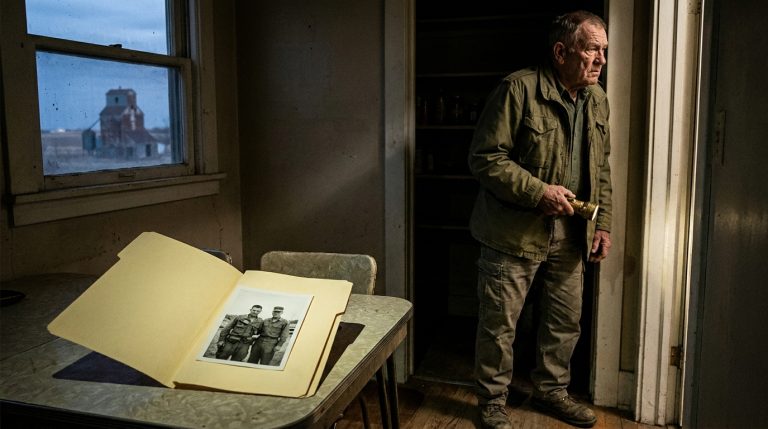
The Silent Scope: A Veteran’s Final Calibration in the Shadow of the Modern Machine
CHAPTER 1: THE WEIGHT OF COLD STEEL
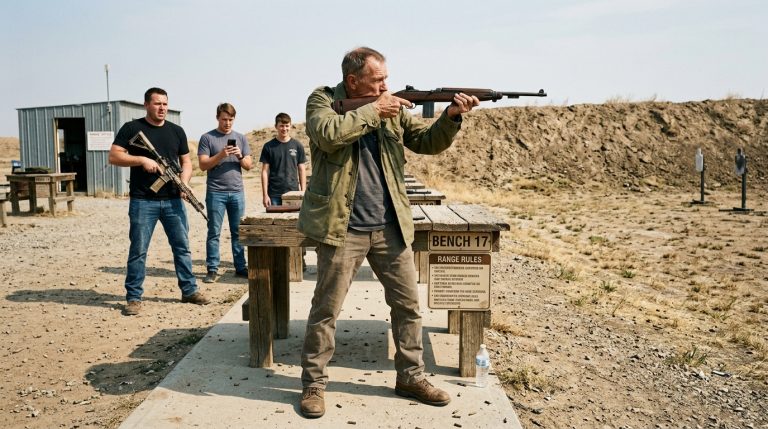
The desert heat was not the heat of the range. It was a dry, punishing heat that baked the sand into fine powder, but inside Lester Newton’s skull, the air was heavy with the thick, suffocating humidity of the valley. He lay perfectly still on the canvas mat, his spine aligned with the barrel, his breathing partitioned into shallow, controlled sips of oxygen.
To the line of young Marines behind him, he was a static object, an aging antique propped up against the modern machinery of war. The sound of their polymer-clad rifles—modern, efficient, clicking with the precision of a calculator—droned in his ears like a swarm of angry hornets.
“Check the registration on that relic,” a voice sneered, drifting over from the lane beside him. It was the young corporal, Davies. He was lean, vibrant, and entirely dangerous in his ignorance. “Might need a permit for a weapon that predates the moon landing.”
Lester ignored the ripple of laughter that followed. He was focused on the scope. The housing was worn, the bluing rubbed down to a matte silver where his cheek had rested thousands of times before. But the optics inside remained perfect—a German-engineered clarity that rendered the thousand-yard target with startling, clinical precision.
His thumb hovered over the windage knob, brushing against the jagged, deep gouge in the metal housing. The moment his skin touched the rough edges of the scratch, the sun-drenched range flickered. The smell of gun oil evaporated, replaced instantly by the copper-thick scent of fresh blood and wet foliage.
Keep her steady, Les. Make it count.
Miguel’s voice was as clear as if the boy were lying right there on the canvas beside him. The memory hit him with the force of a physical blow, a sudden rush of cold in the sweltering heat. He felt the phantom vibration of a ricochet against the scope—the moment the metal had bitten into his hand, saving his eye, ending his innocence.
Lester’s jaw tightened. He wasn’t here for the competition. He wasn’t here to prove he could beat a bunch of kids who measured their skill in technological upgrades. He was here because the silence in his own home had become too loud, and the weight of the rifle—the last object Miguel had ever touched—had become an anchor he could no longer drag through his remaining days.
“Hey, Grandpa,” Davies called out again, his voice now amplified by the bravado of his peers. “You waiting for the target to walk closer?”
The Gunnery Sergeant was moving down the line, his boots crunching rhythmically against the gravel. Lester felt the shift in the air, the collective attention of the firing line pivoting toward him. The threat wasn’t the target downrange. The threat was the interruption—the intrusion of these young men who saw the world in black and white, who didn’t know that the deadliest thing on any range wasn’t the optic, but the man who had long ago forgotten how to fear death.
Lester didn’t flinch. He adjusted his focus, the crosshairs settling onto the center of the white speck in the distance. The world narrowed to that single, dark point. The laughter behind him started to fade, smothered by the sudden, freezing intensity emanating from the old man on the canvas.
He didn’t need a telescope. He needed to find the exact point where his past could finally be silenced. And he knew, with a dark, pragmatic clarity, that the first shot would either be his salvation or the final piece of his undoing.
CHAPTER 2: THE INSPECTION OF GHOSTS
The Gunnery Sergeant’s thumb felt the serrated ridge of the jagged scratch on the scope’s housing. He stood there, boots planted firmly in the gravel, his eyes narrowed as he traced the imperfection. To him, it was a flaw in the mechanical integrity of a tool. To Lester, it was a lightning rod.
The desert wind died. For a heartbeat, the heat of the range evaporated, and the dry, metallic taste of dust was replaced by the cloying, heavy scent of decomposing wet leaves and ozone. Lester was back in the treeline near the DMZ, his cheek pressed against the wood, his world reduced to the narrow, shaky corridor of a brass-fitted scope. Beside him, Miguel was whispering, his voice a jagged edge of youthful optimism. Keep her steady, Les. Make it count.
“Sir?”
The Gunny’s voice hit Lester like a cold splash of water. The jungle vanished. The roar of distant, unseen mortar fire was replaced by the steady, rhythmic crack-crack of the modern rifles down the firing line. Lester blinked, his eyes adjusting to the harsh, unforgiving glare of the midday sun. He was still on the mat. He was still eighty-four years old. But his knuckles were white, locked around the leather sling of the rifle as if he were holding onto the edge of a cliff.
The Gunnery Sergeant was watching him closely, his expression shifting from standard military detachment to a flicker of genuine concern. He worked the bolt again—clack-thud, clack-thud—the movement fluid and whisper-quiet. He didn’t just check for a clear chamber; he checked the tension of the springs, the wear on the firing pin, the way the metal had been polished by decades of tactile obsession.
“It’s old, Mr. Newton,” the Gunny said, his voice dropping to a register that kept the other Marines at bay. “I’ve seen plenty of historical pieces on this range, but this… this has seen things that don’t belong in a competition.”
Lester pushed himself up to a sitting position, his knees popping with the protest of age. He reached out and took the rifle back. The wood felt warm, impregnated with the oil of a thousand cleanings. “She’s sighted in, Gunny,” Lester replied, his voice a gravelly, low rumble. “She doesn’t care about the year. She only cares about the math.”
“The complaint,” the Gunny sighed, casting a glance over his shoulder toward where Davies and his fire team stood, smirking like schoolboys, “is that this isn’t standard issue. I’m forced to follow protocol. Any failure, any malfunction, and you’re off the line. Period.”
Lester nodded, his gaze unfocused as he looked toward the target—a blur in the shimmering heat. “I understand.”
The Gunny hesitated, his eyes lingering on the scope’s scar. “You have a history, don’t you? Before this range was ever built.”
Lester didn’t answer. He turned his back on the Sergeant and lowered himself back onto the canvas. The humiliation from the younger shooters wasn’t just a nuisance; it was a distraction, a tactical disadvantage. He felt the weight of Davies’ gaze, a smug, invasive pressure that clawed at his focus. He needed to recalibrate. Not the rifle—the rifle was an extension of his own skeletal structure—but his mind.
He looked through the scope. The optics were magnificent, pulling the target from the haze and dragging it into sharp, biting clarity. The scratch on the housing, however, caught the light, refracting a tiny, blinding needle of sun that seemed to dance in his peripheral vision. It was a glitch in his reality.
Make it count, Les.
Lester’s breath slowed, synchronizing with the pulse in his fingertips. He felt the movement of the air against his cheek, the infinitesimal drop in temperature that warned of a coming shift in the wind. He wasn’t thinking about the competition, or the scoreboard, or the arrogant kid beside him. He was thinking about the debt. If he fired the perfect string, if he set the record, he would be validating the very system that had chewed up Miguel and spat him out into the mud. If he missed, he was just an old man failing at a game.
He needed to navigate the space between those two failures. The Gunny retreated, his footsteps crunching away into the distance, but the quiet that followed was heavy. It was a vacuum of expectation. Lester could hear the soft, frantic tapping of a phone screen from the bleachers behind him. Someone was watching. Someone was calling in reinforcements.
The ripple of the mockery had reached the higher levels. He could feel it in the tension of the air. He wasn’t just a shooter anymore; he was a problem. And he knew that the moment he pulled the trigger, he wouldn’t just be shooting at a piece of paper. He would be firing into a history that was better left buried.
He leaned his weight into the rifle. The cold steel bit into his shoulder. The phantom smell of the jungle returned, just a wisp this time, a reminder that the war hadn’t ended in 1965—it had just gone silent. He sighted the target, his eye locking onto the center. The crosshairs drifted, then stilled, held in place by a will that refused to bend, even as the world around him began to tighten its grip.
He was waiting for the wind to drop. He was waiting for the command. But mostly, he was waiting for the moment he could finally set this rifle down for the last time.
CHAPTER 3: THE GHOST IN THE DATABASE
The climate-controlled air of the Command Center felt thin, almost brittle, against Colonel Miller’s skin. He stood behind his aide, Captain Hayes, watching the cursor blink on the terminal screen. It was a rhythmic, impatient pulse of light that seemed to mirror the sudden spike in Miller’s own heart rate.
“Run it again,” Miller commanded, his voice tight.
“Sir, I’ve cross-referenced three times,” Hayes replied, his fingers hovering over the mechanical keyboard. The keys were loud in the quiet room, a series of sharp, dry staccatos. “The name, the service number—it returns as a restricted access file. It’s not just classified, sir. It’s purged.”
Miller leaned forward, his hands resting on the cool, synthetic surface of the command console. The grainy black-and-white photograph on the screen was a relic of a different war, a different morality. A young man, barely twenty, stared back at him with eyes that had seen the end of the world and decided to keep walking. It was Lester Newton. But the accolades listed beneath the photo—the citations, the classified programs—were written in a language of violence that the modern Marine Corps had worked hard to forget.
Project Hawkeye. The name hit Miller with a visceral sense of wrongness. It was the kind of operational title that lived in the back-alley legends of the Corps, the sort of thing whispered about in dive bars near Camp Pendleton, never confirmed, always denied.
“Sir,” Hayes said, his voice dropping to an urgent, strained whisper, “the range master is reporting that the competition is being held up. The squad—Corporal Davies’ unit—they’re starting to get vocal. The situation on the gravel is… deteriorating.”
Miller looked at the screen, then at the clock on the wall. Every second they spent in this sterile, humming room was a second that the tension on Range 7 was coiling tighter. He knew that name, now. It wasn’t just a veteran’s name; it was a liability. If Lester Newton was actually there, on his range, being antagonized by the very people Miller was supposed to be molding into the future of the Corps, then the optics of the situation were a catastrophe waiting to happen.
“Get the car,” Miller snapped, turning toward the door. “And get the base commander on the secure line. Tell him we have a Code Alpha heritage issue.”
“A Code Alpha, sir?” Hayes looked up, his brow furrowing. “That’s—that’s a designation for a living legend, sir. We haven’t logged one of those in years.”
“Then we’re about to log one today,” Miller said, moving toward the exit. “And God help us if we’re too late.”
The transit from the Command Center to Range 7 was a blur of calculated, high-speed movement. As the black command vehicles tore across the base, Miller sat in the back of the lead car, his mind racing. He was a creature of structure, a man who believed in the order of things—in the chain of command, in the supremacy of modern doctrine, in the efficiency of the new. But as they approached the range, catching sight of the dust plumes rising against the stark blue sky, he felt a strange, cold intuition.
He looked down at his phone. A message from Elias Vance sat unread on the screen. Get down there. You need to handle this personally.
Miller watched the range emerge over the rise. He saw the firing line, the pristine, expensive geometry of the modern rifles, and then, at the far end, the lone, still figure of the old man on his canvas mat. It looked like a painting—a study in contrast. He saw the young Marines clustered together, a pack of wolves encircling something they couldn’t possibly understand. He saw the gunnery sergeant, looking like a man caught between two worlds, his body language taut with the strain of navigating an impossible request.
As the cars pulled onto the grass—an act of flagrant, urgent authority that shattered the stillness of the competition—Miller stepped out. The air hit him, dry and smelling of burnt gunpowder and sage. The silence that fell over the firing line was instantaneous, a physical weight that pressed down on the shoulders of every person present.
Miller’s gaze locked onto the old man. Lester Newton was moving with a slow, deliberate cadence, pushing himself up from the ground. There was no fear in his movements, no sign of the frantic, messy energy of the young men surrounding him. He was a tectonic plate in a world of shifting sand.
Miller moved toward him, his boots crunching on the gravel. He saw the rifle—the wood darkened by oil and age, the scope reflecting the harsh glare of the sun. He looked at the scratch near the windage knob. It was a ugly, jagged wound in the steel.
He didn’t see an antique. He saw a weapon that had been carried into the heart of a nightmare and brought back out again. He felt a sudden, sharp clarity: everything he had taught, everything he had built his career upon, was about to be put to the test by a man who had already survived the end of the world once before.
He stopped ten feet from the mat. The General was already ahead of him, his posture stiff, his eyes burning with a sudden, dawning recognition. Miller held his tablet like a shield, the ghost file on the screen feeling heavier than the hardware itself. The air felt thin again, charged with the static of something that hadn’t been triggered in decades. The battle for the soul of Range 7 had begun, and for the first time in his career, Colonel Miller realized he had absolutely no idea who was going to win.
CHAPTER 4: THE SALUTE OF IRON
The air on Range 7 had turned from baking heat to something charged and volatile. Colonel Miller’s boots, polished to a mirror sheen, crunched onto the gravel with a sound like breaking glass, each step puncturing the unnatural silence that had descended upon the firing line.
Lester remained in the prone position, his body coiled against the canvas mat. He didn’t look up at the approaching command staff. He didn’t offer the deference of a civilian caught in the machinery of the military. He simply stared down the barrel of his rifle, his eye pressed to the cool, unyielding glass of the scope. The scratch on the housing was perfectly positioned in his peripheral vision, a jagged, dark constant in an otherwise shifting world.
The General stopped three feet away. His shadow fell across Lester’s hands, cooling the blued steel of the rifle. When the General snapped to attention, the movement was so sharp it seemed to tear through the air. The salute was a masterpiece of military geometry—every angle precise, every muscle locked in a demonstration of absolute, unwavering respect.
“Mr. Newton.”
The voice boomed, stripped of the professional detachment Miller had witnessed back at the command center. It was a roar of acknowledgement, a public recognition that turned the firing line into a theater of history. Miller hovered behind the General, his tablet clutched in his hand, the screen still flickering with the redacted ghost file of a man who was supposed to be a myth.
Lester felt the weight of the moment pressing down on him. He pushed himself up slowly, his joints stiff, his movements economical. He looked at the General—not as a superior officer, but as a man who recognized the specific, heavy shape of a legacy he wasn’t yet ready to shoulder.
“General,” Lester replied. His voice didn’t waver. It lacked the brittle edges of the Corporal’s arrogance or the Colonel’s nervous efficiency. It was the voice of a man who had long ago traded his ego for the cold, hard mathematics of survival.
Miller watched as the General’s eyes swept over the firing line. The Corporal, Davies, was currently experiencing a complete disintegration of his composure, his face pale and his posture sagging under the sudden, crushing gravity of his own ignorance. The Colonel felt a surge of cold satisfaction; the arrogance that had been so prevalent only minutes ago was now being stripped away, layer by agonizing layer, by the mere presence of the old man.
“Colonel,” the General barked, not taking his eyes off Lester.
Miller stepped forward, his hand steadying as he turned the tablet toward the squad. “Corporal Davies,” Miller said, his voice echoing in the vacuum of the range. “You will stand at attention. You will maintain this position until you are formally relieved.”
The squad scrambled. They were a mess of fumbling limbs and wide, terror-stricken eyes. The transformation was total. The pride, the sneers, the bets—it had all evaporated, leaving behind a group of boys who realized they were out of their depth.
Miller looked back at Lester. He saw the way the old man touched the scope, his thumb tracing that jagged, ugly scratch. It wasn’t a gesture of vanity. It was a touch of remembrance. Miller finally looked closely at the scar in the metal. It was deep, notched with a precision that didn’t come from a manufacturing error or a fall. It looked like an impact.
“It’s a long way from Hill 881, Mr. Newton,” the General said, his voice dropping to a low, intimate rumble. “The Corps has changed. The rifles are lighter. The optics are clearer. But the math… the math remains the same.”
Lester offered a slow, simple nod. He didn’t try to explain the scratch. He didn’t offer a story about Miguel or the foxhole in the mud. He simply picked up his rifle, the weight of it settling into his arms as if it were a natural extension of his own bones.
Miller felt a sudden, frantic urge to intervene, to pull the old man aside and ask him if he knew what he was doing. Was he here to show them how it was done, or was he here for something else? The way Lester held the rifle—not with the casual grip of a competitor, but with the white-knuckled desperation of a guardian—made Miller’s skin crawl.
“The line is yours, sir,” the General said, stepping back, creating a buffer of empty space that felt like a sanctuary.
Lester returned to his mat. He didn’t check his windage. He didn’t adjust his elevation. He moved with a speed that defied his eighty-four years, his body becoming a rigid, singular line of intent. Miller watched him, a knot of unease tightening in his chest. He realized that the performance he had come here to witness—the breaking of the record, the restoration of order—was merely a cover.
Lester wasn’t preparing to win. He was preparing to finish something. And as the old man drew a breath, his lungs expanding in the dry, heated air, Miller saw the jagged scratch on the scope catch the sun, throwing a long, thin shadow across the rifle’s stock like the blade of a knife. The escalation wasn’t just physical anymore; it was deep in the steel, and it was screaming for a conclusion.
CHAPTER 5: THE PRICE OF THE PROMISE
The firing line had been emptied. The only sound remaining in the valley was the intermittent, rhythmic whistle of the wind through the tall, dry grass and the mechanical, metallic heartbeat of the base’s security sensors. Lester lay on the canvas mat, his world collapsed into the circular aperture of the scope.
He didn’t check the wind. He didn’t look at the monitor. He looked at the paper target a thousand yards away. Even from this distance, through the German crystal, he could see the center of the target, a pristine white circle of paper that seemed to taunt him with its emptiness. But then, as he adjusted the parallax, he caught something—a faint, charcoal-gray smudge, barely a speck, located exactly where his bullet needed to travel. It was a mark that looked hauntingly like the shadow of a bullet hole. It shouldn’t have been there.
His heart didn’t race; it slowed. This was the trap.
“Mr. Newton,” the General’s voice drifted over from the safety zone, too far away to interfere, but close enough to be heard. “The range is clear.”
Lester ignored the invitation. His thumb was back on the scratch—that jagged, deliberate gouge Miguel had patched with epoxy in the mud of a dying world. The memory flared, searing and bright. He wasn’t on a firing range in the sun-drenched desert; he was back in that foxhole, the air thick with the metallic tang of blood, the sound of the enemy closing in.
Make it count, Les.
That was the promise. Not to win. Not to break a record. The promise was to ensure that the shot didn’t just strike the enemy; it had to strike the fear, the doubt, the chaos. It had to be the definitive word in a conversation of violence.
Lester’s finger took up the first stage of the trigger. The weight was familiar, a ghost of an old, heavy pull. He felt the tension of the spring, the subtle resistance of the firing pin. He knew exactly how much pressure was needed to send the round, and he knew exactly what the consequences would be. If he hit the ten-ring, he would be lauded by the very system that had forgotten his brother. If he missed, he would be a tragic relic.
But there was a third option.
He saw the charcoal mark on the paper again. It wasn’t an accident. Someone, perhaps Vance or Miller, had marked the spot. They were testing him, checking if the legend still had the accuracy to hit the exact center of his own history. They wanted to see if the machine was still oiled, if the optics still held their zero.
He felt a cold, jagged anger rise within him. He was a man, not a museum piece. He was the architect of his own silence.
He shifted his aim. Not by much—a fraction of an inch, a breath of wind, a deviation so slight that no automated system would detect it. He aligned the crosshairs not with the charcoal mark, but with the empty, pristine white just to the side of it. He was choosing his own path, one that would fail the test of the range while perfectly satisfying the test of his own soul.
The wind picked up, a sudden, sharp gust that slapped against the canvas mat and tugged at his jacket. He didn’t compensate. He didn’t lean into it. He let the wind take the shot, let the environment claim the bullet, let the entropy of the world decide the outcome.
He squeezed the trigger.
The recoil was a physical shock, a sharp, familiar jolt that bit into his shoulder and sent a vibration through the wood and steel. The rifle roared, a sound that seemed too large for the desert, a sonic fracture that cracked the silence into a thousand pieces.
Lester didn’t watch the monitor. He didn’t look at the results. He immediately chambered the next round, his movements fluid and automatic, a dance he had practiced for sixty years. He felt the empty brass casing clatter against the gravel—a lonely, metallic sound.
Make it count.
The monitor flashed. A number. A result. He heard the sudden, sharp intake of breath from the command staff in the distance, followed by a total, suffocating silence. They had expected a bullseye, the mathematical impossibility of a legend. What they had seen was something else—something that didn’t fit the record books.
Lester ignored the confusion. He was already loading the third round, his focus burning with an intensity that made the surrounding desert seem pale and insignificant. He was going to finish this. Not for them, not for the Marines, not for the history books. He was going to finish this for the boy in the mud who had handed him a tube of epoxy and a promise to survive. The target was no longer the paper. The target was the memory itself, and he was going to tear it to pieces until there was nothing left but the truth.
CHAPTER 6: THE ARCHITECTS FINAL LESSON
The museum was a sanctuary of dust and stillness. Here, the chaos of the firing line felt like a lifetime away. Private First Class Davies stood by the Vietnam-era display, his hands steady as he polished the glass covering a rifle—an identical model to the one Lester Newton had carried onto the range. He didn’t look up when the door creaked open, but he knew the gait. It was a slow, measured tread that didn’t belong to a civilian, nor to the frantic pace of the base’s modern recruits.
Lester Newton walked into the soft, amber light of the exhibit room. He wasn’t carrying the rifle anymore. His hands were empty, their knuckles gnarled and steady, resting against the seams of his slacks. He stopped at the edge of the display, looking at the wood and blued steel behind the glass.
“You’re cleaning,” Lester said, his voice quiet.
Davies turned. His posture was no longer the loose, arrogant slouch of a hot shot. It was rigid, respectful, and deeply weary. “I am, sir. Sergeant Major’s orders. I’ve spent the last month learning why these things matter. Why the names matter.”
Lester walked slowly toward the glass. He pointed to a small, laminated card in the corner of the display case—a citation for a mission that never officially happened. “That’s the secret, Davies. Not the mission. Not the medal. It’s the epoxy.”
Davies frowned, confused. “Sir?”
Lester looked at the young man, his eyes clear and hard as iron. The weight of the last month—the humiliation, the demotion, the grueling, mindless labor—had peeled away the layers of bravado that had once defined the boy. In their place was something tempered. “When you’re out there, and the world is trying to tear you into pieces, you don’t fight for the flag. You don’t fight for the glory. You fight for the person holding the other end of the stick. You fight so that when the scope shatters, you have someone to hold the patch while you keep the crosshairs steady.”
Lester reached into his pocket and pulled out a small, worn tube of epoxy. He placed it on the ledge of the display case. It was an object of no value to anyone else—a relic of a dead man, a ghost of a foxhole in the DMZ. “Miguel gave me this. He died a day later. I spent sixty years trying to prove that the shot I didn’t take—the shot that killed him—wasn’t my fault.”
Davies looked at the tube, then at the old man. The silence in the room wasn’t uncomfortable; it was heavy with the weight of a life finally being laid down.
“That day on the range,” Lester continued, “I went there to destroy that rifle. I wanted to smash it, to grind it into the dust, to kill the memory of the promise I couldn’t keep. But then I saw you. I saw the arrogance, the blind confidence in your high-powered scopes and your black polymer rails. I realized that you were the ones who were going to inherit the silence. If I left you with nothing but your machines, you’d never learn to see through the glass.”
“You missed on purpose,” Davies realized, his voice a soft, dawning whisper.
“I didn’t miss,” Lester corrected. “I chose my target. I hit exactly where I meant to hit—which was nowhere. I proved that the gear doesn’t matter. The man behind the glass—the man who can make the choice to fail and still keep his honor—that’s the marksman.”
Lester looked at the rifle in the display case. The closure he had sought wasn’t in the bullseye; it was in the recognition. He had spent his life protecting a ghost, guarding a promise that only he could hear. But by passing the lesson to Davies—by turning the young, arrogant hot shot into a man who understood the cost of a trigger pull—the ghost was finally allowed to rest.
“Take the epoxy, Private,” Lester said, turning toward the door. “Keep it. Not as a trophy. As a reminder that when you’re standing on that line, you’re not just a soldier. You’re an architect of someone else’s survival.”
Davies took the tube, his fingers trembling slightly. He looked up to say something, to offer a final salute or a word of gratitude, but the museum was empty. The door had clicked shut with a final, echoing sound.
The private stood alone in the amber light. He looked at the reflection in the glass—a young man with the look of a veteran in his eyes. He reached out and touched the glass over the rifle, not to polish it, but to acknowledge it. He was a link in a chain that stretched back through the mud and the blood and the quiet, iron-hard duty of the past. He wouldn’t forget. The lesson had been earned, the debt had been paid, and for the first time in sixty years, the ghost of the range had walked away, leaving the living to hold the line in peace.