The Paperwork War: A Master Gunnery Sergeant’s Methodical Dismantling of a Suburban Tyrant’s Fractured Empire
CHAPTER 1: THE FOUR WOUNDS
The air in Oakridge Estates was typically a curated silence, the kind that cost six figures in HOA fees to maintain. Today, it was punctured by the persistent, rhythmic hum of a distant leaf blower—a sound that usually annoyed me. Now, it sounded like an insult.
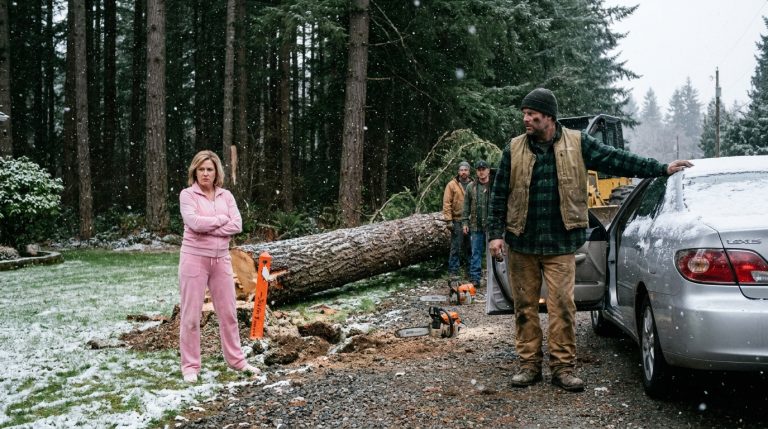
I stared at the four black walnut stumps. My knuckles, locked into fists at my sides, were white enough to contrast against the dark gray of my t-shirt. I had spent twenty-five years in the Corps learning how to process data under fire, how to suppress the biological impulse to explode so that the tactical imperative could take hold. I didn’t reach for my anger. I let it sink, past the ribs, into the dark, cold reservoir where I kept the memories of Sarah that were too sharp to handle in the light.
“They were a menace, John,” Karen said. She didn’t look at the stumps; she looked at her own perfectly manicured cuticles. “I did you a favor. The liability of those nuts—imagine if a child had tripped or a tire had caught one.”
I turned my head slowly. The movement was deliberate, a calculated piece of body language designed to signal that I was no longer a neighbor, but a threat. “Bylaw 7.4,” I said, my voice steady, stripped of all warmth. “Nuisance vegetation.”
“Exactly.” She puffed her chest, the fabric of her mumu straining against the vanity of her own self-importance. “I’m authorized to remove anything that threatens the aesthetic and safety standards of Oakridge. It’s for the good of everyone.”
She looked at me then, expecting a retort, a scream, perhaps a swing. She looked for the “unhinged veteran” stereotype she had clearly cultivated in her own mind to justify this action. Instead, she met eyes that were flat, unblinking, and entirely hollow.
“You have no idea what you’ve done, Karen,” I said, the words landing like lead.
I didn’t wait for her to stammer a defense. I turned my back on her, the most deliberate act of contempt I could perform. I walked toward the front door, the weight of the carnage on my lawn pushing into my heels with every step. My mind was already parsing the ground, the angle of the cuts, the depth of the tire tracks. I was already building the case.
Inside, the house felt cavernous. Sarah’s smell—jasmine and old paper—was still in the hallway. I went to the closet, pulled out the digital camera, and checked the battery. It was full. I picked up the small notepad I used for maintenance logs and flipped to a clean page.
As I stepped back out into the sun, the screen of my phone flashed with a new notification: an automated HOA blast email. “A note on community responsibility. Maintaining standards is the duty of every homeowner.”
I stopped on the porch, the camera heavy in my grip. The enemy had just opened fire again. I began to record.
CHAPTER 2: THE FORENSIC SURVEY
The porch steps groaned beneath my boots—a sound I had never noticed before in twenty-five years. It was a dry, hollow sound, lacking the damp resonance that usually came with the humidity of a North Carolina morning. I didn’t care. I moved with the programmed efficiency of a man who had spent his adult life performing pre-deployment inspections.
I stopped at the first stump. Up close, the carnage was worse than it had appeared from the porch. The chainsaw had not made a clean cut; the operator had been rushed, hacking through the dense walnut wood with a reckless, vibrating force that left the bark shredded and the exposed grain weeping dark, sticky sap. The smell was the worst part—not just the acrid, chemical bite of cheap fuel, but the raw, earthy scent of a living thing forced to surrender.
I knelt, the knees of my cargo pants absorbing the grit of churned topsoil. I raised the digital camera. Through the viewfinder, the world narrowed to a sharp, high-contrast frame. I captured the diameter of the stump first, placing my tape measure across the widest point. Forty-two inches. A king, executed in the dark.
As I shifted to the second stump, a memory pierced through the ice I had built around my chest. I felt the phantom pressure of Sarah’s hand on my shoulder, the way she used to lean against the northernmost tree on summer evenings, her thumb tracing the deep, rough valleys of the bark. “It’s like they’re the lungs of the house, John,” she had whispered once, the sunlight filtering through the canopy like liquid gold.
The memory hit me with the force of a physical blow, a sudden, jagged tear in the calm mask I had strapped to my face. I blinked, the image of Sarah dissolving into the harsh, clinical reality of the chainsaw marks. The sharp edges of the wood grain didn’t look like nature anymore; they looked like teeth marks.
I stood, my pulse a steady, metronomic count in my ears. I didn’t let the grief settle. I cataloged it, categorized it, and shoved it into the locked box where I kept everything else that could compromise the mission.
“Forty-two inches,” I muttered, my voice sounding alien in the quiet cul-de-sac.
I took the shot. Then another. I circled each stump, capturing the tire tracks that marred the grass—heavy, deep ruts that spoke of a commercial-grade truck with a lift or a crane. These tracks were the footprint of the intruder. I followed them across the lawn, tracing the path from the street where the truck had parked, right up to the base of the murdered trees.
I found a scrap of blue plastic wedged into the dirt—a piece of a zip-tie. I retrieved a Ziploc bag from my pocket, pulled on a pair of latex gloves, and bagged the evidence. It was methodical, silent work. I was not a victim anymore. I was an investigator, a surveyor of a crime scene.
A shadow fell over me. I didn’t look up, but I knew the cadence of the footsteps. It was the neighbor from across the street, a man whose name I’d only ever heard in passing, his gait hesitant and fearful. He was watching from his driveway, pretending to adjust a sprinkler. He was looking at the carnage, then at me, his face a mosaic of pity and terror.
He didn’t approach. He knew the HOA bylaws—the unwritten ones that warned against siding with the “disruptive.” I didn’t acknowledge him. I kept my focus on the ground, on the tire tracks, on the jagged, pathetic waste of wood that had stood for a century.
I moved to the third stump. My hands were steady, my movements fluid, stripped of wasted energy. As I framed the shot for the grain pattern, I realized the sawdust wasn’t just piled randomly. It was sprayed in a distinct, concentrated arc, suggesting the truck had been parked at a very specific angle to the trees, likely to maximize the crane’s reach.
Everything had a logic. Everything had a signature. If there was a plan, there was a paper trail. If there was a paper trail, there was a point of failure.
I straightened up, scanning the perimeter of the neighborhood. The “aesthetic standards” Karen preached about were everywhere—the identical mailboxes, the uniform lawn height, the silence that felt like a held breath. It wasn’t peace. It was a pressure cooker, and I was the one who was going to watch the lid blow off.
I checked the timestamp on my camera. 10:17 a.m. I had been at this for over an hour. My logbook in my pocket was already filling with technical observations: Stump diameters confirmed. Tire track depth: 4 inches. Evidence of heavy machinery confirmed. Zip-tie plastic retrieved.
I stood up, the camera hanging from my neck, a black weight against my chest. I looked toward Karen’s house—a beige monolith standing in the center of the street. The blinds were drawn, but I could feel her watching. Let her watch. I wasn’t going to break. I was going to calculate.
I turned back to the remaining stumps, my eyes narrowing as I spotted something embedded in the deep, fresh cut of the fourth tree—a small, dark fragment that hadn’t been there when I first arrived. It wasn’t sap. I stepped closer, my heartbeat accelerating just a fraction, the thrill of the hunt overriding the dull throb of loss.
CHAPTER 3: THE FIRST SCOUT
I reached into the wound of the fourth stump with my needle-nose pliers, my movements as surgical as a bomb disposal technician’s. The shard came free with a reluctant, tearing sound. It was jagged, stamped with a manufacturer’s mark that had already begun to rust in the morning dew. A low-end chain. The kind of blade that tears wood rather than cutting it. It wasn’t the equipment of a professional arborist; it was the equipment of a butcher.
I dropped the fragment into a small plastic bag and sealed it. My pulse, which had spiked when I first spotted the steel, settled back into a steady, rhythmic thrum. This wasn’t just proof of destruction; it was a physical artifact of the incompetence and cheapness behind the operation. Karen Bishop didn’t just want the trees gone; she wanted them gone for the lowest possible price, by the least qualified hands. She had cut corners, and that was the first gap in her armor.
A deep rumble of a heavy engine echoed off the suburban siding—the distinct, authoritative low-end growl of a Sheriff’s patrol cruiser.
I stood, my knees popping, and tucked the evidence bag into the inner pocket of my windbreaker. I didn’t rush. I wiped the sawdust from my hands onto my thighs and walked toward the edge of the curb. The cruiser slowed, the light bar slicing through the filtered morning sun as it turned into the cul-de-sac. Deputy Ror. I recognized him from the community barbecue last year, a man who wore his badge like a heavy, uncomfortable suit.
He pulled up to the curb, the tires crunching against the asphalt with a sound like grinding teeth. He didn’t exit the vehicle immediately. He stared at the stumps, his eyes widening for a fleeting second, before he checked his notes on the dash. I saw the hesitation in his posture. He knew what was waiting for him.
“Master Sergeant,” he said, stepping out. He had the sympathetic look down pat—brows furrowed, shoulders slightly slumped—but there was a defensive flicker in his eyes. He didn’t want to be here. He wanted this to be a quick, clean, “civil dispute” file entry.
“Deputy,” I replied, my voice neutral. I kept my hands visible, relaxed, but my posture was rigid—an old habit from the Corps that always seemed to make people in uniform feel slightly uneasy.
“I got a call from the HOA office,” he said, gesturing vaguely toward Karen’s house. “President Bishop mentioned you were… concerned about the tree removal.”
“Concerned?” I walked him toward the fourth stump, the one where I’d found the blade fragment. “Deputy, these were century-old black walnuts. They were a cornerstone of this property. They were removed in the dead of night without a shred of notice, without a single permit, and in clear violation of the bylaws that govern this community.”
“I understand, sir,” he said, already starting that rhythmic, placating head-nod that meant he had stopped listening three sentences ago. “But as I’m sure you know, HOA covenants are private contracts. If the president of the board acts under the authority granted by the bylaws, it falls under civil jurisdiction. My office can’t arrest someone for following a rulebook.”
“Rulebook,” I repeated, the word tasting like bile. “Did she show you the bylaw? Because the one she cited, 7.4, requires a nuisance determination. There was no arborist assessment. No health report. No hazard evaluation.”
He shifted his weight, his utility belt clinking—a sharp, sterile sound against the quiet of the morning. “She showed me the authorization, Sergeant. It’s signed, it’s dated, and it’s on official letterhead. Unless you have proof of a crime—trespassing, malicious destruction of property—my hands are tied.”
“Malicious destruction,” I said, pointing to the tire tracks that marred the grass. “You call that the work of a professional arborist? You call that an authorized removal?”
He sighed, a long, weary sound of resignation that had nothing to do with me and everything to do with wanting to be anywhere else. “I’ll file the report, John. I’ll document the claims. But my sergeant is going to tell you the same thing: this is for the lawyers to sort out.”
He took out his small, spiral-bound notepad. He was already checking boxes in his head, mentally filing this away as a neighbor-on-neighbor feud. I looked at the notepad. It was pathetic—a thin barrier against the truth. I could see the outcome of this interaction already: a generic report that would be buried in a drawer, cited by an insurance company as ‘no criminal conduct found,’ and used by Karen to cement her narrative of a ‘disruptive’ veteran.
“I’ll need a case number,” I said, my voice dropping an octave, losing the conversational edge. “And I’ll need you to document the presence of the blade fragment I found in the wood. It suggests the use of non-industrial, potentially hazardous equipment.”
He looked at me, a brief flash of genuine interest crossing his face. He wasn’t used to the victims of these “disputes” actually providing evidence. “I’ll put it in the report,” he muttered, scribbling something down.
As he walked back to his cruiser, I watched him. He wasn’t the enemy, but he was a gear in the machine that made the enemy comfortable. He was the reason bullies like Karen thrived—because the law always preferred the path of least resistance.
He didn’t know it, but he had just given me exactly what I needed. A file number. A record of her “official” claim. When I eventually brought the entire structure down, this report wouldn’t be a defense for her. It would be the proof of her perjury.
He drove off, his tires leaving fresh marks in the asphalt. I stood alone in the center of the cul-de-sac. My neighbor, the one from earlier, was still watching from his driveway. He pulled his head back inside as soon as he saw the Sheriff leave.
I looked at the house at the end of the street. It was time to stop waiting for the authorities to realize there was a crime. I had the case number. I had the evidence. Now, I needed the architect of the destruction to pay.
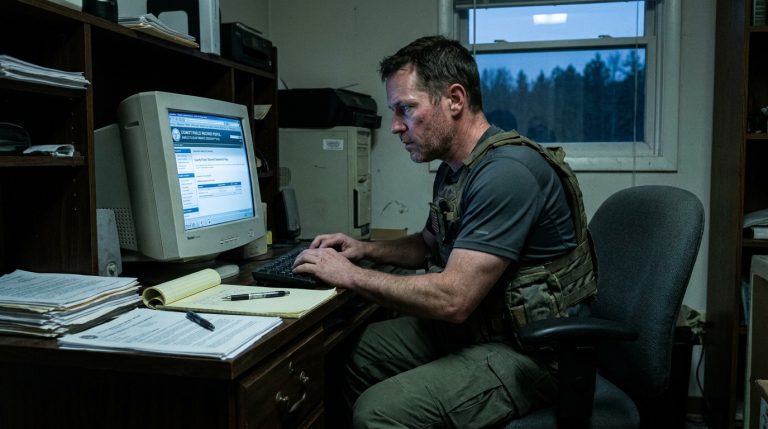
I turned back to the house, the silence feeling heavier now. The house was quiet, but my mind was screaming with the precision of a logistical operation. I walked into the study, the digital camera still heavy on my chest, and opened my laptop. It was time to call in the cavalry.
CHAPTER 4: THE EXPERT WITNESS
The cursor on my laptop screen blinked with the rhythm of a steady pulse. It was the only movement in the room. I had closed the blinds, shutting out the afternoon sun that was currently baking the stumps in the front yard. The house felt like a command bunker—still, functional, and intensely focused.
I had the Covenants, Conditions, and Restrictions—the CC&Rs—spread across the mahogany desk like an adversary’s position on a map. I had highlighted section 7.4 in yellow, but it was the surrounding text that held the real interest. I’d spent the last hour cross-referencing definitions. “Nuisance.” “Architectural Control Committee.” “Board Discretion.” It was a document built on vagueness, designed to allow a power-hungry committee to define reality as they saw fit.
But a contract, no matter how vaguely worded, still required professional validation to be enforced. If Karen wanted to claim the trees were a liability, she needed a certified assessment. My screen blinked with the search results for “Legacy Tree Consultants.” Their website was surprisingly professional, devoid of the flashy suburban aesthetic that defined Oakridge Estates. It spoke of timber appraisal, forensic arboriculture, and litigation support.
I picked up the landline. My hand felt heavy, not from fatigue, but from the deliberate, slow-motion intensity of what I was about to trigger.
“Legacy Tree, this is Dr. Evans.” The voice was thin, academic, and dry—a welcome change from the theatrical, over-the-top arrogance of the HOA board.
“Dr. Evans, my name is John Davis. I have a situation involving four mature black walnut trees that were removed from my property this morning without consent.” I didn’t rush. I laid out the facts: the diameter, the location, the complete absence of notice. I kept my tone flat, a Marine’s report, stripping away the emotional residue of Sarah’s memory and focusing purely on the dimensions of the timber.
There was a silence on the other end, long enough for me to hear the scratch of a pen on paper. “Black walnut,” he said, his voice sharpening. “Mature specimens? What’s the rough diameter at breast height?”
“Forty-two inches, average,” I said.
Another beat of silence. “Mr. Davis, if those trees were in the condition you’re describing, you aren’t just talking about a gardening dispute. You’re talking about high-value commodity timber. I’m clearing my afternoon. I can be at your property by 2 p.m.”
The urgency in his tone was the validation I needed. I hung up the phone and looked out the window. The neighbor from across the street was walking his dog, making a point to cross the road to avoid passing by the house. He was afraid of the conflict, afraid that even proximity to me would draw the HOA’s gaze.
I didn’t blame him. Fear was the primary currency of Oakridge Estates, and Karen had been spending it with reckless abandon.
I spent the next two hours prepping the site. I didn’t want any ambiguity. I placed orange traffic cones near the stumps to define the survey area. I gathered the evidence bags—the rusted blade shard, the wood samples, the zip-tie scrap—and laid them out on a folding table in the garage. I printed out the relevant sections of the CC&Rs and placed them in a binder.
By the time Dr. Alistair Evans pulled his modest, mud-streaked truck into the driveway, I was ready. He was a man of indeterminate age, his face a map of sun-baked lines and deep-set eyes that seemed to look through things rather than at them. He didn’t offer a platitude. He didn’t offer a condolence. He simply stepped out of his truck and acknowledged me with a curt, professional nod.
“Show me,” he said.
We walked to the front yard. He didn’t look at the house. He didn’t look at the neighborhood. He walked straight to the stumps, his boots making a dull thud on the disturbed earth. He knelt at the first stump, his fingers tracing the rings with a reverence I found oddly comforting.
“You’ve got a core borer?” I asked.
“Always,” he replied. He pulled a specialized, hollow-tube drill from his kit. He worked with the grace of a surgeon. He drilled into the heartwood, extracted a thin, cylindrical core, and held it up to the light of the low sun. “Tight rings. Healthy. No sign of fungal decay. No evidence of rot that would justify a ‘nuisance’ declaration.”
He moved to the next stump, then the next. He was silent for twenty minutes, his focus entirely on the biology of the wood.
“Mr. Davis,” he said, finally standing up and cleaning his hands with a clean rag. “I assume you know what these were worth before they were turned into firewood?”
“I have a feeling you’re going to tell me it’s more than I thought.”
“Significantly,” he said. “In the current market, veneer-quality black walnut is rare. These were prime specimens. On-site field appraisal? We’re looking at a base value of sixty-five thousand dollars per tree, easily. And given the nature of the trespass and the lack of a bona fide safety justification, you’re looking at a clear-cut case of timber conversion.”
Sixty-five thousand. I did the math. Two hundred and sixty thousand dollars.
I looked at the house again. The sheer, unmitigated stupidity of it. Karen had destroyed a quarter-million dollars of property because she wanted the lawn to look like a golf course.
“I’ll have a notarized report on your desk within forty-eight hours,” Evans said, packing his gear. “And if this goes to court, I’m prepared to testify. This wasn’t maintenance, Mr. Davis. This was a liquidation of assets.”
I shook his hand. It was firm, calloused, and felt like reality. As he drove away, I went back into the study. The sun was hitting the west wall now, the house cooling down. I opened my phone and dialed a number I hadn’t touched in three years.
“Fixer,” the voice answered on the second ring. Sharp, professional, and familiar.
“Marcus,” I said. “I’m going to need you to dismantle an HOA.”
CHAPTER 5: THE FIXERS STRATEGY
I didn’t wait for Marcus to call back. I stood in the center of the study, the silence of the house pressing against my eardrums, and watched the cursor pulse on my laptop. An email notification had just pinged—a timestamped arrival from the ‘Oakridge Estates Board.’ My finger hovered over the trackpad. I knew the tone of those emails; they were written in a language of faux-politeness, designed to mask the sharp edges of bureaucratic hostility.
I opened it. A “Formal Notice of Violation.”
The subject line was sterile: RE: Property Maintenance and Unresolved Debris.
My breath hitched—not with anger, but with the cold, mechanical satisfaction of a target locking into place. They were charging me a “cleanup fee” for the sawdust and wood chips they had left behind on my driveway. They had committed the crime, executed the trees without a permit, and now they were invoicing me for the privilege of their intrusion.
It was a mistake. A massive, arrogant miscalculation. By sending this email, Karen Bishop had just provided a perfect, time-stamped digital trail of her intent. She wasn’t acting in good faith; she was harassing me.
I didn’t reply. I didn’t reach out to her. Instead, I opened a new folder on my hard drive and labeled it BISHOP_CASE_FILE. I moved every photo, every log entry, and the arborist’s preliminary notes into it. I was building a bunker, and I was doing it with her own bricks.
Forty-five minutes later, my phone rang. Marcus.
“John,” he said, his voice dropping the pleasantries. “I saw the email. You didn’t respond, right?”
“Not a word.”
“Good. Keep it that way. You’re the grieving, law-abiding veteran. She’s the petty dictator. Let her keep writing the script. I’ve already contacted a clerk at the County Courthouse. I want to see if the HOA board ever actually registered the ’emergency’ status of that removal, and if there’s a permit for the machinery they used. If they didn’t, we aren’t just looking at civil liability. We’re looking at code violations that bring the city inspectors down on them.”
“She’s already doubled down, Marcus. She’s trying to fine me for the mess they made.”
“Even better,” Marcus replied, and I could hear the smile in his voice—a dangerous, predatory sound I remembered from our days in the JAG office. “Every fine, every notice, every interaction is a thread. We pull enough of them, the whole tapestry comes apart. What’s your status on the neighbors?”
I looked toward the street. Through the sliver in the blinds, I saw Mrs. Gable on her porch, her gnomes lined up like a silent, defiant army. She had told me about the fines she’d been paying for months. She was scared, but she was tired of the fear.
“I’m moving to the contact phase,” I said. “I’ve got three neighbors who are ready to talk. They’ve been carrying their own scars for too long. If I aggregate their experiences, it’s not just my trees anymore. It’s a pattern of systemic racketeering.”
“That’s the key, Gunny. Don’t frame this as a neighborhood squabble. Frame it as a failure of governance. When you talk to them, don’t ask for their help. Ask for their testimony. Remind them that they are owners, not subjects. They have a right to know where the reserve funds are going. If she’s been funneling money to family members, they’re going to want their assessment fees back.”
“I have a source on that,” I said, thinking of David Chen and the motorcycle garage. “He’s got the books from when he was treasurer.”
“Bring him in. And John? Keep it clean. Don’t go to her house. Don’t shout at her. Every time she sees you, you act like a man who is saddened, not enraged. You are the immovable object. She’s the force that’s going to break herself against you.”
I hung up. The plan was clear. I wasn’t going to fight a war on the lawn; I was going to fight a war of attrition in the archives and the board meetings.
I grabbed my jacket. The air outside was turning cool, the shadows lengthening across the driveway. I walked to my truck, my movements steady. I wasn’t just a widower at the end of the cul-de-sac anymore. I was a man with a mandate.
My first stop was Tom Miller’s house. He was the one who had told me about the swing set. I pulled up to the curb, killed the engine, and took a breath. I looked at the house—a modest, well-maintained place. I saw Tom in the backyard, working with a hand saw on a piece of trim.
I walked up the driveway. He looked up, his expression guarded, his grip on the saw tightening. He was used to the HOA coming around with notices, not neighbors coming around with purpose.
“Tom,” I said, stopping a respectful distance away. “I’m not here to talk about rules. I’m here to talk about what happened to your daughter’s swing set. I’m building a case, and I think we have a common enemy.”
He stared at me for a long, silent moment. I didn’t blink. I waited. The wind rustled through the hedges, the only sound in the neighborhood, and in that silence, I saw the exact moment his fear shifted into something else. It was the spark of a man who realized he wasn’t alone in the dark.
“Come in,” he said, setting the saw down. “You want coffee? We’ve got a lot to talk about.”
CHAPTER 6: THE NEIGHBORHOOD UNDERGROUND
The coffee in Tom Miller’s mug was black, strong, and barely touched. He sat at his kitchen table, his hands wrapped around the ceramic, his knuckles calloused from a lifetime of carpentry. Outside, the sky had turned a bruised, electric purple, and the first heavy drops of rain were already battering the windowpane with the sound of gravel being thrown against glass.
“She didn’t just take the swing set,” Tom said, his voice low, vibrating with the repressed anger of a man who had been forced to bury his own work to keep the peace. “She did it in front of Lily. She brought two of the board members—Gary and that woman, Brenda—and stood in my backyard while I had to take the ramp apart. She told me it was ‘for the visual integrity of the common view.'”
I watched him. His jaw was tight, his gaze fixed on the steam rising from his cup. I didn’t offer a platitude. I didn’t try to soften the edge of his memory. I leaned in, my own hands resting flat on the table, feeling the cold laminate beneath my palms.
“How many others, Tom?” I asked. “If we’re going to do this, I need to know the scale. If it’s just the two of us, she’ll squash us. She needs to see that the neighborhood is no longer a collection of victims, but a unified front.”
“Mrs. Gable,” Tom said, not hesitating. “The gnomes. She’s been paying ‘aesthetic fines’ for six months. And the Andersons—they were forced to replace their siding because the color was one shade off the ‘approved’ chart. They spent four thousand dollars they didn’t have.”
The storm intensified. Rain was now cascading off the eaves of the house, a steady, rhythmic roar that muffled the rest of the world. It felt as if the house were under siege, the environment itself closing in. I caught a glimpse of myself in the dark reflection of the kitchen window—my face looked older, etched with a fatigue I hadn’t acknowledged until this moment.
“She thinks she has the power,” I said, my voice steady, cutting through the sound of the rain. “She thinks that because the CC&Rs give her ‘sole discretion,’ she can rewrite reality. But she forgot one thing, Tom. Power in an HOA isn’t derived from a bylaw; it’s derived from the consent of the members. We’ve been consenting to her silence for too long.”
“What do you need me to do?”
“I need you to talk to them. Not as a petitioner, but as a witness. I need to get as many of these people in one room as possible. No board members, no ‘informational’ newsletters. Just the homeowners.”
“She’ll hear about it,” Tom warned. “She has her ears everywhere. Gary, the car salesman? He’s basically her shadow.”
“Let her hear,” I said. “Let her start sweating. The more she scrambles to defend herself, the more mistakes she’ll make.”
I left Tom’s house an hour later. The rain was a deluge, a solid wall of water that made the streetlights look like blurred, orange halos in the darkness. I had to navigate my truck slowly; the gutters were overflowing, creating miniature rivers that turned the pristine Oakridge streets into a obstacle course of slick, oily debris.
As I turned the corner toward my own cul-de-sac, my headlights cut through the gloom and caught a figure standing at the edge of my lawn.
It was Gary.
He was standing right by the stumps, an umbrella held over his head, staring at the raw, wet wood. He didn’t move as I pulled into the driveway. He didn’t even look up as I killed the engine. He just stood there, a pathetic, sodden silhouette in the downpour.
I opened the driver-side door and stepped out into the rain. The cold water hit my face like needles. I walked toward him, my boots squelching in the mud. He finally looked up, his face pale, his eyes darting toward the house to make sure I was alone.
“You’re making a mistake, John,” he said, his voice thin, barely audible over the roar of the rain. “She’s not going to let this go. You have no idea what she’s capable of. She has files on everyone. Everyone.”
“Is that a threat, Gary? Or are you just looking for a way out?”
He flinched. He looked at the stumps, then back at me, his umbrella dipping. “I just… I have a family. She told me if I don’t support the vote, she’ll make sure my property values are the first to drop.”
“She’s already destroyed the value, Gary. Look at the stumps. Look at the mud. The only way you’re keeping your house is if you stop listening to her.”
He didn’t answer. He turned and walked away, his gait uneven, his umbrella struggling against the rising wind. He was a broken man, a man who had traded his conscience for a seat at a table that was already starting to splinter.
I stood in the rain for a long time, letting the water wash the grit from my hands. My phone buzzed in my pocket—a notification from Marcus. “Found something at the courthouse. The permit for the heavy equipment that did your trees? It was filed under ‘Emergency Storm Cleanup.’ There wasn’t a storm for three weeks in this county.”
I smiled, the cold rain doing nothing to dampen the heat of the realization. She hadn’t just made a mistake. She had created a perjury.
The net was closing. I turned back to the house, the rain drenching my clothes, the weight of the mission grounding me. The next phase wasn’t going to be about talking; it was going to be about evidence. And I had everything I needed to finish this.
CHAPTER 7: THE DECOY MEETING
The community clubhouse was a windowless, beige box that smelled perpetually of lemon-scented industrial cleaner and repressed ambition. I stood just outside the double doors, adjusting the collar of my jacket. I could hear the murmur of voices inside—a low, discordant hum of residents who had been summoned under the guise of an “emergency” to rubber-stamp a disaster.
I didn’t enter. I waited in the hallway, letting the muffled sounds of the proceedings reach me. David Chen was already inside, acting as the vanguard, but I was the tactical reserve.
“The motion is to amend the bylaws regarding nuisance tree removal,” Karen’s voice drifted through the door. It was thin, lacking its usual performative authority, underscored by a tremor of barely contained hysteria. “We are facing a coordinated effort to undermine our property values. We must protect the community.”
I looked at my watch. Three minutes past the scheduled start. I didn’t need to be in the room to know that the room was half-empty. She had gambled that fear would drive turnout, but the neighbors—Tom, Mrs. Gable, the Andersons—were already communicating. They were no longer the silent victims she relied on.
I pushed the door open.
The light inside was brutal, a harsh, fluorescent glare that flattened the faces of everyone in the room. Karen sat at the head of a long, laminated table, her face a mask of practiced indifference that didn’t quite reach her eyes. Gary was sitting to her left, avoiding eye contact with the floor, his hands locked together so tightly his knuckles were bloodless.
When I walked in, the room went cold. It wasn’t the temperature; it was the abrupt cessation of sound.
“You aren’t on the agenda, John,” Karen said, her voice sharpening.
“I don’t need to be on the agenda to attend a public board meeting, Karen,” I replied, my voice calm, steady, and entirely devoid of the aggression she was desperate to provoke. “I’m an owner. I have a right to observe the proceedings.”
I took a seat in the back row, right next to Tom Miller. He gave me a barely perceptible nod. The atmosphere in the room was electric, a tight coil of tension. I could see Brenda, the board secretary, shifting in her chair, her eyes darting between Karen and the stack of documents David Chen had laid out in front of him.
“As I was saying,” Karen continued, though her pacing was off. She was rushing. “These amendments are a necessary clarification to ensure that the Architectural Control Committee retains the sole discretion to maintain our standards.”
“Sole discretion,” David said, his voice cutting through her monologue like a scalpel. He stood up, clutching a folder of financial statements. “Madam President, before we vote on this amendment, I’d like to ask about the current status of the reserve fund. Specifically, the eight-thousand-dollar expenditure for the emergency tree service last month. Can you produce the board meeting minutes where that was approved?”
The silence that followed was absolute. Karen’s face cycled through a spectrum of colors, settling on a dangerous, mottled red.
“That was an emergency action,” she snapped. “Under the existing bylaws, I am empowered to act in the best interest of the community.”
“Emergency?” I stood up then, the movement smooth and deliberate. The room felt like it was shrinking. “I spoke with the county today, Karen. The permit for that work was filed as ‘Emergency Storm Cleanup.’ There hasn’t been a storm in this county for three weeks. If you filed a false document with the county to justify a private expenditure, that’s not just a bylaw issue. That’s perjury.”
The room erupted. The neighbors who had been sitting passively suddenly stood up. The fragile control Karen had exerted over this box of a room vanished instantly. It was as if a physical weight had been lifted.
“She’s lying!” Karen shrieked, pointing a shaking finger at me. “He’s a disgruntled resident who’s trying to bankrupt us!”
“I’m not trying to bankrupt anyone, Karen,” I said, stepping toward the table, keeping my voice low, controlled, and utterly devastating in its calmness. “I’m trying to recover what was stolen. You used our reserve funds to pay a family member for work that didn’t meet the standards of the very rules you claim to enforce. That isn’t management. That’s embezzlement.”
Gary stood up abruptly, his chair clattering to the floor. “I didn’t know,” he stammered, looking around at the hostile faces of his neighbors. “I didn’t sign off on any invoices for Bishop Services. She told me it was a vendor recommendation from the city.”
The look on Karen’s face was one of pure, unadulterated collapse. The realization hit her—not that she was wrong, but that she was alone. The fortress she had built out of paper and intimidation had been set on fire by the very people she thought were her subjects.
She stood, grabbing her purse, her composure completely shattered. “This meeting is adjourned!” she yelled, her voice cracking. “I won’t be subjected to this harassment!”
She turned to bolt toward the exit, but I stepped into her path. I didn’t touch her. I didn’t raise my voice. I simply stood there, an immovable wall, blocking the exit.
“The meeting isn’t adjourned, Karen,” I said. “We still have a vote of no confidence to conduct.”
I looked at the room. Every face was turned toward her, waiting for a move. She looked left, then right, but there was no exit, no ally, and no lie left to tell. The decoy secret—the idea that this was about ‘trees’—lay in ruins on the floor. The reality of the theft, the fraud, and the cowardice was all that remained.
She wasn’t a dictator anymore. She was just a woman who had been caught.
CHAPTER 8: THE FINAL SETTLEMENT
The air in the clubhouse had lost its heat. It was just a room again—beige, windowless, and smelling faintly of floor wax. Karen Bishop stood by the door, her hand resting on the frame as if she were trying to physically anchor herself to the architecture of her failed reign. Her face was no longer red with fury; it was grey, the color of wet cement.
I didn’t move toward her. I didn’t have to. The distance between us was already an abyss. David Chen was at the front, his voice cutting through the remaining tension as he began to outline the immediate steps for the transition. The neighbors were standing in small, tight clusters, their conversation low and urgent, the sound of a community beginning to stitch itself back together.
“You really think this changes anything?” Karen’s voice was thin, a brittle reed snapping in the wind. “They’ll tire of you, John. They’ll tire of the constant work. They want someone to handle the headaches so they don’t have to.”
“They don’t want someone to handle their headaches,” I said, my voice steady, stripped of the last vestiges of my rage. “They want someone who isn’t creating them. There’s a difference.”
I watched her for a moment—the woman who had tried to build a kingdom on the foundation of petty rules and forged documents. She was a hollow person, someone who had confused control with order and malice with management. She had been defeated not by a single act of violence, but by the weight of her own paper trail. The embezzlement, the falsified county permits, the reckless disregard for the fiduciary duties she held—it was all there, documented in the files Marcus was currently delivering to the insurance investigators.
She didn’t wait for a response. She turned and walked out, her footsteps echoing sharply against the linoleum. It was the sound of an ending.
The subsequent weeks felt like a slow, deep exhale for Oakridge Estates. The insurance company, acting with the ruthless efficiency of a corporate entity looking to minimize liability, didn’t just back away from Karen—they pursued her. The legal filings became a public record of her systemic rot. It was revealed that Bishop Property Services was indeed a shell entity owned by her brother-in-law, a realization that confirmed the Layer 2 truth: this was never about neighborhood standards. It was a sophisticated, small-scale criminal enterprise disguised as a suburban governing body.
The final settlement was reached on a Tuesday afternoon. Marcus met me at his office, the glass and steel reflecting the low, autumn sun.
“Nine hundred and fifty thousand,” Marcus said, placing a thick envelope on the mahogany desk. “It’s done. The insurance company pays the HOA limit, and the board has filed a joint motion against Karen personally for the remainder. She’s selling the house. There’s no way she can cover the personal judgment. She’s gone, John.”
I took the envelope. It felt heavy—a physical manifestation of the trees that were no longer standing.
“What now?” Marcus asked.
“I have a project,” I said.
The following year, the landscape of my front yard changed. The scars of the chainsaw cuts were filled, and in their place, we planted. I didn’t want a monument to the conflict. I wanted a monument to the endurance of the community. We designed a small, open park—a space for everyone. We put in four young black walnut saplings, their roots protected by a specialized, steel-reinforced retaining wall designed to last for the next hundred years.
I spent my evenings there, working the soil. The work was different now; it was restorative, not forensic.
One evening, I found Mrs. Gable sitting on one of the benches, her gnomes—restored and freshly painted—arranged in a neat, cheerful circle at her feet. She looked up as I approached, her smile soft and unburdened.
“They seem happy, John,” she said, nodding toward the young saplings. “They seem to like the light.”
I sat beside her. The neighborhood was quiet—not the forced, sterile silence Karen had demanded, but a living, breathing quiet. A child laughed somewhere down the block, and the sound carried through the air like a gift.
I reached into my pocket and touched the cold, bronze finish of a small plaque we had installed. It was simple: Sarah Davis Memorial Grove. May this be a place of peace.
The ultimate truth—the realization that the HOA was never a legitimate organization, but a vehicle for greed—had been dismantled, piece by methodical piece. Karen had been undone by the very rules she tried to weaponize. But the real victory wasn’t the judgment or the settlement. It was the fact that the yard was no longer a crime scene. It was a place where people sat together.
I looked at the saplings. They were small, frail against the encroaching dark, but their roots were deep. They were the lungs of the house, just as Sarah had said. And as I sat there, watching the twilight settle over the neighborhood, I knew the cost had been high, but the ground was finally, truly, clean.