Forged in Timber and Law: How a Retired Combat Engineer Dismantled an Empire of Beige Tyranny
CHAPTER 1: The Weight of Oak
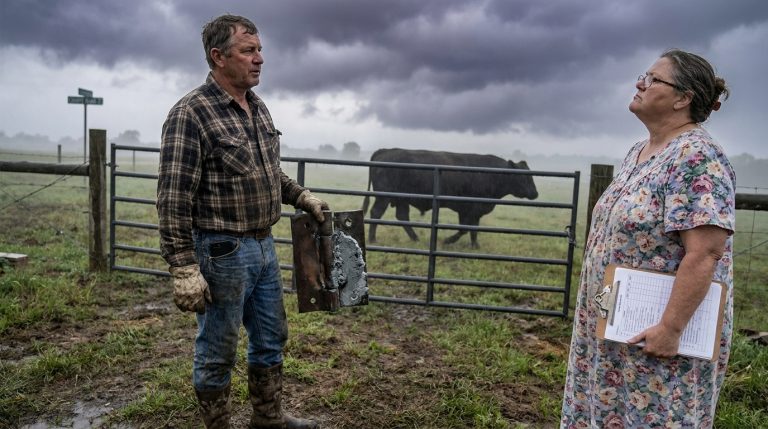
The notice felt like a cheap joke printed on expensive paper, but the cold glare in Karen’s eyes was entirely real. She stood ten feet inside the property line, clutching her clipboard like a shield, her gaze fixed on the solid oak of the barn my father and I had built with our own calloused hands thirty years ago. To her, it was an aesthetic flaw in her uniform world of beige siding and manicured lawns. To me, it was a monument to endurance.
I did not raise my voice. A quarter-century as an Army combat engineer teaches you that the loudest man in the room is rarely the most dangerous. I simply took the paper, turned on my heel, and walked back into the cool dimness of the house.
Inside, the kitchen was quiet. I laid the final notice of asset forfeiture squarely on the wooden table, the stark black text mocking the silence. My hands were steady, but beneath my ribs, a cold, measured fire began to burn. She wanted a war of attrition. She wanted to erase a foundation that had stood long before her subdivision ever carved up the surrounding farmland.
I walked over to the corner of the office and pulled the existing file from the drawer—every courtesy notice, every escalating fine, every certified receipt neatly sleeved in plastic. With a digital camera in hand, I stepped back outside into the sharp afternoon light. I photographed the precise joinery of the barn, the unyielding roofline, and the survey stakes marking the boundaries of my five-acre sovereign island. Every image was captured with clinical precision, framing the contrast between ancient craftsmanship and modern entitlement.
When the documentation was complete, I sat back down at the desk with a fresh legal pad, uncapped a pen, and wrote a single heading at the top of the page: Operation Karen. She had crossed a line that could not be uncrossed, and the first rule of engineering is that you never let an uncontained threat establish a foothold on your ground.
I closed the binder, the snap of the metal rings echoing in the empty room, and reached for the phone.
CHAPTER 2: Whispers Over the Roses
The metal snap of the war binder locking shut remained the only sound in the dim office, a crisp mechanical punctuation mark that settled the dust of my immediate thoughts. I left the house through the back screen door, letting it swing shut with a dull, heavy thud against the weather-stripped frame. The afternoon air carried the dry scent of dust and cut grass, sharp and distinct against the unchanging backdrop of my five-acre refuge.
There was no time to wait for Karen’s next move. A combat engineer does not sit in a fortified bunker and wait for the sappers to lay charges; you push the line forward, map the terrain, and locate the weak points in the enemy’s perimeter.
I walked the perimeter of my yard toward the eastern boundary, keeping my boots planted firmly on the hard-packed earth of my own land until I reached the wire fence separating my property from the Whispering Pines subdivision. Just beyond that rusted wire stood Martha’s immaculate garden, a meticulous grid of red roses that looked entirely out of place against the uniform sea of beige siding behind them.
Martha was there, kneeling on a blue foam pad with a pair of pruning shears in her hand, carefully snipping dead leaves from a blooming crimson stem. The new black mailbox, mandated by Karen’s strict compliance decrees, stood rigidly at the edge of her driveway like a grim, dark sentinel.
I didn’t call out. I simply walked up to the fence line, resting my hands on the weathered top rail of the wire. The cold metal bit into my palms, a grounding texture that matched the calculated rhythm of my thoughts.
“Martha,” I said quietly.
She flinched slightly, her shears snapping shut on empty air before she turned, her tired eyes softening as she recognized me. She set the shears down on the foam pad, wiped her dirt-stained hands on her apron, and stood up with a slow, deliberate stiffness that spoke of years spent tending soil.
“Jack,” she murmured, glancing quickly up and down the empty street to ensure no prying eyes were watching from the identical windows across the asphalt. “You shouldn’t be out here making yourself a target. Word is spreading about that notice she handed you.”
“Let it spread,” I replied, keeping my voice level, stripped of any frustration. “Karen thinks she can drop a formal paper-trail bomb on my front lawn and expect a quiet evacuation. She miscalculated the terrain.”
Martha stepped closer to the fence, lowering her voice to a raspy whisper. “She’s been holding those board meetings like coronations, Jack. Nobody dares question her. Janice and Bob just sit beside her on that tribunal stage and nod like wind-up toys. And the money—nobody knows where the dues actually go. She collected thousands in fines last year alone, and the financial reports are just a single sheet of paper with bloated, round numbers. When people ask for itemized receipts, she tells them it’s too complex for regular homeowners to understand.”
I leaned slightly against the wooden post, absorbing the tactical data. Opaque accounting and dismissive condescension were the classic hallmarks of an unauthorized power structure hiding its tracks. Self-dealing rarely lived in the open; it always hid behind layers of bureaucratic complexity.
“Too complex,” I repeated, tasting the irony on my tongue. “What about her major projects? The community pool?”
Martha scoffed, a sharp, bitter sound devoid of humor. “Her crowning achievement. Cost a fortune. Our monthly dues spiked thirty percent the summer they broke ground on it. She said it would elevate our property values into the premier tier, but all it did was line the pockets of her favorites and lock us into higher maintenance fees.”
“And who built it?” I asked, keeping my gaze locked on hers.
“Some commercial contractor she brought in from out of county,” Martha said, furrowing her brow. “Nobody ever saw the bidding process. It just appeared one day, all waterfalls and expensive landscaping.”
The pieces were beginning to align, snapping into place with the cold precision of a well-designed bridge span. An expensive commercial project built without local oversight, funded by opaque budgets run by a president who treated the neighborhood like a personal fiefdom. The foundation was rotting from the inside, held together only by intimidation and the blind compliance of residents too exhausted to fight back.
“Thank you, Martha,” I said, giving the fence post a firm, reassuring pat. “Keep your head down for now. Let her think the noose is tightening around my barn. The ground is about to shift beneath her feet.”
Martha offered a tight, solemn nod, her eyes flashing with a spark of long-suppressed defiance. “Give her hell, Jack.”
I turned away from the fence and walked back across the sunlit expanse of my property toward the silent silhouette of the barn. My father’s legacy wasn’t going to be painted beige, and Karen Thompson was about to discover what happens when an immovable object stops defending its perimeter and starts mapping the enemy’s flaws.
CHAPTER 3: The Void in the System
The screen of my office monitor cast a pale, steady blue light across the dark grain of the wooden desk. Outside, the sun had slipped entirely below the distant treeline, leaving the five-acre property wrapped in the sharp, clean shadows of early evening. But inside, the only motion was the steady, rhythmic tapping of my fingers against the keyboard as I navigated the clunky, archaic architecture of the county’s public records portal.
Martha’s words about the bloated landscaping costs and the secretive board meetings were still fresh in my mind, but a combat engineer does not rely on hearsay when physical verification is possible. You look for the blueprints, you check the inspection logs, and you find where the load-bearing calculations fail.
I started with the Whispering Pines subdivision’s corporate filings. On the surface, the structure looked standard enough: Karen Thompson listed as president, flanked by her two reliable board members, Janice and Bob, holding down treasurer and secretary duties. Every annual report was submitted on time, neat and orderly. But the moment I pulled the financial spreadsheets attached to those filings, the structure began to warp under scrutiny.
The numbers were massive, round, and entirely unitemized. A single line item for administrative costs sat at twenty thousand dollars; another for general maintenance ballooned past fifty thousand. There were no contractor names, no material invoices, no paper trail to justify where the funds actually went. It was the kind of sloppy, opaque accounting that screamed self-dealing.
I opened a separate browser window and ran a targeted search for any commercial enterprises registered under Karen Thompson’s personal name or residential address.
The database spun for a few seconds before returning a single, neat result: Thompson’s Premier Landscaping LLC.
The registration date flashed on the screen like a red light. It had been officially filed exactly two months after she assumed the presidency of the homeowners association. I pulled up the historical HOA budgets side-by-side with the LLC’s creation date, and the correlation was glaring. The moment she took control of the neighborhood purse strings, the landscaping expenditures tripled overnight, funneling straight into a private, no-bid account she controlled. She wasn’t just managing a community; she was treating the residents’ monthly dues as an open-ended line of credit for her own bank account.
Yet, as damaging as the financial paper trail was, it still felt like a localized skirmish—a disciplinary infraction rather than a decisive blow. To break her grip on the neighborhood, I needed something structural. My eyes drifted back to the community pool, her crown jewel, the expensive resort-style oasis featuring a waterfall and custom stone coping that had justified a thirty percent spike in homeowner dues the previous summer.
A project of that magnitude—costing a quarter of a million dollars—requires an immense apparatus of legal compliance. Excavation permits, structural engineering reviews, electrical load calculations, plumbing seals, and county health inspections. Every single phase of construction must leave a permanent, public footprint in the municipal database.
I navigated to the county permit portal, cleared my search filters, and typed in the precise parcel ID and street address of the community clubhouse.
The system processed the request, the little digital loading icon spinning in circles before the results populated the screen. I leaned forward, narrowing my eyes at the text.
There was a permit for a minor fence repair executed five years prior. There was a permit for a small signage installation before Karen’s tenure. But for the entire span of the previous year—the exact window when heavy machinery carved up the earth to install a massive, commercial-grade swimming pool—the results returned absolute zero.
I tried searching by the contractor’s name, leaving the field blank except for regional parameters. Nothing. I tried searching by parcel numbers of adjacent lots, cross-referencing zoning codes. The digital void stared back at me with deafening silence.
The Whispering Pines Community Pool did not legally exist.
A cold wave of realization washed over me, sharper and heavier than any threat she had leveled against my barn. In this county, you cannot pour a concrete slab for a backyard utility shed without a municipal sign-off, let alone excavate thousands of gallons of water capacity surrounded by high-voltage pump stations and complex filtration systems without a mountain of engineering oversight.
Without permits, there were no inspections. Without inspections, there was no verification of whether the electrical grounding around the water intake pumps met safety codes, or if the structural rebar was thick enough to prevent catastrophic shifting in the clay soil. And most terrifying of all was the insurance implication. No commercial insurance carrier on earth would knowingly write a liability policy for an entirely unpermitted, uninspected aquatic facility.
If a child slipped, or if a pump malfunctioned, the HOA’s master insurance policy would treat the structure as a ghost asset—voiding coverage entirely. The financial ruin wouldn’t just fall on the association as an abstract corporate entity; it would pierce the corporate veil and land directly on the personal assets of every single homeowner in the subdivision. They were all sitting on a financial landmine, entirely unaware that the queen of compliance had built her shining monument on a foundation of pure lawlessness.
My fingers hovered over the keyboard. The contrast was absolute. My father’s barn, weathered by decades of wind and rain, was built with meticulous precision, double-measured and solid to the core. Her gleaming, expensive pool was a hollow legal hazard dressed up in beige paint and tile.
She had spent two years harassing me over the aesthetic integrity of historical timber, while she had single-handedly exposed her entire neighborhood to ruinous liability.
I reached for my phone, scrolling down my contacts until I found the number of the attorney my old military unit buddy had recommended. Ben Carter. A former sapper turned corporate litigator who understood the value of holding your fire until the enemy steps directly into the kill zone.
I didn’t call him yet. It was too late in the evening to drag him into preliminary logistics. Instead, I saved the screenshots, downloaded the digital receipts, and slotted them into the digital folder of my war binder. The trap was no longer theoretical. Karen Thompson hadn’t just overstepped her bounds; she had built her own gallows, and tomorrow, I was going to hand the blueprints over to a man who knew how to pull the lever.
CHAPTER 4: The Operational Briefing
The low hum of the desktop computer faded into the quiet stillness of the room as I closed the browser windows and pulled the physical pages of the war binder together. The digital void I had uncovered in the county database was no longer just a theoretical flaw; it was a loaded weapon. But weapons require maintenance, calibration, and an operator who knows how to navigate the courtrooms of civil law just as cleanly as an engineer navigates structural loads.
The next morning, the drive into the city offered a sharp contrast to the quiet gravel roads of my five-acre property. The landscape transitioned from open green fields to sleek, towering monoliths of steel and tinted glass—a world of polished surfaces where power was negotiated across mahogany desks rather than fence lines.
Ben Carter’s office occupied the thirty-second floor of a high-rise overlooking the downtown civic center. When I stepped off the elevator, the heavy glass doors swung open into an environment that felt entirely transactional. There were no family heirlooms here, no handcrafted timber monuments to the past. Just clean lines, minimalist art, and the steady, quiet hum of air conditioning filtering the city air.
Ben stood up from his desk as I entered, a sharp-featured man in his early forties wearing a charcoal suit that looked like it had been tailored for precision movement. He didn’t offer a theatrical handshake; he offered a firm, brief grip and a nod that acknowledged mutual understanding.
“Mr. Hayes,” Ben said, gesturing toward a leather chair opposite his desk. “Your message indicated you found something substantial. Let’s hear it.”
I didn’t waste time with pleasantries. I set the war binder down on the polished glass surface and flipped it open to the printed screenshots and county financial records I had compiled the night before.
“Karen Thompson isn’t just running an aggressive homeowners association,” I began, my voice steady and measured. “She’s built a closed loop of self-dealing and municipal evasion.”
I slid the corporate registration papers and the municipal budget comparisons across the desk. “Two months after taking the presidency, she formed Thompson’s Premier Landscaping LLC. From that exact month onward, the neighborhood’s landscaping expenditures tripled, funneling directly into her own corporate accounts without itemized invoices or competitive bids.”
Ben’s eyes narrowed as he scanned the documents. A slow, predatory grin touched the corners of his mouth—not a warm expression, but the look of a strategist recognizing a fatal miscalculation in enemy deployment.
“Classic self-dealing,” Ben murmured, his fingers tracing the edge of the financial printout. “It breaches fiduciary duty, and if the funds crossed state or federal reporting lines, it opens up serious civil fraud liability. But embezzlement and sketchy vendor contracts are standard corporate theater in small-time HOA politics. It’ll drag out in civil court for months. What else do you have?”
I slid the final paper across the glass—the certified statement from the county records office detailing the absolute absence of construction, electrical, or plumbing permits for the Whispering Pines community pool.
Ben stopped reading. He looked up from the paper, his gaze locking onto mine with absolute stillness. For a long moment, the only sound in the office was the distant drone of city traffic far below the window.
“No permits,” Ben whispered, the grin widening into something razor-sharp. “Not for a tool shed. Not for a quarter-million-dollar commercial aquatic facility.”
“Nothing,” I replied. “No excavation filings, no electrical inspections, no structural sign-offs. The contractors she hired worked completely off the books. In the eyes of the county, that pool does not exist.”
Ben leaned back in his leather chair, steepling his fingers together as his mind raced through the legal implications. “Which means no safety inspections on the high-voltage pumps, no verification of the rebar depth, and most critically—no commercial insurance carrier will touch it. If a child gets hurt or a short circuit triggers an accident, the liability shield drops entirely. The courts won’t look at the HOA as a corporate shield; they’ll pierce it straight through to the individual homeowners.”
“Every single resident in that subdivision is personally exposed to a ruinous lawsuit,” I added. “And Karen built it as her crown jewel.”
Ben stood up, walking over to the floor-to-ceiling window to look out over the sprawling grid of the city below. The tactical picture was complete. We had moved past defense.
“Here is our play,” Ben said, turning back around with calculated precision. “Karen has called a special public hearing in two weeks specifically to vote on the asset forfeiture of your barn. She’s bringing her own small-time lawyer, she’s bringing her board members, and she’s expecting a public execution.”
“She wants to make an example of me,” I said.
“Exactly,” Ben nodded. “So we let her have her theater. We don’t tip our hand in advance. You show up to that meeting with your deed and your grandfather clause, presenting your case calmly and strictly by the book. Let her pass her illegal three-to-zero vote. Let her stand up in front of the entire neighborhood and declare victory.”
Ben paused, his eyes gleaming with cold satisfaction. “And the moment she gavels the seizure through, I take the floor. We don’t argue about the barn. We drop the reality of the unpermitted pool right in the middle of the room. We give every homeowner in that subdivision the exact legal ammunition they need to dismantle her entire board.”
“She’ll try to spin it,” I warned.
“She can try,” Ben said, sliding the documents back into a neat folder. “A bully in a boardroom relies on intimidation until the structural foundation gives way under their feet. We are going to let her climb as high as she possibly can on her mountain of arrogance before we kick the props out.”
The plan was locked. It required discipline, patience, and absolute silence over the next fourteen days while Karen planned her triumphant ambush. I closed the war binder, secured the papers, and stood up. The combat engineer in me recognized a well-engineered operation. The trap was set, and the enemy was walking straight toward the center of the kill zone.
CHAPTER 5: The Tribunal
The community clubhouse smelled faintly of commercial bleach, stale coffee, and artificial pine, a sterile environment designed to project institutional authority. Rows of cheap metal folding chairs faced a raised long table at the front of the room, where Karen Thompson sat flanked by her two board members, Janice and Bob, like a tribunal presiding over a staged trial. A small, flimsy wooden podium stood to one side, intended for whoever was unfortunate enough to be called to account.
I walked through the double doors with Ben Carter walking step-for-step beside me. I carried my war binder—now a thick, tabbed record of targeted harassment and institutional overrule—while Ben carried a sleek, zippered leather briefcase containing certified municipal printouts. We did not slip into the back rows or seek out the shadows. We took our seats in the very front row, right under the gaze of the tribunal.
Within minutes, the rest of the room began to fill. Martha arrived first, her expression carved from absolute resolve, taking a seat directly on the aisle. The Rodriguez family filed in right behind her, followed by Mr. Gable and a dozen other residents who had spent the past two weeks quietly organizing on our encrypted chain. They scattered themselves methodically across the rows, creating an unavoidable physical block of dissent.
Karen looked up from her paperwork, her severe navy blue pantsuit framing a posture of rigid smugness. For a fraction of a second, her eyes registered the larger-than-usual crowd and the sharp, unblinking focus of the faces arrayed before her. A flicker of confusion crossed her features, but it was instantly smoothed over by her default expression of bureaucratic dominance. She assumed they were there to watch her execute a textbook seizure.
She banged a small wooden gavel against the table with unnecessary force.
“This special hearing of the Whispering Pines Homeowners Association is now in session,” Karen announced, her voice bouncing harshly off the acoustically poor ceiling tiles. “The sole item on tonight’s agenda is the persistent and egregious violation of community standards by the property at fifteen-fifteen Oak Creek Road, owned by Mr. Jack Hayes.”
She didn’t look at me. She pointed a manicured finger toward the air, launching into a fifteen-minute speech detailing her vision of a premier, cohesive community. She projected enlarged photographs of my barn taken from public streets through telephoto lenses, manipulating the lighting to cast the weathered oak planks in the worst possible shadow.
“This structure,” she declared, tapping a photograph with her clipboard, “stands as a deliberate defiance of the standards we have all agreed to uphold. It drags down property values and threatens our collective excellence.”
Her hired lawyer, a nervous man in a rumpled gray suit sitting at the end of the table, chimed in on cue with legal justifications built entirely on fabricated emergency bylaws. Ben leaned down slightly, his voice a low, steady murmur near my ear. “Let her finish. Let her lock the vote in.”
Karen turned her attention down to me, her smile tight and triumphant. “Mr. Hayes, you have five minutes to explain why this board should not proceed with the immediate remediation and forfeiture of this non-compliant structure.”
I stood up, walked deliberately to the podium, and opened my binder. I did not raise my voice; I did not lean into anger. I simply laid out the facts.
“My name is Jack Hayes,” I began, my tone even and rhythmic. “My family has owned this property since nineteen forty-eight. The barn was built by my father and me. As this official county deed explicitly states, my five-acre property is permanently exempted from the Whispering Pines HOA covenants. This board has no legal jurisdiction over my land.”
I held up copies of the recorded survey and county filings for everyone to see. I concluded in under four minutes and sat back down in my front-row seat.
Karen waved her hand dismissively, refusing to acknowledge the physical document. “We are well aware of the so-called grandfather clause, Mr. Hayes. However, the board’s emergency amendments grant us full authority to act against external threats to community value.” She swept her gaze across her loyalists. “I call for a vote on the motion to authorize the board to take all necessary steps, including physical remediation and legal seizure, to assume control of the structure.”
“I second the motion,” Janice snapped shrilly.
“All in favor?” Karen asked. Her hand shot straight up into the air, instantly mirrored by Janice and Bob.
“The motion passes three to zero,” Karen declared, a broad, radiant smirk spreading across her face. “The barn is now under the administrative control of the association. This hearing is adjourned—”
“A point of order, Madam President.”
Ben Carter’s voice sliced through the room like a cold razor. He stood up, towering over the front row with absolute, immovable calm.
Karen froze, her gavel hovering a fraction of an inch above the table. Her smirk faltered, replaced by sudden, sharp irritation. “And who are you? This meeting is strictly about Mr. Hayes’s property violation. Any other business is completely out of order.”
“On the contrary,” Ben replied, stepping into the center aisle so his voice carried clearly to every corner of the room. “My name is Benjamin Carter, counsel for Mr. Hayes. And before this board adjourns, I have a few vital questions regarding a different matter of fiscal accountability and public safety—a matter every homeowner in this room has a legal right to hear about.”
The air in the room instantly chilled. Karen’s posture stiffened. “This meeting is adjourned,” she repeated, her voice rising in pitch. “You have no floor here.”
“Let’s talk about the community pool,” Ben said smoothly, ignoring her command entirely. “A project costing a quarter of a million dollars according to your own financial reports. For the record, Madam President, could you please direct the homeowners to the county-approved construction and electrical permits for that facility?”
The room went dead silent. You could hear the faint hum of the overhead fluorescent lights. Karen’s face drained of color, her mouth opening and closed like a fish stranded on dry land.
“Permits?” she stammered, her voice cracking slightly. “Of course there were permits. The contractors handled all of that.”
“And what is the name of that contractor?” Ben pressed, taking another step forward. “Because I hold in my hand a certified statement from the county records office, dated yesterday. It confirms that no permits for construction, plumbing, or electrical work were ever applied for or issued for that address during the entire period of the pool’s construction.”
Ben held a single sheet of paper aloft, letting the stark black text catch the light. “In the eyes of the law, that pool does not exist.”
A collective gasp swept through the folding chairs. People turned to one another, eyes wide with sudden, dawning terror. Martha nodded grimly from the aisle. The Rodriguez family stared directly at the tribunal, their expressions hardening from confusion into pure, unadulterated fury.
“It’s a lie!” Karen shrieked, slamming her hand onto the table. “He’s fabricating documents to distract from his own violations!”
“It’s a public record,” Ben countered, his voice cutting cleanly through her panic. He turned his attention directly to the homeowners, raising his volume so every person in the rows could absorb the full weight of the words. “What this means for all of you is that the pool was never inspected by the county. There is no verification of electrical grounding around the water pumps. There is no structural sign-off. And most critically, no insurance company will cover an illegal, unpermitted structure. If an accident occurs, the master liability policy is completely void. The lawyers won’t sue the HOA corporation; they will come directly for your homes and your personal assets.”
The room exploded.
Shouts erupted from the back rows. Mr. Rodriguez stood up, pointing a finger directly at the terrified board members. “My children swim in that water every single week! You risked our families?”
“Recall!” someone yelled from the middle rows. “Recall the board!”
The chant caught fire instantly, bouncing off the beige walls louder and sharper with every repetition. “Recall! Recall! Recall!”
Karen stood frozen behind the long table, her face mottled and distorted by panic. Her two board members cowered in their seats, while her rumpled lawyer packed his briefcase with frantic speed and slipped out the side door into the night. The tribunal had collapsed into a riot, and the queen of compliance had nowhere left to run.
CHAPTER 6: The Foundation Restored
The chaotic roar of the community clubhouse dissolved into a heavy, suffocating silence by the time the emergency session ended. Karen Thompson did not stay to face the wreckage of her own making. Gathering her paperwork with shaking, fumbling hands, she had pushed past the surging wall of angry homeowners and retreated into the dark, vanishing behind the locked doors of her beige house. Her two board members, Janice and Bob, submitted their formal resignations via email before sunrise, while their legal counsel remained entirely unreachable.
The collapse of the regime was absolute, but the operational clean-up required the steady, methodical execution of a combat engineer clearing a compromised zone.
The fallout began early the following Monday morning. Standing on my front porch, nursing a cup of black coffee, I watched a heavy-duty county vehicle turn off the main asphalt and rumble down the subdivision street. A grim-faced municipal inspector named Miller stepped out, carrying a clipboard and a roll of industrial zip-ties. He walked the perimeter of the resort-style pool that Karen had built without a single sheet of paper or municipal sign-off. He didn’t linger; he didn’t debate. With practiced efficiency, he secured a bright red, weather-resistant placard across the main iron gate.
Unsafe structure. Do not enter. By order of the county building department.
The jewel of Karen’s kingdom was officially condemned. The pool was drained within days, leaving behind a stark, cracked concrete basin that mirrored the hollowness of her administrative overreach. The municipal report, which quickly circulated among the homeowners, confirmed every worst fear: improper electrical grounding near the water intake valves, non-compliant suction drains, and a total absence of structural engineering reviews. It was a municipal hazard masquerading as a luxury asset.
Legal and political restructuring followed with relentless speed. An emergency election was held two weeks later to form an interim board, spearheaded by Martha and the Rodriguez family. To ensure stability and integrity, the neighborhood elected Mr. Gable—the quiet, retired teacher whose vegetable patch had once been the target of Karen’s petty fines—as the new interim president. His first official act as president was swift and unequivocal: he proposed a formal motion to strike down bylaw seventeen, section C, and to issue a written, unreserved apology to me regarding the unlawful attempt to seize my family’s property. The motion passed unanimously, accompanied by a sharp round of applause that echoed off the very walls where Karen had once held court.
The new board’s second act was financial triage. They brought in an independent forensic accountant to audit the neighborhood’s books. The investigation laid bare the extent of Karen’s corruption: no-bid contracts funneled directly into her newly minted landscaping LLC, and thousands of dollars in neighborhood dues siphoned off for personal expenses disguised as administrative supplies. The findings were immediately handed over to the district attorney’s office, leaving Karen facing potential criminal charges for embezzlement alongside her complete social ostracization. Her car remained parked inside her garage, her curtains permanently drawn. The queen had locked herself in her own tomb.
As for the condemned pool, the community was forced to make a hard choice between an astronomically expensive rebuild or complete demolition. Opting for practicality, the residents passed a special assessment to tear down the hazard and convert the space into a simple, open green park.
One Saturday afternoon, weeks after the dust had finally settled, the heavy rumble of construction equipment could be heard faintly from the center of the subdivision as a bulldozer broke apart the remaining concrete shell of the pool. But out on my property, the world was entirely still.
I stood by the side of my father’s barn, a fresh can of protective wood sealant in one hand and a wide brush in the other. The warm afternoon sun caught the rich, deep grain of the oak planks, highlighting the tight joinery and solid framing we had built together decades ago. The wood was weathered, marked by time and weather, but it was structurally unyielding.
Mr. Gable walked up the gravel drive, stepping carefully around the restored boundary stakes before stopping near the open doors of the barn. He looked up at the timber roofline, then glanced out toward the distant green space where the bulldozer was quietly reshaping the neighborhood.
“Funny how things work out, Jack,” Mr. Gable said, his voice quiet and reflective. “She spent two years trying to tear down a historic structure because it didn’t fit her idea of perfection. And in the end, the only thing that got demolished was her own illegal empire.”
I set the sealant can down on a wooden workbench and wiped my hands clean on a rag, letting the quiet rhythm of the afternoon settle around us.
“She tried to erase a foundation she didn’t understand,” I replied, looking back at the solid oak beams. “You don’t build things just to match the surface, Mr. Gable. You build them to last against whatever pressure comes down the road.”
“Well,” the old teacher said with a faint, appreciative smile, “you woke us all up. The neighborhood is finally starting to feel like a community again instead of a barracks.”
“People just needed to see that the rules protect everyone, or they protect no one,” I said.
He nodded slowly, offered a respectful parting gesture, and turned back down the driveway toward the subdivision. I watched him go until his figure receded into the distance, leaving me alone with the quiet hum of the countryside.
I picked up the brush, dipped it into the rich amber sealant, and applied a smooth, even stroke to the lower sill of the barn. The wood drank it in, the grain darkening and tightening against the elements. The war was over, but the victory didn’t feel like a conquest. It felt like balance restored. The property line was secure, the history was intact, and the quiet peace of the land had finally returned to where it belonged.