A Quiet War Waged in the Dust: How a Retired EOD Technician Dismantled an HOA Tyranny With Cold Logistics
CHAPTER 1: THE WEIGHT OF THE HIVE
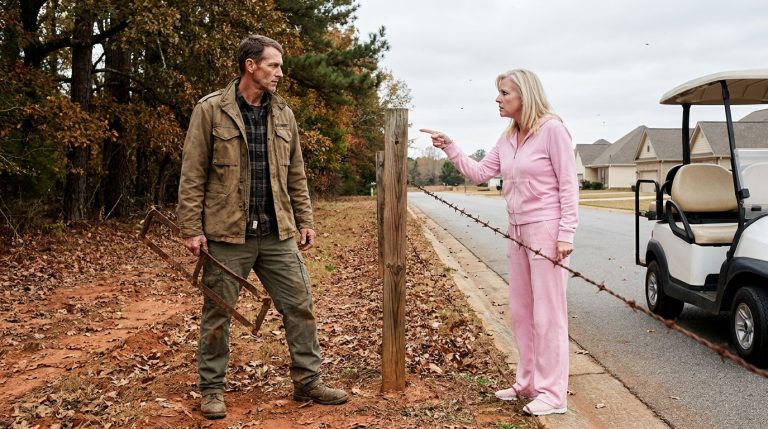
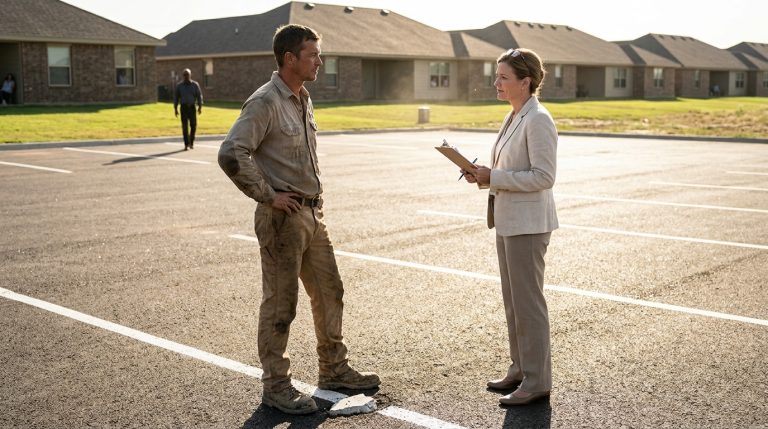
The afternoon air carried the dry, metallic tang of sun-baked cedar and the low, vibrational hum of thousands of wings working in unison. Jack straightened slowly, the vertebrae in his lower back clicking into place with a familiar, dull ache. Twelve years of defusing high-explosive ordnance in desert heat had taught him the value of absolute stillness, of letting the adrenaline spike fade before making a micro-adjustment. He applied that same unhurried discipline now, looking down at the heavy floral pantsuit standing on the edge of his property line as if the grass itself might stain it.
Karen did not look like an adversary built for open field combat; she was constructed of rigid lines, clipboard armor, and an absolute, unyielding entitlement that smelled faintly of lemon bleach. Beside her, Gerald clutched his plastic-coated folder like a man holding a detonator switch with no idea which wire to cut.
“The fine is five thousand dollars, due immediately,” Karen repeated, her voice cutting through the rhythmic drone of the apiary. She held the envelope out as though bestowing a citation upon an insurgent.
Jack did not reach for it immediately. He let the silence stretch, measuring the distance, calculating the angle of her posture. The five-acre plot at the dead-end fringe of the development was supposed to be a dead zone, a buffer between his past life and whatever quiet he could salvage out of the wreckage. His therapist at the VA had prescribed the bees—a living, breathing focus requiring hands steady enough to handle a queen cage without crushing her thorax.
When he finally took the envelope, his fingers—stained with sticky, dark amber resin—left a distinct thumbprint on the corner of the thick, expensive bond paper.
“These are Italian-strain honeybees, Karen,” Jack said, keeping his tone flat, stripped of all inflection. “They don’t produce smoke, fumes, or noise. They have a state agriculture permit signed by Dr. Grant himself.”
Karen’s smile didn’t reach her eyes; it tightened into a sharp, structural crease. “State permits don’t pave our roads or maintain our property values, Mr. Thompson. The covenants are absolute. You have thirty days to remove the infestation before the numbers start multiplying.”
She turned on her heel, her companion scuttling in her wake like a pilot fish caught in the wash. Jack stood motionless on the sun-bleached grass as the quiet settled back over the hives. But the hum had changed frequency, turning from a meditative drone into a low, persistent hum of friction. He walked back toward the converted barn workshop, the gravel crunching under his boots, knowing precisely what phase of the operation they had just entered.
CHAPTER 2: THE WORKSHOP STRATEGY
The screen door of the converted barn groaned on its rusted iron hinges, a dry, protesting shriek that Jack had never bothered to oil. Inside, the space smelled of old oak shavings, warm beeswax, and the sharp, coppery tang of metal files. It was an environment built for precision, where every tool had its designated shadow on the pegboard, and every millimeter of tolerance mattered.
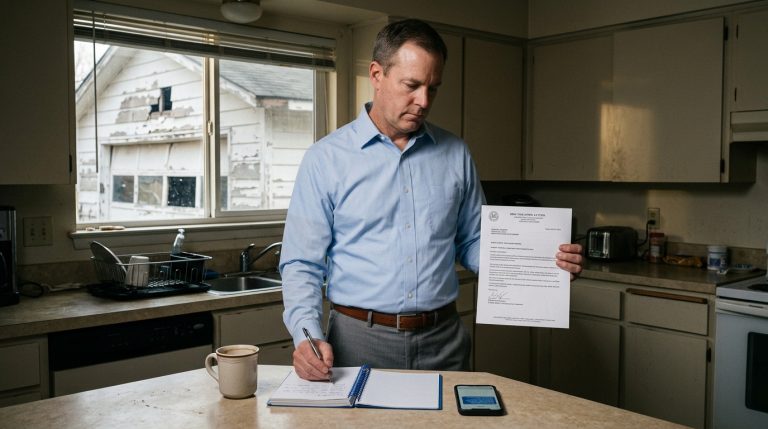
Jack tossed the formal notice onto the scarred butcher-block workbench. The five-thousand-dollar figure stared back up at him in bold, clean typography—a stark manifestation of paper tyranny.
He didn’t reach for a phone, and he didn’t storm down the asphalt to hammer on her door. That was the mistake most people made when confronted with institutional pressure; they reacted with raw, uncalculated heat, matching the aggressor’s emotional volume and handing them the advantage of the narrative. Instead, Jack walked over to the corner sink, turned the brass handle, and scrubbed his hands with a pumice stone, working the dark, sticky propolis out from under his calloused fingernails. The water ran cold, biting into his skin.
Twelve years of clearing unexploded ordnance in the arid ruins of Kandahar had burned a singular truth into his nervous system: panic was a lethal variable, and haste was a structural flaw. When a tripwire was buried beneath two feet of sun-baked silt, you didn’t yank the line to see where it led. You cleared the dirt inch by inch, mapped the tension points, and neutralized the mechanism before it had room to breathe.
He dried his hands on a rough rag, walked to his metal filing cabinet, and slid open the bottom drawer. Inside, nested behind his DD-214 discharge papers and medical evaluations from the VA, was a thick manila folder labeled Covenants & Jurisdiction.
He pulled it out, carried it to the workbench, and laid it flat beneath the harsh yellow beam of an articulated swing-arm lamp.
The HOA covenants were a dense, bureaucratic brick of legalese designed to induce exhaustion in anyone foolish enough to read past the first ten pages. Most residents signed the closing documents without cracking the spine, treating the rules as background noise until someone like Karen weaponized them. Jack had spent three weeks with a highlighter and a legal dictionary before he ever placed a single wooden Langstroth hive on the southern fence line.
His finger traced down Article 9, Section 3. Prohibition against any trade, business, or commercial activity conducted in any way which is noxious or offensive by reason of the emission of odor, dust, fumes, smoke, or noise.
“Noxious,” Jack murmured to the empty room, his voice flat and dry.
The bees didn’t emit fumes. They didn’t burn fuel, roar at midnight, or deposit waste on the shared greenbelts. They gathered nectar from wild mustard and clover, returning silently to their boxes to convert raw pollen into golden, hexagonal combs. They were cleaner than the electric lawnmowers that buzzed up and down the cul-de-sac every Saturday morning.
He reached into the drawer, pulled out a yellow legal pad and a Pilot G2 pen, and began to outline his defense. Not with anger, but with structural architecture.
First, jurisdictional boundaries. The state Department of Agriculture held primary statutory authority over all apiculture within state lines, superseding municipal ordinances and private neighborhood bylaws alike. Dr. Alan Grant, the state apiarist who had walked this exact patch of dry grass three months ago, had signed an explicit certificate declaring the location a protected pollinator habitat.
Second, the psychological necessity clause. He didn’t want to include Dr. Evans’s evaluation from the VA hospital, but the record was a clinical fact. Beekeeping wasn’t a commercial enterprise; it was occupational therapy designed to manage service-related hyper-vigilance. Removing the hives wasn’t just a financial penalty; it was a direct interference with a federally documented medical protocol.
The light through the high, dirty windows of the barn shifted as the sun began to dip behind the line of scrub oaks bordering the state woodland. Dust motes drifted lazily through the amber beam of the lamp, spinning in the thermal currents rising from the small electric heater in the corner.
Jack stopped writing for a second, his pen hovering over the paper as a sharp, sudden gust of wind rattled the corrugated tin roof overhead—a minor atmospheric shift that made the old barn groan like the hull of a ship. He didn’t look up. He kept his eyes locked on the white paper, feeling the familiar, steady rhythm of his own pulse.
Karen wanted a war of attrition. She wanted him to feel isolated, cornered, and financially bled until he packed up his boxes and vanished back into the anonymity he had sought out here. She thought she was running an absolute monarchy on five acres of manicured Kentucky bluegrass.
She didn’t realize that a man who had spent his twenties mapping blast radiuses wasn’t particularly intimidated by someone who weaponized floral pantsuits and laminated clipboards.
Jack finished drafting the first response, signing his name with clean, deliberate strokes. He folded the letter, slipped it into a fresh envelope, and set it squarely in the center of the workbench, weighting it down with a heavy chunk of raw beeswax. The first tripwire had been mapped. Tomorrow, he would walk it down to the management office and demand a signed receipt, watching the gears turn in their administrative machinery as they realized the line wasn’t going to snap the way they expected.
CHAPTER 3: THE ESCALATION AND THE PETITION
The gravel driveway leading to the administrative offices of Westridge Management hummed under the tires of Jack’s aging Ford truck. The building was a single-story brick structure wedged between a strip mall and a concrete drainage ditch—a sterile box of beige dry-wall and fluorescent humming that felt entirely detached from the quiet dirt roads of the outer development.
Jack killed the ignition, the engine sputtering once before dying into silence. He picked up the envelope from the passenger seat, its edges crisp, checked twice for alignment. He didn’t rush his exit. He stepped out onto the sun-baked asphalt, the heat radiating up through the rubber soles of his boots with a dry, mineral bite.
Inside, the reception area smelled faintly of ozone from a copier running overtime and cheap floral air freshener. A young woman with bored eyes and a plastic name tag reading Chloe sat behind a high laminate counter, staring blankly at a glowing monitor.
Jack laid the envelope down on the counter with a deliberate, soft click.
“I need this logged, scanned into the digital ledger, and stamped with a physical date-received receipt,” Jack said, his voice dropping into the quiet cadence that commanded attention without raising volume.
The clerk blinked, her gaze shifting from the screen to the envelope, then up to Jack’s weather-lined face. She reached for the packet, slit the flap with a plastic letter opener, and scanned the first paragraph. Her eyebrows twitched upward, a silent registration of the dense legal citations and the state agricultural seal attached to the back.
“You’re… contesting the assessment from the board president?” she asked, her voice dropping an octave as if discussing a biohazard.
“I’m establishing a formal record,” Jack replied, sliding a pre-typed carbon-duplicate receipt across the counter along with a silver-barrel pen. “Sign and date the duplicate, please. Include the exact time.”
She complied, her pen scratching a hurried signature onto the slip before she fed the document through an old manual stamping machine. The heavy thwack-clack of the metal die echoed sharply off the low acoustic-tile ceiling. Jack pulled the receipt free, checked the ink imprint against his watch, and slid it into his shirt pocket.
The first counter-move was logged. But reality had a way of accelerating when pressure was applied to a closed system.
Four days later, the response arrived not through the mail slot, but via certified delivery that required a physical signature. Jack stood on his front porch under the glare of the midday sun, watching the mail carrier retreat down the gravel path. He broke the seal with his thumb.
The new violation notice didn’t retract the original claim. It multiplied it. The five-thousand-dollar penalty had doubled to ten thousand for failure to comply with the board’s directive, and a secondary assessment of twenty-five hundred had been tacked on for “creating a public nuisance and safety hazard.” Total debt: twelve thousand five hundred dollars.
Jack’s gaze dropped past the bold typography to the attached sheet of paper—a petition.
At the top, typed in neat, neutral fonts, was a warning about the aggressive nature of swarming insects and the liability of anaphylactic shock in a residential zone. Below it were fifteen signatures, scrawled in various inks. Jack’s eyes tracked down the list, and the ambient noise of the afternoon seemed to drop out entirely, leaving only the dull, rhythmic thrum of his own pulse in his ears.
There was the sprawling, jagged signature of the Millers from two doors down. There was the careful, block-letter script of the Patels. And near the bottom, written in delicate, spidery cursive that he had looked at just three days prior when he delivered a fresh jar of spring clover honey, was the signature of Eleanor Gable.
The paper felt suddenly cold between his fingers, despite the heat radiating off the wooden porch railing. Eleanor—the woman who had praised the honey, promised a loaf of zucchini bread, and tended her petunias in the steady hum of his hives—had signed a document demanding their eradication.
Jack walked back inside the house, the hardwood floor cool beneath his boots. The logic didn’t hold. A human equation with a missing variable always pointed back to a flawed premise. Karen hadn’t gathered those signatures by holding neighborhood town halls; she moved through this subdivision like a shadow operating on leverage, fear, and manufactured panic.
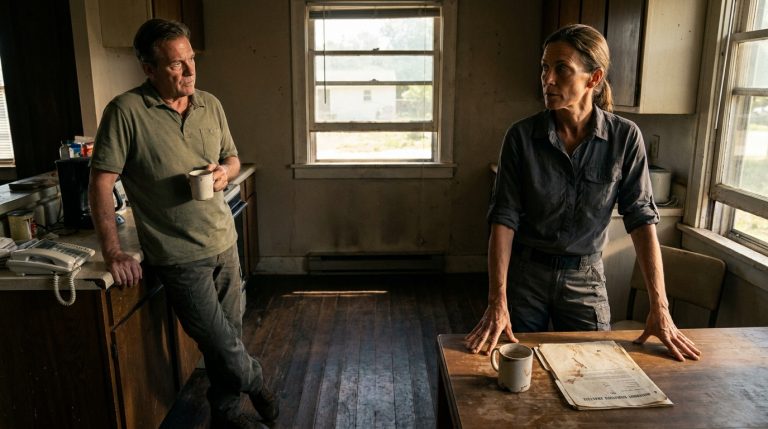
He set the petition down on the kitchen island beside a half-empty mug of black coffee. The air in the room was still, save for the rhythmic ticking of the wall clock.
His reflection stared back at him from the dark glass of the microwave—a man who had spent years defusing hidden triggers buried by unseen enemies, realizing that the most dangerous traps weren’t the ones made of copper wire and C4, but the ones spun from whispers and neighborly trust. He picked up his truck keys from the counter. The paperwork defense had hit a brick wall of fabricated consensus; now, he had to walk the line and find out where the wire had been cut.
CHAPTER 4: REBUILDING THE LINE
The afternoon sun beat down hard against the asphalt of the subdivision roads, baking the scent of dry pine needles and trimmed grass into the heavy air. Jack didn’t drive fast. He kept the truck in second gear, letting the engine hum a low, steady bass note as he navigated down the winding street toward Eleanor Gable’s cottage.
The cottage sat three blocks away, its front lawn a riot of vibrant color—potted petunias, sprawling hydrangeas, and low borders of sweet alyssum. It was a garden that depended entirely on the silent, persistent labor of the very insects Karen was trying to legislate out of existence.
Jack cut the motor, stepped out into the dry heat, and walked up the paved brick path. He carried a small, square mason jar filled with a fresh batch of amber honey, the glass cool against his palm. Before his boots even touched the wooden deck of the porch, the screen door clicked open.
Eleanor stood there, wearing a floral apron dusted with fine white flour, holding a wooden rolling pin loosely at her side. Her bright eyes were lined with a momentary flash of surprise before softening into deep concern.
“Jack,” she said, her voice dropping as she stepped back to let him onto the shaded porch. “I was just pulling the zucchini bread out of the oven. What is it? You look like you’re tracking an unexploded shell.”
Jack didn’t smile. He set the honey jar down on the weathered wicker side table. Then he reached into his jacket pocket, pulled out the folded sheet containing the neighborhood petition, and smoothed it flat across the glass top.
“I need you to look at the bottom line, Eleanor,” he said quietly, his gaze steady on her face.
She put down the rolling pin, adjusted her half-moon reading glasses, and leaned over the table. Her finger, worn by years of gardening and baking, traced down the column of signatures until it stopped near the bottom.
“Well,” she murmured, her breath catching. “That’s my name. My hand wrote those loops. But Jack, I never signed any paper about your bees.”
“Think back,” Jack prompted, his voice maintaining its neutral, unyielding rhythm. “Who had a clipboard last week? Who talked about park benches and neighborhood appeal?”
Eleanor’s brow furrowed deep, the lines on her forehead tightening like dry earth. A flash of sharp realization flickered in her eyes, followed instantly by a surge of heat.
“Karen,” she spat out, the name tasting like ash. “She stopped by last Tuesday while I was transplanting my tomatoes. She had a blue clipboard pressed against her chest like a shield. She was talking on and on about the community pond, about new cedar benches for the seniors, about keeping the neighborhood values high. She pointed right where I should sign. I didn’t even grab my glasses. I trusted her.”
The betrayal in Eleanor’s voice wasn’t loud; it was brittle and cold, the sound of a foundation cracking under stress.
“She lied to you,” Jack said. “She used your name to manufacture a safety hazard against my property.”
“That conniving woman,” Eleanor whispered, straightening up, her hands clenching into fists against her apron. “For ten years she’s played the grand dame of this subdivision, pushing people around just because her husband bought into the developer’s board early on. No one’s ever stood up to her because everyone’s afraid of getting fined. But forging my signature to attack my neighbor? Oh, no. That crosses the line.”
Jack watched the shift in her posture, noting the way the initial shock hardened into a cold, tactical resolve. He had his first anchor on the social front. But a single ally wasn’t enough to break a structural monopoly; he needed to map out the rest of the perimeter before the board could consolidate their next move.
“I need to talk to Dave Miller,” Jack said, glancing down the street toward the row of identical two-story colonials.
“Dave’s a good boy,” Eleanor said firmly, untying her apron and tossing it onto the porch chair. “He’s just busy with that toddler of his, and Karen has been whispering in his ear about safety hazards and liability. Let me get my sunhat, Jack. I’m coming with you.”
The walk down the sun-bleached sidewalk felt less like a neighborhood stroll and more like a reconnaissance patrol across contested ground. The air smelled of hot asphalt and dry turf, the sky above a flat, blinding blue. They turned the corner toward Miller’s driveway, where Dave was wrestling a bag of fertilizer out of the trunk of his crossover SUV.
As the two of them approached, Dave looked up, saw Jack’s face, and instinctively stepped back, his shoulders tensing with defensive guilt.
“Look, Jack,” Dave began, holding up a gloved hand. “I know about the second notice. I saw what the board put out. If it’s about the petition—”
“It’s about the pen strokes, Dave,” Jack interrupted, his voice dropping into a register that stopped the younger man dead in his tracks. He didn’t raise his voice; he simply held out a copy of the state agricultural certificate in one hand and the petition page in the other. “Did Karen tell you my bees were unlicensed, or did she tell you they were chemical hazards?”
Dave blinked, swallowing hard as he looked from Jack’s stone-cold expression over to Eleanor, who stood beside him with her arms crossed and fire in her eyes.
“She… she said you were running an uncertified commercial operation right against the property line,” Dave muttered, dropping the fertilizer bag onto the concrete. “She said my daughter, Chloe, couldn’t even play in the backyard safely.”
“She lied,” Eleanor said sharply, stepping closer. “She did the same thing to me with a fake clipboard about park benches. She’s fabricating a crisis, Dave, and she’s using your kids as an excuse to do it.”
Dave stared at them, the color draining slightly from his face as the cognitive dissonance of the situation settled in. He looked down at the state permit, reading the embossed seal and Dr. Grant’s signature. The anger that replaced his guilt wasn’t loud; it was the quiet, dangerous realization of a man who had been played for a fool.
“She told me… she told me everyone on the cul-de-sac had already agreed,” Dave said, his voice dropping to a harsh whisper. He looked toward his own front door, then back at Jack. “Man. She really spun a web, didn’t she?”
” Webs are easy to tear down once you find the anchor points,” Jack said, handing Dave a duplicate of the state document. “Keep this. And keep your eyes open. Because the paperwork war is just getting started, and we’re going to need more than words to dismantle what she’s built.”
Dave took the paper, his fingers curling tightly around the edges. A slow, heavy nod replaced his hesitation. The line was holding, and the perimeter was expanding.
CHAPTER 5: THE BUREAUCRATIC COUNTERSTRIKE
The Ford’s tires crunched across the gravel as Jack pulled back into his own drive, killing the engine before the cooling manifold could even begin to tick in the dry heat. The sun was sliding low behind the treeline of the state woods, casting long, sharp shadows across the stacked wooden supers of his apiary. The bees were returning for the evening, a steady, low-frequency current cutting through the stillness of the yard.
He didn’t go inside. Instead, he walked straight to the back of the truck, unlatched the tailgate, and pulled out a heavy cardboard carton filled with duplicate records, state statutes, and the signed carbon receipts from Westridge Management. It was time to shift from local reconnaissance to institutional leverage.
The bylaws of the homeowners association were built like an old compound: fortified on the outside to keep residents out, but hollow at the core where the administrative machinery operated. Buried deep within Article 12, Section 2 was a transparency clause—a mandatory right for any property owner to inspect and copy all financial records, meeting transcripts, and official vendor contracts upon written demand.
Jack walked into the cool, sawdust-scented quiet of his barn workshop, set the carton down on the workbench, and pulled out a fresh sheet of paper. He didn’t write with anger; he wrote with the clinical, unsparing precision of an ordnance report.
To: Westridge Management and the Board of Directors.
Subject: Formal Demand for Inspection of Records pursuant to Article 12, Section 2.
He itemized every vulnerable seam: two years of complete general ledger entries, itemized expense reports for common area maintenance, all contractor bids and awarded service agreements, and every digital or physical correspondence relating to his property. It was an administrative carpet bomb designed to choke their filing cabinets and force a choice between compliance and explicit contract breach.
He folded the document, sealed it in a heavy-gauge envelope, and drove it directly to the postal station for certified delivery with return receipt requested.
The response arrived seven days later, carried by a curt, one-paragraph rejection letter signed personally by Karen. It stated flatly that the request was “overly broad, burdensome, and seeks confidential proprietary information.”
Jack stared at the signature line under the harsh swing-arm lamp of his workshop. A slow, cold smile touched the corners of his mouth. She had done it. In her absolute arrogance, she had put her refusal in writing, formally violating the association’s own governing documents to stonewash an inquiry. She thought she was building a wall; she had just handed him the detonator wire.
He picked up his phone and dialed a number he had pulled from a veterans assistance registry—the Veterans Legal Institute. Within an hour, he was connected to Sarah Jenkins, a young pro bono attorney whose voice crackled with sharp, unrestrained energy.
“She put a refusal in writing?” Sarah’s voice came through the receiver, bright and predatory. “Jack, that’s not just a procedural hiccup. That’s a breach of fiduciary contract. She thinks she’s a queen, but she just gave us the exact lever we need to crack the whole vault open.”
The meeting was set for the following morning at a quiet corner booth in a diner off the highway. Sarah didn’t bring a notepad; she brought an analytical mind that processed details like an intel brief. Jack slid Karen’s rejection letter across the worn laminate table, alongside the state agricultural protection letter from Dr. Alan Grant.
Sarah read through both documents twice, her eyes narrowing as she digested the legal weight.
“Here is our play,” Sarah said, leaning forward, her voice dropping to a low, tactical murmur. “We use a pincer movement. First, I draft a formal demand letter carrying enough legal gravity to make their corporate counsel sweat through his collar. We demand immediate compliance with the document request and a total rescission of the fraudulent fines, giving them a strict ten-day deadline before we file a motion to compel in civil court. But while I handle the paper front, you handle the ground.”
“The ground?” Jack asked, stirring his black coffee.
“People,” Sarah said sharply. “Karen rules by isolation. She makes targets out of anyone who questions her because she thinks no one else will look behind the curtain. But if you consolidate the neighbors she’s lied to—if you show them that her petty tyranny is hiding administrative chaos—her authority collapses from the inside out.”
Jack looked out the diner window toward the parking lot, where the midday sun glared off the hood of his truck. The strategy was clear. The paperwork war was no longer about defending a few wooden hives on the edge of the woods; it was about exposing the rot beneath the manicured lawns. He finished his coffee, set the cup down with a soft click, and prepared for the next phase of the advance.
CHAPTER 6: THE CLUBHOUSE CONFRONTATION
The community clubhouse usually smelled of damp linoleum and stale coffee from morning committee socials, but tonight the air was thick with a heavy, restless static. The double doors had been propped wide open, yet the cross-breeze failed to clear the palpable tension radiating from the packed rows of folding chairs. Attendance had tripled overnight. Neighbors who typically avoided annual meetings entirely now lined the perimeter walls, their faces lit by the harsh fluorescent glare of overhead troffers.
Jack slid into an empty seat near the back row, his posture rigid, hands resting flat on his knees. Beside him, Eleanor and Dave Miller sat in absolute silence, a united front forged out of discovered deceit.
At the front of the room, behind a long laminate table draped in a forest-green vinyl cloth, sat Karen and her two executive loyalists—Gerald, whose hands fluttered nervously over a stack of color-coded agendas, and Brenda, whose expression remained locked in a defensive, tight-lipped squint. Karen wore another structured pantsuit, this one a slate gray that caught the overhead light like a sheet of galvanized tin. She looked out over the crowded room with an air of absolute, unshakeable monarchy, completely unaware that the foundation beneath her platform had already been hollowed out.
The preliminary items dragged on with tedious, calculated slowness. Approval of previous minutes. Landscaping committee updates regarding seasonal mulch. Jack sat motionless, measuring the cadence of Karen’s voice, noting the slight tremor in her knuckles when she turned a page. She was treating the room like a parade ground, waiting for the designated moment to execute her public shaming.
When she finally tapped her gavel against the wooden block, the sharp crack echoed off the acoustic tiles.
“Moving to new business,” Karen announced, her voice dripping with artificial regret. “The board has received numerous concerned communications regarding an ongoing liability on the outer edge of our development. Specifically, the unpermitted commercial operations and safety hazards maintained on the property of Mr. Jack Thompson.”
Every head in the room swiveled toward the back row. Karen pointed a manicured finger directly at Jack, her smile thin and triumphant.
“Despite multiple warnings, administrative notices, and financial penalties, Mr. Thompson has chosen defiance over community safety,” she continued, raising her voice to capture the room’s undivided attention. “The board cannot and will not tolerate a rogue actor putting our children at risk.”
She paused, expecting the standard ripple of anxious murmurs, the quiet nodding of compliant homeowners falling in line behind her manufactured threat.
Instead, the room remained dead, heavy silence.
Jack did not shout. He did not explode out of his seat. He simply stood up, his movements slow, deliberate, and entirely unhurried. He let the silence stretch for three full seconds before his voice cut through the space, flat, steady, and projecting effortlessly to the front.
“Madam President,” Jack said, his tone carrying the precise weight of an operational brief. “Before the board proceeds with accusations of non-compliance, I have a few procedural questions for the record.”
Karen’s smug expression flickered, her eyebrows snapping together in a sharp crease. “This is not an open floor, Mr. Thompson. The agenda is set by the executive committee.”
“According to Bylaw Article 4, Section 1,” Jack replied, stepping smoothly into the aisle, “any homeowner in good standing retains the explicit right to address the board during new business regarding active administrative notices.”
A low, collective murmur rippled through the middle rows. Gerald dropped his pen, the plastic clatter sounding loud against the laminate table. Cornered by her own written rules, Karen’s jaw tightened until the skin around her mouth went white.
“One question,” she snapped, her voice losing its polished veneer. “Make it brief.”
“First,” Jack said, his eyes locked onto hers without a flicker of hesitation. “Can the board confirm for the record whether it received formal legal notice from the state Department of Agriculture regarding the protected, fully licensed status of my apiary?”
The color drained entirely from Karen’s face, leaving her skin looking chalky under the fluorescent lights. Gerald began shuffling papers frantically, his hands shaking so badly he dropped half the stack onto the floor.
“That—that is an internal administrative matter,” Karen stammered, her composure cracking at the edges.
“So the board acknowledges receipt of a state-level directive clarifying that my hives are neither commercial nor a public hazard,” Jack pressed, his voice unyielding. “And my second question concerns Article 12, Section 2. Why did the executive committee formally deny a legal request for financial ledger inspection, violating the association’s own governing covenants?”
Before Karen could slam her gavel down to cut him off, Eleanor Gable stood up from her chair in the second row. Her small frame radiated an immense, quiet dignity that immediately commanded the room’s focus.
“It’s a valid question, Karen,” Eleanor said clearly, her voice cutting through the rising panic at the front table. “And I have one of my own. Why did you come to my porch last Tuesday with a clipboard, lying about signatures for park benches, when you were actually getting me to sign a petition to hurt my neighbor?”
The room exploded. Shouts of disbelief bounced off the walls. Dave Miller surged to his feet beside Eleanor, pointing directly at the board table.
“She lied to me too!” Dave shouted over the din. “She said my daughter was in mortal danger while hiding the fact that she was stonewalling state permits!”
Karen hammered her gavel three times in rapid succession, the wood splintering slightly against the block as her face twisted into a mask of pure, unadulterated fury. The illusion of control had shattered entirely, leaving only exposed wires and raw, panicked noise.
CHAPTER 7: THE AUDIT ROOM AND THE LEDGER OF EMBEZZLEMENT
The fluorescent lights of Sarah Jenkins’s downtown pro bono office hummed with a flat, electric persistence that matched the steady pulse of the digital scanner across the hall. Five thick cardboard banker’s boxes sat stacked in the center of the large oak conference table like unexploded ordnance waiting for a clearance team.
Jack stood beside the table, rolling up his sleeves. The emergency phone call from the HOA’s newly retained corporate counsel had come less than twelve hours after the clubhouse meltdown: all fines against his apiary were rescinded, all administrative violations expunged, and the requested two-year financial ledgers were surrendered in full to avoid civil litigation.
“They folded faster than a dry tent,” Sarah said, dropping a heavy ring binder onto the wood surface with a dull thump. She pulled the packing tape free from the top carton, breaking the seal with a sharp metal letter opener. “When an executive board realizes their president traded legal authority for a personal slush fund, survival instincts kick in. They threw Karen under the bus before the ink on her gavel could even dry.”
Jack didn’t celebrate. In his line of work, the moment an adversary retreated was the exact moment you checked the surrounding tree line for secondary charges. He pulled the first manila-tabbed folder from the box.
“Let’s see what was hiding behind the drywall,” Jack said.
For the next six hours, the conference room turned into a command post of dry paper and cold numbers. They weren’t looking at bee permits anymore; they were mapping financial vectors. Mr. Henderson, the retired CPA from the neighborhood who had volunteered his expertise, sat at the corner of the table with a high-liter yellow marker in one hand and a calculator clicking rhythmically beneath his thumb.
The first thread unraveled in the landscaping budget.
“Look right here,” Henderson muttered, his finger tapping against a line item labeled Common Area Maintenance – Emergency Planting. “The baseline allocation for the entire subdivision’s greenbelts is one hundred thousand dollars annually. But the actual disbursements hitting the corporate account for the last three years have averaged a hundred and fifty.”
Jack leaned over the ledger, tracing the accounting codes with his index finger. “Where is the variance going?”
“Nowhere in the common areas,” Henderson replied grimly, sliding a separate regional breakdown across the table. “I cross-referenced the work orders with the municipal address map. Every single dollar of that fifty-thousand-dollar annual overage was coded to special project orders exclusively within the cul-de-sac where Karen and her executive cronies live. Brand-new imported stone pathways, mature Japanese maples, custom retaining walls—all paid for out of the general maintenance reserve.”
Jack felt that familiar, cold dead-weight settle into his stomach—the same sensation he used to get when his sweep-rod hit a buried density change in the road. It wasn’t just administrative overreach; it was systematic misappropriation.
Sarah pulled a business entity filing from the second box, her eyes widening as she scanned the registered agent details. “Wait a minute. Look at who holds the commercial contract for Evergreen Vistas—the landscaping firm cashing those inflated checks.”
Jack looked down at the state corporate registry sheet. The name listed as principal owner and registered agent was Frank Miller.
“Frank Miller,” Jack repeated flatly. “Karen’s brother-in-law.”
“A closed loop,” Sarah whispered, a sharp, predatory smile cutting across her face. “She awards no-bid contracts to her family at inflated rates, bills the homeowners association for the difference, and uses her board majority to block any independent audit. It’s textbook white-collar self-dealing.”
Jack flipped open the third folder containing the fine enforcement records. Sarah had spent the morning mapping penalty assessments against property locations using a color-coded spreadsheet. The pattern was an absolute mirror of corruption. Unapproved paint colors, unauthorized lawn decorations, and minor structural modifications belonging to homeowners in Karen’s cul-de-sac showed dozens of documented infractions—every single one marked with a stamped notation: Waived by Executive Discretion.
Meanwhile, families on the opposite side of the subdivision had been hit with thousands of dollars in compounding penalties for identical infractions, culminating in Jack’s fabricated twelve-thousand-five-hundred-dollar bee assessment.
“The petition fraud was just a tactical smokescreen,” Jack said, his voice dropping into a low, steady cadence. “She didn’t care about the bees. She cared about anyone who looked too closely at the administrative perimeter. When I questioned the rules, she tried to crush the dissent before anyone else could see the books.”
Mr. Henderson stacked the highlighted invoices into a neat, squared pile, his expression grim. “We have the money trail, the family ties, the written waivers, and the refusal letters. This isn’t just a matter for an HOA recall vote anymore. This is a criminal referral.”
Jack looked back down at the scattered papers across the oak table. The puzzle was complete. Every wire had been traced, every trap location verified. The final assembly of evidence lay waiting for the morning light, when the entire architecture of her manufactured kingdom would be brought down all at once.
CHAPTER 8: THE HIGH SCHOOL AUDITORIUM AND THE FINAL LEDGER SETTLED
The high school gymnasium smelled of polished hardwood, floor wax, and the dense, collective breath of three hundred agitated residents packed tightly onto metal bleachers and folding chairs. The fluorescent lighting overhead hummed with a harsh, unyielding frequency, casting long shadows across the stage where Karen, Gerald, and Brenda sat behind a long folding table. They looked isolated under the glare, like defendants brought before a military tribunal without counsel.
Jack sat in the front row beside Sarah, Eleanor Gable, and Dave Miller. He did not watch the board members squirm. He kept his eyes fixed on the heavy double doors at the back of the auditorium, where a quiet shift in the air signaled the arrival of the local news crew carrying camera mounts and heavy audio cables.
The neutral moderator from the management firm tapped his microphone, the feedback squealing briefly before cutting through the murmur of the crowd. He called the special recall meeting to order and immediately turned the floor over to Karen for her standard five-minute defense.
Karen stood up, clutching a stack of papers to her chest like a shield. Her voice, usually sharp and commanding, carried a desperate, brittle edge. She launched into a self-pitying tirade, painting herself as a tireless martyr who had sacrificed her free time to protect property values from rogue elements and uncooperative neighbors. She dismissed the financial discrepancies as minor accounting oversights and claimed the landscaping contracts awarded to her brother-in-law were nothing more than a convenient coincidence.
“You are attacking my character over a personal vendetta!” Karen shrieked into the microphone, her face flushing a deep, mottled crimson as the crowd remained dead silent. “I kept this community clean! I kept your investments safe!”
At that exact moment, the side doors of the auditorium swung wide open. A television reporter with a heavy boom microphone and a cameraman bearing a glowing red recording light strode down the center aisle.
Panic flashed across Karen’s features. She slammed her hand down on the table, pointing frantically. “No! No cameras! This is a private executive session!”
“Madam President,” the moderator interrupted smoothly, stepping up to the central mic. “Special recall sessions are matters of public record under state governance. They have every right to document these proceedings.”
The red tally light of the camera locked directly onto Karen’s face. Jack stood up, walked to the podium, and placed a single manila folder on the wood surface. He did not raise his voice; he projected it with the cold, measured cadence of an operational debrief.
“We are not here because of a personal vendetta,” Jack said, his words echoing off the gymnasium walls. “We are here because of documentation.”
Behind him, a projector clicked on, casting a massive digital ledger onto the pull-down screen above the stage. It displayed Mr. Henderson’s audited breakdown of the maintenance overages, side-by-side with the state corporate filings proving that Evergreen Vistas was wholly owned by Karen’s brother-in-law, Frank Miller.
“For three years,” Jack continued, pointing toward the screen, “general association funds—your money—were systematically funneled through inflated, no-bid contracts into private family accounts. While ordinary homeowners faced aggressive, arbitrary fines for minor infractions, the board systematically waived every violation within their own cul-de-sac.”
The auditorium erupted into a wall of angry shouts. Homeowners stood up in the bleachers, waving copies of their own paid penalty notices. The pressure cooker had finally ruptured.
Cornered, stripped of her procedural armor, Karen completely unraveled. She snatched the microphone from its stand, her voice rising to a frantic, hysterical shriek. “Yes, my brother-in-law got the contract! He does good work! Yes, my friends got a pass because they aren’t rule-breakers like him!” She spun around and pointed a trembling, manicured finger straight at Jack’s chest. “You ruined everything! You and your filthy insects!”
It was a full-throated, unscripted confession broadcast live across the state.
The moderator didn’t wait for parliamentary procedure. He called for an immediate vote on the recall petition. The response was absolute. Over ninety percent of the homeowners raised their hands in unison, stripping Karen, Gerald, and Brenda of their authority effective immediately. As the disgraced board members gathered their scattered papers and fled the stage under the unrelenting glare of the news camera, the entire auditorium rose to its feet—not in applause for Jack, but in a thunderous, collective roar of reclamation.
The denouement was slow, quiet, and deliberate.
Two months later, the state attorney general’s office formally charged Karen and her brother-in-law with felony fraud and embezzlement. Facing the weight of the digital ledgers and sworn affidavits, Karen quietly put her house up for sale at a steep discount and moved out of the neighborhood before the trial could even begin, leaving behind a community finally free of her tyranny.
The interim board, led by newly elected President Eleanor Gable, enacted a sweeping forensic audit and permanently expunged every trace of Jack’s fraudulent violations. The restitution funds recovered from the legal settlement were funneled directly into community projects, including the installation of the very park benches Karen had lied about to harvest signatures.
Back on his five-acre plot at the edge of the state woodland, the air smelled of dry pine needles, sweet clover, and aged cedar. The low, rhythmic hum of the apiary rose and fell like a steady heartbeat.
Jack stood beside his workshop workbench, carefully wiping a drop of dark amber honey from the side of a glass jar. The afternoon sun streamed through the dusty windowpanes, catching the golden liquid and turning it clear and bright.
Mrs. Gable walked up the gravel path, carrying a fresh batch of her famous zucchini bread wrapped in wax paper. She set it gently on the wooden table, looking out across the active hives where thousands of bees moved with unhurried, purposeful precision.
“It’s quiet again, Jack,” she said softly, brushing a stray lock of hair from her forehead.
Jack picked up a blank paper label, uncapped his Pilot pen, and wrote two clean words across the surface: Community Blend. He peeled the backing and pressed it firmly onto the glass.
“Quiet,” Jack agreed, his hands steady and completely free of tension. “And the work is done.”
He looked out past the fence line toward the quiet trees, where the wind moved through the leaves without resistance. The war was over, the land was settled, and the hives kept turning the chaos of the world into something whole and sweet.