The Concrete Sovereign: A Suburban Siege of Water, Rules, and Cold Friction
CHAPTER 1: GROUND FRICTION
“Those toxic swamp barrels have to go, Davies. Today. Or the fines will make your mortgage look like pocket change.”
The voice cut through the dry July afternoon like a dull saw blade pulling across rusted rebar. I didn’t jump. Twenty years in the Army Corps of Engineers teaches you to isolate noise from threat.
I kept my knees in the dirt, my right hand resting against the cold, brass spigot of the fifty-five-gallon food-grade drum tucked beneath the jasmine trellis. Between my thumb and forefinger, I slowly rolled a polished brass pressure gauge—a 0-100 PSI instrument from my last deployment in Al Anbar. The weight was familiar. Heavy. Grounding.
“They’re sealed, Karen,” I said, not looking up yet. I pulled a weed from the damp soil, roots snapping with a crisp pop. “Stainless steel mesh. One-sixteenth inch gauge. Marine-grade sealant.”
“I don’t care if they’re lined with silver,” she snapped, stepping off the sidewalk and onto my turf. Her heels sank an inch into the Bermuda grass with a wet, sucking sound. “I’ve already filed a formal complaint with County Vector Control. An officer is on his way right now. West Nile. Zika. Public nuisance.”
I stood up slowly, letting my six-foot-two frame uncoil until shadow fell across her garish floral top. Her eyes flicked upward for a fraction of a second, her arms folding tightly over her chest. A defensive posture. But her mouth stayed set in a hard, pale line. She didn’t step back.
“You called municipal authority on a closed-loop collection system,” I stated. No anger in the voice. Just cold data.
“I called an inspector on an illegal exterior modification that threatens neighborhood health,” she countered, her voice rising to reach the open window of the Henderson house two doors down. “This isn’t a combat zone, Mr. Davies. You don’t get to build utility bunkers on Oakmont Creek property.”
“My property,” I corrected softly, thumbing the edge of the brass gauge until the metal clicked against my wedding ring. “To the curb line.”
“Subject to the Covenants, Conditions, and Restrictions,” she said, leaning forward. Her breath smelled of stale mints and sour coffee. “You sign the deed, you sign away the right to improvise. The letter is already drafted. Pay the initial assessment or watch the daily interest compound.”
She turned on her heel, her wedges tearing two small plugs of turf out of my lawn as she marched back toward the pavement. She didn’t check her watch. She didn’t look at the sky. She walked with the deliberate, heavy stride of an officer who believed the artillery was already inbound.
I stood on the heat-radiating concrete of my driveway, watching her shadow retreat toward her corner lot.
My knuckles were dark with rich black loam. The brass gauge in my hand felt hot from the sun. I looked down at the rain barrels—clean, sealed, fitted with bottom-drain ball valves and overflow lines routed directly into a stone French drain I’d cut through the hardpan by hand.
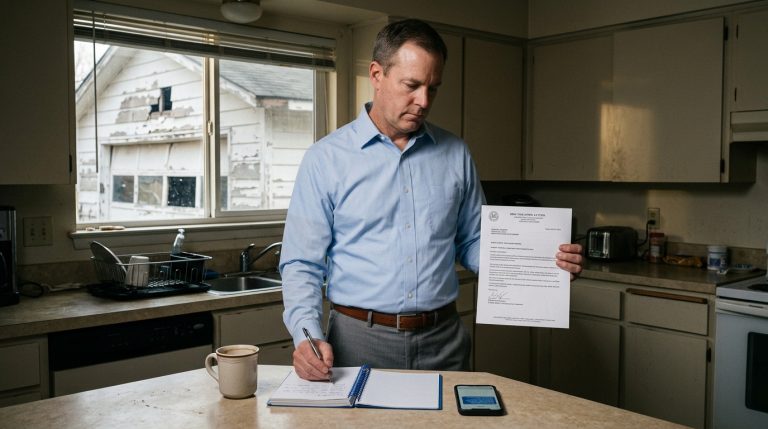
A notification pinged in my pocket. I pulled out my phone.
It was an automated security alert from the neighborhood portal. A new flag had been attached to my parcel address.
Violation Code: 7.14 – Unapproved Structural Addition.
Penalty: $100.00 base. Escalation rate: $25.00/day.
Below the notice was a single attached file code: AG-404-REF.
Not an HOA tracking format. A corporate utility designation.
I slipped the phone back into my pocket, my thumb coming to rest on the heavy brass gauge. This wasn’t about mosquitoes. It wasn’t even about aesthetics.
The front door opened behind me. Sarah stood in the shade of the porch, holding two glasses of ice water. She looked at the fresh tear marks in the grass, then at my face.
“How bad?” she asked quietly.
“She called the county,” I said, walking toward the porch. “And she brought a ledger.”
CHAPTER 2: THE INSPECTION TRAP
The white utility truck sat idling at the curb, its diesel rumble sending a low vibration straight through the soles of my boots. Painted on the driver’s door was the county seal, faded and flaking around the edges, alongside the crisp stencil: VECTOR & MOSQUITO CONTROL DIVISION.
Karen didn’t waste a second. She took two sharp steps onto the concrete, her clipboard tapped sharply against her hip like an officer summoning a private.
“Officer Miller,” she called out, her voice pitching up into a practiced, authoritative register. “Over here. The hazardous installation is at the rear corner.”
The driver’s door swung open. A man in his late thirties stepped down, his heavy work boots hitting the pavement with a solid thud. He wore a crisp khaki uniform with a brass nametag pinned above the left pocket: D. Miller. A leather belt held a heavy flashlight, a digital thermometer, and a sampling kit. He didn’t rush. He had the measured, unhurried posture of a state bureaucrat who had seen a hundred petty neighborhood wars and cared about none of them.
“Morning,” Miller said, taking off his aviator sunglasses and tucking them into his collar. His eyes swept past Karen’s signaling hand and locked onto me standing by the front porch. “Mr. Davies?”
“Mark Davies,” I said, stepping off the low stone step. I held the cold glass of ice water in my left hand, keeping my right clear. “Thanks for coming out, Officer.”
“This is the property owner who installed the illegal drums, Officer Miller,” Karen interjected, stepping directly between us. She pointed a manicured finger toward the jasmine trellis. “Two fifty-five-gallon containers filled with stagnant water. Unsealed. Open to the air. In the middle of a West Nile advisory.”
Miller didn’t answer her. He glanced down at his clip-mounted tablet, tapped the screen with a stylus, then looked back up at me. “County received a Code 88 complaint. Harboring standing water in excess of fifty gallons without municipal vector clearance.”
“Code 88 applies to open catchment—unfiltered pools, ornamental ponds, and broken drainage,” I said, my voice quiet, level. Between my thumb and forefinger inside my pocket, I felt the sharp, knurled rim of the brass pressure gauge. “This is a closed-system rainwater harvesting array. Built to state agricultural specs.”
Karen let out a dry, theatrical laugh. “Agricultural specs? This is Oakmont Creek, not a farm, Mr. Davies. You can’t just slap industrial waste barrels against a residential siding and call it engineering.”
Miller walked past her. He didn’t ask permission; he simply tracked the line of the house until he reached the corner where the two dark-blue polyethylene drums sat on a level pad of crushed limestone.
Karen marched behind him like a prosecutor trailing an expert witness. I followed at a measured distance, taking a slow sip from my glass. The ice clinked against the glass rim—sharp, cold, steady.
Miller stopped a foot from the first barrel. He didn’t just look at it; he dropped to one knee, his khaki trousers creasing against the stone. He pulled a heavy tactical light from his belt and clicked it on. The bright beam illuminated the top seal.
“Food-grade high-density polyethylene,” Miller muttered to himself. He ran his thumb over the rim where the inlet pipe met the barrel head. “Marine-grade silicon bead. No gaps.”
“Check the intake, Officer,” Karen insisted, leaning over his shoulder. “That’s where they breed. They lay eggs in the rim.”
Miller reached out and tapped the custom mesh cap I’d machined in my garage workshop. “What gauge is this mesh?”
“One-sixteenth-inch woven stainless steel wire cloth,” I said, standing three feet back. “Double-clamped with a stainless worm-gear band. The downspout drops into a sealed diverter box. Anything larger than sixty microns gets flushed into the French drain under the gravel.”
Miller pulled a small depth gauge from his pouch and probed the edge of the mesh cap. The steel didn’t yield a millimeter. He shone his light straight down through the wire cloth into the water below.
The water inside was crystal clear. No rafts of eggs floating on the surface. No larvae twitching in the beam.
“You’ve got an overflow line?” Miller asked, looking up from his knee.
“Right there,” I pointed to the lower lateral pipe. “Vented three inches below the top cap, fitted with an internal check-valve and the same stainless mesh. Routes directly to the subsurface gravel bed. Zero surface pooling.”
Miller stayed on his knee for five long seconds. The only sound was the faint hum of his truck’s engine at the curb and the cicadas buzzing in the oak trees above.
Karen shifted her weight from one heel to the other, her wedges clicking against the limestone border. “Well? It’s an unapproved modification. It holds standing liquid.”
Miller stood up smoothly, dusting off his left knee with a flat palm. He reached for his tablet, tapped the screen twice, and clicked his stylus back into its side holder.
“Mrs. Smith, isn’t it?” Miller asked, his tone completely flat.
“President Smith,” she corrected, her chin tilting up. “Of the Oakmont Homeowners Association.”
“Mrs. Smith,” Miller repeated, ignoring the title entirely. “I’ve been inspecting vector risks for the county for twelve years. Half the houses in this subdivision have birdbaths with green scum an inch thick and clogged rain gutters holding ten gallons of stagnant mud. Those are West Nile breeding grounds.”
He turned and looked directly at the barrels, then back at Karen.
“This installation is better sealed than the municipal reservoir on County Road 4. There are no larvae. There is no access vector. There is zero risk of mosquito propagation.”
Karen’s face went from pale pink to a mottled, splotchy red. Her fingers tightened around her plastic clipboard until the edge bent. “That is impossible. It is a fifty-five-gallon drum sitting on bare ground—”
“It’s sitting on a six-inch compacted limestone base with subsurface drainage,” Miller cut her off, his voice carrying the cold weight of absolute technical authority. “And as far as the county is concerned, this complaint is closed as unsubstantiated.”
He tapped his tablet screen one final time. As he turned back toward his truck, he paused beside me, his eyes sweeping over the clean line of the house.
“Nice work on the mesh fitting, Davies,” Miller said under his breath, low enough that Karen couldn’t hear over the diesel chatter. “Most people just throw cheesecloth over a trash can and wonder why they get swarms. Keep the seal clean.”
“Appreciate it, Officer,” I said.
Miller walked down the driveway, climbed into his cab, and pulled away from the curb without a second glance. The white truck disappeared around the bend of Oakmont Drive, leaving behind the faint smell of exhaust and an absolute, suffocating silence.
Karen remained on the limestone path. Her eyes weren’t on the barrels anymore. They were locked on me.
She wasn’t breathing through her nose; her chest rose and fell in rapid, shallow hitches. The public humiliation wasn’t just a setback for her; it was a structural breach in her authority. I could see the mental gears grinding behind her eyes—recalculating, abandoning the public health narrative, and falling back on the raw, administrative power of the association code.
“You think you’re clever, don’t you?” she whispered. The theatrical loudness was gone, replaced by a thin, bitter hiss.
“I’m an engineer, Karen,” I said, stepping past her to set my empty water glass on the workbench inside the open garage. “I build things to code.”
“The county code doesn’t govern this neighborhood, Davies,” she said, her heels snapping against the driveway as she backed away toward the street. “The board does. And by tomorrow morning, you’re going to realize that logic doesn’t mean a damn thing when you’re standing on private covenant land.”
She pulled a small black smartphone from her pocket, tapped a single speed-dial entry, and held it to her ear. As she reached the sidewalk, I caught her opening words over her shoulder:
“Frank? Issue the secondary assessment under Section 7. Use the commercial reference tag. Yeah—the AG-404 template.”
She didn’t look back.
I stood in the doorway of my garage, the shade pulling over my shoulders as the sun dipped behind the roofline. I pulled my phone back out and opened the HOA portal once more.
The flag on my address hadn’t vanished with Miller’s departure. Instead, a new line item had just popped up underneath the fine summary, updating in real-time:
Status: Non-Compliant.
Action Pending: Notice of Intent to File Lien.
Jurisdictional Flag: Ordinance 404 – Utility Access Priority.
My thumb brushed against the brass gauge in my pocket. She wasn’t fighting me over a pair of water drums. She was executing a pre-programmed legal sequence.
I turned back into the dim quiet of the garage, reached for a yellow legal pad, and uncapped a black felt-tip pen. It was time to stop reacting to her paperwork and start auditing her trail.
CHAPTER 3: THE PAPERWORK SIEGE
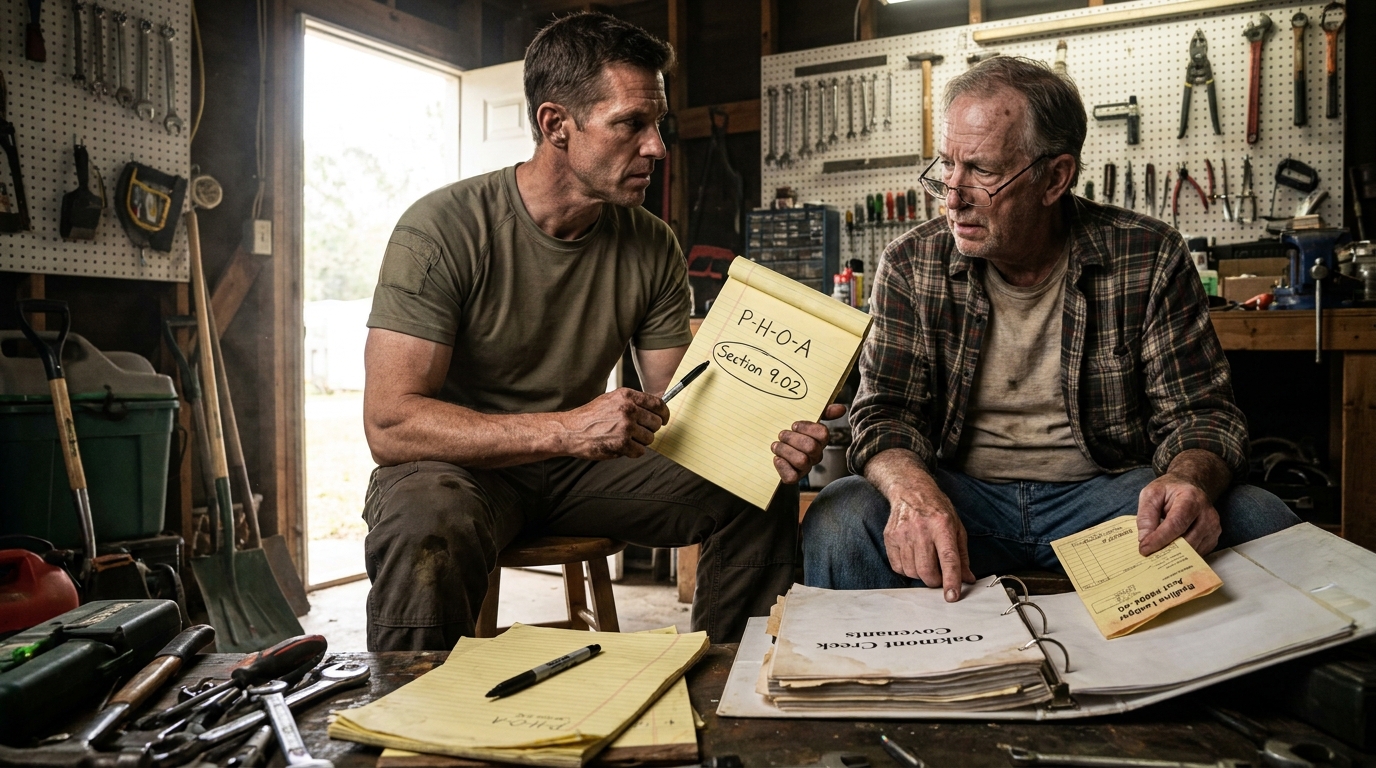
The black ink bled slightly into the wood-pulp fiber of the yellow legal pad. At the top of the page, I wrote four letters: P-H-O-A.
The garage smelled of lawn fertilizer, motor oil, and wet cedar from the jasmine trellis outside. I pulled a wooden stool out from under the workbench, sat down, and reached for the thick ring binder resting on the bottom shelf. It was the master copy of the Oakmont Creek Covenants, Conditions, and Restrictions—a hundred and fourteen pages of dense, single-spaced legal prose given to every buyer at closing. Most people filed it in a kitchen drawer and forgot it existed until they wanted to paint a fence.
I flipped past the boilerplate real estate disclosures, my thumb tracing the bottom margin of each page.
My phone sat beside the legal pad, screen glowing with the portal’s red flag. Ordinance 404 – Utility Access Priority. That wasn’t standard HOA language. In municipal codes, Ordinance 404 typically referenced easement exemptions for county infrastructure, but Karen had tied it directly to Section 7—the ARC structural approval clause.
I tapped my pen against the stool leg. Tap. Tap. Tap.
If Section 7 gave the board blanket authority over exterior modifications, there had to be a counterweight. No legal covenant written in this state could completely override municipal water rights without explicit statutory authorization. I turned the page to Article IX: Environmental and Landscaping Maintenance.
My eyes stopped halfway down page eighty-two.
Section 9.02: Water Conservation Exceptions.
“The Association shall encourage the implementation of residential water conservation mechanisms, including but not limited to drip irrigation, xeriscaping, and rainwater harvesting equipment…”
I drew a sharp red circle around the phrase rainwater harvesting equipment.
“…Provided such equipment is maintained in a sanitary condition and does not alter the primary load-bearing envelope of the dwelling, installations under this section are designated as exempted utility accessories and shall not require pre-installation review by the Architectural Review Committee.”
I read the paragraph three times. The language was unambiguous. It wasn’t an ambiguity she could argue away in a committee meeting; it was a hard statutory exemption buried right inside her own rulebook. Karen had issued the fine under Section 7, banking on the assumption that I had never read past page twenty.
She had built her entire legal threat on a foundation that didn’t exist.
“Mark?”
I looked up. George Henderson was standing at the edge of my open garage door. He wore a faded flannel shirt over a white undershirt, his hands tucked into the pockets of his denim work trousers. He looked past me toward the driveway, where the tire marks from Karen’s wedges were still visible in the soft turf.
“Saw the county truck leave,” George said softly, stepping inside. He didn’t come all the way to the workbench; he stayed near the door, his eyes scanning the driveway as if watching for an ambush. “Karen was talking loud enough on her porch to wake the dead. Said she’s putting a lien on you.”
“She can try,” I said, rotating the legal pad so he could see the circled text. “She cited Section 7. Section 9.02 exempts water collection completely.”
George leaned down, his spectacles slipping slightly on the bridge of his nose as he read the small print. A long, slow breath escaped his mouth, smelling faintly of pipe tobacco and peppermint.
“She knows the rule, Mark,” George murmured, looking up, his eyes grave. “She doesn’t care.”
“It’s in the book, George. Signed by the developers, registered with the county clerk.”
“So were my garden gnomes,” George said flatly. His left thumb twitched against his pocket—an involuntary, nervous rub against the seam of his jeans. “Five years ago. My Martha passed, and I put a three-inch ceramic fisherman by the birdbath. Karen sent me three letters in six days. Said it violated the ‘Aesthetic Uniformity’ clause. I showed her the clause said ‘structures over two feet high.’ My fisherman was seven inches.”
“What happened?” I asked.
“She fined me fifty dollars. Then twenty-five a day. I didn’t pay. She sent a formal notice from the association’s lawyer—a firm downtown called Vanguard Legal. Said if I didn’t clear the balance, they’d initiate a judicial foreclosure for unpaid assessments.” George stopped, his jaw working silently for a second before he swallowed. “My daughter panicked. Thought I was going to lose the house over a seven-inch piece of painted clay. So I paid three hundred and forty dollars out of my pension check, and I put the fisherman in the closet.”
The garage was silent except for the faint hum of the refrigerator in the laundry room inside.
“She’s done this to others?” I asked.
“Tom on Birch Street,” George said quietly, pointing a thumb west. “He built a ramp for his boy’s wheelchair. Karen said the handrail was raw pine instead of painted composite. Fined him until he tore it down and hired her cousin’s crew to rebuild it. Sarah Beth over on Elm? Tried to paint her front door navy blue. Got hit with four hundred in fines before she painted it back to beige.”
He reached into his shirt pocket, pulled out a folded piece of paper, yellowed at the edges, and set it on my workbench beside the binder.
“That’s my receipt from three years ago,” George said. “Notice the account number at the bottom? It doesn’t go to the Oakmont General Fund. It goes to a sub-entity called The Redline Ledger.”
I picked up the paper. It was a standard HOA payment receipt, but stamped across the bottom in faint blue ink was a secondary routing line: Redline Ledger / Acct #8804-AG.
AG. The same prefix as the violation code on my portal.
“She isn’t just enforcing rules, George,” I said, my finger resting on the stamp. “She’s building leverage. If she gets a lien on a house, she controls the title.”
“She controls the street,” George corrected softly. “People get tired, Mark. They’re old, or they’re working two jobs, or they don’t have twenty-two years of Army legal training to read these books. They just pay because they’re scared of losing their roof.”
“Not this time,” I said.
I picked up the black pen again. Underneath P-H-O-A, I wrote two names: Frank Miller (Treasurer) and Mary Vance (Secretary).
“Frank’s an accountant, isn’t he?” I asked.
“Works for a commercial firm downtown,” George nodded. “Quiet guy. Nervous. Keeps his lawn cut exactly three inches, never speaks at the annual meetings.”
“And Mary?”
“Retired middle school principal. She votes with Karen because Karen tells her it protects the neighborhood property values.”
“They have personal liability if the board knowingly violates state exemptions,” I said, capping the pen with a sharp snap. “If Karen is using association letterhead to collect private assessments through an unlisted ledger, Frank and Mary are sitting on a live grenade.”
George looked at me, the tired hesitation in his posture shifting slightly. “What are you going to do?”
“I’m going to call a lawyer I served with in the Corps,” I said, standing up from the stool. “And then you and I are going to take a walk down Birch Street and Elm Street.”
George stared at the receipt on the workbench, then reached out and tapped the yellow pad where I’d written the section number. His hand was steady now.
“I still have that fisherman in the closet, Mark,” he said quietly.
“Get him out, George,” I replied, grabbing my phone and the binder. “He’s going back on the lawn.”
CHAPTER 4: THE LEGAL VANGUARD
The snap of the pen cap was still ringing off the garage rafters when I dialed Ben Carter’s direct line.
Outside, a light drizzle had begun to fall, water drops rattling against the metal roof overhead. I stood by the workbench, my thumb pressing the cold rim of the brass pressure gauge as the phone connected on the second ring.
“Davies,” Ben’s voice came through the speaker, crisp and stripped of preamble. “Tell me you’re calling about a pension filing and not a local dispute.”
“Oakmont Creek HOA issued a notice of intent to file a lien,” I said, looking at the scanned documents lined up across my tablet screen. “Cited Section 7 for an unapproved rainwater catchment. They completely bypassed the Section 9.02 exemption.”
A three-second pause stretched over the line. I could hear the faint scuff of a fountain pen moving across heavy paper on his end. “Section 9.02 of the residential environmental code? That’s a statutory safe harbor. If your array meets state sanitation specs, any board attempting to levy fines under general architectural clauses is acting ultra vires.”
“They aren’t just levying fines, Ben,” I said, holding up George’s yellowed receipt to the light. “They’re routing payments into an off-book account labeled The Redline Ledger. And the violation notices carry a corporate cross-reference: AG-404-REF.”
The sound of Ben’s pen stopped dead.
“Read that reference tag back to me.”
“AG-404-REF,” I repeated. “Tied to a code line labeled Ordinance 404.”
Ben cleared his throat—a low, raspy sound. “Ordinance 404 is a municipal utility access directive passed by the county board last year. It allows private infrastructure operators to acquire encumbered residential titles if three or more uncured code liens are attached to the parcel. Who is the HOA board president?”
“Karen Smith. But she isn’t acting alone. Frank Miller is treasurer, Mary Vance is secretary. They’re signing off on the assessments.”
“They won’t be once they open tomorrow morning’s mail,” Ben said, his tone dropping an octave into his courtroom register. “I’m drafting a cease-and-desist right now. I’m not sending it to the board’s general inbox. I’m serving it individually to Frank Miller and Mary Vance at their personal residences via courier.”
“What’s the teeth?” I asked.
“Bylaw 15.04,” Ben said flatly. “The fee-shifting clause. If the board initiates a lien action without statutory cause and fails to prevail in court, the association—and the individual directors who authorized the action in bad faith—are jointly liable for all accrued legal costs. I’m putting my current billable rate at six hundred an hour. I’m also attaching an affidavit from George Henderson regarding the secondary ledger.”
I shifted my weight, my boot heel catching on a seam in the concrete pad. “Make sure Frank reads the liability clause twice. He’s an accountant. He knows what personal exposure looks like.”
“It’ll be on his kitchen table before he finishes his morning coffee,” Ben said. “Be at that clubhouse meeting tomorrow night, Mark. And bring every homeowner who ever paid a dime into that sub-account.”
I hung up and set the phone on the legal pad next to George’s receipt.
The rain outside was coming down harder now, streaming off the gutter line and pouring into the intake funnel of the lead rain barrel. The water passed through the stainless steel mesh with a clean, steady hiss, filling the sealed drum millimeter by millimeter.
An hour later, my doorbell rang.
I walked through the dark hallway and opened the front door. Frank Miller stood on the porch under a golf umbrella. His coat was buttoned wrong, one button off-alignment, and his face was the gray color of wet newsprint. In his left hand, he held an opened courier envelope with Ben Carter’s firm logo embossed in gold foil across the top corner.
He didn’t step onto the mat. His knees were visibly trembling beneath his trousers.
“Mark,” Frank gasped out, his voice cracking on the first syllable. “What… what is this?”
“That’s a formal notice of personal liability, Frank,” I said, leaning against the doorframe, keeping my hands resting casually in my pockets. “You signed the secondary assessment order two hours ago.”
“I didn’t… Karen told me it was standard procedure!” Frank’s hand shook so violently the envelope rattled like dry leaves. “She said you were defying a lawful directive! She brought the paperwork from Vanguard Legal!”
“Vanguard Legal doesn’t represent the homeowners, Frank. They represent the entity holding The Redline Ledger,” I said softly, stepping closer until I was two feet from his umbrella line. “Did you look at the bank routing code on those assessment checks before you endorsed them?”
Frank’s jaw worked silently. His eyes darted past my shoulder toward the dark street, where a single black sedan was idling near the entrance to the subdivision, its headlights switched off.
“I just do the books,” Frank whispered, his voice shrinking into a desperate plea. “I don’t look at the corporate filings. I’m an accountant for a produce distributor, Mark! I can’t afford a fifty-thousand-dollar legal judgment! My wife…”
“Then you’d better read page four of that letter,” I said, pointing at the paper trembling in his hand. “Section B. The board has an emergency meeting scheduled for tomorrow at seven. If you vote to proceed with the lien on my house, Ben files the federal complaint at eight zero one Thursday morning. You, personally, will be named as Defendant Two.”
Frank swallowed hard, a dry, clicking sound in his throat. He looked down at the courier letter, his thumb digging into the paper until it tore.
“She told us… she told Mary and me that if we cleared four more parcel encumbrances this quarter, the regional utility would subsidize our annual maintenance budget,” Frank stammered, the words spilling out of him like water from a burst pipe. “She called it an access acquisition agreement. She said it was backed by AquaGrid.”
The name hung in the damp night air. AquaGrid Syndicate. The regional private water utility whose haulage trucks I’d seen patrolling the county roads outside the subdivision.
“She’s selling parcel encumbrances to a private utility, Frank,” I said, the truth locking into place with a cold, metallic click. “And you signed the transfer orders.”
Frank backed down the porch steps, his golf umbrella tipping sideways, letting the cold rain streak across his forehead. He didn’t say another word. He turned and practically ran down my driveway, his dress shoes splashing blindly through the puddles toward his house.
I stood on the porch, watching his shadow disappear into the dark.
I pulled my phone out one last time, opened the community portal, and took a screenshot of the pending lien status, along with the newly revealed source entity: AquaGrid Development Division.
The decoy of an overzealous HOA president enforcing arbitrary neighborhood rules was completely gone. This was an asset-stripping pipeline operating right through the front office of our own subdivision.
I walked back into the garage, picked up the legal pad, and flipped to a fresh page. At the top, I wrote three words in heavy block letters: THE PUBLIC EXECUTION.
Tomorrow night at seven, the entire neighborhood was going to learn who really owned their property.
CHAPTER 5: THE PUBLIC EXECUTION
The low, electric hum of an ungrounded microphone echoed off the drywall ceiling of the Oakmont Creek clubhouse.
Forty-seven metal folding chairs were set up in rows across the linoleum floor, every single one occupied. Residents spilled out into the side carpeted aisles and lined the back wall under the framed community guidelines.
At the front table sat the board. Karen Smith occupied the center seat, her posture rigid as a iron fence post, her hands folded tightly over a thick crimson folder. To her left, Frank Miller sat with his shoulders hunched, his eyes fixed firmly on his glass of tap water. To her right, Mary Vance kept nervously smoothing the hem of her beige cardigan.
I stepped out from the center aisle, my heavy leather boots echoing on the linoleum. In my left hand, I carried the thick black binder containing my master file. My right thumb rested inside my pocket, pressing against the knurled steel rim of the brass pressure gauge.
“Mr. Davies,” Karen said, her voice amplified through the desk mic, thin and harsh like gravel grinding in a tin cup. “This meeting was called for executive board business and general budget ratification. You are not on the scheduled speaker list.”
“I don’t need to be on your list, Karen,” I said, stopping three feet from the podium. I dropped the heavy binder onto the wood laminate top. The thud hit the quiet room like a pistol shot. “Under Bylaw 4.08, any active property owner faced with an accelerated assessment or lien notice has the absolute right to an open hearing before the assembled quorum.”
Frank Miller reached out with a trembling hand, tapped his own mic button, and leaned in. “He… he’s right, Karen. Page twelve. It’s an open hearing.”
Karen turned her head slowly, her eyes locking onto Frank with a look that could have stripped paint off a hull. “Frank. Silence.”
“No,” George Henderson’s voice boomed from the front row. The old man stood up, leaning on his wooden cane, his navy jacket neat and buttoned. On the empty seat beside him sat a seven-inch ceramic fisherman gnome, freshly cleaned, staring straight at the board table. “Let him speak, Karen. We’re all sitting here waiting to hear about these assessments.”
A low chorus of voices rippled across the room—nods, quiet murmurs, chairs scraping as people leaned forward.
I opened the binder to Tab 1.
“Forty-eight hours ago,” I began, keeping my voice level, filling the room without shouting, “the board issued a notice of non-compliance against my property for installing a zero-emission, sealed rainwater catchment array. The violation cited Section 7. The board president claimed it was an illegal exterior modification.”
I pulled a single sheet from the sleeve and held it up for the room to see.
“This is the official report from County Vector Control Officer D. Miller. It confirms zero health hazards, zero standing water, and zero code infractions. In fact, it explicitly notes that my system is cleaner than half the municipal holding basins in this district.”
Karen didn’t blink. She reached for her mic. “County inspectors do not dictate HOA architectural standards, Davies. Section 7 gives the committee sole discretion over property aesthetics.”
“Section 7 applies to general structures, Karen,” I replied, turning to Tab 2. “It does not apply to utility conservation equipment. Section 9.02 of our own registered covenants explicitly exempts residential rainwater systems from ARC review. You knew that clause existed when you wrote the violation letter. You ignored it.”
Mary Vance blinked, her brow furrowing as she looked over at Karen. “Karen… is that true? Is there an exemption in Section 9?”
“It’s a misinterpretation!” Karen snapped, her knuckles turning white against her folder. “He’s twisting the legal definitions to evade a valid neighborhood maintenance fee!”
“Then let’s talk about the fee,” I said, flipping to Tab 3. I pulled out a stack of twenty collated paper packets and set them on the edge of the podium. George stood up and began handing them out down the front row.
“What is that?” Karen demanded, half-rising from her seat. “That is confidential board correspondence!”
“Those are transaction receipts, Karen,” I said flatly. “Over the last twenty-four months, thirty-one homeowners in this room have been hit with accelerated fines under Section 7. George for a seven-inch lawn ornament. Sarah Beth for painting her front door an unapproved blue. Tom for a wheelchair access ramp.”
The room swelled with noise—voices rising, people unfolding the packets, rustling paper echoing off the walls.
“Every single fine was paid by check or electronic transfer,” I continued, pointing a finger at the ledger printouts. “But those funds didn’t go into the Oakmont General Maintenance Fund. They didn’t pay for pool cleaning, and they didn’t pay for lawn care. They were routed through a private sub-account.”
I leaned over the podium, locking eyes with Karen.
“Account Number 8804-AG. Titled The Redline Ledger.”
Frank Miller put both hands on the table and pushed himself back, his chair legs squealing against the floor as he stood up. “I didn’t authorize those transfers! I signed the routing sheets because Karen told me they were regional management fees!”
“Sit down, Frank!” Karen hissed, her composure finally shattering, her face flushing deep crimson.
“No, Karen!” Frank yelled back, his voice shaking with sheer panic. “I received a legal notice from a federal practitioner last night! You told us those secondary liens were standard procedure for default parcels! You didn’t tell us they were being cross-referenced with Ordinance 404!”
The word hit the room like a dead weight. Ordinance 404.
“What is Ordinance 404?” Sarah Beth called out from the third row, standing up to look at the board. “What is he talking about?”
I reached into the binder, pulled out the final document—a certified corporate registry filing obtained by Ben Carter six hours ago—and held it flat against the podium top.
“Ordinance 404 is the municipal mechanism that allows private utility concessionaires to acquire encumbered residential titles,” I said, my voice cutting through the noise in the room like a cold knife. “If a parcel carries three or more unpaid administrative liens, the title gets flagged for utility acquisition. The entity holding The Redline Ledger isn’t an HOA subcommittee.”
I looked directly at Karen, whose eyes had gone wide, fixed on the certified corporate stamp at the bottom of my page.
“It’s a shell company owned by AquaGrid Syndicate,” I said softly. “You weren’t trying to enforce neighborhood rules, Karen. You were intentionally manufacturing encumbrances on our homes so a private water company could buy out the subdivision’s land rights.”
The room went dead silent for two full seconds.
Then the clubhouse exploded.
People surged out of their chairs, shouting, waving the paper packets in the air. George Henderson stepped up to the table, his cane hitting the carpet with a sharp crack, while Tom from Birch Street marched straight down the aisle toward the front.
Mary Vance covered her face with both hands, weeping silently. Frank Miller pulled a pen from his jacket pocket, flipped to the back of the meeting agenda, and wrote three short lines before sliding the paper across the table.
“I resign,” Frank said, his voice carrying over the din. “Effective immediately. And I’m turning over every ledger disk in the office to the county prosecutor.”
Karen stood isolated behind the desk. She didn’t look at Frank. She didn’t look at the screaming crowd. She looked at me, her chest heaving, her fingers twitching against her red folder like a cornered animal searching for an escape route.
“This meeting is adjourned,” she whispered into the dead mic.
She grabbed her purse, shoved past Mary Vance’s chair, and bolted for the side exit door leading to the parking lot. The heavy door slammed shut behind her, the latch clicking into place with a hollow, metallic ring.
I didn’t run after her. I didn’t need to.
I stood at the podium, set my hands flat on the laminate surface, and looked out at forty neighbors standing together in the center aisle, talking, sharing documents, organizing their signatures on George’s petition pad.
I pulled the heavy brass gauge out of my pocket, set it on the wood top next to my binder, and let out a single, long exhale.
The siege was over. The counter-offensive had begun.
CHAPTER 6: THE RUSTED LEDGER
The latch clicked shut against the metal doorframe, a dull, final thud that echoed across the linoleum before dying against the acoustic ceiling tiles.
I didn’t reach for the microphone. I simply reached down, picked up the brass pressure gauge from the laminate podium, and slipped it into my coat pocket. On the table before me, Frank Miller’s handwritten resignation letter lay beside the certified corporate filing.
George Henderson walked up to the podium, his wooden cane tapping rhythmic and steady against the floor. Beside him, Mary Vance remained in her chair, her face pale, holding a manila folder filled with two years of ARC meeting minutes.
“It’s done, Mark,” George said softly, his voice gravelly but clear. “Frank’s in the back room on the landline with the county prosecutor’s office right now. Mary handed over the master keys to the office filing cabinets.”
“It’s not just the HOA office, George,” I said, stepping around the podium to face him. “The corporate filing ties The Redline Ledger directly to AquaGrid Syndicate’s regional development arm. Every fine issued under Section 7 was structured as a recorded encumbrance. They weren’t trying to collect cash—they were building a cloud on thirty-one property titles to force a bulk buyout under municipal Ordinance 404.”
Mary Vance looked up, her fingers trembling as she smoothed the edge of her folder. “She… Karen told us it was a grant program. She said AquaGrid was providing private utility credits to offset our community water drainage costs. She had us sign authorization forms every quarter.”
“She had you sign parcel encumbrance waivers, Mary,” I said, keeping my tone flat, stripped of anger. “Every time a homeowner paid a fine into that sub-account, it triggered a secondary notice under Ordinance 404. Three notices, and the county ordinance allowed a private utility operator to petition for mandatory grid integration and easement acquisition.”
A heavy silence settled over the front of the hall as the remaining residents gathered in small groups near the doorway, quiet, relieved, watching us.
“What happens to the liens?” George asked, his hand tightening around the head of his cane.
“Ben Carter’s filing an emergency injunction with the county chancery court at eight tomorrow morning,” I said. “With Frank’s affidavit and the corporate registry match, every assessment issued through The Redline Ledger gets voided ab initio. The encumbrances drop off the county land records by Friday.”
George let out a long breath, his shoulders dropping two inches as if a physical weight had been lifted off his neck. He turned, walked back to his chair in the front row, and picked up the seven-inch ceramic fisherman gnome. He tucked it under his arm like an old friend.
“I think I’ll put him right on the front porch step tonight,” George murmured. “Facing the street.”
The sun was setting three hours later when a commercial moving van backed slowly into the driveway two doors down.
I stood on my front porch, watching the yellow hazard lights flash against the oak trees lining Oakmont Drive. Karen Smith didn’t come out to supervise the movers. Two men in blue uniforms loaded wooden furniture crates into the back of the truck while her husband stood on the lawn, holding a stack of real estate signboards.
There was no yelling. No public confrontation. The formal notice of board removal and the pending civil investigation had rendered everything quiet, bureaucratic, and absolute. The real estate sign went up in her front yard before dusk: Bank Owned – Notice of Foreclosure Pending.
When the moving truck pulled away, its heavy tires crunching over the gravel at the subdivision entrance, the street returned to the deep, unbroken quiet of a midsummer evening.
I walked down my front steps and paced the line of my driveway until I reached the limestone pad at the corner of the house.
The two dark-blue polyethylene rain barrels sat straight and secure against the wall, tucked behind the climbing jasmine trellis. The D. Miller inspection mark was still visible on the lower brass ball valve—a small blue chalk mark indicating compliance.
I pulled my tool roll from my apron pocket, unrolled the canvas, and pulled out an adjustable wrench.
I knelt on the limestone base, placing my hand against the cold side of the lead barrel. The drum was full to the top, fifty-five gallons of clear, harvested rainwater resting behind the stainless steel mesh cap. I attached the wrench to the brass spigot’s packing nut, gave it a quarter turn clockwise, and tightened the seal until the faint moisture bead disappeared.
The brass clicked solid against the steel threads.
Sarah came out onto the back patio, carrying a pitcher of iced tea and two glass mugs. She set them on the outdoor table, then walked over to the trellis, her hand resting gently on my shoulder as I stood up.
“It’s quiet out here,” she said softly.
“It’s clean,” I replied, wiping my thumbs on a rag before tucking the wrench back into the canvas roll.
Down the block, I could see George Henderson standing on his porch, holding a watering can, slowly filling a clay pot near his garden gnomes. Across the street, Sarah Beth’s front door stood wide open to the evening breeze, its fresh navy coat of paint catching the last orange rays of the sun.
I reached into my pocket, pulled out the 0-100 PSI brass pressure gauge, and set it on the small wooden shelf I’d built above the rain barrels. The heavy metal caught the fading light—scratched, functional, and grounded.
The neighborhood was no longer a grid of managed parcels on a corporate ledger. It was just a street, built on hard ground, defended by the people who lived on it.
I took the glass from Sarah, felt the cold condensation press against my palm, and watched the first evening fireflies drift across the lawn.