The Price of Concrete and Soil: How a Retired Engineer Weaponized the Law Against a Suburban Empress
CHAPTER 1: The Scar Across the Acre
The gnats had a rhythm to them, a high-pitched whine that hovered just an inch above the sweat on the back of my neck. I didn’t swat at them. In twenty-two years with the Corps, you learn that movement wasted on minor annoyances only drains the reserve you need when the real weight drops.
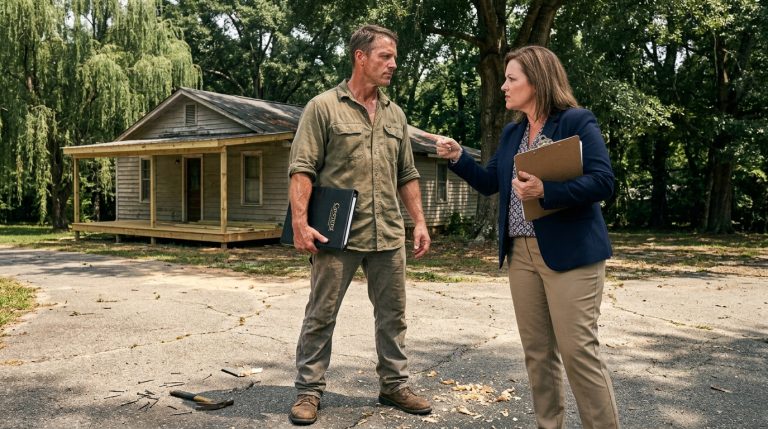
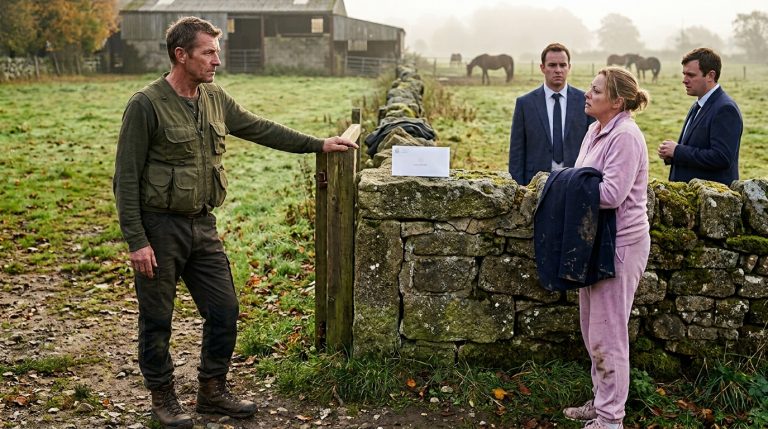
Karen’s floral moo-moo was a violently cheerful insult against the fresh, ragged tear she had carved through my heirloom bloody butcher corn. Fifty yards wide. A quarter-mile gash of pulverized stalks and pulverized dirt that ended abruptly at the treeline, like a incision made by a surgeon who had forgotten how to stitch.
“We’ve improved it, major.”
The words didn’t float; they dropped onto the dirt between us like lead shot. Her diamond earrings caught the humid morning glare, tiny prisms of arrogance flashing in the Carolina sun. Behind her, the yellow Bobcat sat idling, its diesel engine ticking as it cooled, smelling of hot oil and crushed roots. Four generations of my family had poured sweat into this dirt, turning a stubborn patch of Carolina clay into a living pedigree of non-GMO heritage. She had flattened three acres of it in twenty minutes because her evening walks wanted a smoother view of the sunset.
My fingers curled inside my pockets, nails biting hard into the meat of my palms until the pain became a solid, grounding point. I let the silence stretch, watching a drop of sweat trace the edge of her meticulously lined jaw. She expected noise. She expected the red-faced sputtering of a rustic who didn’t understand the finer points of community value.
“Improved,” I said. My voice was flat, hollowed out of tone, stripped down to the tactical minimum.
“Don’t be dramatic, Major Callahan,” she snapped, her chin lifting with that practiced, HOA-board superiority that had likely cowed every real estate agent and timid accountant from here to Charlotte. “It’s a walking trail. The residents wanted direct access to the woods. Your eyesore was simply in the way.”
She gestured toward the horizon where the beige stucco skin of Whispering Pines Estates sprawled over the ridge like a rash of identical scabs. Every house painted within a three-shade tolerance of vanilla. Every lawn scalped to the exact same millimeter of artificial perfection. My barn—weathered, historic, painted a deep, honest red that had weathered sixty winters—was a personal affront to her geometry.
I didn’t look at the barn. I looked at her shoes. Clean white sneakers. Not a speck of Carolina clay on them. Which meant she hadn’t walked the path she had just ordered cleared; she had ridden in the cab of the Bobcat or followed safely behind on the asphalt.
“You crossed a recorded boundary line,” I said softly. “There is no easement. There has never been an easement.”
“We are a community,” she said, her voice rising, losing its polished edge as the heat began to bake through her composure. “You should try being a part of it instead of hoarding land like a hermit.”
She turned on her heel then, dismissing me with the casual cruelty of someone who had never faced a consequence she couldn’t buy her way out of. She marched back toward her beige kingdom, her floral hem swaying with rhythmic entitlement.
I stayed where I was in the wreckage of my crop, watching the dust settle over the broken red stalks. My phone was in my pocket. I pulled it out, brought up the camera, and began to film the tire tracks without saying a word.
When the screen blinked, a notification flashed at the top: a local weather alert warning of sudden afternoon squalls rolling in from the west, dropping the pressure and turning the humidity into a suffocating blanket.
CHAPTER 2: The CounterOffensive and the Paper Trail
The kitchen was quiet, save for the rhythmic hum of the old refrigerator and the steady, metallic tapping of rain against the windowpane. I didn’t turn on the overhead lights. A single desk lamp cast a harsh, amber wedge across the scarred oak tabletop, illuminating the neat stack of documentation I had spent the last twenty-four hours compiling.
In the corner, leaning against the wall, rested my grandfather’s surveyor’s rod—weathered wood with faded brass markings. It was a tool of precision, a reminder that boundaries were not matters of opinion, but of absolute measure. Karen wanted a war of impressions and aesthetic dominance; I intended to give her an audit.
The phone sat to my left, silent. Outside, the Carolina sky had turned the color of bruised slate, the storm finally breaking over the ridge and washing the distant, uniform rooftops of Whispering Pines in a grey, unsparing blur.
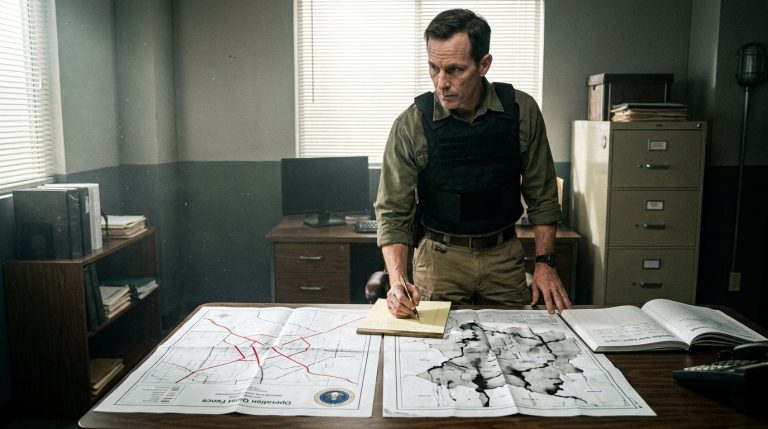
I opened the heavy manila folder labeled Operation Enduring Justice. Inside, the video files from my phone were cataloged by timestamp, geo-tagged and cross-referenced with the county tax maps. Every trampled stalk of heirloom bloody butcher corn was accounted for. Every tire tread, measured to the inch. But a pile of digital proof was only as good as the leverage it carried.
A sharp rap at the back door cut through the hum of the fridge. Not a timid knock, but the firm, rhythmic double-tap of someone accustomed to being answered.
I didn’t get up immediately. In the tactical calculus of defense, you never yield control of the threshold until you’ve assessed the approach. I checked the shadow through the frosted glass—tall, lean, slightly stooped against the driving rain. Arthur Pendleton.
I walked over and threw the deadbolt, pulling the heavy wood door back just enough to let the damp night air rush in, carrying the smell of wet asphalt and pine needles.
“You’re tracking mud, Arthur,” I said, stepping aside.
“The county roads are turning to grease, Jack,” Arthur replied, shaking out his umbrella with a sharp snap before stepping into the kitchen. He looked tired, the skin beneath his bifocals shadowed by the kind of exhaustion that only comes from decades of reading fine print. He set a thick leather briefcase on the table, right beside my photos of the ruined crop. “And the gossip at the mail kiosks is getting greasier.”
He didn’t sit down. He unlatched the briefcase, pulled out a certified copy of the county master plat from 1974, and unrolled it, anchoring the corners with a salt shaker and a heavy ceramic coffee mug.
“They’re not backing down,” Arthur said, his voice dropping to a gravelly murmur. “I spoke to a contact on the HOA board—someone who realizes Karen is steering this car straight toward a concrete abutment. They’ve already consulted outside counsel in Charlotte. A high-end firm. They’re going to try and bury you in procedural motions before this ever sees a courtroom.”
I pulled out a chair and sat down across from him, resting my forearms on the cool wood. “Let them file. A motion is just paper until it meets a fact.”
“It’s expensive paper, Jack,” Arthur countered, tapping a finger against the edge of the master plat. “They’re banking on your stamina. They think a retired engineer with a 160-acre farm will run out of capital or patience. But that’s not what worries me. Look at this.”
He slid a smaller, crisp piece of paper across the table. It was a formal notice printed on heavy cream-colored stock, bearing the embossed logo of Whispering Pines Estates.
I picked it up. My eyes scanned the text. It wasn’t a settlement offer or an inquiry. It was a retroactive citation for unapproved property modification, citing the historical barn on the western ridge and the vintage John Deere parked a hundred yards from the property line. The fine was nominal—a hundred dollars—but the intent was unmistakable. It was an opening salvo designed to establish a paper trail of non-compliance on my end, laying the groundwork for a broader injunction.
“She’s manufacturing a record,” I said, the words tasting like dry ash. “She wants the county to see me as the chronic violator.”
“Precisely,” Arthur nodded, leaning back and crossing his arms. “If you ignore it, they default judgment and slap a lien on your access road. If you fight it in their internal tribunal, you’re playing by their rules on a rigged board.”
I looked down at the citation, then past the window into the dark, rain-streaked expanse of my fields. The bloody butcher corn was out there in the blackness, battered by the storm, its roots holding fast to the clay my grandfather had cleared with an axe and a mule. Karen thought she was dealing with a stubborn old man sitting on valuable real estate. She didn’t understand the geometry of a siege. You don’t fight a fortress by charging the gates; you starve its supply lines and wait for the occupants to turn on each other.
“We don’t go to their tribunal,” I said quietly, the cold fire in my gut steadying my pulse. “We don’t pay the fine, and we don’t file an informal appeal.”
Arthur raised an eyebrow, a flicker of cautious interest in his eyes. “Then what’s the play?”
“We respond with a formal cross-notice of tortious interference and criminal trespass, served directly to every individual board member, not just the HOA as an entity,” I said, my voice flat and unyielding. “If Karen wants to treat my farm as a community asset, we’ll force every single homeowner on that board to look at the personal financial liability they’re assuming by backing her.”
Arthur stared at me for a long moment, the silence broken only by the steady drumbeat of the rain on the tin roof. Slowly, a thin, razor-sharp smile touched the corners of his mouth.
“Personal liability,” Arthur murmured, tasting the words like a vintage wine. “Now, that is a language a corporate board understands. They think they’re hiding behind an acronym.”
“Let’s strip the acronym away,” I said, reaching for my pen. “Draft the notice, Arthur. Make sure every name on that board is listed individually. We’re going to make sure they know exactly whose pocket the bill is coming from.”
Arthur reached for his briefcase, pulling out a legal pad and a silver fountain pen. The storm outside intensified, a sudden gust of wind rattling the windowpanes, but inside the kitchen, the air was sharp, clear, and perfectly still. The defense was over. The counter-offensive had begun.
CHAPTER 3: The Alliance in the Shadows
The ink dried slowly in the heavy, humid air of the kitchen. Arthur didn’t move his hand away from the legal pad; his fingers remained curled around the barrel of the pen, knuckles slightly pale under the amber light of the desk lamp. Outside, the rain had settled into a steady, gray hiss, blurring the amber streetlights of Whispering Pines far across the ridge into dull, bleeding smears against the dark.
“Every name on the board,” Arthur repeated softly, his eyes fixed on the list of titles he had just jotted down. “If we target them individually under the state’s agricultural protection statutes, we aren’t just suing an abstract legal entity. We’re piercing the corporate veil right down to their personal homeowners’ insurance policies.”
I stood up from the table, my knees popping slightly against the quiet of the room. A sudden memory flared behind my eyes—not of the farm, but of a forward operating base in the Korengal Valley, staring at a stress-fracture report on a reinforced concrete levy while mortar dust sifted down onto my collar. In engineering, you don’t waste ammunition on the outer wall if the foundation bolts are loose. You find the single point of shear stress and apply continuous, calculated pressure until the structure yields under its own weight.
Karen had built her authority on the assumption that rules were a one-way street, that people would fold when confronted with official-looking letterhead and petty fines. She hadn’t counted on a structural audit.
“We need more than just names, Arthur,” I said, walking over to the counter to pour a fresh cup of black coffee from the percolator. The ceramic mug was thick, cold at first against my palm before the heat sank through. “If we’re going to hold them individually liable, we have to prove they had prior knowledge of her actions, or that they abdicated their fiduciary duty by letting her run a private vendetta using association funds.”
Arthur looked up, his bifocals catching the lamplight. “Which means we need access to the internal board communications. The emails, the text threads, the private chat groups they use to coordinate outside of official meetings.”
“And David Chen is the exact man to find them,” I said, turning back with the mug in my hand.
The transition wasn’t immediate. I didn’t snap my fingers or cut corners with a narrative shortcut. Walking out of the kitchen meant putting on my oilskin coat, stepping out into the cold Carolina drizzle, and walking the three hundred yards across the perimeter fence line toward the subdivision’s lower tier where David’s modern, flat-roofed house sat like a sterile glass box in the dark.
The mud caught at the heels of my boots, heavy and clinging, dragging at every step with the stubborn suction of river clay. The wet scent of pine sap and crushed weeds filled my lungs, sharp and clean. Every yard I crossed was a reminder of the physical space Karen had violated—the exact spot where her Bobcat had sheared through the root systems of my heirloom bloody butcher corn.
When I reached David’s property, the motion-activated security light clicked on with an abrupt, harsh glare, washing out the shadows and pinning me against the wet cedar fence. I didn’t flinch. I waited, standing motionless in the light until the internal sensor timed out and plunged the yard back into a dim, amber twilight.
I knocked twice on the heavy frosted glass of his garage side-door.
Inside, the faint whir of a 3D printer cut out abruptly. A latch clicked, and David pulled the door open, wiping a smudge of black machine grease from his forehead with the back of his wrist. He looked surprised, glancing past my shoulder into the dark emptiness of the farm before stepping back to let me in.
“Jack,” he said, lowering his voice as the door sealed shut against the rain. “At this hour? The neighborhood text threads have been dead quiet since you served those cross-notices, but I figured Karen was huddled with her legal team.”
“She is,” I said, stepping onto the clean, epoxy-coated concrete floor of his garage. The contrast between my muddy boots and his immaculate workspace was absolute—sharp edges meeting sterile order. “And we need to know what’s in the pipeline before they file their motion to dismiss.”
David crossed his arms, leaning against the side of his workbench where a half-printed plastic drone housing sat cooling. A slow, thin smile crept across his mouth, the expression of a data analyst who had been waiting for root access to a locked system.
“You want the backend data,” David said.
“I want the operational logs,” I replied, setting my coffee mug down on the edge of a metal tool chest. “If Karen used association funds to rent that Bobcat, there has to be an electronic paper trail—an authorization code, an invoice routed through the HOA’s digital payment portal. Something their lawyers can’t scrub with a retroactive resolution.”
David turned back to his triple-monitor workstation, his fingers flying across the mechanical keyboard with a sharp, rhythmic clatter. Pale blue light washed over his face, reflecting off the lenses of his glasses.
“The HOA migrated their administrative portal to a cloud service last year,” David muttered, lines of code and directory trees cascading down the center screen. “They thought it made them modern. But the administrator credentials for the backend database were set up by Karen’s brother-in-law when he was on the board two terms ago. He used a default administrative key.”
He paused, a single keystroke holding the cursor blinking at the edge of a secured folder labeled Confidential_Board_2026.
“If I pull these logs, it’s technically a gray-area access,” David whispered, looking back at me over his shoulder, his eyes wide with a mixture of professional thrill and nervous hesitation. “If her lawyers catch wind of how we got them, they’ll try to scream illegal wiretap or data breach.”
I stepped closer, resting my hand on the cold steel edge of the workbench. I looked past him at the scrolling text, smelling the faint trace of hot plastic and solder from the printer.
“It’s not a breach if the data belongs to an association you pay dues to, David,” I said quietly, my voice flat and unyielding. “And it’s not a wiretap if it’s sitting on an unencrypted public server with a default security hole left open by their own negligence. That’s not a hack. That’s finding an unlocked door on a public trail.”
David stared at me for a long beat, the tension in his shoulders slowly unwinding as the logic took hold. He turned back to the screen, drew a sharp breath, and hit the enter key.
The screen flashed, the directory tree expanding to reveal a dozen hidden sub-folders, each one marked with dates, invoice numbers, and digital signatures. The first file at the top of the list was a PDF titled Lush_Green_Maintenance_Override_Approval.
The trap was fully unspooled. We had the coordinates, the authorization code, and the signature.
CHAPTER 4: The Deposition and the Smoking Gun
The blue glow of the monitor was the only light in the garage, washing out the details of the 3D printer and the scattered tool chests until the room felt less like a workshop and more like a tactical operations center. David didn’t move his hand away from the mouse; his index finger rested lightly over the left click button, hovering above the expansion toggle for the hidden sub-folder.
“Look at the metadata timestamp,” David murmured, his voice tight, dropping into a register barely audible over the faint hum of the server stack. “The file was modified at 0200 hours, three days before Karen brought the Bobcat onto your land. But check the originating IP address. It doesn’t route through the HOA’s local subnet.”
I leaned closer, resting my weight on the edge of the workbench. The air in the garage smelled of ozone and hot solder, sharp and dry compared to the damp chill of the rain outside. I squinted at the row of alphanumeric strings trailing across the lower third of the screen.
“External routing,” I said, my voice flat. “She didn’t just authorize it from a kitchen table. She used an outside terminal or routed it through a proxy to mask the paper trail.”
“Except she forgot to clear the temporary cache on the cloud portal’s staging server,” David said, a sharp, vindictive edge creeping into his tone as he double-clicked the file. The screen flickered, expanding the PDF into full view.
It was a digitized copy of an invoice from Lush Green Landscaping for nine thousand, five hundred dollars, filed under generic common-area maintenance. But attached to the bottom of the document, tucked into the metadata like a thumbprint left in wet cement, was a text string containing a direct phone number and an exported text message chain between Karen Miller and the landscaping contractor.
I didn’t need Arthur to tell me what I was looking at. The words were burned into the white field of the PDF with absolute clarity: The farmer is a problem and we are solving it. Just get it done and bill it under the maintenance account.
“That’s not an administrative oversight,” I whispered, the cold fire in my gut tightening into a hard, unyielding knot. “That’s deliberate, premeditated conversion of association funds for a targeted tort.”
“Which blows right through the corporate immunity shield,” David said, spinning his chair around to face me, his eyes wide behind his lenses. “If she used association money to finance a private trespass, the board as an entity might have initial liability, but under state statute, the individual officer who initiated and masked the transaction assumes personal exposure. Every penny of that judgment can be attached directly to her personal assets.”
“Provided we get it into the record before their lawyers manage to scrub the cloud server,” I replied, standing straight and rolling my shoulders against the stiffness of the cold draft seeping under the garage door.
We didn’t linger. The transition back into the wet night was silent and deliberate. I pulled my oilskin coat tight against my throat, stepping back out into the steady, unsparing drizzle. The mud clung to my boots with renewed tenacity, but I didn’t rush. Every step back toward the farmhouse was measured, each movement calculated to conserve energy for the next phase of the siege. Karen’s lawyers were scheduled to file their initial motion to dismiss in forty-eight hours; our counter-strike had to be locked, verified, and ready to drop before the ink on their brief was dry.
When I reached the kitchen, the amber wedge of the desk lamp was still burning, casting its lonely light across Arthur’s empty seat and the legal pad where the list of board members’ names waited like targets on a firing range. I didn’t turn on the overhead lights. I sat down, pulled my notebook across the scarred wood, and began writing out the deposition schedule for the landscaping contractor, line by hard line.
The paperwork was our artillery now. And the range was zeroed in.
CHAPTER 5: The Public Detonation at the Clubhouse
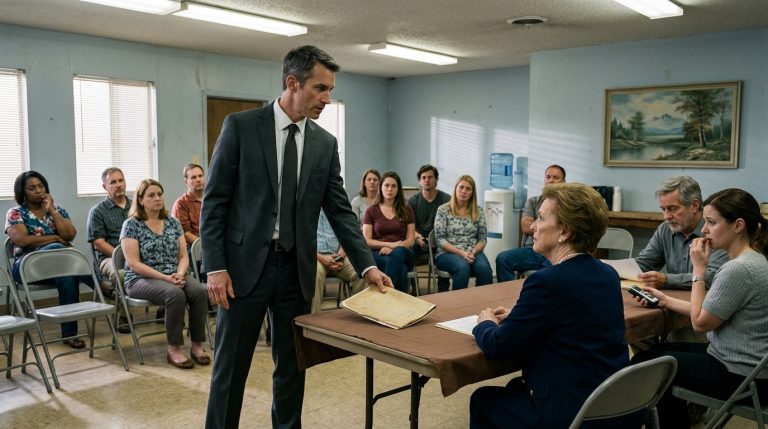
The air inside the Whispering Pines community clubhouse tasted of recycled air conditioning and stale decaf coffee, heavy with the nervous murmur of fifty homeowners packed tightly into plastic folding chairs. Fluorescent panels buzzed overhead, casting a harsh, flat light across rows of identical beige walls and identical faces.
I stood near the back, just inside the double doors, holding a worn leather folio containing Frank’s survey maps, David’s data logs, and the printed text chain between Karen Miller and the landscaping contractor. Beside me, Arthur adjusted his bifocals, his expression neutral, his posture rigid as an old fence post.
At the front table, Karen sat flanked by two nervous-looking board members. Her face was pale, pulled tight over her jaw like dry leather, her gaze fixed rigidly on the agenda papers in front of her. She looked like a general whose supply lines had been cut in the dead of winter, trying desperately to pretend the frost wasn’t already biting through her uniform.
The acting treasurer, a round-faced accountant named Tom, fumbled with a stack of papers, his voice shaking slightly as he droned through routine neighborhood maintenance updates. No one was listening. The room hummed with a different kind of frequency—the low, dangerous static of a community realizing the castle walls were built out of hollow drywall.
When the agenda finally dragged to the open forum portion for new business, Sarah Jenkins stood up near the third row.
“I have a point of order,” Sarah’s voice cut through the hum of the room, clear, steady, and entirely devoid of the habitual deference Karen had demanded for years. “And I yield my three minutes to Major Jack Callahan.”
A sharp intake of breath rippled through the rows. Karen’s head snapped up, her eyes flashing with sudden, defensive fury.
“He’s not a property owner within the subdivision’s residential covenants,” Karen snapped, her voice tight and strained, rising over the murmur of the crowd. “Guests are not permitted to address the board during operational sessions.”
Arthur didn’t wait for permission. He stepped forward out of the shadows near the back doors, his voice carrying effortlessly across the sterile room.
“Madame President,” Arthur said, each word measured and cold. “The bylaws state a member may address the board and may designate an representative to speak on their behalf regarding property disputes involving association actions. If you wish to challenge that interpretation, we can submit the question to the county magistrate currently reviewing the active tort filing against your individual bond.”
The silence that followed was absolute. The fluorescent lights hummed overhead, a tiny, insect-like drone filling the vacuum. Karen’s mouth opened slightly, but no sound came out. She looked around the room, expecting the usual chorus of nodding supporters, but the faces turned toward her were blank, guarded, and cold. The shield had dropped.
I walked down the central aisle, the rubber soles of my boots squeaking faintly against the polished linoleum floor. I didn’t rush. I carried the heavy folio like a field report, placing it down on the podium at the front of the room with a dull, resonant thud.
David Chen flicked a switch on the portable projector we had set up near the side outlet, casting a bright, white rectangle of light directly onto the beige wall behind the board members.
“This is an invoice dated three days before a quarter-mile gash was cut through my heirloom cornfield,” I said, my voice flat, uninflected, and carrying the steady rhythm of an engineering briefing.
I clicked to the next slide. The text message chain blown up to ten feet wide appeared on the wall in stark black letters: The farmer is a problem and we are solving it. Just get it done and bill it under the maintenance account.
A collective gasp swept through the room, followed immediately by a sharp, rising wave of angry murmurs. People shifted in their seats, turning to look at one another, the realization settling over them like cold water.
“She didn’t just authorize a trail,” I continued, scanning the room from left to right, meeting the eyes of the homeowners who had spent years paying fines for sidewalk chalk and faded front doors. “She used your dues—the money you pay to protect your property values—to finance a personal trespass, and then lied to the contractor to cover the tracks.”
Karen stood up abruptly, her chair scraping violently against the linoleum. “This is slander! This is an illegal distortion of internal records—”
“It’s a sworn deposition, Mrs. Miller,” Arthur interrupted smoothly from the back. “Signed by the contractor under oath, backed by server metadata and bank routing numbers.”
Karen looked around the room, her breath coming in shallow, ragged gasps, her expression shifting from imperious rage to cold, trapped panic. She grabbed her leather briefcase from the table, turned on her heel, and marched down the side aisle, pushing past the double doors without a backward glance.
The door swung shut behind her with a dull, final click.
In the sudden stillness, Tom the accountant cleared his throat nervously, looking out over the restless sea of his neighbors.
“The chair,” Tom whispered, his voice trembling slightly, “recognizes a motion from the floor.”
CHAPTER 6: The Liquidation and the Harvest
The fluorescent lights of the community clubhouse buzzed overhead, casting a cold, unyielding glare across the rows of plastic chairs. Tom the accountant stood frozen behind the front table, his fingers gripping the edges of his papers while the murmur of the room swelled into a steady, undeniable tide.
I didn’t move from my spot near the podium. My hands rested flat against the cool, dark wood, the heavy folio of documents lying open beneath my palms. The evidence was no longer an abstraction; it was a physical weight anchored by the cold reality of bank routing numbers, sworn depositions, and the state agricultural board’s final ruling.
Arthur stepped forward from the back of the room, his leather briefcase clicking shut with a dry, metallic snap. He walked down the central aisle, his footsteps measured and deliberate, stopping just short of the front row.
“The structural integrity of this association has been compromised by the unauthorized, willful actions of a single individual operating outside her statutory authority,” Arthur said, his voice carrying clearly over the murmurs of the room. “The state agricultural division’s ruling has rendered its verdict. The liability is not an association burden. It is personal.”
The silence that rushed back into the room was heavier than before. It was the quiet of a structure settling onto its foundation after a load-bearing pillar has been kicked away.
Tom swallowed hard, looking out across the sea of his neighbors. “The judgment,” he whispered, his voice cracking slightly. “What is the total?”
“Two hundred and twenty-five thousand dollars,” I said, my voice flat, level, and entirely devoid of triumph. “Inclusive of treble damages under the state Right to Farm Act, accounting for willful property destruction, genetic contamination of seed stock, and fraudulent misrepresentation of association funds.”
The numbers hung in the air like lead shot. Two hundred and twenty-five thousand dollars. No insurance carrier covers intentional fraud or criminal trespass committed by an officer acting ultra vires. The policy had denied coverage three days prior.
Two weeks later, the physical reality of that judgment manifested itself on the lawn of the grandest house on the ridge in Whispering Pines.
I stood on my front porch, the morning sun cutting through the mist rising off the Carolina clay, casting long, sharp shadows across the fields. The air smelled of damp earth, diesel, and the rich, organic promise of growing things. Across the valley, parked on the manicured, flawless zoysia grass of Karen Miller’s front lawn, was a large, ostentatious real estate sign bearing the stark, bold lettering of a luxury property liquidation.
The fuchsia-colored convertible in the driveway was gone, replaced by the empty, echo-chamber quiet of an oversized house stripped of its illusions. The judgment was a legal lien recorded against the title. The castle was being sold off piece by piece to settle the ledger.
A low rumble of an engine drew my eyes down the gravel access road. A modest Ford pickup truck slowed, turning onto my property and parking neatly beside the restored red barn. Tom the accountant stepped out from the driver’s side, accompanied by David Chen. They walked up the wooden steps of the porch carrying a heavy, sealed cashier’s check resting inside a manila envelope.
“Morning, Jack,” Tom said, offering a tired, genuine smile as he handed me the envelope. “This is from the new board. Twenty-five thousand dollars from the unallocated reserve fund—money that should have been spent on proper maintenance instead of vanity projects. It’s to help cover the immediate restoration of the acreage.”
I took the envelope, feeling the solid, crisp weight of the paper inside. I didn’t smile, but I gave him a single, respectful nod.
“It’s a fair start, Tom,” I said, opening the door to the kitchen and inviting them inside out of the morning chill. “The soil is already turning over nicely. Frank’s survey stakes are set, and the boundary is locked.”
By late afternoon, the legal machinery had quieted entirely. The notification from the escrow account confirmed that the remaining balance of the judgment had cleared, transferred cleanly from the proceeds of the house sale. The war was over, won not through noise or brute force, but through the relentless, unyielding mechanics of documentation, patience, and the law.
I walked out past the barn and into the center of the three-acre scar Karen had carved into the earth months ago. The heavy machinery tracks were gone, plowed under, aerated, and enriched with dark, nutrient-rich compost. In their place, a healthy, vibrant stand of bloody butcher corn stood tall, its broad green leaves rustling in the afternoon breeze, the deep red tassels catching the golden Carolina light.
Down the newly marked, sanctioned walking trail along the edge of the woods, a family from the subdivision walked slowly, their voices carrying softly on the wind. They paused at the boundary line, looking out over the rows of heirloom corn not as an eyesore or an obstacle, but as a living part of the landscape, quiet and enduring.
The father raised a hand in a brief, neighborly salute. I raised mine in return, turning back toward the farmhouse to check the irrigation valves. The land was whole. The legacy was secure. And the harvest was coming in heavy.