[The Iron Perimeter: A Cold-War Veteran’s Pragmatic Stand Against Suburban Extortion]
CHAPTER 1: THE ULTIMATUM AT THE FENCE LINE
The brass slide of my dial-caliper clicked twice in my thumb pocket before I set it on the cedar fence post.
“That ugly thing comes down, Mr. Callahan. Today starts the clock.”
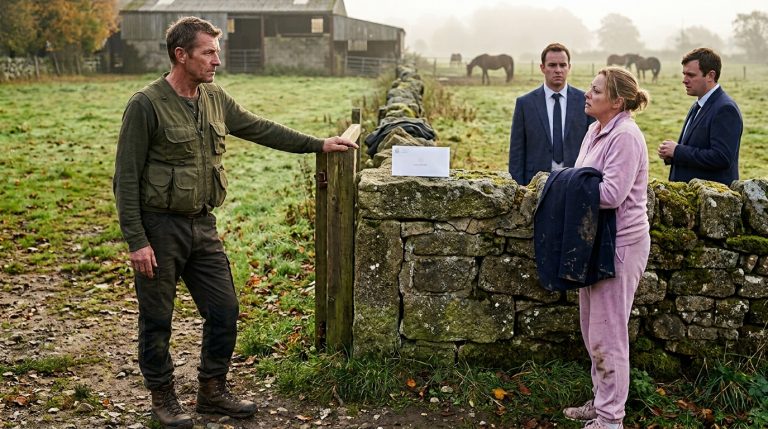
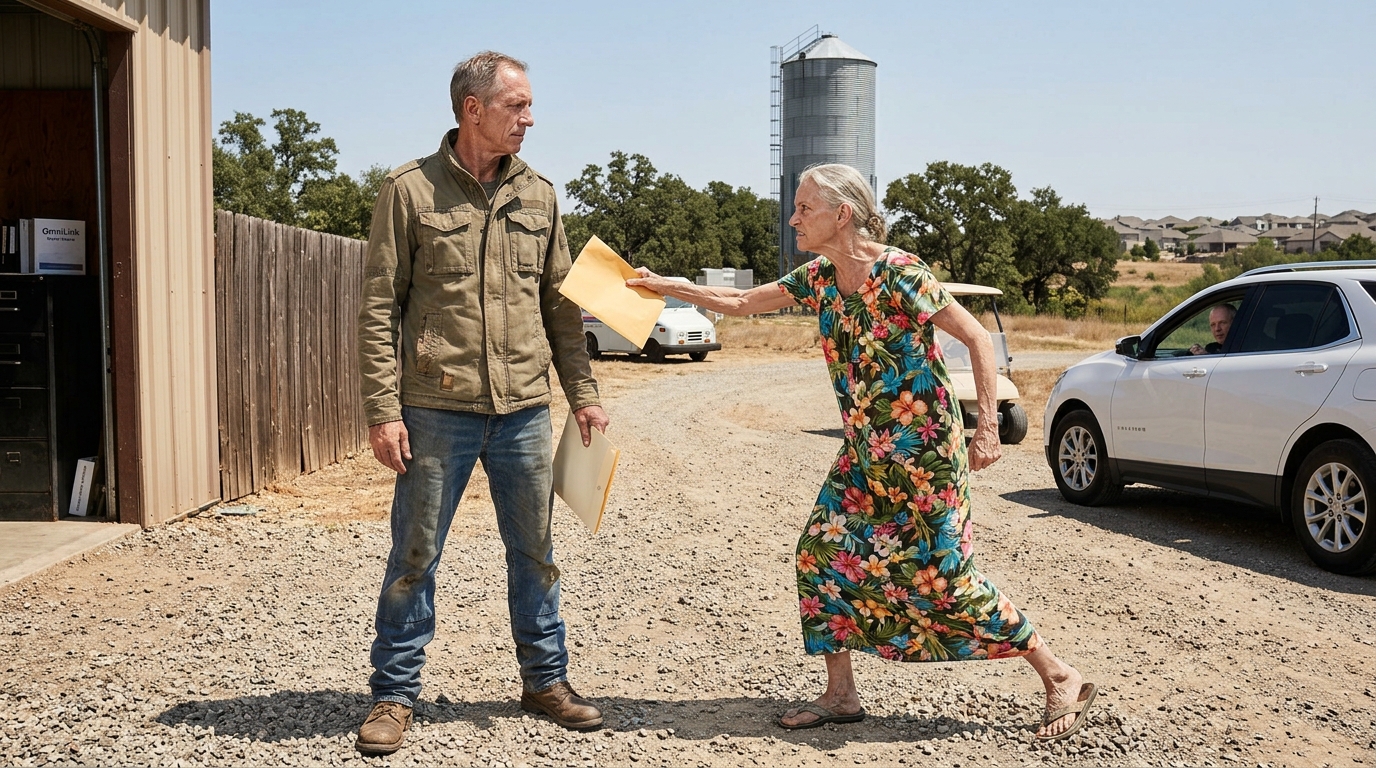
Her voice had the scraped-iron edge of a bad alternator. Karen stood six inches onto my gravel turn-around, floral mumu stretched taut against the dry heat, her left heel sinking a quarter-inch into the unpaved property border. She didn’t look at the rolling oak trees. She looked past my shoulder, straight at the sleek, 150-foot mono-pine silo tucked behind the eastern timber line.
“Thirty days,” she said. She didn’t offer a hand. She thrust a thick, cream-colored document envelope into my chest. The heavy stock didn’t give. It hit my sternum with a dull, dry thud. “Or the daily non-compliance levies trigger. Section 4, Paragraph B. Read it and weep.”
I didn’t open the flap. My thumb rubbed the smooth, waxy edge of the paper, feeling the raised seal of the North Ridge Meadows Homeowners Association.
“Property line ends at the culvert, Mrs. Vance,” I said. My voice stayed low, flat, unhurried. Air Force comms training teaches you one thing early: never give a hostile voice a target to frequency-match. “You’re standing on county-unincorporated dirt.”
Her eyes narrowed into tight, wet slits. She didn’t pull her heel back. “This entire valley is subject to regional aesthetic codes now. The board ratified the revised covenants last Tuesday. Your rustic eyesore drops our median valuation by four percent.”
“The silo was built fifteen years ago.”
“And the board’s authority was registered six months ago,” she snapped, stepping closer until the synthetic lavender perfume on her collar hit the hot scent of my cedar shavings. “You don’t get a pass because you were here first, old man. You adapt, or we take the land under statutory lien.”
She turned on her heel, her sandals crunching violently against my crushed limestone driveway. She climbed into a beige plastic golf cart parked near the ditch, slammed the foot pedal, and rattled off toward the paved suburban grid quarter-mile east.
I didn’t watch her go. I turned back to the fence post, picked up the brass caliper, and checked the depth of the mortise joint I was cutting. Zero point zero five inches off.
I set the tool down, slid the thick envelope under my arm, and walked toward the workshop. The dry valley air carried the faint, high-frequency hum of the relay array inside the mono-pine—a steady 120-hertz vibration that meant three thousand homes in the valley were currently making calls, streaming data, and running their security systems without a single dropped packet.
Inside the shade of the corrugated steel barn, the smell of burnt oil and cut pine settled the heat. I laid Karen’s envelope flat on the workbench next to a disassembled AN/PRC-117 radio chassis. I didn’t tear the paper. I used a utility knife to slice the top edge clean.
Ten thousand dollars initial fine. Five hundred dollars a day retroactive to the first of the month. The signatures at the bottom were fresh black ink: Karen Vance, President. Todd Miller, Treasurer. Brenda Cole, Secretary.
Below the legal terms, a single handwritten note in red ballpoint was scribbled across the margin: Remove it or lose it.
I pulled a steel drawer open under the main bench, bypassed the standard tax returns, and pulled out a faded blue leatherette binder stamped OmniLink Tower Lease — 2006. I flipped straight to Section 11A.
The text was plain black, printed twenty years ago, long before the first tract home was framed in North Ridge: Federal Preemption under Section 704 of the Telecommunications Act. No local ordinance, municipal board, or private covenant shall prohibit or have the effect of prohibiting the placement, construction, or operation of personal wireless service facilities.
My thumb slid across the cold brass caliper in my pocket.
Karen hadn’t read the master deed. She hadn’t checked the county register. She had looked at a retired veteran living on ten acres of unmanicured dirt and assumed she was dealing with an isolated target who would fold at the sight of a notary seal.
I picked up the desk landline, keyed the ten-digit direct line to OmniLink’s regional infrastructure desk, and listened to the tone dial out.
“Chen,” a voice flatly answered on the third ring.
“Jack Callahan. Tower 734.”
A brief pause, the sound of keys clicking over a open mic. “Jack. Signal reports look clean on our end. You got a hardware alarm?”
“Hardware’s fine, David. The new HOA president just served me a thirty-day demolition order and a ten-thousand-dollar levy.”
David Chen let out a short, nasal snort. “A what? What’s her name?”
“Karen Vance.”
“Right. Another neighborhood warlord,” Chen muttered. “Send me a scan of the notice. Our legal team will draft a standard preemption notice and drop it in her certified mail. We’ll shut her down by Friday.”
I looked out the open barn door. At the end of my gravel lane, right where my dirt met the HOA’s pristine blacktop, a shiny white crossover SUV was idling slow, its tinted passenger window rolling down two inches. Todd Miller’s pale face was visible in the gap, staring down my driveway, taking a photograph with his phone before pulling away.
“Hold the legal letter, David,” I said softly.
Chen stopped typing. “Hold it? Jack, that’s what we pay legal for. Why waste your time?”
“If you shoot a warning shot, she backs off and finds a different angle to cut my power line,” I said, my thumb clicking the brass slide tight. “Let her file the lien. Let her build the case. Have the preemption papers ready, but don’t send them until I give you the grid signal.”
“You’re giving her space to maneuver, Jack. That can get messy.”
“I’m giving her enough rope to hang the whole board,” I said. “Just set up my remote NOC access codes. I might need a five-minute diagnostic window next week.”
“A diagnostic shutdown?” Chen’s voice went sharp. “Jack, if that tower drops, the whole south valley goes dark.”
“I know,” I said. “That’s the point.”
CHAPTER 2: THE PAPER FORTRESS THE FIRST SKIRMISH
The phone receiver settled back into its cradle with a heavy, plastic latching sound. Outside the workshop door, the dust cloud from Todd’s white SUV hung suspended in the stagnant valley air, drifting slowly east toward the manicured asphalt of North Ridge Meadows.
I didn’t set the sliced envelope down. The heavy paper felt stiff between my thumb and forefinger, sharp enough to nick skin if handled carelessly.
My thumb slipped into my pocket, finding the cold brass slide of the dial-caliper. I clicked it once, twice, three times—a mechanical habit from my days tracking signal drift on high-frequency arrays. Precision requires baseline reference points. Right now, Karen and her quiet lieutenant were building their own baseline, and it relied on me acting like an isolated, panicked old man.
I walked to the eastern edge of the corrugated barn, where the shadow of the steel roof cut a sharp line across the gravel lane. Two hundred yards out, near the dense pine border that hid the mono-pine tower, something caught the midday heat. A dark grey commercial pickup—no logos on the driver’s door, no state municipal plates—sat idling on the shoulder of the county road. A man in a high-visibility vest was leaning against the tailgate, holding a digital survey laser aimed directly at the base of my tower enclosure.
I didn’t shout. I didn’t run out there with a shotgun like they probably hoped I would.
Instead, I stepped into the shadows of the workshop interior, pulled a pair of heavy 10×42 tactical binoculars off the shelf, and rested the rubberized barrels against the steel doorframe.
Through the optics, the survey crew’s door bore a small, freshly slapped magnetic magnet over a scraped-off decal: Lush Greenscapes LLC. Below it, in tiny block lettering, was a contractor license code and a secondary tag: Sub-Contractor Operations.
I adjusted the focal wheel until the laser target card came into crisp focus. They weren’t measuring the tower height. The red laser beam was bouncing off the ground pins marking the boundary line between my ten acres and the HOA’s common drainage basin. They were plotting an easement corridor.
My thumb clicked the caliper slide again. A landscaping outfit running boundary survey lasers on a telecommunications right-of-way. The pieces were sloppy, but the intent was obvious: establish a physical trespass line to justify a civil injunction.
I lowered the binoculars, walked over to my desk, and pulled a clean yellow legal pad from the drawer. I wrote down the date, the time, the license plate of the grey truck, and the exact orientation of their survey rig. Every entry in precise, blocky military print.
An hour later, the rumble of the mail truck signaled the day’s second delivery.
I walked down the gravel drive to the aluminum mailbox mounted on a creosote post at the road’s edge. Inside was a second cream-colored envelope, identical to the first, along with a bright red certified mail slip requiring a signature.
I signed the slip with the mailman’s offered ballpoint, handed it back, and cracked the second letter right there on the roadside.
The fine had escalated. Fifteen thousand dollars. Accrued interest. A mandatory appearance date before the North Ridge Meadows Architectural Review Committee in seven days, failure of which would trigger an immediate filing of a Notice of Assessment Lien with the county clerk.
Account 402-B, the fine remittance voucher read at the bottom. Direct all certified bank drafts to HOA Escrow Account 402-B, care of First Regional Commerce.
I carried the letter back to the barn, laying it side by side with the first notice. Two notices in forty-eight hours. That wasn’t standard administrative procedure for a voluntary homeowners association; that was a blitzkrieg designed to force a settlement before the victim could consult a lawyer or review local zoning filings.
I reached for my phone, keyed the number for the county land records office in town, and waited while the automated queue beeped in my ear.
“County Recorder, land and titles,” a woman’s tired voice eventually answered.
“This is Jack Callahan, parcel 408-West,” I said, leaning against the workbench and tracing the edges of the red ink on the second notice. “I need to check the recent filings on the parcel adjacent to my eastern line. North Ridge Phase 3.”
“Hold on, Mr. Callahan. Pulling up the digital ledger.” The clack of a mechanical keyboard rattled down the line. “Okay, I have Phase 3. What are you looking for?”
“Any proposed utility access modifications or private easement applications filed in the last ninety days.”
A pause. More typing. “Nothing from the county public works department… wait. There was a preliminary boundary adjustment application submitted two weeks ago by a private entity. Pending review.”
“Who’s the applicant?”
“Listed as Lush Greenscapes LLC, acting as authorized agent for North Ridge Meadows HOA. They’re requesting a forty-foot wide access corridor across the eastern boundary for ‘drainage and equipment staging.'”
I felt a cold, clear stillness settle behind my eyes. The landscape company wasn’t just mowing lawns for the HOA. They were trying to carve a forty-foot swath straight through my lease corridor to create a secondary access point for commercial development behind the valley ridge.
“Has the board president signed off on the filing?” I asked.
“Signature on file is Karen Vance,” the clerk confirmed. “Application fee was paid via cashier’s check drawn from a commercial account.”
“Thank you, ma’am.”
I hung up the phone. The picture was sharpening. Karen wasn’t just trying to get rid of an “eyesore” because it bothered her pristine suburban sensibilities. She was using the threat of ruinous HOA fines to squeeze my property, force a legal defect on my title, and clear the way for a lucrative easement deal that her brother-in-law’s shell company would execute.
She thought I was just an old man sitting on ten acres of dirt, trapped in a room with no doors. She didn’t realize I’d built the room, wired the lights, and held the master key to the power box.
I took the legal pad, my binoculars, and a fresh stack of index cards, and walked over to my F-150. I threw the gear onto the passenger seat, turned the key, and let the old V8 rumble to life.
It was time to take a drive through North Ridge Meadows. Not to confront Karen, not to argue about bylaws, but to map the terrain and find the people she had already crushed under her heels. A fortress built on extortion only stands as long as the victims stay quiet and isolated.
I pulled out of my driveway, turning left onto the fresh, dark asphalt of the subdivision. The sun was dipping toward the ridge, casting long, sharp shadows across identical beige houses, identical lawns, and the silent, growing anger of a neighborhood under siege.
CHAPTER 3: MOBILIZING THE OUTSKIRTS
The idle of the 351 Windsor engine vibrated through the floorboards, a low, rhythmic pulse that rattled the brass caliper lying on the open legal pad beside me.
Through the dust-streaked windshield, the community bulletin board at the entrance of Meadow View Drive stood under the harsh angle of the late afternoon sun. A fresh piece of paper—laminated, stapled at all four corners with heavy-duty steel wire—glared back in bold scarlet ink: COMMUNITY NOTICE: PARCEL 408-WEST UNSANCTIONED INDUSTRIAL USE.
They’d put my exact parcel number right at eye level. No name, but every homeowner who drove past the mail kiosks had to look at it before turning into their driveway.
I shifted the F-150 into park, pulled the handbrake until the cable groaned, and stepped out into the dry heat. My boots crunched over the gravel shoulder.
Up close, the laminated sheet smelled of cheap adhesive and hot plastic. I reached into my shirt pocket, pulled out the small digital camera I kept for site surveys, and took three clean shots—one macro on the wording, one framing the entire board, one wide shot showing the board’s position relative to the public right-of-way.
“Takes a lot of nerve to post a man’s parcel number like a wanted poster.”
The voice came from behind a tall, meticulously trimmed privet hedge forty feet up the sidewalk. A man in gray work pants and a faded USMC physical training shirt stepped out, holding a pair of heavy bypass loppers. His hair was high-and-tight, salt-and-pepper, and his left elbow bore the long, pale track of a surgical scar.
I didn’t turn around fast. I finished stowing the camera in my pocket before leaning against the wooden frame of the kiosk.
“Jack Callahan,” I said.
“Marcus Vance,” he replied, taking two slow steps forward. He paused, looking at my boots, then up at my face. “No relation to the queen bee, thank God. I live at 114. Two houses down from the cul-de-sac.”
“You’re the flag pole guy,” I said, remembering the notes from my first lap around the grid.
A cold, thin smile touched Marcus’s lips. He tapped the loppers against his thigh. “Six feet two inches. Rules say six feet maximum height for unattached garden fixtures. Karen personally brought a fiberglass measuring rod onto my lawn while my wife was putting up groceries. Sent me a forty-dollar non-compliance fee three days later.”
“You pay it?”
“I wrote Section 704 Federal Exemption across the check memo and mailed her a copy of the flag display code,” Marcus said. His thumb rubbed the rubber grip of the loppers—a tight, repeated pressure that betrayed the heat behind his quiet tone. “She sent it back stamped Refused. Now the fine is four hundred, and Todd Miller dropped a notice in my box yesterday saying they’re freezing my voting proxy for the annual meeting.”
I looked down the street. Row after row of identical timber-framed houses, pristine turf, and uniform beige trim. But under the surface, the tension was thick as creosote.
“She’s isolating people,” I said softly. “One house at a time. Makes everyone think they’re the only ones breaking the rules, so everyone pays quietly.”
“Divide and conquer,” Marcus grunted. “Standard tactical suppression. What are you doing out here, Jack? She’s telling the board you’re running an illegal commercial scrapyard on the ten acres.”
I pulled my yellow legal pad off the truck seat and turned it so he could see the entry from the county land office. “She filed a forty-foot easement request across my eastern boundary under Lush Greenscapes LLC. She’s trying to clear a commercial access road through my tower corridor.”
Marcus leaned in, his eyes scanning my block print. He read the parcel numbers twice. His jaw hardened, the muscles along his neck locking like iron cables.
“Lush Greenscapes,” he muttered. “That’s her brother-in-law, Barry. He’s the one who gets sixty thousand a year from our dues to mow the common parkways. Half the time the grass is four inches high and full of dandelions, but the checks clear every first of the month.”
“She’s using the fines to pressure title holders,” I said. “And she’s funneling the money through the HOA escrow account. Account 402-B.”
Marcus looked up from the pad, his eyes locking onto mine with the hard, sharp focus of a man who recognized a operational grid when he saw one. “You’re not just fighting the notice on your silo.”
“I’m opening the books,” I said. “And I need five households who are willing to sign a joint legal demand for an emergency audit under the State Nonprofit Corporations Act.”
Marcus looked down the street toward the Henderson place—an older ranch-style lot at the corner where an elderly woman was currently hand-watering her hydrangeas with a short green hose.
“Eleanor Henderson got hit with a hundred-dollar fine last week because her birdbath wasn’t an approved clay tone,” Marcus said quietly. “Her husband’s in hospice in the front room. She cried on her porch for two hours because she thought they were going to put a lien on their house.”
He set the bypass loppers down on the grass, wiped his palm on his work trousers, and extended his hand toward me.
“I’ll sign,” Marcus said. “And I’ll walk door-to-door with you right now. Let’s go talk to Eleanor.”
We crossed the pavement together, our shadows stretching long across the hot asphalt as the sun dropped behind the ridge. The quiet resistance wasn’t just a list of complaints anymore. It was turning into a line of battle.
CHAPTER 4: THE FINANCIAL AUDIT TRAP
The ballpoint pen clicked twice as Eleanor Henderson lifted her hand from the wooden doorframe. Her signature sat at the bottom of the petition in tight, shaky blue cursive, right below Marcus’s bold block lettering and my own.
“They’ll come after my garden next, won’t they, Jack?” Eleanor’s voice was barely a whisper, her knuckles still white where she gripped the edge of the clipboard. Behind her, through the screen door, the rhythmic, mechanical click of her husband’s oxygen concentrator hummed against the quiet house.
“They can try,” I said, taking the clipboard back and sliding the paper into my manila folder. “Set the porch light off, Eleanor. Keep your door locked tonight.”
Marcus took the steps two at a time, his boots hitting the lawn without a sound. “That makes six signatures. That’s ten percent of the registered title holders in Phase 1 and 2. Enough to legally force an inspection of the books under Section 53-A of the State Code.”
“We drop it in certified mail tomorrow morning,” I said, stepping off the porch as Eleanor’s porch light clicked off behind us, plunging the lawn into deep shadow. “Give them seven business days to produce the unredacted ledgers for Account 402-B.”
The match-cut transition across three days of waiting was marked only by the steady build-up of heat in the valley. By Friday morning, the postal carrier’s truck didn’t stop at my road box. Instead, a courier vehicle with regional commercial plates pulled right up my gravel turn-around, kicking up a plume of dry dust before grinding to a halt outside my workshop door.
The driver didn’t get out. He reached through the open window, handed me a heavy, padded envelope, and held out a digital signature pad.
“Sign here, Mr. Callahan. HOA response package.”
I signed the pad, took the envelope, and carried it straight to the steel workbench. The sender’s label bore the return address of Vance & Miller Administration, Care of North Ridge Meadows HOA.
I slit the top with my utility knife. Inside was a thick, black three-ring binder labelled FINANCIAL DISCLOSURE SUBMISSION — CONFIDENTIAL.
I opened the binder flat under the overhead shop lamp. The first twenty pages were standard administrative summaries: lawn maintenance schedules, streetlight power bills, water management district fees. But when I flipped to the ledger section for Account 402-B, the physical state of the paper changed.
Every single transaction line for the past eighteen months had been processed through a secondary clearing system. The vendor column didn’t read Lush Greenscapes LLC or County Water. It read VENDOR REF 88-A through VENDOR REF 88-Z. And right across the middle of the third quarterly page, an entire nine-inch section of the ledger sheet had been manually razor-cut out of the master page before photocopy duplication.
The physical discrepancy was blatant. The cut line wasn’t straight—it curved near the bottom margin, showing the faint top loop of a handwritten signature that hadn’t been fully severed by the razor blade.
My thumb went to my pocket, finding the cold brass slide of the dial-caliper. I pulled the tool out, laid the hardened steel jaw against the margin of the photocopied page, and measured the cut gap. Zero point seven-five inches wide. Just enough space to hide a check routing number and a secondary account designation.
I picked up my cell phone and dialed Marcus’s line. He picked up on the first ring.
“They sent the binder,” I said.
“Is it clean?”
“They used a razor blade on the master ledger before making the copy,” I said, leaning over the page with a magnifying lens. “They missed the tail of the authorizing signature on page fourteen. It’s an upper-case T with a distinct left-hand loop.”
“Todd Miller,” Marcus said instantly. “He signs all the HOA checks with that stupid stylized flourish.”
“And there’s more,” I continued, tracing the margin with the point of my calipers. “They attached a cover memo from their legal counsel. They’re claiming the unredacted vendor contracts are protected under trade secret exemptions, citing Section 704 Federal Exemption incorrectly as a commercial privacy clause.”
Marcus let out a short, harsh laugh. “They’re misusing the federal telecom code to hide their own checkbook?”
“They’re desperate, Marcus. Layer 1 just broke. They aren’t trying to enforce community aesthetics anymore—they’re scrambling to cover a paper trail before the annual meeting.”
“What’s the next move?”
“We don’t send another letter,” I said, closing the black binder with a heavy, hollow thud. “We let Karen think this redacted binder satisfies our legal demand. Let her feel secure enough to call the special emergency board meeting she threatened in her first notice.”
“She called it an hour ago,” Marcus said, his voice turning cold. “E-mail alert just went out to the whole neighborhood. Next Tuesday, eight o’clock, at the community pavilion. Agenda item one: Judicial foreclosure authorization for Parcel 408-West.”
I looked out the workshop door toward the eastern timberline. The sun was reflecting off the high metallic dish of my mono-pine tower, sending a pale beam of light across the dry forest floor.
“Good,” I said. “Tell Eleanor and the Garcías to bring every notice they’ve ever received. It’s time to take the pavilion.”
CHAPTER 5: THE KILLSWITCH SHOWDOWN
The dial tone clicked off in my ear, leaving only the low 120-hertz hum of the workshop transformer. On the steel bench, page fourteen of the black binder lay open, the razor-cut margin showing the curved tail of Todd’s signature under the fluorescent bulb.
I didn’t pack the binder. I slid it into my canvas field bag along with my laptop, two legal pads, and a handheld digital display receiver hooked directly to my cellular diagnostic rig.
The match-cut transition across four days ended under the corrugated steel roof of the community pavilion.
Eighty metal folding chairs sat lined up in neat, tight rows over the swept concrete floor. The air inside smelled of damp cedar, cheap coffee, and the nervous sweat of sixty homeowners packed shoulder-to-shoulder under the high-bay sodium lights.
Karen Vance sat behind a long folding table at the front, flanked by Todd Miller and a sharp-faced lawyer in a navy suit. She wore a dark blue blazer, her hair pinned tight, her hands resting flat on a thick leather portfolio. Todd sat to her left, his forehead slick with perspiration despite the night air, his thumb nervously clicking the top of a silver ballpoint pen.
I took a chair in the fifth row next to Marcus. Eleanor Henderson sat on my right, her small hands holding her purse flat against her knees. Two rows ahead, Mr. Garcia gave me a single, firm nod.
At eight sharp, Karen slammed a wooden gavel against the folding table. The sharp crack echoed off the steel rafters.
“This special meeting of the North Ridge Meadows Homeowners Association is called to order,” she announced, her voice projected through a portable PA speaker. “Agenda Item One: Resolution to authorize immediate judicial foreclosure and mandatory removal of the unsanctioned industrial structure on Parcel 408-West.”
A quiet murmur rippled through the back rows.
“The board has provided full due process,” Karen continued, her eyes locking onto mine over her reading glasses. “The owner has refused compliance, ignored statutory fines, and submitted frivolous legal demands. The board moves to vote.”
“Seconded,” Todd blurted out instantly, his voice cracking slightly.
“Before the board votes,” I said, standing up from my folding chair. My voice was low, flat, carrying straight through the open pavilion without the PA. “The title holder has a statutory five minutes to address the assembly under Section 12 of the community bylaws.”
Karen’s jaw tightened. The lawyer beside her leaned over, whispered three words into her ear, and pulled back.
“Five minutes, Mr. Callahan,” Karen said coldly. “Keep it brief.”
I walked down the center aisle, setting my canvas bag on the edge of the speaker’s podium. I didn’t open a binder. I plugged a short USB cable from my handheld diagnostic receiver into the pavilion’s digital projector input.
A sharp white rectangle flashed across the pull-down screen behind her table.
“The board claims Parcel 408-West harbors an unsanctioned industrial eyesore,” I began, clicking a remote. The screen filled with a high-resolution aerial map of the valley. A bright yellow polygon marked my ten acres, with the mono-pine tower highlighted in green. “What you are looking at is Tower 734. It operates under a federal land lease granted in 2006.”
“This is irrelevant administrative noise—” Karen started, reaching for her gavel.
“It is governed under Section 704 Federal Exemption of the Telecommunications Act,” I interrupted, my tone cutting straight through her. “A federal statute that explicitly prohibits any private covenant or local board from interfering with cellular relay infrastructure. Every fine levied against my parcel is legally void.”
“The fine stands at twenty-five thousand dollars!” Todd shouted from the table, his face flushing dark red. “You owe the escrow account!”
“Let’s talk about Account 402-B,” I said softly.
I pressed the remote again. The aerial map vanished, replaced by a macro scan of page fourteen from the black binder. The razor-cut gap filled the twelve-foot screen, showing the curved tail of Todd’s signature right where the vendor name had been sliced out.
The pavilion went dead silent. You could hear the dry moths hitting the sodium lamps above.
“This is the unredacted disclosure the board sent under legal compulsion,” I said. “Three thousand dollars a month transferred from Account 402-B to Lush Greenscapes LLC—a shell company registered to Karen Vance’s brother-in-law. A company currently applying for a private commercial access corridor across my eastern line.”
Karen bolted out of her chair, her chair legs shrieking against the concrete. “Turn that off! That is confidential board record! You are in violation of—”
“And to show you what this ‘eyesore’ actually does for this room,” I said, taking my phone from my belt.
I didn’t yell. I tapped speed dial number one, held the phone to my ear, and switched the audio to the pavilion’s auxiliary PA input.
A crisp, automated voice echoed from the speakers: “NOC Operations. Authorization Code Delta 7 Alpha confirmed. Initiating five-minute diagnostic isolation on Sector Tower 734 in three… two… one…”
A soft chime sounded from sixty pockets simultaneously.
Across the room, screens went dark. Signal bars dropped from five to zero. The small ‘No Service’ indicators flashed in red text across every phone in the pavilion.
A woman in the third row gasped. A man near the doors held his phone high over his head, staring at the blank screen in absolute disbelief.
“My wife’s heart monitor link just went down!” a man three rows back yelled, standing up.
“I don’t have a signal!” another voice called out. “I can’t even dial out!”
“That tower handles ninety percent of the emergency data traffic in this valley,” I said into the microphone, my voice steady as iron. “Karen Vance wants to tear it down so her family’s landscaping firm can build a commercial haul road through my timber line. She cut your service to line Account 402-B.”
The room didn’t murmur. It exploded.
Neighbors stood up from their chairs, pointing at the front table. Mr. Garcia was on his feet, shouting over the din. Marcus moved to the foot of the stage, his arms crossed, blocking Todd as the treasurer tried to gather his loose papers with trembling hands.
Karen stood behind her chair, her face drained of all color, her hands clutching her leather portfolio like a shield as sixty furious homeowners surged toward the edge of the platform.
“Restore the grid, Jack!” Marcus called out over the roar.
I tapped the screen once, sending the override packet back to David Chen’s desk. Ten seconds later, sixty phones chimed in unison as five bars of signal flooded back into the valley.
Karen looked at me across the table—her authority shattered, her paper fortress in ruins, the cold reality of what she had done finally settling into her eyes.
CHAPTER 6: THE CLEAN SWEEP ABSOLUTE RESTORATION
My thumb slipped into my pocket, the phone sliding flat against my thigh as the last chimes of sixty reconnected devices faded into the pavilion roof.
Karen didn’t sit down. Her fingers dug into the edge of her leather portfolio until the fake grain turned white under her nails. Beside her, Todd Miller made a sharp, panicked move to snatch his yellow legal pad off the table, his elbow knocking his water glass flat. The water pooled across the printed agenda, soaking the bold header of Item One.
“The meeting isn’t adjourned!” Karen shouted, her voice thin, strained, cutting across the rumble of the crowd. She reached for the wooden gavel lying in the spilled water. “This is a gross breach of board protocol! The vote on Parcel 408-West will proceed—”
“The board doesn’t have a quorum, Karen,” Marcus said. His voice didn’t rise. He stepped up onto the low wooden platform, his six-foot-two frame blocking the glare of the projector light. He held up three sheets of white paper stapled at the corner. “As of six o’clock tonight, sixty-five percent of registered title holders signed a petition for immediate recall under Section 14 of the master covenants. You, Todd, and Brenda are removed effective this second.”
Todd froze, his thumb twitching over his silver pen. “You can’t just… that requires a formal election committee—”
“Eleanor Henderson is heading the interim committee,” I said, stepping away from the podium and unhooking my USB cable from the projector. The projection screen went dark, leaving only the dull yellow overhead sodium lamps. “And the county sheriff’s economic crimes unit was handed a certified copy of your razor-cut ledger for Account 402-B at four o’clock today.”
Karen’s head snapped toward her lawyer. The man in the navy suit didn’t look at her. He deliberately closed his briefcase, snapped both brass locks shut with two clean metallic clicks, and stood up.
“I am withdrawing as counsel for the board,” the lawyer said softly, stepping around the table without offering Karen a hand. “Mrs. Vance, I strongly advise you not to make any further public statements.”
He walked down the center aisle, his leather soles clicking briskly against the swept concrete until he vanished out the open side doors into the night.
The cornered beast didn’t go quietly. Karen’s face flushed a deep, mottled purple. She grabbed her wet portfolio and thrust it toward the front row of homeowners.
“You think this old man saved you?” she spat, her breath ragged. “He’s running a commercial utility rig on agricultural land! The easement through Lush Greenscapes LLC was a legal land-use consolidation! We were securing a five-hundred-thousand-dollar regional infrastructure grant for this neighborhood!”
“Lush Greenscapes LLC is registered to your brother-in-law, Barry,” Mr. Garcia called out from the third row, stepping forward. “And the grant application filed with the county lists Account 402-B as the sole disbursement destination.”
The room surged forward another step. The anger wasn’t a roar anymore—it was a cold, dense wall of neighbors standing shoulder-to-shoulder. Karen looked left, then right. Todd had already backed off the rear of the stage, his head down, slipping out through the shadows of the storage shed.
She pulled her portfolio against her chest like armor, turned on her heel, and marched down the side ramp toward her golf cart parked in the grass. Nobody chased her. Nobody yelled. They just parted like a wake, watching her go in absolute silence until the electric whine of her cart faded down Meadow View Drive.
The match-cut transition across forty-eight hours brought the valley back to its natural rhythm.
By Thursday afternoon, the high desert sun had baked the humidity out of the air. The community bulletin board at the entrance of Oakridge Trail was clear. Marcus had personally used a pair of pliers to pull the heavy steel staples, dropping the laminated warning notice into a galvanized trash can.
In the center of the subdivision, the Garcia kids were out on their front lawn. The swing set wasn’t beige anymore. Mr. Garcia had spent Wednesday morning with two cans of bright rust-resistant cobalt blue enamel, painting every steel pipe until it shone under the sky.
Down at the Henderson house, Eleanor sat on her front porch, hand-watering her hydrangeas. Beside her door, on a simple iron hook, hung a bright hand-carved cedar birdbath painted in soft turquoise. No notices arrived in her box. No clipboard-bearing inspectors walked her grass.
I sat on the tailgate of my F-150 at the far eastern edge of my ten acres, where the gravel lane met the oak line. The afternoon was quiet, save for the steady, reassuring 120-hertz hum of Tower 734 rising clean and tall against the mountain backdrop.
In my lap lay the brass dial-caliper. The slide was slightly stiff from the dry trail dust. I pulled a small tin of gun oil and a scrap of flannel from my pocket, wiped the hardened steel surfaces clean, and adjusted the thumb screw until the jaw moved with zero resistance, reading dead true at zero point zero zero.
A dust cloud formed down the lane. Marcus’s truck pulled up, stopping near my rear bumper. He got out, leaning his elbows on the tailgate beside me, holding two cold bottles of sarsaparilla. He handed one over without a word.
I took a long drink, the cold carbonation cutting through the heat in my throat.
“Interim board completed the audit review this morning,” Marcus said, looking out toward the mono-pine tower. “The county prosecutor issued formal grand jury subpoenas for Todd’s bank records and Barry’s equipment accounts. They’re freezing Account 402-B.”
“And the easement filing?”
“Dismissed with prejudice by the land recorder,” Marcus replied. He looked down at the brass caliper in my hand. “The HOA covenants are being rewritten next week. Simple stuff. Common road maintenance, snow removal, transparent books. No color codes. No measuring rods.”
I set the oiled caliper back into its felt-lined wooden box and snapped the brass latch shut.
“Good,” I said.
The wind shifted from the east, carrying the clean, dry scent of pine needles and warm granite across the fence line. No engines idle on the shoulder. No laser survey crews plotted lines through my timber. The perimeter was clear, the land was quiet, and the valley belonged to the people who built it.