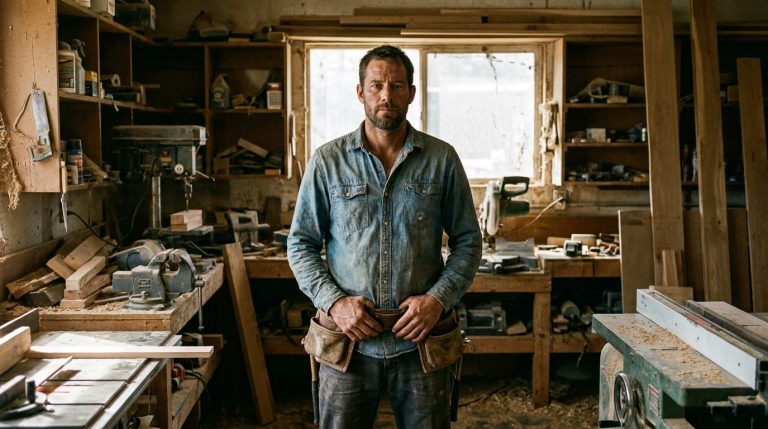
The Weight of Red Clay: One Man’s Surgical Dismantling of a Suburban Empire
CHAPTER 1: THE SHORELINE AUDIT
The sun hit the surface of the lake like a blade, slicing across the water until the glare made my eyes ache. I didn’t look away. I stood there, boots planted on the red clay that had belonged to my grandfather since before these women were born, watching the way their posture stiffened as I didn’t move.
“Mr. Harrove,” the one on the left—Bev, I remembered from a neighborhood flyer—started. Her voice was too practiced, a clipped cadence designed to disarm. “You aren’t authorized to be on the shoreline. This is private property for Stonebridge residents only.”
I didn’t answer. Instead, I looked down at the bank. The ground here was soft, churned up by something heavier than a casual walker. I saw the indentations—deep, rhythmic tread marks that didn’t match the light, recreational foot traffic of a weekend kayaker. They looked like the heavy, lugged soles of industrial work boots. A tremor of cold went through my chest, the kind that had nothing to do with the morning air.
“Authorization,” I repeated, the word tasting like copper.
“It’s a managed community,” the second one, Trish, chimed in. She clutched a leather folio to her chest as if it were a shield. “You haven’t displayed your lake use badge, and you’re obstructing the maintenance path.”
I stepped forward. I didn’t rush it. I moved with a slow, deliberate gravity, noticing how they both took a half-step back, their smiles flickering for a micro-second before snapping back into place. That was the first tell. They weren’t just protecting a fence; they were protecting a secret. My eyes caught the edge of a plastic stake poking out of the weeds near the water line—a surveyor’s marker, freshly driven. It wasn’t there when my father was alive.
“Who told you this was your water?” I asked, my voice flat, stripped of the fatigue that had been clinging to me since the funeral.
“It’s in the bylaws,” Bev said, though her gaze darted toward the tree line, not at me.
I looked down at the mud again. I noticed a small, discarded brass fitting partially buried in the silt—a high-end pipe coupling, the kind used for industrial irrigation, not residential lawn care. My father had never installed anything like that. I reached down, but before my fingers touched the cold metal, a heavy, familiar dread settled in my gut. This wasn’t about mailbox posts or smokehouse emissions. This was about something being pulled from the lake bed itself.
I picked up the fitting. It was heavy, wet with lake silt, and stamped with a serial number I didn’t recognize.
“You’re not managing a neighborhood,” I said, my voice barely above the sound of the water lapping against the bank. “You’re managing a theft.”
They didn’t move. They just stood there, framed by the expensive, fake perfection of their development, while I stood in the reality of the red clay. I turned away, the weight of the brass in my pocket feeling like a lead sinker. I had to get to the basement. I had to see the original maps.
I didn’t look back as I walked to the truck. I didn’t need to. I could hear the sharp, frantic clatter of their radios coming to life behind me. The game wasn’t just on; it had already shifted.
CHAPTER 2: THE FORENSIC ARCHIVE
The walk from the truck to the farmhouse basement was a blur of calculated friction. My tires had crunched the gravel with an aggressive, uneven rhythm, mirroring the internal pulse that refused to settle. I entered the basement through the rear bulkhead, the heavy metal door groaning on hinges that needed oil—a sound I had ignored for years, but which now hit my ears like a dissonance that demanded fixing.
Inside, the air was stagnant, heavy with the scent of damp concrete, old cardboard, and the lingering, sweet-sour trace of hickory smoke that seemed to permeate every fiber of the house. I didn’t turn on the main light. I clicked on a single desk lamp, its yellow beam isolating the piles of records like a spotlight on a crime scene.
My father had been a man of terrifying order. Every deed, every permit, every letter from the county had been filed in chronological, color-coded folders. But as I pulled the Stonebridge Meadows development file from the stack, my fingers brushed against a stack of receipts that felt wrong. They weren’t in the same heavy stock paper as the official filings. They were thinner, thermal-printed, and smelled faintly of chemical cleaner.
Granddad never bought anything at a supply store three counties over.
I sat in the swivel chair, the leather cracked and cold against my skin, and laid the brass coupling I’d scavenged from the shoreline on top of the desk. Beside it, I placed the folder. A sudden, jarring memory surfaced—a phantom weight on my shoulder. I was twelve, and Granddad was standing on this very spot, showing me how to check the water pressure in the old smokehouse lines. He hadn’t said a word, just pointed at the pipe, his eyes hard as flint. He knew even then that the land was a living thing, and that to protect it, you had to watch the plumbing as closely as the borders.
I shook the thought away. I needed data, not ghosts.
Constance was already here, or would be within the hour. I didn’t wait for her. I began pulling the deeds—not the copies the HOA sent, but the original hand-drawn plat maps my grandfather had insisted on getting from the surveyor in 1982. The ink was faded, the paper brittle, but the geography was absolute.
I traced the shoreline with my index finger, comparing it to the recent notices Trish and Bev had waved in my face. The HOA’s claim was built on a series of “easement expansions.” I cross-referenced the dates. The expansions were dated 2017—a year after Stonebridge Meadows broke ground. They had simply rewritten the map, using language that sounded official, designed to baffle anyone who didn’t know how to read a parcel boundary.
But the money… where was the money going?
I found a file labeled ‘Community Infrastructure Maintenance.’ It wasn’t in the main box; it was tucked behind a false backing in a binder of property tax records. I pulled it out. It was a ledger. Not an official one, but a personal log—likely a copy of a ledger the treasurer had kept before getting nervous and leaving it on my father’s porch a year ago. My father had never mentioned it. He had just filed it away, waiting for a day that required more than patience.
The entries were staggering. Monthly deposits for “Dock Access,” “Water Utilization,” and “Marina Construction Surveys.”
I felt the skin on my arms prickle. A marina? In a shallow-water lake zoned for rural, non-commercial use?
The absurdity of it was almost surgical. They weren’t just taking my water; they were trying to convert a protected rural shoreline into a commercial slip for private boats. The zoning changes required for a marina would effectively kill the agricultural status of the entire property, stripping me of the “Right to Farm” protections that Constance had used to shield us.
It was a trap. A slow, grinding, bureaucratic trap designed to squeeze the farm until it was no longer viable as a farm, and then, when I finally folded, they would be standing there with an offer to “save” me from the disaster they had engineered themselves.
I heard the crunch of gravel outside—Constance’s car. I looked down at the ledger, the figures blurred under the dim lamplight. I hadn’t been fighting a petty power trip; I had been fighting a land grab disguised as a neighborhood cleanup campaign.
I stood up, the chair scraping sharply against the concrete, and slid the ledger into my coat pocket. My hands were steady now. The heat in my skin had gone cold, and my mind was already constructing the counter-move. If they wanted a battle over lines on a map, they had come to the right place.
I left the basement, the smell of damp earth clinging to me, and walked out to meet the attorney who would help me sharpen the teeth of this document. The game was no longer about defending a boundary; it was about reclaiming the ground they thought they had already bought and paid for.
CHAPTER 3: THE DECOY EXPOSED
The crunch of tires on gravel outside stopped, followed by the heavy, rhythmic thud of a car door closing. I didn’t rush to the surface. I stayed in the yellow circle of the desk lamp, my eyes locked on the ledger entries. The math was elegant, simple, and utterly predatory. If I was going to turn this, I needed the forensic anchor.
I stood up just as the bulkhead door groaned open. Constance Waverly descended the wooden steps with a measured grace that usually intimidated people; today, it just looked like efficiency. She carried a sleek, leather-bound briefcase and a travel mug that smelled of bitter, black coffee. She didn’t say a word as she crossed the concrete floor, her heels tapping a steady beat until she reached the desk.
“You found it,” she said, not as a question, but as a confirmation of her own expectations. She wasn’t looking at me; she was looking at the ledger I’d pulled from the false backing.
“It’s not just an HOA complaint, Constance,” I said, sliding the ledger toward her. “They’re building a marina. Or at least, they’ve been selling the rights to build one.”
She pulled a pair of rimless glasses from her bag, put them on, and flipped through the pages. Her face remained a mask of practiced neutrality, but I saw the way her jaw tightened—a faint, rhythmic pulsing of the muscle there. “This isn’t just a violation of the governing documents, Clint. This is conversion of assets. They’re treating your shoreline as a commercial commodity to secure construction loans.”
“Construction loans for who?” I asked.
Constance finally looked up. Her eyes were sharp, scanning the basement as if checking for ears in the walls. “Look at the ink. Look at the stamps.”
She pointed to the ledger’s ‘Community Infrastructure’ section. I leaned in. There was a discrepancy. The official HOA seal—the one they slapped on every courtesy notice and fine—was absent. Instead, there was a series of handwritten initials, barely legible, nestled in the margin of every transaction entry.
“Those aren’t HOA approval stamps,” I whispered, the realization hitting me with the force of a physical blow. “Those are initials. Personal initials.”
“Exactly,” she said. “They’ve been bypassing the board’s voting process entirely. They’re moving money through a shadow account and labeling it as ‘maintenance’ to keep the funds liquid for whoever is holding the note on that marina project.”
I looked at the surveyor’s marker I had left on the desk. “The marina isn’t for the neighborhood. It’s for them. They’re selling off pieces of the lake front to private investors, then using the ‘HOA’ to enforce the zoning compliance that makes those slips worth millions.”
“It’s a shell game,” Constance agreed, closing the ledger with a soft, final sound. “Darla Fitch is the face, but someone else is the architect. She’s too transparent to manage this level of financial complexity.”
I walked over to the workbench, picking up the heavy brass coupling I’d found earlier. I turned it over in my hands. The weight of it felt like a promise. “If they’re using the neighborhood’s name to sign off on these agreements, then the neighborhood is liable. They’ve compromised the entire board, intentionally or not.”
“Which gives us our leverage,” Constance said, her tone hardening. “If we go to the county right now, we’re just two people with a binder. We need the board to implode from the inside. We need to find out who’s leaking the approval, and we need to force them to disavow the marina project publicly before the final permit hearing.”
“That’s a narrow window,” I said.
“It’s a door,” she corrected. “And I have the key.”
She opened her briefcase and pulled out a stack of documents—not deeds, but emails. “One of the board members reached out to me two days ago. Patty. She’s frightened. She realized the money she signed off on for ‘shoreline stabilization’ was actually for pier concrete.”
My skin went cold. “Patty.”
“She’s terrified of Darla, but she’s more terrified of the potential litigation,” Constance continued, her voice dropping to a low, intense register. “I need you to stay out of sight, Clint. Don’t go back to the lake. Don’t answer any more ‘courtesy notices’. Let them think you’re still playing the game of ‘polite landowner.’ Meanwhile, I’m going to meet with Patty. If she provides the board minutes that prove they never voted on this, we have them.”
I looked around the basement—the archive of my grandfather’s life, the smokehouse records, the map of a world they thought they could carve up and sell. “And if they realize we know?”
“Then we’ve already moved the goalposts,” she said, packing the ledger back into her bag. “They’re operating on a clock, Clint. They need to secure those permits by the end of the month, or the investors pull out. We don’t need to win the battle; we just need to run out their time.”
I watched her walk toward the stairs, the yellow light catching the sharp edges of her briefcase. I felt a surge of cold, focused energy. The fight had changed. It wasn’t about the smokehouse anymore. It was about exposing the rot that had made this entire community a house of cards.
“Constance,” I called out.
She paused on the third step, looking back.
“Make sure Patty understands,” I said, my voice steady, “that the only way out of this for her is to be the one who opens the door.”
She nodded once, a brief, sharp motion, and disappeared into the shadows of the floor above. I was alone again in the basement, but for the first time, the silence didn’t feel like a weight. It felt like a countdown. I pulled my notebook out and began to map the next step. If they were playing with private initials, I was going to track every cent. And I was going to make sure that when the floor gave out, they were the ones standing on the trapdoor.
CHAPTER 4: THE INFILTRATION AT THE FENCE LINE
The sound didn’t belong on my land. It was the low, aggressive rumble of a diesel engine—not the steady hum of the local delivery trucks, but the impatient, uneven stutter of a heavy-duty landscaping rig. I stepped out of the basement bulkhead and into the biting midday air, my eyes narrowing as I spotted the white flatbed idling right where my property line met the Stonebridge development.
A man in a neon-orange vest was standing near the fence, pacing off distances with a digital rangefinder. He had the brisk, confident gait of someone who believed the ground beneath his feet was already titled in his name.
I didn’t call out. I walked, my boots finding the familiar, uneven path through the tall grass. I felt the weight of the ledger—now safely tucked into the hidden compartment of my truck’s center console—reminding me of what was at stake. The man noticed me when I was still twenty feet away. He didn’t look startled; he looked annoyed.
“You the owner?” he barked, not looking up from his rangefinder.
“I’m Clint Harrove,” I said, my voice measured, keeping the heat behind my ribs. “And you’re trespassing on a working farm.”
He finally looked at me, a quick, dismissive scan that took in my worn work jacket and the dust on my jeans. He gestured toward the shoreline with a laser-pointer. “I’m with Precision Landscapes. We’ve got a contract to begin clearing the brush along this embankment for the slip-site survey. HOA sent us out to handle the prep work.”
The word hit me like a physical strike. Slip-site.
“There is no site here,” I said, stepping into his personal space. I didn’t get loud. I just became a barrier. “This land is not zoned for commercial piers. I’ve checked the county records, and there hasn’t been a single permit issued for this bank.”
The man laughed, a short, dry sound that grated on my nerves. “Look, pal, I don’t write the permits, I just read the stake markers. I got an authorization code right here on the folio.” He tapped a clipboard resting on his truck’s tailgate. “Stonebridge HOA gave the go-ahead. If you’ve got a beef, take it up with their office. I’m just trying to get these markers in before the rain starts.”
He turned back to the fence, reaching for a bundle of metal stakes.
I moved faster than he expected. I didn’t shove him—that would be a tactical error—but I stepped firmly onto the stake he was reaching for, pinning it to the dirt with the heavy heel of my boot. The movement was calculated, a display of immovable force. He pulled on the bundle, realized it wouldn’t budge, and looked up at me, his face flushing a mottled, angry red.
“You need to move your foot,” he said, his voice dropping into a dangerous, low pitch.
“This is private property,” I said, looking him dead in the eyes. I didn’t blink. I focused on the way his breathing hitched, the way his eyes darted toward his truck, looking for a distraction or a way out of the confrontation. “I’m not asking you to leave. I’m telling you that if one more inch of this land is surveyed without a court-ordered permit, I’ll have the county sheriff out here to drag your equipment off my property. And I’ll make sure the HOA’s ‘authorization’ is the first thing he reads on the report.”
The man stood there for a heartbeat, the tension thick enough to choke on. He was weighing the cost. He looked at the fence, then at me, then at the empty road behind him. He wasn’t a hero; he was a contractor on a clock, and he didn’t want the paperwork headache that would follow a call to the sheriff.
“Fine,” he muttered, pulling his hand back. He grabbed the stakes from the ground, his movements jerky and hurried. “Waste of my time anyway.”
He scrambled back toward the flatbed, the engine roaring to life as he threw it into reverse, the tires kicking up a spray of red clay that settled on the grass like dried blood. I watched him go, my pulse finally beginning to settle.
But as he swung his truck around, I saw something that made the cold in my gut sharpen. Mounted on the side of his truck, partially obscured by a magnetic company decal, was a sticker: Stonebridge Marina Development – Phase 1.
It wasn’t an official county project. It was a private enterprise.
I stood by the fence line for a long time after the dust settled, the wind whipping through the pines. He hadn’t been here to survey the brush; he had been here to mark the line for a permanent structure. They were accelerating. The pressure from Constance’s investigation must have tipped them off, or they were simply moving to finalize the claim before the truth caught up to them.
I pulled out my phone and dialed Constance.
“He was here,” I said the moment she picked up. “They’re not waiting for the permits. They’re marking the land for construction.”
“I know,” Constance said, her voice sounding strained, distant. “Patty just called. She’s been fired from the board. Darla found out she was talking to me. They’re calling an emergency meeting for tonight. They’re going to try to push through a retroactive authorization for the ‘shoreline stabilization’ project.”
“If they get that vote, they’ll have the legal cover to keep the equipment here,” I said, my grip tightening on the fence wire.
“Which is why we’re going to that meeting,” Constance said. “Be ready, Clint. We’re going to walk into that room with the ledger, and we’re going to show every single one of them exactly who they’ve been signing their names for.”
I hung up and looked back at the lake. The water was perfectly still, a mirror reflecting the gathering clouds. They thought they could own it. They thought they could build their monuments on my family’s legacy. But as I turned to head back to the house, I knew one thing for certain: tonight, the board was going to learn exactly how much a secret weighs when it’s forced into the light.
CHAPTER 5: THE EMERGENCY DISSENT
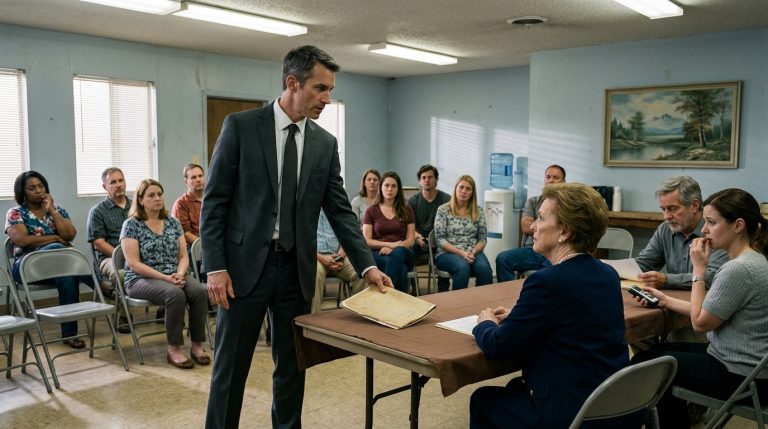
The community center smelled of stale floor wax and the metallic tang of too many people crowded into a small space. The fluorescent lights flickered overhead with a rhythmic, irritating buzz that seemed to set the tone for the evening. I stood at the back of the room, my jacket buttoned, my hands shoved deep into my pockets. Constance was beside me, a silent, predatory presence. She didn’t look at the crowd; she watched the dais, where Darla Fitch sat like a queen on a throne of folded plastic chairs, her leather folio open and ready.
“We have to move before she calls the vote,” Constance whispered, her voice barely audible over the low, ambient roar of the neighborhood.
“Wait,” I said, watching the board members. They were sweating—nervous, shifting in their seats, their eyes avoiding the audience. They looked like people waiting for an axe to fall.
Darla stood up, and the room went deathly quiet. She didn’t need a microphone; her voice had that brittle, high-frequency command that pierced through the chatter. “We are here to discuss the necessary infrastructure updates for Stonebridge Meadows. Our community requires stability, and that requires adherence to our planned development strategy.”
She began to speak about “resource optimization,” a hollow phrase that tasted like ash. I watched the faces of the people in the room—some were nodding, caught in the hypnotic rhythm of her authority, while others were whispering, uneasy. This was the decoy. The “stability” and “maintenance” facade.
Suddenly, a memory of my father flickered in my mind—not a grand speech, but the sight of him sitting at our kitchen table, carefully organizing his receipts with those rough, calloused hands, his face devoid of anger even when Darla had been at her worst. He had possessed a quiet, grounded dignity that I hadn’t realized was a weapon until this very second. Darla, in contrast, was all motion and noise, a hollow shell of authority.
“The board moves to ratify the retroactive authorization for the shoreline stabilization project,” Darla announced, her smile tight and triumphant.
I didn’t wait for a second. I stepped into the aisle. The movement felt like shifting gears in a heavy machine. Every eye in the room turned toward me.
“That’s a lie,” I said. My voice wasn’t shouting, but it carried in the dead air.
Darla’s smile didn’t break, but her eyes narrowed, two pinpricks of cold glass. “Mr. Harrove, this is a private meeting of the homeowner’s association. You are not a resident of Stonebridge Meadows.”
“I don’t have to be a resident to know that you’re laundering funds through a shell project,” I replied, walking toward the front. The crowd parted, a ripple of movement. I could hear the sharp intake of breath from the people in the front rows. “I have the ledger, Darla. The one you tried to bury in the ‘infrastructure’ files.”
“Security!” Darla snapped, her composure finally beginning to fray at the edges.
But no one moved. The board members, Patty among them, were frozen, watching me with a mixture of terror and desperation.
“Is this it, Darla?” I asked, reaching the foot of the dais. I looked up at her, seeing the small, frantic tremor in her hand as she clutched her folio. “Is this where you explain why the ‘stabilization’ contract has your private initials on every single wire transfer?”
The room exploded. People were standing up, chairs clattering against the floor. A reporter in the corner, a local kid with a camera, started recording. The chaos was immediate and visceral—the perfect cover.
“You don’t know what you’re talking about!” Darla shouted, her voice losing its polished veneer. “This is an attack on the integrity of our board!”
“It’s not an attack,” Constance stepped forward, her voice calm and absolute, cutting through the noise like a blade. “It’s an audit.”
She held up the thick binder of permits and receipts. The sight of it seemed to suck the oxygen out of the room. I saw Darla’s gaze shift, searching the faces of the board members for support, but they were already looking away. They were counting their losses, realizing that the house of cards they’d built was finally buckling.
One of the board members, a man named Miller, stood up. His face was pale, his voice shaking. “We didn’t vote on this, Darla. We never saw these transfers.”
The room went silent, a sudden, ringing stillness that felt heavier than the shouting. Darla looked at Miller, then back at me, her face a mask of disbelief. She tried to say something, but the words died in her throat. The narrative she had spent years building had just collapsed in sixty seconds.
I stood there, feeling the weight of the floorboards beneath my feet. I hadn’t needed to win with a fight; I had won by showing them the truth. But as Darla picked up her folio and began to back away from the dais, her eyes met mine—not with defeat, but with a sudden, desperate, and dangerous clarity. She wasn’t finished. She was cornered, and the cornered beast is the only thing more dangerous than the one still on the hunt.
CHAPTER 6: THE TRAP CLOSES
The silence in the community center was a living thing. It pressed against my eardrums, thick with the scent of unwashed bodies, overheated plastic, and the metallic tang of fear. Darla had vanished through the side exit, leaving behind a vacuum that felt less like a retreat and more like an orchestration. My pulse hammered in my throat, a rhythmic, frantic reminder that I was still standing in the middle of a war zone.
Constance moved to my side, her presence a cold, solid anchor in the swirling chaos. She didn’t look at the crowd. She kept her eyes on the remaining board members—Patty, Miller, and the silent, terrified treasurer, Greg. They were huddled together at the far end of the dais, looking like shipwreck survivors clinging to a piece of floating debris.
“They’re going to try to move the funds,” Constance whispered, her voice a razor-thin line of calm. “They know the ledger is in our hands, but they think we’re just after the HOA. They don’t realize we’re after the bank records that prove who actually holds the signature authority.”
I looked at Miller. He was staring at the floor, his hands gripped so tightly around the edge of the table that his knuckles were white. He knew. If the ledger proved the marina project was a shadow operation, then he was the one who had signed off on the initial wire transfers.
“Miller,” I said, my voice cutting through the murmuring of the crowd. I walked toward him, the sound of my boots on the polished floor echoing like gunshots. “You’re the treasurer. You’re the one who signed the ‘infrastructure’ checks.”
He flinched, his head snapping up. His eyes were wide, bloodshot. “I was told it was for the common good! Darla said it was a state-backed improvement project. She had the documents, the seals, the county planning stamps…”
“Those stamps were forged,” I said, stopping a few feet from him. I held up the binder. “I have the originals. I have the state planning office’s direct response to my request for verification. They’ve never heard of a marina project in this county, much less a state-backed one.”
The murmuring in the room stopped entirely. A few people in the front rows moved closer, their faces illuminated by the harsh, flickering fluorescent lights. The reality of what I was saying—that their dues, their neighborhood security, and their very property values had been gambled on a phantom construction project—was beginning to sink in.
“It’s not just the HOA,” I continued, pressing the advantage. “This was a pyramid scheme designed to leverage the neighborhood’s equity into private accounts. Every dollar you paid for ‘maintenance’ went into a pocket that had nothing to do with this subdivision.”
Miller’s face crumpled. He leaned forward, his voice cracking. “She told us the interest would pay for the maintenance for the next ten years. She said it was the only way to keep the HOA solvent.”
“And where is the money now?” I asked.
Miller looked at Greg, the treasurer. Greg’s face was a mask of gray, sweat beading on his forehead. He didn’t speak. He just sat there, shaking his head.
“The bank closed the bridge account an hour ago,” Constance said, her voice carrying across the silent room. “They received an anonymous tip about potential fraud. The funds have been frozen, and the forensic auditors are already en route.”
The reaction was instantaneous. A shout went up from the back of the room—a man whose voice I recognized as one of the neighbors who had once waved at my father. “You stole our money!”
The room shifted from shock to a rolling, violent wave of collective anger. People began to surge forward, their faces twisted into masks of rage. They weren’t looking at me; they were looking at the board. The air in the room became electrified, the smell of ozone and aggression filling the space.
I turned back to the crowd, raising my hands, trying to hold them back. “Wait! We need them to testify! If you hurt them, they’ll clam up, and you’ll never see a cent of that restitution!”
But they weren’t listening to me. The anger had a momentum of its own, a dark, pulsing energy that ignored logic. A chair went flying, clattering against the wall. Someone grabbed Miller by the lapels, and the board members scrambled, knocking over the table, papers and documents scattering like autumn leaves across the floor.
“Clint,” Constance shouted, grabbing my arm, her grip bruising. “We have to go! Now!”
I looked at the chaos—the documents being trampled underfoot, the board members cowering, the absolute destruction of the order I had tried to restore. I had wanted the truth to come out, but I hadn’t realized that when you pull a truth this rotten out of the ground, the smell of it can choke the whole world.
We backed away toward the rear exit, the sound of the shouting growing louder, more frantic. I felt a fleeting, terrifying moment of doubt—was this my fault? Had I pushed too hard?
Then, I saw her.
Standing in the shadows of the side doorway, watching the wreckage with a calm, predatory interest, was Darla. She wasn’t fleeing. She was waiting for the fire to finish its work. Her eyes met mine across the madness, and she offered a slow, cold smile. She didn’t care about the board, or the money, or the neighborhood. She only cared that the evidence was being buried under the fury of the crowd.
I turned to Constance, my voice barely audible over the roar of the room. “She’s not running away. She’s watching us burn.”
CHAPTER 7: THE FALLEN FOLIO
The silence in the community center was heavy, textured with the grit of pulverized drywall and the sharp, lingering ozone of a shorted-out light fixture. The room looked like a battlefield after the combatants had dragged themselves away; chairs were upended, the dais was scarred by the scramble, and a thin layer of dust hung suspended in the stagnant, humid air. Constance was already near the exit, checking the perimeter, but I remained by the dais.
My eyes were drawn to a leather folio discarded near the edge of the platform. It was Darla’s. It looked almost obscene in its pristine, organized state, lying amidst the wreckage of a failed suburban utopia. I reached down, my fingers brushing the smooth, expensive grain of the leather. I picked it up, expecting it to be empty.
Instead, a thick envelope slid from the inner pocket.
I opened it, the sound of the paper tearing unnaturally loud in the void. Inside was a resignation letter, dated two weeks prior, addressed to the board, and signed by Darla Fitch. It was complete, formal, and—most importantly—unsent.
My heart stalled. She hadn’t been fighting for the HOA; she had been preparing for an exit. Why?
I flipped the page. Behind the resignation was a private financial statement, not for the HOA, but for a personal account linked to a private development firm in a neighboring state. It wasn’t the marina project. It was a bankruptcy filing, personal and devastating. Darla hadn’t been managing a neighborhood; she had been running from a personal financial collapse, using the HOA as a life raft to keep her own head above water until she could finalize her flight.
The marina project wasn’t the goal. It was the desperate, final grab for the capital she needed to vanish before her own creditors caught up.
“Clint?” Constance called from the doorway. Her voice sounded thin. “We need to move. The police will be here in minutes, and if we’re found with their documents, we’re going to be the ones dealing with the fallout.”
I shoved the folio into my jacket, the weight of it suddenly making me feel exposed. “She wasn’t trying to keep the neighborhood. She was trying to strip it.”
“What are you talking about?”
“She was already gone, Constance,” I said, my voice shaking with a cold, jagged realization. “She had the exit planned for weeks. The marina, the fees, the harassment—it was all just a fire sale. She was liquidating everything she could touch to pay off her own debts.”
Constance walked over, her expression unreadable. She looked at the folio in my hand, then at the wreckage of the room. “That explains why she was so reckless. She didn’t care about the board’s reputation because she was already out the door. She just needed one last score.”
“And she used us to do it,” I realized. “She knew we were digging. She knew we were going to expose the marina project. She let us lead the charge, let us tear the board apart, just to distract everyone from the fact that she had already drained the reserve accounts and was preparing to vanish.”
A sudden, sharp realization hit me. “The money. The bridge account Constance said was frozen. If she was liquidating, then that account…”
“Is empty,” Constance finished, her voice turning hard.
My stomach dropped. I had spent weeks focusing on the marina, on the legal battle, on the defense of my grandfather’s land. I had played the role of the righteous avenger, but I had been the distraction. While I was focused on the front door, Darla had been walking out the back with the neighborhood’s survival in her pockets.
I felt a surge of cold, biting rage. It wasn’t just about the farm anymore. It was about the fact that she had taken an entire community’s trust and turned it into the fuel for her own cowardice.
“She’s not at home,” I said, a sudden certainty taking hold. “She didn’t leave the room to hide. She left to get to the bank one last time.”
“Clint, stop,” Constance warned, catching my sleeve as I turned to head toward the exit. “We have the evidence. We have the proof of the fraud. Let the police handle the rest.”
“No,” I said, pulling away. “The police will take months to trace the offshore transfers. By then, she’ll be on a plane to somewhere that doesn’t have an extradition treaty.”
I looked out the window. The parking lot was empty, the streetlights casting long, distorted shadows across the asphalt. Darla’s sedan was gone.
“She’s heading for the airfield,” I whispered, the logic clicking into place with a terrifying, mechanical precision. “The flight schedule out of the county hub… there’s a private charter departing in twenty minutes.”
I didn’t wait for Constance. I bolted for the door, my boots thudding against the floor, the cold night air hitting my face with the impact of a physical blow. The trap had closed, but it hadn’t caught the beast. She was still out there, and she was still holding the keys to the future she had stolen from everyone I had been fighting to protect.
I reached my truck, the metal door handle cold and unyielding in my hand. I wasn’t going to let her disappear. Not this time.
CHAPTER 8: THE FINAL ANCHOR
The highway was a ribbon of black glass under the moonlight, and my truck felt like a projectile. I drove with a singular, violent focus, the speedometer needle dancing past the limit. I wasn’t thinking about the farm anymore, or the HOA, or the noise of the community center. I was thinking about the folio in my passenger seat—the evidence that the grand architecture of Darla’s schemes was nothing more than a desperate, pathetic scramble to stay ahead of her own ruin.
The airfield appeared as a sparse cluster of sodium-vapor lights against the dark, featureless expanse of the fields. As I banked off the exit ramp, my tires screaming in protest, I saw the private hangar at the far end of the tarmac. A single small jet was idling, its turbines whining a high, thin note that cut through the silence of the night.
I didn’t stop at the security gate. I steered the truck into the ditch, tearing through a flimsy chain-link fence, and accelerated across the wet grass toward the runway. The jet was beginning to taxi, the exhaust kicking up a storm of grit and debris.
I jumped out before the truck had fully stopped, my boots hitting the asphalt with the force of a hammer. I didn’t reach for a weapon; I reached for the light. I slammed the truck into high beams, aiming them directly at the cockpit, and stood in the path of the movement.
The jet stuttered, the pilot braking hard, the whine of the engines dropping to an aggressive idle. I walked toward the nose gear, holding Darla’s folio high, the documents fanning out like a white flag of war.
A moment later, the cabin door hissed open and Darla stepped out onto the boarding ladder. She wasn’t wearing khakis anymore. She was dressed in something expensive, dark, and practical. She looked down at me, her face pale, her hair whipping in the turbine wash.
“You’re making a mistake, Clint,” she shouted over the engines. “That land is worthless! You’re chasing a ghost!”
“I’m not chasing the land,” I called back, my voice steady, stripped of the anger that had been driving me for weeks. “I’m chasing the truth. The auditors are at the bank, Darla. The bridge account is empty. There’s no money left to fly to.”
She froze. For a second, the mask of controlled authority didn’t just slip—it dissolved. The reality of the absolute, total collapse of her world hit her. She looked at the cockpit, then back at me, her eyes frantic. “You don’t understand! They would have taken everything! I had to—”
“You chose to,” I said. “You chose to steal from people who trusted you. You chose to try to destroy the only thing that mattered to my family.”
I stepped closer, the heat of the jet engines radiating against my skin. “The board members are talking. Patty, Miller, all of them. They’re trading your name for their own immunity. You have nowhere left to go.”
She looked behind her, toward the pilot, then back at the empty, dark horizon of the runway. She realized the game wasn’t just over—it had never been a game she could win. She slumped, her shoulders dropping, the sharp, rigid posture she’d held for years finally giving way to a hollow, exhausted fragility. She stepped down from the ladder, her feet hitting the tarmac with a soft, final sound.
I stood there, watching as the security vehicles from the main terminal finally breached the perimeter, their sirens rising to a shriek. The air was filled with the blinding flash of strobes. It was done.
The next few hours were a blur of cold paperwork and sharp, transactional questions. But the pay-off wasn’t in the handcuffs or the flashing lights. It was in the silence that followed when the sirens faded and the airfield returned to its dark, lonely state.
I drove back to the farm as the first gray light of dawn began to bleed into the sky. When I pulled up to the gate, I didn’t go inside. I walked down to the shoreline. The lake was still—a vast, perfect mirror of the morning. I reached into my pocket and pulled out the brass skeleton key I’d kept since my father’s funeral. I knelt by the water, the damp clay cool against my knees, and placed the key on the flat stone at the water’s edge, right next to the surveyor’s stake I had pulled up.
I took the small, bent piece of iron from the fence line—a remnant of the “maintenance” the HOA had tried to force on us—and worked it back into the ground, securing the wire. It was a small thing, a simple, quiet repair.
I sat there for a long time, watching the sun catch the surface of the water, turning the brass-colored light into something warm and enduring. I wasn’t the man who had buried his father on a Monday. That man had been angry, fractured, and uncertain. The man sitting by the lake now was tired, but he was quiet.
I heard the back door of the farmhouse open. Constance was standing on the porch, her coat pulled tight against the morning chill. She didn’t call out. She just stood there, watching the sunrise. I stood up, feeling the ache in my joints, and walked back toward the house. The smokehouse was waiting for November. The farm was still there, the red clay still holding the history of everything that had come before us.
It was enough. It was more than enough.