The Echo of Integrity: How One Quiet Question Dismantled a Legacy of Performative Power and Fear
CHAPTER 1: THE WEIGHT OF THE UNKNOWN
The mess hall at Fort Liberty didn’t just smell of food; it smelled of institutional exhaustion. It was a Friday evening, the kind where the air is thick with the scent of industrial cleaner and the low, constant hum of two hundred people trying to shed the skin of their daily rank.
Marcus Kaine sat at the center of the room, his presence a deliberate anchor. He was thirty-four, broad-shouldered, and currently in the middle of projecting exactly the brand of mild contempt that kept his subordinates in a state of perpetually performative alert. Beside him, Corporal Davis leaned in, his grin already primed, waiting for the signal to echo Marcus’s next jab.
Then, she appeared.
She stood near the serving line with the stillness of a statue in a storm. She wore an oversized uniform jacket that hung off her frame like a borrowed skin, and her blonde hair was pulled back with zero pretense. To anyone else, she was a civilian error, a administrative clerk lost in the wrong building. To Marcus, she was a gift.
“Who let the tourist into my mess hall?”
His voice carried, hitting the back wall and bouncing forward. The ripple effect was instantaneous. The scrape of trays ceased. The low murmur of football arguments and gripes died as if snuffed out by a sudden vacuum. Phones, as if controlled by a single nerve, emerged from pockets.
Marcus stood, the motion practiced and rhythmic. He walked toward her, not with the gait of a soldier in a rush, but with the measured pacing of a predator who had already calculated the kill.
The woman didn’t look up immediately. She stood by the counter, holding a transfer packet as if it were the only thing in the room that possessed real gravity. When she finally met his gaze, the expected flicker of flustered embarrassment never came. There was no tremor in her hands, no frantic shifting of her weight to find an exit.
“Hey, you lost, sweetheart?” Marcus asked, his tone dripping with a faux-paternal concern that made the room smirk.
She didn’t flinch. She simply watched him, her expression shifting into a quiet, patient observation—the look of a person who had spent months waiting for the exact frequency of a sound that was finally, finally arriving.
“No,” she replied, her voice low enough that Marcus had to lean in to catch it, drawing the audience even closer. “I’m exactly where I need to be.”
Marcus felt the heat of the room’s attention, the intoxicating rush of being the gravitational center. He didn’t see the tiny detail—the way the oversized jacket concealed the curve of her shoulders, or the fact that her pulse, visible at the base of her throat, didn’t quicken by a single beat. He only saw the victory he was about to claim.
“Is that right?” Marcus chuckled, glancing back at Davis. “Because you don’t look like you belong. No patches. No badges. You’re a ghost in an empty uniform.”
He stepped within arm’s reach. He could smell the faintest trace of ozone and dry earth on her, but the scent didn’t register. He was too busy waiting for the crack in her composure.
“What’s your assignment?” he pressed, his shadow falling over her, intended to dwarf her.
She paused, not out of confusion, but with the calculated brevity of someone deciding just how much truth the room could handle without buckling.
“Classified,” she said.
The room erupted in a sharp, derisive laugh. But as the laughter rippled outward, Marcus didn’t notice that it was thinning, turning from a roar into something brittle. He didn’t see Private Ethan Brooks, sitting two tables away, slowly lower his fork, his eyes fixed on the woman’s hands—hands that were steady, rhythmic, and utterly unafraid.
Marcus smiled, but it was a jagged, hollow thing. He leaned in until their foreheads were almost touching. “Listen,” he whispered, loud enough for the inner circle to hear, “at Fort Liberty, we don’t do ‘mysterious.’ Everyone earns their place. What have you earned?”
She looked him directly in the eyes. The silence that followed wasn’t just quiet; it was pressurized.
“More than you know,” she said.
And in that moment, for the first time in his career, Marcus felt the ground shift. It was a subtle, microscopic adjustment—a realization that the stage he had built wasn’t his anymore. It belonged to the woman, and he had just stepped into the center of her trap.
CHAPTER 2: THE TACTICAL MIRROR
Marcus didn’t retreat. He couldn’t. To step back now would be to signal to the two hundred pairs of eyes—many now glowing with the blue light of smartphone screens—that he had been rattled by a clerk in an oversized jacket. He kept his posture locked, his shoulders wide, though he could feel the cold prickle of sweat starting to bloom at the back of his neck.
“More than I know,” Marcus repeated, the words tasting like copper. He gestured vaguely at the mess hall, his hand shaking, just a fraction, a twitch of kinetic energy he couldn’t quite suppress. “That’s a bold claim for someone who hasn’t even shown an ID card.”
The woman—Ava—didn’t offer the card. She didn’t reach for her pockets. She simply stood there, hands folded, the oversized fabric of her sleeves hiding her wrists. She was looking past Marcus, scanning the room, not with the predatory look of someone searching for a target, but with the flat, analytical gaze of a technician diagnosing a machine that had stopped running efficiently.
“I’m here for the transfer processing, Sergeant,” she said, her voice devoid of any defensive edge. It was maddeningly calm. “I have no interest in your mess hall, nor in your audience.”
“My mess hall,” Marcus said, his voice dropping into the register he usually reserved for dress-down briefings. He looked toward the tables. Corporal Davis was no longer grinning. He was looking at his food tray with intense, studied concentration. Marcus felt a phantom pull, a desperate need for the room to mirror his own indignation. “You see this, people? We get a transfer, and she doesn’t think she has to answer to the NCO in charge of the floor?”
He waited for the chuckle. He waited for the wave of camaraderie that usually buoyed him when he was putting someone in their place.
It didn’t come.
The silence stretched, thin and fraying. A fluorescent light overhead flickered, casting a strobe-like shadow over the mess hall, making the scene feel slightly disjointed, unreal. Marcus felt a sudden, sharp spike of vertigo. For a heartbeat, the room seemed to tilt, the tables and the soldiers appearing distorted, like an image seen through a cracked lens. He shook his head, clearing the sensation, but the unease remained. It wasn’t the room. It was the woman. She hadn’t changed her posture, hadn’t raised her voice, yet the gravity of the room had visibly shifted toward her.
“Sergeant Kaine,” she said, cutting through his internal noise. “I believe you were about to conduct a test. You mentioned something about earning one’s place.”
Marcus blinked. He hadn’t phrased it exactly like that, but she was forcing the narrative into a structure he had built for her—a trap she was walking into with her eyes open. “Fine,” he snapped, leaning in close enough to smell the faint, clean scent of rain and antiseptic that clung to her. “You want to earn it? Then let’s see what you’re made of. FM 322.9. Walk me through the malfunction clearance for an M4, step by step. If you’re as qualified as your orders claim, this should be reflexive.”
He expected a stutter. He expected a moment of hesitation where she would have to search her memory.
Instead, she began to speak, and the words were like water flowing over stone—clear, inevitable, and perfectly measured. She described the immediate action drill with a terrifying lack of emotion. She didn’t look at him while she spoke; she looked at the space above his shoulder, her eyes unfocused, as if she were reading from a manual imprinted on the wall behind him.
“Tap the magazine. Rack the charging handle. Observe the chamber. If the weapon fails to fire, re-engage,” she recited. Her voice was steady, rhythmic.
With every syllable, Marcus felt his internal architecture buckling. He had intended to humiliate her, to expose her as a fraud, but she was performing the procedure with the clinical detachment of a surgeon. The soldiers at the nearby tables had stopped eating. The ambient noise of the mess hall had bottomed out into a silence so absolute it made his ears ring.
“Is that sufficient, Sergeant?” she asked when she finished, her voice a flat, neutral line.
Marcus stared at her. He felt a sudden, irrational impulse to reach out and grab her arm, to see if she was real, if she was as solid as she seemed, or if she was some phantom he had conjured to test his own dwindling relevance. He pushed the thought away, his grip tightening on the edge of the service counter.
“Lucky guess,” he muttered, though the words sounded small, thin, and entirely unconvincing, even to his own ears. He turned back to the room, seeking a face—any face—that would confirm he was still the one in charge. He found only the cold, hard stare of Private Ethan Brooks, who wasn’t looking at him at all, but was watching the woman’s hands, his expression one of growing, quiet recognition.
“Tactical question,” Marcus called out, his voice a little too loud, a little too desperate. “Someone, give me something that isn’t in a book. Something real.”
He didn’t notice that his own shadow, cast long by the overhead lights, looked like a hollow, stretching thing against the floor. He didn’t see the trap. He only saw the next move, and he played it with the reckless abandon of a man who didn’t realize he had already lost the game.
CHAPTER 3: THE SHATTERING
Marcus watched her, his breath hitching in a way he hoped no one else could hear. He had asked for a tactical question, a “real” test, and the room had responded. A voice from the back—a soldier whose face Marcus couldn’t even see—called out, “Casualty assessment under fire. No medic. How do you stabilize and move?”
The question was blunt, brutal, and completely outside the scope of the administrative work he assumed she performed. Marcus wanted to see her hesitate. He wanted to see her fumble the terminology or blink under the weight of the collective expectation.
Instead, her reaction was immediate and terrifyingly fluid. She didn’t look at him; she looked at the empty space beside him, her focus sharpening as if she were mentally reconstructing a battlefield he couldn’t see.
“First, suppress the threat,” she said, her voice cutting through the mess hall’s hum with the cold precision of a scalpel. “If you move before you’ve established local superiority, you’re just creating a second casualty. Secure the perimeter. Then, assess. If the arterial bleed is distal, tourniquet. If it’s junctional, pack and pressure.”
She moved her hands as she spoke, a phantom rhythm that mimicked the application of a pressure dressing.
“If the airway is compromised by facial trauma, position for drainage,” she continued. Her eyes flickered to Marcus for a fraction of a second, not with malice, but with a clinical indifference that he found far more offensive. “You do not waste time on minor wounds. You triage based on survivability, not on the loudest cry for help. You stabilize, you coordinate the extraction, and you stay in the fight.”
As she finished, the room’s atmosphere changed. It wasn’t just quiet; it was breathless. Marcus felt a sudden, sharp jolt of memory—a ghost of a childhood afternoon in a sun-drenched parking lot, the sound of a nine-year-old boy crying over ruined shoes. The phantom memory was so vivid that for a heartbeat, he could smell the hot asphalt. He felt a wave of nausea, the same sharp, twisting sensation he had felt when he was small and had realized, for the first time, that he could use his voice to make someone else feel less than he was.
He shook the memory away, but it left him hollow, his performative armor feeling suddenly heavy, ill-fitting, and absurd.
“Lucky,” Marcus whispered, the word barely audible. He looked around, his eyes wild and unfocused. “She just studied the manuals. She’s… she’s an academic. This isn’t experience. This is rote memorization.”
He stepped toward her, his movements erratic. He was no longer the sergeant in charge; he was a man cornered by his own inability to stop speaking. He reached out, his hand hovering toward the hem of her jacket, a move born of pure, panicked curiosity.
“If you’re so experienced,” he hissed, the “performer” slipping entirely now, replaced by the naked, trembling fear of a man whose center was missing, “then show me the record. Show me the proof. Take off the jacket.”
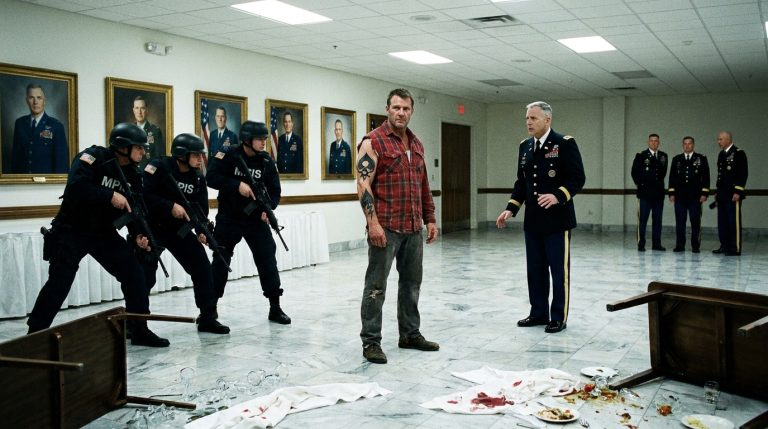
He didn’t realize that he had crossed a line, a threshold of professional conduct that would be impossible to retract. He didn’t see the way Colonel Mitchell had just entered the room, his eyes scanning the gathering with the cold, measured assessment of an officer who had seen enough to know exactly when a command structure was bleeding out.
The woman didn’t pull back. She didn’t call for help. She simply stood her ground, her expression settling into something that looked, for the first time, like pity. She reached for the zipper of the oversized jacket with movements that were agonizingly slow, rhythmic, and deliberate.
“You want to see?” she asked, her voice barely a whisper in the echoing hall.
She pulled the zipper down. The sound was like a gunshot in the silence. She slipped the garment off one shoulder, then the other, and folded it over the counter with the care of a soldier putting away a weapon. Underneath, she wore a standard-issue olive undershirt. She took a breath, and with one swift, fluid motion, she lifted the back of the shirt, exposing her skin to the cold, recycled air of the mess hall.
Marcus’s world stopped.
Across the expanse of her back, rendered in intricate, silver-black ink, was the Dragon—a mark so dense, so terrifyingly detailed, it seemed to shift in the flickering light. It wasn’t just a tattoo; it was a promise, an identifier that belonged to the shadows of the special operations world, the kind of designation that was spoken about in hushed, reverent whispers in the deepest corners of the Pentagon.
It was the Dragon Mark.
The mess hall became a tomb. Soldiers who had been ready to cheer for Marcus’s next jab were now frozen, their eyes locked on the ink, their faces draining of color. Three veterans near the front, including Master Sergeant Holloway, went as pale as if they’d seen a ghost.
Marcus felt the ice beneath him shatter. He looked at the mark, then back at her face, and for the first time in his life, he didn’t know what to say. The performer had no script. The authority figure had no stage. There was only the cold, hard, and undeniable truth that he had spent the last twenty minutes bullying a legend, and the entire room—everyone who had laughed, everyone who had recorded, everyone who had followed his lead—was now an accomplice to his ruin.
CHAPTER 4: THE COLONELS RECKONING
The silence in the mess hall was not simply the absence of noise; it had a texture, thick and suffocating like damp wool. Marcus felt it pressing against his chest. He stood frozen, the image of the ink on Ava’s back burned into his retinas. The dragon, in its stark black and silver, looked less like a tattoo and more like a brand of a reality he had spent years pretending didn’t exist. He had spent his career convincing himself that the military was a hierarchy of noise and presence—that he who spoke loudest, commanded the longest. Now, the quietest person in the room had rendered that entire philosophy obsolete.
Then, the floorboards groaned under a measured, heavy tread.
The crowd parted. It wasn’t a choice; it was a reflex. Soldiers shuffled back, their shoulders hunched, trying to make themselves small. Colonel David Mitchell moved through the center of the aisle with a gait that lacked the theatricality Marcus usually admired. There was no puffing of the chest, no aggressive scanning of the room. There was only the singular, focused intent of a man walking toward a destination that required his full gravity.
Marcus saw Mitchell’s eyes. They weren’t looking at him. They were fixed, with the intensity of a laser, on the woman in the olive undershirt.
Marcus felt a frantic, desperate hope flare in his chest. The Colonel will handle this. Surely, this was a breach of protocol. Surely, the Colonel would demand to know who this woman was and why she was disrupting his base. Marcus started to open his mouth, his mind already spinning a defense—She disrupted the mess, sir, she was being insubordinate— but the words died in his throat as the scene unfolded.
Mitchell reached the counter. He stopped. He didn’t ask for identification. He didn’t demand an explanation. He brought his heels together with a sharp, synchronized snap that echoed off the high ceiling, and he brought his hand up in a salute so precise, so devoid of hesitation, it felt like an indictment of every movement Marcus had made that evening.
It wasn’t a salute to a rank, or to a position. It was a salute to a person, and to the weight of everything that person represented.
“Lieutenant Ava Morgan,” Mitchell said, his voice stripped of the command-tone he usually reserved for his soldiers. It was, instead, a tone of profound, almost religious recognition. “Navy SEAL Team Six, call sign: Dragon Ghost.”
The name landed in the mess hall like a physical blow. The effect was immediate. A collective, staggered gasp rippled through the room. Phones that had been held up to capture the “tourist” were lowered, or simply dropped, sliding across tables and clattering to the floor. Marcus felt the air vanish from his lungs. Dragon Ghost. He had heard the name in the back-alley rumors of the Special Ops community, the kind of stories you told over warm beer and didn’t really believe because they were too terrifying to be true.
He looked at Ava. She hadn’t moved. She hadn’t even blinked. She accepted the salute with a calm that bordered on the transcendent. She was neither arrogant nor humble; she was simply present, anchored in a reality that Marcus couldn’t comprehend.
Marcus tried to retreat, but his legs felt heavy, as if the floor had turned into deep, viscous mud. He looked at Corporal Davis, his right hand, but Davis wouldn’t meet his eyes. Davis was staring at the floor, his face a mask of sudden, frantic insignificance.
“I apologize, Lieutenant,” Mitchell said, not looking at Marcus, not looking at the room, but keeping his gaze locked on Ava. “I apologize for the state of this installation. I apologize for the behavior you’ve been subjected to this evening. It is not reflective of the standard we aim to maintain.”
“Colonel,” Ava replied, her voice soft but carrying easily to the furthest corners of the room. “I appreciate the sentiment. But the assessment is not yet concluded. There is… further work to be done.”
She didn’t look at Marcus. She didn’t have to. The exclusion was complete. He was no longer a participant in the events of the evening; he was merely an object in the room, a piece of furniture that had been rendered obsolete.
Marcus watched as the Colonel stepped aside, gesturing toward the mess hall exit as if he were guarding a doorway for royalty. The soldiers around them were silent, their movements slow and cautious. The aura of the room had fundamentally inverted. Before, it had been a space where Marcus held the power to define reality. Now, it was a space where the reality was defined by someone else, and he was forced to stand within it, powerless and exposed.
He felt a deep, gnawing hollow in his stomach. The realization was dawning, slow and painful, that his entire identity had been built on a foundation of sand. Every joke, every jab, every “commanding” moment he had manufactured was a defense mechanism against this very moment—the moment where he would be forced to realize that he was small, and that the world was much larger and much more dangerous than his performative life allowed him to believe.
He looked at Private Ethan Brooks. The young soldier was standing at the edge of the crowd, his posture not bowed or small, but upright, his eyes reflecting a quiet, steady understanding. Ethan wasn’t afraid. He was witnessing.
Marcus realized then that he was the only one in the room who had lost anything, because he was the only one who had tried to build a kingdom in a hallway. He started to turn, his only desire to find a shadow, to disappear from the light that the Colonel had inadvertently shined on his failure. But his legs wouldn’t cooperate. He was forced, by the weight of his own sudden realization, to stand there and watch as the woman who had been his “tourist” turned to the Colonel, her face a clean, unwritten slate, ready to begin the work of dismantling the silence of Fort Liberty.
CHAPTER 5: THE ECHO OF THE QUESTION
The mess hall felt cavernous now, stripped of the manic energy that had defined it only thirty minutes prior. Marcus remained where he stood, his posture rigid, his knuckles white where they gripped the edge of the service counter. The departure of Colonel Mitchell and Lieutenant Morgan hadn’t ended the event; it had merely removed the focus, leaving the room to fester in the sudden, sharp aftermath of exposure.
Soldiers began to move, but they did so with a strange, unnatural care. Chairs were pushed in silently. Trays were returned with mechanical precision. No one spoke; the usual Friday evening banter had been permanently cauterized. Marcus watched, his eyes darting to each group as they passed, searching for a familiar look of camaraderie—a smile, a nod, anything that would signal he was still the man who commanded the room.
He found only eyes that glanced at him and then dropped, fixating on the floor or the table corners. He was being treated like an unexploded ordnance: dangerous, volatile, and best avoided.
Corporal Davis was the worst. He had been Marcus’s shadow for three years, the reliable echo to every laugh. Now, Davis was walking toward the exit with his head ducked, shoulders hunched, his pace quickening as he approached the door.
“Davis,” Marcus said. The name came out as a plea, a sharp, ragged sound that echoed poorly against the stainless steel walls.
Davis didn’t stop. He didn’t even look back. He simply sped up, disappearing into the corridor, his departure a definitive punctuation to the end of Marcus’s reign.
“Everything alright, Sergeant Kaine?”
The voice was cool, clinical, and entirely devoid of heat. Marcus turned to find Lieutenant Rachel Pierce standing a few feet away. She wasn’t looking at him with pity, nor with the sycophantic grin she usually wore when Marcus was holding court. She was looking at him with the precise, detached curiosity of an officer observing a training exercise that had gone catastrophically wrong.
Marcus’s throat went dry. “I don’t know what you’re talking about, Lieutenant.”
“The room,” she said, her voice barely rising above the hum of the ventilation fans. She waved a hand at the empty rows of seats. “The atmosphere. It seems to have… changed.”
“Things happen,” Marcus said, trying to summon the old, jagged confidence. He stood taller, pulling his shoulders back, but the movement felt artificial. The “performer” in him was trying to find a script, but the page was blank. “People get rattled easily. Especially when they don’t know who they’re talking to.”
“Is that what happened?” Rachel stepped closer. She was small, but her presence felt suddenly, disproportionately large in the thinning space. “Because from where I was sitting, it looked like you were the one who didn’t know who he was talking to.”
She turned and began to walk away, her movements sharp, disciplined, and utterly indifferent to him. She didn’t offer a jab or a witty retort; she simply dismissed him as an irrelevant variable.
The weight of her dismissal was the final crack in the dam. Marcus felt the room’s temperature plummet. He walked to the center of the mess hall, his boots sounding loud and hollow on the floor tiles. He felt as if he were walking through the debris of a wreck, the remnants of his manufactured legacy scattered at his feet.
A young private, the same Ethan Brooks who had stood his ground earlier, was the last to leave. He was carrying his tray to the window, his movements slow and deliberate. As he passed Marcus, he didn’t stop, didn’t even turn his head, but his voice came out low and steady.
“She asked a question, Sergeant,” Ethan said, not looking at him. “If you didn’t know who she was… why didn’t she deserve basic respect?”
The private didn’t wait for an answer. He walked to the return window, dumped his tray, and exited the room, the heavy metal door clicking shut behind him with finality.
Marcus was alone. He looked at the empty tables, the half-eaten meals, the discarded plastic forks. The question echoed in the stale, recycled air. Why didn’t she deserve basic respect?
He closed his eyes, and for the first time in his life, he didn’t search for a lie. He didn’t reach for an excuse. He let the question sit in the hollow of his chest, heavy, cold, and inescapable. He had spent his career assuming that respect was a commodity to be earned by performance, by volume, by the ability to fill a room with his shadow. He had been wrong. Respect wasn’t something you claimed; it was something you were given in the measure you were willing to give it to others, even to the people who seemed to have no rank, no patches, and no voice.
He opened his eyes and looked at his own reflection in the darkened window of the service window. He didn’t see the man who commanded the mess hall. He saw a man standing on a foundation that had entirely vanished, leaving him suspended over an abyss of his own making. He realized then that the “traps” he thought Ava had set were irrelevant. The real trap hadn’t been set by her; it had been set by him, years ago, and he had been walking into it every single day, never knowing that the floor was already gone.
CHAPTER 6: THE QUIET WORK
The walk to his office was the longest distance Marcus had ever traveled. He didn’t look at the walls, didn’t nod to the few soldiers passing in the corridors. He kept his eyes locked on the scuffed toes of his boots, measuring the progress of his own exile one step at a time. Every shadow in the hallway seemed to take the shape of a question, a silent accusation from the institution he had served, and served poorly.
When he entered his office, the air was still warm, held in by the closed door. The hum of the computer monitor filled the space, a mechanical, uncaring sound. He slumped into his chair, the leather creaking under his weight, and for a moment, he simply stared at the blank wall. The silence here was different from the mess hall. In the mess hall, the silence had been communal, a shared realization. Here, the silence was personal. It was the silence of a life being held up to the light, and Marcus didn’t like what he saw.
He pulled a legal pad toward him, intending to write—to organize, to justify, to plan—but his hand hovered over the paper. The pen felt heavy, a tool he no longer knew how to wield with any authority. He looked down at the desk. Something was wrong.
His equipment logs were slightly misaligned.
Marcus frowned, leaning forward. He was a man of fastidious habits; his desk was his fortress. He reached out and shifted the stack of folders, revealing a discrepancy in the inventory sheet—a signature from a junior soldier that didn’t match the standard protocol he had mandated. It was a small thing, a clerical error that in any other week would have resulted in a sharp, humiliating reprimand issued in front of the entire unit.
He held the paper. The old instinct flared—the desire to find the error, to expose the person, to re-establish the hierarchy.
He stopped.
He looked at the signature again. It was shaky, rushed. He remembered the soldier—a young man who had been struggling with a family emergency, someone Marcus had essentially ignored for the last month because the soldier’s performance didn’t serve the “narrative” of the unit Marcus was cultivating.
He dropped the pen. The realization hit him with the force of a physical blow: he had been so busy managing the image of his authority that he had completely stopped managing the reality of his people. The error wasn’t the soldier’s failure; it was his. He had set a standard that demanded perfection for his own benefit, not for the mission’s.
He didn’t issue the reprimand. He didn’t even pick up the phone to call the soldier. Instead, he sat there, the weight of the inventory sheet pressing against his palm. He realized that the “culture” of Fort Liberty hadn’t just been a failure of the Colonel; it was a failure of the middle-management, the people like him who had allowed the rot to flourish because it made them feel important.
He walked to the window. Outside, the base was moving—trucks idling, soldiers marching to final formations, the life of an installation that didn’t care about his shame. He saw a shadow moving near the training bays—a figure in PT clothes, unhurried, walking alone. It was Lieutenant Morgan. She was moving toward the perimeter with the same stillness she had carried into the mess hall.
He watched her go, and for the first time, he didn’t feel anger toward her. He felt a desperate, clawing need to understand the “practice” she had spoken of. He turned back to his desk. He reached into his drawer and pulled out a second, hidden ledger—a record of the twelve grievances that had been filed and then suppressed. He hadn’t known about them until today, when the IG investigator had casually mentioned their existence.
He opened the ledger. The names stared back at him—names of soldiers he had overlooked, names of people he had treated as obstacles to be removed rather than human beings to be led.
He began to read. He didn’t rush. He read each entry, letting the reality of their words sink in. Each grievance was a map of his own incompetence. He didn’t reach for his phone to call his contacts, didn’t attempt to spin the narrative, didn’t look for a way to mitigate the damage to his record. He simply kept reading, the grit of the dust on the floor under his boots feeling increasingly like the only real thing in the room.
He stayed there for hours. The sun set, the light in the office shifting from the harsh, clinical glare of the afternoon to the soft, fading blue of the dusk. When he finally looked up, his eyes were tired, but his head was clear. He had found the source, just as Briggs had told him to. The source wasn’t the institution. The source was the man sitting in the chair.
He picked up the pen again. He didn’t write a justification. He didn’t write a defense. He wrote four names on the top of a fresh page—the first four soldiers he needed to find, not to reprimand, but to listen to. It was the hardest thing he had ever done, and as he wrote the first name, his hand didn’t shake. He was no longer a performer, no longer a sergeant projecting an image. He was just a man starting the work, the quiet, painful, and absolutely necessary work of being a leader who actually existed.
CHAPTER 7: THE MIRRORS COST
The briefing room felt like a cold, hollow cathedral. It was 0800, and the institutional morning had begun with the same relentless, grinding efficiency it always did—trucks moving across the perimeter, the distant rhythmic thud of boots on gravel, the pervasive hum of a base that kept moving even when the people inside were breaking. Rachel Pierce stood in the fourth row, her uniform crisp, her posture perfect, but her skin felt like it was two sizes too small.
The vertigo she had mentioned to Dr. Oay wasn’t just a metaphor anymore. It was a physical sensation of leaning into a void. Every time she looked at another officer, she saw the calculation running behind their eyes—how do I align? How do I stay safe? Who is currently holding the power? She had performed that same silent, internal calculus every day for eleven years. And now, seeing it in others, she realized it looked exactly like cowardice.
Colonel Mitchell stood at the front, flanked by the assessment team. The air in the room was thick with the residue of the Friday evening incident. It was a heavy, stagnant air, unmoving and charged with the potential for sudden collapse.
“The IG investigation is underway,” Mitchell said. His voice was steady, but there was an exhaustion in his posture that Rachel hadn’t seen before. “We are identifying systemic failures, but let me be clear: the failures didn’t happen in a vacuum. They happened because we allowed them to, through our silence and our alignment with the wrong priorities.”
Rachel felt her heart hammering against her ribs. She glanced at Marcus Kaine, sitting two rows ahead. He looked like a man who had been hollowed out, his shoulders slumped in a way that made him look older, smaller. He wasn’t performing authority anymore; he was just sitting, absorbing the weight of the moment.
The assessment lead, Dr. Oay, stepped forward. She didn’t look at the crowd with judgment; she looked with a piercing, uncomfortable clarity. “Many of you are waiting to see what the consequences will be,” she said. “You’re looking for a name to blame, a career to end, so you can go back to believing that the system is fine, and only the people are broken.”
She stopped, letting the silence expand until it felt like it would swallow the room.
“But if you’re looking for a villain, you’re missing the point,” she continued. “The villain isn’t the Sergeant or the Lieutenant. The villain is the belief that surviving a hierarchy is more important than building a human one.”
Rachel’s gaze drifted to the window. Outside, the sky was a bruised, heavy grey. She thought about the note she had started in her journal—The vertigo is changing. That’s probably good. She realized then that the discomfort she felt wasn’t a punishment. It was the process of her own moral architecture being rebuilt.
She stood up. The sound of her chair scraping against the concrete floor was startlingly loud, a gunshot in the stillness of the briefing room. Sixty heads turned in unison.
“Lieutenant Pierce?” Mitchell asked, his voice cautious.
Rachel didn’t look at him. She looked at the center of the room, at the space where the fear usually lived. “I spent eleven years aligning with power because I thought it was the only way to be safe,” she said. Her voice didn’t shake, which surprised her; it felt like speaking in a different language, one she was only just learning to pronounce. “I helped maintain this culture because I was afraid of what would happen if I didn’t. That wasn’t strategy. It was a trade-off. I traded my integrity for the comfort of being on the winning side.”
She felt a strange, cold release as the words left her. She wasn’t asking for forgiveness. She was simply stating the math of her own survival, and in the stating of it, the math no longer seemed to add up.
“I don’t expect this to fix anything,” she continued, looking finally at Dr. Oay. “I just… I needed to name the calculation.”
She sat down. The silence that followed was different from before. It wasn’t the silence of suspicion or judgment; it was the silence of a group of people who had just been forced to recognize a truth that was sitting in the room with them, hidden in plain sight. Marcus Kaine turned his head slowly, looking at her with an expression that wasn’t anger or surprise, but a haunting, mirror-image recognition.
Colonel Mitchell didn’t admonish her. He didn’t order her to sit or silence her. He let the words hang, a bridge spanning the gap between the room they were in and the place they were all trying to navigate toward.
The vertigo was still there, but as Rachel looked at the back of the seat in front of her, she realized she wasn’t falling anymore. She was standing on the edge, and for the first time in eleven years, the view didn’t make her want to look away. It made her want to see everything, clearly, without the protective screen of her own alignment.
CHAPTER 8: THE HORIZON CHECK
The departure of the assessment team didn’t happen with a roar, but with a quiet, efficient finality. Three weeks after Rachel Pierce had stood in the briefing room and named her own cowardice, the atmosphere at Fort Liberty had shifted from a brittle, performative shell to something altogether more raw and honest.
Rachel walked toward the perimeter gate, her boots crunching on the gravel. She wasn’t carrying a heavy pack, just a small, leather-bound journal—the one Dr. Oay had recommended she start. She had spent the last twenty-one days doing the “quiet work.” It hadn’t been glamorous. It hadn’t been the kind of heroics that warranted a commendation or a medal. It had been, quite literally, the work of showing up and being honest. She had apologized to the junior officers she had ignored. She had corrected the reports she had previously padded for political safety. She had stopped performing the role of the “sharp, ambitious lieutenant” and started simply being a soldier who did her job and expected the same from others.
She passed Marcus Kaine near the training bays. He was watching a group of privates practice a routine drill. He wasn’t barking orders. He wasn’t pacing. He was just standing there, arms crossed, observing. When he saw Rachel, he didn’t attempt to engage in the old, cynical banter they had shared for years. He gave her a brief, solid nod—the kind of nod one soldier gives another when they’ve both survived something they didn’t think they’d come out of intact.
It was enough.
Rachel continued toward the administration building, where she was scheduled to meet with Colonel Mitchell for a debrief. The Colonel had changed, too. He was less preoccupied with the optics of his command and more focused on the substance of it. The IG report had been harsh—a systematic indictment of the culture he had presided over—but Mitchell hadn’t hidden from it. He had published the summary to the unit. He had taken the hit.
She entered the office. The air inside was warm, smelling of old paper and the sharp, clean scent of rain coming in through the cracked window. Mitchell was sitting behind his desk, looking at a file. He looked tired—that deep, bone-weary exhaustion that comes from long hours of genuine reflection—but his eyes were clear.
“Sit down, Lieutenant,” he said, gesturing to the chair.
Rachel sat. She felt the absence of the vertigo that had plagued her for weeks. The floor felt solid.
“I’m leaving in an hour,” Mitchell said, not looking up from the file. “I’ve requested a transfer to a training command. I’ve reached the limit of what I can do here. The culture is broken, and while we’ve started the repairs, it needs a new foundation. A foundation I can’t provide.”
Rachel felt a pang of something—not sadness, exactly, but a recognition of the cost. “You’re taking responsibility for the systemic failure,” she said.
“I’m taking responsibility for the man I was when I built this system,” he corrected. He closed the file and looked at her. “You’ve done well, Rachel. You didn’t hide.”
“I was tired of hiding,” she said.
He nodded. “That’s the truth of it for most of us, eventually.”
After the meeting, Rachel stepped back outside. The base was settling into the late afternoon. The harsh, fluorescent glare of the artificial life they had been living was giving way to the golden, honest warmth of the setting sun. She walked past the mess hall. It was empty at this hour, quiet, a place that had seen a destruction and a slow, painful rebuilding.
She spotted Ethan Brooks near the barracks. He was sitting on a crate, a notebook in his lap, the same one she had seen him with during the assessment. He looked up, saw her, and stood.
“Lieutenant,” he said.
“Private,” she replied. She stopped. “How’s the notebook?”
Ethan looked down at it. He was a different soldier than he had been three weeks ago—less guarded, more settled. “It’s getting full,” he said. “I’m learning that being wrong in the right direction is a lot more productive than being right in the wrong one.”
Rachel smiled—a genuine, small thing. “Keep going,” she said. “The system is going to try to train that out of you again. Every day. You have to be the one who decides not to let it.”
She walked away, leaving the base behind her. As she crossed the perimeter fence, she paused and looked back. Fort Liberty didn’t look different—the fences were the same, the buildings were the same, the trucks were the same—but the air, the way the light hit the pavement, felt different. It was lighter.
She took a breath. The “Dragon Ghost” was gone, likely moving on to another base, another mess hall, another room filled with people performing for power. She had left a mark here, a small, quiet, and absolutely permanent change. She realized then that the “5-Pillar Catharsis” she had been looking for wasn’t a grand finish. It was just this: the ability to walk away, knowing that the work wouldn’t stop, because the people who knew the truth—the ones who had finally decided to act—were still there, doing it.
She turned and walked into the sunset, the journal in her hand feeling light, as if it were finally empty of the things she had needed to write down, and ready to be filled with the things she had yet to live.