A Portrait in the Hall: The Quiet Resilience of a Marine Daughter Standing Her Ground
CHAPTER 1: THE CORDON AT 0500
The air in Manama at 0500 was thick, a humid shroud that clung to the skin before the sun had even begun to bleed gold over the horizon. I stood at the outer security cordon, two hundred meters from the embassy’s main gate, watching the city wake up. The call to prayer drifted over the causeway, a haunting, undulating melody that served as a backdrop to the tension radiating from the guard shack.
Lance Corporal Brody Sutter was twenty-two, and he was currently vibrating with the frantic, misapplied energy of a man who didn’t know the difference between security and hostility. He had his hand clamped over his holster, his radio pressed tight against his shoulder. He saw a woman in a navy linen blazer and jeans, carrying a roller bag, and decided she was a threat.
“Get behind the cordon, lady,” he barked. His voice cracked.
I didn’t flinch. The air felt heavy, saturated with the smell of exhaust and dry earth, and for a split second, I wasn’t in Bahrain. I was thirteen, standing in my childhood kitchen as the towers fell, listening to my father’s immovable decree that the Corps was not for me. The phantom weight of the brass challenge coin my brother had given me nearly two decades ago pressed into the meat of my palm, a steadying pulse of steel against my skin.
“Lance corporal,” I said, my voice steady, stripped of any inflection. “I am going to reach into my jacket and remove my credentials.”
“Behind the cordon, lady!”
He was staring at me, but he wasn’t seeing a person. He was seeing a distraction, an obstacle to his carefully manicured, rigid world of rules that existed only for him to enforce. I moved slowly—two fingers into the inner pocket of my blazer. The movement was a negotiation of physics. If I moved too fast, I was a threat; too slow, and I was a target for his panic.
I pulled the wallet out and held it flat against the dawn light. He snatched it, his grip frantic, his eyes darting to the embossed letters on the leather.
United States Department of Defense. Lieutenant Colonel Eva R. Mel.
I watched the color leach from his face. It was a physical collapse of his internal architecture; the moment the uniform he thought he was protecting became the very thing that stripped away his authority. His hand, which had been steady in its aggression seconds ago, began to tremor.
I held his gaze. I didn’t need to shout. I didn’t need to threaten. “I am the RSO.”
The silence that followed was absolute, until the crunch of boots on pavement signaled an arrival. Captain Liam Frasier rounded the corner of the guard shack, his eyes snapping from his subordinate’s shaking hand to my face. He processed the scene in a single, fluid heartbeat. He stepped forward, the professional distance closing as he rendered a crisp, perfect salute.
“Colonel Mel, welcome to post, ma’am.”
Sutter’s spine snapped to attention so violently I heard the sharp crack of his boots against the asphalt. He looked smaller now, a boy drowning in a suit he hadn’t earned. I didn’t acknowledge his panic. I just reclaimed my credentials, the leather cool and firm in my hand. I walked past him, and as I did, I stopped for a half-second, just long enough to let the weight of the moment settle on his shoulders.
“Lance corporal,” I said, my voice barely a whisper in the morning wind. “We will talk inside.”
I didn’t wait for his reply. I walked toward the embassy, the gold of the sun catching the tops of the walls. I knew, with the cold precision of twenty years of service, that I hadn’t just arrived at a post. I had arrived at a reckoning.
CHAPTER 2: THE CLIMATE FILE
I kept my eyes locked on the embassy doors, my boots measuring the asphalt in even, deliberate strikes. Behind me, the silence was a physical weight, heavier than the humid Bahraini dawn. I could feel Lance Corporal Sutter’s paralyzed stillness without having to look back. The sun was cresting the compound walls now, casting long, faded shadows that stretched across the courtyard like bruised fingers.
Captain Frasier fell in at my right shoulder. He didn’t speak. He didn’t attempt to fill the void with frantic apologies or defensive bluster. That was a point in his favor. For the first ten meters, the only sound was the synchronized crunch of our steps and the distant, rhythmic hum of the city waking up.
“Ma’am,” Frasier finally said, his voice a low, controlled murmur meant only for the two of us. “I’ll brief the Sergeant of the Guard.”
“Do that, Captain,” I said, not breaking stride.
He peeled away toward the guard shack. I crossed the inner courtyard alone. The air inside the perimeter felt different—sterile, tightly wound. The marine posted at the heavy, reinforced inner door snapped to attention as I approached, his salute crisp and sharp. I returned it, pulling open the door and letting the blast of over-conditioned air wash over my face. The linen of my jacket, damp from the brief exposure to the gulf humidity, immediately felt cool against my skin.
The Regional Senior Officer suite was quiet. It smelled of old floor wax, ozone from the servers, and the ghost of stale coffee—a universal scent that clung to every embassy desk I had ever sat behind. I set my travel bag gently on the floor near the coat rack. I slipped off the linen blazer, draping it over the back of the chair, the fabric creasing softly where the challenge coin pressed against it from the inside pocket.
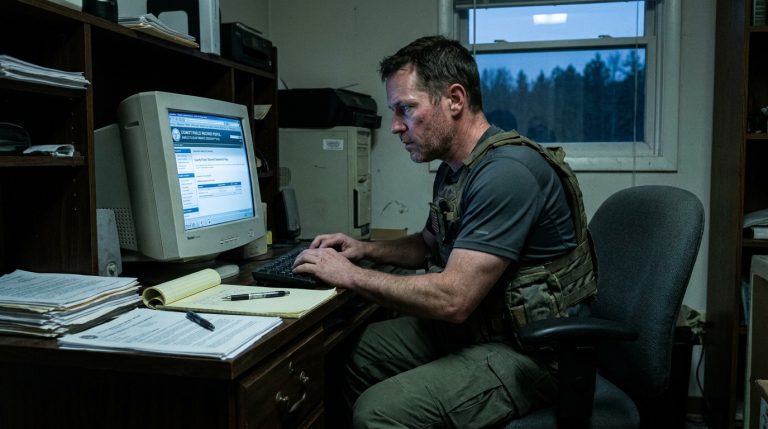
I sat down. The desk was immaculate, the surface cleared of everything but a standard-issue monitor and a docking station. I slotted my laptop in. The screen flared to life, casting a pale, clinical light across the faded wood grain of the desk.
I didn’t open my email. I didn’t check the regional operational traffic. I bypassed the standard morning sitreps and navigated directly to the embassy’s secure intranet.
I opened the Manama Detachment’s professional climate file.
The Marine Corps requires these files as a diagnostic tool. They are meant to be a pulse check—a ledger of informal complaints, command observation reports, and documented incidents. They tell you exactly where a detachment is fraying before the thread actually snaps.
I scrolled through the first page, the blue light of the monitor reflecting in the window pane. It took exactly two pages to see the fracture.
There were four informal complaints filed within the last six months. They were written in the careful, measured language of female embassy staff—three Foreign Service Officers and one civilian contractor. I read the first one, my eyes tracking the digitized text. A female contractor had been physically blocked at the inner checkpoint and spoken to with what the report called “condescending hostility.” The second involved a Foreign Service Officer who was repeatedly told she didn’t “understand the security posture” when asking for a standard escort.
Two of the four explicitly named Lance Corporal Brody Sutter.
But it wasn’t the complaints that held my attention. It was the white space at the bottom of the forms. It was the disposition. In every single instance, the resolution block was signed by Staff Sergeant Drake Halbrook, the detachment commander. And in every single instance, the typed resolution was identical.
Counseled.
Just a single, faded word, repeated like a mantra to ward off accountability. Counseled. It was a rug big enough to sweep a culture under.
I leaned back in the chair. The room was perfectly silent, but in my head, I heard my father’s voice, a ghost lingering in the drywall of my childhood home. The Corps is for men. It’s not a place for girls, Eva. It wasn’t malice when he said it; it was an absolute, unyielding certainty about how the world was structured. Halbrook and Sutter weren’t evil. They were just comfortably resting in the grooves of an old, broken system, protecting a toxic definition of brotherhood because it was the only one they had been taught.
I checked the clock on the wall. 0900.
I picked up the desk phone and dialed the OIC’s extension. Frasier answered on the first ring.
“Captain. In my office, please.”
He arrived three minutes later, carrying a hardcover green notebook and a clean laptop. He stood in the doorway in his service Charlies, waiting to be recognized.
“Have a seat, Liam,” I said.
He sat down across from me, placing the notebook squarely on the desk. He didn’t look at the screen of my computer, but he knew exactly what was on it. I could see the tight lines around his eyes, the subtle tension in his jaw. He was a good officer, a man who walked his own cordons at five in the morning, but he was carrying a burden he didn’t know how to set down.
“Walk me through the detachment, Captain,” I said gently.
He briefed me for over two hours. He didn’t hedge. He didn’t offer defensive posturing. He delivered the slides and the operational readiness numbers with the crisp, dry precision of a man waiting for the other shoe to drop. I let him finish. I let the silence stretch out, watching the dust motes drift through a shaft of sunlight cutting across the desk.
“Captain,” I said, my voice low, stripped of any reprimand. “How many informal climate complaints has this detachment received from female embassy staff in the last six months?”
Frasier’s hand stilled on his notebook. He didn’t need to look at his notes. He looked directly at me.
“Four, ma’am.”
“And how many were escalated to formal complaint status?”
“Zero, ma’am.”
I folded my hands over the keyboard. “Why?”
The air in the office seemed to thin. Frasier looked down at the faded green cover of his notebook, tracing the edge with his thumb. He was caught between his loyalty to his men and his duty to the badge on my desk.
“Ma’am,” he said, his voice betraying a quiet exhaustion. “They told the Ambassador’s deputy they did not believe a formal complaint would go anywhere. They told the deputy they would rather have the cordon running smoothly, so they did not file.”
I nodded once, slowly. The tragedy wasn’t just that Sutter had snapped at me. The tragedy was that the women in this building had simply accepted it as the cost of doing business. They had learned to walk around the broken glass instead of asking for it to be swept up.
“Did you bring these patterns to Staff Sergeant Halbrook in writing?” I asked.
“Three times, ma’am.” Frasier’s jaw tightened. “His response was that the cordon was the cordon, and that the climate file was a State Department concern.”
“I see.” I closed the laptop. The click of the latch was the loudest sound in the room. “Clear your afternoon, Captain. We have work to do.”
As Frasier stood and walked out of the room, closing the door softly behind him, I reached into the pocket of my blazer on the chair. My thumb brushed the raised eagle, globe, and anchor on the brass coin. The metal was warm. The problem wasn’t a lance corporal with a temper. The problem was a rot in the foundation, and to fix it, I was going to have to tear up the floorboards.
CHAPTER 3: THE MIDNIGHT WALK
The quiet in the RSO suite was not the peaceful silence of a finished day; it was the suffocating stillness of a room where a decision has been made but not yet enacted. I stared at the closed laptop for a long time, the black screen acting as a mirror. My reflection was tired—the lines around my eyes seemed deeper in the low light of the office, etched by two decades of holding a line that most people didn’t even know existed.
I stood up, the chair creaking against the floorboards. I didn’t reach for the light. I walked out of the office and into the corridor, my footsteps sounding unnaturally loud on the polished floor. It was 23:45. The embassy was asleep, but the detachment was alive, ticking away in the dark like the heartbeat of an organism that had forgotten how to breathe.
I went out the side door of the suite, stepping into the inner courtyard. The air had cooled, shedding the oppressive heat of the Bahraini afternoon, and the moon, three-quarters full, hung over the causeway like a silver lantern. The shadows here were long, faded things, cast by the date palms that lined the inner perimeter.
I began to walk the inner wall. My hands were shoved deep into the pockets of my trousers, my fingers brushing the cool brass of the challenge coin. It was a grounding weight, a physical reminder of the promise I had made to myself in the back of that bus out of Wilmington nearly twenty years ago.
As I rounded the southwest corner of the wall, the scene ahead snapped into sharp, tactile focus.
Staff Sergeant Drake Halbrook and Lance Corporal Brody Sutter were there, conducting the midnight cordon rotation. They looked identical in the moonlight, both dressed in their service Charlies, both with their sidearms holstered with that rigid, practiced, and ultimately performative posture. They were standing at the outer cordon, the exact geographic point where Sutter had told me to get behind the line eighteen hours ago.
They saw me coming. Their response was instantaneous—a robotic, perfectly executed maneuver of coming to attention. They frozen in place, their gazes fixed on a point somewhere over my left shoulder.
I didn’t stop. I couldn’t. I returned the courtesies with a sharp, brisk motion of my hand, but I kept moving, my boots finding a rhythm that felt like an intrusion on their silence. As I walked past them, the air between us felt charged, a static friction of unspoken things. Halbrook’s face was a mask of stoic compliance, but his eyes were darting, searching for a clue in my posture that I wasn’t going to give.
I reached the edge of the perimeter wall, where the view opened up over the causeway and the lights of Manama flickered like embers in the dark. I stopped here, leaning my forearms against the cool, rough surface of the masonry.
This was the phantom moment. Standing here, watching the lights, I was suddenly struck by a memory so visceral it made my skin prickle: a Sunday evening in 2016, sitting on the floor of my quarters in Pendleton, the phone receiver pressed against my ear until my shoulder ached. My father had asked me if I’d “run a desk” over in Afghanistan, as if the Bronze Star I’d earned had been a clerical error or a favor from a commander.
I had been sitting in the dark then, and I was sitting in the dark now. The ghost of that conversation felt like a presence standing on the wall beside me, asking the same question: Do you know what you’re doing?
I looked down at the cordon. The rotation was moving with a fluidity that was technically perfect, yet spiritually empty. It was the “cordon as a craft” that I had preached for years, but it was being performed by men who viewed that craft as a weapon to be used against those they deemed unworthy, rather than a shield for the embassy they were tasked to protect.
The weight of the leadership review I was drafting pressed against my mind. It was a heavy, ugly piece of administrative work. To move forward with the Article 15 and the review was to trigger a cascade of consequences that would end careers and shatter the detachment’s current reality. And yet, if I turned back now, if I accepted the “counseling” that Halbrook offered as a sufficient fix, I was merely becoming the very thing my father believed I was: a girl running a desk, playing at a profession that was too big, too hard, and too important for her to truly govern.
I stayed on the wall for forty minutes. My mind, usually a clean, efficient machine of tactical priorities, was cluttered with the faces of the people I had met today—the Foreign Service officers who had learned to stay silent, the Captain who was trying to lead in a toxic environment, and the young Lance Corporal who had simply inherited a culture of arrogance.
The wind picked up, carrying the faint, metallic tang of the sea. I pushed off the wall and turned back, retracing my steps across the courtyard.
Halbrook and Sutter were still there. They moved with the same practiced efficiency as I passed. They remained at attention, rigid, waiting for me to leave. I saw them for what they were—not villains, but men who had been led down a narrow path by a leadership that mistook stubbornness for strength.
I returned to the RSO suite at 0100. I didn’t turn on the overhead lights. I sat in the darkness, the blue light of the laptop screen casting long shadows against the walls as I opened the document. I began to draft the Article 15 package.
Article 91. Article 134. Reduction in rank. Reassignment.
The words appeared on the screen, black and uncompromising. This wasn’t a choice I was making because I wanted to be punitive. It was a surgical necessity. I had to prune the branch to save the tree.
When I finally reached the end of the draft, the first light of dawn was beginning to bruise the horizon. My hands were shaking, just a little, not from fear, but from the sheer kinetic weight of what I was about to trigger. I hit the send button, the soft ‘ping’ of the confirmation echoing in the empty suite.
The line was drawn. The process was in motion. There was no going back to the comfortable, quiet, drifting detachment I had inherited. The transformation had begun, and for the first time in my life, I wasn’t just observing the change. I was the one holding the pen.
CHAPTER 4: THE CALIBRATION
The embassy’s small conference room felt less like a workspace and more like a vacuum. The air was unnaturally still, recycled and cooled until it held no scent of the outside world, no hint of the dust or the heat of Manama. I sat at the head of the polished mahogany table, my service bravos pressed so sharply they felt like armor.
Lance Corporal Brody Sutter entered the room at 1300 hours exactly. He was in his service bravos, his uniform pristine, his eyes fixed on a point directly ahead of him. He looked younger than I remembered him on the cordon. The arrogance I had seen in his posture that first morning had been replaced by a stiff, brittle formality. He walked to the center of the room, came to a halt, and snapped to attention. The sound of his boots hitting the floor was a sharp, percussive snap that vibrated through the table.
He saluted. I returned it, my hand moving with a slow, deliberate precision.
The room was sparse. The recording clerk sat to my left, fingers poised over the keyboard. To my right, the Ambassador’s deputy, a man named Henderson, sat with a notebook in his lap. His presence was an unexpected variable—the Ambassador’s way of ensuring that this calibration didn’t just happen, but was witnessed.
I didn’t acknowledge Henderson. My focus was entirely on the boy standing in front of me.
“The record will reflect the start of the proceeding,” I said, my voice cutting through the silence of the room. It was not loud, but it possessed a weight that made the clerk’s fingers pause for a heartbeat before they began to tap.
“Lance Corporal Sutter,” I began. I read the charges from the tablet in front of me. I didn’t look at him. I read them as if I were reading a technical manual, the words stripped of all emotion, all history, all bias. “Failure to render proper courtesies to a commissioned officer under article 91 of the Uniform Code of Military Justice. Conduct unbecoming a Marine under article 134.”
The silence that followed the final word was absolute. The hum of the air conditioning unit seemed to amplify, a low-frequency drone that filled the corners of the room.
“Lance Corporal,” I said, finally raising my eyes to meet his. “Do you understand the charges?”
He didn’t blink. He didn’t look at the deputy. “Yes, ma’am,” he said. His voice was steady, though there was a tremor in the muscles of his jaw.
“Do you wish to accept non-judicial punishment in lieu of a court-martial?”
“Yes, ma’am. I accept.”
The weight of the room shifted. This was the moment of calibration—the point where the system acknowledged the failure and took the necessary step to correct it. I looked at the sentence I had drafted under the flickering fluorescent light.
“The sentence is as follows,” I stated, my voice steady, the rhythm of my speech as controlled as the breathing of a long-distance runner. “Reduction in rank from Lance Corporal, paygrade E-3, to Private First Class, paygrade E-2, effective immediately. Forfeiture of one-half month’s pay for two months. Extra duty for forty-five days. Reassignment off Marine Security Guard duty, effective on receipt of orders, with assignment to First Marine Division at Camp Pendleton.”
I paused. I wanted to see if he would try to argue, if he would attempt to offer the kind of excuses that Halbrook had leaned on during our private conversation. I watched his face—the way his eyes darted for a fraction of a second toward the wall, perhaps seeing the life he had built here in Manama dissolving in real-time.
He didn’t say a word. He didn’t offer a rebuttal.
“Ma’am,” he said, the word coming out as a formal acknowledgment. “I understand.”
I closed the folder in front of me. The sound was a final, decisive note. The recording clerk tapped one last sequence of keys and stopped the recording.
“Proceeding is concluded,” I said.
Ambassador Henderson, who had remained a silent observer throughout the entire nineteen minutes, finally closed his notebook. He stood up, nodded to me once with a look of quiet, professional respect, and left the room without a word.
Sutter remained at attention. He held his position with a discipline that was, ironically, the most professional thing he had done since I arrived. I stood up, gathered my documents, and walked toward the door.
As I passed him, I stopped. I didn’t reach out. I didn’t offer any words of comfort or professional posturing. I simply let my eyes meet his for a moment. He was a Private First Class now, a boy who had been broken by the very institution he thought he was protecting.
“You’re a Marine, Sutter,” I said quietly, my voice soft enough that only he could hear it. “That means something. It means you take the hit, you learn the lesson, and you move forward. Don’t let this be the end of the work. Let it be the start of it.”
He didn’t move. He didn’t respond. He just stood there, staring ahead, but I saw the slight tension in his shoulders soften just a fraction. It wasn’t forgiveness—it was a recognition of the cost.
I walked out of the conference room and into the hallway. The sudden brightness of the afternoon sun hitting the corridor windows was blinding, a stark contrast to the sterile dimness of the room I had just left. My heart was thumping a steady, heavy rhythm against my ribs.
I had done what I had to do. I had calibrated the detachment, corrected the standard, and enforced the law. The cost was real, and it was signed into his record for the next two years. But as I walked toward the RSO suite, I realized the cost wasn’t just his. It was mine, too. I had crossed the line from a regional officer who observed and reported to one who dismantled.
The path forward was no longer clear. I felt the familiar weight of the challenge coin in my pocket, the brass biting into my skin, but for the first time in years, the comfort it brought was muted. I had broken the detachment to save it, and now I had to live with the silence that followed.
CHAPTER 5: THE SHIFT
The hallway outside the conference room was a long, narrow artery of cool air and shadow. As I walked, the sound of my own footsteps felt alien, rhythmic and steady. The previous two weeks had been a blur of administrative labor, a relentless grind of drafts, reviews, and signatures. Now, the weight of the Article 15 package hung in the air like ozone before a storm.
I didn’t head back to the office immediately. I walked toward the inner courtyard, my mind cycling through the faces of the detachment. Gunnery Sergeant Tomas Reedi, the new detachment commander who had arrived nine days after the NJP, was already standing near the guard shack, his posture relaxed but his eyes scanning the perimeter with a calm, predatory vigilance. He was forty-one, a man who understood that leadership wasn’t about the volume of your voice, but the clarity of your expectations.
Reedi saw me approaching and came to attention, his salute a crisp, fluid motion. He didn’t look like he was waiting for orders; he looked like he was waiting for the work.
“Colonel,” he said.
“Gunny,” I replied, returning the salute. “How are they?”
Reedi looked toward the outer cordon. The marines were rotating, their movements sharp, their eyes tracking the movement of the embassy staff with a focus that hadn’t been there a month ago. “They’re tired, ma’am. But they’re finally doing the job they were trained to do.”
I looked across the courtyard. It was 15:00. The sun was beginning to dip, casting long, gilded shadows over the stone. I saw the Marines on watch, the way they stood—the absence of that performative, defensive posture Sutter had favored. They were simply standing guard. It was quiet. It was clean. It was exactly what the manual demanded, and what the detachment had been missing for so long.
“The climate survey results,” I said, my voice steady. “They’re out.”
Reedi nodded, a small, knowing crease appearing at the corner of his eyes. “I saw, ma’am. Eighty-seven percent satisfaction. That’s a long way from where we started.”
I felt a sudden, sharp ache behind my ribs. It wasn’t the pain of a mistake, but the strange, hollow sensation of a burden being set down. For months, I had been holding the image of this detachment in my mind, a jagged, broken thing that I had been trying to piece back together, Kintsugi-style, using the gold of standards and accountability. And now, looking at the way they held themselves, the seams were starting to mend.
“It wasn’t just my doing, Gunny,” I said. “It was the shift in how they view the cordon. They’re no longer fighting to protect their own fragility. They’re fighting for the integrity of the post.”
“They needed someone to show them what that looked like, ma’am,” Reedi said simply.
He didn’t offer a compliment; he offered an observation of reality. I walked past him, my gaze lingering on the outer wall. My mind drifted back to the letter from Sutter, folded and tucked into the top drawer of my desk. I hadn’t replied, not because I was angry, but because there was nothing left to say. The work had been the conversation.
I spent the next two hours walking the compound, not as a regional inspector, but as a silent observer. I watched the interaction between the Marines and the embassy staff. I watched as a Foreign Service Officer approached the checkpoint, and instead of the rigid, challenging behavior that had defined the post, the guard on duty simply checked the ID, rendered a polite, professional greeting, and opened the gate.
It was a small, almost invisible change. To an outsider, it was nothing. To me, it was everything. It was the difference between a system that functioned through intimidation and a system that functioned through authority.
I returned to the RSO suite as the sky turned the deep, saturated violet that signals the end of a desert day. I sat at my desk and opened the laptop. The regional inspection plan for the next cycle was waiting—Tunis, Rabat, Manama. The workload hadn’t decreased, but the friction had.
I picked up the phone. The secure line to Quantico rang, and Priya picked up on the second ring.
“Eva,” she said. Her voice sounded tired, the familiar, grounding fatigue of a peer who knew exactly what the last few weeks had cost. “I heard the news about the climate survey. The General is calling it the new regional best practice.”
“It’s not my practice, Priya,” I said. “It’s just the standard.”
“You know how they talk, Eva. You’re going to be famous for this. In the wrong way.”
I looked out the window. The lights of Manama were coming up, a field of distant, warm gold. For the first time in my career, the idea of being ‘famous’ for the wrong reasons didn’t feel like a threat. It felt like a consequence I had already paid.
“I know,” I said. “But the post is running.”
“Yeah,” Priya said softly. “It is.”
We talked for another few minutes—not about the mission, or the politics, or the climate files—but about her daughter, about the small, mundane, beautiful things that had nothing to do with the Corps. We talked until the night had fully settled over the embassy, until the only sound was the distant hum of the generators and the steady, reassuring cadence of the guard rotation outside.
When I hung up, the room felt empty, but in a way that felt like space, not isolation. I walked to the door of the RSO suite and stood there for a long time, watching the courtyard. The Marines were still there. They were still standing guard. The work was ongoing, a continuous, living thing that didn’t stop because I had finished my inspection.
I had been trying to prove something to my father for twenty years. I had been trying to prove that I belonged in a place that didn’t want me, that I could hold a line that he thought I couldn’t see. But looking at the detachment now, I realized that I hadn’t been fighting to get into his world. I had been fighting to define my own.
The work wasn’t a defense of his legacy. It was the construction of my own.
CHAPTER 6: THE PORTRAIT
The screen door’s slap against the frame was a sharp, final sound, followed immediately by the steady, receding rumble of my father’s pickup truck idling down the driveway. I sat at the kitchen table, the air around me still swirling with the lingering scent of coffee and the faint, dusty aroma of the morning.
My mother didn’t move. She stood at the stove, a spatula still in her hand, her back a quiet, sturdy line of resolve. She had spent thirty-six years teaching fifth grade, navigating the intricate, often messy landscape of human growth, and she understood better than anyone that some things cannot be rushed. They can only be lived.
I looked at the mug of coffee in front of me. The steam rose in thin, lazy ribbons, catching the light that slanted through the kitchen window—that specific, pale gold of a North Carolina July. It was the same light that had hit the OCS grinder on the day I commissioned, the same light that had washed over the parade ground at Camp Lejeune when I was eight years old.
I stood up, my joints feeling loose, the tension that had been coiled in my neck and shoulders for months finally beginning to dissipate. I walked out of the kitchen and into the hallway.
The house was quiet, save for the muffled, low-volume drone of the television in the den. I stopped in front of the front door. There, hanging in the dead center of the wall, exactly where the porch light fixture cast its warm, afternoon glow, was the portrait.
I was in service bravos, the silver oak leaves of a Lieutenant Colonel pinned to my collar, my expression neutral, professional, and entirely my own. It was a photograph that didn’t capture the struggle, the long nights in the RSO suite in Manama, or the weight of the Article 15 package I had carried like a physical burden. It just captured a Marine.
I reached out, my fingers hovering just an inch from the wood of the frame. It was a simple, store-bought frame, nothing fancy, but it had been hung with a deliberate, painstaking care that spoke more than a thousand apologies.
The light is better there in the afternoon. My father’s voice, rough and tired, echoed in the stillness of the hall. He hadn’t apologized. He wasn’t going to. That wasn’t who he was, and in the strange, Kintsugi-patterned logic of our family, I realized that I didn’t need him to. The apology was in the framing. The apology was in the portrait hanging under the light where anyone who walked through the front door would see it.
I turned away from the wall and walked back toward the kitchen.
My mother was setting the table for two. She had placed a clean cloth, two mugs, and the buttered toast in the center. She looked at me as I entered, her eyes soft, conveying a lifetime of understanding that had always been there, beneath the surface of the discipline she had maintained to keep our home standing.
“He’s going to work, Eva,” she said, her voice a calm, steady anchor.
“I know,” I said.
“He’s proud of you.”
I sat back down at the table. For the first time in my life, the words didn’t feel like a foreign object, or a prize I had to fight to earn. They felt like a truth I had finally arrived at on my own. I looked at my hands, the same hands that had held the challenge coin on the bus in 2006, the same hands that had signed the orders for the Manama detachment. They were tired, but they were steady.
I thought about Sutter, somewhere back in the fleet, learning to take the hit and move forward. I thought about Reedi, running a detachment that finally understood the craft. I thought about the regional policy that was now the standard, changing the way young commanders saw the file, and by extension, how they saw the Marines under their charge.
The struggle to be perceived as an equal had been the decoy. The real work had been in the becoming.
I picked up the toast. The butter was soft, melting into the bread. The cicadas outside were beginning their steady, rhythmic pulse in the heat of the morning. It was a quiet, domestic peace, the kind I had only ever glimpsed from the outside, but it was mine now.
I was a Marine Lieutenant Colonel. I was the RSO for Region 5. But in this house, in this kitchen, I was just Eva, sitting with my mother on a Sunday morning.
The sound of the truck’s engine faded away entirely, swallowed by the rising heat of the day. I took a bite of the toast and looked at the kitchen window. The world outside was expansive, filled with the potential for new orders, new detachments, and new lines that would need to be held. But for this one moment, for this one morning, there was nothing to defend. There was only the light, the quiet, and the work I had finished.
The portrait in the hall would stay exactly where it was. The light would continue to shift across the floorboards as the day wore on. And I would stay here, in the kitchen of the home I grew up in, finally comfortable with the silence that followed the long, hard climb.
I had come home. And for the first time, I realized I had never really left.