The Echo of the Sycamore: A Veteran’s Final Pilgrimage to Honor a Forgotten Promise of Peace
CHAPTER 1: The Weight of Rust
The November air tasted of exhaust and ancient rain, a cold that settled deep into the marrow of Arthur’s bones. He gripped the steering wheel, his knuckles white against the cracked vinyl, the tremor in his fingers rhythmic, like a ticking clock he couldn’t silence. Beside him on the passenger seat, the leather satchel felt impossibly heavy, containing nothing more than a thermos and a memory that refused to fade.
He looked up at the gate. It was a sterile, unforgiving structure of glass and steel, a sharp contrast to the wooden arm that had once stood here—the gate where a boy named Danny had joked about the coffee being burnt enough to strip paint. The cameras swiveled, their lenses focusing on his rust-colored truck with an unnerving, predatory precision.
Arthur’s thumb brushed the dashboard. Behind the cheap plastic, the Medal of Honor, wrapped in coarse oilcloth, pressed against his palm like a heartbeat. He didn’t need to see it to know it was there. He felt the weight of it every day, a burden of survival he had carried long after the fire had died down.
“Just a walk, Danny,” he whispered, his voice barely audible over the clatter of the cooling engine. “Just to the tree.”
A sharp, metallic rapping on the window shattered the moment.
Arthur turned his head slowly. A young man, Sergeant Rask, stood there, his uniform so impossibly stiff it seemed to define his very posture. His jaw was a hard line of frustration, his eyes darting toward the backup forming in the lane behind the truck. The sergeant wasn’t looking at an old man in a tweed coat; he was looking at an obstacle to his efficiency, an irregularity that threatened the perfect, geometric order of his morning.
“Sir,” Rask barked, the sound cutting through the air like a blade. “I said stop. This is a restricted military installation. You don’t have the clearance to be here, and you’re holding up the lane. Engine off. Now.”
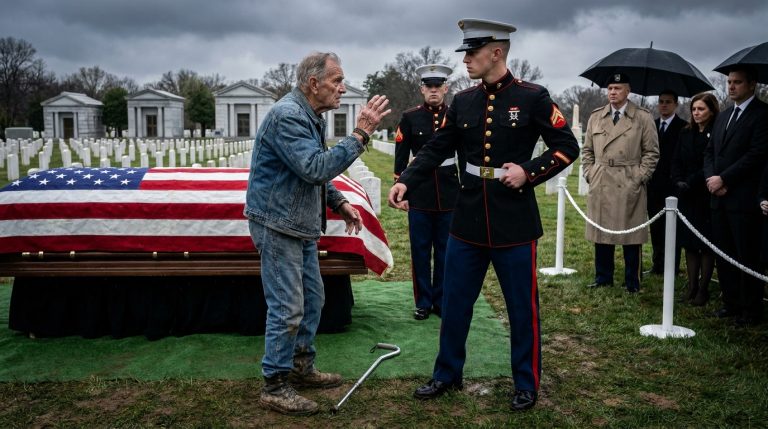
Arthur didn’t panic. Panic was a luxury he had exhausted decades ago. He reached for the door handle, the hinges giving a pained, familiar groan as he stepped out onto the gravel. The ground felt different beneath his boots—not just asphalt, but the stage for a final act. As he stood, he saw the sergeant’s hand hovering near his sidearm, a nervous, habitual gesture that spoke of a deep-seated fear.
Arthur looked past the sergeant, toward the oak-lined road beyond. He could see it—the sycamore tree, a small, dark shape on the distant rise, swaying in the November wind. He felt a sudden, sharp ache in his hip, a phantom pain from a shrapnel wound that had scarred him sixty years ago.
He didn’t answer the sergeant. He simply took a step forward, his eyes locked on the rise.
“Hey!” Rask grabbed his arm, his grip hard and demanding. “I’m talking to you. You are entering a restricted area. Show me your ID, or I will have you removed.”
Arthur felt the fingers on his coat, and for a fleeting, terrifying second, the parking lot dissolved. The smell of fresh-cut grass turned into the acrid, metallic stench of sulfur. The sergeant’s grip tightened, turning into the crushing pressure of a soldier’s hands as they pulled him into a foxhole. The sky turned gray with ash.
He blinked, fighting the intrusion of the past, and looked down at the sergeant’s hand on his sleeve. Then, he looked at the name tape on the man’s chest: RASK.
“Son,” Arthur murmured, his voice a low, raspy echo of a life spent in the shadows. “Take your hand off me.”
The sergeant stiffened, his face reddening with the heat of his own confusion and anger. He didn’t know what he was looking at—the old man’s eyes weren’t those of a trespasser; they were the empty, vast, and terrifying eyes of a ghost. And in the silence that followed, the air grew thin, charged with the sudden, heavy realization that the order of the day was about to shatter.
CHAPTER 2: The Geometry of Order
The silence that followed Arthur’s command was not empty; it was pressurized. It hummed in the narrow space between them, a static charge born from the collision of a lifetime of quiet purpose and a few years of frantic, unearned authority. Sergeant Rask’s hand did not immediately drop away. For a heartbeat, his fingers tightened, the knuckles whitening as if he were trying to physically restrain the very concept of defiance. His face, normally a mask of disciplined composure, spasmed—a tremor of genuine, unvarnished fear hidden beneath a veneer of professional fury.
He was a man who lived by the manual. To Rask, the world was a series of checkboxes, ID scans, and uniform regulations. Everything that didn’t fit into a pre-approved category was a threat, a failure, or an error. And right now, he was staring at the greatest error he had ever encountered: a man who simply refused to be categorized.
Arthur stood motionless. He didn’t pull away; he didn’t raise his voice. He simply held the space, his eyes focused somewhere just past the sergeant’s shoulder, toward the gentle rise where the sycamore tree waited. The chill of the November morning seemed to coil around them, biting into the exposed skin of the sergeant’s neck and settling into the thick, worn tweed of Arthur’s coat.
“You don’t understand,” Rask finally rasped, his voice sounding thin, stripped of its previous, booming authority. He released Arthur’s arm as if burned. He took a single, jerky step back, his polished boots crunching loudly on the loose gravel. “You have no idea what the protocol is. This is a federal installation. There are procedures for this.”
Arthur looked at him, his gaze soft, devoid of malice but heavy with a pity that Rask found far more insulting than any shout. The sergeant’s chest rose and fell in short, jagged motions. He felt the eyes of the other guards—Airman Chen, most notably—fixed on the back of his uniform. He knew he was losing the room, losing his grip on the narrative of the morning. The pressure of the passing cars, the slow-motion tragedy of the backup forming in the lane, all of it funneled into the tight, constricted space of his own ego.
“Procedures,” Arthur repeated, the word sounding foreign on his tongue, like something plucked from a dead language. He reached into his coat pocket and withdrew a small, leather-bound notebook, its edges frayed and darkened by years of handling. He didn’t open it; he simply held it, the weight of it a quiet testament to a life governed by different rules—rules etched in mud, blood, and the unspoken promises made between men who knew they might not see the sunrise.
“I didn’t come here to challenge your gate, son,” Arthur said, his voice a low, steady drone that seemed to pull the oxygen from the immediate vicinity. “I came here to finish something. The gate is just a threshold. You’re making it into a wall.”
Rask opened his mouth to retort, to demand the credentials, the paperwork, the proof of identity that would justify his own stress, but the words withered. He looked at the old man’s hands—the familiar, persistent tremor that spoke of nerves stretched to their breaking point long ago—and for the first time, he saw the man instead of the obstruction. It was a fleeting, uncomfortable moment of clarity. He realized, with a sudden sinking feeling in the pit of his stomach, that he was the only one in this scene who was currently panicking.
“Stay here,” Rask ordered, though his tone was defensive now, more of a plea than a command. He turned and marched toward the guard shack, his movements losing their razor-sharp efficiency. He was seeking the safety of the radio, the reassurance of the command post, the comfort of knowing that someone else—someone with more stars, more seniority, more protection—would handle this.
Arthur didn’t stay where he was. He didn’t run, either. He simply moved a few inches to the side, shifting his weight to ease the ache in his hip, and watched the sergeant disappear into the glass-walled box. He was content to wait. He had waited sixty years for this morning; a few more minutes, a few more bureaucratic maneuvers, were of no consequence.
His gaze drifted again to the sycamore. It was there, a sentinel of memory, watching over the parade grounds of the living. He wondered if Danny would have liked the way the base had changed—the sterile, cold geometry of it all—or if he would have laughed that deep, sun-drenched laugh of his and pointed out that the only things that truly mattered remained unchanged: the ground beneath their feet, the wind in the branches, and the promises they had carved into the stillness of the world.
Inside the shack, Rask’s voice was a frantic, muffled stream of jargon, but outside, the silence returned, thick and absolute, blanketing the gate in the cold, gray promise of the approaching winter.
CHAPTER 3: The Fractured Reflection
Sergeant Rask stood within the cramped confines of the guard shack, his back to the glass. The radio was humming, a low, persistent buzz that usually signaled nothing more than the routine chatter of base security. Today, it felt like an interrogation. He stared at his own reflection in the darkened monitor of the perimeter camera. His uniform was perfect—not a wrinkle on the sleeves, not a stray thread on the collar—but his eyes looked frantic, like a man seeing his own ghost.
He reached for the microphone, his movements stiff. Outside, he could see Arthur Finch standing in the cold, a solitary, weathered figure in a tweed coat that looked like it had been salvaged from another century. The man wasn’t moving. He wasn’t checking his watch or looking agitated. He was simply waiting, his posture anchored by a gravity Rask couldn’t calculate.
“Command Post, this is Gate One,” Rask said, his voice coming out tighter than he intended. He cleared his throat, trying to regain the cadence of command. “I have a non-responsive civilian on-site. He’s refusing to provide ID. He’s… he’s just standing there, ignoring the restricted access warnings. Requesting immediate guidance.”
The static crackled, then a voice replied—bored, administrative, and entirely unhelpful. “Gate One, have you initiated the standard deterrent protocols? Are you observing any weapons?”
Rask looked through the glass again. Arthur was standing with his hands buried deep in his pockets, his shoulders hunched slightly against the biting November wind. He didn’t look like a threat; he looked like a man standing at a funeral.
“Negative on weapons,” Rask replied, his knuckles tightening around the mic cord. “But he’s not compliant. He’s just… he’s just standing here. It’s a breach of protocol. I need a decision.”
While he waited for the duty officer to sift through the files, Rask’s mind began to race. He started to catalog the reasons for his own agitation. It wasn’t just the breach; it was the way the old man had looked at him. There was no defiance in those pale eyes, no anger at the uniform, no respect for the authority it represented. There was only a profound, hollow distance. It made Rask feel small, as if the sergeant’s stripes on his shoulders were nothing more than props in a play where he didn’t know the lines.
He thought of his upcoming inspection. The Provost Marshal was coming tomorrow. If this mess wasn’t cleared, if this old man wasn’t pushed back into the world beyond the gate, it would go on his record. A notation of incompetence. A stain on the narrative of his ambition.
He’s an obstacle, Rask told himself, the words a rhythmic mantra. He’s a piece of debris that needs to be cleared.
But even as he thought it, his peripheral vision caught something. Arthur had shifted. He had reached into the breast pocket of his coat and pulled out a small, yellowed photograph. He was holding it up, not for the cameras, but for the air itself.
A sudden, jarring shift in Rask’s perception occurred. The smell of the guard shack—stale coffee, floor wax, and the dry, recycled air of the ventilation system—seemed to warp. For a fleeting second, he caught the faint, phantom scent of wet earth and copper. His breathing hitched. He wasn’t at the gate anymore. In his mind’s eye, he saw a landscape of shattered sycamores and grey, suffocating mist. He saw a man with the same pale, distant eyes, carrying someone through the mud.
He shook his head violently, a physical spasm that made him stumble back against the equipment rack. The radio hissed. “Gate One, acknowledge. Are you still there?”
Rask blinked, the sterile light of the shack flooding back in. He wiped a hand over his forehead, finding a thin sheen of cold sweat. He was spiraling. He was projecting. The old man wasn’t a hero, and he wasn’t a ghost. He was a trespasser. That was the law. That was the only thing that kept the chaos of the world at bay.
“Copy, Command,” Rask snapped, his voice brittle. “I’m going to go back out there. I’ll make him leave.”
He set the microphone down and stepped out into the cold. The wind hit him like a physical blow, grounding him, stripping away the strange, feverish hallucination he’d just experienced. Arthur Finch was still there, watching the sycamore on the rise with that same, unsettling patience.
Rask walked toward him, his boots clicking with rhythmic intensity. He needed to be loud. He needed to be firm. He needed to be the sergeant in charge.
“Look,” Rask started, his voice rising in volume, trying to drown out the doubt that was beginning to gnaw at his confidence. “You’ve had your moment. You’ve made your point. But you’re not going up that hill. It’s private property, and I’m not going to let you disrupt the flow of this post any longer. I need you to get back in your truck and leave. Now.”
Arthur turned his head slowly. The movement was fluid, quiet, and carried a strange, weary grace. He looked at Rask, and this time, the pity was gone. In its place was something far more difficult to bear: a quiet, absolute expectation.
“I’m not leaving, son,” Arthur said softly, the wind catching the words and carrying them to Rask as if they were a secret. “And you’re going to have to decide if you’re the kind of man who stops a person from visiting his friend, or if you’re just a man who follows orders until he forgets why he’s giving them.”
Rask felt the color drain from his face. He stood there, his hand unconsciously resting on his duty belt, the weight of the steel against his hip suddenly feeling heavy, burdensome, and entirely irrelevant.
CHAPTER 4: The Unearthing of the Past
The silence was broken by the sound of a heavy diesel engine idling nearby, a low, mechanical growl that seemed to mock the stillness between the two men. Rask’s fingers twitched against the leather of his belt. He wanted to shout, to retreat back into the comfortable armor of his rank, but the look in Arthur’s eyes held him fast. It was an expectation that Rask hadn’t known was missing from his own life—the expectation that he was capable of being something more than a set of rules.
“I’m not asking for a favor,” Arthur said, his voice rising just enough to carry over the wind. “I’m asking you to see what’s in front of you, son. Look at the ground.”
Rask lowered his gaze. In the struggle, the leather satchel had spilled its contents onto the gravel. A silver thermos lay on its side, a small dent marring its surface. An apple rested near the curb. And there, glinting in the pale, flat morning light, was a small, hinged wooden box that had tumbled open during the scuffle.
Rask took a step forward, his boot scuffing against the gravel. He reached down, his movements cautious, and retrieved the small object. It felt surprisingly heavy in his palm, the wood worn smooth by years of friction. He opened the lid. Nestled on a patch of faded, moth-eaten velvet was a dog tag, its edges dulled by time and the harshness of long-forgotten elements.
He held it up, squinting against the glare of the morning sun. The letters were faint, worn deep into the metal. D. HENDERSON.
“Who is this?” Rask asked, the question slipping out before he could filter it through the screen of standard operating procedures.
“He was the best man I ever knew,” Arthur replied. He didn’t move to take the tag back. He just watched the sergeant, his gaze steady. “He was my shadow, my anchor, and my brother. We were in a valley that doesn’t show up on any of your maps, and we made a promise beneath a tree that’s still growing on that rise.”
The air around the guard shack seemed to shift. For a second, the sterile, high-tech perimeter of Fort Holloway felt like a thin veneer, a brittle stage-set draped over something much deeper and older. Rask looked at the tag, then at the sycamore tree in the distance. He felt a sharp, sudden pang of inadequacy. His entire world was built on the premise that what was current was what was important. Yet, here was this man, carrying a piece of history that made Rask’s morning inspection, his promotion prospects, and his entire career feel like nothing more than dust.
“You’re trespassing,” Rask said, though the words lacked their previous bite. He sounded tired, suddenly, the weight of the morning catching up to him. He felt the tag, the cold metal biting into his skin. It was a physical, tangible weight—a piece of a story he wasn’t supposed to know.
“I’m visiting,” Arthur corrected gently. He took a step toward the sergeant, not threateningly, but with the measured, inevitable motion of a tide coming in. “There’s a difference.”
As Rask watched, the old man reached out and, with an incredibly gentle, almost reverent motion, plucked the dog tag from the sergeant’s hand. The contact was brief—the brush of Arthur’s calloused, trembling fingers against Rask’s palm. The moment the old man took the box back, Rask felt a strange, cold void, as if he had just let go of a piece of his own understanding.
“I have an inspection,” Rask muttered, his voice barely audible. He was looking at his hands, trying to reconcile the duty he had been sworn to uphold with the sudden, undeniable realization that the world was larger than his guard shack. “If you go up there, if you walk onto that rise… I’ll have to report it. It’ll be on the record.”
Arthur tucked the small wooden box back into his satchel with practiced care. He looked at the sergeant, and for the first time, Rask saw a flicker of something that might have been a smile—a tired, ancient thing that reached the old man’s eyes.
“Report what you have to, son,” Arthur said. “But ask yourself what you’re really protecting. Is it this base? Or is it the fear that you might be wrong?”
Without waiting for an answer, Arthur turned and began his slow, steady walk toward the rise. He didn’t look back to see if Rask followed, or if the sergeant reached for his radio, or if he stood there, frozen in the cold, holding onto the memory of the weight of a piece of metal that didn’t belong to him.
Rask stayed where he was. The radio in the shack began to chirp, an insistent, high-pitched demand for attention. He watched the old man’s back—the slightly stooped shoulders, the determined rhythm of his gait. He felt the cold seeping into his own boots, but for the first time, he didn’t try to hide from it. He stood in the middle of his kingdom, a king who had just realized that the borders of his realm were entirely imaginary.
CHAPTER 5: The Arrival of the Authority
The gravel under Sergeant Rask’s boots felt less like solid ground and more like shifting sand. He remained standing by the guard shack, his eyes locked on the distant, tweed-clad figure of Arthur Finch. The old man was halfway to the rise now, his pace slow but agonizingly steady, a stubborn mark of ink on the pristine, sterile landscape of Fort Holloway.
Rask’s radio crackled to life, but he didn’t reach for it. The sound—a sharp, demanding static—was an intrusion from a world that had suddenly lost its primacy. He watched as the silhouette of a black staff car appeared at the end of the oak-lined road. It moved with a smooth, lethal grace, flanked by two military police interceptors that tore through the morning air with predatory precision.
The escalation was immediate. The drivers in the queue behind the gate began to stir, their curiosity piqued by the sudden appearance of the general’s detail. Rask felt a prickle of cold sweat at the base of his neck. He had failed to clear the gate, failed to turn back the trespasser, and now, the highest authority on the base was descending upon his failure like a hammer blow.
He turned toward Airman Chen, who was leaning out of the booth, her face pale. “Sergeant,” she whispered, her voice barely audible over the growing thrum of the approaching motorcade. “That’s the Commanding General. Why is he coming to the gate?”
Rask didn’t answer. He couldn’t. His throat felt as though he had swallowed a handful of dry dust. He watched the lead MP vehicle swerve toward the entrance, its tires kicking up a spray of gravel that rattled against the glass of the security booth. He moved forward, his legs feeling weighted, instinct overriding his paralysis. He needed to be at attention. He needed to frame this in the only language he had left: procedure.
The staff car screeched to a halt, the smell of burnt rubber and heated metal filling the air. The passenger door opened, and Major General Marcus Thorne stepped out. He was a man composed of sharp angles and iron-gray authority, his uniform so precise it seemed to hum with the energy of his rank. He didn’t look at Rask. He didn’t look at the MP escorts who were already swarming the area with practiced efficiency.
His eyes were locked, with an intensity that bordered on the painful, on the distant figure of Arthur Finch.
“General,” Rask barked, the word slipping out as a reflex of training, his hand snapping to his brow. His salute was rigid, a desperate, crumbling attempt to reestablish the boundaries of his world.
Thorne’s head snapped toward him. The look the general gave him was not the look of a superior officer acknowledging a subordinate; it was the look of a man who had suddenly been confronted with a memory he thought was buried under six decades of history. It was a cold, piercing appraisal that stripped away Rask’s stripes, his credentials, and his carefully curated sense of professional worth.
“Sergeant,” Thorne said, his voice quiet—a dangerous, vibrating low that seemed to be heard by everyone at the gate. “Who gave you the order to touch that man?”
The question was a trap, a snare that snapped shut around Rask’s throat. He felt the gaze of the MP officers, the silent, wide-eyed stare of Airman Chen, and the crushing weight of the general’s attention. He thought of the dog tag, still heavy in his mind’s eye, and the quiet, impossible resolve of the old man walking toward the sycamore.
“Sir, he was a trespasser,” Rask stammered, the words sounding hollow, pathetic. “Standard protocol… I—”
“Protocol,” Thorne repeated, the word dripping with an icy, biting contempt. He took a step toward the sergeant, his presence expanding until he seemed to fill the entire gate. “You are guarding a gate, Sergeant. You are not a judge, and you are certainly not a historian. You had the audacity to lay hands on a man who carried this country’s survival on his back.”
Thorne didn’t wait for a response. He didn’t care for the sergeant’s justifications. He turned, his gaze sweeping the field, and began to walk. He didn’t run, but he moved with a purpose that was terrifying to behold, his boots crunching into the gravel as he followed the path Arthur had taken.
Rask stood alone in the center of the entrance, the motorcade idling behind him like a pack of wolves. He watched the general—the man who held the keys to his future, the man whose approval he had spent his life chasing—discard his rank, his ceremony, and his duty to chase after a ghost in a tweed coat.
The air shifted again. The wind picked up, a sudden, violent gust that rattled the gate’s automated arm, causing it to twitch and shudder like a nervous muscle. Rask looked down at his own hands. They were trembling. He realized, with a clarity that made his chest ache, that the incident at the gate was no longer about a security breach. It was about a debt of honor that had finally come due, and he had been standing, blindly, in the way of its payment.
He watched the general’s silhouette merge with the distant, shuffling gait of the old man. The distance between them shrank, the two figures converging under the shadow of the hill. Rask didn’t follow. He couldn’t. He was a man tethered to a gate that no longer kept anyone out and no longer let anyone in.
He leaned against the guard shack, the cold metal biting into his back. He had tried to protect his world, and in doing so, he had ensured its absolute and total collapse.
CHAPTER 6: The Salutation of Legends
The gravel shifted underfoot, a rhythmic, crunching sound that punctuated the profound stillness of the hillside. General Thorne walked two paces behind Arthur, his posture no longer the rigid, display-ready stance of a base commander, but the slightly hunched, attentive carriage of a subordinate. The transformation was complete. The stars on his shoulders, the ribbons on his chest, the heavy, polished authority of the uniform—it all felt like a costume he had donned for a play that had just ended.
He watched Arthur. The old man moved with a fragile, deliberate gait, his breath misting in the frigid morning air. Every step seemed to extract a toll from his aging frame, yet there was no hesitation in his trajectory. He was homing in on the sycamore with the unerring focus of a compass needle.
“The tree was just a sapling, sir,” Thorne said, his voice breaking the silence. He kept his eyes fixed on the back of the tweed coat. “My father used to say you and Danny Henderson spent three nights digging the irrigation trench by hand because the base mechanics wouldn’t spare a detail.”
Arthur didn’t turn. He merely nodded, his chin dipping toward his chest. “The ground was like iron. Danny spent the whole first night cursing the roots, and by the second night, he was thanking them because they gave him something to fight.” A brief, ghost-like chuckle escaped the old man, a sound as dry and brittle as the leaves skittering across the slope. “He was a man who needed friction to feel alive. If things were too easy, he worried he was already dead.”
Thorne felt a tightening in his throat. He had grown up on these stories, but they had always been bedtime myths—hagiography designed to instill a sense of duty in a young man born into a family of warriors. Seeing the protagonist of those stories, a man who had been reduced to a ‘trespasser’ by a twenty-four-year-old sergeant, felt like a fundamental violation of the natural order.
As they crested the rise, the sycamore tree came into full view. It was a monolith of gnarled, silver-gray bark and a sweeping, golden crown that seemed to catch the morning sun and hoard it. It looked impossible—too large, too vibrant for the sterile, manicured perfection of Fort Holloway.
Arthur stopped at the base of the trunk. He placed a hand against the bark, his fingers disappearing into the deep, vertical fissures of the wood. Thorne stopped, too, keeping his distance. He sensed that this was the threshold. This wasn’t just a site of memory; it was an altar.
“He’s still here,” Arthur whispered.
Thorne stepped closer, his gaze drifting over the root system, which had buckled the earth into a series of uneven mounds. He saw it then—a small, weathered plaque, nearly swallowed by the bark, bearing the initials D.H. and a date from a lifetime ago. The General felt the weight of his own rank, his own history, and the vast, unbridgeable chasm of his own ignorance. He had spent his life protecting the base, enforcing the rules, and managing the machinery of the military, but he had never truly understood the terrain he was guarding. He had been protecting the buildings and the fences, while this man had been protecting the spirit.
Arthur turned slowly, his face etched with a fatigue so deep it seemed to transcend the physical. He looked at Thorne, and for a moment, the General felt like the boy he once was, sitting in his father’s office, listening to the stories of the ‘old man’ who had carried the wounded home.
“General,” Arthur said, his voice firming, shedding its rasp. “You have a post to run. You have men to lead.”
Thorne didn’t move. He felt the pull of his duty—the calls waiting at his office, the teleconference with the Pentagon, the endless, grinding wheel of command—but it all seemed to lose its color, fading into a dull, grey background. He did something that, in any other context, would have been a career-ending abandonment of protocol. He stepped up beside Arthur and, with a slow, deliberate motion, placed his own hand on the bark of the sycamore.
“The post will wait, Chief,” Thorne replied, his voice ringing with a newfound, quiet strength. “For the first time in twenty years, I think I’m finally exactly where I’m supposed to be.”
They stood together under the canopy of the great tree, a two-star general and a retired chief warrant officer, the present and the past locked in a silence that was more powerful than any order or regulation. The wind picked up, swirling through the golden leaves, and for a fleeting, beautiful instant, the roar of the military base below—the helicopters on the pad, the traffic at the gate, the hum of the command post—fell away completely. There was only the wood, the wind, and the man who had kept his word through the long, shifting darkness of the years.
Thorne felt a vibration in the ground beneath his feet, or perhaps it was just the tremors in Arthur’s hand, passing through the bark of the tree, through the earth, and into his own palm. It was the frequency of sacrifice, the steady, rhythmic heartbeat of a promise kept. He finally understood why his father had spoken of this man with such reverence. It wasn’t about the medals, or the tactical success of Hill 488; it was about the simple, devastating act of refusing to leave anyone behind, even sixty years after the fire had gone out.
The reality of his own life—the ambition, the drive, the endless climb—suddenly felt small. It was a life of managing things, while Arthur Finch had spent his life witnessing things. And as the sun climbed higher, casting long, elegant shadows across the rise, Thorne made a silent vow. He would not just be the man who managed the fort; he would be the man who ensured that what had happened here was never again relegated to a footnote in a restricted file.
He looked at Arthur, who was staring up into the branches, his eyes clear and wide, as if he were seeing the world as it had been on the day they planted the sapling. The old man’s face was serene, the mask of endurance finally, mercifully, beginning to slip.
CHAPTER 7: The Return to the Threshold
The descent from the rise was slower than the ascent. The gravity of the place seemed to hold them back, the roots of the great sycamore clinging to their memory of the last hour. General Thorne walked with his hands clasped behind his back, his stride measured and thoughtful. He was no longer looking at the perimeter fence or the distant guard towers; he was looking at the ground, tracing the path that Arthur had carved through the tall, browning grass.
“You know, Chief,” Thorne began, his voice devoid of the command-tone that had defined his career. “The base is changing. My replacement, the board—they want to expand the perimeter. They talk about ‘modernizing’ the infrastructure. They view all this history as dead weight.”
Arthur continued to walk, his breathing steady, the tremor in his hands seemingly dampened by the stillness of the hill. “Things change, General. That’s the nature of time. The steel rusts, the concrete cracks, and the men who walked these roads are replaced by boys who have never seen a shadow grow long over a trench.”
“And that’s supposed to be enough?” Thorne asked, a flash of frustration breaking through his calm. “That’s supposed to be the end of it? We just bury it under new paint and better cameras?”
Arthur stopped. He turned, the wind catching the collar of his tweed coat. His face was a map of years, but his eyes were clear, piercing in their clarity. “You were given a command, Marcus. Not just of this base, but of what it represents. You don’t have to keep the steel from rusting. You just have to make sure that when someone asks what this ground cost, you have an answer.”
They reached the edge of the paved road. The sounds of the base began to reassert themselves—the distant, rhythmic thud of a helicopter landing, the intermittent beep of transport vehicles. The reality of the world they had temporarily stepped out of was rushing back to meet them.
As they rounded the bend that led back to the main gate, the scene shifted. The MPs had cordoned off the area. A small crowd of personnel—officers, technicians, and even a few of the younger airmen—had gathered, their expressions a mixture of confusion and intense, hushed curiosity. They weren’t looking at the General as a commander anymore; they were looking at him as something else, a man who had walked away from his station to stand in the mud with an old man.
Sergeant Rask was still there, standing by the guard shack. He was no longer the imposing, rigid sentry he had been hours earlier. He looked aged, his posture slumped, his uniform appearing almost oversized on his frame. When he saw the General and Arthur approaching, he didn’t reach for his sidearm or bark a greeting. He simply stood, a man adrift, waiting for a verdict he knew he could not escape.
Thorne stopped ten feet from the sergeant. The silence that fell over the gathered crowd was profound. Airman Chen watched from the booth, her hand pressed against the glass. The MPs at the perimeter kept their distance, sensing that the theater of authority had been permanently altered.
“Sergeant,” Thorne said. His voice wasn’t loud, but it carried a weight that made the air seem heavy.
Rask looked up. There was no defiance left in him. He looked at the General, and then, slowly, he turned his gaze to Arthur. He saw the old man—not as a trespasser, not as an obstacle, but as a man who had finished a journey that Rask hadn’t even realized had started.
“Sir,” Rask replied, his voice barely a whisper. He looked at the gate, then back to the General. He didn’t offer an excuse. He didn’t cite the regulations or the security protocols. He simply waited.
Thorne reached into his jacket pocket and pulled out a small, worn notebook. He didn’t look at it. He stood for a long moment, looking at the gate, the cameras, the rows of cars, and the people standing in silent witness. He looked at the world he had spent his career managing, and then he looked at Arthur, who was standing beside him with the calm, quiet grace of a man who had nothing left to prove to anyone.
“We have a lot of work to do, Sergeant,” Thorne said, his gaze shifting back to Rask. “And it starts with learning how to look at the people standing on the other side of this wire.”
He turned to Arthur. The General didn’t salute. Instead, he reached out and, with a brief, firm grip, clasped Arthur’s shoulder. It was a gesture that ignored rank, ignored distance, and ignored the sixty years of silence.
“Thank you, Chief,” Thorne said.
Arthur looked at the General, then at the sergeant, and finally at the gate. He nodded, a single, decisive movement of his head, and began to walk toward his old, rusted Ford truck. He didn’t look back again. He climbed into the cab, the metal groaning in protest, and turned the key. The engine coughed, sputtered, and then roared to life, a rough, mechanical sound that cut through the silence of the gate like a final, deliberate statement.
As the truck pulled away, moving slowly through the gate—the automated arm swinging up to let him pass, this time without a beep or a flash of red light—Rask watched the taillights disappear into the distance. He stood at the edge of the asphalt, a small, fragile figure in a landscape that was suddenly, terrifyingly vast.
CHAPTER 8: The Aftermath of Honor
The gate was quiet again. The routine, mechanical bustle of the base had resumed, but it felt thin, a surface-level noise that couldn’t penetrate the newfound, unsettling stillness that had settled over the guard shack. Sergeant Rask stood at the edge of the asphalt, his hands tucked deep into his pockets to hide the lingering tremor in his fingers. The sky was turning a bruised, vibrant purple as the sun dipped toward the horizon, casting long, reaching shadows across the parade ground.
He looked at the gate—the automated barrier, the cameras, the rows of cars—and for the first time, he didn’t see a defensive perimeter. He saw a boundary that had been built to keep the world out, a wall of glass and steel that had only succeeded in blinding him to the truth. The dog tag, the old man, the General’s unexpected pilgrimage—it all swirled together in his mind, a kaleidoscope of broken certainties.
He didn’t move toward the shack. He didn’t check the radio. Instead, he walked slowly toward the visitor’s lot, where the gravel crunched with a hollow, final sound. He found the spot where the contents of Arthur’s satchel had spilled. The apple was gone, picked up by some passerby or perhaps carried off by the wind, but the small indentation in the gravel where the wooden box had lain remained.
Rask knelt down. He traced the rough, uneven surface of the earth with his fingertips. He realized that the ‘breach’ he had spent the morning defending against wasn’t a threat to the installation; it was a threat to his own carefully constructed ignorance. He had been a sentinel guarding a tomb, never realizing that something living—something sacred—had been trying to pass through.
The heavy, metallic hum of a vehicle approaching pulled him from his thoughts. A base utility truck pulled into the lot, and a familiar face—Airman Chen—stepped out. She walked toward him, her steps hesitant. She stopped a few feet away, her expression guarded.
“They’re asking for the incident report, Sergeant,” she said, her voice soft, lacking its usual note of bureaucratic efficiency. “Command wants the full details on the ‘trespasser’.”
Rask stood up. He wiped the dirt from his knees, his movements heavy and deliberate. He looked at Chen, really looked at her, and saw not a subordinate, but a person who had witnessed the same transformation he had.
“Write it down,” Rask said, his voice raspy, grounded in a new, uncomfortable honesty. “Write that the gate was breached by a man who had more authority in his silence than we have in our entire regulation manual. Write that we failed to provide passage to a veteran, and that the Commanding General had to do our job for us.”
Chen looked at him, stunned. “Sergeant, that’s not… that’s not going to look good for us. It’s an admission of failure.”
“It is a failure,” Rask replied, his eyes tracing the road where Arthur’s truck had vanished. “And if we don’t own it, we’re never going to be anything more than guards. We have to start seeing what’s actually there.”
He turned back to the guard shack, the structure appearing smaller, less significant than it had hours ago. He realized the repair work—the symbolic closure of his own arc—wouldn’t happen in a day. It would require him to read the archives, to understand the names on the dog tags, to learn the stories that the steel and concrete had tried to suppress. It was a long, slow road, but for the first time in his career, he felt the heavy, necessary burden of someone who actually understood his duty.
A few yards away, the sycamore tree on the rise caught the final rays of the setting sun. It glowed with an amber, otherworldly light, a sentinel standing guard over the memory of Danny Henderson and the promise that Arthur Finch had finally, after six decades, fulfilled.
The weight of the morning—the struggle, the shame, the confrontation—began to settle into a quiet, enduring calm. Rask realized that the peace Arthur had found on that hill wasn’t just for the man in the tweed coat; it was a grace that had been extended to everyone at the gate. He hadn’t been defeated; he had been redirected.
As the stars began to poke through the deepening twilight, Rask stood at the gate, no longer a king of a small, narrow kingdom, but a man finally, painfully, awake to the vast, complex world beyond the wire. He reached out and touched the metal of the gate, the cold, smooth surface finally feeling like nothing more than what it was—a barrier, easily crossed, if one only knew the right reason to ask.