The Weight of Silence: A Pragmatic Hunt Through the Rusted Corners of a Forgotten Life
CHAPTER 1: The Rusted Threshold
The gravel path leading to the Mercer homestead was more gully than road, a jagged scar across the earth that rattled the truck’s chassis with every turn. Gavin kept his hands at ten and two, the leather of his gloves slick with sweat despite the bite of the mountain air. He didn’t look at the horizon; he looked at the ground, reading the texture of the soil, the way the tire tracks from a heavy vehicle—a truck, judging by the width—cut deep into the mud near the gate. They were weeks old, hardened into ridges by the sun, but they told a story of a recent departure.
He killed the engine. The silence of Red Hollow was not peaceful; it was heavy, laden with the metallic tang of dry earth and old iron. Gavin stepped out, his boots crunching into the grit. Koda hopped down from the bed, his nails clicking against the stone. The dog didn’t waste time sniffing the air for small game. He went straight to the porch, his body low, his hackles barely rising—not in aggression, but in a localized, focused alertness.
The front door sat ajar. It was a clean, quiet invitation.
Gavin pulled his flashlight, not because he needed the light, but for the weight of it in his palm. He moved into the house with the systematic grace of a man who had long ago traded instinct for geometry. The hallway was empty. The kitchen smelled of stale coffee and something synthetic—plastic dust. He stopped in the center of the living room, his eyes scanning the floorboards.
Everything was in its place: the rocking chair, the lace doily on the end table, the stack of mail. But then he saw it. A gap. On the side table, where the family ledger—a thick, leather-bound book his mother had kept for thirty years—should have been, there was only a pale, rectangular rectangle of dust. The book wasn’t just gone; it had been systematically removed, leaving behind the ghost of its presence.
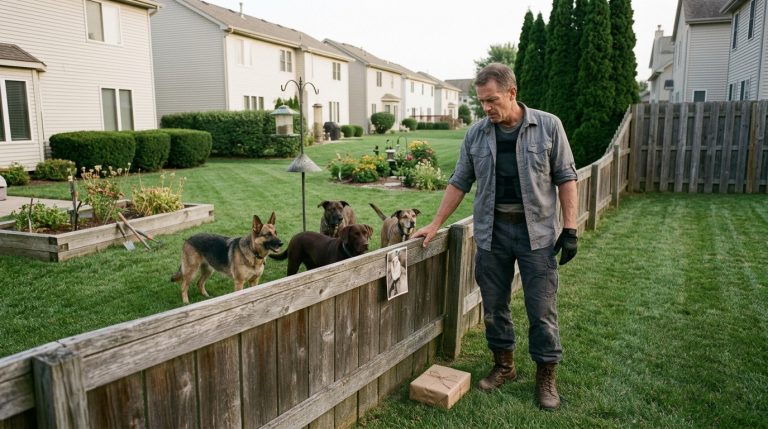
He walked to the window. The northern tree line, where the forest swallowed the light, looked different than he remembered. A new fence line, crude and hastily constructed, snaked through the brush, cutting off the access to the creek. Someone had been marking territory.
Gavin crouched, his fingers tracing a deep scratch in the floorboards near the baseboard. It wasn’t natural wear. It was a drag mark. He looked at Koda. The dog was staring at the wall, his ears twitching at a frequency Gavin couldn’t hear—a low, rhythmic tapping coming from the other side of the wood.
He stood up, his jaw tight. He hadn’t come back to mourn. He had come back to calculate the damage, and the math was already beginning to add up to something much larger than a missing person. He reached for his pocket, pulled out the worn, sun-bleached photograph of his mother, and tucked it into the ledger-sized hole in the dust on the table.
There was a movement outside—the screen door of the neighboring house creaked, a thin, sharp sound like a rusted hinge in a storm. Martha Bell. She was standing on her porch, her hand gripping the railing as if she were holding onto a lifeline. She didn’t wave. She didn’t call out. She just looked at Gavin’s truck, then at the front door, and then, with a slow, deliberate movement, she turned her back and retreated into her own shadow.
Gavin didn’t need to speak to her. The way she had flinched told him everything. The neighborhood hadn’t just watched his mother disappear; they had allowed it, likely in exchange for the same rusted promises he was now seeing etched into the landscape.
CHAPTER 2: The Paper Trail
Gavin watched the screen door of the neighboring house tremble, a final tremor of wood against frame, before the silence closed over it like water. Martha’s disappearance behind the curtain wasn’t just a neighborly withdrawal; it was a tactical retreat. She knew something, and the friction in her voice told him she was afraid of the very thing she was hiding.
Gavin turned back to the living room, his boots feeling heavy on the floorboards. The pale rectangle of dust where the ledger had once rested seemed to glow in the dim light of the afternoon. He walked to the kitchen, opening the drawers with a deliberate, practiced caution. No silverware was missing, but the junk drawer—the one his mother had kept for decades, filled with rubber bands, dried-out pens, and loose tax receipts—was stripped bare. Not disorganized, but emptied.
He didn’t panic. Panic was a waste of internal resources. Instead, he pulled out his own notebook and began sketching the floor plan of the room, noting the empty spots with a grim, surgical focus. This wasn’t a burglary; burglars take the silver, the electronics, the things with resale value. This was an audit. Someone had gone through the house with a specific mandate to sanitize the record.
Koda paced the perimeter of the room, his claws ticking rhythmically against the hardwood. He stopped at the heavy, roll-top desk in the corner. The lock was scratched—not by a pick, but by a blunt, forced twist of a flathead screwdriver. Gavin kneeled, his hands steady as he examined the damage. He didn’t touch the desk. He didn’t want to compromise the scene before he knew exactly what was missing.
As he leaned in, the smell of the room changed. It wasn’t just dust and pine; beneath it, faint and sickly sweet, was the sharp, metallic tang of industrial-grade cleaning solvent. It was the smell of a professional job.
A memory pierced his focus—the time his mother had shown him the Power of Attorney document, a thin, crisp sheet of paper she kept in the ledger. She had laughed about it, calling it a precaution against her own aging. If I lose my way, Gavin, she had said, her voice steady and warm, I want to be sure you have the key.
The memory hit him like a physical blow. The ledger was the key. If they had the ledger, they had the history of the house, the titles, the medical directives. They had the roadmap to everything his mother owned.
He pulled the flashlight out again, the beam cutting through the gloom. He moved to the trash can under the sink. It was empty, save for a single, discarded slip of paper—a carbon copy of a receipt from a private medical clinic two towns over. It was dated three weeks ago.
Three weeks. The exact timeframe of her silence.
Gavin stood up, his legs stiff, his heart rate spiking but his breath remaining controlled, a rhythm he had perfected in colder, more lethal environments. He was no longer looking for a missing person; he was looking for a paper trail that had been systematically buried.
He moved to the front door, Koda at his heels. The dog paused on the porch, his ears pinning back. He looked north, toward the forest, but then he looked down at the gravel. A set of deep, singular tread marks caught Gavin’s eye—heavy duty, the kind used for construction equipment, not a standard pickup.
He reached down and touched the gravel. The impressions were still soft. Someone had been here within the last twelve hours, likely waiting to see if the house remained empty, or perhaps hoping he wouldn’t return at all.
Gavin looked at his watch. Sunset was three hours away. He had the clinic receipt, the memory of the ledger, and the physical reality of the fence line he’d seen earlier. He needed to verify the nature of the clinic. If his mother had been seen there, there would be a record—a signature, a medical file, a point of contact.
He climbed back into the truck, the smell of iron and dust clinging to his clothes. He started the engine, the engine’s idle vibration rattling the dashboard. Koda jumped in, his weight settling against the passenger seat. The dog’s amber eyes remained locked on the tree line as the truck pulled away, the tires churning the gravel.
He knew, with the cold, hard logic of a man who had fought in shadows, that he was being watched. The silence of the town was not just an absence; it was a perimeter. And he had just stepped inside it.
Gavin merged onto the main road, his knuckles white against the wheel. He wasn’t going back to the sheriff yet. Rourke was a good man, but he was a man of the law, and the law worked at the speed of bureaucracy. Gavin was moving at the speed of survival. He turned the truck north, toward the clinic, his eyes scanning the rearview mirror.
A dark sedan, parked a quarter-mile down the road near the brush, didn’t move. But as Gavin sped up, the sedan’s lights clicked on. Not to follow, but to signal. A flash—twice, then off.
Gavin didn’t look back. He kept his eyes on the road, his mind shifting into the next gear. If this was a corporate play, they wouldn’t stop at just stealing a woman. They would be moving to clear the land by the end of the week.
He looked at Koda. The dog leaned his head against the glass, watching the trees blur past. The trail was getting warmer, and the rust was beginning to flake away, exposing the truth underneath.
CHAPTER 3: Tracking the Green Pickup
The road to the clinic was a ribbon of cracked asphalt that wound through the low-hanging shadows of the valley. Gavin kept his gaze locked on the road, though the rearview mirror had become a secondary eye. The sedan had not moved, yet he felt its presence like a dull ache at the back of his neck. Every time the headlights of an oncoming car flared, he instinctively anticipated the turn of a chassis, the rhythmic flash of a signal, the onset of a pursuit that hadn’t yet committed to violence.
Koda shifted, his weight pressing heavily against Gavin’s thigh. The dog was staring out the side window, his nose twitching. He didn’t growl, but his breathing was deep, rhythmic, a steady sound of warning that Gavin echoed in the silence of his own chest.
They reached the clinic at 6:42 PM. It was a single-story structure, faded yellow brick with windows that looked like tired eyes. Gavin pulled into the gravel lot, his engine ticking as it cooled. He sat for a moment, letting the silence of the motor’s death settle into the cabin. He looked at his reflection in the rearview—gray stubble, eyes that looked like stones washed in cold water, and a jawline set in a permanent, grinding lock.
He didn’t just walk into the clinic. He surveyed the perimeter first, noting the back exit, the single security camera—old, likely non-functional—and the empty spaces where a green pickup might have been parked. Nothing.
Inside, the air smelled of stale pine cleaner and the sharp, chemical sting of hand sanitizer. The receptionist was a woman in her fifties, her glasses perched on the edge of a nose that had likely seen a thousand worried faces and had stopped caring about the nuances of any of them.
“I’m looking for a patient,” Gavin said, his voice flat. He didn’t lean on the counter. He kept his hands visible, relaxed but ready. “Helen Mercer. She would have been here about three weeks ago.”
The woman didn’t look up immediately. She typed something, the clack of keys sounding like gunfire in the quiet lobby. “We don’t release patient information without a subpoena, sir.”
Gavin leaned in just enough to draw her eyes to his. He didn’t use aggression; he used the weight of his own stillness. “This isn’t a medical inquiry. It’s a missing person’s report. The Sheriff’s office is already aware of the situation. I have the receipt.” He slid the crumpled carbon copy across the desk.
She looked at the paper, then at him. Her eyes scanned his face, searching for the crack in the facade, for the desperation that usually accompanied such requests. She found nothing but the cold, hard surface of his resolve. She sighed, a tired, rasping sound, and turned to a heavy metal cabinet behind her.
“She was brought in by a man,” the receptionist said, her voice dropping to a near-whisper. “He insisted on handling the paperwork. Said he was her nephew, or some legal proxy.”
Gavin’s hand tightened into a fist in his pocket. “What kind of paperwork?”
“Medical Power of Attorney. He had a notarized document. Said she was experiencing cognitive decline, needed to be transferred to a private facility for… specialized care.” She paused, her gaze shifting to the window where Gavin’s truck sat under the flickering light of the parking lot. “He paid in cash. And he kept the records. We just have the entry log.”
“Name?”
She hesitated, then slid a yellow card across the counter. “Derek Shaw.”
Gavin didn’t thank her. He took the card—the paper was thick, slightly textured, a business card for a firm that didn’t exist in any directory he knew. Red Hollow Consulting.
As he stepped out into the evening air, the wind picked up, swirling dust around his boots. The sedan was gone, but the feeling of being watched intensified. He stood by his truck, looking at the card under the dim light. It wasn’t just a forgery; it was a blueprint.
He knew now why his mother had been targeted. She hadn’t been picked for her vulnerability; she had been picked for her property. The Red Hollow lands were part of a larger tract, and by obtaining a Power of Attorney, Shaw hadn’t just moved her—he had effectively seized the right to sell the land she sat on, likely for the very developers who were currently laying the fences he’d seen earlier.
He gripped the card until the edges bit into his palm. The logic was cold, efficient, and entirely devoid of human empathy. Shaw wasn’t a kidnapper; he was a corporate scavenger.
Koda let out a sharp, sudden bark. Gavin spun, his body reacting before his mind registered the sound. From the darkness of the tree line at the edge of the lot, a pair of headlights flared—the sedan, turning back onto the highway, moving slowly, deliberately, as if waiting for him to follow.
Gavin didn’t hesitate. He knew the risk, but the frustration of the last two years had reached a breaking point. He got back into the truck, cranked the engine, and followed the tail lights. The game had shifted from a search to a chase, and the road ahead felt like a trap waiting to spring.
CHAPTER 4: The Confrontation at the Crossroads
The sedan didn’t accelerate away. It braked hard, tires screeching against the asphalt with the protest of dying rubber, forcing Gavin to slam his own truck into a controlled skid. Dust billowed, thick and choking, momentarily blinding them both in a swirling haze of grit. Gavin shifted his weight, hand hovering near the gear shift, body coiled like a spring. Koda let out a low, vibrating growl, his hackles raised, ears pinned flat against his skull.
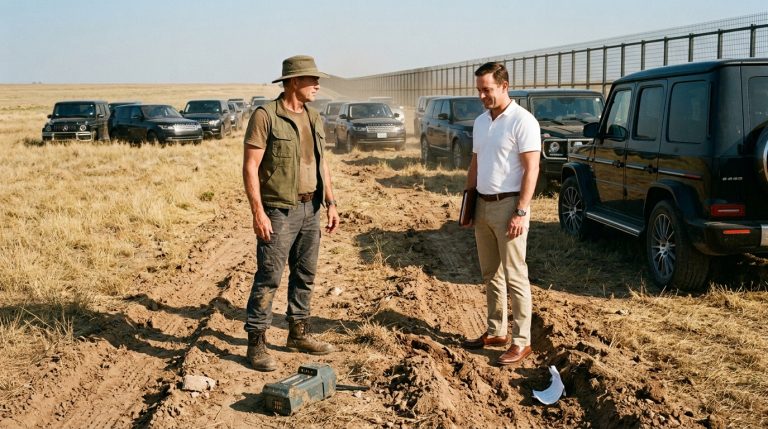
The driver’s side door of the sedan opened. A man stepped out—tall, thin, with a beard that looked like it had been trimmed by someone who lacked a steady hand. It was Derek Shaw. He didn’t look like a kidnapper; he looked like a man whose time had been wasted. He stood in the middle of the road, the moonlight casting long, skeletal shadows across his narrow face.
Gavin stepped out of his truck, the gravel crunching with deliberate, heavy steps. He kept his distance, staying within the safety of his truck’s flank. He didn’t want a fight; he wanted the truth. But as he looked at Shaw, he saw the man’s eyes—they weren’t fearful. They were bored.
“You’re making a mistake, Mercer,” Shaw called out, his voice steady, carrying over the wind like a dry leaf skittering across pavement. “Following me won’t give you back the time you’ve already lost.”
Gavin didn’t stop. He kept his pace slow, methodical. “I’m not interested in time, Shaw. I’m interested in the ledger. And the papers you signed at the clinic.”
Shaw tilted his head, a jagged movement that felt robotic. “Papers are just ink on wood pulp. They don’t have a soul. Much like this town.” He reached into his jacket—not for a weapon, but for a cigarette. He lit it, the ember glowing like a baleful eye in the darkness. “You think you’re protecting something, don’t you? A legacy? A home? It’s all rust, Gavin. It’s all decaying. I’m just accelerating the process.”
Gavin felt the cold steel of the truck bed beneath his fingertips. He felt the weight of his own exhaustion, two years of it, pressing against his ribs. “You’re a scavenger,” Gavin said, his voice dropping an octave, becoming the tool of command he once used in the desert. “You saw an elderly woman and you saw a chance to file a claim. That’s not progress. That’s theft.”
Shaw smiled, a thin, humorless expression. “I’m a consultant. I provide solutions for people who don’t know how to let go.”
Koda surged forward, a blur of muscle and shadow. He stopped three feet from Shaw, his growl turning into a sharp, staccato bark. Shaw didn’t flinch. He didn’t even blink. He blew a plume of smoke into the air and tossed his cigarette into the dirt.
“You want to know where she is?” Shaw asked, his voice suddenly sharp, transactional. “She’s safe. Better than she was in that rotting house. But if you keep pushing, the paperwork will finalize, and she’ll be legally relocated to a facility where you won’t be able to find her. That’s the choice, Gavin. You can have the house, or you can have her. But you cannot have both.”
Gavin felt the trap close. It wasn’t a physical cage; it was a legal one. Shaw had weaponized the system. He had created a decoy secret—the idea that this was just about kidnapping—while hiding the real, administrative mechanism that was already in motion.
Gavin’s eyes darted to Shaw’s vehicle. The glovebox was slightly ajar, the edge of a heavy, leather-bound ledger protruding. It was the family book—the physical record of the house. Gavin realized then that Shaw hadn’t just been holding the ledger; he was using it to legitimize the theft.
“Step away from the vehicle,” Gavin said, his hand gripping his flashlight—a heavy, tactical-grade piece of metal.
Shaw laughed, a dry, wheezing sound. “Go ahead. Look at it. See what you’ve really been defending.”
Gavin moved past him, his focus zeroed in on the glovebox. He grabbed the ledger, its cover cracked and peeling from years of humidity. He opened it, the beam of his flashlight cutting across pages filled with forged signatures, power of attorney documents, and land-deed transfers marked with official-looking stamps. But it wasn’t just his mother’s name in there. It was dozens of others.
Gavin felt his stomach turn. This wasn’t a kidnapping case. This was a land-clearance scheme, a systematic erasure of an entire town’s title history, sanctioned by entities that were far larger, and far more dangerous, than a lone scavenger like Shaw.
Shaw leaned against his sedan, watching Gavin with an expression of quiet, smug satisfaction. “You think you’ve uncovered a crime, Gavin? You’ve only uncovered the process. The deeds are already filed. The land is effectively spoken for. You’re fighting a tide.”
Gavin snapped the ledger shut. The weight of it was immense, not because of the paper, but because of what it represented: a future for Red Hollow that had been sold out from under everyone while they were still sleeping. He looked at Shaw, really looked at him, and realized that for all the man’s arrogance, he was nothing more than a clerk. A clerk for a much larger, faceless machine.
“I’m not fighting the tide,” Gavin said, his voice hardening into steel. “I’m building a dam.”
Shaw looked at him, a flicker of genuine irritation crossing his face—the first crack in his armor. He climbed back into his sedan, his movements sharp, agitated. “You’re a ghost, Mercer. And ghosts don’t get to hold onto property.”
The sedan roared to life, the tires spraying gravel and dirt as Shaw spun the vehicle around, tearing off back down the highway toward the dark expanse of the valley. Gavin stood in the middle of the road, the ledger heavy in his hand, Koda pacing beside him. The immediate conflict had ended, but the stakes had tripled. He had the evidence, but he also had the attention of a syndicate that didn’t tolerate interference.
He climbed back into his truck, his mind racing. He needed to go to the Sheriff, not with a missing person’s report, but with a mountain of documented fraud. He turned the truck around, the rusted frame groaning under the strain. The road home was going to be long, and he knew now that the shadows were only getting deeper.
CHAPTER 5: The Syndicates Reach
The first drop hit the windshield like a bullet—sharp, heavy, and sudden. Within seconds, the sky above the highway vanished behind a curtain of slate-gray rain. The wipers slapped rhythmically against the glass, struggling to clear the torrent, but the road ahead turned into a blurred, shimmering ribbon of slick asphalt. Gavin didn’t slow down. He couldn’t. He knew the sedan—or whatever else was watching him—would be using this storm as a shroud.
He kept the truck in a low gear, his grip on the wheel firm enough to turn his knuckles white. The ledger rested on the passenger seat, anchored by his heavy field coat. It felt lighter than it should have, despite the weight of the evidence inside.
Koda sat upright, his gaze fixed on the road, his ears twitching at the sound of the rain drumming against the metal roof. The dog was uneasy. He let out a low, vibrating whimper—not of fear, but of anticipation. He knew the change in the air, the way the pressure dropped before a storm, the way the scent of oil and wet earth intensified.
Gavin’s phone chimed. He didn’t look at the screen, but the glow illuminated the dash, casting a ghostly, pale light over his face. He kept his eyes on the road. The phone chimed again. A series of messages. He tapped the voice-to-text button on the wheel.
“The file on Shaw is restricted, Mercer,” Sheriff Cross’s voice crackled through the speakers, distorted by the static of the storm. “I tried to pull the state records you mentioned. They’ve been wiped. Not deleted—wiped by an administrative override. We’re talking about an entity with deep, systemic access. Don’t go home. Don’t go back to the station. Someone is monitoring the traffic patterns near the Hollow.”
Gavin felt the blood in his veins turn cold. An administrative override. This wasn’t just a scavenger operation anymore; it was an institutionalized campaign. They weren’t just clearing land; they were scrubbing the existence of anyone who stood in their way.
“I have the ledger,” Gavin said, his voice clipped.
“Get rid of it,” Cross replied, his tone shifting from professional to urgent. “If they know you have it, you’re not just a witness anymore. You’re a liability. Get off the main road. The turnoff at Miller’s Creek—there’s a logging path. Take it. I’ll meet you at the old bridge in twenty minutes.”
Gavin took the turn without a second thought. The truck swerved, the tires losing traction on the slick mud of the shoulder before grabbing hold. He plunged into the dark, narrow trail that wound through the dense pines. The logging path was overgrown, the branches of the trees clawing at the metal of the truck like skeletal fingers.
The rain intensified, turning the trail into a sluice of mud. Gavin felt the truck fishtail, the heavy rear end sliding dangerously close to the steep embankment that led down toward the creek. He corrected, his movements fluid and precise, his focus narrowed to the ten feet of visibility the headlights allowed.
Koda growled, a deep, rumbling sound that filled the cab. He was looking at the side mirror—the one reflecting the dark tunnel of trees they had just passed.
Gavin checked the mirror. Two sets of headlights, high-intensity beams, were cutting through the rain behind him. They were moving fast, unbothered by the mud or the narrowness of the path. They weren’t patrol cars; they were heavy-duty off-roaders, the kind favored by private security firms.
“Hang on,” Gavin muttered.
He floored the accelerator. The engine roared, a guttural sound of mechanical protest, and the truck surged forward, bouncing over exposed roots and rocks. The trail began to climb, snaking up the side of the ridge. The rain hammered against the roof, drowning out everything but the sound of his own heart hammering against his ribs.
He couldn’t outrun them, not on this terrain. He needed a bottleneck. A place where the road narrowed, where the terrain itself would force the pursuers into a choke point.
He remembered this trail from childhood—a narrow cut where the mountain wall pressed against the path on one side, and a sheer drop to the creek bed yawned on the other. It was barely wide enough for one vehicle.
He drove harder, the truck sliding, the chassis groaning as it bottomed out over a large rock. Koda was braced, his claws dug into the upholstery, his eyes fixed forward. Gavin kept his eyes on the light-streaked dark, searching for the bend.
There.
He slowed, just enough to let the truck settle, then cut the wheel hard, drifting the back end across the muddy lane until he blocked the path entirely. He jumped out, the rain hitting him with the force of a hammer. He grabbed the ledger from the seat and ran to the edge of the embankment.
The headlights behind him slowed, the engines whining in the dark. They were fifty yards out, then forty.
Gavin didn’t hide. He stood in the rain, his jacket soaked through, his skin tingling with the cold. He had to stop them. He didn’t have a weapon, only the weight of the ledger and the desperate, burning need to protect what was left of his life.
The vehicles stopped twenty yards back. Doors opened. Figures—two, maybe three, dressed in dark tactical gear—stepped out into the deluge. They didn’t shout. They didn’t call for a surrender. They moved with the calculated, silent efficiency of professionals.
One of them raised an arm, a flash of red light piercing the rain. A laser sight.
Gavin ducked, the movement instinctive, the sound of a suppressed crack tearing through the storm. A bullet chipped the wood of a pine tree just inches from his head, showering him in bark and splinters.
He scrambled back, the mud sliding beneath his boots, and felt the ledger slip from his grasp. He lunged for it, his hand closing around the leather, but he was exposed. Another shot rang out, louder this time, hitting the truck’s rear tire with a hiss of escaping air.
He was pinned. The blockade he’d created was now a trap. He looked at Koda, who was cowering low under the dash. Gavin realized then that he couldn’t win this with strength. He had to use the environment.
He looked down at the creek bed, then back at the road. He gripped the ledger to his chest and dived into the dark, slick, mud-coated descent toward the water. The descent was steep, dangerous, and likely suicide, but it was the only way to vanish into the rust and the rain.
As he tumbled down the slope, the cold water of the creek rushing up to meet him, he knew that the next few minutes would decide whether he was a hunter or a ghost.
CHAPTER 6: Mapping the Final Extraction
The creek was a freezing, roiling mass of brown water and jagged stone. Gavin surfaced, gasping, his lungs burning with the sudden intake of icy air. The rain roared against the surface of the water, a chaotic symphony of violence that masked his movements. He hauled himself toward the bank, his fingers digging into the slick, clay-heavy mud. Beside him, Koda broke the surface, his thick coat matted and heavy, his eyes alert and scanning the dark tunnel of the trees above.
They scrambled up into the brush, the mud clinging to their skin like a second, freezing layer. Gavin didn’t look back at the ridge. He knew they were there, somewhere in the gloom, their thermal sights likely scanning the heat signatures of the woods. He had to keep moving, but the terrain was a labyrinth of wet stone and tangled roots.
He pressed his back against the base of a massive, rotted oak, his breath hitching as he tried to regain control of his heart rate. The ledger was a sodden mess, the leather cover soft and weeping water, but the contents were protected by the tight binding. He shielded it with his body, the paper pulp turning to mush against his chest.
A memory flared—his mother, years ago, kneeling in the dirt of her garden. She had been explaining the importance of the property line, how the old iron stakes were buried deep, marking the history of the soil. You don’t just own the land, Gavin, she had whispered, her hands stained with earth. You own the truth that’s buried in it. If someone tries to move the stakes, they’re trying to bury the truth.
He looked at the sodden ledger. The names he’d seen in the light of his flashlight—the forged deeds, the fake power-of-attorney documents—they weren’t just random targets. They were all plots adjacent to the creek. The syndicate wasn’t just clearing the Hollow; they were mapping a specific, resource-rich corridor that followed the natural water table.
They weren’t just thieves; they were surveyors of a ghost town.
He had to get to the old bridge. Cross would have the radio frequency, the tactical support, the only chance to push back. He forced himself up, his muscles screaming with the strain of the cold.
“Stay low,” he whispered to Koda. The dog didn’t need the command. He moved like a shadow, his dark form disappearing into the undergrowth, his paws making no sound on the wet leaves.
They trekked through the heart of the woods, the rain turning the forest floor into a sludge that sucked at their boots. Every crack of a branch sounded like a gunshot; every flicker of lightning felt like a searchlight. Gavin tracked the elevation, keeping the creek on his right, moving toward the rusted iron structure of the old logging bridge.
He stopped, his hand shooting out to catch Koda’s collar.
Up ahead, near the bridge, a light flickered—a dim, red beam. Not a laser, but a lantern, sitting on a flat stone. It was a signal. A trap, or a rescue?
He watched from behind a thicket of ferns. A figure stood by the bridge, illuminated by the lantern. It wasn’t Cross. It was a man in a long, dark coat, his face obscured by the brim of a hat. He stood motionless, his silhouette etched against the backdrop of the bridge’s rusted steel girders.
Gavin felt a surge of adrenaline, cold and sharp. This was the syndicate. They had anticipated the meeting point. They hadn’t just been hunting him; they had been herding him.
He didn’t move. He observed. He saw the figure reach into his coat and pull out a device—not a radio, but a phone. He watched the man dial, the glow of the screen reflecting in his eyes.
“He’s in the sector,” the man said, his voice carrying clearly through the wet air, sounding oddly melodic and detached. “Direct the teams to the bridge. We’ll terminate the search here.”
Gavin’s jaw tightened. Terminate. The word landed with the finality of a gavel. He looked at Koda. The dog was staring at the man, his growl low and continuous.
Gavin realized he couldn’t get to the bridge. The entire area was compromised. He had to change the terrain. He had to draw them away from the bridge and back into the densest part of the forest, where the mud and the darkness would be his allies.
He picked up a heavy stone and hurled it into the brush to his left, twenty feet away.
The sound of the stone hitting the leaves was sharp. The man by the bridge froze, his head snapping toward the sound. He drew something from his coat—a pistol, the suppressor visible even in the dim light.
“Move,” Gavin whispered to Koda.
They slipped back into the dark, Gavin moving with the silent, predatory grace of a soldier in his element. He wasn’t retreating; he was positioning. As the man by the bridge began to cautiously advance toward the sound of the thrown stone, Gavin began to circle wide, moving toward the bridge’s support structure.
The rusted iron girders were slick with algae and rain. He could climb them, get above the man, and wait. If he could neutralize the point-man, he could seize the device and perhaps, just perhaps, find the location of the rest of the team.
He reached the girder, his boots finding purchase on the cold, wet metal. He climbed, his muscles burning, his breath coming in shallow, controlled bursts. From up here, the world looked like a desaturated photograph—the dark woods, the swirling rain, the isolated, glowing lantern in the center of the trap.
He looked down at his hands. They were trembling, not from cold, but from the sheer, raw intensity of the situation. He gripped the ledger, tucked it into the inner pocket of his jacket, and focused on the man below. He was the sovereign protector of this land, and he was about to make sure the scavengers paid for every inch they’d tried to steal.
He waited for the man to pass underneath, his senses sharpened, the rust of the bridge grating against his skin like the friction of time itself. This was the turning point. He wouldn’t just survive this night; he would dismantle the entire operation from the inside out.
CHAPTER 7: The Final Maneuver
The rain had slowed to a rhythmic, heavy drip from the iron girders, each drop hitting the stagnant water below with a sound like a ticking clock. Gavin held his breath, his muscles locked in a rigid, cramping suspension. Below him, the man in the dark coat continued to move with a sluggish, methodical pace, scanning the brush with his lantern.
The man paused directly under the bridge. He looked at his phone again, his thumb hovering over the screen. Gavin saw the reflection—a bright, white light highlighting the man’s features. He was older than he’d appeared from a distance, with a face that looked like weathered stone, impassive and entirely devoid of heat.
Gavin didn’t hesitate. He swung his legs forward, his boots finding a narrow, rusted support strut. He dropped.
The movement was silent, a blur of motion through the humid air. He landed on the man’s shoulders with the full force of his momentum. They hit the mud with a wet, heavy thud. The lantern spun away, its light catching the bridge’s rusted rivets as it rolled into the dark.
The man struggled, his arms whipping around with the desperate strength of someone fighting for their life. He managed to shove Gavin off, his hand darting into his coat. Gavin lunged, his fingers catching the man’s wrist, pinning it against the mud.
“Who sent you?” Gavin roared, the sound swallowed by the rain.
The man smiled, a jagged, broken expression. He didn’t speak. He bit down—not on his tongue, but on something hidden in his molar. A sharp, chemical scent filled the air, acrid and biting. His eyes rolled back, his body twitching once, then going limp under Gavin’s grip.
Gavin stood, panting, his lungs feeling like they’d been scrubbed with wire. He checked the man’s pulse. Nothing. He searched the man’s pockets, finding only a key card with a generic logo—a stylized, geometric shape that looked vaguely like a corporate seal.
This was their commitment. A level of operational discipline that bordered on the fanatical.
He took the key card and the phone. The phone was locked, but the device’s GPS was still active. A single pulsing blue dot indicated a location less than two miles away—a site marked Extraction Point Alpha.
Gavin looked back toward the woods. He had to decide. Go to the extraction point and face whatever was waiting there, or retreat to find Sheriff Cross and try to alert the state authorities. But the state records had been wiped. There was no one to call. There was only him.
“Koda,” he whispered.
The dog emerged from the shadows, his ears pinned back, his coat slick with rain and mud. Gavin looked at him, then at the ledger, which was now nothing more than a ruined brick of paper in his pocket. The decoy secret—the idea of a kidnapper—had been shattered. The truth was something far larger: a corporate machine that treated the history of the land as an obstacle to be cleared.
He wiped the mud from his face. The exhaustion was a heavy weight in his bones, but his mind had never been clearer. He had been looking for a man to arrest; now he understood he was looking for a network to dismantle.
He navigated toward the blue dot, his movements more deliberate now. He wasn’t running anymore; he was advancing. The forest began to thin, the trees giving way to a large, flattened clearing that had been cleared of brush and leveled with fresh gravel.
There, in the center, sat a modular, industrial trailer, lit from within by the hum of high-powered generators. It was a temporary operations hub. A command center for the land-grab.
Gavin crept to the edge of the clearing, his body blending into the dark, rusted iron of an abandoned logging loader. He saw the green pickup—the same one he’d been tracking for weeks—parked near the trailer’s ramp. And next to it, a black SUV, the engine idling.
He didn’t need to see Shaw again. He knew he was inside. He knew the files were there. He knew the fate of Red Hollow was locked in the drives sitting on those desks.
He checked the key card in his hand. If it worked, it would open the door. If it didn’t, he was about to make a very loud statement.
He looked at Koda. “Stay,” he whispered. The dog obeyed, settling into the mud, his eyes fixed on the trailer’s door.
Gavin stood, his hand gripping the heavy flashlight, his heart beating a steady, rhythmic cadence. He wasn’t just a former Marine anymore; he was the last line of defense for a home that didn’t know it was being erased. He walked into the clearing, the gravel crunching beneath his feet, the sound amplified by the sudden, eerie silence of the rain stopping.
He reached the ramp, the metallic smell of fresh paint and ozone hanging in the air. He pressed the card to the reader. The light clicked from red to green. The door unlocked with a sharp, pneumatic hiss.
He pushed the door open. The light from inside spilled out, blinding him for a heartbeat, and he stepped into the center of the trap, ready to bring the entire system down.
CHAPTER 8: Denouement: The Rusted Horizon
The interior of the trailer was stark, clinical, and smelled of ozone and scorched plastic. Gavin stepped inside, his boots heavy on the metal grate floor, the flashlight in his hand sweeping across rows of server towers and sleek, desk-mounted monitors. Derek Shaw sat in a swivel chair near the back, a tablet in his hands, his face bathed in the cold, flickering blue light of a topographic map of Red Hollow.
He didn’t jump. He didn’t scramble. He simply looked up, his expression one of weary resignation, as if he’d been expecting the interruption since the moment he’d first stepped into the Hollow.
“You’re late, Mercer,” Shaw said, his voice quiet, devoid of the smug edge he’d carried on the road. “The land titles were transmitted to the county server ten minutes ago. The clearance is legal, binding, and entirely beyond your reach.”
Gavin didn’t speak. He stepped forward, the weight of the sodden, ruined ledger in his jacket pocket contrasting sharply with the pristine, high-tech environment of the hub. He walked to the main console and smashed the screen with the base of his heavy flashlight. The glass shattered, a shower of sparks and dark liquid crystals erupting into the air.
“The titles might be filed,” Gavin said, his voice a low, steady rumble that seemed to vibrate in the confined space, “but the truth about how you got them is in this building. Every forged signature, every coerced medical document, every illegal survey marker. It’s all here.”
Shaw chuckled, a dry, rattling sound. “You think evidence matters to the people behind me? You think a few pieces of paper will stop an infrastructure project of this scale?”
“It’s not about stopping them today,” Gavin said, leaning over the console until his face was inches from Shaw’s. “It’s about making sure that every single person involved in this—every corporate lawyer, every state official who signed off on your ‘clearance,’ every developer who knew exactly what you were doing—is exposed. I’ve already contacted a federal oversight group. They’ve been tracking the pattern of land displacement in this corridor for months. They just needed the local link. You were that link, Derek.”
Shaw’s face paled. The arrogance finally withered, replaced by the hollow realization of his own expendability. “They won’t let you leave this clearing,” he whispered.
“They’re already gone,” Gavin replied. “When you didn’t check in after the bridge, they cut you loose. You’re not a consultant anymore, Shaw. You’re a liability.”
The realization hit Shaw like a physical weight. He slumped in his chair, his hands trembling. Gavin moved to the server rack, pulled the primary drive, and looked at the man who had torn apart his family’s history for a few lines of code and a corporate contract.
Outside, the rain had stopped. The sudden, eerie silence was broken only by the distant, rhythmic chirping of crickets—the sound of the natural world reclaiming the space. Gavin walked out of the trailer, the cool night air hitting his face like a benediction. Koda was waiting for him, standing guard by the ramp.
He didn’t leave Shaw behind to die or to flee. He stood in the clearing, and ten minutes later, the blue and white lights of a Sheriff’s patrol car—led by Cross—bounced over the ridge, illuminating the trailer and the ruined equipment.
The arrest was as clinical as the office had been. Shaw was led away in silence, his head bowed, his corporate mask completely discarded.
Gavin stood by the old logging loader, watching the process. Sheriff Cross approached him, his face lined with the gravity of the situation. “We’ve got the servers, the ledger, and the witness testimony from the clinic. You did the heavy lifting, Gavin. You broke the chain.”
Gavin didn’t reply. He watched as the trailer was sealed, the bureaucratic machine that had threatened to erase his home now being systematically dismantled by the very law it had tried to subvert.
The following morning, the sun broke over Red Hollow, turning the mist on the trees into golden, shimmering light. Gavin walked the property line with Koda. They reached the spot where the old iron stake had been pushed over—a jagged, rusted piece of metal embedded in the earth.
He knelt, his hands working the soil, the dirt cool and rich beneath his fingernails. He pulled the stake upright, bracing it against a stone, and hammered it firmly back into the ground with the heel of his boot.
It was a small act, a simple restoration, but as he felt the earth settle around the metal, he felt the tension that had been coiled in his chest for two years finally begin to loosen. He looked up at the house, the porch now quiet and still, no longer under the shadow of a threat.
He heard the creak of a door behind him. Helen stood on the porch, wrapped in a blanket, the morning light catching the gray in her hair. She looked at him, then at the stake, and a slow, faint smile touched her lips. She didn’t say a word, and she didn’t need to.
Gavin stood, his muscles aching with the pleasant, earned tiredness of a task completed. He had come home to fix something that had worn down, and he had learned that some things couldn’t be fixed by simply moving them—they had to be defended.
He walked back toward the porch, Koda trotting happily at his side. He stepped up onto the wood, the familiar groan of the boards beneath his boots feeling like a greeting. He looked out over the land—the forest, the creek, the quiet, stretching valley—and for the first time in his life, he felt that he wasn’t just existing in a place; he was part of its history.
He sat down, the weight of the past finally set aside, and let the sun warm his skin. The rust would return, as it always did, but the truth remained buried, anchored, and secure. He had kept his promise. He had come back, and he had stayed.