A Fragile Peace: The Quiet Journey of a Soldier Carrying the Weight of Unspoken Truths
CHAPTER 1: THE WEIGHT OF THE PROMISE
The silence in the garage was not empty. It was pressurized, filled with the hum of a refrigerator in the corner and the slow, rhythmic settling of the brick house against the cooling earth of North Carolina. Walter Jessup stood at his workbench, the light of a single overhead bulb casting long, amber shadows across the tools he had spent a lifetime maintaining.
His hands were steady now. The tremor was a ghost of the morning, suppressed by the late-afternoon calm. He looked at the photograph of David Pruitt—the caution in the eyes, the untarnished hope of a boy who had no idea what the mountains of Laos held for him. The air in the room smelled of cedar and motor oil, a sharp, clean scent that anchored Walter to the present.
He reached out, his calloused thumb brushing the edge of the frame. He had delivered the message to Ellen, and for three weeks, he had felt a strange, terrifying lightness in his chest. It was as if the weight he had carried for over half a century—a weight that had bent his spine and compressed his stride—had finally been handed off, piece by piece, to a kin who could hold it.
But the silence was interrupted. A soft thwack against the front door echoed through the house, the sound of paper meeting wood.
Walter didn’t rush. He moved with the calculated efficiency of a man who knew that nothing in the world was so urgent that it required a frantic step. He walked to the front door, the aluminum cane striking the floorboards with a steady, metallic rhythm. He opened the door. The porch was empty, save for the evening light filtering through the pine needles. At his feet lay a thick, manila envelope. No postage. No return address. Just his name, written in an ink that looked as old as the memories he kept in his closet.
He took it inside, the paper cool and heavy against his palm. He didn’t open it immediately. He walked to his kitchen table, sat down, and set the envelope under the harsh, clinical light of the overhead fixture. He had learned in 1968 that an envelope was never just paper. It was a catalyst.
He slid a butter knife under the seal. The paper tore with a sound that felt like a rupture. Inside was a single dossier, marked with a stamp he hadn’t seen since the war: a faded, crimson “Q” inside a circle.
As he opened the file, his eyes narrowed. It was a service record, but the pages were interleaved with notes in the same meticulous, upright script he had seen on the invitation from Colonel Devereaux. But this was not from the Colonel. The entries were dated, stamped, and cross-referenced with files he knew were still marked top secret. And there, near the bottom of the second page, was a name he hadn’t spoken in years: Gunnery Sergeant Raymond Lao. The man with the radio, the man who had been killed in Hue City.
Walter flipped the page, his breath catching in his throat. Beside the official report of Lao’s death was a handwritten note, sharp and cold: Correction: Lao did not die in Hue. Lao was recovered at Limestone Creek. And the record was scrubbed before the body reached the base.
The room seemed to tilt. Walter felt the weight return to his chest, heavier than before, a dense, physical pressure that pushed the air from his lungs. If the record of Lao was a lie, then everything he had built his peace upon—the orderly, disciplined memory of his brothers—was standing on a foundation of sand.
CHAPTER 2: THE ARCHIVE THRESHOLD
Walter did not stand up. The air in the kitchen, usually so predictable and still, felt heavy, charged with the ozone of a gathering storm. He stared at the stamp—the crimson Q, bleeding slightly into the low-grade paper. It was a mark of a system that had been designed to be invisible, a ghost in the bureaucratic machine that had now materialized on his kitchen table.
He pushed the dossier away, but his fingers trembled against the wood grain. If the record of Lao was a lie—if the military had orchestrated the “death” of a man who was actually recovered at Limestone Creek—then the entire architecture of his life, built upon the foundation of military honor and absolute records, was suddenly porous.
He stood, the chair scraping sharply against the linoleum. He didn’t think about dinner. He didn’t think about the yard or the maintenance of the house. He went to his truck, the 2006 Silverado that he had serviced with his own hands a thousand times. He needed to get to the archive, or at least to the nearest point where he could verify the discrepancy.
The engine turned over with a familiar, comforting growl, but as he pulled out of his driveway, a rhythmic clack-clack-clack began to vibrate through the steering wheel. It wasn’t the engine. It was the front-left wheel bearing. He’d known it was going to fail eventually, but he hadn’t expected it now, not when the very ground beneath him felt like it was shifting.
He pulled over to the shoulder of the highway, the gravel crunching beneath his tires. The silence of the North Carolina evening was absolute, broken only by the tick-tick-tick of the cooling engine. Walter stepped out, his cane bracing him against the slight incline. The wind carried the scent of pine needles and damp earth—faded textures, familiar and grounding. He knelt, his titanium hip protesting, and reached for the lug wrench. He had to be sure. He had to be mobile.
He didn’t fix it with the casual speed of a younger man; he fixed it with the deliberate, slow-motion grace of a master craftsman. He checked the brakes, the hub, the rotor. He was losing daylight, and with every passing minute, the red ink of that Q burned in his mind.
He finished, stood, and wiped his hands on a rag that was already stained with a decade of service. He wasn’t just a veteran anymore; he was an investigator of his own history. He climbed back into the cab, the smell of old, dry upholstery welcoming him. He looked at the dashboard.
He didn’t head for the base. He headed for the small town of Hubert, toward the local VOA office, where he had contacts from his years of retirement—men who knew how to look into the “inactive” archives. He knew the record of Lao wasn’t going to be sitting on a digital server. It was going to be in a physical file, buried under layers of procedural dust.
As he drove, the headlights cutting through the growing gloom of the pine barrens, he realized the magnitude of what he was doing. He wasn’t just clearing a name. He was walking into a conflict with the institution that had defined his existence. He gripped the steering wheel, his knuckles white. The road ahead wasn’t just blacktop; it was the start of an interrogation of silence.
He reached the VOA office just as the security lights were flickering on. It was a nondescript building, the kind of place that held the mundane realities of thousands of veterans. Walter parked, his eyes scanning the windows. There, in the front office, he saw a light still burning. He stepped out, the cane hitting the pavement with a sharp, punctuating sound.
He was going to find out who had signed off on the Lao file. He was going to find out why a dead man had been erased from the official record, and why, fifty-six years later, that erasure was still being maintained by someone with enough power to mark a file with a crimson Q.
He stepped toward the entrance, his jaw set. The weight of the message was still there, but now, it was accompanied by the heat of purpose. He wasn’t just carrying the past anymore; he was actively dismantling it.
CHAPTER 3: THE GHOST IN THE RECORDS
The door to the VOA office opened with a dry, metallic protest, a sound that seemed too loud for the late hour. Walter stepped inside, the foyer dim and smelling faintly of floor wax and stale coffee—a scent that reminded him of a thousand forgotten administrative centers. The desk sergeant, a younger man with the weary eyes of someone who spent his life processing paperwork for ghosts, looked up from a computer screen.
“Office is closed, Sergeant Major,” the man said, his voice dropping in automatic deference as he took in the dress blues, which Walter had not removed, though he had discarded the heavy coat. The uniform felt like a second skin, a reminder of the man he had been and the man he was currently fighting to preserve.
“I’m not looking for a handout, son,” Walter said, his voice steady, anchored by the cane he held in his right hand. “I’m looking for an archival log. Vietnam-era, Da Nang regional, 1968. Personal effects and casualty reports.”
The clerk hesitated. He glanced at the wall clock—10:14 PM. Then he looked at Walter’s ribbons. The dark green and black ribbon wasn’t displayed, but the medals of a career of service were, and they commanded a space in the room that even the dim light couldn’t diminish. “We don’t keep that level of detail on the floor, sir. That’s all moved to the deep storage vault at the back. It’s off-limits to everyone except authorized historians.”
Walter didn’t blink. He walked to the counter, leaning forward just enough to be felt. “I’m not a historian. I’m the record.”
The clerk sighed, the sound of a man caught between bureaucratic survival and the weight of a legacy he didn’t quite understand. He pulled a heavy ring of keys from his belt. “Ten minutes. If there’s an alarm, I didn’t see you.”
The storage vault was a labyrinth of sliding metal shelves, the air cold and motionless, as if it hadn’t been disturbed since the war itself. Walter navigated the rows with a practiced, heavy gait. He knew the systems; he knew how to search for a name when you didn’t have a file number. He moved past the racks, his fingers tracing the spines of the boxes.
He found it in aisle four—a series of dusty, cardboard containers labelled Da Nang Personnel Recoveries: Late 68. He hauled the box labeled October 1968 onto a reading table. The grit of the storage facility left a fine, gray film on his fingertips.
He began to flip through the files. He wasn’t looking for Pruitt this time; he was looking for Lao. Gunnery Sergeant Raymond Lao. The record was thick, full of standard death notifications and funeral arrangements. He found the page: Raymond Lao, Cause of Death: Small arms fire, Hue City.
It was the official story. But then, Walter saw it—the anomaly he had suspected. He pulled a magnifying glass from his vest pocket. Under the official stamp, there was a faint, embossed ridge in the paper—a sequence number. D-489-L. He turned to the file behind it, the one for the soldier who had supposedly been recovered alongside Lao. D-489-M.
He counted. The sequence was off by one.
In a system built on linear precision, a missing sequence number meant a hidden entry. Someone had pulled a record from the middle of the batch. He flipped back to the index card at the front of the box. October 1968, 14 entries. He counted the files.
Thirteen.
The air in the room seemed to thin. He leaned back, his heart hammering against his ribs. It wasn’t just a misfiling. It was an extraction. Someone had physically removed a record from the stack, an entry that existed between Lao and the next man, and in doing so, they had broken the continuity of the recovery process. He looked at the bottom of the index card. There, barely visible in pencil, was a scribbled note: Ref: Agency Review 12-A.
Agency. The word sat on his tongue like bitter metal. It wasn’t a Marine unit. It wasn’t a logistical error. It was the mark of the shadow organization he had served under, the one that operated in the gaps of maps and the silence of records.
Walter felt the cane tremble against the floor, not from nerve damage, but from the realization that he was not just chasing a lie; he was chasing an entity. He looked at the empty space in the file box where the fourteenth entry should have been. The gap was a physical presence—a hole in the world where a man’s life, or his death, had been swallowed whole.
He didn’t need to look any further. He knew now that the “Q” stamp was not an internal military mark. It was an administrative flag—a warning for anyone else looking through these boxes to stop. He snapped the file shut, the dust rising in a small, gray cloud in the sterile light.
He turned to leave, but the sudden sound of a sliding bolt from the other end of the aisle stopped him. The office clerk had locked the door. Walter wasn’t alone.
He heard the quiet, rhythmic sound of footsteps—the soft-soled shoes of someone who knew exactly how to move without being heard. The footsteps weren’t those of the clerk. They were too slow, too deliberate. Walter gripped his cane, his eyes scanning the gloom. He wasn’t afraid. Fear was a secondary reaction, something he had burned out of himself decades ago. Now, there was only the tactical assessment of the room, the awareness of the weight he carried, and the quiet, iron-cold certainty that he was standing on the precipice of a truth that the people in the shadows were desperate to keep buried.
He took a step forward, the sound of his boot on the concrete floor echoing into the dark. “I know you’re here,” he said, his voice steady, filling the cold, stale air. “And you know I’m not leaving without what you took.”
The footsteps stopped. Silence reclaimed the room, a heavy, suffocating weight that pressed against the rows of records, pressing against the thousands of stories that, like the one he was hunting, had been silenced by the same crimson mark.
CHAPTER 4: THE CONFRONTATION OF MEMORY
Walter didn’t turn his head. He didn’t need to. His eyes, trained by decades of operational experience to map a space by sound and vibration, were fixed on the shadows near the back of the row. He leaned slightly on his cane, the aluminum shaft a solid, grounding presence against the concrete.
“You’re not the clerk,” Walter said, his voice flat, stripped of all conversational pleasantries. He was not asking a question; he was stating a fact that had already been confirmed by the deliberate, predatory patience of the silence.
A figure stepped out from behind a shelving unit. It was a man, dressed in a nondescript gray suit that looked like it had been chosen specifically to vanish into the dim lighting of the vault. He was older—perhaps sixty—with a face that suggested he had spent his life behind a desk, yet his posture was that of a man who had never forgotten how to hold a weapon. He didn’t have a gun drawn, but his hands were empty, held in a relaxed, ready position that was far more threatening than a weapon would have been.
“Sergeant Major,” the man said, his tone smooth, conversational, and utterly devoid of warmth. “You have a habit of looking for things that are better left buried.”
Walter looked at the man’s face, tracing the lines of his jaw and the cold, unreadable distance in his eyes. He recognized the type—not the operator, but the handler. The man who orchestrated the movements of others from the comfort of an air-conditioned office, far from the mud, the blood, and the mountain jungles.
“I’m looking for the truth,” Walter replied. He took a single, slow step toward the man. His knee throbbed, a sharp reminder of the titanium beneath the skin, but he ignored it. “You erased a man. You removed a record from a box that should have been sealed. I want to know why.”
The man in the gray suit smiled, a thin, paper-dry expression that didn’t reach his eyes. “Truth is a commodity, Walter. It fluctuates depending on the needs of the institution. Sergeant Lao was not a man anymore. He was a variable in an equation that had been resolved long before you went into those mountains.”
The word variable hit Walter with the force of a physical blow. It confirmed the cold, clinical nature of the history he was uncovering. “He was a Marine,” Walter said, his voice rising, just a fraction, the iron of his discipline holding the fury in check. “He was a Marine who stood next to me. He carried a radio until he couldn’t carry it anymore. You don’t get to turn that into a variable.”
“Don’t you?” The handler shifted his weight, his eyes tracking Walter’s cane with a practiced, evaluating look. “You’re living in a world that doesn’t exist anymore, Sergeant Major. You think this is about honor. You think this is about the sanctity of the uniform. But you’re just a man with a tremor and an old piece of paper. If you walk out of here with that file, you’re not just breaking classification rules—you’re violating an agreement that has kept the peace for over five decades. Do you have any idea what happens if the truth about Limestone Creek comes out? It won’t be the institution that suffers. It will be the families. The families who think their sons died for something meaningful.”
Walter paused. The argument was designed to strike exactly where he was most vulnerable—the memory of Ellen Pruitt Weston and the peace he had finally delivered to her. The handler was using his own sense of duty against him, trying to equate the erasure of the truth with the protection of the innocent.
It was a brilliant, wicked tactic.
“I’m not doing this for the institution,” Walter said, his voice lowering to a growl. “I’m doing this for the men who didn’t get to come home to tell their own stories.”
He swung the cane—not at the man, but at the shelving unit to his left. He slammed the aluminum into the metal rack with a resonant, booming clang that echoed through the confined space. The shock of the sound was instantaneous. It served two purposes: it broke the handler’s composure, forcing him to blink, and it dislodged a heavy box of archival logs from the top shelf, which crashed to the floor, sending a cloud of dust and yellowing paper into the air.
In the confusion, Walter surged forward. He didn’t use the cane for support; he used it as an extension of his will. He didn’t strike the man, but he closed the distance so rapidly that the handler was forced to retreat, stumbling back into the dark corner of the aisle.
“You think you’re in control because you hold the records,” Walter said, his eyes locking onto the man’s. “But you’ve forgotten the most important rule of the Corps. You never leave a man behind. Not even when he’s been dead for fifty-six years. Not even when he’s been reduced to an empty file in a box.”
The handler looked at the scattered papers on the floor—the yellowing, brittle history of a team that had ceased to exist. His confidence flickered. He realized, perhaps for the first time, that he wasn’t dealing with a confused old man; he was dealing with a veteran who had navigated the chaos of a mountain war and had come out the other side with his discipline intact.
“I can’t let you leave with that file, Walter,” the man said, his voice hardening, losing the conversational mask.
“Then you’re going to have to do something about it,” Walter replied. He stood his ground, his silhouette framed against the dim light of the vault. He was no longer the retiree from Hubert; he was the staff sergeant in the jungles of Laos, the man who had carried his brothers to safety through the dark.
The standoff lasted for an eternity. The silence returned, thicker than before, heavy with the weight of decades of buried history. The handler’s hand went to his inner jacket pocket, a subtle, practiced motion. Walter saw it—the glint of something cold and metallic. He didn’t flinch. He adjusted his grip on the cane, his thumb finding the release catch on the handle—the mechanism for the hidden internal blade he had carried since the day he’d returned from the war, a tool he had never used, and prayed he would never have to.
The tension was a physical pressure, a tightening of the air that made it difficult to breathe. The handler was calculating the risk—not the risk to himself, but the risk of a public incident in a regional office. He was a creature of the shadows, and he knew that bringing light into this space would be his own undoing.
Finally, the man’s hand eased away from his jacket. “This isn’t over, Walter. The records aren’t the only thing that’s protected.”
He stepped back, moving into the deeper shadows of the vault, his form dissolving into the darkness of the shelves. “You’ll find that the past is a lot heavier than you remember.”
He was gone before Walter could move. The sound of a heavy door clicking shut in the distance signaled his exit. Walter stood alone in the vault, surrounded by the silence of the records and the lingering, stale scent of dust. He looked down at the floor, at the scattered pages of the Da Nang files. He reached down and retrieved the file—the one with the missing sequence, the one that held the hole where a man’s story should have been.
He didn’t celebrate. He felt no sense of victory. There was only the cold, hard realization that the enemy was not just a shadowy figure in a gray suit; it was the entire architecture of a system that had built itself on the silence of the dead. He shoved the folder into the waistband of his trousers, beneath the heavy wool of his dress blues. He turned and began the walk toward the exit, his limp more pronounced now, his body protesting the strain.
He had the file, but he had opened a door that could never be closed. He walked out of the vault, past the clerk who was staring at his computer with feigned ignorance, and out into the cooling, humid night air of the parking lot. The Silverado was waiting. He climbed in, the scent of the old upholstery providing a brief, fleeting moment of stability. He started the engine, the engine’s rumble the only thing keeping the world from spinning off into the dark. He had a name, a reference number, and a destination. Quantico. He was going to the source.
CHAPTER 5: THE MIDPOINT DECOY
The drive from Hubert to the Quantico area was a marathon of concentration, the kind that Walter had mastered decades ago, but age had altered the cost. Every hour on the road was a tax on his spine, and the file tucked beneath his dress blues felt like a branding iron against his ribs. He didn’t stop for gas until the fuel light warned him, and even then, he avoided the crowded truck stops, opting for a dimly lit station where he could keep the Silverado in his sight at all times.
He pulled into the parking lot of a budget motel just outside the base perimeter as the sun began to bleed across the horizon. His joints were stiff, his movements slow as he climbed out. The air was crisp, typical of a Virginia autumn, and it smelled of damp leaves and impending cold. He didn’t check in; he sat in the cab, the file spread out on the passenger seat, the dome light casting a pale, sickly yellow glow over the pages.
He scrutinized the notes again. The name Agency Review 12-A was not a dead end. It was a pointer. Through the long hours of the drive, he had mentally cross-referenced the names of the agency advisors from his team with the administrative headers in the file. One name kept resurfacing: Harding. He remembered him—a man who had been obsessed with the team’s physiological data, a man who had spent more time monitoring their heart rates and sweat levels than their tactical readiness.
Harding wasn’t just an advisor; he was a gatekeeper.
As Walter stared at the handwritten notes, he realized the “Midpoint Twist.” The institutional falsification he was chasing—the scrubbed record of Lao—was a decoy. It was designed to lead someone like him to believe the military was covering up a botched mission, a simple failure of bureaucracy to protect a hero’s image. It was a clean, honorable lie.
But the real secret, the one that lay buried in the inconsistencies of Harding’s notes, suggested something far more clinical. The files indicated that the “objective” of Limestone Creek hadn’t been the intelligence they were supposedly gathering; it had been a stress-tolerance study. The mission was a trap, a controlled environment designed to test how long a team could operate under unsustainable conditions. The casualties weren’t failures of the operation—they were data points.
Walter’s hand went to his chest, the tremor returning in a sharp, sudden burst. He wasn’t just a soldier who had lost his brothers in a war; he was a survivor of an experiment that had treated his entire squad as disposable biological assets. The realization didn’t make him angry. Anger was too simple, too loud. Instead, it made him cold. A deep, arctic chill that settled into the marrow of his bones.
He heard a car engine cut nearby—a low, rhythmic purr of a late-model sedan. He didn’t look up, but his hand moved to the handle of the cane, his thumb finding the release. He kept his gaze focused on the file, his breathing measured and slow.
“You’re a long way from home, Sergeant Major.”
The voice was familiar. He recognized it from the archives he had spent the last two days combing through. It was soft, academic, the voice of a man who dealt in equations rather than people. Walter looked up. Standing in the soft glow of the motel’s exterior lights was a man in his eighties, leaning heavily on a cane of his own.
It was Harding.
He looked older, his hair white and thin, but the eyes—the eyes were the same. They were the eyes of a man who looked at the world and saw only numbers.
“I was wondering if you’d realize it,” Harding said, moving a few steps closer. He didn’t look like an antagonist; he looked like a grandfather who had wandered too far from his porch. “Most men would have stopped at the Lao record. They would have blamed the military, shouted about honor, and felt satisfied with the closure of a corrected file. But you… you were always the one who counted the pulses.”
“You used us,” Walter said, his voice a low, gravelly rasp.
“We studied you,” Harding corrected. “There is a difference. You were a high-functioning group of variables. The data we harvested from Limestone Creek provided the foundation for every operational doctrine the agency has utilized for the last fifty years. You were the reason we know exactly how to push the human machine to the point of breaking—and how to keep it functioning just a fraction longer.”
Walter stood up, the movement fluid despite the ache in his hip. He didn’t use the cane for support; he used it to balance the weight of his resolve. “And what happens to the variables when the study is over?”
“The variables are retired,” Harding said, a faint, sad smile touching his lips. “But sometimes, the variables don’t understand that they have reached the end of their utility.”
The air around them seemed to contract. The parking lot, empty and quiet, felt like a stage, the stage of a play that had been running for fifty-six years and was finally approaching its final act. Walter felt the ghost of Pruitt beside him, felt the weight of the men who had been carried through the jungle, felt the collective, silent demand of the team that had been sacrificed for a study.
He didn’t make a move. He didn’t shout. He simply watched Harding, his eyes narrowing as he assessed the situation. He realized now that this wasn’t a confrontation; it was a termination. The file in the Silverado was no longer just evidence—it was the last piece of a record that would destroy everything Harding had spent his life building. And Harding, old as he was, was here to ensure that no such record ever reached the light of day.
The silence grew, a vast, oppressive thing, as the two men—one who had lived by the sword, and one who had lived by the numbers—stood in the dim light of the motel, waiting for the first strike of the final phase.
CHAPTER 6: THE WEIGHTLESSNESS
The glare of headlights swept across the motel parking lot, cutting through the darkness and forcing both men to shield their eyes. Walter didn’t move, his hand tight on the hidden release of his cane, but the arrival of the patrol car—a local county unit—was a tactical variable he hadn’t accounted for. Harding’s calm remained undisturbed, a thin, paper-dry smile lingering on his lips.
“It seems our time is limited, Sergeant Major,” Harding said, his voice as smooth as polished stone. He stepped back, merging into the deeper gloom of the motel’s eaves. “The variables are shifting. You have the file, but you have no concept of the momentum you’re trying to stop.”
Walter didn’t chase him. To lunge into the darkness after a man who knew the terrain better would be a tactical error of the highest order. Instead, he turned, the rustle of the file against his ribs a burning reminder of his goal. He slipped into the cab of the Silverado just as the patrol car rolled slowly past, the spotlight grazing the side of his truck. He remained perfectly still, his breath shallow, until the cruiser’s taillights vanished around the bend.
He was vibrating with adrenaline, his muscles taut and protesting. He didn’t start the engine. He needed the silence to process the encounter. Harding had confirmed it: Limestone Creek wasn’t a tragedy; it was a baseline. The men of his squad had been measured, tested, and ultimately discarded once their metrics had been recorded. The weight he had carried for fifty-six years—the grief, the guilt, the obsession with finding the truth—suddenly felt light, almost buoyant, replaced by a cold, hard clarity. If his brothers were data points, then he was the error in the calculation.
He pulled out of the parking lot, his movements jerky and precise. He drove with his lights off until he hit the main road, the darkness of the Virginia countryside wrapping around him like a shroud. He needed to reach the kin of the next man on his list: Gunnery Sergeant Raymond Lao’s widow, who lived in a small coastal community near the Chesapeake.
He didn’t make it five miles.
The truck began to shudder, a rhythmic, violent shaking that rattled his teeth. The damage to the wheel bearing, which he had improvised a repair for in Hubert, had finally given way under the stress of the high-speed pursuit and the aggressive, tactical driving he had been forced to employ. The Silverado swerved, the tires losing traction on the gravel shoulder, and Walter fought the wheel, his shoulders straining against the resistance. He managed to bring the truck to a halt just off the pavement, the engine dying with a wet, labored cough.
Silence descended, heavy and absolute. He sat in the cab, the smell of ozone and burnt grease filling the interior. He was stranded, three hundred miles from his home and fifty miles from his objective, with nothing but the stolen file and the resolve that had kept him going since the open house.
He stepped out, the cool night air biting at his skin. He opened the hood, but the internal damage was clear even in the dark—the drive assembly was a tangle of sheared metal and torn rubber. It was over for the truck.
He walked to the rear, opened the tailgate, and pulled out his small, leather-bound kit. He didn’t panic. Panic was a waste of resources. He inventoried his gear: his canteen, his compass, the file, and the photograph of Pruitt. He was a Marine. He had walked forty-seven kilometers through the jungles of Laos under conditions that made this roadside breakdown look like a training exercise.
He looked toward the horizon, where the distant, amber glow of the highway promised traffic and, eventually, a way forward. He began to walk. The gait was uneven, his titanium hip clicking with every step, but he didn’t slow down. He felt a strange sense of weightlessness, as if the physical act of moving toward his target were stripping away the last remnants of the man who had lived in the small brick house in Hubert.
As he walked, his mind returned to the files. He realized that the “Midpoint Twist” wasn’t just about the study—it was about the continuation of it. The agency hadn’t stopped at Limestone Creek. They had expanded the study. The reason the records were scrubbed, the reason the agency had fought so hard to keep the truth buried, was because the protocol they had tested on his squad was still being applied to every generation of Marines that had followed.
He was walking into a conflict that involved far more than just his fallen brothers; he was walking into the heart of a machine that turned every sacrifice into a variable.
He reached a crossroads, the signpost pointing toward the coast. He stopped, his lungs burning, the cold air feeling like needles in his throat. He looked at the file tucked into his waistband. He had to reach the widow. She was the key. She held the last piece of the puzzle—not a document, not a record, but the memory of the final communication Lao had attempted before he was erased.
He stepped onto the secondary road, the gravel crunching under his boots, his silhouette a dark, singular line against the vast, star-swept landscape. He was tired, his body screaming for rest, but the weight of the promise he had made to Pruitt—and now, to the entire squad—drove him forward. He wasn’t just a survivor anymore; he was the one who was going to break the calculation.
CHAPTER 7: THE UNVEILING
The morning mist clung to the Chesapeake shoreline like a shroud, gray and suffocating. Walter walked, his boots heavy with the grit of ten miles of secondary road. His hip was no longer just a source of pain; it was a rhythmic, stabbing reminder of every kilometer he had surrendered to the march. He moved with a mechanical, jerky cadence, the cane biting into the soft earth with every step, his vision tunneling until the world was reduced to the space immediately in front of his feet.
He was losing the thread of the present. The rhythmic click-thump of his cane began to mirror the thrum of a rotor blade overhead. For a heartbeat, the salt air of the Virginia coast smelled of stagnant jungle mud. He saw the canopy of the Laotian mountains overhead, heard the muffled shouts of the team—Pruitt, Lao, the others—the sensory intrusion so violent he stumbled, his shoulder catching on a roadside fence post.
He froze, his breath coming in ragged, freezing gasps. He leaned against the damp wood, waiting for the hallucination to recede. He wasn’t in Laos. He was in a suburb of Virginia. He was Sergeant Major Walter Jessup, and he was hunting a lie.
He steadied his breathing, the cold air scraping his lungs. He focused on the file against his ribs. The heat of the paper was the only reality left. He pushed away from the fence and continued, his jaw set so tightly his teeth ached. He reached the coordinates he had derived from the service logs—a modest, salt-worn house overlooking the bay.
The front porch light was still burning, a pale, flickering yellow beacon in the gray dawn. Walter approached, the gravel driveway sounding like gunfire in the pre-dawn stillness. He reached the door and stopped. He didn’t knock. He stood there, his hand trembling on the wood, and listened.
Inside, he heard the soft, muffled sound of a television—the static hum of a weather report. He imagined the woman inside: a widow who had spent decades wondering why the government had scrubbed the final chapter of her husband’s life. She was the one who held the key, the final, unrecorded witness to the experimental cruelty Harding had orchestrated.
He raised his hand to knock, but the door creaked open before he could make contact. A woman stood there, wrapped in a faded blue cardigan, her eyes widened as they took in the figure on her porch—the old man in the mud-stained dress blues, the aluminum cane, the face that looked like it had been carved out of granite and grief.
“I’m looking for the family of Raymond Lao,” Walter said, his voice stripped of everything but the essential.
She didn’t speak, but her hand flew to her throat. She stepped aside, a silent invitation, and Walter entered the house. The interior was a shrine to a life that had been suspended in 1968. There were photographs on the mantle—Raymond in his dress uniform, the same grin as Pruitt, the same youth.
He didn’t wait for her to ask. He sat down at the small kitchen table, the wood scarred by time. He pulled the file from beneath his jacket. He laid it out, the pages fanning across the table.
“Your husband didn’t die in Hue,” Walter said, his voice flat, factual. “He was taken. He was part of a study. A study that never ended.”
As he spoke, he watched her. The shock on her face was not the shock of a woman hearing a lie; it was the shock of a woman who had known for fifty-six years that the official record was a fabrication, but who had lacked the evidence to name it. She reached out, her fingers hovering over the crimson Q stamp on the document.
“I have been waiting,” she whispered, her voice a thin, brittle thread. “For someone to come and tell me what the silence meant.”
Walter felt the final barrier of his resolve crumble. He wasn’t just a Marine anymore. He was a vessel for the truth he had carried through the jungle, through the archives, and across a thousand miles of road. He opened the file to the final page—a document he had found folded inside the back cover, a document that contained the signature of the agency director and the operational mandate for the “Limestone Protocol.”
It was the smoking gun. It detailed the experimental parameters, the biological harvesting of the team, and the absolute mandate for the erasure of every record. It was proof that the entire squad, every man he had carried on his back, had been murdered by a bureaucratic experiment.
But as he looked at the document, he saw something else—a notation in the margin, written in Harding’s hand. It wasn’t a mandate. It was a projection. It detailed the next phase of the study—the application of the protocol to current recruits, a program disguised as advanced stress-conditioning for special operations.
They weren’t just covering up the past. They were actively refining the experiment.
Walter looked up at the widow, his eyes meeting hers. He realized now that he wasn’t just here to deliver a message. He was here to prevent the cycle from repeating. He realized that the document in his hands was not just an end; it was a weapon.
“We’re going to release this,” Walter said, his voice hard, absolute. “We’re going to take this to the one place they can’t erase.”
“Where?” she asked.
“The Commandant’s office,” Walter replied. “And we won’t be doing it quietly.”
The final piece of the mystery had clicked into place. The decoy was the institution’s protection of its history; the reality was the continuation of the experiment on a new generation of soldiers. He stood up, his hip screaming in protest, but the weight of the truth in his hands made him feel stronger than he had in decades. He had the weapon, he had the witness, and for the first time in fifty-six years, the silence was broken.
CHAPTER 8: THE FINAL CATHARSIS
The halls of the headquarters were high-ceilinged and cold, polished to a mirror finish that seemed to reflect a version of Walter he no longer recognized. He walked slowly, the click-thump of his cane ringing out against the marble like a rhythmic reprimand. Beside him, the widow of Raymond Lao walked with a quiet, terrifying grace. She held her head high, the brittle fragility of her early mourning replaced by the hardened steel of someone who had spent decades waiting to see this day.
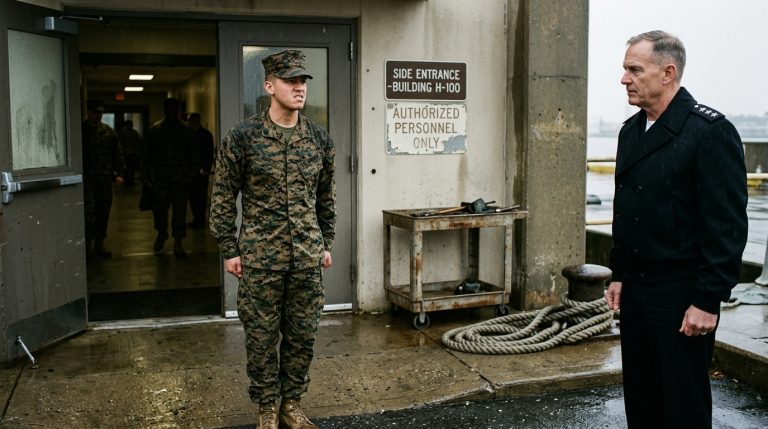
They reached the heavy mahogany doors of the Commandant’s office. Two sentries stood guard, their posture rigid, their eyes fixed on the horizon. When they saw Walter—an old man in worn dress blues, his uniform dusty from the road, his cane held like a weapon—they hesitated, the training of their discipline warring with the instinctive recognition of someone who carried a different kind of authority.
“I am Sergeant Major Walter Jessup,” Walter said, his voice a low, resonant boom that filled the corridor. “And I have a delivery for the Commandant that is sixty years overdue.”
He didn’t wait for permission. He moved with a sudden, surging momentum, his shoulder catching the edge of the door, and pushed it open.
Inside, the office was a cathedral of history. The Commandant, a man whose career was defined by the very traditions Walter was here to defend, sat behind a massive desk. He looked up, his expression shifting from surprise to a profound, immediate recognition as he took in the ribbon on Walter’s chest. The ribbon of Limestone Creek.
“Sergeant Major,” the Commandant said, his voice dropping in respect. He rose from his desk, but Walter stopped him with a single, sharp gesture of his cane.
“Don’t,” Walter said. He stepped forward and placed the file on the center of the desk—the mandate, the protocols, the notes signed by Harding. “This isn’t about me, and it isn’t about the past. It’s about the continuation. It’s about a study that never stopped.”
He stood back, his breath ragged, his body screaming with the exhaustion of the last seventy-two hours. He watched the Commandant’s face as he read. The process was slow—first confusion, then a subtle shifting of the blood beneath the skin, the realization of what he was looking at. The Commandant’s hands gripped the edges of the desk, his knuckles turning white.
“Where did you get this?” the Commandant asked, his voice a shadow of itself.
“It doesn’t matter,” Walter replied. “What matters is that it’s in your hands now. You can burn it, and you can bury me with it, but you know as well as I do that if you do, you aren’t just protecting a secret—you’re endorsing the murder of every Marine you claim to lead.”
The office was silent, a suffocating, heavy silence that felt like the bottom of the ocean. The Commandant looked at the documents, then at the widow, then back at Walter. The weight of the moment, the fifty-six years of silence, the lives stolen for data—it all converged in that single, small space.
Then, the Commandant moved. He reached for the secure phone on his desk, his movements deliberate, final. He spoke a name into the receiver—a name that, even to Walter, sounded like the call of a death sentence for the agency Harding represented. He didn’t monologue. He didn’t justify. He simply initiated the protocol that would drag the agency’s experimental program into the light of a public audit.
The pay-off was not a shout or a victory parade. It was the quiet, terrifying efficiency of a structure finally turning against itself.
The aftermath came in waves. The following weeks were a whirlwind of investigations, silent removals, and the quiet disintegration of the agency’s clandestine influence. Harding did not fight. He vanished, his name redacted from all future records, his legacy dismantled by the very paperwork he had used to control others.
Walter found himself back in Hubert, in the small brick house on the quarter-acre lot. The quiet had returned, but it was different now. It was no longer a pressurized silence; it was a settled, atmospheric peace.
He sat on his workbench in the garage. He had taken the photograph of David Pruitt from its frame. He took a small piece of fine-grit sandpaper and began to polish the edge of a brass button from his dress blues, a button he had accidentally damaged during the stand-off in the vault. He worked slowly, the rhythm of the sandpaper soothing, a sensory restoration of the order he had spent his life maintaining.
He looked at the shelf where he had placed the medal, the ribbon, and now, a small, clipped newspaper article about the official acknowledgment of the Limestone Creek operation—a brief, sanitized report that finally identified the men who had been lost.
His wife’s presence was a quiet, lingering warmth in the room, a memory that no longer stung. He felt a deep, profound connection to the men he had carried—a connection that had been forged in the jungle and tempered by the truth he had finally delivered. He picked up his cane, the aluminum smooth and cool in his hand. He walked to the door of the garage and looked out at his garden.
The world was changing. The shadows were receding. He took a deep breath, the air clean, devoid of the weight that had defined his life for fifty-six years. He was an old man, his body a map of scars and service, but as he looked out at the evening light, he realized he wasn’t tired. He was finally, truly, awake.
He walked back into the house, his gait steady, the click of his cane a singular, resolute note against the floorboards. He stopped at the kitchen table, touched the surface where the red-stamped file had once lain, and felt the quiet satisfaction of a debt finally paid. He had come home, and for the first time in his life, he didn’t have to carry anything else.