The Paper Shield: A Calculated Descent into the Architecture of Suburban Control and Retribution
CHAPTER 1: THE ORANGE STAMP
The orange square was a slap. Not a polite request, not a notification, but a jagged, neon-bright violation slapped onto my garage door at an angle that screamed intentional disrespect. It was a warning tag, the kind you’d see on a condemned structure, not a brand-new build in a neighborhood that still smelled of fresh stucco and dry, heat-cracked earth.
I didn’t reach for the edge immediately. I let it sit. I leaned against the doorframe of my garage, the cool metal of the light switch casing biting into my palm. My pulse remained steady. In my line of work, you learn early: panic is a tactical error. If you jump at every sound, you lose the ability to hear the footsteps that actually matter.
I pulled out my phone and held it steady. The screen illuminated the driveway—the extension cord I’d left near the wall, the socket set laid out on the bench. Nothing illegal, nothing that put a single person at risk, yet there it was, captured in the lens: “Unsafe storage.”
From the curb, the woman in the neon vest clicked her shutter. She didn’t look up, didn’t offer a nod. She was a machine of administrative friction, recording the geometry of my life for someone else’s archive.
“Problem?” I asked. My voice was level, calibrated to avoid giving her the emotional response she clearly wanted to catalog.
She didn’t stop typing. “Documenting,” she replied, her tone as dry and synthetic as the desert floor surrounding us. “You’ll be notified.”
I watched her walk back to her white SUV. The magnets on the side door shifted in the breeze, mocking the official look she wore like armor. She wasn’t an inspector. She was an employee of a vision, a foot soldier for an HOA board that viewed property lines as suggestions and control as a primary asset.
I turned back to the garage. The orange sticker glared at me. I could rip it down, feed it into the shredder, and call the office to demand an explanation. That’s what a normal neighbor would do. But as I traced the edges of the sticker with my thumb, the paper felt thin, cheap, and entirely too confident.
They weren’t looking for a clean garage. They were looking for a reaction. They wanted to see if I would scream, if I would cower, or if I would fight back with the wrong tools. They were testing the friction of my resistance.
I didn’t peel the sticker. I didn’t move the toolbox. I went inside, poured a glass of water, and waited for the sound of an engine starting. When it finally did, I walked to the window. The white SUV wasn’t pulling away. It was idling, watching, waiting for the light to flick on in my office.
My phone vibrated. A new email. Subject: Notice of Violation – Mosquite Ridge.
The trap wasn’t the sticker. The trap was the silence that followed. And as I stared at the screen, I realized the orange square on my door wasn’t just a threat; it was a deadline.
CHAPTER 2: THE DIGITAL PAPER TRAIL
The silence in my office was heavy, a sharp contrast to the aggressive, artificial stillness the HOA was trying to cultivate outside. I sat at my desk, the glow of the dual monitors the only light in the room. My fingers felt cold, a residual chill from the encounter at the curb, but my mind was clicking along with the rhythm of a well-oiled machine.
I didn’t reach for the phone to call an attorney. I didn’t vent my frustration on social media. I opened the county planning database.
For a man who had spent years assessing the safety of crumbling industrial infrastructure, the “Mosquite Ridge” portal looked like a child’s toy. It was sleek, polished, and entirely hollow. I dug into the back-end, filtering through layers of public records that the average homeowner wouldn’t have the patience to navigate. The HOA was counting on that—they were counting on the assumption that we would look at the glossy brochures and skip the technical filings.
The first anomaly wasn’t a smoking gun; it was a ghost.
Mosquite Ridge Community Resilience Pilot Phase 1.
The project was filed under a grant umbrella designed for “emergency infrastructure.” On the surface, it looked benevolent—smart locks, centralized access points, standardized entry protocols for first responders. But as I pulled the map, the geometry of the proposal shifted. The red rectangle marking the “Central Access Hub” wasn’t positioned near the neighborhood gates or the community center.
It was positioned squarely over my lot.
My house was the epicenter.
I pulled up the metadata for the site plans. The file size was astronomical for a simple suburban neighborhood, filled with data-transfer protocols and server-ping requirements. My skin prickled. I knew this code. I’d seen similar specs in old industrial contracts where “security” was just a euphemism for tracking the movement of every worker, every shift, every minute of labor. They weren’t building an emergency access hub; they were building a data-mining node, and they needed my home’s infrastructure to anchor the network.
The psychological weight of the realization hit me in a sudden, sharp wave. It reminded me of a job I’d handled in the Mojave years ago—a warehouse retrofit where the owner claimed it was for “efficient lighting,” but the blueprints showed hidden sensors tucked behind every fire exit. He hadn’t been monitoring energy usage; he’d been tracking the employees to find ways to prune the staff.
Veronica Hail wasn’t a petty bureaucrat obsessed with lawn tools. She was a curator of people. She didn’t want the spare key for emergencies; she wanted it so she could install the hardware without permission.
I leaned back, my chair creaking in the sterile room. I wasn’t just a neighbor to her. I was a test case. If she could make me, the guy who made a living identifying hidden hazards, surrender my property rights under the guise of “safety,” every other house in the block would follow.
I began to document. I took high-resolution screenshots of the grant filing, the map overlays, and the hidden technical specs. I cross-referenced the grant ID with the state’s oversight registry. The numbers didn’t align. The amount requested in the public filing was half of what the internal metadata suggested. Someone was skimming, and someone else was buying into the data.
Every move I made was precise, methodical. I saved everything to an encrypted drive, then created a secondary backup, hidden inside a partitioned directory that looked like nothing more than a cache of old technical manuals. I wasn’t going to fight them on their terms. I was going to turn their bureaucracy against them.
My phone chimed—a notification from the home security app. A motion alert.
I switched the display to the porch camera. The street was empty, the desert wind catching a stray plastic bag and tumbling it across the pavement. There was no white SUV, no woman in a neon vest. Just the dark, unblinking eye of the camera mounted above my door.
But then I saw it.
On the edge of the screen, a shadow moved. It wasn’t the wind. It was slow, deliberate—a silhouette detached from the house across the street. Someone was standing in the dark, watching the front of my property.
They weren’t trying to hide. They were letting me know they were there.
I didn’t flinch. I reached for my keyboard and typed out a single, clean email to the county planning office, requesting clarification on the “emergency access” grant. I didn’t mention the surveillance. I didn’t mention the orange sticker. I acted like a confused, concerned citizen seeking transparency.
I hit send. Then, I turned off the monitors. The room plunged into darkness, and I sat in the silence, listening to the hum of the cooling fan, waiting for the shadow to move again. They were playing a game of intimidation, but they were about to find out that I was the one who controlled the layout of the board. I checked the lock on the front door one more time, then moved to the kitchen to gather the physical files. The fight had moved beyond the garage. It was in the paper, and I was going to read it until every hidden line was exposed.
CHAPTER 3: THE NIGHT STALKER
The shadow didn’t move for ten minutes. It stood at the edge of the neighbor’s property, a static blot of darkness against the amber glow of the streetlights. I didn’t reach for a weapon, and I didn’t call the police. I simply watched, tracking the silhouette’s subtle shifts—the tilt of a head, the slight weight-shift of someone who was waiting for a reaction.
They were testing the perimeter. It was a classic escalation tactic: start with the orange stickers, move to the surveillance, and end with a physical presence meant to erode the victim’s sense of safety within their own four walls.
I stood up and walked to the kitchen, my movements deliberate. I made a show of it. I kept the lights on. I moved through the living room, ensuring my silhouette would be visible through the front bay window. If they wanted to watch, I would give them a performance. I wasn’t the frantic homeowner they expected; I was the architect of my own defense, and right now, I was building a barricade of indifference.
The doorbell chimed.
It was a soft, melodic sound, utterly incongruous with the tension coiling in the room. I didn’t jump. I walked to the door, my feet making no sound on the hardwood. I checked the monitor. No one was on the porch.
I opened the door, just a crack, keeping the security chain engaged. The street was empty. The shadow I’d tracked from the window was gone. But tucked into the door frame, wedged tightly so it wouldn’t fall, was a white envelope. No logo. No return address. Just my name, handwritten in block letters that looked like they’d been traced with a ruler.
I pulled the envelope inside and closed the door. The paper felt heavy, high-quality, the kind of stationery used for wedding invitations or legal summons. I didn’t open it under the foyer light. I walked back to my office, the neutral space I’d converted into my command center, and sat down.
My phone vibrated. A text from an unknown number. “Curiosity is a liability in a managed community. Leave the database alone.”
They weren’t just watching; they were inside the network. They knew I’d been digging.
I didn’t panic. Panic was for people who had something to lose. I had already lost the illusion of a quiet suburban life, and in that vacuum, I found a cold, sharp clarity. I opened the envelope. Inside was a single sheet of paper with a photocopy of the property deed to my house. A red X had been drawn over the legal description of the lot, and underneath it, a hand-written note: “Assessment pending. Compliance is the only path to equity.”
It was a threat, plain and simple. They were going to try and seize the house, or at least force a lien against it that would make living here impossible.
I looked back at the monitor. I needed to feed them something. If they were watching my traffic, I would give them a digital trail that led exactly where I wanted them to go. I opened a document, titled it “Project Resilience – Draft,” and began typing a fake list of demands—a demand for an arbitration meeting, a list of legal statutes regarding HOA overreach. I left the document open, the cursor blinking like a heartbeat, and then I stepped away from the desk.
I moved to the garage. The workbench, the tools, the “unsafe” items that had started this entire conflict—they looked different now. They weren’t just tools; they were my leverage. I cleared a space on the bench, not to hide them, but to rearrange them. I laid out a series of diagnostic cables and a spare laptop, creating a visual setup that suggested I was preparing to host a server or run a complex hardware diagnostic.
As I worked, the sound of a heavy engine rumbled down the street. A utility truck, bright yellow with reflective stripes, pulled up directly in front of my driveway. It didn’t belong to the city; the logo on the side was a generic graphic—“Residential Infrastructure Solutions.”
The driver stepped out, a man in a hard hat who spent entirely too much time looking up at my roof and the eaves where the security cameras were mounted. He wasn’t there to fix a line. He was doing a site survey for the installation of the smart-hub hardware.
The “Butterfly Detour” had arrived. I couldn’t stay in the office and monitor the screen; the worker was physically checking the exterior access points.
I walked out the front door, not with a defensive stance, but with the casual air of a homeowner who had nothing to hide. I walked straight to the edge of the driveway, stopping just short of the grass.
“Everything alright?” I asked.
The worker froze, his hand midway to his belt where a pouch of tools sat. He looked at me, then at the roof, then back to me. “Just checking the lines, sir. Reported interference in the area.”
“Strange,” I said, leaning casually against the porch pillar. “I haven’t had any issues. And my cameras are recording at a higher resolution than that gear can handle, so if there was interference, I’d have the data on file.”
The man’s eyes flickered to the camera above the door. He didn’t answer. He just tightened his grip on the clipboard.
“You’re from the HOA, right?” I asked, keeping my voice conversational, light, almost bored.
He hesitated, a telltale micro-expression of discomfort. “Contracted,” he muttered.
“Right. Well, since you’re already here, why don’t you let me see the work order? Just to make sure you’re authorized to be near my service entrance.”
He didn’t have one. He turned around, muttered something about needing to check with the office, and climbed back into the truck. He didn’t even look back as he pulled away, leaving nothing behind but the smell of exhaust and a lingering sense of unease.
I stayed on the porch, watching the truck disappear around the corner. They were getting sloppy. They were pushing harder, faster, and in their urgency to secure my lot, they were making mistakes. I turned back toward the house, the envelope still clutched in my hand. The game had shifted from surveillance to active preparation. I had to be ready for the next move, and I had to make sure that when they finally came for my front door, they weren’t just walking into an empty house—they were walking into an architecture of their own ruin.
CHAPTER 4: THE MAINTENANCE LEAK
The utility truck had vanished around the corner, its exhaust fumes still hanging in the stagnant, desert air like a low-slung, gray curtain. I didn’t move immediately. I kept my posture relaxed, my hands visible, until the sound of the engine faded entirely into the rhythmic cicada-thrum of the late afternoon. Then, I stepped off the porch.
I walked to the exact spot where the truck had idled. The pavement was scorched, a faint oil-stain blooming on the fresh asphalt like a bruise. Tucked against the curb, nearly invisible in the long shadows of the late sun, lay a sleek, black tablet. It had been dropped, the glass spider-webbed with cracks, likely dislodged when the driver had scrambled to flee my line of questioning.
I crouched, checked the street in both directions, and retrieved it. It was cold to the touch, heavy, and silent. I slipped it into the waistband of my jeans, covered it with my shirt, and retreated into the house. My heart rate didn’t spike; it settled into the familiar, slow-burning rhythm of a job that was finally yielding results.
Inside, I didn’t go back to the office. I took the tablet to the garage, shielding it from the windows, and sat at the workbench. My tools were waiting. I popped the casing—it wasn’t a standard consumer-grade device; the internal architecture was proprietary, reinforced with physical encryption seals. But I had spent years working on industrial hardware that was designed to stay silent in hostile environments. I knew how to jump a bypass.
I spliced a connector into the port and hooked it to my isolated workbench rig.
The screen flickered to life. It didn’t boot into a standard OS. It opened directly into a node-map—a real-time feed of Mosquite Ridge. My house was a pulsing red beacon at the center. I swiped through the directories, my eyes tracking the data packets.
It wasn’t an emergency access hub. It was a metadata-harvesting station. Every time a car pulled into a driveway, the system logged the model, the time, and the occupants. Every time a door opened, the audio sensors at the “emergency” nodes recorded the decibel levels and speech patterns.
And then I saw it—the connection that blew the lid off the “grant.” The data wasn’t being uploaded to a county server. It was being routed to an IP address owned by a data-brokerage firm in the city, a company that specialized in predictive behavioral modeling. Veronica Hail wasn’t a hero protecting a community. She was a middleman, selling the rhythms of our daily lives to the highest bidder under the guise of municipal infrastructure.
My stomach tightened, but not from fear. It was the cold, hard weight of vindication. The “problem case” internal chat I’d suspected existed—it was right there in the maintenance log.
“Rios is the primary node-blocker. If he doesn’t submit to the hardware install, reroute the signal through the secondary relay in the neighboring garage. We need the data-stream consistent by Friday.”
They weren’t just monitoring me; they were going to bypass me.
I exported the logs, the IP headers, and the communication thread between Veronica’s personal account and the brokerage firm. I didn’t look for a way to stop it yet. I looked for the weakness in the chain. These systems were automated, reliant on the integrity of the individual nodes. If I could overload the transmission or introduce a localized error, the entire “resilience” network would flag itself as corrupted and trigger a system-wide reset.
The sound of a car pulling into my driveway snapped me back to the present.
I didn’t reach for the tablet. I reached for the toolbox. I slapped a piece of heavy tape over the diagnostic cables, shoved the tablet into the back of a drawer, and picked up a wrench. I moved to the workbench, making it look like I was just finishing a repair on the truck’s transmission.
The front door opened—my wife, Sarah, home earlier than expected. She stopped in the garage, her brow furrowing at the sight of me, standing in the dim light, covered in a light sheen of sweat.
“You’ve been out here for three hours,” she said, her voice soft, carrying that edge of concern that always made my throat tighten. “The neighbor said a truck was parked here earlier. They’re starting to talk, David. People are scared. Just give them the key. Let it be over.”
I looked at her, at the genuine, tired worry in her eyes. She didn’t know about the node-map. She didn’t know that our front door was the gateway to a digital prison. If I told her, I was putting her in the crosshairs. If I didn’t, I was leaving her exposed to a system that treated her life as a data point.
“It’s not about the key, Sarah,” I said, my voice steady, though I kept my back to the wall where the drawer was hidden. “It’s about who owns the lock. And right now, we’re the only ones who can keep it shut.”
She didn’t understand, but she saw the look in my eyes—the absolute, unwavering focus of a man who had stopped defending his home and started preparing a counter-attack. She sighed, turned, and went inside, the door clicking shut with a finality that echoed in the garage.
I waited until the house went quiet. I turned back to the drawer, my hand gripping the edge. The game had reached its escalation phase. The “security” crew was probably already planning the night shift to bypass my garage, and I had exactly enough time to burn their network to the ground. I grabbed the tablet, pulled it out, and began the hard task of writing a localized virus to cripple the hub.
CHAPTER 5: THE DINER MEETING
The air in the garage was thick with the scent of hot plastic and ozone. I sat back, the keyboard clicking once as I finalized the upload. The virus I’d built—a simple, elegant loop of false data packets—was now bleeding into the HOA’s central server. It wouldn’t destroy their network; it would just make it lie to them. Every time they pinged my node, they’d see a perfect, functioning stream of data, while the reality of the network drifted further and further into corruption.
I wiped the tablet, pulled the SD card, and wrapped it in a piece of industrial plastic. My movements were automatic, the result of years spent on jobsites where one wrong wire could send an arc of current through your chest.
I checked my watch: 2:00 AM.
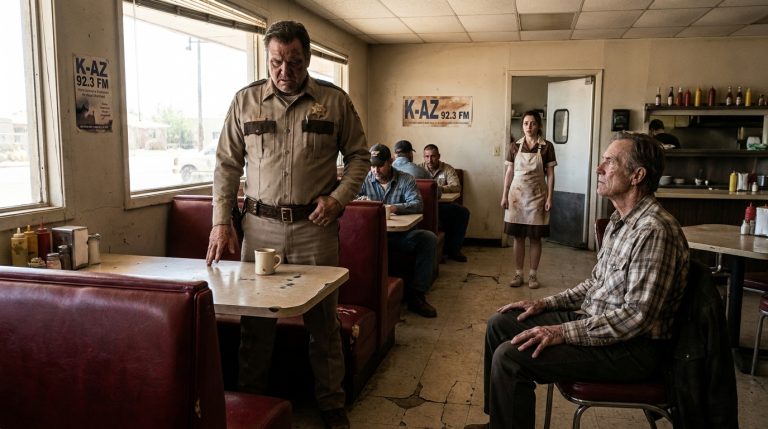
The diner at the edge of the county highway was the only place that stayed open past midnight. It was a sterile, fluorescent-lit box of linoleum and grease, the kind of place where people went to hide in plain sight. I knew the county engineer, a man named Miller, met his contacts there. I’d seen his truck in the parking lot once before, while I was scouting the area for potential leverage.
I left the house, leaving the lights in my office on to create the illusion of occupation. I drove my truck, taking the long way around, watching the rearview mirror for the tell-tale shimmer of the community safety SUV. There was nothing but the dark, ribboning asphalt of the desert road.
Miller was in a corner booth, hunched over a mug of black coffee. He looked tired—a man who had spent his career trying to fix bureaucratic disasters, only to be buried by the next wave of red tape. He didn’t look up until I slid into the seat across from him.
“You’re late,” he said, his voice a low rasp.
“I had to finish something,” I replied. I reached into my pocket, keeping the movement beneath the table level, and slid the SD card toward him. “That’s the core. The grant filing is a shell. They’re running a data-brokerage operation out of the HOA office, using the infrastructure nodes to monitor every movement in the neighborhood.”
Miller didn’t take the card immediately. He stared at it as if it were a live grenade. “If this is what I think it is, Rios, you’re not just looking at a zoning violation. You’re looking at federal oversight. Conspiracy. Fraud.”
“I know,” I said. “And I have the logs to prove they were planning to bypass individual homeowners who resisted. They were going to force the install.”
He finally picked up the card, turning it over in his calloused fingers. His expression shifted—the tiredness was replaced by a sharp, predatory focus. He was an engineer; he understood the weight of a system that was built to fail. “This takes time to process. The county legal department isn’t known for its speed. If you’ve got them spooked, they might move before I can get a warrant.”
“They’re already moving,” I said. “The technician I spoke to today wasn’t looking at the lines. He was scouting. They’re going to try to gain physical entry to the garage by the end of the week.”
Miller leaned forward, his voice dropping to a near-whisper. “Then don’t let them in. You need to make this a documented event, not a private confrontation. If they show up, call the Sheriff’s department. Don’t call the community safety line—call the county dispatch. I’ll make sure the call is flagged for internal review.”
He stood up, tucking the card into his wallet. He didn’t offer a handshake. He knew the risk we were both taking; we were two men standing on a fault line.
“Stay off the grid,” he added, already heading for the door. “If they find out you’ve bypassed the node, they won’t just send a notice to your door. They’ll send a team to wipe the evidence.”
I watched him walk out into the cold, midnight air. The diner felt suddenly empty, the fluorescent lights humming with an aggressive, artificial intensity. I realized then that my perception of this conflict had been flawed; I had treated it like a problem to be solved with better engineering. But Miller was right—it was a war of documentation, and I was holding all the keys.
I left the diner and walked out to my truck. The parking lot was desolate, save for a lone sedan idling near the entrance. I didn’t recognize the car, but as I started my engine, I saw the driver’s silhouette. It was someone I’d seen near the HOA office, one of the volunteers in the neon vests.
They were tailing me.
I didn’t lead them back to the house. I drove in a wide, winding circle through the industrial district, staying well within the speed limit, letting them watch me. If they wanted to play cat and mouse, I’d give them a tour of the county’s decaying infrastructure. I watched them in the mirror—they were aggressive, staying close, their high beams blinding. They were desperate to see where I’d hidden the evidence of their failure.
I turned down a dark, gravel service road that led to the old drainage basins—the site of a failed flood-control project from a decade ago. It was a dead end, a graveyard of concrete pipes and rusted metal. I pulled over and killed my lights.
They followed, their tires crunching loudly on the gravel. They stopped twenty yards behind me, their lights flooding my interior with a harsh, white glare.
I sat still, my hands on the wheel. I could see the shape of the driver’s head as he stepped out—a figure in a tactical vest, just like the ones on my porch. He walked toward me, his hand near his belt, his confidence absolute.
I didn’t reach for a tool. I reached for the phone. I hit the speed dial I’d pre-programmed to the county dispatch.
“I’m at the north service basin,” I said, my voice projecting clearly for the microphone. “I’m being followed and threatened by unauthorized security personnel. I’m requesting immediate backup.”
The man froze, the glow of my dome light catching his face. He wasn’t a cop. He was a contractor, and he knew, in that exact second, that he’d walked into a trap. He reached for his radio, but the sirens were already cresting the hill—the real ones, the ones that sounded like authority.
I opened the door and stepped out, the cool night air washing over me. I wasn’t just a homeowner anymore. I was the witness, and I was ready to testify.
CHAPTER 6: THE FINAL KNOCK
The red and blue strobes painted the gravel of the drainage basin in rhythmic, jarring flashes. The man in the tactical vest didn’t try to run; he simply stood there, hands raised, his bravado leaking out of him like air from a punctured tire. Behind him, the HOA sedan sat idling, a useless relic of a failed project.
I didn’t move until a deputy, his movements clinical and rehearsed, approached me. He didn’t ask questions; he took the phone from my hand, checked the recording status, and nodded.
“County Sheriff’s Office,” the deputy said, his voice clipped. “You’re Rios?”
“I am.”
“We’ve got the report on file. Miller sent the digital packet through the encrypted relay ten minutes ago. We’re proceeding with the arrest of the security personnel and we’re executing the warrant on the HOA office now. Stay here.”
I watched as they handcuffed the driver. He didn’t offer a defense. He just looked toward the HOA sedan, his expression shifting from arrogance to a hollow, dawning realization. He was a pawn, and he finally understood that his queen had already abandoned the board.
The ride back to my neighborhood was a blur of flashing lights and radio static. When we arrived, the street—so recently a place of calculated intimidation—looked transformed. Deputies were already at the HOA office, their heavy flashlights cutting through the darkness. I saw Veronica Hail standing on her porch. She wasn’t holding a phone, and she wasn’t smiling. She looked small, framed against the pristine, artificial perfection of her home, watching as the deputies loaded the servers—the very servers that held the data streams of our lives—into a transport van.
I stepped out of the patrol car. My legs felt heavy, a strange, residual tension gripping my muscles. I walked to the edge of my property, the place where I had stood against them just days ago. The orange notice was gone, but the ghost of it remained, a stain on the garage door where the adhesive had peeled away the paint.
Veronica spotted me. She walked toward the sidewalk, her heels clicking with a brittle, uneven rhythm. “You don’t understand, David,” she said, her voice thin. “I was creating order. This neighborhood needed oversight to maintain its value. You’ve just dismantled the only system that kept this place from falling apart.”
“You weren’t building a community, Veronica,” I replied, my voice devoid of the anger I’d felt earlier. I was too tired for anger. “You were building a ledger. You didn’t care about the property values; you cared about the data-stream you could extract from the owners. You sold our privacy to pay for the illusion of authority.”
Her mask finally cracked. The professional, practiced veneer of the HOA president dissolved into a look of genuine, haunting fear. “It was going to work,” she whispered. “The brokerage firm… they promised—” She stopped, her eyes darting to the deputies.
She had sold us all out, and in the end, it was the market that failed her.
The deputy approached us, his hands already hovering near his duty belt. “Veronica Hail, you’re under arrest for conspiracy to commit wire fraud and criminal impersonation. Turn around.”
She didn’t struggle. She went down with a strange, quiet dignity that was more chilling than her previous arrogance. As they led her to the cruiser, she didn’t look back at the neighborhood she had tried to curate. She looked at the pavement, as if checking the quality of the concrete one last time.
The street went silent. The neighbors began to emerge, not in a rush, but slowly, like people waking from a fever. I saw the father and daughter from earlier; I saw the couple who had lived across the street for months without ever saying a word. They were looking at me, but they weren’t looking with fear anymore.
I walked to my garage. I found the socket set and the extension cord that had started this. I pulled the cord from the wall, coiled it with the precision of a man who understood the value of maintenance, and hung it on the rack. I wasn’t fixing a hazard anymore; I was reclaiming the space.
I went inside. Sarah was waiting in the kitchen, the lights dim, the air soft and still. She didn’t speak. She just walked over, took my hand, and held it. The silence wasn’t the heavy, watchful silence of the HOA; it was the quiet of a house that belonged, finally and absolutely, to us.
The next morning, the sun rose over the desert, casting long, clean shadows across the pavement. The blue posters at the entrance had been pulled down. The community safety SUV was gone. I walked out to the mailbox, the morning air crisp and tasting of sage.
I picked up the mail—the usual pile of utility bills and flyers. I looked at the garage door. The paint was peeling slightly where the sticker had been, a small scar on the architecture of my home. I walked into the garage, grabbed a can of matching paint, and spent the next hour carefully touching up the spot. It wasn’t about aesthetics. It was about repair. It was about restoring the integrity of the property, layer by layer.
The street hummed with the sound of a normal morning. A neighbor waved, a gesture that was small, hesitant, and entirely real. I waved back. The fear that had kept the neighborhood divided was evaporating, replaced by the mundane, beautiful reality of people just living their lives, invisible to anyone but themselves.
I locked the garage, the click of the deadbolt sharp and satisfying. The central access hub was dead, its servers sitting in an evidence locker, its grant funding frozen, its logic exposed. My home was secure, my records were mine, and the authority that had once loomed over us like a mountain had been reduced to a footnote in a county report.
I leaned against the doorframe, watching the light change on the desert floor. The wind blew, moving the dust in patterns that no one would ever log, no one would ever track, and no one would ever sell. I took a deep breath, the air filling my lungs with a sense of peace that was deeper than safety. Authority is a machine, I realized. It only functions as long as the parts believe they have no other choice.
I had made a different choice.
The cameras were still there, small and black, but I didn’t check them. I didn’t need to. I knew what was happening outside, and for the first time in months, I didn’t care. I walked back inside, the door closing behind me, sealing in the quiet, the warmth, and the truth.