The Echo of the Land: A Retired Guardian Reclaims His Quiet Sanctuary Through Courage and Connection
CHAPTER 1: THE WEIGHT OF THE GLOSSY EDGE
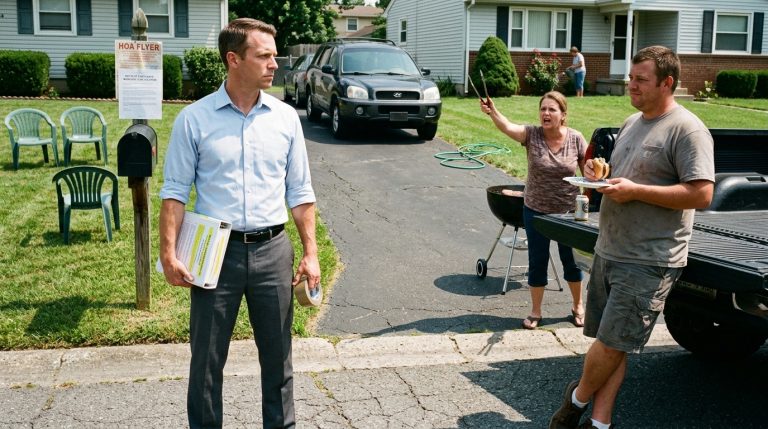
The paper was still warm from the sun where it had been wedged into the doorframe. It didn’t just carry ink; it carried a threat. I pulled it free, the thick, high-gloss stock crinkling softly in my grip—a stark, sterile contrast to the weathered cedar of my front door.
“Unauthorized alterations,” I read aloud, my voice raspy from the morning chill.
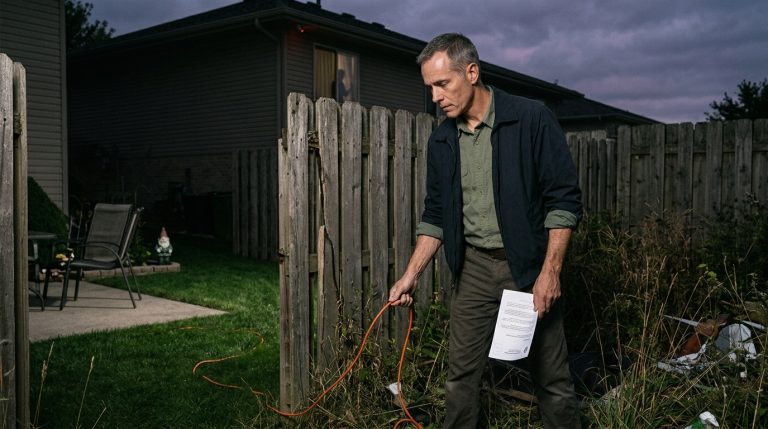
I didn’t need to look at the fence to know it hadn’t changed. The timber remained as solid as the day I’d set it, seasoned by months of rain and sun, a barrier I had built with my own hands to keep the world at a manageable distance. I leaned my back against the frame, feeling the familiar, dull throb of my spine—a persistent reminder of a life spent in the service of things far removed from suburban boundary disputes.
Rex and Valor were already at my heels, their heavy, rhythmic breathing the only sound in the hallway. Valor nudged my hand with a wet, insistent nose, his golden eyes searching mine. He knew. They both knew that when these glossy notices appeared, the air in the house grew thin.
I tucked the notice into my pocket, the sharp corner digging into my hip. It was a small, physical discomfort, but it tethered me to the present. I didn’t reach for a weapon, and I didn’t lash out. I looked at the floorboards, worn smooth by years of pacing, and thought of the original deeds locked in the shed. That paper in my pocket was a lie, a thin veneer of authority meant to provoke a reaction I couldn’t afford to give.
The morning light crept through the window, catching the fine dust motes dancing in the air. For a fleeting second, the house felt like a sanctuary, a place where the edges of the world were supposed to soften. But Evelyn Harrow’s reach was long, and she was relentless.
I walked to the kitchen, the dogs following in a precise, silent formation. I poured a cup of coffee, the steam rising in lazy curls. My hands were steady, despite the tension coiling in my chest. I knew who was coming, and I knew what they wanted. I just didn’t yet understand why the soil in the backyard had been so carefully surveyed by the men in the black SUV three days ago, or why their eyes had lingered not on the fence, but on the earth itself.
A sudden, sharp metallic sound echoed from the front driveway—the distinct, high-pitched clack of a clipboard hitting the pavement. My pulse quickened, not with anger, but with the sudden, jarring realization that someone was standing on my porch.
I set the coffee down, the ceramic rattling against the granite, and turned toward the door. I saw a shadow stretch across the threshold, longer and more deliberate than a delivery man’s. The handle turned, slowly, testing the lock.
CHAPTER 2: THE SHADOW IN THE CULDESAC
The brass knob turned with a grating, reluctant scrape. It was a sound that didn’t belong in my home—a mechanical intrusion that sent a ripple of cold static down my spine. My hand remained frozen on the edge of the kitchen counter, fingers brushing against the rough, cold ceramic of my mug. The shadow on the other side of the frosted glass didn’t just loom; it felt predatory in its stillness, a dark, truncated shape cutting across the morning light that spilled into the hallway.
Rex and Valor didn’t bark. That was their training. Instead, they became liquid, two hundred and eighty pounds of muscle flowing silently toward the door. They stood like statues, hackles slightly raised, their silence far more intimidating than any warning growl.
I didn’t rush. I moved with the measured, deliberate pace of a man who had learned that haste was the precursor to catastrophic error. The memory flared, unbidden and sharp—the dry heat of a sand-swept doorway in a forgotten sector, the same tension, the same weight of the unknown pressing against a wood-and-hinge barrier. I exhaled, grounding myself in the present. The smell of damp mulch and dying cedar replaced the phantom scent of scorched earth.
“The house is closed,” I said, my voice steady, stripped of any warmth.
The handle stopped turning. A muffled rustle of fabric—stiff, expensive polyester—sounded from the porch.
“Mr. Mercer,” a voice replied. It was dry, precise, and carried the practiced cadence of a woman who spent her days reading bylaws to people who didn’t want to hear them. Evelyn Harrow. Even through the door, the name felt like grit in the gears. “I’m here for the requested site inspection regarding the setback violations. You were notified in writing.”
I didn’t answer immediately. I took two steps forward, my boots making no sound on the hardwood, until I was close enough to see the silhouette of her frame against the glass. She was holding her clipboard like a shield. Behind her, out on the drive, I caught a glimpse of movement. A black SUV sat at the curb, its engine idling. It wasn’t the delivery truck I’d expected. Two men stood near the hood, their attention not on the house, but on the ground—measuring tape pulled taut across the edge of my lawn where the gravel met the wilder, overgrown patch near the shed.
The realization hit me with the force of a physical blow. They weren’t inspecting my fence. They were mapping the ground itself.
“The notice is under review,” I said, my voice barely above a whisper, though I knew she could hear me. “If you’re here for an inspection, you need a warrant. If you’re here to harass, you’re currently trespassing on private property.”
“Trespassing?” She gave a sharp, brittle laugh. “Mr. Mercer, this is a planned community. You signed the covenant. The board has every right to ensure the safety and aesthetic integrity of these grounds.”
She reached out to tap on the glass, but pulled back as Rex let out a low, vibrating sound—not a bark, but a deep, resonant warning that made the glass rattle in its frame. I could see her silhouette flinch, a momentary break in her composure.
“My dogs are agitated,” I continued, my hand resting on the heavy, sturdy collar of Valor’s neck. His fur felt like coarse wire under my palm. “I suggest you leave the property before they decide that your presence is a breach of their perimeter.”
There was a long, heavy silence. I could hear the wind rustling through the oaks in the backyard—a soft, whispering sound that seemed to mock the tension at the front door. Evelyn stood there, her shadow remaining fixed on the porch. She didn’t turn to leave. She looked toward the men at the SUV, and I saw her give a subtle, imperceptible tilt of her head.
One of the men produced a camera, the lens glinting in the morning sun as he turned it toward my front window.
My pulse spiked. It wasn’t just about the notice. They wanted me to open the door, to step out, to engage. They were building a record, a manufactured narrative of an unhinged veteran and his dangerous, uncontrolled animals. If I went out there, if I let them bait me into a shouting match or a confrontation, I would be handing them exactly what they needed to justify a court-ordered seizure.
I retreated a step, pulling the dogs with me.
“I’m recording this,” I said, clicking the voice memo button on my phone, loud enough for her to hear through the door. “Every word. Every trespass. Every move your associates make on my land.”
The handle stopped vibrating. I heard the sharp, rhythmic click of her heels turning on the concrete porch.
“We’ll be back, Mr. Mercer,” she said, her voice dropping into a tone that was chillingly devoid of emotion. “The property isn’t yours because you say it is. It’s yours because the record says so. And the records are about to change.”
I watched through the small slit of the window as she walked toward the SUV. She moved with a stiff, calculated elegance, but as she reached the pavement, she paused. She looked back at the house, her face obscured by the reflection of the sun, but I knew she was looking at the shed—at the place where the original deeds were locked away.
The SUV pulled away, tires crunching slowly over the gravel, taking their time, as if to imprint the threat into the very foundation of my home. The silence that followed was heavy, suffocating.
I leaned my forehead against the door, my back screaming a dull, pulsing protest against the physical strain of the last ten minutes. I wasn’t just a man in a house anymore. I was a target in a game I didn’t know the rules to, fighting for a patch of earth that held a secret I had only just begun to suspect existed.
Rex sat down at my feet, his head resting on my boot, his eyes fixed on the empty driveway. Valor paced the length of the entryway, back and forth, back and forth, a restless pendulum of protective instinct. I reached into my pocket and touched the glossy notice. It felt colder now, the edges sharper, as if the paper itself were hardening into a weapon.
I had to get to the county records. I had to know what was hidden in the soil. And I had to do it before Evelyn Harrow decided she had collected enough “evidence” to force the issue.
CHAPTER 3: THE FIRST CONFRONTATION
I didn’t wait for the dust to settle on the gravel. Evelyn Harrow’s threat hadn’t just been words; it was a declaration of an approaching front. I turned from the front door, my boots rhythmic and heavy against the hallway floor, and headed straight for the mudroom.
Rex followed at my left flank, Valor at my right. Their presence was a constant, solid weight, a tether to the ground. I grabbed my canvas jacket, the material worn thin at the elbows—a faded, familiar texture that offered no protection, only the comfort of utility. I slipped a heavy, multi-tool into my pocket, the cold steel biting into my palm. It was an instinctive motion, born from years of preparing for contingencies that were far more lethal than suburban zoning laws.
I pushed open the back door. The morning air was sharp, smelling of pine needles and the damp, earthy scent of the garden. My eyes immediately went to the perimeter. The fence line was undisturbed, but the mud near the shed—a patch of soft, dark soil that usually lay dormant—was marked with fresh, jagged impressions. Two sets of boot prints, wider and more aggressive than my own. They had been here, testing the perimeter while I was distracted at the front.
I walked toward the shed, my back muscles locking in a slow, steady protest. Every movement required a conscious effort, a mental negotiation between my will and the limitations of my body. I reached the shed door, the wood weathered to a soft, silver-gray, and laid my hand on the heavy iron latch. It was cold, slick with a fine film of morning dew.
I didn’t swing the door open. Instead, I stood still, letting my senses expand, listening for the telltale sounds of the cul-de-sac. A neighbor’s lawnmower hummed a dull, distant drone. The wind chimes on the back porch of the Miller house rattled intermittently. Nothing out of place.
I pulled the latch. The door groaned, a long, low sound that seemed to echo across the entire yard. Inside, the air was cool and smelled of gasoline, sawdust, and the metallic tang of old tools. My safe was in the corner, a heavy, bolted-down block of steel that represented the only reality I had left. I knelt, the action drawing a sharp, hot sting through my lower back, and began the sequence.
My fingers traced the dial. There was a comfort in the tactile process, the slow, deliberate rotation of steel on steel. I wasn’t just opening a box; I was reaffirming my ownership.
My thoughts drifted back to Evelyn. Why the ground? Why the measurements? I had spent the last hour reviewing the maps in my head, cross-referencing them with the topography of the neighborhood. The land here, the specific dip in the valley where my lot sat, was an anomaly. It held water differently than the rest of the tract. I had always assumed it was a drainage issue, something I had to manage to keep the basement dry. But if Evelyn was looking at the aquifer, if she was planning on breaking ground for a project that required subterranean access…
A sudden, sharp snap came from the direction of the back fence.
I was on my feet before the sound even fully registered. The movement was fluid, born from muscle memory that never truly retired. I didn’t reach for the safe; I reached for the shadows behind the workbench. Rex and Valor were already there, ears flattened against their skulls, their bodies low to the ground.
I peered through a gap in the shed’s siding. Two men were standing at the fence line, just ten yards away. They weren’t in vests this time. They were in nondescript, dark clothing—no logos, no clipboards. One of them held a handheld device, a rhythmic, pulsing light emitting from its face as he tracked it across the grass.
It was a geophone. They weren’t inspecting my property. They were surveying the water table.
The realization sat in my gut like lead. My pulse, usually a steady, predictable drum, spiked in rhythm with the pulsing light of the device. This wasn’t about the fence. This wasn’t about the HOA fines. This was about clearing the path for something much larger, something that required the land to be empty, abandoned, and legally forfeited.
I saw one of the men point toward my shed, his hand resting on the top rail of the fence. He laughed—a short, jagged sound that carried across the yard.
My instinct was to move, to challenge them, to make them realize they were trespassing on something that was defended by more than just wire and wood. But I held back. I stayed in the shadows, my heart hammering a warning against my ribs. I needed them to think they were winning. I needed them to believe I was the isolated, broken veteran who could be pushed out with a little bit of noise and a few glossy letters.
I gripped the multi-tool in my pocket, my knuckles white. I was not the man they thought I was. I was a man who knew how to wait, how to observe, and how to turn an intruder’s confidence into their own unraveling.
The men turned and began walking back toward the alleyway, leaving the fence undisturbed. They didn’t know I was watching. They didn’t know I had seen the device. I remained perfectly still, waiting for them to clear the property line, my breath slow and deliberate.
The weight of the situation was settling in, heavy and irreversible. The game had moved from the front porch to the very foundation of my home. I took a final look at the shed, at the safe, and then toward the house. There was work to be done, evidence to be gathered, and an aquifer to be protected.
I stepped out of the shed, the sun now fully cresting the roof, bathing the backyard in a harsh, unforgiving light. I didn’t look back. I headed straight for the house, my pace brisk, my mind already calculating the steps I needed to take before the sun set again.
CHAPTER 4: THE MIDNIGHT BREACH
I didn’t step back from the shed. My gaze stayed fixed on the lock-box, a heavy-duty steel casing I’d mounted to the interior frame. The scratches were deliberate, gouged by hardened steel—a crowbar, most likely. It wasn’t just a sign of an attempted break-in; it was a signature. Whoever had been here had come with the intent to destroy, not just to look.
Rex let out a soft, low huff of air, his nose inches from the metal. He sensed the residual scent of someone who didn’t belong—a stale, synthetic odor, like the interior of a rental car. I knelt slowly, the familiar ache in my lumbar region serving as a rhythmic pulse against the cold concrete floor. My fingers hovered over the lock, tracing the damage. It was a failure on my part, a momentary lapse in vigilance. I had expected them to come through the front; I hadn’t prepared for the audacity of a daylight prowl while I was still on the property.
“Easy,” I whispered, the word barely audible, a grounding force for both the dogs and myself.
I stood, the transition stiff, and turned my attention back to the interior of the shed. Everything else seemed undisturbed—the shovels, the rakes, the heavy-duty power tools. This had been a surgical strike, focused entirely on the safe and the documents within. They were looking for the deeds, the legal proof of the land’s original boundary lines. If they found them, they could fabricate a chain of title that invalidated my claim, clearing the way for their water-table project.
I checked the security feed on my phone again, my thumb scrolling back through the hours. I’d set a motion-sensitive tripwire near the perimeter fence, hidden among the overgrown wild-flowers. I tapped the icon. The video flickered to life.
There, at 2:00 a.m. exactly, the screen showed a black pickup idling at the edge of the alley. Two shadows stepped out, moving with the rhythmic confidence of men who had done this before. They didn’t stumble; they didn’t hesitate. They moved straight to the shed. I zoomed in, the resolution grainy but sufficient. The taller man, the one who’d held the geophone earlier, carried a specialized pick-set. He worked the lock for three minutes. He didn’t force it; he dismantled the resistance, piece by piece.
He was a professional. Evelyn wasn’t just hiring muscle; she was hiring specialists.
A cold, hollow sensation opened in my chest—not fear, but a sharp, clinical clarity. My back was against the wall, literally and figuratively. I needed to move the physical evidence, the real deeds, to a location that couldn’t be mapped or picked.
I spent the next hour moving the documents, my hands moving with surgical precision. I didn’t just hide them; I re-secured the shed, reinforcing the internal framing with high-tensile steel bolts I’d kept from my days in the service. It was work that required patience, the kind of quiet, steady labor that kept the mind from spiraling into the chaos of the “what ifs.”
As the sun began its slow descent, painting the cul-de-sac in long, bruised shades of purple and amber, I stepped out of the shed. The air had turned crisp. I looked across the street. The Miller house was dark, but a sliver of light peeked through the blinds of the second-story window—Evelyn’s house. She was watching. I knew she was.
I didn’t give her the satisfaction of a glance. I headed toward the house, Rex and Valor flanking me like shadows. I needed to call the county records office, but I needed a burner—a way to inquire about the aquifer rights without tying the request to my name or my property address.
Inside, the house felt like an island in a rising tide. I sat at my small kitchen desk, the wood scarred and stained by years of coffee spills and late-night repairs. I opened the drawer, pulling out the small, nondescript phone I’d kept dormant for months. My thumbs tapped the screen, the plastic cool against my skin.
I was about to dial the clerk, but a thought stopped me. If they were surveilling my movements, they were likely monitoring my communications. I pushed the phone aside and stood up, walking to the window.
The SUV was back. It had parked three doors down, its lights extinguished. They weren’t just watching anymore; they were establishing a siege.
I looked at the dogs. Valor’s ears were perked, his focus entirely on the window. He growled—a soft, guttural vibration that started in his chest. I followed his gaze. A man was walking casually down the sidewalk, checking his watch, his hand resting on the handle of a heavy, metal-cased flashlight.
He wasn’t checking the time. He was checking the patrol.
I reached for the light switch, my heart rate steady, climbing into that familiar, cold zone where the adrenaline stopped being a distraction and started being a tool. I wouldn’t call the clerk from here. I would go to them. I would walk out the back gate, disappear into the woods behind the property line, and take the fight to the place they least expected: the county records office, three miles away, under the cover of the night I knew better than anyone.
The house grew dark as I clicked the lights off, leaving only the soft glow of the kitchen clock. The game had shifted again. I wasn’t waiting for the breach; I was going to beat them to the source.
CHAPTER 5: THE GATHERING STORM
I didn’t move immediately. I let my eyes adjust to the absence of light, letting the familiar contours of the kitchen—the worn edge of the table, the chill of the refrigerator’s hum—become my anchor. The SUV was still out there, a dark, hulking presence at the edge of my property line. I could imagine the men inside, their eyes fixed on the house, waiting for a sign of movement. They were patient. That was their biggest mistake. They thought I was a man who stayed behind walls.
I shifted, the floorboards offering a familiar, silent protest beneath my boots. Rex stood beside me, his fur brushing against my thigh, his breathing perfectly synchronized with mine. Valor was by the back door, his ears rotating toward the sound of the wind, his body coiled.
I grabbed my coat—the heavy, canvas one, smelling of dust and oil—and pulled it on, checking the pockets one last time. The burner phone was there, along with a small flashlight and a set of skeleton keys I hadn’t touched in years. I didn’t need to look at the gear; I knew the weight of it, the specific friction of every item.
I moved to the back door, my hand closing over the handle with deliberate pressure. I didn’t open it fully. I cracked it just enough to let a sliver of the night air inside. It smelled of rain and iron. I slipped out, the dogs following in a formation so tight they seemed like an extension of my own body. We moved into the shadows of the garden, the tall, unkempt weeds masking our silhouette from the street.
The path to the county records office took me through the back woods, a stretch of land that hadn’t been touched in decades. It was tangled, dark, and uneven—perfect for someone who wanted to disappear.
We reached my old truck, a rusted-out shell I kept parked in the dense brush near the rear fence. I hoped for a quick start, but the engine let out a shuddering, metallic cough before dying completely. The battery was dead. The cold had gotten to it. I leaned my head against the steering wheel, the metal cold and biting against my forehead, the frustration rising in my chest like bile. A delay. I couldn’t afford a delay.
I popped the hood, the metal protesting with a high-pitched squeal that sounded like a gunshot in the stillness of the night. I fumbled with the cables, my fingers numb, the light from my flashlight casting long, erratic shadows across the engine block. I stripped the wire, reconnected the terminals, and cursed under my breath. It was a failure of maintenance, a weakness I should have anticipated. I felt the weight of my own age—the back, the slow reaction time—clutching at me.
Then, the engine roared to life. It wasn’t the clean, smooth sound of a healthy vehicle, but a rattling, hungry growl that promised to hold together just long enough.
I didn’t drive out of the main alley. I took the fire-road that cut behind the neighboring properties, a narrow, rutted trail that hadn’t seen traffic since the town expanded. It was slow, agonizing work. Every bump sent a shockwave through my spine, every sharp turn a reminder of why I’d stopped driving this beast years ago.
We crested the ridge overlooking the records office. The building was a sprawl of concrete and security glass, sitting in the heart of the district. I killed the engine, letting the truck roll to a stop in the shade of a line of pines.
I checked the time on my watch. I was behind. And as I looked toward the building, I saw a familiar black pickup parked in the shadow of the rear entrance.
They weren’t just watching my house. They were already here.
My breath hitched. The decoy—the HOA files, the property claims—it was all a distraction. They weren’t just trying to bully me; they were already gutting the records, scrubbing the files, and overwriting the deeds. If they were inside, the documents were likely already gone.
I gripped the steering wheel, my knuckles white, the realization slamming into me with the force of a landslide. They hadn’t just been measuring my soil; they were rewriting the truth. And if I didn’t stop them now, if I didn’t find that one copy, that one original map that still existed in the physical archives, there would be nothing left to defend.
Rex shifted beside me, his head leaning against my arm. I could feel his heat, a constant, living thing in the cold cab of the truck. I wasn’t alone. I had the knowledge of the terrain, the advantage of the dark, and a set of tools that were perfectly suited for a quiet, professional entry.
I opened the door, the hinges groaning in the night. I stepped out, the wet pavement slick beneath my boots. The storm was coming, the air heavy with the scent of electricity and impending rain. It was time to go to work.
CHAPTER 6: THE FORGERYS ARCHITECTURE
The cold rain started as a fine, stinging mist, plastering my hair to my forehead and slicking the asphalt until it shone like black glass under the security lights. I didn’t rush toward the building. I waited in the cover of the pines, my breath hitching in the damp air as I watched the two men from the pickup exit the vehicle. They didn’t move like men performing a routine inspection; they moved with the weighted, tactical caution of soldiers on patrol.
Rex pressed against my leg, his muscles corded and ready, while Valor stood a few feet ahead, his eyes fixed on the rear entrance of the records office. The heavy steel door was slightly ajar—a flaw in their security, or perhaps a trap. My pulse thrummed against the handle of the flashlight in my pocket. It wasn’t just about getting in; it was about ensuring that if I went through that threshold, I didn’t walk into a dead end.
I signaled the dogs to stay. They sank into the shadows of the tree line, silent as ghosts. I took a step, my boots finding purchase on the slick, wet earth. The gap between the trees and the office building was exposed, a stretch of open parking lot that felt like a mile of clear ground. I moved quickly, staying low, my eyes tracking the movement of the two men as they disappeared inside.
They weren’t carrying gear. They were carrying heavy-duty folders. The realization sent a shiver through me that had nothing to do with the freezing rain. They weren’t just stealing files; they were replacing them.
I reached the doorway and pressed my back against the cold, industrial brick. The smell of the office spilled out: stale coffee, floor wax, and the dry, suffocating scent of old, disintegrating paper. I didn’t push the door; I slid my fingers along the edge, feeling the slight vibration of the internal locking mechanism. It was a digital system, modern and supposedly secure. I pulled the small kit from my pocket—not a set of lock picks, but a bypass tool I’d scavenged years ago.
The mechanism clicked, a sound so soft it was nearly lost in the patter of the rain. I slipped inside.
The interior was a labyrinth of steel shelves and dim, yellow-tinted lights that flickered in a stuttering, disorienting rhythm. The air was heavy, as if the oxygen had been sucked out by the mass of archived history. I kept my flashlight off, relying on the ambient glow from the hallway. I knew the layout. I’d studied the city’s building records enough times to map the path to the original land-title repository in my sleep.
I reached the section marked 1980–1990. The shelves here were rusted, the metal edges sharp enough to slice skin. I ran my fingers along the spines, my heart rate slowing into a rhythmic, calculated beat. This was the place where the original covenants and land grants were stored.
I heard voices, low and jagged, emanating from the central desk three rows over.
“Everything’s staged,” one of them said. His voice was flat, devoid of inflection. “Harrow wants the signed copies in the vault by dawn. If the audit happens on Monday, there won’t be a trace of the original mapping.”
“And the Mercer property?” the other asked.
“Already wiped. Re-plotted as a drainage easement. By the time he realizes the ground is being broken, he won’t have a square inch of standing room left.”
My grip on the shelf tightened, the metal digging into my palm. An easement. They weren’t just taking the land; they were using the legal system to claim the water rights underneath it, effectively rendering the house uninhabitable. The fury, cold and sharp, flared behind my eyes, but I pushed it down. This was the moment I had feared, but it was also the moment I needed. I had them on record.
I pulled my phone, the screen shielded by my palm, and activated the recording. I stepped out from behind the rack, not to confront, but to move. I needed the original map—the one document that would contradict their fabricated easement.
I checked the secondary row, the one reserved for legacy titles. The box labeled Mercer Estate was there, but it was empty.
My breath hitched. The decoy—the HOA files they were currently handling at the desk—was a massive, well-organized pile of deception. But the original, the real, signed, and stamped map, was gone.
I looked back at the desk. The men were now packing a document case. I saw the corner of a map, the familiar yellowed parchment of the original survey. It was sitting right there, atop their stack.
My muscles coiled. I had one shot. I didn’t need to fight them; I needed to move them. I reached into my pocket and pulled out the small, high-intensity strobe light I’d saved for emergencies. I set it on the ground near the far rack, hidden behind a stack of binders, and triggered the timer.
Ten seconds.
I retreated into the darkness of the aisles, my heart drumming against my ribs. The light erupted—a blinding, chaotic strobe that flooded the records room with a disorienting, rhythmic glare. The two men shouted, the sound of falling chairs and dropped folders shattering the quiet.
“What the—!”
They scrambled, their focus shifting toward the back of the room, toward the source of the distraction. I broke cover, a silent blur in the flickering shadows, and surged toward the desk. My hand caught the edge of the parchment, the paper dry and fragile as dead leaves. I tucked it into my jacket, the weight of it feeling like an anchor against my chest.
I didn’t turn back. I moved toward the side exit, my boots silent on the linoleum. Behind me, the men were still shouting, the strobe light casting their panic in long, distorted shapes against the walls.
I hit the door, the cool night air rushing to meet me. I ran, my back screaming, my lungs burning, but I didn’t care. I had the map. The truth was in my hands, and the storm outside was no longer a threat—it was a curtain, pulling shut on the world they thought they owned.
CHAPTER 7: THE REVELATION
The rain had turned into a torrent, drumming against the concrete with a manic intensity that masked the sound of my own footsteps. I didn’t head back to the truck. It was a beacon now, a piece of evidence they would be watching. I bolted toward the maze of low-income apartments that bordered the county district—a sprawling, unlit complex of brick and rusted steel.
The shouting behind me sharpened, a chorus of aggressive, clipped commands. They weren’t calling for police; they were calling to each other. They were here to silence the leak.
I cleared a six-foot chain-link fence, my boots catching on the top rail and sending a jolt of white-hot agony through my lumbar. I landed on the other side, the impact jarring my teeth, and scrambled to my feet. Rex and Valor were right there, shadows among shadows. I signaled them to hold, and we crouched behind a line of rusted dumpsters.
I pulled the parchment from my jacket. It was damp, the edges soft from the humidity, but the ink was clear. In the dim light filtering through the clouds, the truth finally snapped into focus. It wasn’t just a survey map. It was an engineering blueprint for a private extraction well. Evelyn wasn’t representing a board of neighbors. She was the sole signatory for a shell corporation—”Harrow Holdings”—that had been buying up the surrounding land for pennies on the dollar, all to gain exclusive access to the deep-strata aquifer beneath my backyard.
The “HOA” was a sham, a bureaucratic cudgel used to intimidate residents into selling before the development news broke. My house wasn’t a violation; it was the final missing piece of a multi-million-dollar land-grab.
My hands trembled, but it wasn’t from the cold. It was the adrenaline of a man who had finally seen the target. I didn’t need to fight them in the courts—not yet. I needed to bring this to the one place they couldn’t control: the public eye.
“Rex. Valor,” I whispered, the command precise. They shifted, their bodies tense and waiting.
I moved through the alleyways, navigating by the familiar geometry of the district. We emerged three blocks over, near the local news station’s secure drop-box—a relic of the analog age that still sat in a quiet, recessed corner of their parking lot. I didn’t hesitate. I slid the original map into the slot, along with a note detailing the forged deeds I’d seen on their desk, and turned back toward the shadows.
But the silence was too sudden.
A flashlight beam cut through the rain, sweeping over the pavement, dancing over the brickwork, and locking onto my silhouette.
“There! By the drop-box!”
I didn’t try to hide. I turned, my boots finding purchase on the slick, wet pavement, and started to run. But I wasn’t running toward safety; I was running back toward the records office. If I could draw them away from the station, away from the evidence I’d just deposited, I could ensure the truth had time to be processed.
I led them through the narrowest streets, through yards clogged with overgrown shrubbery, and over fences that forced me to use every ounce of my remaining strength. My back was a continuous, throbbing line of fire, and my lungs felt like they were being filled with ground glass, but I didn’t break stride.
I reached the main road, the streetlights reflecting off the slick, wet surface. I stopped at the edge of the curb, waiting.
A black pickup roared around the corner, its headlights blinding, its engine whining with a high-pitched, desperate intensity. It veered toward me, the tires losing traction on the rain-slicked road, sliding sideways in a chaotic, physics-defying skid. I waited until the last possible second—until I could see the man behind the wheel, his face a mask of rage and panic.
I ducked behind a heavy, concrete municipal barrier. The truck clipped the barrier, the metal groaning as it crumpled against the concrete, the force of the impact sending the vehicle spinning into a line of parked cars.
Glass shattered. A horn blared, a long, continuous, discordant note that cut through the sound of the rain. The truck came to a stop, its front end accordion-folded against a telephone pole.
I didn’t move to help. I stood in the shadow of the barrier, my chest heaving, watching the driver scramble out of the wreckage, his clothes torn, his face bloodied. He wasn’t looking for me anymore. He was looking at his phone, his hands shaking as he dialed a number.
“It’s gone,” he screamed into the receiver, his voice cracking. “The map is gone. She’s going to kill us.”
I turned away, the rain soaking into my clothes, but the cold didn’t reach me. I felt a strange, quiet warmth radiating from the center of my chest. I didn’t need to finish this. The truth was already in the night, and the people who built their world on lies were about to discover how quickly a foundation of glass could shatter.
I walked away, the dogs trotting at my heels, heading home—not to defend a piece of property, but to watch the endgame.
CHAPTER 8: THE QUIET SUNSET
The aftermath didn’t come with a roar. It came in the form of a soft, gray dawn that bled over the horizon, turning the jagged wreckage of the truck and the broken street into a tableau of mundane, broken things. Deputies were everywhere, their flashlights casting long, clinical beams over the pavement. Evelyn Harrow stood near the center of the intersection, her clipboard long since discarded in the gutter, her face a pale mask of shock as the reality of her unraveling empire settled upon her.
I walked toward the center of the cul-de-sac, Rex and Valor at my side. The weight of the original map was gone from my jacket, replaced by a strange, hollow lightness in my chest.
Evelyn saw me coming. She turned, her eyes hollow, the frantic energy that had fueled her obsession finally burned out. She didn’t speak. She didn’t need to. The presence of the county attorney, standing next to a lead deputy with a folder of documents—my documents—was enough of a verdict.
“The water rights,” I said, my voice cutting through the damp, morning air. It wasn’t a question. I didn’t need her to explain; I saw it in the way she looked at the ground, at the earth she had been so desperate to pave over for her aquifer project. “It was never about the neighborhood, Evelyn. It was about what was underneath it.”
She looked away, her jaw tightening. For a fleeting second, the persona of the HOA president flickered—the sharp, clipped woman who wielded rules like weapons—and underneath it, I saw only a tired, grasping architect of a dream built on stolen ground. “You don’t understand,” she whispered, the sound brittle and thin. “They were going to drain it anyway. I just… I wanted to be the one who profited.”
The confession hung in the air, a pathetic, small thing against the vast, quiet morning. A deputy approached her, the familiar clack of handcuffs sounding like a final punctuation mark. She offered no resistance, her movements listless, her authority having evaporated along with the lies she’d woven into the neighborhood’s fabric.
The neighbors had begun to emerge, stepping cautiously onto their porches, their faces a mix of confusion and emerging relief. I watched them, noting the way they looked at the street—at the house that had been a thorn in their side, the house they had been conditioned to view as a nuisance. They didn’t see a nuisance anymore. They saw a man who had held the line, and they saw a secret revealed that would change the neighborhood’s future forever.
I didn’t stay to watch them take her away. I turned and walked back to my property.
My backyard was a sanctuary of wild, tangled growth, untouched by the sleek, artificial order Evelyn had tried to impose. I walked to the shed, the metal latch now smooth and unmarred under my hand. I opened the doors, the interior smelling of woodsmoke and old steel.
I knelt by the safe, the pain in my back a familiar, dull echo of the struggle. I opened it, sliding the original deeds back into their place alongside the backup archives. I wouldn’t need them for a fight anymore, but they would stay here, a reminder of the cost of integrity.
I left the shed and walked to the fence—the one I had rebuilt with my own hands. There was a section near the corner where the wood had splintered during the scuffle with the hired men days ago. I retrieved my toolbox, the familiar weight of the hammer and the scent of raw cedar grounding me in the reality of the work. I pulled the old, fractured boards free, the wood creaking in protest, and fitted the new lumber into place.
It was slow, physical labor. Every nail driven home was a rhythmic release of the tension that had held my muscles in a vice for months.
As the sun fully cleared the trees, casting a warm, golden light over the yard, I felt the world settle. The frantic, high-stakes edge of the past week began to fray at the edges, replaced by a deep, resonant calm.
Rex and Valor emerged from the house, their tails swaying in a slow, rhythmic motion. They trotted to the grass and collapsed, their heads resting on their paws as they watched me work.
I finished the final nail, stood up, and wiped the sweat from my brow. I walked to the porch, pulling a worn, wooden chair into the light. I sat down, the wood solid and familiar beneath me. I didn’t think about the records office, or the truck wreckage, or the empty, desperate look in Evelyn’s eyes.
I looked at the land. It was quiet. It was mine. And for the first time in years, the silence didn’t feel like a vacuum. It felt like a promise. The aquifer would remain untouched, the land would remain as it was meant to be, and the neighborhood—now awake to the truth—would have to find its own way forward.
I reached down, scratching Valor behind the ears, his low, satisfied rumble echoing in the stillness. I breathed in the scent of the wet grass and the rising morning sun, a man finally at peace with the quiet, sturdy ground that bore his name.