The Iron Ledger: How One Man Dismantled a Corrupt Kingdom Through Calculated Procedural Resistance and Steel
CHAPTER 1: THE AESTHETIC VIOLATION
The medieval fire pit was not merely a construction in Karen’s eyes; it was a tumor on the landscape of her carefully curated world. She stood at the edge of the workshop, her silhouette sharp against the autumn sun, clutching a clipboard as if it were a tactical manual for the soul. The silence that followed her declaration was not the peaceful quiet of a Sunday afternoon, but the heavy, pressurized silence of a loaded weapon.
I held the forging hammer in my right hand, the weight of the seasoned hickory handle grounding me against the sudden, abrasive intrusion. My skin was still warm from the furnace, the air inside the workshop holding the scent of carbon and iron, a sharp contrast to the antiseptic, manicured sterility she brought with her from the subdivision’s main gates. She didn’t look at the forge; she looked through it, her eyes darting over the racks of steel with a visceral, practiced disgust.
“Two hundred dollars a day,” she recited, her voice holding the metallic rattle of a rusty hinge. “Plus assessments for the commercial activity and fire risk.”
She tapped her manicured nail against the clipboard, the sound mimicking the rhythmic ticking of a clock counting down my eviction. She didn’t expect a defense; she expected a retreat. In the geography of Summit Creek Estates, people like me were supposed to fold under the weight of a beige suit and a laminated violation notice.
My gaze shifted from her face to the anvil—my grandfather’s anvil—which had survived the transition from a dying era into this polished, pressurized present. The steel vine I had been shaping, a delicate articulation of fire-wrought patience, lay on the workbench, cooling. To her, it was an unauthorized structure. To me, it was the only thing keeping the past from devouring the present.
“You’re making a mistake, Karen,” I said, my voice quiet, stripped of the reflexive anger that used to boil in my blood during my years in the service.
She offered a thin, tight-lipped smile that didn’t reach her eyes. “The rules are the rules, Mr. Caldwell. The neighborhood values depend on the standard we set. You’re simply not part of the standard.”
She turned, her heels clicking against the dry earth with the rhythm of a firing squad. She didn’t look back. She didn’t need to. She believed she had already won, that the ink on her violation notice was as permanent as a mountain range.
I waited until she was fifty yards away, her beige jacket blending into the neutral, uninspired hues of the neighboring homes. I set the hammer down on the workbench. The steel on the anvil was darkening from cherry-red to a dull, bruised gray. I didn’t reach for the phone to argue. I didn’t raise my voice to protest. Instead, I walked to the back of the shop, pulled the heavy, fire-proof safe from beneath the workbench, and felt the cool, reassuring weight of the original developer’s architectural approval—the document that proved she hadn’t just made an error. She had started a war.
And the first thing I realized, staring at the seal on the paper, was that the neighborhood was going to smell like iron for a very long time.
CHAPTER 2: THE BINDING OF THE BYLAWS
The workshop returned to its natural, somber state—the scent of hot iron dissipating into the cool, biting air of an autumn afternoon. I stood alone in the dim light, the heavy weight of the safe’s steel door still lingering in my hand. Karen had left a trail of threats and imaginary fines in her wake, but the real impact was the lingering sense of violation. It wasn’t the money, nor was it the demand to shutter my livelihood; it was the audacity of her assuming that her reality—a curated, beige-toned delusion—could simply overwrite the physical weight of my life’s work.
I walked to the house, the gravel crunching under my work boots with a sound that felt entirely too loud in the quiet neighborhood. Every house I passed looked identical in its stillness, a row of compliant, shuttered faces hiding the truth of the people who lived inside. I didn’t look back at the forge. I knew what it held, and I knew what it was worth.
Inside, the house was a sanctuary of a different sort. Sarah was in the kitchen, the soft hum of the dishwasher the only sound. She looked up as I entered, her eyes immediately finding the folder I carried. She didn’t need to ask. The tension in my shoulders was a language she understood well after fifteen years of living on the edge of my deployments.
I headed straight for the small, windowless office at the back of the house—a room filled with the detritus of my previous life: topographical maps, discarded tactical manuals, and the organized chaos of my current business. I cleared the desk, sweeping aside a stack of invoices for fireplace screens, and laid out the binder I had kept since we first moved into Summit Creek.
The Covenants, Conditions, and Restrictions (CC&Rs) binder was thick, the plastic spine groaning under the weight of hundreds of pages of legalese. It was a document designed by developers to keep the peace, but in the hands of someone like Karen, it was a manual for siege warfare.
I sat down and opened it. The paper was dry, brittle to the touch, smelling faintly of the stagnant air of the storage closet where it had lived for a year. I began to read. I didn’t skim; I didn’t skip. I read it with the same exhaustive focus I had once applied to enemy terrain maps before a mission.
The strategy was simple: identify the rules she was misusing, find the loopholes she had overlooked, and systematically dismantle her authority using her own bureaucracy. If she wanted to play by the rules, I would give her a masterclass in them.
My eyes traced the section on ‘Architectural Review.’ It was ironclad. My plans had been approved, signed, and dated. There was no ambiguity, no clause for “aesthetic revision” by a subsequent board president. As I read, a detail caught my attention: the specific formatting of the violation notices. They were supposed to be issued via registered mail, with a thirty-day grace period for appeal. She had tried to serve me verbally, a tactic meant to intimidate rather than inform.
She was cutting corners. She was operating on a frantic, ego-driven schedule, and in doing so, she was leaving a paper trail of incompetence.
For three hours, the only sound in the house was the rustle of turning pages and the rhythmic scratching of my pen as I highlighted discrepancies. My perspective began to shift. The forge, the steel, the fire—these were the tangible realities. This binder, however, was the terrain of the current battlefield.
I found a paragraph in Section 7, Paragraph C, regarding ‘Detached Hobbyist Structures.’ It clearly stated that such structures were permitted provided they adhered to local building codes. It made no mention of ‘aesthetic harmony.’ She had invented that term. She had layered a subjective, emotional requirement over an objective, legal standard to suit her own crusade.
It was a brilliant, if dangerous, tactic. By redefining ‘standards’ as ‘aesthetic harmony,’ she could target anyone who didn’t fit her vision of a perfect suburban utopia.
I paused, the pen hovering over a clause about board voting procedures. The rules clearly mandated a majority vote for any fine exceeding fifty dollars. If she had been levying these fines unilaterally, she was not just being a bully—she was acting in violation of the very governance she claimed to protect.
I felt a cold, hard clarity settle in my chest. The fight wasn’t going to be about the forge anymore. It was going to be about the procedure. Every hammer blow I had ever made in the forge had taught me the value of tempering steel, of knowing exactly where the metal was brittle and where it was strong. Karen was brittle. Her entire kingdom was built on the assumption that no one would bother to read the fine print.
Sarah entered the room, holding two cups of coffee. She set one down on the desk, her gaze lingering on the highlighted pages.
“You’re not going to let her win, are you?” she asked, her voice quiet.
“She doesn’t know what she’s started,” I replied, looking at the mountain of paper before me. “She thinks she’s dealing with a hobbyist. She doesn’t realize she’s fighting a man who knows how to tear down a system from the inside out.”
I closed the binder, the snap of the plastic rings echoing like a gunshot in the small, silent office. The war would be fought on paper, but the outcome would be decided by the same principles that kept my forge safe: attention to detail, structural integrity, and the refusal to break under pressure.
I walked over to the desk lamp and clicked it off, plunging the office into shadow. Outside, the neighborhood was settling into the evening, the streetlights flickering to life one by one. I would need to meet with David Chen. He had been on the board, and he knew the secret mechanisms of her control. If she was bypassing the board to issue these fines, she was already vulnerable.
The path ahead was clear. I wouldn’t rush. I wouldn’t confront her at her doorstep again. I would gather the evidence, compile the history, and wait for the precise, inevitable moment when her own rules would turn against her. The forge would stay cold tomorrow. The paper war had just begun.
CHAPTER 3: THE ACCOUNTANTS EVIDENCE
The drive to David Chen’s house was a study in contrasts. Summit Creek Estates was a masterpiece of manufactured tranquility, its streets lined with perfectly spaced oaks and houses that looked like they had been scrubbed clean by the local HOA’s obsession with order. But as I crossed the threshold of the neighborhood, the city skyline began to loom, casting long, industrial shadows over the suburbs. The air shifted—less pine and manicured lawn, more soot and urban friction.
David lived in a neighborhood that felt like a bridge between the beige kingdom and the actual, messy world. His home was an exercise in pragmatism, just like the man himself. I pulled my truck into his driveway, the gravel crunching beneath the tires with a sound that felt entirely too aggressive in the quiet cul-de-sac.
He opened the door before I had even reached the porch. He was wearing a grey sweater that seemed to blend into the shadows of his foyer, his posture guarded. He didn’t offer a pleasantry; he just stepped aside and gestured toward the kitchen table, which was already buried under a landscape of spreadsheets and ledger sheets.
“You got the letter,” I said, my voice low. It wasn’t a question.
David tapped a specific page on the table—a list of vendor payments from the previous fiscal year. “She’s not just a control freak, Jack. She’s systemic. Look at the payment cycles for Evergreen Solutions. They’re billed for emergency tree trimming in the middle of a drought, and again for irrigation maintenance during a flood. It’s impossible, but the invoices were processed and paid in full within forty-eight hours of submission. No review, no board sign-off.”
I leaned in, the fluorescent light of the kitchen buzzing overhead. The paper felt thin, cheap—a stark contrast to the thick, cream-colored stationery the HOA used for their official correspondence. “Who signed them?”
“She did,” David replied, his finger tracing a line on the document. “And she did it using an electronic signature that bypassed the treasurer’s override. When I questioned it during my tenure, she told me it was a ‘streamlined process’ for the sake of efficiency. I was just the accountant, the guy who made the math work. I wasn’t supposed to ask if the work actually happened.”
I looked at the names of the other board members listed on the approval forms. Gerald, Brenda—the names were there, but the signatures were all identical. It was a digital stamp of compliance. “She used their identity to give herself total fiscal control.”
David nodded, his eyes tired. “She’s smart. She knows that people like Gerald and Brenda are conflict-averse. They don’t want to see the mess, so they look at the pretty newsletter and think everything is fine. She’s created a reality that only exists in those spreadsheets.”
He slid another folder across the table. It was heavy, the edges worn from repeated handling. “I did some digging after I resigned. I couldn’t just walk away and let it happen, even if I couldn’t stop it at the time. I tracked down the registration for Evergreen Solutions. It leads to a P.O. Box in a commercial park on the outskirts of the city. I went there, Jack. It’s a derelict warehouse. There are no trucks, no crews. Just a pile of old mulch and a sense of complete abandonment.”
I felt a surge of cold satisfaction. The decoy wasn’t just a rule violation; it was a grift. If I could prove the services were never rendered, the entire financial basis of her authority would disintegrate. But it wasn’t just about the money. It was about the exposure.
“She has an ego,” I said, my voice steady. “She needs people to think she’s the one who makes this place run. If we attack the money, we’re just another annoyance. If we attack the perfection—the gates, the manicured trees, the image—we break the hold she has over the board.”
David looked at me, a flicker of something like hope in his eyes. “What are you planning?”
“I’m going to need a copy of every single invoice from Evergreen over the last two years,” I said, taking out my phone to photograph the documents. “And I’m going to need to know who the independent contractors were that she rejected in favor of her cousin’s firm. If we can show that she turned away lower, qualified bids, we move from embezzlement into breach of fiduciary duty.”
The silence in the kitchen deepened. David sat back, the weight of the information clearly visible in the slump of his shoulders. “She’ll come after you, Jack. She doesn’t just want to win; she wants to erase the opposition.”
“Let her,” I replied, tucking the photos into my folder. “She thinks the neighborhood is a set of rules on a page. She doesn’t realize that every system has a breaking point. We’ve found the rust in her machine, David. Now, we just have to wait for the load to become too heavy for the metal to hold.”
I left his house an hour later, the binder tucked under my arm like a shield. The city air felt thicker, more real than the curated atmosphere of Summit Creek. As I drove back, I watched the reflection of the headlights in my rearview mirror. I was being cautious, aware that the stakes had shifted. This wasn’t a hobbyist’s grievance anymore; it was an investigation.
When I pulled into my driveway, the house was dark, the forge sitting silent at the end of the lot. I walked out to the workshop, the ground crunching under my boots. I didn’t turn on the lights. I just stood in the center of the space, the smell of iron and coal seeping into my clothes, a sensory reminder of the life I was fighting to protect. The evidence was real, the corruption was documented, and the queen of the beige kingdom was walking on a floor I had already begun to dismantle.
CHAPTER 4: THE ARCHITECT OF DISSENT
Marcus Thorne’s office was a cathedral of glass and mahogany, located on the twenty-second floor of a building that looked down on the city like a judge surveying a defendant. Everything here was curated for impact—the polished surfaces, the quiet efficiency of the staff, and the way the light fractured against the cityscape. It was the antithesis of my forge, yet it was the only place where the kind of leverage I needed was manufactured.
Marcus didn’t stand when I entered. He remained seated behind a desk that looked like a slab of obsidian, his attention divided between two computer monitors. When he finally looked up, his gaze was clinical, stripped of the casual camaraderie of our past. He gestured to the chair opposite him.
“You’ve been busy, Jack,” he said, his voice clipped and precise. He tapped the binder I’d placed on his desk—the collection of financial records and David Chen’s notes. “I’ve gone through what you sent. You’ve got a case, but it’s a delicate one. If we go in with these allegations of fraud, we have to be prepared for the fallout. Karen Peterson isn’t just an HOA president; she’s a symptom of a much larger, more expensive sickness.”
I sat down, feeling the friction of my denim jacket against the expensive leather chair. “I’m not looking for a compromise, Marcus. She tried to foreclose on my home.”
“And that’s where we start,” he said, opening the binder to the page where Karen had unilaterally levied the fines. He traced the signature line with a fountain pen that looked like it cost more than my first anvil. “She’s cutting corners. She’s bypassing the board’s voting requirements, which is a procedural goldmine. If we can show that she’s consistently ignoring the CC&Rs she’s supposedly upholding, we can trigger a recall petition. That’s the wedge.”
The memory of a briefing in Kandahar suddenly pushed to the front of my mind—a legal officer explaining how to isolate a target by starving their supply line, not by charging the front gate. I shook it off, grounding myself in the present. This wasn’t the field; it was a courtroom, and the weapons were even more dangerous because they were invisible.
“She’s using a law firm—Smith Klene and Associates—to draft these rules,” I said, leaning forward. “David Chen confirmed it. And the lead partner is her brother-in-law.”
Marcus’s predatory grin returned, sharper than before. “That’s not just a conflict of interest. That’s racketeering by proxy. If we can link the drafting of those specific rules to the financial benefits she’s funneling to her family, we’re not just talking about a recall anymore. We’re talking about an investigation.”
He stood up and walked to the window, looking out over the city. The ambient noise of the office—the click of a keyboard, the distant ringing of a phone—faded into a dull background hum.
“The problem is the board,” Marcus continued, his back to me. “She’s poisoned the well. She’s made everyone believe that she’s the only one protecting the neighborhood’s property values. To pull her down, you have to show them that the very thing she’s selling—the ‘harmony’—is the most expensive lie they’ve ever bought.”
He turned back, his expression hardened. “I need you to be the face of this, Jack. Not the blacksmith. The resident. The homeowner who read the rules and found them wanting. If you go in there angry, she wins. She’ll paint you as the aggressive, unhinged element. You have to be the most reasonable person in the room.”
I thought about the forge. I thought about the hours of quiet, focused work that went into every leaf, every scroll. The discipline I applied to the steel had to be the same discipline I applied to this.
“How do we force a hearing?” I asked.
“We don’t,” Marcus said, returning to his desk. “We present a demand for a formal board review of the financial records. We use the procedural flaws in the violation notices to force a stay on the fines. Once the board sees the evidence of the financial irregularities, the pressure will mount. She won’t be able to stay in the center of the storm for long.”
He started scribbling on a notepad, his movements efficient and calculated. “You go back, you keep your head down, and you wait for my signal. I’m going to start filing the motions to freeze the fine assessments. Keep gathering those invoices, Jack. Every time she sends a new demand, we need to document it as evidence of retaliatory harassment.”
I stood up, the binder feeling lighter in my hands. Marcus was the architect, but I was the one who had to navigate the terrain. The path was becoming increasingly narrow, the steps more calculated.
As I walked out of the office, the sterile chill of the hallway felt like a warning. I was playing a game of chess, but Karen was playing with the board, the pieces, and the table itself. I reached the elevator and watched the numbers count down toward the lobby. I wasn’t fighting for a piece of property anymore. I was fighting for the truth of what lived behind the beige facade of my life.
Back on the street, the city felt colder, the rust of the industrial district more prominent against the grey sky. My truck was waiting in the garage, a mechanical reminder of the physical, grinding work I’d left behind for a life of affidavits and motions. I started the engine, the vibration of the steering wheel a familiar, grounding sensation. The road ahead wasn’t just physical; it was a slow, agonizing crawl through the gears of a broken system. I shifted into gear and pulled out into the evening traffic, the weight of the file folder on the passenger seat a constant, heavy reminder of the fire I was still fanning.
CHAPTER 5: THE POISONED WELL
The community pool was a mirror of Summit Creek itself: pristine, controlled, and deeply uncomfortable for anyone who didn’t fit the expected aesthetic. I pushed through the gate, the metallic click echoing against the water’s surface. My intention had been to keep a low profile, to move through the neighborhood unnoticed while Marcus worked the legal gears behind the scenes. But the pool was the epicenter of Karen’s influence, and today, it felt like a tactical error.
A dozen parents were clustered near the shallow end, their conversation abruptly dying as I stepped onto the pool deck. The silence was tactical, intentional—a weaponized exclusion that I had become increasingly familiar with over the past weeks. I didn’t acknowledge the shift. I walked toward the far side, my movements deliberate, my focus on the way the sunlight caught the surface of the water, revealing a thin, oily film near the drainage grate.
As I passed the lounge chairs, Mrs. Gable, a woman whose entire identity was built around the neighborhood’s “aesthetic harmony,” tilted her sunglasses down. She didn’t speak, but her gaze lingered on my clothes—work boots and a heavy cotton shirt—with a look of practiced disdain.
“Mr. Caldwell,” she said, her voice dripping with artificial sweetness. “I believe there’s a rule about appropriate attire on the pool deck. Bare feet and work clothes aren’t exactly what we cultivated here.”
I stopped, the heat of the day pressing against my skin. “I’m just passing through, Mrs. Gable. I’m not here to swim.”
“The rules are quite clear,” she continued, her voice rising just enough to capture the attention of the surrounding parents. “They’re designed to protect the comfort of our residents. Perhaps you should read them again, instead of spending so much time in that… workshop of yours.”
The tension in the air tightened, a physical pressure that I could feel in my lungs. She was doing exactly what Karen had taught her: using the bylaws as a social bludgeon.
“I’ve read the rules, Mrs. Gable,” I replied, my voice flat. “I’ve read them better than most. And I’ve read the sections about board oversight and financial transparency, too. Maybe you should ask Karen how much of your monthly dues are being funneled into her cousin’s shell company.”
The response was immediate. The nearby parents stiffened, their expressions shifting from polite dismissal to genuine, wide-eyed alarm. Mrs. Gable gasped, a sharp, ragged sound.
“That’s a ridiculous accusation! Karen is protecting this community! She’s doing everything she can to keep our property values from plummeting because of people like you.”
“She’s doing a great job at that, isn’t she?” I didn’t wait for her reply. I turned and walked toward the gate, the silence behind me now heavy with whispered speculation. I had just dropped a stone into a still pond, and the ripples were already beginning to spread.
As I reached the parking lot, my phone vibrated. It was a notification from Marcus—a copy of a motion he had filed to stay the enforcement of the fines. Attached to it was a photograph of a legal notice he had served to the HOA board. The timing couldn’t have been worse—or better. By bringing the accusation to the pool, I had inadvertently accelerated the schedule. I was no longer waiting for the board’s reaction; I was forcing it.
I climbed into my truck, the interior smelling of dust and dried metal. The cool, controlled air of the vehicle offered little comfort. My hands were gripping the steering wheel so hard my knuckles were white. The tactical error of the pool encounter was clear: I had signaled my intent before the infrastructure for the coup was fully built.
I started the engine, the roar of the truck echoing against the quiet, manicured homes. I had meant to be a ghost, a tactical observer, but now I was a target. The community was no longer a silent witness; it was a participant, and I had just turned the spotlight onto the very corruption I was trying to dismantle. The war was no longer in the courts; it was in the streets, in the whispers, and in the sudden, sharp fractures of the neighborhood’s curated peace. I pulled onto the main road, my jaw set, aware that there was no going back. The next move wouldn’t be mine; it would be theirs.
CHAPTER 6: THE TRIBUNAL OF BEIGE
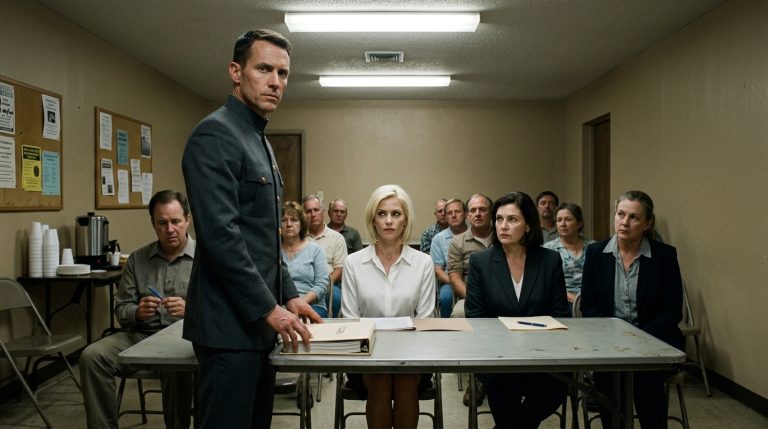
The air inside the clubhouse was recirculated, cold, and smelled faintly of floor wax and forced formality. I stepped into the room and the noise—a low, discordant murmur of dozens of residents—clattered against the vaulted ceiling. They were all there: the Hendersons in the front row, their posture rigid; David Chen, looking like a man holding a bomb in a briefcase; and, at the center of the folding table, Karen. She didn’t look up when I entered. She was busy adjusting a stack of papers, her movements precise, robotic, a woman who had spent the last twenty-four hours perfecting a performance of absolute authority.
I moved to the side, my boots making no sound on the industrial carpet. Beside me, Marcus remained a pillar of composure, his briefcase held at his side like a shield. We didn’t speak. We didn’t need to. Every step I took felt like a calculated movement on a field of frozen, fragile glass. One wrong word, one stutter, and the entire structure of the defense we’d built would shatter.
“Is the recording started?” Karen asked, her voice carrying an edge that cut through the murmur. She didn’t wait for an answer. She banged the gavel—a sharp, wooden crack that sounded like a dry bone snapping. “This special hearing of the Summit Creek Estates Homeowners Association is now in session. The agenda is the continued and egregious violations of community standards by the resident at 112 Oak Hollow Lane.”
She looked up then, locking her eyes onto mine. They were small, hard, and devoid of anything resembling empathy. In that look, I didn’t see a neighbor; I saw a machine that had been designed to process people like me into compliance.
“Mr. Caldwell,” she continued, her voice rising to meet the expectant silence of the room. “You have been notified of your fines. You have been notified of the intent to place a lien on your property. You have been given every opportunity to rectify your… artistic endeavor. Do you have anything to say before the board proceeds with the final vote?”
I didn’t answer immediately. I took a breath, feeling the weight of every person in the room waiting for me to falter. I looked at the board members—Gerald, Brenda, and the others—who were all visibly trying to look anywhere but at me. They were the ones who held the actual power, even if Karen held the gavel.
I stood up, the chair scraping loudly against the floor. As I walked toward the front of the room, I caught a glimpse of David Chen. He gave me a barely perceptible nod. I felt the folder in my hands—the evidence, the invoices, the proof of the shell company. It was no longer just a collection of paper; it was the mechanism of her undoing.
“I have a lot to say, Karen,” I began, my voice steady, projecting to the back of the room. “But let’s start with why we’re actually here. You call this a hearing about community standards. I call it a hearing about who owns the truth in Summit Creek.”
“The truth is written in our governing documents!” she snapped, her face flushing a dangerous shade of crimson. “And you have spent every day since you arrived trying to rewrite them.”
“I haven’t rewritten anything,” I said, stopping a few feet from the table. “I’ve just been reading what’s already there. And it turns out, there’s a lot of fine print you’ve been hoping no one would notice.”
I didn’t open the folder yet. I kept the suspense, letting the air in the room thicken until it felt like it was pressing against everyone’s chests. I could see Brenda shifting in her seat, her hand hovering over a pen. The room was no longer just a tribunal; it was a pressure cooker, and I was holding the release valve.
“Mr. Caldwell, you have exactly three minutes to address the board,” she said, her voice trembling with barely controlled fury. “Do not waste our time with your pseudo-legal posturing.”
“Three minutes is plenty,” I replied. I laid the folder on the table, the impact sounding like a final decision. “But I think the board might want to listen to every second of it. Because if what I’m about to show you is true, then we’re not just talking about a workshop violation. We’re talking about the systematic dismantling of this community’s assets for the sake of a family business.”
The room went dead silent. It was a vacuum, a hollowed-out space where even the humming of the air conditioner seemed to vanish. I reached out and opened the folder, revealing the top page—the bank records linking the landscaping payments to the shell company. I didn’t look at her. I looked at Gerald, the man who had asked for the bids. I looked at the man who had been sold a lie for two years.
Karen’s hands were visibly shaking now, her control over the gavel and the meeting slipping away into the frantic, panicked energy of a cornered animal. She reached for the gavel again, her eyes darting between me and the silent, staring board members. I had initiated the sequence. Now, I just had to make sure it reached the point of no return.
CHAPTER 7: THE MASTERPIECE OF IRON
The silence in the room had transitioned from expectant to tectonic. It was the sound of a community shifting on its axis. Karen was still gripping the table, her knuckles white, her gaze frantic as it darted across the faces of the board members. She was looking for a lifeline—a nod, a word of support, anything to anchor her back to the reality where she was the undisputed queen of the beige kingdom. She found nothing but stone-faced avoidance.
I held the invoice up, not as a weapon, but as a mirror. “This is the invoice,” I said, my voice cutting through the hollow air. “The one you used to justify your authority, the one you touted to every new resident to sell them on the ‘quality’ of Summit Creek. You love the scrolls. You love the leaves. You love the permanence of the gates. But you hated the man who made them because he wasn’t part of your aesthetic harmony.”
I turned the page to reveal the timestamped photograph of the gates in my workshop, the steel still raw and pitted with weld spatter. “You didn’t want a community, Karen. You wanted a stage. And you were willing to burn everything down—my shop, my family’s peace, your neighbors’ bank accounts—to keep the curtains closed.”
“You… you’re trying to ruin me!” she shrieked, the veneer finally, completely snapping. “I built this! You’re just a drifter who showed up and decided you were better than the rules!”
“I never said I was better than the rules,” I replied, stepping closer to the table until I was towering over her. “I just followed them better than you did. That’s the difference. You looked at the bylaws as a way to control people; I looked at them as a contract. And you breached that contract the second you decided your family’s profit was worth more than this community’s trust.”
Gerald, the timid board member who had spent months following her lead, stood up. His chair screeched against the floor, a jarring, dissonant sound that seemed to signal the final collapse. “Karen… did you authorize the payments to Evergreen Solutions without checking the other bids?”
She didn’t answer. She couldn’t. She was staring at the invoice in my hand as if it were a snake coiled to strike.
Marcus stepped forward, his presence filling the void left by her silence. “The records speak for themselves, Mr. Fleming. And the records are currently in the hands of the district attorney’s office. Every invoice, every contract, every ‘special assessment’ that was funneled into her cousin’s shell company. It’s all there.”
The room erupted. It wasn’t the laughter of liberation this time; it was the raw, angry noise of betrayal. People stood up, voices overlapping, the anger boiling over from months of suppressed frustration. I didn’t join in. I didn’t need to. I watched as Karen’s composure dissolved into a mask of pure, unadulterated fear. She looked small, stripped of the red blazer, the clipboard, and the gavel. She looked like a person who had spent her entire life trying to fill a hole that could never be filled, and in the process, had made everyone around her pay for the attempt.
“I move to remove the president,” David Chen said, his voice rising clearly over the chaos. “And I move to freeze all HOA assets effective immediately.”
“Seconded,” a chorus of voices replied.
Karen stumbled back from the table, her chair tipping over with a heavy thud. She looked at the faces around her—the people she had fined, bullied, and belittled—and saw the judgment that had been building for years. There was no argument left. No bylaw could save her now.
She turned and fled, pushing past the confused security guards who were standing frozen by the door. Her escape was not the graceful exit of a defeated leader; it was the stumbling, panicked retreat of someone who realized that the world had finally caught up to them.
I stood at the front of the room, the binder still heavy under my arm. The room was noisy, chaotic, and messy—it was a human space, no longer a sanitized exhibit of perfection. I looked at the board members, who were already huddling together, their faces pale as they realized the depth of the hole they were in. The repair work would be long, and it would be difficult, but for the first time since I moved to Summit Creek, the air felt like it belonged to the people who breathed it.
I looked down at the invoice one last time, then set it on the table. It was just paper, just ink, just a record of a job done with pride. It had been enough. I walked toward the back of the room, my boots echoing with a steady, grounding rhythm, leaving the wreck of the old regime behind me. The fire in the forge was long dead, but as I walked out into the cool, biting air of the evening, I felt the warmth of a job properly finished. The kingdom was gone, the beige was fading, and for the first time in a long time, the road ahead was finally, truly, my own.
CHAPTER 8: THE WEIGHT OF THE GATES
The setting sun cast long, amber shadows across the entrance to Summit Creek, turning the iron scrolls into silhouettes against the darkening sky. I worked the file over the last bit of burred metal, my hands steady, the rhythm of the work becoming a part of my own heartbeat. My muscles ached with a deep, productive fatigue—the kind that only comes after a task has been truly, fully earned.
It had taken a week to strip the rust and the cheap, peeling paint that had been applied by Karen’s cousin’s crew. The iron underneath was resilient, though. It had survived the neglect, just as the neighborhood had survived the reign of the person who claimed to be its protector. As I applied the final, multi-layered protective coat, I found my mind wandering to the “why” of it all. For months, I had focused on the mechanics of her corruption—the invoices, the shell companies, the bylaws—but looking at the metal now, I saw the woman behind the files.
Karen hadn’t just been a grifter. She was a woman terrified of a world that was moving on without her. Her insistence on beige uniformity, her obsession with perfectly coiled hoses, and her mania for aesthetic harmony were never about the community. They were about control. She felt that if she could just force the world to be exactly as she dictated, she could stave off the creeping, inevitable realization that her own life was fraying at the edges. She had been clinging to this neighborhood because it was the only piece of reality she felt she could truly hold, and in her desperation to secure it, she had become the very thing she feared most: a source of chaos.
She was afraid of being irrelevant. She was afraid that without the gavel and the clipboard, she was just another person passing through a world she didn’t understand. The irony was heavy—the harder she fought to preserve her kingdom, the more she insured its destruction. She had spent all her energy trying to force an image of perfection, never realizing that true strength isn’t about being uniform; it’s about enduring the wear and tear of real life.
My daughter, Lily, ran up to the gate, her footsteps light on the pavement. She reached out and touched the scrollwork, her fingers tracing the smooth, clean lines. “You fixed it, Daddy.”
“I did,” I said, putting my tools away. “It’s going to last a long time now.”
“Does this mean you’re going back to the shop?”
“I’m going back to the forge,” I corrected, a small, quiet smile touching my lips. “There’s always more steel to shape.”
As we walked away, I looked back once more. The gate stood proud, its finish deep and uniform, reflecting the light of the first few stars. The neighborhood seemed quieter tonight, the artificial tension that had hung over the streets for months finally breaking. People were out in their yards—not obsessively trimming hedges to avoid a fine, but simply existing, enjoying the cool, honest air of a Thursday evening.
The battle wasn’t just about the forge or the house or the gates. It was about reclaiming the agency to exist in a space that hadn’t been filtered through someone else’s insecurity. As I reached our house, I saw George Henderson out in his driveway, his classic car gleaming under the lights. He caught my eye and gave a slow, deliberate nod. It was a gesture of solidarity, a signal that we were both part of a community that was finally breathing again.
Inside, the house felt different—lighter, settled. Sarah was in the kitchen, the soft clatter of dinner preparation filling the silence. I washed the grit and the scent of industrial cleaner from my hands, watching the grey water swirl down the drain. The feeling of the work was still there, embedded in my skin, a reminder of the friction that had led to this moment of clarity.
I sat down at the kitchen table, the house quiet, the hum of the appliances a reassuring, mundane sound. The binder of evidence was gone, turned over to the investigators, and the legal threats were being dismantled, layer by layer, by Marcus. The war of paper was over, and the war of procedure had been won.
I stood up and went to the back of the house, looking out toward the workshop. It was dark, the propane furnace cold and silent. I didn’t need the forge tonight. I had built what I needed to build. The gates at the entrance weren’t just a structure; they were a testament to the fact that integrity, when it’s forged under pressure, doesn’t rust.
I took a deep breath, the air in the house feeling cleaner, less laden with the weight of the last year. I went back to the kitchen, the simple, honest routine of dinner ahead of me. For the first time in a long time, there was nothing to plan, no procedures to map, and no enemy to outmaneuver. There was only the quiet, steady rhythm of a life that was mine to shape, one day, and one strike, at a time. The road forward was open, unburdened by the fear of irrelevance, and that was the greatest victory of all.