A Fortress of Steel and Silence: One Man’s Engineering of Justice Against a Corrupt Empire
CHAPTER 1: THE CONVOY
The silence of the pasture was a fragile thing, easily shattered, and today, it was being torn to ribbons.
Jed stood on the porch, his hand resting on the smooth, weathered railing of the farmhouse. His eyes didn’t track the movement of the dust cloud first; they tracked the trajectory of the vehicles. Eighteen luxury SUVs, an incongruous parade of chrome and aggressive paint jobs, cut a jagged path through the tall, dry grass of his property.
They weren’t just driving; they were claiming.
He watched the lead vehicle, a silver G-Wagon, veer sharply toward his prize heifers. The animals bolted, a chaotic, panicked swarm of muscle and fear. Jed’s jaw set, a sharp, rigid line of suppressed tension. He didn’t move. He didn’t shout. He watched the way the lead driver, a man in crisp khakis who looked like he’d never seen a callus, leaned out the window to point a smartphone at the chaos.
This wasn’t a mistake. It was a production.
The lead vehicle came to a shuddering halt fifty yards from the porch. The engine ticking of eighteen cooling motors sounded like a rhythmic, metallic heartbeat. Jed took a breath, the air tasting of exhaust and hot iron, and stepped off the porch.
He didn’t walk fast. He moved with the measured, deliberate economy of a man who spent his career calculating load-bearing capacities. Every step on the gravel was a test of the ground’s stability, a silent appraisal of the pressure being applied to his land.
Bryce Kellerton stepped out of the Mercedes, his loafers pristine against the dirt of the Texas prairie. He adjusted his collar, his smile practiced, devoid of any genuine warmth. He looked at Jed as if he were an obstacle to be cleared rather than a man standing in his own home.
“Mr. Hawkins,” Bryce said, his voice carrying too clearly across the open space. “I believe we’re here to settle the matter of the easement. We’ve brought the survey team to begin the initial site preparations.”
Jed didn’t look at the papers in Bryce’s hand. He looked at the tire ruts the SUVs had carved into the earth—deep, aggressive gashes that would take years of rain and root growth to heal. His gaze shifted past the man, toward the rear of the convoy where a black Range Rover had stopped. The driver-side window was rolled down just a crack, and for a split second, Jed saw a camera lens glinting in the morning sun, angled directly toward his daughter’s bedroom window.
The air in Jed’s lungs felt suddenly thin. The threat wasn’t the law or the land. It was the reach.
“There’s no easement here, Bryce,” Jed said, his voice low, steady, and devoid of the anger he felt coiling in his gut. “And you’re standing on private property.”
Bryce chuckled, a smooth, rehearsed sound. “Possession is nine-tenths of the law, Jed. And we have the public interest on our side.”
Jed looked back at the ranch house. Emma was inside. He saw the flicker of the curtain move as she pulled it back, a small, frightened face peering out at the steel wall of SUVs.
He didn’t need to argue. He needed to be invisible. He turned his head slightly, noticing a small, dark object lying in the dirt near the G-Wagon’s rear tire—a discarded, high-end drone battery, out of place in the middle of a cattle range.
“Public interest,” Jed repeated, his voice barely a whisper.
He kept his eyes on Bryce, but his mind was already calculating the depth of the betrayal, and the exact weight required to snap the foundation of this entire charade.
CHAPTER 2: THE DIGITAL FRONT LINE
The drone battery lay in the dust, a piece of high-tech debris that didn’t belong in a pasture where cattle grazed and the only rhythm was the seasonal migration of the herd. I didn’t pick it up. I kicked it—just enough to turn it over with the toe of my boot. The brand logo was partially abraded, but the serial number was still legible.
My pulse was a steady, measured beat in my ears. The convoy was already moving on, a slow, predatory procession back toward the main road, leaving the deep, jagged scars of their tires in my soil. They thought they had left me with nothing but a headache and a property dispute. They didn’t know I had spent twenty years in the Corps of Engineers learning that the most effective way to secure a perimeter wasn’t by standing guard with a rifle, but by knowing exactly where the enemy would place their next step.
I turned back toward the house. The screen door creaked, a thin, wooden protest that felt too loud in the sudden silence of the pasture. Inside, the kitchen was still, but the air felt heavy. Emma was at the table, her cereal bowl untouched, the milk filming over in the morning light. She didn’t look at me when I entered, but her shoulders were hunched, a defensive posture I hadn’t seen since the divorce.
“They’re taking pictures, Dad,” she said, her voice small, tight.
“I know,” I replied. I walked to the counter, pulled out the heavy, industrial-grade map of the ranch, and spread it out. I wasn’t just looking at fence lines anymore. I was looking at lines of sight.
I had spent my life building things—bridges that held weight, barriers that redirected force. Now, I had to build a system of observation. I grabbed my keys and went back out, not to the porch, but to the barn. In the shadows of the rafters, tucked away in an old ammunition crate, I kept the gear I’d brought back from the desert. Trail cameras, motion sensors, solar-linked nodes.
I worked with a mechanical focus, checking the seals on the sensor casings. Every movement was efficient, stripped of wasted energy. As I calibrated the first sensor, a flicker of doubt crossed my mind—a cold, sharp edge of introspection. Was this real? Was I reading a hostile insurgency into what was likely just the arrogance of wealthy, bored real estate developers? My hands paused on the wiring. I looked out the barn door at the expanse of the prairie, the golden light of the morning masking the ruts in the road. Maybe I was the one out of step, seeing threats in the wind because I’d spent too long looking for them in the sand.
But then I remembered the camera lens I’d seen earlier. Nobody takes a photo of a private residence from inside the fence line unless they have a reason to want to know what’s inside. That wasn’t a real estate survey; that was surveillance.
I mounted the first camera on the old oak tree near the back fence, the one that offered a clear view of the north approach. I masked it with bark and lichen, blending it into the landscape until it was invisible to anyone not looking for it. I moved on to the second, then the third, creating a web of coverage that would turn my ranch into a panopticon.
I wasn’t just defending my land. I was building a trap.
By the time I finished, the sun was high and unforgiving. I returned to the house, my clothes dusted with earth and my skin tight from the heat. I checked the digital display I had rigged to the laptop on the kitchen table. Four cameras were active. I watched the feed—a grainy, high-definition view of my own life.
I looked at the feed from the north fence. It was empty, just wind-blown grass and the occasional shadow of a hawk. Then, for a split second, I saw it: a small, dark shape near the fence line. I zoomed in. It was a pair of bolt cutters, left in the grass.
They weren’t just surveying. They were scouting the structural integrity of my boundary.
I sat down, pulled my coffee toward me, and watched the empty field. The silence of the house was no longer peaceful; it was a tactical advantage. I had the ground, I had the discipline, and now, I had the eyes. Bryce Kellerton thought he was dealing with an old veteran who wanted to be left alone. He was wrong. He was dealing with an engineer who had just found the first weak point in his design.
I looked at the bolt cutters on the screen again, and a slow, cold resolve settled into my chest. Tomorrow, they’d come back. And when they did, I’d be ready to document every single mistake they made.
CHAPTER 3: THE DUSTY PROOF
The house was silent, save for the rhythmic, low hum of the server stack tucked beneath the workbench in the office. I didn’t turn on the lights. I didn’t need them. I knew the floorboards of this 1890s house better than I knew the back of my own hand—which ones groaned under the pressure of a boot, which ones held firm.
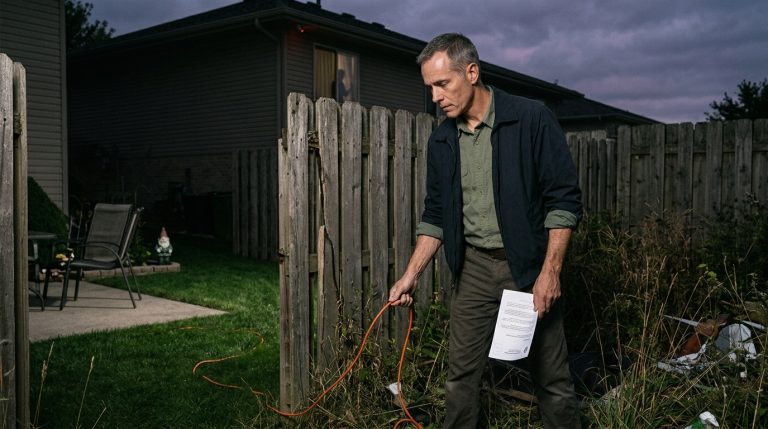
I grabbed my jacket and stepped out onto the porch. The air was thick, heavy with the scent of dry prairie grass and the metallic tang of an approaching storm. I walked out into the yard, moving toward the north fence line where I’d left the bolt cutters earlier that afternoon. My pulse was steady, a rhythm of tactical focus. I wasn’t just checking a perimeter; I was hunting for the narrative that Bryce and his crew were trying to overwrite.
I reached the tree line, my boots crunching softly on the hard-packed earth. The bolt cutters were gone.
I knelt in the dirt, the moonlight providing just enough illumination to see the impression left in the soil. Not a boot print—a boot print would have been too simple. It was the drag mark of a heavy, metal-soled shoe, consistent with the expensive loafers Bryce wore. He had been back. He had cleared the evidence.
I stood up, my fingers brushing against the rough bark of the oak tree. The realization didn’t feel like fear; it felt like confirmation. Bryce wasn’t just arrogant; he was careless. He thought the night belonged to him because he had the money to pay for the cover. He didn’t realize that in the dark, the advantage belonged to the man who knew how to stay still.
I headed toward the feed store near the highway, the place where the locals gathered to trade rumors like currency. I had a meeting scheduled with Dorothy Peton. She had dropped the HOA minutes in my lap yesterday, and I hadn’t yet had the time to go through them with a fine-toothed comb.
The meeting point was the back of the store, a dusty alcove shielded from the streetlights. Dorothy was already there, her antique Buick idling nearby, the engine sounding like a box of gravel being shaken. She handed me a manila folder, her hands trembling slightly—not from age, but from a controlled, righteous indignation.
“They’re voting to take you down, Jed,” she said, her voice dropping to a harsh, gravelly whisper. “They think they’ve got the environmental reports signed, sealed, and delivered to the county council. But I caught something. A contradiction in the math.”
I opened the folder under the glow of a small penlight. I flipped through the pages—meeting minutes, project timelines, budget allocations. My eyes scanned for the discrepancies. There, in the minutes from the last emergency session, was a blank space where the signature of the Lead Environmental Consultant should have been.
But it wasn’t just blank. I pulled the page into the light. Someone had glued a separate piece of paper over the original document—a draft version of the zoning proposal. I peeled it back with the blade of my pocketknife. Beneath the draft was a signature I recognized, but not from the consulting firm. It was Sutton Blackwood’s.
“They’re signing their own reports,” I murmured, the implications snapping into place like a gear locking into a machine.
“They don’t have a consultant,” Dorothy said, leaning in. “They haven’t had one for months. They’ve been siphoning the fees into a shell account. That road they promised? It’s a ghost. They’re using the ‘environmental mitigation’ as a cover to strip the land of its value, then buying it up for pennies on the dollar once the zoning gets tangled in court.”
I looked at the signature again. It was hurried, sloppy. A mistake.
“Why tell me now, Dorothy?” I asked, looking up at her.
“Because I live here, Jed,” she said, her eyes hard. “I’ve spent forty years building a life in Willowbrook. I won’t watch it get turned into a tax shelter for a man who doesn’t even know the color of the soil he’s stealing.”
I closed the folder, the cold, hard weight of the evidence sitting in my hand. I had the motive, I had the evidence of fraud, and I had the proof that they were operating without a legal foundation.
I walked back to my truck, the engine turning over with a low, predatory growl. I wasn’t going home. I was going to find Jake Martinez. The game had moved past local skirmishes; it was time to bring in the heavy artillery. Bryce wanted a battle for the ranch, but he was about to find himself in a war of attrition, and I was holding all the supply lines.
I drove out of the lot, the headlights cutting through the darkness of the prairie. I had the proof, but the proof was only as strong as the person willing to use it. And as I looked in the rearview mirror, checking to see if I was being followed, I realized the most dangerous part of this entire situation wasn’t the embezzlement—it was the desperation. A man with everything to lose doesn’t play by the rules, and Bryce was quickly running out of room to maneuver.
I touched the compass in my pocket, the needle unmoving, pointing true north. I knew exactly where I was going.
CHAPTER 4: THE FEED STORE RUSE
The rain didn’t just fall; it hammered, turning the dry, hard-packed earth of the pasture into a slick, treacherous slurry. I sat behind the wheel of my truck, the wipers fighting a losing battle against the deluge. The cabin was dark, the only illumination coming from the occasional strobe of lightning that turned the world outside into a jagged, monochrome photograph.
I had been driving for forty minutes, heading toward the regional feed store where the local gossip held the most weight. My plan was simple: lean into the persona of a man on the edge of financial ruin. The army had taught me that if you give an enemy the version of yourself they expect to see, they’ll stop looking for the version of you that’s actually dangerous.
I pulled into the lot, the tires skidding slightly on the mud. A few other trucks were parked under the overhang, their tailgates down. I kept my head low, stepping out into the cold, driving rain, and walked toward the entrance. My boots felt heavy, weighted down by the thick, red clay of my own land. I made sure to walk with a slight drag—not a limp, just the heavy, defeated gait of a man who’d spent his last dollar on a losing battle.
Inside, the store smelled of dry grain, cedar, and the damp wool of coats. I walked to the counter, my face schooled into a mask of weary frustration. I didn’t have to act much; the anger I felt was real, even if I was channeling it into a performance.
“Morning, Jed,” the clerk said, not looking up from his ledger. “Saw those SUVs on your place the other day. Looked like a parade of vanity.”
I leaned against the counter, my arms crossing over my chest. “Yeah, well, vanity doesn’t pay the property taxes, Dave. Lawyers, on the other hand, seem to think they’re entitled to a percentage of my heritage.”
I made sure my voice carried. Three men were standing by the coffee station—locals, farmers who knew every inch of this county. Their ears pricked up. That was the bait. I started in, complaining loudly about the legal bills, about the threats from the Willowbrook HOA, about how I was looking at the liquidation of the cattle just to keep the fence lines intact. I painted the picture of a man drowning.
“They’re offering me pennies, Dave,” I said, letting a note of desperation bleed into my voice. “But what choice do I have? I can’t fight them in court forever. The bank is breathing down my neck, and these Willowbrook people… they act like they own the county.”
I watched the men by the coffee station out of the corner of my eye. One of them, a man I recognized as a former contractor, leaned in to whisper to his companion. They were listening. That was exactly what I needed. If the word got back to Bryce—and it would, because these guys loved a good story about a fallen rancher—it would signal that I was ready to fold.
I finished my transaction, grabbed a bag of feed I didn’t need, and turned to leave. Just as I reached the door, the bell chimed.
Sutton Blackwood walked in.
She looked out of place, her designer raincoat pristine, her heels clicking sharply against the concrete floor. She didn’t look like she belonged in a feed store, and that was the point. She was here for a reason. She spotted me almost immediately, and her expression shifted from professional indifference to a shark-like appraisal.
“Mr. Hawkins,” she said, her voice smooth, almost melodic. “What a surprise. I was actually on my way to your property to drop off a revised offer.”
I stopped, my hand on the door handle. I allowed my shoulders to slump, just a fraction. “A revised offer, Sutton? Unless it’s got another zero on the end, I’m not sure it’s worth the paper it’s printed on.”
She stepped closer, invading my personal space. She smelled of expensive perfume and rain—a clashing, synthetic scent that made my stomach turn. “Let’s be reasonable. We both know the pressure is mounting. We’ve successfully transitioned three other rural properties this way. Once owners understand the pressure that can build, they usually find that selling is the most… dignified option.”
She leaned in, her eyes locking onto mine, searching for the crack in my armor. I held her gaze, my face a carefully constructed void. I didn’t flinch. I didn’t argue. I let the silence hang between us, thick and uncomfortable, a tactical pause that forced her to reveal her hand.
“Three properties?” I asked, keeping my voice low. “That’s a lot of environmental studies, Sutton. How exactly does an HOA manage to finance that kind of expansion?”
She didn’t miss a beat. “We have investors, Jed. People who believe in the future of this valley.”
She handed me a manila envelope. It was heavy, thicker than a standard purchase agreement. I took it, my fingers brushing against hers. Hers were cold; mine were steady.
“Think about it, Jed,” she said, her voice dropping to a whisper. “Before things get complicated.”
She turned and walked out, her heels echoing against the floor. I watched her go, my heart rate barely elevated. I had the offer, I had the confession of their methods, and I had the proof that they were over-extended.
I walked out into the rain, the envelope tucked securely under my coat. I wasn’t going to sell, and I wasn’t going to fold. But now, I had something better: I had the documentation of their hubris. Bryce and Sutton were playing a game of intimidation, but they were playing it with a deck they’d stacked themselves. And as I started the truck, the headlights cutting through the dark, I knew exactly what my next move would be. I wasn’t just defending my land anymore; I was preparing to dismantle theirs.
CHAPTER 5: THE CONFESSION IN INK
The kitchen was cold. The storm that had raged outside during my trip to the feed store had transitioned into a steady, persistent drizzle, the sound of water tapping against the windowpanes like nervous fingers. I sat at the heavy oak table, the manila envelope Sutton had given me lying before me. It felt heavier than it should have, a deceptive weight that promised salvation but held only the blueprints of a trap.
I didn’t open it immediately. Instead, I stood up and walked to the window. The reflection staring back at me wasn’t just my own. In the low, flickering light of the kitchen, I saw the face of the man who had lost his own farm decades ago—a ghost of frustration and helplessness. I shook the thought away, the sharp, metallic tang of the rain outside grounding me. My father lost his land because he played by the rules against a man who didn’t. I wasn’t going to make that mistake.
I returned to the table and slit the envelope open. Inside were a series of documents, property surveys, and what appeared to be the internal accounting ledgers of the Willowbrook HOA. I spread them out, the paper crisp and expensive.
As I sifted through the files, the decoy secret began to unravel. These weren’t just purchase agreements. They were structured for a massive, multi-million dollar environmental mitigation project—a bypass road that was supposed to cut through the neighboring ranches and my own. But as I cross-referenced the land surveys with the regional geological records, the discrepancy screamed at me. The environmental impact studies they had submitted were fabricated; they cited rock strata and water table levels that didn’t exist in this part of the county.
They were building a road over a phantom landscape to justify a massive budget. It was a classic embezzlement scheme, sleek and predatory.
I picked up the final document, a transcript of a recorded conversation between Bryce and a faceless investor. The audio, written out in cold, clinical text, detailed the exact timeline for the “land transition.” It was a roadmap for destruction, a step-by-step guide on how to bleed a rancher dry until they were forced to sell.
My hand brushed against a small, integrated digital recorder stuck to the inside of the folder. I pressed play.
“We’ve successfully transitioned three other rural properties this way,” Sutton’s voice crackled out, clear and arrogant. “Once owners understand the pressure that can build, they tend to sign without reading the fine print. Jed will be no different. He’s already showing signs of cracking.”
I felt the temperature in the room drop. She hadn’t just handed me a purchase agreement; she had handed me the confession. But why? Why give me the very thing that could destroy them?
I looked back at the ledger, my eyes narrowing. There, tucked in the back, was a wire transfer slip—a personal deposit into a private, offshore account in the Cayman Islands. It was a massive sum, far larger than any standard consulting fee. It wasn’t just corporate embezzlement. It was a fire sale of assets.
The realization hit me with the force of a physical blow. Bryce wasn’t just a greedy developer; he was a man staring down the barrel of total, irrevocable personal bankruptcy. This wasn’t about building a road or developing land. It was about siphoning every drop of value he could before the entire structure collapsed. They needed my land to cover the shortfall, to bridge the gap before the auditors caught up.
The house suddenly felt too small. I looked toward Emma’s bedroom door, the sliver of light beneath it a reminder of what was truly at stake. If I pushed too hard, if I revealed what I knew too early, they would stop acting like corporate bullies and start acting like cornered animals.
I heard a sound—not the rain, but the crunch of gravel. A vehicle had pulled into the drive. No lights, no engine roar, just the quiet, deliberate sound of tires on wet stone.
I moved to the window, my body instinctively dropping into a low, tactical stance. A dark sedan was parked at the edge of the property, its engine cut. Two figures stepped out, their silhouettes framed by the faint glow of the security lights I’d installed. They weren’t looking at the front door. They were looking at the barn—where I kept the server, the cameras, and the proof.
The game had changed. They weren’t waiting for me to sell anymore. They were coming to ensure I couldn’t.
I checked the monitor on the desk. The cameras showed the two men moving toward the fence line with a precision that didn’t come from HOA board members. These were professionals—fixers. The weight of the moment settled in my gut, a heavy, cold anchor. I had the truth, but the truth was a beacon, and I had just lit the match. I turned toward the back door, my hand closing around the heavy steel wrench I kept on the workbench. It wasn’t a weapon of choice, but it was a tool, and tonight, I was going to be an engineer of my own survival.
They wanted to close the case? I was going to open it wide.
CHAPTER 6: THE SABOTAGE
The darkness in the barn was absolute, save for the faint, rhythmic pulse of the server’s standby light—a single, blinking green eye that felt like a heartbeat under stress. The crunching of gravel stopped abruptly just outside the sliding door.
I didn’t move. I leaned against the heavy oak post, the steel wrench gripped so tightly in my hand that my knuckles ached. I could hear them breathing—two men, their respiration ragged and heavy, trying to be silent but failing against the unnatural stillness of the Texas night. They weren’t here to talk. They were here to silence the data, to cut the wire, to ensure that the trail leading back to Bryce and Sutton went cold.
A sharp, metallic rasp echoed as a blade sliced through the heavy canvas tarp covering the equipment crates. Then, the sound of a crowbar finding purchase against the sliding door’s metal track. They were forcing it.
I shifted my weight, my boots making no sound on the packed dirt floor. I had spent years in the Corps learning that if you can’t outgun an opponent, you make sure the terrain works for you. I knew every loose board, every hidden gap, every shadow in this structure. They were entering a cage they thought was empty, but they were the ones being trapped.
Suddenly, the power grid for the entire ranch cut out. The server’s green light flickered and died. The hum of the cooling fans ceased. The silence that followed was heavy, almost suffocating. The barn was now a tomb, and I was the ghost in the rafters.
One of them slid the door open just enough to squeeze through. A sliver of moonlight cut across the barn floor, illuminating a pair of tactical boots. The second man followed, his silhouette broad, his movements heavy.
“Keep the light low,” one of them whispered, the sound tight with professional urgency. “Find the drive, smash the server, and get out. The employer wants this quiet.”
I didn’t wait for them to find their footing. I moved to the loft ladder—a relic of the barn’s original construction. I climbed silently, my movements fluid and practiced. From the dark, I watched them move deeper into the space, their flashlights creating nervous, erratic beams that danced over the equipment crates.
They were looking for the server on the workbench. They expected a resistance of wires and alarms, not a resistance of patience.
I reached for the counterweight of the old hay pulley system, a massive, rusted iron hook attached to a length of thick rope. It was a simple, brutal piece of engineering. I waited until the lead man reached the workbench, his hand stretching out toward the server chassis.
I released the lock.
The weight dropped with a sound like a thunderclap—a sudden, violent rush of iron through the air. It didn’t hit them, but it slammed into the floor between them with such force that the entire barn seemed to shake. The impact sent a plume of dust and debris into the air, effectively blinding their flashlights.
“Contact!” one of them yelled, spinning around, his light cutting through the dust.
I dropped from the loft, landing silently on the hay-covered floor behind the second man. He turned, but I was faster. I used the wrench not to strike, but to jam the mechanism of the sliding door, effectively locking us all inside. I didn’t need to fight them; I needed to contain them.
“You’re in the wrong line of work for this county,” I said, my voice echoing in the confined space, stripped of all emotion.
They pivoted, their flashlights locking onto me. For a second, the light was blinding, but I had already mapped their positions in the dark. I wasn’t just a rancher. I was the person who designed the flow of this room.
“Get him,” the lead man commanded, his voice shaking.
They charged. I didn’t stand my ground; I retreated, drawing them toward the back of the barn, toward the loose floorboards I had loosened days ago. I kept the movement tight, calculated. I didn’t use the wrench as a weapon; I used it as a lever, hitting the structural support of the feed chute.
The chute gave way, a torrent of grain and heavy gear cascading down on them like a landslide. It wasn’t a lethal blow, but it was a chaotic one. It broke their momentum, buried their footing in a shifting sea of oats and corn, and turned their precision into frantic stumbling.
One of them hit the floor hard, his flashlight spiraling away into the dark. The other tripped, his arms windmilling as he tried to find a stable surface. I didn’t hesitate. I moved through the chaos, not with aggression, but with the cold, relentless purpose of a machine. I disarmed the first man, taking his flashlight and pinning him against the wall with the heavy timber of the stall.
“Who sent you?” I demanded, the light fixed on his face, stripping away his anonymity.
He didn’t speak. He just stared, his eyes wide, his breathing shallow. He was a contractor—just a man paid to do a job, a man who didn’t realize that some doors shouldn’t be opened.
I looked at the server on the workbench, still intact, and then back at the two men scrambling in the grain. I had them contained, but the victory felt hollow. This was only the beginning. Bryce was sending in muscle because he was afraid, and fear, I knew, was the most dangerous kind of fuel.
I stepped back, my chest heaving with the exertion, the adrenaline finally beginning to ebb. I had defended the barn, but I knew the next wave wouldn’t come from a couple of contractors. They would come from the top. And as I turned the flashlight toward the door, preparing to call the Sheriff, I realized that the fight for the land was shifting—the physical defense was over, and the legal offensive was about to start.
CHAPTER 7: THE BOLT OF JUSTICE
The sirens didn’t reach the ranch until twenty minutes later. By then, the two men were zip-tied to the support beams of the hay loft, their professional demeanor shattered, their silence replaced by the frantic, useless justifications of people who realized too late that they’d been sold out. I stood in the barn’s entrance, the cold night air biting at my skin, watching the patrol lights paint the pasture in rhythmic slashes of blue and red.
Sheriff Miller didn’t look happy. He knew me—knew the discipline, knew the background—but he didn’t like the optics of a vigilante setup. I didn’t care about optics. I walked up to him as he stepped out of his cruiser, his boots sinking into the wet mud.
“They were here to destroy the evidence, Sheriff,” I said, my voice flat. “Check the server chassis on the workbench. It’s all there. The shell accounts, the fake environmental reports, the signatures. Everything.”
Miller looked toward the barn, then back at me. He didn’t ask how I’d handled two men on my own. He just nodded to his deputy. “Get the gear. We’re securing the scene.”
I watched them work, my body feeling the heavy, dull ache of tactical exhaustion. My hands were stained with grease and red clay, the grit under my fingernails a testament to the night’s labor. As the deputies moved back and forth, I slipped away toward the north fence—the site of the installation. I needed to do a final systems check before the morning.
I knelt by the control box for the hydraulic bollards. The metal was cold, slick with rain. I opened the panel, the hinges groaning in the damp air, and reached for the diagnostic override. That’s when I saw it. Tucked against the main power relay was a small, secondary circuit board—a bypass override I hadn’t installed.
My breath hitched. Someone had been here. Someone had rigged the bollards to stall, to fail exactly when the weight of the SUVs hit them. If I hadn’t checked, the demonstration wouldn’t have been a triumph of engineering; it would have been a catastrophic, lethal failure.
I didn’t panic. I pulled the bypass, the small board clicking free in my fingers. I replaced the relay, my movements steady despite the sudden spike in my heart rate. The system was now mine again. Total control. I closed the box, locked it, and leaned my forehead against the cool, unforgiving steel of the casing.
The realization was a jagged, uncomfortable weight. My own security had been compromised, and it meant the leak wasn’t just in the HOA’s ranks—it was closer to home. But there was no time to hunt for the internal sabotage now. The sun was already beginning to bleed a thin, gray light across the horizon.
I walked back to the house. Emma was sitting in the kitchen, a blanket wrapped around her shoulders. She looked at me, her eyes tracking the mud on my boots, the exhaustion in my posture.
“Is it done, Dad?” she asked.
“Not yet,” I said, going to the sink to wash the grit from my hands. “But it’s set. Tomorrow morning, when the convoy shows up, it’s going to be the end of the show.”
I watched the light grow stronger. I wasn’t just an engineer anymore. I was an architect of a reckoning. Every detail, every structural point, every movement had been calculated. The bollards were live, the federal agents were positioned in the peripheral tree line, and the trap was ready to spring.
I looked at the clock on the kitchen wall. 7:15 a.m.
In fifteen minutes, they would arrive, thinking they were coming to film my defeat. They were coming to record the spectacle of a rancher being broken by the weight of a system he couldn’t control. They were bringing drones, cameras, and their own narrative of power.
I walked out to the porch, the air crisp and smelling of ozone. I stood there, watching the main gate. I could see the dust in the distance, the first rhythmic flash of headlights cutting through the dawn mist.
They were coming. I checked my pocket—the compass was cold, the needle vibrating ever so slightly. I took a final, steadying breath, the silence of the ranch feeling like the calm before a storm. The empire had come to tear down my fence, but they were about to hit a wall they couldn’t bribe, couldn’t threaten, and couldn’t break.
The sound of the convoy grew—the roar of V8 engines, the heavy thrum of luxury tires on gravel, the collective, arrogant confidence of a predator that had never been checked. I watched them roll into the pasture, their chrome grills flashing in the sunrise like teeth.
It was time.
I reached for the remote, the trigger heavy and absolute in my palm. The distance was closing. The stage was set. And for the first time in months, the only thing I felt was the precise, beautiful, engineering certainty of what was about to happen next.
CHAPTER 8: THE COLLAPSE OF EMPIRE
The impact was not a singular sound; it was a symphony of destruction. At 7:30 a.m., as the silver Mercedes G-Wagon surged forward with the arrogance of an entitled king, the steel bollards rose from the earth with a mechanical growl.
The Mercedes hit the steel at thirty-five miles per hour. The front end crumpled like foil, the hood folding backward against the windshield as the vehicle’s momentum was instantly arrested. Behind it, the Range Rover—driven by Sutton Blackwood—couldn’t stop in time. She swerved, the heavy luxury SUV sliding on the wet grass before slamming into the side of the Mercedes, the sound of glass shattering and metal screaming echoing across the valley.
I watched it from the porch, my thumb still resting on the transmitter. It was precise. It was engineered. And as the pickup truck behind them lost control and nosedived into the cattle pond, sending a spray of muddy water into the gray morning air, I felt no thrill of victory. I felt only the cold, hollow satisfaction of a job finished to spec.
The air quickly filled with the acrid, chemical tang of deployed airbags and burning rubber. Silence, sudden and heavy, followed the chaos, broken only by the hiss of steam from a ruptured radiator.
Then, the true cavalry arrived. From the tree line, federal agents emerged with tactical precision, their blue jackets stark against the green of the pasture. They didn’t run; they moved with the practiced ease of people who knew the end was already written.
I walked down the porch steps, the gravel crunching under my boots. Bryce Kellerton had crawled out of the shattered remains of his Mercedes, his khakis torn, his face smeared with grease and blood. He stood in the mud, staring at the steel posts as if he couldn’t comprehend how his momentum—his wealth, his influence—had been stopped by eight inches of reinforced steel.
Margaret Smith, the forensic accountant Dorothy had brought into the fold, walked up behind him with a digital tablet and a set of federal agents. She didn’t shout. She just handed him a stack of papers.
“Bryce Kellerton,” she said, her voice clear in the morning air. “You are under federal investigation for wire fraud, embezzlement, and racketeering. The environmental studies you submitted to the county? They were fabricated. We have the offshore accounts, the internal ledgers, and the signed purchase agreements. Your firm is insolvent, and you are finished.”
Bryce looked at the documents, then at the agents, then back at me. He looked smaller, suddenly—not the confident executive of Willowbrook, but a man who had bet his life on a shell game and finally lost. He tried to speak, to invoke his status as HOA president, but his voice failed him.
Sutton Blackwood, seated on the ground near her wrecked Rover, didn’t even look up. She was finished.
The cleanup took hours. News crews arrived, cameras humming, capturing the wreckage of a criminal enterprise. I watched from a distance as they cuffed Bryce and led him away, his expensive shoes sinking into the mud of the pasture he’d tried to steal.
As the sun climbed higher, the tension that had gripped my chest for months began to dissipate, leaving behind a profound, quiet exhaustion. I walked back to the farmhouse. Emma was waiting on the porch, her eyes clear, no longer fearful.
“Is it really over?” she asked.
“It’s over,” I said.
I spent the rest of the day clearing the debris near the barn. I found a loose plank near the foundation that had been damaged during the construction of the sensors—the same plank I’d been meaning to fix for weeks. I took a hammer and a few nails from the toolbox and secured it, the rhythmic thud-thud of the hammer a grounding, human sound in the quiet of the afternoon. It wasn’t a grand gesture, but it was mine. It was maintenance. It was the act of a man reclaiming his home.
The cattle had returned to the north pasture, grazing peacefully as if nothing had happened. The air felt cleaner, the oppressive weight of the “development” finally lifted.
That evening, I sat on the porch with General Patton, the dog’s head resting on my knee. The prairie grass swayed in the wind, the sound soft and rhythmic. I looked out over the forty acres. They were scarred by ruts and mud, but they were mine. I reached into my pocket, pulled out the rusted compass, and opened it. The needle, for the first time, sat perfectly still.
I hadn’t won by force, and I hadn’t won by luck. I had won because I had understood the load-bearing capacity of a lie.
I took a sip of lukewarm coffee, the silence of the ranch no longer a challenge, but a comfort. Tomorrow, I would start the repairs on the fence. I would grade the road. I would get back to the work that actually mattered. And as the first stars began to pierce the twilight, I realized that peace wasn’t something you waited for—it was something you engineered, day by day, against the noise of the world. I was home.