A Fragile Pulse in the Gated Silence: Seeking Redemption Through the Echo of a Lost Life
CHAPTER 1: THE WEIGHT OF THE ASPHALT
The asphalt was still warm beneath my knees, holding onto the day’s heat like a stubborn secret. I stared at the spot where Jalon had been, a rectangular patch of concrete that looked no different from the rest, yet felt entirely alien. The sirens had faded into the hum of distant traffic, leaving a silence that felt heavy enough to bruise.
I reached into my pocket, my fingers brushing against the cold, smooth plastic of my own AED—the device that had been silenced by a pair of handcuffs. I pulled it out, turning it over in my hands. The casing was scuffed, a thin, jagged scratch running across the display where it had hit the pavement during the struggle. I remembered the sound of the metal cuffs snapping shut, a sharp, surgical click that had severed the connection between my hands and the boy’s chest.
Rick Masterson was gone now, driven away in his black SUV, but the impression of his mirrored sunglasses—the way they had reflected the scene, turning the tragedy into something manageable, something he could control—burned in my mind. He hadn’t seen a boy. He had seen a liability. He had seen an unauthorized variable in his perfectly curated environment.
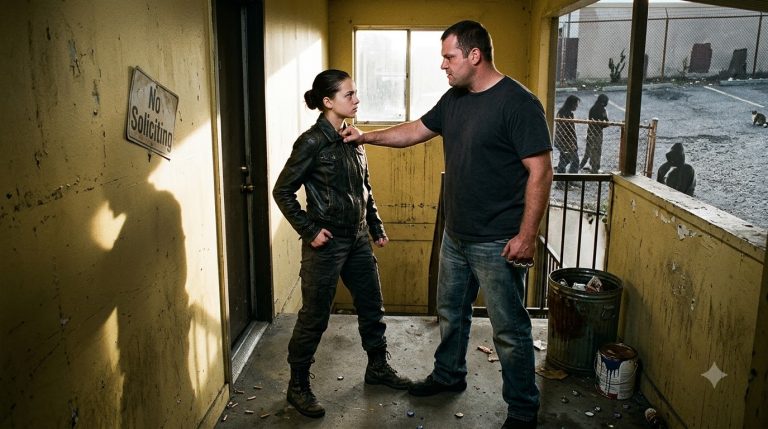
A stray basketball rolled across the court, coming to a halt against my sneaker. I looked up. A few feet away, a girl—the same one who had been screaming earlier—stood clutching her elbows, her knuckles white. Her eyes were red-rimmed, glassy, darting between the court and the distant, dark houses. She wasn’t looking at me; she was looking at the ground, as if searching for the boy who had just been there.
“He used to practice here every Tuesday,” she whispered, her voice so thin it barely carried over the wind. She didn’t look at me, but I knew she was speaking to the space I occupied. “He thought if he hit enough shots, he’d make the varsity team.”
I looked down at the court. The white lines were peeling at the edges, paint flaking away to reveal the gray, weathered concrete beneath. It was the same everywhere in this place: a veneer of perfection stretched over something rotting.
“I’m sorry,” I said, the words feeling brittle and inadequate.
She finally looked at me, and there was no anger in her eyes, only a hollow, terrifying exhaustion. She reached down and picked up the ball, her movements robotic. As she turned to walk away, I noticed something caught in the chain-link fence—a small, silver keychain that had fallen off Jalon’s bag. It was a miniature basketball hoop, the net frayed and hanging by a single thread.
I stood up, my knees popping, the ache in my ribs from the struggle a dull reminder of my failure. As I walked toward the fence to retrieve it, I saw a flicker of movement from one of the houses—a curtain falling back into place. They were watching. They were always watching, and yet, when the air left the room, none of them had breathed for him.
I reached for the keychain, but as my fingers brushed the metal, I realized it was tangled in something else. A thin, black wire, likely from a security camera the HOA had tucked into the fence line, was frayed and exposed, its connection severed. I pulled the keychain free, but my thumb caught on a jagged piece of the mounting. It wasn’t just old; it had been cut.
My heart stuttered. This wasn’t just a gated community. This was a place where things were kept in, and things were kept out, and the cameras were more important than the people they were meant to watch.
CHAPTER 2: THE CHAPEL OF STILLED BREATHS
The hospital chapel smelled of floor wax and silence. It was a sterile, suspended space where the city’s roar was muffled to a faint, rhythmic thrum, not unlike the steady, mocking beat of a heart that refuses to quit. I kept my thumb pressed against my palm, hiding the small, jagged cut I’d earned from the fence at Pine Ridge. It throbbed in time with my pulse, a sharp, physical reminder of the wire I had touched—the wire that shouldn’t have been cut.
Across from me, Jalon’s parents sat on a pew that seemed to be eroding under the weight of their stillness. The mother, Mrs. Evans, clutched a basketball jersey against her chest. The fabric was vibrant—a bright, defiant orange—but the edges were fraying, threads pulling loose where she gripped it too tightly. It was a faded texture of a life that had been interrupted, caught between the sharpness of the past and the hollow gray of the present.
“The doctor said they did everything they could,” the father said. His voice was cracked, like dry earth under a midday sun. He stared at a stained-glass window where the light filtered through in dull, muted hues of blue and violet. “But they keep talking about ‘protocols.’ They keep talking about the ‘delay in transition.'”
I sat back, the wood of the pew digging into my spine. My thoughts were a disjointed mess of medical training and tactical frustration. I could still feel the phantom sensation of 30 compressions—the one-and-two-and-three-and cadence that had been my only reality for ten years. It was an intrusive, rhythmic phantom, ghosting over the silence of the chapel. I tried to focus on his parents, to offer something other than clinical detachment, but my mind kept drifting back to the broken wire on the fence. Why would a gated community, one obsessed with the maintenance of its manicured hedges and spotless walks, leave a security sensor dangling and severed?
“Protocol is a word they use to hide the gaps,” I said, my voice sounding harsh in the small, hollow room. I leaned forward, my hands locked together to hide the tremor of adrenaline that hadn’t yet faded from my nerves. “But protocols are meant to save lives, not dictate boundaries. What happened on that court… that wasn’t a failure of medicine. That was a failure of the environment.”
Mrs. Evans looked up. Her eyes were rimmed with a dull, heavy fatigue, yet a spark of something sharp flickered behind them. “The HOA president came by this morning. He brought flowers. Lilies.” She gestured toward a vase near the altar, where the flowers sat in stiff, forced symmetry. “He talked about ‘neighborhood standards.’ He didn’t say Jalon’s name once. He just kept talking about the ‘unauthorized’ nature of the gathering.”
“Unauthorized,” I repeated, the word tasting like copper on my tongue. The memory of Rick Masterson’s tactical vest, the way he had stood over the dying boy like he was commanding a battlefield, surged forward. I hadn’t just been looking at a security guard. I had been looking at someone who viewed the human body as a liability to be managed, a flaw in the gated perfection of Pine Ridge.
I reached into my bag and pulled out the small, silver keychain I had retrieved from the fence. It caught the dull light of the chapel, the miniature hoop spinning slowly on its broken wire. I placed it on the pew between us.
“I found this at the scene,” I said softly. “But the gate area… it’s been tampered with. There’s wiring exposed, things disconnected.”
Mr. Evans leaned in, his focus narrowing on the small piece of metal. “That’s right by the main gate, near the auxiliary security feed. The HOA told us that camera was down for maintenance. They said the system was being upgraded.”
“Upgraded,” I muttered. My mind raced, mapping the geography of the court, the placement of the cameras, and the sheer, aggressive speed with which Masterson had arrived. He hadn’t been patrolling. He had been waiting, or perhaps watching, for an ‘authorized’ incident to occur.
The air in the chapel felt heavier, the dust motes dancing in the slanted light like microscopic debris. I felt a sudden, cold clarity. The HOA wasn’t just obsessed with rules. They were terrified of something. The severed wire, the rigid, almost militaristic response of a man trained in “zip-tie drills”—this wasn’t about property values. It was about containment.
“I’m going to find out what that wire was for,” I said, the words a promise I wasn’t sure I could keep. I stood up, the movement sudden, causing the parents to flinch. I felt a surge of unearned, desperate hope—a dangerous thing in a place where hope had been so thoroughly dismantled.
As I turned to leave, the chapel door groaned, a long, drawn-out sound of protest. I stepped out into the hospital corridor, where the harsh, fluorescent lights hit me like a physical weight. I had come here to offer condolences, but I was leaving with a target on my back and a fragment of broken metal in my pocket. The war against death hadn’t ended on the basketball court; it had merely changed, shifting from the rhythm of a failing heart to the cold, calculated silence of a neighborhood that refused to be seen.
I walked toward the exit, my steps echoing against the linoleum. Every shadow in the hallway seemed to take the shape of a black SUV. My phone buzzed in my pocket—a text from Emilio. The HOA’s records are being moved. They’re scrubbing the servers.
I didn’t stop. I couldn’t. The real emergency wasn’t the past; it was the mechanism of the silence they were trying to build.
CHAPTER 3: THE ARCHITECTURE OF DISSENT
The hospital exit was a set of heavy, double glass doors that pushed out into the humid evening. The transition was instantaneous: the climate-controlled sterility of the chapel and the muted, antiseptic scent of the facility were replaced by the smell of exhaust, damp concrete, and the lingering ozone of a cooling summer day. I stood on the sidewalk, the screen of my phone still glowing with Emilio’s message. Scrubbing the servers. It was a clean, professional phrase for digital erasure, yet in my mind, I saw it as a desperate, frantic act—someone frantically hitting keys, deleting the very logs that would show why the gate’s auxiliary camera had been disconnected.
I didn’t head for my car. Instead, I walked toward the edge of the hospital parking lot, where a row of older, weather-beaten payphones stood—relics of a time before the convenience of real-time communication. My thumb throbbed against the cut I’d received from the fence. It was a small, stinging pain, but it kept me anchored. I had to think. If the HOA was scrubbing records, they weren’t just protecting a liability; they were protecting an agenda.
I leaned against the brick wall of the hospital wing, my back scraping against the rough texture. I pulled out my own trauma kit—the one I’d been carrying that day—and began to check the supplies. Gauze, saline, the AED. Everything was standard, professional, reliable. But beneath the organized rows of equipment, I found a small, black notebook I’d tucked away years ago. It contained notes from previous shifts, half-remembered observations of neighborhoods like Pine Ridge. Places where the silence was too heavy, where the order was too aggressive.
I remembered a call three years back. Not in Pine Ridge, but in a similar gated community across the city. A stroke victim. We’d been delayed by the exact same brand of “authorized personnel,” a security guard who had insisted on checking our IDs against a digital list while the patient’s time window for effective treatment closed. I had written down the guard’s name, the company, the absurd rules.
I flipped the pages until I found the entry. Pine Ridge Management Services. The company name was listed as a subsidiary of the HOA’s holding firm. They weren’t just hiring security; they were building an infrastructure of exclusion.
“They aren’t just guards,” I whispered to the empty parking lot.
The realization hit me with the force of a physical blow. The “zip-tie drills” Lena had mentioned—it wasn’t just a manual. It was a rehearsal for a specific type of control. They weren’t protecting the neighborhood; they were training the residents to see the outside world, and anyone who lived in it, as an existential threat. The cut wire on the gate wasn’t an accident. It was the moment they decided to stop watching the world and start isolating themselves from it.
I needed to see Lena. If she had been part of those drills, she knew where the documentation was stored—not the digital files that were being scrubbed, but the hard copies, the internal memos that the board would have kept for their own protection.
I began to walk. My car was in the hospital lot, but I didn’t want to drive. I wanted to feel the city, to understand the distance between the sanctuary of Pine Ridge and the reality of the streets outside. The walk was long, taking me through neighborhoods where the houses were unadorned, the lawns were lived-in, and the fences weren’t built to keep the world out. Every step was a calculation. I was an intruder in their eyes, just as I had been on that basketball court.
As I neared the edge of the district where Lena lived, a black SUV rolled slowly past me, its tires humming against the asphalt. It wasn’t the Pine Ridge vehicle, but the model, the tint, the way it moved—it felt like an echo. I ducked into the shadow of a bus stop, my heart rate spiking. Was I being followed? Or was I finally seeing the world the way they did, through the lens of constant, suffocating surveillance?
The thought left a bitter taste in my mouth. I had prided myself on being a professional, someone who reacted to chaos with training and composure. But now, I was starting to look over my shoulder, to measure the distance between shadows. I was becoming the very thing they feared: an unauthorized variable, a person who didn’t follow the lines they had drawn on the map.
I reached Lena’s apartment complex, a nondescript brick building with a flickering light above the entrance. My hand hovered over the buzzer. If I pushed this, if I asked the questions I needed to ask, there was no going back. I would be confirming my role as an antagonist to their order. I looked at my reflection in the dark glass of the door—tired, bruised, and wearing a uniform that stood for something they had tried to delete.
I pushed the button. The silence that followed was heavy, a vacuum waiting to be filled. When the intercom finally buzzed, it didn’t sound like a greeting. It sounded like an opening, a door to a reality that was far more tangled than the simple, tragic death of a boy on a basketball court.
CHAPTER 4: THE VIGIL OF BROKEN TRUST
The door clicked open, revealing a sliver of dimly lit hallway. Lena stood there, not as the self-assured woman I’d seen in the news clips, but as someone who looked like she’d been sleeping in her clothes. The apartment smelled of damp cardboard and cold coffee, a stark, uncomfortable shift from the clinical, air-conditioned world I had just left. She didn’t offer a greeting, only a sharp, searching look before she pulled the door wider.
“I saw the news,” she said, her voice flat. She didn’t invite me in; she simply retreated into the gloom of her living room, leaving the door ajar. I stepped inside, the floorboards groaning under my boots. Every surface in the room was covered in stacks of paper—patrol logs, HOA meeting minutes, printouts of emails. It looked less like a home and more like an archive of failures.
“You’re the one from the court,” she said, finally turning to face me. She was clutching a lukewarm mug of something brown and stagnant. “The paramedic. You’re lucky they didn’t keep you in those cuffs longer.”
“Lucky isn’t the word I’d use,” I said, setting my bag on a pile of folders. The movement caused a sheet of paper to slide off the stack, fluttering to the floor. I picked it up. It was a patrol log from two years ago. My eyes skimmed the entries: Unauthorized pedestrian, 14:02. Incident reported: Detained for questioning, 14:15. Incident cleared: 14:30.
It was routine, systematic, and entirely dehumanizing.
“They trained you for this,” I said, pointing at the log. “They told you it was for the community’s safety.”
Lena sat down on the sofa, a spring popping audibly under her weight. “They told us we were the first line of defense. That the world outside the gate was a chaotic, dangerous place that didn’t understand the value of order. Rick made us feel… necessary. Like we were building something that wouldn’t fall apart.” She gestured to the surrounding stacks of paper. “I spent six months recording every interaction, thinking I was documenting our heroism. It wasn’t until the end that I realized I was documenting the construction of a prison.”
I moved toward the sofa, careful not to disturb the fragile mountains of documentation. “What changed? What made you walk away?”
She looked up at me, her eyes clouded with the kind of fatigue that doesn’t sleep. “Jalon wasn’t the first, Diego. He was just the first one who couldn’t be hushed up.” She reached into the pile and pulled out a binder, its spine cracked and faded to a sickly yellow. “The HOA board has been ignoring the medical response protocols for years. They denied every request for professional emergency staff within the gates because it would mean letting the city authorities in. They wanted total control. And when that control failed… they simply adjusted the narrative.”
She opened the binder. Inside were photographs—grainy, low-resolution shots of past medical emergencies within the community. In each one, the same black SUV was visible, the same tactical vest reflected in the background. In each one, the focus wasn’t on the patient; it was on the perimeter, on the ‘unauthorized’ onlookers being cleared away.
The room seemed to shrink. I felt the familiar, cold creeping of a realization I wasn’t ready to process. The HOA wasn’t just negligent; they were structurally insulated from the consequences of their actions. The infrastructure of the community was designed to fail in a way that protected the board, shifting the blame to the ‘unauthorized’ variables—people like me—whenever things went south.
“They aren’t just protecting their property values,” I said, the weight of the evidence sitting heavy in my chest. “They’re protecting a specific version of reality where they are the ultimate authority. And they’ll go to any length to maintain that. Including erasing the people who see the cracks.”
Lena leaned back, the shadows of the room deepening around her. “I have the originals of the security manual Rick used. Not the redacted ones the media got. The real ones. The ones that explicitly state that medical emergencies are to be treated as security breaches first, life-saving events second.”
I looked at the documents, the ink faded, the paper brittle with age. This wasn’t just a discovery; it was the foundation of the war I was now fighting. I reached out and touched the cover of the binder, feeling the grit of dust and the cold, unyielding reality of the paper. I was no longer an off-duty paramedic helping a sister move. I was a witness to an architecture of dissent, a structure built on the denial of human need.
“I need these,” I said, my voice steady, though my hands had begun to shake.
Lena nodded, a slow, solemn movement. “They’re yours. But be careful. You’re already an unauthorized variable. And now, you’re looking at the blueprint.”
As she pushed the binder toward me, the windowpane rattled in the wind. Outside, the city was moving, indifferent to the secrets hidden in this cramped apartment. But in the dim light of the room, the truth felt solid, jagged, and entirely dangerous. I took the binder, the weight of it anchoring me to the floor, and looked at Lena. We were two strangers bound by a dead boy and a pile of broken paper, and for the first time since the basketball court, I felt a flicker of something that wasn’t just rage. It was a cold, hard sense of purpose.
CHAPTER 5: THE CRACKS IN THE HEDGE
The rain began as a sudden, violent assault, turning the streetlights into blurred, halos of static. I clutched the binder against my chest, the cheap cardboard cover quickly soaking through, threatening to turn the evidence into mush. I stepped into the alcove of a closed dry cleaner, the overhang offering a temporary, cramped reprieve from the deluge. The street in front of me was a dark river of slick, oil-stained asphalt, reflecting the occasional, hurried sweep of car headlights.
I wasn’t just walking away with paper; I was walking away with their fear. And fear, as I had learned too well, made people do irrational things.
I tucked the binder under my jacket, huddling against the cold, damp brick. I needed to reach Emilio. If the HOA was scrubbing their servers, my best play wasn’t to fight the fire directly, but to preserve the ash. I pulled my phone from my pocket—the screen was cracked, a spiderweb of light that made reading difficult. No service. Of course. In a storm like this, the grid in this part of the city was fragile at best.
I looked back down the street toward the direction of Lena’s apartment. A pair of headlights rounded the corner—not a steady, passing light, but one that swept the storefronts with intentional, predatory slow-motion. I felt my skin prickle. It was the black SUV again. Or at least, it was the same silhouette, the same deliberate cadence. They weren’t just patrolling; they were hunting.
I didn’t wait to see if it would turn. I moved, darting into the labyrinth of an alleyway that cut behind the buildings. The ground was uneven, slick with moss and debris, and my boots skidded on the wet concrete. My breath came in short, jagged bursts, the smell of rotting leaves and wet trash filling my lungs. This was the antithesis of the Pine Ridge aesthetic. There were no hedges here, no perfectly trimmed lawns, no signs reminding you of your place. There was only the raw, neglected reality of a city that had been forgotten.
As I navigated the alley, the thunder rolled overhead, a deep, resonant sound that felt like it was tearing the sky apart. It masked the sound of my own footsteps, but it also masked the sound of anything else moving behind me. I stopped, flattening myself against a rusted, dripping fire escape. I listened. Click.
The sound of a door latch.
My pulse hammered against my ribs, a chaotic, irregular rhythm. One-and-two-and-three-and. I closed my eyes, forcing myself to count, forcing the clinical, detached discipline of my training to settle the panic. I wasn’t a victim; I was a witness.
I edged forward, peering around the corner of the fire escape. At the far end of the alley, a figure was silhouetted against the ambient glow of the streetlamp beyond. They were holding a flashlight, the beam cutting through the rain, sweeping the ground with a rhythmic, systematic arc. They weren’t looking for someone to help. They were looking for tracks.
The realization was as cold as the rainwater running down my neck. They were using the same military-style tracking techniques Lena had described. This wasn’t just a guard; this was someone who had been trained to view a human being as a target. My grip tightened on the binder. I had the evidence, but I was currently caught in a tactical bottleneck with no exit.
I looked for an alternative route. A low wall to the left, topped with broken glass, led to a residential backyard. It was a risk—a serious one—but staying here was a certainty. I crouched, bracing my legs against the damp wall, and prepared to scramble.
Then, my phone buzzed. A single, short vibration. I pulled it out, shielding it from the rain with my hand. A message from Emilio. They know. The meeting on Tuesday is the play. Get the hard copies to the courthouse. Now.
My hand slipped, and the phone skittered across the wet concrete, sliding just out of reach toward the middle of the alley. The beam of the flashlight flickered, caught the reflection of the screen, and froze.
I didn’t move. The silence that filled the alley was absolute, broken only by the steady, relentless beat of the rain. I knew the figure was moving toward me—not with a run, but with that same, predatory, measured gait. I didn’t need to see his face to know who it was. I could see the silhouette, the tactical vest, the way he moved like a man who owned the very air he breathed.
I wasn’t a paramedic anymore. I wasn’t just a witness. I was the variable they had been trying to delete from the start, and in the dark of this alley, with the rain washing away everything but the immediate, sharp reality of the danger, I realized that the only way to save the truth was to stop hiding from the shadow, and start facing the light they were so terrified of.
I didn’t grab the phone. I didn’t run. I stood up, my back against the rusted fire escape, and watched the beam of the flashlight widen as it approached, steady and unyielding, just like the man behind it.
CHAPTER 6: THE SHATTERED OATH
The flashlight beam hit my eyes with the force of a physical blow, blinding me to everything but the white-hot glare. I squinted, shielding my face with the binder, and in the momentary distortion, the man behind the light stepped into the range of the streetlamp’s diffuse glow. He wasn’t Rick Masterson. He was younger, his face set in a mask of rigid, professional detachment that I recognized immediately.
I’d seen that look before. In hospital lounges. In the back of ambulances after a particularly grueling shift. It was the face of a man who had decided that the world was too broken to fix, and had opted instead to build a cage for it.
“Marcus?” I breathed, the name coming out as a rasp.
He didn’t falter. He didn’t even acknowledge the recognition. He kept the light leveled at my chest, his hand steady. He was wearing the same tactical gear, the same Pine Ridge emblem stitched onto his shoulder. We had trained together at the academy. We had spent nights debating the nuances of triage, the ethics of the job, the heavy, intangible burden of holding someone’s life in your palms.
“Diego,” he said. His voice was devoid of inflection. “You need to put the documents down. You’re trespassing, and you’re in possession of property that doesn’t belong to you.”
“Property?” I felt a surge of incredulous, hollow laughter clawing its way up my throat. “It’s not property, Marcus. It’s a record of why a sixteen-year-old boy is dead. How did you end up here? How did you end up on the side of the people who think a zip-tie is a medical intervention?”
“I ended up where I was needed,” he replied, taking a measured step forward. “This community has resources. It has stability. It has a framework where people actually follow the rules, Diego. You know better than anyone that the system out here—in the city—it doesn’t work. It’s reactive, it’s underfunded, and it’s constantly failing. Pine Ridge is a controlled environment. We prevent the failures before they happen.”
“By cutting the wires? By detaining anyone who dares to cross the perimeter?” I took a step back, my boot finding purchase on the slick, uneven ground. “That’s not a framework, Marcus. That’s a burial ground.”
“It’s security,” he corrected. He reached for his belt, and I didn’t wait to see if he was pulling a radio or a pair of cuffs. I swung the binder—the wet, heavy cardboard acting like a club—knocking the flashlight from his hand. The beam swung wildly, illuminating the rain-lashed alley in disjointed, strobe-like flickers of chaos, before hitting a puddle and dying.
Darkness rushed back into the alley like a tide. I didn’t stay to fight. I dove for the wall, my fingers finding the rough, protruding iron of the fire escape. I hauled myself up, the metal biting into my palms, my muscles screaming from the exertion. I heard Marcus cursing below, the sound of his boots slamming against the concrete as he pursued.
I reached the top of the wall and didn’t look down. I jumped, landing hard in the mud of a suburban backyard. The grass was long, wet, and smelled of earth. I scrambled to my feet, the binder still clutched in my arms, and bolted toward the glow of the next street.
The rain intensified, a wall of gray that made it impossible to see more than a few feet in front of me. I pushed through a hedge—a real, overgrown hedge, not the meticulously trimmed ones of Pine Ridge—and stumbled out onto a main road.
I was exhausted. My ribs, still bruised from the previous confrontation, throbbed with every step. But as I leaned against a bus stop pole, gasping for air, I looked at the binder. The cover had torn away, revealing the first page of the original, unredacted security manual.
It was all there. Every procedure, every protocol, signed by the HOA board members. The evidence wasn’t just a list of grievances; it was a map of their moral collapse. The ‘Layer 1’ secret I had been hunting—the hidden history of medical negligence—wasn’t a hidden cache of emails. It was the operating philosophy of the entire community. They had institutionalized the abandonment of the vulnerable.
My phone, recovered from the alley floor in the chaos, buzzed. It was a location pin from Emilio. The court office. Entrance B. I’m waiting.
I started walking, my pace deliberate and slow. My legs felt like lead, and my lungs burned, but the fog in my mind had vanished. I knew who they were now. I knew the architecture of their betrayal. And as the rain began to slacken, revealing the cold, unyielding outline of the city skyline, I knew exactly what I had to do. I wouldn’t just expose them. I would dismantle them, one layer of their manufactured order at a time. The battle hadn’t been lost; it had just moved from the streets into the only place that could hold them accountable: the truth.
CHAPTER 7: THE WEIGHT OF THE VERDICT
The courthouse steps were vast, cold slabs of granite that seemed to drink the remaining warmth of the day. As I ascended, the city around me—the constant, frantic motion of traffic and pedestrians—faded into a dull, rhythmic background hum. My movements were stiff, fueled by the residual adrenaline of the alley and the lingering, throbbing pain in my ribs. Each step toward the heavy, brass-trimmed doors felt like a transition into a different state of reality. Behind me lay the shadow-filled alleys and the frantic, desperate pursuit of a man I had once called a peer. Ahead lay the sterile, illuminated arena of the law.
I paused before the entrance. Through the glass, I could see Emilio standing near the security checkpoint. He looked sharp, composed, his suit a stark contrast to my mud-stained jacket and the soggy, ruinous state of the binder I held. He saw me, and his posture shifted—the slight tension in his shoulders relaxed just a fraction. He didn’t wave. He simply nodded, a silent acknowledgment of the threshold we were about to cross.
The security guard at the door signaled me through, his eyes flicking over the binder with a momentary, curious gaze before returning to his monitor. The air inside the courthouse was different—it was heavy with the scent of floor cleaner, stale coffee, and the unique, dusty smell of ancient paper. It was a space designed to adjudicate, to sort the chaotic mess of human life into neat, categorized boxes.
“You look like you’ve been through a war,” Emilio said as I approached, his voice low, matching the hushed, cavernous atmosphere of the rotunda.
“I have,” I replied. I held out the binder. The cardboard had essentially dissolved, leaving the papers inside damp and wrinkled, but the ink—the damning, black-and-white proof of the HOA’s tactical abandonment of their residents—remained legible. “This is it, Emilio. The operational manual. The evidence that they didn’t just fail; they planned for it.”
He took the binder with a look of intense, measured gravity. He didn’t open it immediately. He looked at me, and for a second, the years of our shared history, the private, unspoken understanding of the cost of our work, flickered between us.
“They’re trying to block the filing,” he said, his voice dropping another octave. “The board is claiming executive privilege, citing the community’s right to self-governance. They’re trying to bury this in a procedural loop that could take years.”
“They don’t get years,” I said, a cold, hard clarity settling into my chest. I thought of Jalon’s mother, holding that frayed jersey in the quiet of the hospital chapel. I thought of the silence of the basketball court, a silence that had been manufactured, not accidental. “The truth isn’t a procedural detail. It’s the baseline.”
We walked toward the clerk’s desk, the hollow, resonant sound of our footsteps echoing against the marble floors. Every movement felt significant, a deliberate act of erosion against the foundations of the HOA’s manufactured reality. As we approached the counter, I saw a familiar face standing near the elevators—the HOA president, surrounded by a phalanx of suits, their expressions carefully curated to project unbothered power. They saw us, and the veneer of their confidence faltered. It was subtle—a slight tightening of a jaw, a sudden, sharp look between them—but it was there.
They were used to the world bending to their rules. They weren’t used to being looked at directly, to being confronted with the evidence of their own moral decay.
Emilio placed the binder on the counter. The clerk, a woman with tired eyes and a practiced, bureaucratic patience, looked at the papers, then back at us. “This will need to be properly documented and cross-referenced with the existing filings,” she said, her voice monotone.
“It’s all there,” Emilio said, his gaze fixed firmly on the clerk. “And we’re requesting an immediate emergency injunction.”
I looked over at the HOA president. He was staring at the binder, his hands clasped behind his back, his posture rigid. For the first time, he didn’t look like an authority. He looked like a man standing on the edge of a precipice, realizing that the structure he had spent years building was finally, inevitably, giving way beneath him.
The weight in my chest, the heavy, constant pressure of the last few days, began to dissipate, replaced by a sense of hollow, quiet resolve. The truth was no longer mine to carry; it was now in the hands of the system, set on a path that no amount of spin or legal maneuvering could entirely derail. As the clerk began the process of indexing the documents, I felt a strange, jarring sense of lightness. The war hadn’t ended, but the battlefield had shifted. And for the first time, the outcome was no longer defined by how well they could control the silence, but by how well they could defend their lies.
CHAPTER 8: THE ECHO OF A HEARTBEAT
The courtroom was a study in stillness. The air, heavy with the scent of floor wax and the lingering presence of those who had argued the fate of a neighborhood, had settled into a quiet, almost sacred hush. My hands were finally steady. The binder, once a jagged, wet weapon of truth, sat open on the prosecution table, its contents now part of the permanent record.
Across the aisle, the board members of Pine Ridge looked like statues carved from granite—stiff, unyielding, and utterly stripped of the authority they had wielded for years. They weren’t looking at me; they were looking at the space ahead, at the undeniable, unredacted reality of the manuals they had signed, the logs they had ordered, and the emergency protocols they had deliberately sabotaged. The pay-off was immediate: the HOA board had dissolved by executive order, their power dismantled by the same legal infrastructure they had tried to twist into a shield.
Poetic justice was a cold, clinical thing. The judge, an older woman with sharp eyes and a weary, knowing expression, had laid it out in clear, precise language. No heroics, no grand speeches—just the law acknowledging that power without wisdom was, as I had once thought, a form of violence. The association was being restructured under city oversight, and the security manual—that manual that had once served as a bible for their isolation—was now Exhibit A in a state-wide investigation into private security practices.
I turned my gaze toward the gallery. Jalon’s parents were there. They looked different than they had in the chapel. The mother was no longer clutching the jersey like a shield; she had it folded neatly in her lap, a quiet, tactile memory. They weren’t smiling, and there was no sense of triumph, only a deep, settling peace—the kind that comes when the questions that haunt you are finally, finally answered.
“Diego,” Emilio whispered, leaning in. “It’s done.”
“For now,” I said, my voice barely audible in the quiet.
We walked out of the courtroom, the heavy double doors swinging shut behind us with a satisfying, final thud. The transition into the evening air felt different this time. The city didn’t feel like a series of gates and barriers; it felt expansive, open, and undeniably real. The sun was dipping low, casting long, golden fingers of light across the courthouse square, turning the grit and the gray into something soft and warm.
I walked toward the spot where I’d left my car. My movements were slow, deliberate. I reached into my pocket and pulled out the miniature basketball hoop keychain I’d retrieved from the fence. It was still tangled, the net fraying at the edges. I stopped by a small, public park adjacent to the courthouse, where a rusted metal trash can stood near a bench. I sat down, the wood cool and solid beneath me.
I took out my pocket knife, the blade sharp and steady, and began to work on the keychain. I pulled the tangled wire apart, straightened the miniature rim, and carefully, with the precision of a decade of emergency care, I knotted the fraying threads of the net. It wasn’t perfect—it would always show the wear—but it held. It had form again.
I heard footsteps and looked up. Mrs. Evans stood a few feet away, her husband beside her. They didn’t speak for a long time. The wind rustled the leaves of the nearby trees, a gentle, rhythmic sound that seemed to answer the phantom ticking of my own internal metronome.
“He would have liked that,” she said, nodding at the keychain in my hand.
I handed it to her. She took it, her fingers brushing mine—a brief, human connection that felt more substantial than anything I had experienced in the last week. We sat in silence as the light faded, the city turning into a tapestry of evening lamps and moving traffic. There was no noise of protest, no shouting of slogans, just the quiet settling of the world into a new, fragile kind of peace.
I watched a group of kids playing on the nearby street, their laughter thin and sweet in the cool evening air. They weren’t playing in a gated court, and they weren’t being watched by men in tactical vests. They were just playing.
My arc, the one that had started with the scream on a basketball court and the cold reality of a pulse that wouldn’t return, had finally reached its end. I was a paramedic, a watcher of the gaps between life and death, and I understood now that my job wasn’t just to keep a heart beating—it was to ensure that the world they lived in had the space to breathe.
I leaned back, closing my eyes, and for the first time in ten years, I didn’t reach for my radio. I didn’t scan the horizon for the next emergency. I simply listened to the city—the hum, the movement, the chaotic, beautiful life that was finally, finally continuing. The echo of that lost heartbeat was still there, woven into the fabric of the neighborhood, but it was no longer a ghost. It was a foundation.