A Stranger in a Rain-Soaked Leather Vest Rides into a Failing Hospital to Save a Mother and Child
CHAPTER 1: Rain and Empty Shelves
The machine screamed with a flat, unending pitch that told anyone listening that someone was already slipping away. A nurse grabbed a bag of saline, her knuckles white as she squeezed it with both hands to force the fluid through a line that couldn’t keep up. Blood pooled beneath a rolling gurney, spreading in a thick, dark circle across the scarred white tile. Maria lay flat on her back, her mouth slightly open, her skin the color of wet paper under the harsh fluorescent glare.
Her belly was heavily swollen, eight and a half months along with her first child. Her eyes kept rolling back toward the ceiling tiles. A second nurse pressed folded gauze against her abdomen, and the white fabric soaked through to a deep crimson in a matter of seconds. Across the room, a doctor shouted for O negative blood, her voice cracking with exhaustion. Another staff member sprinted down the hallway toward the storage bank, returning empty-handed less than a minute later. The supply wasn’t just low; it was completely gone.
Outside the heavy glass partition, Dany stood with both palms pressed flat against the cold surface. He watched the sudden chaos unfold inside the room, completely cut off from the frantic movement. His mouth moved, forming words that could not cross the glass, but no sound came out. He was twenty-eight, skinny from long hours working at a body shop sanding fenders, and his hands were still stained with primer.
Two hours earlier, Maria had felt a sharp cramp while washing dishes in their small kitchen. She had gripped the edge of the laminate counter so hard her knuckles turned white, whispering that it was probably just false labor. Dany hadn’t believed it for a second. He had seen the way her breath caught, the way the pain wrapped around her lower back like a tightening belt, and he had grabbed the car keys off the hook by the door.
By the time they reached the community hospital, Maria was doubled over in the passenger seat, one hand braced against the dashboard. Dany had run inside through the sliding doors, yelling for help into an empty lobby until two nurses rushed out with a wheelchair, took one look at Maria’s pale face, and abandoned the chair for a gurney. Dr. Reyes, the attending physician who had already worked nineteen straight hours without a break, took one look at the initial ultrasound and felt the blood drain from her own face.
It was a placental abruption, tearing away from the uterine wall and dumping blood into the body cavity with terrifying speed. Without an immediate emergency delivery and a massive transfusion, Maria would bleed out on the table before the hour was through. But Maria carried AB negative blood, a rare type found in fewer than one percent of the population. In a fully funded urban trauma center, reserves might exist. In this struggling local hospital, the cupboards were completely bare.
Dr. Reyes had already burned through the remaining stock earlier that night handling a highway collision and a downtown stabbing. Now, she picked up the desk phone to call the regional blood center forty-five minutes away, knowing the torrential rain battering the windows would stretch that travel time past the breaking point. Maria’s heart rate was climbing frantically as her body panicked in the absence of circulating blood, and the baby’s monitor began a slow, dangerous descent.
Dany stared through the glass partition, watching the monitor lines diverge toward opposite ends of the screen. He had already offered his own A positive blood twice, only to be turned away by nurses who knew it would destroy her. He had offered to drive anywhere, to pay anything, but money could not manufacture blood that wasn’t there. The clock on the wall blinked silently toward midnight, leaving them with nothing resembling a safety net.
CHAPTER 2: The Weight of Silence
Dany stared through the smudged windowpane at the frantic movement of medical staff moving in short, jerky arcs. A nurse rushed past the barrier with a tray of clamps, her face pale and glistening with sweat under the harsh overhead panels. The steady hum of the building’s ancient ventilation system vibrated through the floorboards beneath his worn work boots.
He did not blink as Dr. Reyes leaned over the operating table, her shoulders tense beneath her paper gown as she fought to contain the internal bleeding. Every second stretched like a rusted cable pulled past its breaking point, threatening to snap and leave him with nothing. The monitor lines across the room continued their terrifying dance, one climbing in panic while the other drifted toward a flat, lifeless descent.
A heavy silence hung in the hallway despite the distant shouting from the trauma bays down the hall. Dany shifted his weight from one foot to the other, feeling the grit of shop dust stuck in the treads of his soles against the polished linoleum. He reached out with one trembling hand and lightly tapped the glass, though he knew the sound would never carry over the monitors inside.
The door behind him clicked open with a dry, metallic snap, breaking his frantic focus on the operating theater. Two hospital administrators in pressed shirts stepped out from the inner offices, their clipboards held like shields against the mounting tension of the night shift. They did not look at the blood smeared near the doorway or the empty supply carts left abandoned in the corridor. Their eyes locked directly onto Dany’s stained work jacket with calculated disinterest.
The taller administrator adjusted his collar, his expression tight with the practiced annoyance of a man interrupted during paperwork. He checked his wristwatch before stepping closer to the glass partition where Dany stood guarding the quiet perimeter of the room. The second man stayed slightly behind, tapping the glowing screen of a sleek mobile phone with his thumb.
“You need to step back from the restricted observation zone, son,” the taller administrator said, his voice dropping into a flat, bureaucratic register. “Family members aren’t authorized to loiter in the active surgical corridors during an emergency procedure.”
Dany slowly turned his head away from the operating window, his jaw clenched so tightly the muscles ached beneath his skin. He looked at the clipboard in the man’s hand, noting the clean white paper untouched by a single drop of the night’s reality. A sharp metallic scent drifted from the open doorway behind them, mingling with the bitter odor of industrial floor wax.
“My wife is bleeding out on that table,” Dany said, his voice flat, low, and stripped of all polite restraint. “I am not moving an inch.”
The administrator exhaled a short, exasperated breath, clearly treating the grief as a scheduling inconvenience rather than a human crisis. He raised his pen to point at the warning sign bolted to the wall above the door frame. “We have liability protocols to maintain, and loiterers create an administrative bottleneck for our support staff.”
Dany took one slow step forward, closing the distance between his worn boots and the polished shoes of the administrator. He did not raise his voice or swing his fists, but the sheer weight of his exhaustion radiated off him like heat from a forge. The administrator took an involuntary half-step back, his pen hesitating mid-air as the cold reality of the room finally registered in his eyes.
CHAPTER 3: Kicking Open Doors
The heavy glass doors at the entrance of the emergency wing suddenly shuddered against their tracks. A sheet of driving rain slammed into the foyer outside, but the noise that cut through the lobby was not the weather. It was the loud, distinct sound of a heavy boot cracking against the aluminum threshold.
A large figure stepped through the entryway, soaked from head to toe with water dripping from the heavy fabric of a dark vest. Thick shoulders filled the doorway, and the damp smell of motor oil and wet leather instantly cut through the antiseptic odor of the hallway. The man did not hesitate or look around for directions. He strode straight toward the front desk with a heavy, rhythmic tread that made the floor tiles seem to shake beneath the weight.
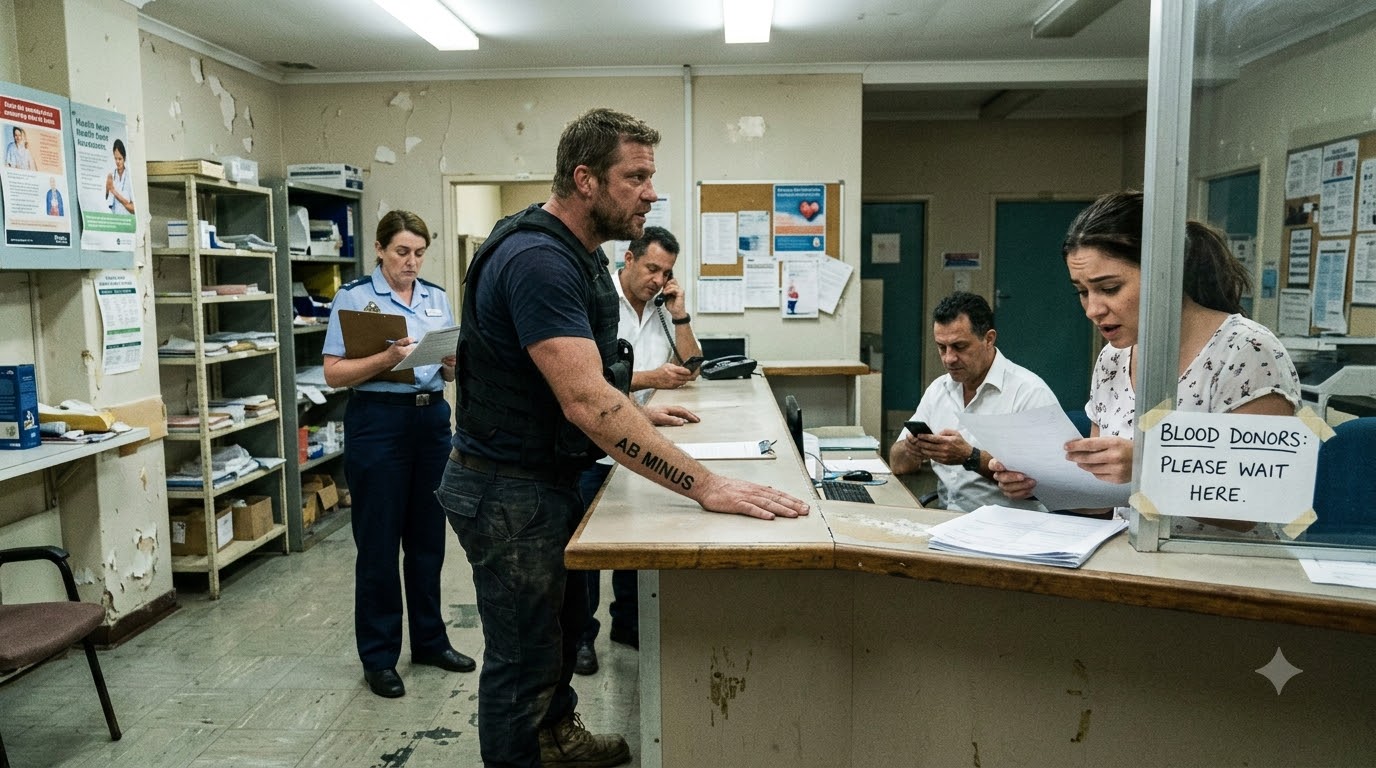
The receptionist looked up from her computer terminal, her eyes widening as she took in the patches stitched across the heavy vest. Her fingers hovered over the keyboard, frozen between reaching for the silent alarm and demanding an explanation. The broad-shouldered man stopped right at the counter, planting both heavy hands on the laminate surface.
“I heard you need blood,” he said, his voice low, steady, and entirely devoid of panic.
The receptionist blinked twice, trying to find her professional voice behind a wall of sudden intimidation. “Sir, you can’t just—”
“An ambulance driver out front told me,” the man interrupted, his tone flat and immovable. “Pregnant woman. Bleeding out. AB negative supply is empty.”
He pulled back the left sleeve of his dark t-shirt with a quick, practiced motion. On the inside of his thick forearm, stark black ink spelled out two letters and a symbol that stopped the receptionist’s breath short. AB minus.
“Test me,” he said, leaning slightly closer over the counter. “And do it fast. She doesn’t have time for paperwork.”
Down the hall, Dany watched the sudden intrusion over the shoulder of the blocked administrator. The heavy silence of the surgical wing fractured completely under the sheer gravity of the newcomer’s presence. Without a single word of argument, the receptionist scrambled out of her chair, grabbing a collection kit from the back shelf and waving frantically toward the lab testing window.
CHAPTER 4: The Vinyl Chair
The lab window slid open with a sharp click, and a technician handed a small, sealed vial back across the counter. The test took less than four minutes from start to finish, strip testing clearing every marker with absolute certainty. AB negative confirmed. Clean, compatible, and ready to move immediately.
Dr. Reyes received the confirmation call in the prep room while her surgical team held their breath around the sterile trays. Without missing a beat, she gave the order to initiate the transfusion line directly into Maria’s recovering veins.
The heavy-set donor walked down the short corridor toward the donation bay without waiting for an escort. He lowered his large frame into a standard vinyl chair behind a thin cloth privacy curtain, extending his left arm without a word. A nurse stepped forward with a sterile needle, her hands steady as she secured the line.
“You need anything?” she asked quietly, eyeing the heavy patches on his vest.
“Just make sure it goes where it’s supposed to,” he replied, staring straight ahead at the white wall.
The blood began to flow into the collection bag, a steady, dark stream carrying the exact biological match required to pull two lives back from the edge. Behind the partition, the monitors changed their frantic rhythm. The harsh, erratic warning alarms began to soften into an even, measured pace as the pressure lines ticked upward.
Dr. Reyes watched the numbers stabilize on the screen, letting out a long, slow breath through her mask. She picked up the scalpel and signaled her team to begin the C-section procedure. Every second counted now, backed by a resource that had appeared out of nowhere just as the clock ran out.
CHAPTER 5: The Lanyard Protocol
The plastic tubing filled with a steady, dark current as the last drop cleared the needle entry. Two hospital administrators rounded the far corner of the quiet recovery corridor, their lanyards swinging against pressed cotton shirts. One carried a clipboard with blank compliance forms already clipped to the surface. The other held a glowing mobile phone with the camera application active, its lens angled forward.
They stopped directly beside the vinyl chair where the donor sat peeling the cotton ball away from his arm. The man with the clipboard adjusted his glasses, his expression locked into a mask of rigid bureaucratic authority.
“Sir, we need formal identification and organizational documentation regarding your vest insignia,” the administrator said, tapping his pen against the paper. “Hospital liability protocols require an incident report for unverified persons entering restricted clinical zones.”
The second man raised his phone slightly higher, the screen casting a pale, cold light across the dark leather patches. “Hold still for a second, we just need a clear image for the internal risk management database.”
The donor did not stand up, but his posture shifted with a slow, deliberate gravity. He set the empty apple juice can down on the plastic armrest with a soft metallic clink.
“I walked through those doors because someone was bleeding out on your table,” the donor said, his voice flat, low, and completely devoid of intimidation. “You can write whatever you want on your paper. But you are not taking pictures of me.”
The clipboard holder took a half step forward, attempting to reclaim control of the hallway through sheer corporate posture. “It’s standard hospital procedure, not personal—”
“It stops right here,” a sharp voice cut through the corridor from the opposite end.
Dr. Reyes strode toward them, her surgical gown still stained at the cuffs, her face etched with the exhaustion of a nineteen-hour shift. She stepped directly between the administrators and the donor, her eyes burning with cold fury.
CHAPTER 6: The Quiet Exit
Dr. Reyes did not raise her voice, but every word carried the absolute weight of a physician who had held life in her hands while the building around her slept.
“This man saved my patients tonight,” she said, her bloodshot eyes fixed on the man with the clipboard. “Both of them. A twenty-six-year-old mother and her newborn daughter. If you need to document something, write that down in your files.”
The administrator opened his mouth to protest, his pen hovering uselessly over the blank compliance sheet. He glanced from the doctor’s rigid posture to the broad shoulders of the donor standing silent beside the vinyl chair. The second man quietly slipped his phone into his pocket, the glowing screen blinking out before he took a half step backward.
“I don’t care about your liability forms,” Reyes continued, stepping closer until the bureaucrat had nowhere left to retreat. “He is under my care, and right now, I am telling you to walk away.”
Neither administrator spoke another word. They turned on their heels and retreated down the corridor, their polished shoes clicking rapidly against the floor until the doorway swallowed them whole.
The donor looked down at Dr. Reyes, and the two exchanged a single, heavy nod of mutual understanding. Without a word of farewell, he turned and started down the hallway toward the exit.
As he neared the double doors, Dany stepped out from the shadows near the recovery rooms. The skinny kid from the body shop stood with red-rimmed eyes and shaking hands, looking at the large man who had come out of the rain. Dany did not offer a handshake or a formal greeting. He simply stepped forward and wrapped both arms around the man in the leather vest, holding on with the desperate grip of someone who had nearly lost everything.
The big man stood completely still for a long moment, then raised one large hand and gave Dany’s shoulder a single, firm squeeze.
“Go back inside,” the man said softly.
He pulled away, pushed through the heavy doors into the cool night air, and crossed the dark asphalt lot. He swung his leg over his motorcycle, kicked the engine to life, and rode out into the empty highway as the rain finally began to ease.