The Midnight Guard: How One Pilot Defied Fate Over Dark Philippine Skies
CHAPTER 1: SHADOWS OVER MINDORO
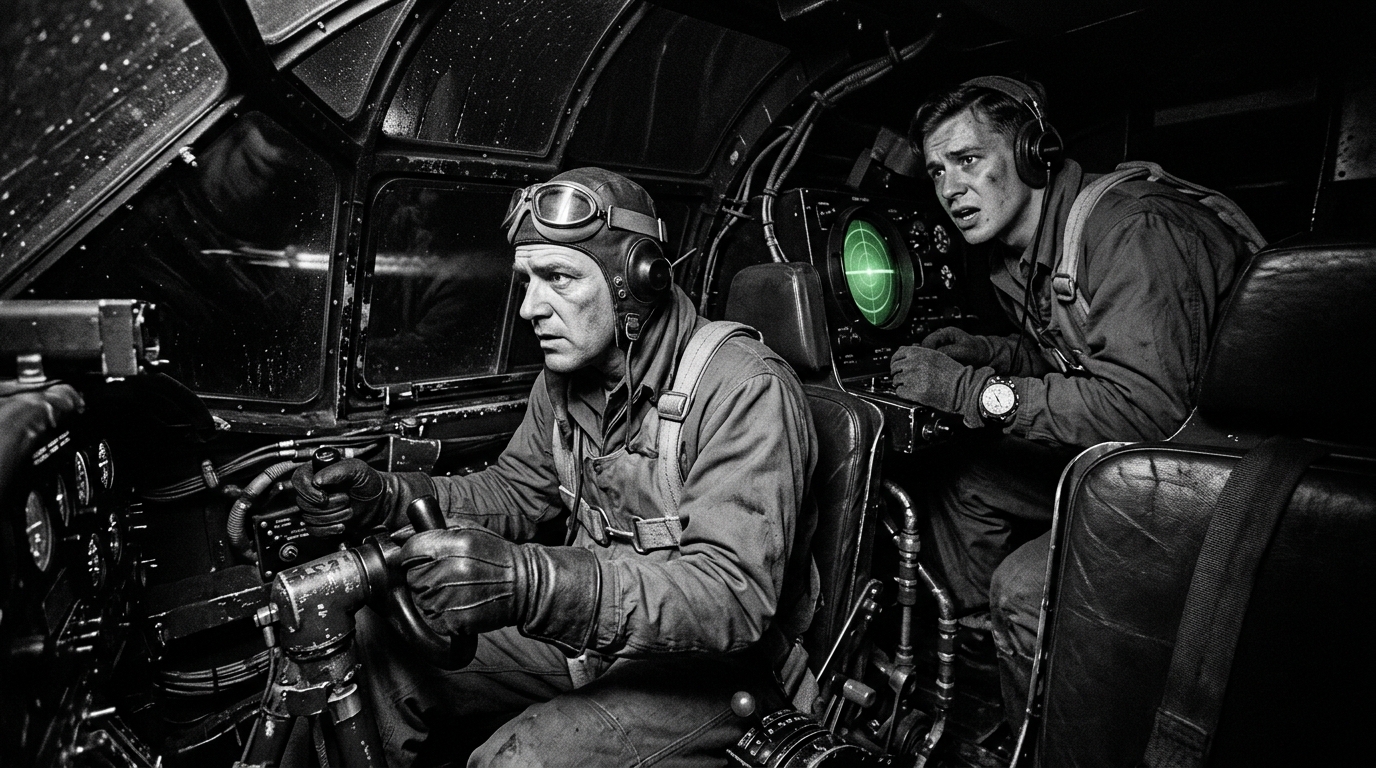
The twin Pratt & Whitney engines rattled the aluminum skin of the P-61 until my teeth felt loose in their sockets.
Under my left thigh, the cockpit floorboards vibrated with the heavy, dull thud of Japanese five-hundred-pounders tearing up the tree line two miles south. The air inside the glass canopy smelled like burnt oil, stale sweat, and the damp, rotting jungle mud we’d been dragged through for three weeks straight.
I reached forward, tapping the cracked glass face of the brass stopwatch mounted near the throttle quadrant. The mechanical tick was a dry, metallic click against the roar of four thousand horsepower.
“Smith,” Lieutenant Philip Porter’s voice came through the intercom wire, stripped of any polish by the static. He was crammed into the rear seat behind my bulkhead, shifting his boots against the metal floor. “Main board just sparked. Smell that?”
A thin, acrid ribbon of blue smoke curled out from the nose housing right between my pedals.
The green glow on the radar scope flickered twice, stretched into a flat, dead line, and went completely dark.
“Is the sweep dead?” I asked, keeping my hand steady on the wheel.
“Dead as a hammer,” Porter muttered. “Filament snapped. We’ve got no scope, Major. We’re flying a sixty-foot iron anvil into a pit of coal.”
I didn’t answer. Down on the strip, a kerosene lantern flickered out as another stick of high explosives walked across the dirt palm groves.
Twenty thousand American soldiers were sitting in canvas tents down there, listening to the drone of twin-engine Mitsubishi bombers circling overhead like bloated flies. If those construction crews didn’t finish the crushed-coral runway by morning, the invasion force heading for Lingayen Gulf would float into the beaches without a single fighter plane covering their heads.
I squeezed the throttle handles until the leather on my flight gloves groaned. “Hold onto your teeth, Phil. We aren’t turning back.”
The Black Widow surged down the rough strip, wheels bouncing hard off the uneven coral pits until the air caught the wings and lifted thirty thousand pounds of metal into the pitch-black sky.
CHAPTER 2: BLIND HORIZON
The altimeter needle swept past seven thousand feet, shuddering with the airframe.
Without the radar scope, the glass canopy was nothing more than a mirror reflecting my own pale face back at me. No stars. No moon. Just an endless, wet wall of clouds hanging over the Philippine Sea.
“Porter,” I called out, leaning forward until my chest pressed against the flight control column. “Look through the floor glass. Any fires below?”
“Negatory, Major,” Porter’s voice came back, tight and thin. “Just pitch. Ground crews turned off the beacon lamps when the second air raid siren went off. We’re floating in a bottle of ink.”
I tapped the brass stopwatch on the instrument panel with my gloved thumb.
Five minutes since takeoff. The twin Pratt & Whitneys were burning fuel at a terrifying rate at full climb power. Without Porter’s radar dish scanning ahead, we were flying straight into a wall, searching for twelve Japanese bombers by looking for needle-points of light in a pitch-black coal mine.
“Level off at eight thousand,” I muttered, easing the throttles back just enough to keep the superchargers from whining. “They’ll come in high first. That’s how they usually run the run-up to Mindoro.”
“Got a faint engine rumble to the port side,” Porter shouted through the static. “Can’t give you a distance, Major. It’s loud enough to shake my canopy glass, but it ain’t us.”
I threw the Black Widow into a steep left bank, pressing my temple against the cold side-glass.
My eyes strained against the dark until hot tears welled in the corners. Nothing. Just clouds, black and thick as wet wool.
Then, two thousand feet above us, a faint, sickly orange pulse cut through the gloom.
It wasn’t a searchlight, and it wasn’t a backfire. It was the dim, rhythmic glow of twin engine exhaust dampeners glowing white-hot under heavy load.
A Mitsubishi G4M—a Betty bomber—plowing south toward the airfields.
“Found him,” I said, my thumb slipping over the safety latch on the control stick’s trigger. “Keep your eyes peeled, Phil. He doesn’t know we’re in his shadow.”
I pulled the nose up, climbing straight toward the orange embers.
Without the electronic scope to tell me his exact speed or distance, I had to judge the gap purely by the size of those twin orange spots growing in the dark. If I miscalculated by fifty yards, we’d slice right through his tail section at three hundred miles an hour.
The Black Widow shook as we crossed into his propeller wash, the heavy fighter bouncing like an iron safe dropped down a flight of stairs.
“Range feels like six hundred yards,” I muttered, my heart slamming a steady, heavy beat against my ribs. “Closing fast.”
“Watch his tail gunner,” Porter warned from the back. “Those twenty-millimeter stingers in the glass bubble will cut our nose right off.”
At four hundred yards, the silhouette materialized out of the cloud bank—a long, cigar-shaped shadow cutting through the night.
I didn’t align a radar grid. I lined up the dark, looming shape of his twin rudders right in the center of the illuminated iron gunsight, holding my breath to keep my hands from shaking against the cold metal stick.
Then I saw it.
High up on the Betty’s fuselage, a small, shielded orange light flashed once every forty seconds. Not an exhaust spark. A signal light, rhythmic and deliberate, pointed straight down at the ocean.
“He’s not flying blind,” I whispered into the mic, my finger tightening on the iron spur. “He’s leading a line.”
I squeezed the trigger.
The four belly-mounted Hispano cannons roared in unison, lighting up the inside of my canopy with blinding, white-hot muzzle flashes that wiped out my night vision instantly.
The heavy high-explosive rounds tore across the gap, ripping straight into the Betty’s starboard wing root.
A second later, the bomber’s fuel tanks let go with a brilliant, deafening orange flash that turned the midnight sky into broad daylight.
CHAPTER 3: THE FUEL EQUATION
The burning wreckage fell away into the cloud bank below, leaving us back in the pitch-black void.
I tapped the brass stopwatch on the housing. Twelve minutes elapsed since takeoff. I reached for the fuel selector valves on the floor panel, feeling the cold, notched steel click into place beneath my leather glove.
“Fuel gauge is reading forty-two percent, Carroll,” Porter said from behind me, his breath blowing harsh across his intercom microphone. “That dive to catch the first target ate up our climb margin.”
“We’ve got another one out there,” I said, leaning my brow against the cold windshield frame. “Did you see that signal light on the fuselage before she broke?”
“I saw it,” Porter replied, shifting his boots against the metal rudder tracks. “A belly beacon. He wasn’t aiming for the runway, Carroll. He was marking an assembly point for the rest of the package.”
I pulled the throttles back to economical cruise, forcing my shoulders to drop an inch. The engines smoothed out from a scream to a heavy, rhythmic thudding that vibrated straight through my spine.
“Where’s the next one, Phil?”
“Engine noise coming from the south-southwest,” Porter said, leaning his ear against the canopy frame to catch the faint vibration through the metal hull. “Sounds lower than the last one. Maybe six thousand feet.”
I nudged the control stick forward, diving the Black Widow through a patch of freezing rain.
The airframe shuddered as we picked up speed, the speed indicator needle creeping past three hundred miles an hour. Every extra mile of air speed we wrung out of those twin engines took gallons of high-octane gasoline we wouldn’t get back.
Two miles ahead, a dark shape cut across a gap in the cloud deck—another Nakajima bomber, moving fast and steady toward the coast.
“No lights on this one,” I muttered, my left thumb resting on the cold steel trigger ring. “He’s relying on the lead plane’s path.”
I throttled back, sliding the heavy fighter under his blind spot beneath his tail.
Without an electronic scope to calculate our closure rate, I had to watch his engine exhaust stubs—two tiny orange pinpricks—grow from the size of matches to the size of quarters. If he hit his brakes or banked hard, we’d slam right into his ventral machine gunner.
“Range feels right,” I whispered. “Hold on.”
I squeezed the trigger ring.
The four cannons thundered, the recoil shaking the instrument panel so hard the stopwatch needle jumped a notch. Red tracer streams cut straight through his port engine nacelle, tearing away chunks of metal skin before the wing ruptured in a sheet of blue flame.
The bomber spiraled down into the dark, illuminating the sea for three seconds before blackness swallowed it whole.
“That’s two,” Porter rasped, his voice tight with adrenaline. “How’s the gauge?”
I looked down at the small illuminated needle on the fuel display.
Twenty-eight percent. We were already three points below the Navy’s mandatory return threshold, floating over forty miles of open ocean with ten more bombers somewhere in the dark ahead of us.
CHAPTER 4: THE FOURTH ARC
“Carroll, look down,” Porter snapped over the wire, his voice sharp enough to cut through the hum of the twin Pratt & Whitneys. “To the south. Low.”
I leaned my forehead against the damp canopy side-glass, peering past the black curve of the cowl.
Four thousand feet below, three white searchlight beams cut through the rain-soaked dark over McGuire Field. They weren’t sweeping back and forth. They were locked together in an apex, illuminating a fast-moving shape diving straight toward the central troop encampment.
A fourth bomber—a Ki-49 Helen—was skimming the tree line, bypassing the outer perimeter completely.
“He’s under their radar floor,” I muttered, easing the control column forward until my harness straps bit hard into my shoulders. “He’s making a straight run for the tent city.”
The Black Widow dropped like a dropped stone, air screaming across the rivets.
Without our electronic scope to guide us in, diving from nine thousand feet straight into an active anti-aircraft zone was sheer insanity. Down below, twenty-millimeter tracer rounds were already streaming up into the clouds in long, red arcs, crisscrossing the dark sky with live fire.
“We’re diving right into our own flak!” Porter yelled, his boots slamming against the floorboards as gravity pulled us into our seats.
“If he drops those anti-personnel clusters on the camp, two hundred men die before they get out of their cots,” I said, my jaw clenching until my rear molars ached. “Keep your eyes on his tail.”
The speed indicator needle spun past three hundred and fifty miles an hour.
The airframe vibrated with a terrifying, metal-on-metal shudder as the dive flap controls stiffened under the pressure. I aligned the dark silhouette in my illuminated sight ring, using the flash of our own anti-aircraft guns on the ground to outline his rudders.
He was three hundred yards ahead, pulling his nose up to level out over the palm trees for his bomb run.
“Get us out of his tail arc!” Porter shouted. “His rear gunner’s tracking!”
A string of green tracer fire erupted from the Helen’s tail bubble, snapping past our starboard engine nacelle so close I could smell the burnt cordite through the air intake.
I didn’t turn away. I kicked the left rudder pedal down hard, side-slipping thirty feet to the left while keeping the control stick centered on his starboard wing root.
I squeezed the trigger ring until it hit the metal stop.
The four belly cannons roared, dumping forty-eight high-explosive shells into his fuselage in two seconds flat.
The Nakajima’s starboard wing tore completely free from the frame, spraying high-octane fuel that ignited into a wall of yellow flame directly in front of my canopy. I pulled back on the stick with both hands, straining every muscle in my back to lift the thirty-thousand-pound fighter over the fireball.
The heat slammed against the glass like a furnace door opening.
We cleared the burning debris by twenty feet, the shockwave tossing our tail section up as the bomber hit the surf off the beach at three hundred miles an hour.
“That’s four down,” Porter breathed, his voice cracking as the g-force eased off his chest.
I looked down at the fuel display on the dashboard.
The needle sat at twenty-three percent—well past the point of safe return. And down below, the twelve searchlight lamps along the McGuire Field strip suddenly flickered once, twice, and went completely dark.
CHAPTER 5: BLACKOUT APPROACH
“Airfield defense killed the strip lights,” Porter reported through the wire, his voice flat with cold focus. “Command thinks there’s still an active raid overhead.”
“We can’t divert,” I said, tapping the brass stopwatch mounted on the panel. “Fuel gauge shows nine percent. Tacloban is ninety miles out—we’d drop into the ocean forty miles short.”
I eased the throttles back, letting the twin Pratt & Whitneys spool down to a low, throaty hum.
Without the electronic scope or ground lights, landing thirty thousand pounds of iron on a five-thousand-foot strip of crushed coral meant flying purely on needle readings and guesswork. If we came in twenty feet too low, the main gear would tear off against the palm trees at the beach head; twenty feet too high, and we’d overshoot straight into the jungle bayou.
“Radar altimeter’s live,” Porter called out, leaning over his panel in the rear compartment. “Measuring four hundred feet above ground level, Carroll. Heading one-eight-zero.”
“Keep calling the height,” I said, my thumb flicking the landing gear lever down.
A heavy mechanical clunk echoed through the airframe as the nose and main gear swung down and locked into position. Three green indicator lights flickered on the dash, casting a dim glow across my knuckles.
“Three hundred feet,” Porter called out. “Airspeed one-thirty.”
“Drop flaps to full,” I muttered, pulling the flap handle back until the airframe shuddered against the drag.
The nose pitched down as the airspeed bled off to one hundred and ten knots.
Below the canopy, the pitch-black darkness offered zero visual references—no horizon, no tree line, no white surf break. Just a needle sinking toward zero on a small dial while the engines sucked the last few gallons out of the wing tanks.
“One hundred feet,” Porter rasped, his boots bracing against the metal bulkheads behind me. “Heading holding steady on one-eight-zero.”
“Hold your breath,” I whispered, easing the control column back toward my chest to flare the nose.
The dark pulled up to meet us in absolute silence.
CHAPTER 6: CRUSHED CORAL
The main gear slammed into the coral runway with a bone-jarring jolt that rattled the instrument glass against its rivets.
The Black Widow bounced once, settled heavy on its struts, and rolled straight down the dark strip as I stomped on the toe brakes with both feet. The hydraulic lines groaned, tires skidding through wet gravel until thirty thousand pounds of iron came to a dead stop fifty yards from the jungle palm line.
I unclipped my oxygen mask and let it dangle, taking a deep breath of thick, hot jungle air that tasted of exhaust fumes and sea salt.
My hands were shaking on the control wheel—not from fear, but from holding three hundred miles an hour through sixty minutes of sheer tension. Beside my left knee, the brass stopwatch clicked its final, irregular beat and settled into silence.
“We’re down, Carroll,” Porter said from the rear compartment, his voice raspy as he unlatched his canopy glass and slid it back. “We’re on the ground.”
Down the length of the runway, three ground crewmen ran up through the darkness waving hooded yellow flashlights, their boots crunching loudly over the coral.
They guided us off the active strip and into the revetment shelter, where an intelligence officer was already standing in the rain with a clip-board under his arm, staring at our blackened cannon ports.
I cut the magnetos. The twin Pratt & Whitneys sputtered, coughed once, and died.
The fuel needle on the dashboard sat flat against the bottom stopper—six percent remaining, less than twenty-nine gallons of high-octane gasoline sloshing in the main tanks.
I climbed down the side ladder, my boots hitting the wet dirt with a heavy thud.
The air was quiet now, save for the dull, distant rumble of thunder out over the ocean where the remaining seven bombers had turned back into the night.
The intelligence officer stepped up, shining a small flashlight onto my flight jacket. “Major Smith? Command saw the explosions off the coast. What’s the count?”
I reached into my pocket, pulled out a small piece of chalk, and walked over to the nose section of the P-61.
“Four bombers,” I said, rubbing a smudge of engine soot off my sleeve. “And one fighter that tried to jump us on the way in.”
Porter stepped down beside me, resting his hand against the cold, rain-slicked wing root. “No radar scope either, Captain. We flew it on visual glows and engine noise.”
The officer stared at the nose of the plane, then looked down at his watch, writing something quickly across his paper. “Five kills in under an hour. You just broke the Pacific night record, Major.”
I didn’t answer. I leaned against the fuselage, feeling the engine casing slowly radiate its remaining heat into the cool night rain.
Down in the palm groves, the kerosene lanterns were being relit one by one.
Through the trees, the sound of diesel tractors and heavy earthmovers roared back to life as the construction crews climbed back onto their machines, leveling crushed coral under the searchlights so the invasion force could land on schedule.