A Debt Paid in Iron: The Quiet Dismantling of a Fugitive Life in the Kansas Dust
CHAPTER 1: THE WEIGHT OF THE PROPERTY
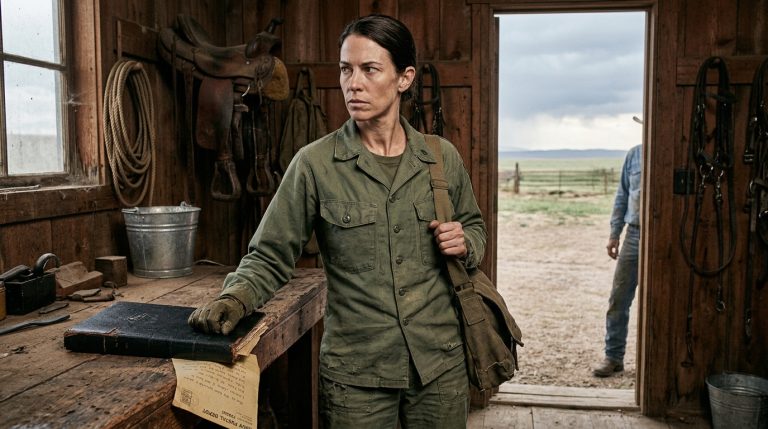
The closet in the Kansas bedroom smelled of dry earth and old paper. Colleen knelt on the floorboards, the wood groaning under her weight, and pushed aside a row of winter coats that had seen better decades. She wasn’t looking for a dress. She was looking for the anchor.
Her fingers brushed against the rough grain of a wooden box tucked behind a loose baseboard. It was heavy, a compact, suffocating weight that had held her life in stasis for twenty-two years. She pulled it out. The hinges were stiff, coated in the oxidation of a humid, long-forgotten summer. When she pried the lid open, the smell of iron filled the air, sharp and metallic.
Inside lay the single photograph of her mother and the original keys to the sedan she had stolen in Tulsa. But beneath them, pushed into the velvet lining, was the Ledger—a small, leather-bound notebook she had found in the glovebox all those years ago. It hadn’t just been a car. She had driven away with a life’s worth of records, an accidental thief of information that had haunted her as much as the stolen metal.
The truth was a rust that never stopped spreading.
Outside, the wind whipped across the plains, rattling the windowpane in its frame. Somewhere in the distance, a tractor engine sputtered, its rhythmic clanking echoing the mechanical instability of her own heart. The wedding invitation rested on the vanity, cream-colored and impossibly pristine, a stark contrast to the grit under her fingernails.
She wasn’t just a mother preparing to give a daughter away. She was a tenant of a life she didn’t own, occupying space that belonged to the past. The police hadn’t knocked, but the silence had become a physical pressure, a vacuum that threatened to collapse her lungs every time Sam, the firefighter, looked at her with that unsuspecting, crooked grin.
She touched the edge of the ledger. The paper was dry, brittle enough to crumble. If she walked down that aisle, she would be leaving the lock engaged on a cage that had held them both captive. The decision wasn’t about the law anymore. It was about property—about who owned the narrative of her daughter’s future.
A sharp rap on the bedroom door made her freeze.
“Mom? You decent? The florist is here and the peonies are starting to wilt.”
Colleen slid the ledger back into the box, her heart hammering against her ribs like a trapped bird. She stood up, her jeans stiff and heavy, the material worn thin at the knees. She wasn’t wearing the silver dress. She was wearing the uniform of a woman who was done hiding.
“I’m coming, Emma,” she said, her voice raspy, like dry leaves skittering across pavement.
She opened the door, but her hand lingered on the handle. The light from the hallway caught the edge of the wooden box, and for a split second, she saw not her daughter, but the reflection of a stranger—a woman with iron in her blood and a secret that was finally, inevitably, turning to dust.
CHAPTER 2: THE AUDIT
The closet door remained slightly ajar, a sliver of darkness amidst the sun-bleached neutrality of the bedroom. Colleen stood motionless, the air in the small room feeling thin, as if the oxygen were being steadily displaced by the weight of the objects she had just unearthed. Her fingers were still stained with the fine, red-brown grit of the box’s interior—the residue of time, or perhaps just the accumulated decay of two decades of cowardice.
She didn’t move toward the door where Emma’s voice had just vanished. Instead, she turned back to the box. She pulled out the leather-bound ledger. It was light, deceptively so, given the gravity it exerted on her stomach. She opened it. The pages were yellowed, brittle as autumn leaves, covered in a neat, fountain-pen script that detailed accounts, dates, and names of people long since buried or dispersed. It wasn’t just a record of a car owner’s finances; it was a map of a stranger’s existence, a life she had inadvertently intercepted on a night when her own world had been falling apart.
Her heart rhythm was erratic, skipping beats with the precision of a failing clock. She scanned the entries. There were references to Tulsa—to streets she used to walk, to a grocery store parking lot that no longer existed in the same form. As she turned the pages, a loose slip of paper fell out, fluttering to the floorboard with a soft, dry sound.
It was a receipt, pinned to a scrap of stationary with a handwritten note in the margin: Final notice. The debt must be settled by the month’s end.
Colleen’s breath hitched. For twenty-two years, she had lived with the idea that the theft was a singular, isolated act of desperation—a clean break. She had convinced herself that the car owner’s insurance had covered the loss, that the inconvenience had been erased by the bureaucratic machinery of the state. But this—this was personal. This was a man struggling against a closing window, just as she had been. The guilt that had been a dull ache in her chest sharpened into a jagged, physical pressure.
She heard footsteps in the hall—quick, light, the unmistakable cadence of Emma walking toward the kitchen. The sound brought with it a phantom chill. If Emma saw this, if she stumbled upon this box while searching for a spare shoe or a hidden roll of tape, the life they had built—the life built on a foundation of “good,” “honest,” and “kind”—would dissolve into ash.
Colleen tucked the ledger back into the box and shoved it behind the baseboard, forcing the wood to snap into place. She had to move. The wedding couldn’t wait for her internal audit. She stood up, her knees popping with the protest of a body that had spent too long crouched in the dark.
She walked out of the bedroom, crossing the threshold into the hallway. The house was humming with the frantic, localized energy of a pending event. There were vases of peonies everywhere, their scent cloying and suffocating, masking the smell of the dust and the rust that she felt clinging to her own skin.
She walked into the kitchen. Emma was standing at the island, a stack of programs in her hand. She looked up, her expression bright, eager—a mirror of the innocence Colleen had worked so hard to cultivate.
“Mom, are you okay? You look like you’ve seen a ghost,” Emma said, stepping toward her.
Colleen forced a smile, the muscles in her face feeling tight, unpracticed. “Just a bit overwhelmed, honey. It’s a lot of flowers.”
“It’s just one day,” Emma said, reaching out to squeeze Colleen’s hand. Her grip was warm, solid, and terrifyingly real. “We’ve got everything under control. The car is coming for us in an hour, and the venue is all set. You just need to get yourself into that silver dress and breathe.”
Colleen looked down at their joined hands. She thought of the ledger hidden in the wall, only ten feet away. She thought of the 911 operator she hadn’t yet called, the voice she hadn’t yet heard. She was standing in the center of a life built on a lie, and the floorboards beneath her felt less like home and more like a trapdoor.
“I know,” Colleen said, her voice steadying. “I just need a moment to settle myself.”
She moved toward the kitchen counter, needing a point of contact, something physical to ground the vertigo that threatened to pull her under. She picked up a glass of water, the cold condensation slick against her palm. She didn’t drink. She just watched the way the sunlight hit the water, refracting into a thousand tiny, distorted rainbows.
She had to ensure that the box remained hidden until the moment she was ready to pull the entire structure down. She wasn’t just a mother anymore; she was an architect of an inevitable collapse, and for the first time in twenty-two years, the weight of the truth felt less like a burden and more like a necessary tool—a crowbar she would eventually use to pry her own life open.
“Mom?” Emma asked again, her tone shifting, touched by a faint, intuitive concern. “You’re gripping that glass like you’re trying to crush it.”
Colleen set the glass down. The sound of it hitting the granite was sharp, a final, punctuating note. “I’m fine, Emma. Truly. Go finish the programs. I’ll be ready.”
She turned away, heading back toward the silence of the house, where the past was waiting behind the wall.
CHAPTER 3: THE MIRROR
Colleen didn’t make it to her bedroom. Before she reached the hallway’s midpoint, a violent, metallic shudder coursed through the walls of the house. It started with a low, visceral groan from the floorboards beneath her feet and exploded into a high-pitched, abrasive screeching behind the kitchen wall. Water pipes, calcified and weary, were finally giving up the ghost under the strain of the morning’s activity.
She stopped, her hand hovering over the doorframe. The sound was like a scream cut short—an abrupt mechanical death. In the kitchen, she heard the distinct, splashing rhythm of water hitting hardwood.
“Mom? Something burst under the sink!” Emma’s voice, previously light with wedding-day anticipation, now carried the sharp edge of panic.
Colleen forced herself to pivot. The internal, frantic need to return to the box in her closet—to the ledger that felt like a burning weight against her conscience—was momentarily superseded by the immediate, pragmatic crisis. She moved back into the kitchen. Water was already pooling across the floor, a dark, spreading stain that curled around the base of the cabinets like ink.
Sam, who had been hovering near the back porch, was already kneeling under the sink, his movements efficient and practiced. He was a firefighter; leaks and structural collapses were the mundane language of his life.
“Shut-off valve is seized, Colleen,” Sam said, not looking up. His voice was calm, but there was a tension in his shoulders that hadn’t been there ten minutes ago. “The rust has pretty much welded it to the pipe. I need a wrench—the heavy-duty one. Is there one in the garage?”
Colleen stood there, looking at the water. It was clear, yet as it pooled on the floor, it picked up the dust and the grime of the house, turning murky. It was a perfect, accidental mirror of her own situation. For twenty-two years, she had lived by the philosophy of surface-level maintenance—painting over the cracks, ignoring the slow oxidation of her own history, keeping the pipes of her life quiet so that no one would notice the corrosion inside.
“Colleen?” Sam’s voice sharpened.
“The garage,” she said, her voice sounding hollow to her own ears. “On the pegboard. Behind the oil cans.”
She watched Sam sprint out the back door. Emma was on her knees, desperately trying to divert the water with a stack of wedding programs. It was a futile gesture, one that made Colleen’s chest ache with a sudden, sharp clarity. Emma was trying to save the appearance of the day, to keep the floor clean for the guests who would arrive in a few hours, unaware that the foundation of the house—and the mother they were coming to celebrate—was literally leaking.
Colleen didn’t help with the water. She couldn’t. She walked over to the kitchen island and leaned against it, her hands gripping the cold, hard granite. She watched the water seep into the grout, into the hidden, inaccessible spaces beneath the floor. She realized then that she had been doing the exact same thing with the truth. She had been letting it leak, hoping the floor would absorb it, hoping the rot would remain beneath the surface where no one could see.
“It’s not going to stop the damage, Em,” Colleen said softly.
Emma looked up, her face flushed, her hair coming loose from its carefully pinned styling. “We have to try, Mom. Everything is supposed to be perfect today.”
“Nothing is ever perfect,” Colleen replied. The words felt heavy, the first true thing she had said in two decades. “Sometimes the pipes just break. It doesn’t mean the house is gone, but it does mean we have to stop pretending it’s dry.”
Sam burst back through the door, his face streaked with a smudge of grease. He dove back under the sink. The screeching of metal on metal filled the room—a raw, grating sound that made Colleen’s teeth ache. She watched the physical exertion, the way Sam’s muscles corded as he fought the seized valve. It was a battle of physics. He was applying force, leverage, and grit to a system that had surrendered to the elements years ago.
Colleen looked at her own hands. They were clean, but she could still feel the phantom sensation of the ledger’s rough, leather cover. She had been the one to let the rust take hold. She had been the one to keep the water running when she should have cut the supply.
She turned and walked out of the kitchen, leaving Sam and Emma to the flooded floor. She didn’t head for the garage to help. She headed back to her bedroom. The crisis in the kitchen had been the final trigger. The “Sovereign Protector” of her own secrets had failed. The house was flooding, and she was the one who had kept the tap open for twenty-two years.
She reached her room, closed the door, and locked it. She didn’t look in the mirror. She knew what she would see: a woman who was no longer just waiting for the knock on the door, but a woman who was finally ready to open it.
CHAPTER 4: THE JOURNEY TO THE CHURCH
The air in the bedroom was still, heavy with the scent of dust and the faint, lingering perfume of the lilies Emma had chosen for the altar. Outside, the house was a cacophony of dripping water and Sam’s frustrated commands to himself, but in here, the silence was absolute. Colleen stood before the vanity, her hands resting on the cold glass surface. She stared at her reflection, but it wasn’t the face of a mother she saw; it was the face of an impostor.
Twenty-two years of maintenance had eroded her features in ways she had never noticed until now. The tension lines around her eyes were not from age, but from the constant, low-level vigilance of a fugitive. She reached into the mirror’s frame, touching the reflection of her own cheekbone, feeling the reality of skin and bone, and wondering how much of her was genuine and how much was a performance designed to keep the shadows at bay.
She walked to the closet, her movements deliberate and slow. She didn’t look at the wedding dress hanging on the door, ivory and pristine, an object of such terrifying purity that it felt like an accusation. She went straight to the baseboard. She pried it loose with the edge of a flathead screwdriver she had kept hidden in the drawer for just such a purpose. The wood gave way with a splintering crack that sounded, in the quiet room, like a gunshot.
She pulled the wooden box into the light. She opened the ledger again. She needed to memorize the names, the dates, the specific details of the life she had derailed. If she was going to turn herself in, if she was going to finally stop the running, she needed to know exactly what she was paying for. The entries were a record of a man named Elias Thorne—a man who had been struggling to keep a small business afloat, a man whose life had been thrown into disarray by a stolen sedan. She had never known his name until now. For two decades, he had been an abstract victim, a faceless consequence. Now, he was a person with a bank account and a ledger, and the guilt she felt was no longer an abstract concept. It was a weight, heavy and iron-willed.
The bedroom door rattled. “Mom? We’ve got the leak under control, but we’re behind. We need to leave in twenty minutes.”
“I’m coming, Emma,” Colleen called out. Her voice was steady, surprised by its own calm.
She slipped the ledger into her handbag, the leather cool and slightly abrasive against her fingers. It felt like carrying a live coal. She stood up, shoved the box back into the dark recess, and hammered the baseboard back into place with the heel of her hand. The pain in her palm was sharp, a grounding sensation that helped her push down the rising tide of panic.
She left the room, her walk steady. The hallway was damp, the carpet beneath her feet feeling spongy and unnatural. She walked past the kitchen, where Sam was wiping down the floor with a thick, gray rag. He looked exhausted, his shoulders slumped, the adrenaline of the repair having left him drained. He didn’t look up, and Colleen didn’t stop. She didn’t offer a platitude or an apology. There was no room left for small talk.
The journey to the church was a blur of gray asphalt and the relentless, rhythmic swish of windshield wipers, though the sky above the Kansas plains was clear. Colleen sat in the back of the car, watching the landscape roll by. The fields were brown, dry, and scarred by the remnants of the harvest. Everything looked worn, used, and tired. She felt a strange kinship with the earth outside. It had been worked, broken, and pushed to its limits, and yet it remained, indifferent and vast.
She kept her hand on the strap of her bag. The ledger was inside, a physical representation of the truth that was currently vibrating in her mind. Every mile the car traveled was a mile closer to the altar, and every mile was a countdown. She found herself counting the telephone poles, the fence posts, the cracks in the road. It was a compulsion, a way to keep her brain from splintering.
She looked at Emma in the rearview mirror. Her daughter was staring out the window, her expression pensive. Emma was probably thinking about the vows, about the future, about the life she was about to build with Sam. She had no idea that her mother was sitting behind her, carrying a confession that would turn her world into a storm.
“Are you nervous, Mom?” Emma asked, catching Colleen’s gaze in the mirror.
“No,” Colleen said, and she meant it. The nervousness had burned away, leaving behind a cold, clear resolve. “I’m just thinking about how much has led to this moment. How many paths had to cross for us to be here.”
Emma smiled, a soft, genuine expression that reached her eyes. “I’m glad you’re here, Mom. I wouldn’t have been able to do this without you.”
The words struck Colleen with the force of a physical blow. She had been the one who had made the journey possible, but at the cost of the very integrity she was now trying to reclaim. The car turned onto the gravel road leading to the church. The white steeple appeared on the horizon, stark and unforgiving against the endless blue of the sky.
Colleen closed her eyes. She could hear the rustle of the ledger in her bag as the car hit a bump. It was the only sound in the world that mattered. She was at the threshold, and there was no turning back. The road had finally run out.
CHAPTER 5: THE THRESHOLD
The car rolled to a slow, crunching halt on the gravel path. Outside, the Kansas sun hung low and relentless, casting long, needle-thin shadows across the white-washed facade of the Little Flower Church. The air was dry, carrying the scent of parched earth and the sweet, cloying perfume of the floral arrangements waiting inside.
Colleen didn’t move. She sat in the backseat, her hand still locked onto the strap of her bag. Inside, the ledger felt like it had doubled in weight, pressing against her hip like a lead weight. She was looking at the church steps, counting the concrete risers. Six of them. Six steps between the world of the lie and the world of the consequence.
“We’re here, Mom,” Emma said, turning in the passenger seat. Her eyes were bright, filled with the specific, terrifying optimism of a bride on her wedding day. “You ready?”
“Almost,” Colleen said. Her voice didn’t shake. It was a flat, pragmatic sound.
She watched Emma climb out of the car. The sunlight caught the ivory satin of her daughter’s dress, making it glow with an ethereal, almost painful brilliance. It was the visual manifestation of everything Colleen had fought to protect—the purity of Emma’s future, the integrity of the life she had crafted out of scraps and silence. But as Emma turned to help her out of the car, Colleen saw a discrepancy.
Tucked into the stone planter near the church entrance was a familiar, weather-beaten brochure for a local law firm—the same name she had seen on a business card she had plucked from the ledger back in the bedroom. It was a triviality, a coincidence of geography, yet it sent a cold, electric jolt through her spine. She had spent two decades believing she was the only ghost in this story, but the world was smaller, more interconnected, and more demanding than she had ever dared to believe.
“Mom? Is something wrong?” Emma asked, her hand extended.
Colleen took it. Her daughter’s palm was warm, dry, and trusting. She stepped out of the car, the gravel shifting under her heels with a harsh, grinding sound. She took a deep breath, the air filling her lungs with the metallic tang of the coming storm.
“Nothing is wrong, Emma,” Colleen said, and she meant it. The ambiguity of the last few hours had crystallized into a single, kinetic purpose. “Everything is exactly where it needs to be.”
She walked toward the church door, her movements precise and measured. She passed the stone planter, and for a fleeting second, her eyes flickered toward the business card tucked into the soil. It was a sign, a nudge from the universe. She didn’t pause. She couldn’t afford the luxury of hesitation.
As they approached the threshold, the sound of the organ began to drift through the heavy wooden doors—a low, melodic hum that vibrated in the soles of her feet. It was the sound of an ending.
She stopped at the foot of the stairs. Emma started to move toward the entrance, but Colleen held her back with a gentle, firm pressure on her arm.
“Emma, wait,” she said.
The organ music continued, a mournful, steady pulse. Around them, the guests were beginning to congregate, their voices a soft, indistinct murmur that seemed to come from a different reality. This was the transition zone, the thin, razor-sharp edge between the life she had stolen and the life she was about to reclaim.
She looked at her daughter. She saw the confusion beginning to cloud Emma’s eyes, the first fracture in the perfect, polished surface of the day. It was the most difficult thing she had ever done—to intentionally mar that beauty—but it was necessary. If she didn’t do it now, the truth would eventually tear through Emma’s life anyway, and it would do so without the context of her mother’s hands holding her through the breaking.
“Mom, what is it? The ceremony is about to—”
“I know,” Colleen interrupted. Her gaze shifted from her daughter’s face to the heavy, iron-latched doors of the church. She could feel the ledger against her side, a burning, jagged truth that refused to stay buried any longer. “I need you to listen to me, Emma. Not as a bride, and not as a guest. Just as my daughter.”
She saw the shadow of fear cross Emma’s face, a sudden, intuitive recognition of the gravity in Colleen’s voice. She didn’t run. She didn’t pull away. She stood still, rooted in the dust of the driveway, waiting.
Colleen reached into her bag. Her fingers found the edge of the leather cover, the rough, worn texture of the past. The time for the facade was over. The structure was coming down.
“I’ve spent twenty-two years keeping a secret that wasn’t mine to hide,” Colleen said, her voice dropping into the quiet, resonant space between the cars. “And before you walk into that church, you have to know who is walking behind you.”
The wind gusted, swirling dust around their feet, and for a moment, the world seemed to hold its breath.
CHAPTER 6: THE TESTIMONY
The doors to the Little Flower Church groaned as they swung inward, the sound echoing like a dry, rasping breath. Inside, the world was bathed in a thick, amber glow filtered through stained glass, the air smelling of lilies and floor wax—a scent so clean it felt like an indictment. Emma stood before her, her face an unreadable mask of shock, her ivory dress seeming to absorb the dim light rather than reflect it.
“Mom,” she breathed, the word barely audible over the swelling organ chords. “What are you talking about?”
Colleen didn’t let the moment settle. The momentum was a physical force, pushing her forward across the threshold. She walked into the nave, the heels of her boots striking the wooden floorboards with a sharp, rhythmic finality. The congregation was already seated—two hundred people in pastels and suits, a sea of normalcy that was about to be forcibly drained.
She reached the center aisle and stopped. She didn’t look at the altar where Sam stood, a confused frown pulling at his features. She didn’t look at the pews, where neighbors she had fed and friends she had cherished sat in expectant, polite silence. She looked straight ahead at the space where the bride and the mother were supposed to walk, and she saw the fracture she had created.
She turned to face the room. Her pulse was a low, steady thrum against her collarbone, a metronome for the collapse of her life. She reached into her bag and felt the ledger again, the leather cover now slick with the cold sweat of her palms. She didn’t pull it out; she didn’t need to. The weight of it was enough.
“My name is Colleen Massie,” she began. Her voice was thin at first, brittle, but it gained depth as the words left her mouth. It was the sound of a rusted gate being forced open after decades of being welded shut.
The church went silent—not the silence of waiting, but the silence of an held breath. In the third row, a woman in a floral dress stood up, her movement slow and uncertain. The organist, sensing the shift in the air, faltered, the last chord dying away in a discordant whine that hung in the rafters like a trapped bird.
Colleen felt the phantom presence of her own past—the memory of that long, desperate night twenty-two years ago, the steering wheel slick under her fingers, the radio off, the darkness of the road pressing against the windshield. It wasn’t just a memory anymore; it was an active force, a ghost that had finally caught up to her.
She saw Sam step off the altar. His face was a shifting landscape of confusion, hurt, and, beneath it all, a dawning realization that he was witnessing something that could not be un-seen. He moved to place a hand on her shoulder, a gesture of comfort or containment, but Colleen stepped aside, her movement sharp and defensive. She was not a victim to be rescued, and she was not a problem to be fixed. She was a woman paying a debt.
“Twenty-two years ago,” she continued, her voice stronger, carrying to the very back of the sanctuary, “I took something that didn’t belong to me. I told myself it was for a good reason, but a lie has no expiration date. It only grows in the dark.”
Emma was still standing by the doors, her hand pressed against the wood, her knuckles white. She looked smaller, younger—the child who had never known a mother who was a fugitive. The look in her eyes wasn’t anger. It was a profound, hollow betrayal that made Colleen’s resolve waver for a fraction of a second. She wanted to run to her, to wrap her in the ivory satin and tell her it didn’t matter, but that would be the final, most damaging lie.
Colleen pulled her phone from her pocket. The screen glowed with an aggressive, artificial blue light in the dim church. She tapped the emergency call button, her thumb steady despite the tremors shaking her core.
“Mills County Sheriff’s Department,” the dispatcher said, the voice tinny and distant through the speaker. “How can I help you?”
The room felt as if the air had been vacuumed out of it. People were standing now, turning, whispering, the fabric of the wedding turning into the backdrop of a crime scene. Sam was frozen, his mouth slightly parted. Emma had moved forward, her steps shaky, her eyes locked on the phone in her mother’s hand.
“My name is Colleen Massie,” she said into the phone, her voice echoing off the vaulted ceiling. “I have an outstanding warrant for grand larceny from Tulsa County, Oklahoma, dated twenty-two years ago. I am at the Little Flower Church on Highway 42. I am ready to turn myself in.”
She hung up. The silence that followed was total, absolute, and suffocating. It was the silence of a house when the last light goes out. Colleen lowered her hand, the phone feeling light, insignificant. She turned to face her daughter, and for the first time in two decades, she saw her clearly—not as an extension of herself, not as the jewel of a life built on sand, but as a person who was now standing in the wreckage of a truth she had been denied.
Colleen took a step toward the exit, her eyes scanning the faces of the people she had known for years. They looked back at her with a mix of shock and an oddly terrifying curiosity. She didn’t blame them. She wasn’t the woman they thought they knew. She was someone else entirely, someone forged in the furnace of a choice she had made when she was younger and more desperate than they could ever understand. She started the slow walk back down the aisle—a walk that was, in its own way, the most important ceremony of the day.
CHAPTER 7: THE HANDCUFFS
The patrol car pulled to a stop at the base of the church steps, its engine cutting out with a dull, mechanical shudder that seemed to vibrate through the very earth. Colleen stood at the bottom of the flight, her posture rigid, her hands folded in front of her. She watched as two officers—a man and a woman, their uniforms crisp and dark against the dusty Kansas landscape—stepped out. They moved with the deliberate, unhurried pace of professionals who knew that the person they were looking for wasn’t going anywhere.
Colleen didn’t look back at the church doors. She knew Emma was there, standing in the frame of the entrance, the ivory lace of her dress catching the dying light of the afternoon. The silence between the church and the patrol car was thick, heavy with the weight of twenty-two years of unspoken expectations.
“Colleen Massie?” the female officer asked, her voice professional, stripped of any curiosity.
“That’s me,” Colleen replied. Her voice was steady, a clear, sharp contrast to the grinding of the patrol car’s tires on the gravel.
The male officer moved to her left, his hands hovering near his belt. He looked around the churchyard, his eyes catching on the small cluster of guests who had drifted out to the porch, their faces pale, their conversations reduced to thin, panicked whispers. He checked his clipboard, then looked back at Colleen with a flicker of genuine confusion.
“We received a call regarding an outstanding warrant from Tulsa County,” he said, his brow furrowing as he looked from the church to the woman in jeans and a blouse. “Grand larceny. Twenty-two years ago.”
“I’m ready,” Colleen said.
The female officer stepped forward, her expression softening just enough to show she was human. She reached for the handcuffs. The metal was cold, dull, and heavy. Colleen felt the familiar, biting snap of the steel as it closed around her wrists. It was a strange, grounding sensation—a physical conclusion to a long, internal drift. The metal bit into her skin, a reminder of the debt she was finally beginning to repay.
Behind her, the church doors opened again. The sound of the latch was loud, almost violent. Emma walked down the steps, her movements jerky and stiff. She reached the bottom of the stairs, her eyes fixed on the cuffs, then looked up at her mother. The distance between them, which had seemed so small moments ago, now felt like a canyon.
“Mom,” Emma said, her voice a fragile, broken thing.
Colleen turned her head. She couldn’t raise her hands to brush a strand of hair from Emma’s face, but she could look at her. She saw the tears, the raw, unprocessed pain of a daughter realizing that her mother’s life had been a masterpiece of fiction. But beneath the pain, there was a kernel of something else—an understanding that was just beginning to take root.
“I’m sorry for the timing, Emma,” Colleen said. “But truth doesn’t wait for a convenient day.”
The male officer steered Colleen toward the back of the cruiser. She moved with a stiff, heavy grace, the metal clinking softly against her wrists with every step. She felt the eyes of the guests on her back, their stares heavy and intrusive, but she didn’t care. The only opinion that mattered was currently standing in the gravel, her hand trembling as it rested on her own hip.
As the female officer opened the door, Colleen paused. She looked at Emma one last time. She saw the way the wind caught the train of the wedding dress, the lace fluttering like a wounded wing.
“Go back inside, Emma,” Colleen said, her voice low. “Don’t let this be the only thing you remember today. Remember the promises you made in there. Those were yours. That was the truth.”
The officers guided her into the back of the car. The interior smelled of plastic, old coffee, and stale air—a sharp, sterile environment that stood in stark contrast to the lilies and the sunshine outside. As the door clicked shut, the sound was final, a mechanical period at the end of a long, rambling sentence.
The engine roared to life. Through the mesh-protected window, Colleen watched as the patrol car began to pull away. She saw Emma walk toward the car for a fleeting second, her hand reaching out, before she stopped. She saw Sam standing behind her, his hand on her shoulder, a anchor in the sudden sea of chaos. They didn’t run. They just stood there, watching the police car disappear down the long, dusty ribbon of road that led out of town.
For the first time in twenty-two years, Colleen didn’t look over her shoulder. She didn’t brace for the next knock on the door or the next shadow on the wall. She sat back, the cuffs cold against her skin, and felt the immense, terrifying relief of having absolutely nothing left to hide. The road ahead was long, but it was straight, and for the first time in her life, she was traveling it in broad daylight.
CHAPTER 8: THE RESIDUALS
The ride to the county jail was not the terrifying voyage Colleen had imagined for twenty-two years. There were no flashing lights, no siren screaming to announce her arrival to the world. Just the steady, rhythmic thrum of tires on asphalt and the occasional, jarring vibration of the cruiser hitting a pothole in the rural road. The female officer driving kept her eyes on the rearview mirror, checking on Colleen not with suspicion, but with a guarded, professional curiosity.
Colleen looked out the window at the landscape. The flat, wide-open expanse of Kansas was darkening into a deep, bruised purple. She watched the fence posts blur into a single, continuous line—a stark, mathematical division of the land. She thought about the ledger in the evidence locker at the church, the physical weight of her secret now officially in the hands of the state. It was a strange, hollow sensation. The panic she had carried in her chest for two decades—the “second heartbeat”—had ceased. In its place was a profound, aching quiet.
She began the “Gradual Unpacking.” It wasn’t about recounting the crime, but about the ledger. When the intake officer finally sat her down in the sterile, windowless room of the holding facility, he didn’t start with the larceny charge. He held up the leather-bound book.
“We found this, Colleen,” he said, his voice dropping the hard edge of the patrol car. “It’s not just an account book. It contains the names of the car owner’s employees, his medical records, and a series of private, legal correspondences regarding his estate. You didn’t just steal a car, Colleen. You intercepted a man’s entire life in a moment of crisis.”
Colleen nodded, her hands folded in her lap. The revelation of Layer 2 was here—not a violent confrontation, but a quiet, crushing understanding of the scope of her error. She hadn’t just taken property; she had inadvertently frozen the gears of a man’s existence at his most vulnerable hour. She realized now why she had been so haunted. The Ledger wasn’t just a record of the theft; it was the record of the cost of her own survival.
She told him everything. She spoke of the night she drove, the hospital bed, the sound of her mother’s fading breath, and the paralyzing fear that had gripped her when she realized the ledger was in the seat beside her. She didn’t offer excuses. She offered facts, piece by piece, stripping away the narrative of the “struggling mother” to reveal the raw, human choice she had made. The officer listened, his pen moving across a notepad, his expression shifting from detached inquiry to something approaching reluctant respect.
The pay-off came in the form of a quiet, methodical processing. The DA’s deal, already discussed in the margins of the case, became a reality—one year of supervised probation, community service, and a formal, handwritten apology to the descendants of Elias Thorne. She would do it all. She would serve every hour, every day, with a focus that bordered on the monastic.
Poetic Justice followed, though it was not the kind found in movies. It was the justice of consequence. The theft had cost her twenty-two years of authentic life. She had to walk back into the world not as the woman she had pretended to be, but as the woman she was—a woman with a record, a woman who had failed a stranger, and a woman who had finally stopped running. There was no grand dramatic exit, only the slow, grinding process of accountability.
The cool down was a slow transition to a new existence. In the holding cell, the air was cold, smelling of bleach and old metal. Colleen sat on the edge of the cot and closed her eyes. She thought of Elena, her granddaughter, and the Sunday visits that would now be marked by a different kind of truth. She thought of Emma. She knew the road to reconciliation would be long—a mountain of broken glass that they would have to walk together—but for the first time, she wouldn’t be doing it in the dark.
For Symbolic Closure, she pulled a small, worn piece of silver thread from her cuff—a loose strand from the wedding ensemble she had intended to wear. She rolled it between her fingers, the friction a soft, calming sensation. She had destroyed the idea of a perfect wedding, but she had saved the possibility of a real relationship with her daughter. She had repaired the most important connection in her life by tearing away the veneer that was holding it back.
As she drifted into a light, exhausted sleep, the final Pillar of Catharsis settled over her. She was a mother, she was a felon, and she was, at long last, a human being. She heard the distant, muffled sound of the city outside—the movement of cars, the hum of life continuing, indifferent and vibrant. She felt the heavy, solid reality of the concrete beneath her, the absolute, unyielding truth of where she was. She was not a fugitive. She was a woman who had arrived at her destination.