The Tail Gunner’s Cold Iron: Falling Four Miles Through Fire and Refusing to Yield
CHAPTER 1: THE FOURMILE DESCENT
The air at twenty thousand feet didn’t just freeze; it scraped the throat like broken glass.
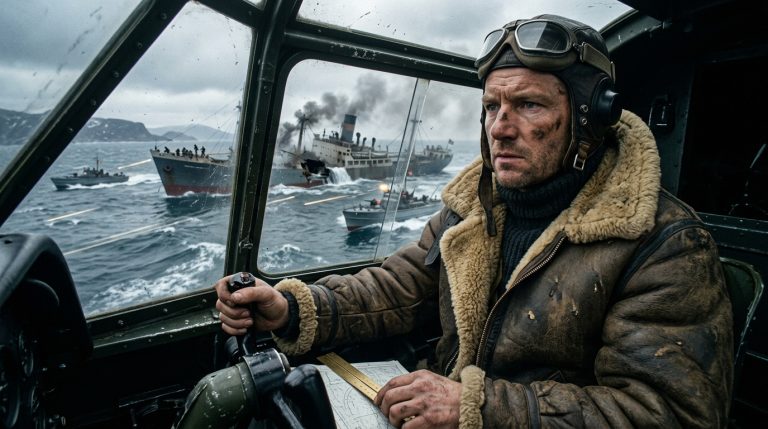
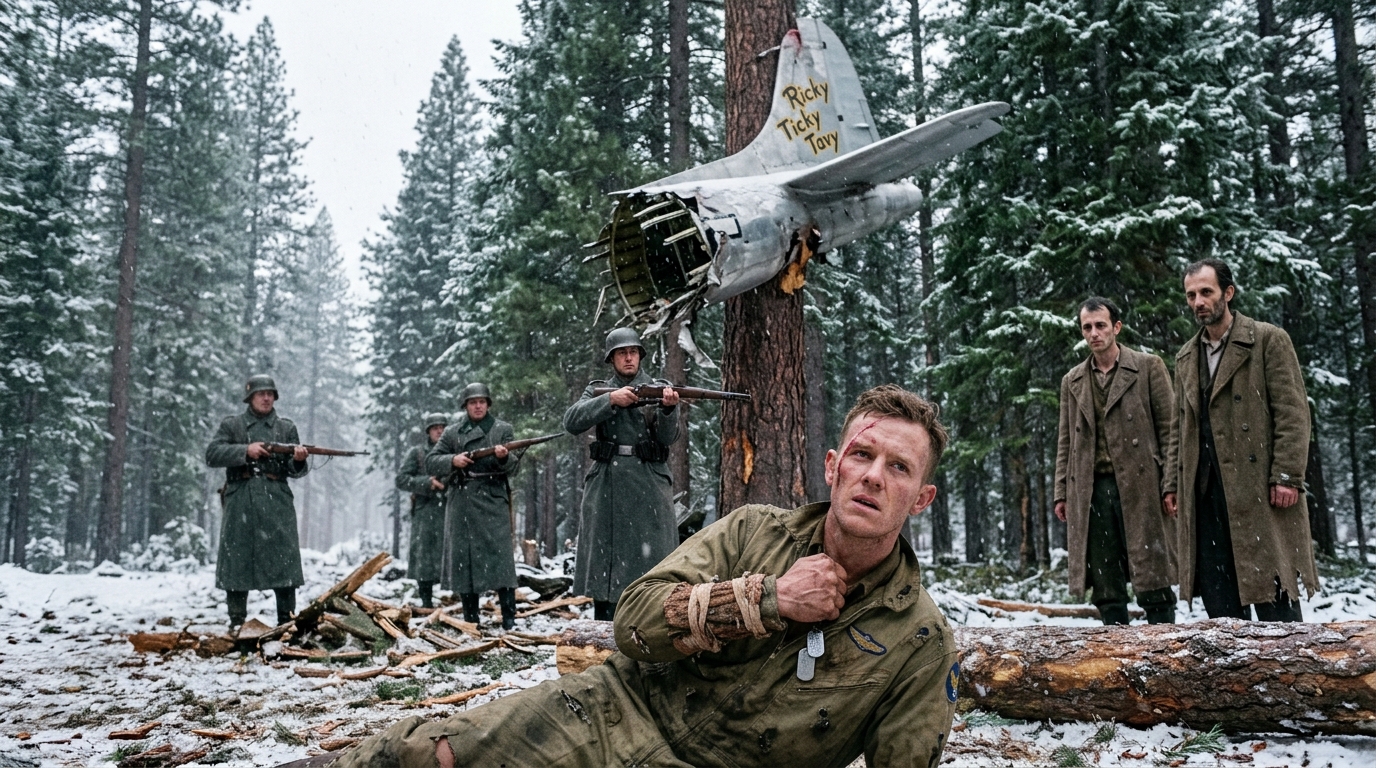
I braced my boots against the aluminum ribs of the tail section, the icy wind howling through bullet holes in the skin of the Ricky Ticky Tavy. Spent brass casings clattered across the deck like iron hail every time the twin Browning 50-calibers chattered. Down the narrow crawl space, there was no voice on the intercom—just the dead hiss of static and the smell of high-octane fuel burning somewhere forward.
Then came the flash.
It wasn’t a sound so much as an absolute slap of heat and pressure that slammed my forehead directly into the ring-and-bead sight. The fuselage ahead of my boots simply ceased to exist. One second the waist section was there; the next, a wall of gray sky and black flak smoke opened up where the plane used to be. The tail assembly shuddered, groaned with a sound like tearing sheet metal, and broke clean off.
Gravity didn’t pull us straight down.
The horizontal stabilizers caught the thin atmosphere, spinning the severed tail section into a wide, sickening spiral. Centrifugal force pinned my back against the cold steel bulkhead. I reached for the parachute harness hooked near the hatch, but my fingers snagged on shredded, oil-soaked silk. The canopy was ruined.
Outside the plexiglass, a Messerschmitt 109 banked hard, its pilot curving back to inspect the debris. He didn’t expect the tail of a dead bomber to bite. I jammed my thumbs onto the spade grips, hauled the twin barrels against the spinning horizon, and squeezed.
The recoil shuddered through my teeth, iron chatter rattling through my jawbone as tracers arced across the clouds. The German pilot yanked his stick, startled by the spatter of lead from a falling corpse, and rolled away into the overcast.
The altimeter needle on the cramped panel was sweeping backward in a blur: fourteen thousand, twelve thousand, ten thousand.
The air grew thick and heavy, pressure hammering into my ears until my fillings throbbed. The pine forest outside the town of Psych rushed up to meet the glass—a sea of dark, jagged green needles reaching out like iron spikes. I grabbed the release handle of the escape hatch and yanked with everything I had. The frame was warped solid. Locked in.
Eight thousand. Five thousand. Two thousand.
I tucked my chin into my collar, gripped the frozen steel handles of the Brownings, and let the trees take us.
The impact didn’t feel like a crash; it felt like being struck by a locomotive. The tops of eighty-foot pines sheared through the aluminum skin, snapping branches with the roar of artillery. The vertical stabilizer caught a massive trunk, spinning the section end-over-end as wood and metal pulverized around me. My skull cracked against the steel sight bracket, dark blood blinding my left eye as both forearms snapped like dry pine twigs against the gun mounts.
Then the world stopped moving, leaving only the smell of crushed pine needles, hot oil, and the quiet drip of my own blood onto frozen soil.
CHAPTER 2: FOREST OF BROKEN BONE
The silence in the woods was heavier than the explosion.
I lay pinned on my left hip in the cold mud, my right ear pressed to the dented aluminum skin of the tail section. Blood, warm and thick, pooled beneath my jawline, freezing where it hit the damp pine needles. Every shallow breath pulled a jagged streak of fire across my ribs.
I tried to move my right arm to push myself clear. Nothing happened. The message sent from my brain simply dissolved in the dark space between my shoulder and my wrist. Both forearms sat at crooked, unnatural angles against the shattered frame of the tail gun mount, dead weight bound by torn flight leather.
Footsteps crunched through the brush. Heavy, uneven, and fast.
I squeezed my eyes shut, holding the breath in my chest until the ribs groaned. The metal framework creaked as someone leaned over the torn hatchway. Harsh, raspy voices broke the quiet—speaking in short, urgent bursts, but it wasn’t German.
Hands reached into the wreckage. Not the cold, efficient grip of Wehrmacht infantry, but rough, calloused fingers that hauled me backward out of the aluminum coffin. The light hit my open eye like an iron spike.
Two men in tattered wool coats knelt over me in the snow. Their faces were hollow, greyed by hunger, but their eyes moved with sharp, desperate speed. One of them reached for his coat pocket, pulling out a strip of grey cotton ripped from his own undergarment. No field kits. No morphine. Just bare hands and dirty cloth.
He didn’t ask for my name or unit. He gripped my left wrist, set his foot against my ribs, and yanked the shattered bone back into alignment.
The pain didn’t ring; it went dead black behind my eyes. My teeth bit so hard into my lower lip that the copper taste of fresh blood flooded my mouth, but I didn’t give them a sound. The second man worked fast, binding the forearm tight against a flat piece of pine bark to keep the bone from tearing through the skin.
A sharp metallic snap echoed from the ridge above us—the crisp racking of a Mauser bolt.
German infantry moved down the slope in a wide semicircle, rifles leveled at the chest level of the two men. The Serbian doctors didn’t drop their hands. They finished tying the dirty knot around my wrist, stood up slowly, and placed themselves directly between the Mauser barrels and my head.
A German sergeant stepped forward, his mud-caked boots stopping six inches from my face. He looked at the severed tail section embedded sixty feet up in the pine canopy, then down at the blood-soaked patch on my chest.
He didn’t shout. He didn’t demand a unit number. He just lowered the muzzle of his rifle, kicked a piece of aluminum out of his path, and gestured toward the military transport idling on the dirt road half a mile back.
They dumped me onto a bare wooden stretcher. The Serbian doctor walked beside the frame, keeping one heavy, dirt-stained hand pressed firmly against the side of my fractured skull to keep the bone from shifting with every violent bounce of the trail.
I didn’t offer a word. I didn’t ask where the truck was going. My fingers slowly curled around the sharp, crumpled metal edge of my dog tags tucked beneath my collar, using the point to dig into my neck to stay awake.
The German driver shoved the gear lever into place, and the truck lurched forward toward Bremen.
CHAPTER 3: STALAG IN THE FROST
The coal stove at the center of Barracks 14 gave off a thin spiral of gray smoke that froze before it hit the rafters.
I leaned my spine against the ice-rimed wooden wall, balancing the chipped bowl of burned-barley coffee between two useless splints. My forearms had fused. The bones were setting sideways, pulling my hands inward at fifteen-degree angles, but my fingers could still twitch enough to clamp the clay dish against my chest.
A boy from Ohio named Miller sat on the bunk below me, scraping the ice off his leather boot heel with a rusty nail.
—Drink it before it freezes over—Miller said, not looking up. His breath hung in the air like steam from a boiler. —Guards are running three extra roll calls today. Somebody tried the south wire last night.
I didn’t answer. I tipped the bowl, letting the bitter, lukewarm fluid trickle down my throat. Every swallow jarred the fracture lines in my ribs, a dull, familiar ache that had settled into my marrow since the crash.
Across the room, behind a false wall panel near the chimney stack, a tiny copper coil hummed. It was small enough to fit inside a matchbox, cobbled together over eighteen months from smuggled copper wire and stolen radio valves. Nobody talked about the box, but every night when the searchlights swept past the frost-caked windows, the BBC’s muffled signal told us the front line was creeping closer.
The heavy oak door swung open with a bang, sending a cloud of sub-zero air across the floorboards.
Two German guards stepped inside, their boots caked in packed snow. Behind them stood an officer in a long grey overcoat, his leather gloves spotless despite the mud outside. He carried a clipboard, his pencil hovering over a list of names.
—Outside—the officer said. His English was flat, stripped of emphasis. —All hands on the parade ground. Now.
Miller dropped his rusty nail, his jaw clenching as he stood up. I slid my back up the wall, using the rough timber to brace my spine until my legs took the weight. My feet, wrapped in torn wool rags inside ruined boots, felt like blocks of frozen wood.
We lined up in four ranks on the packed ice of the quadrangle. Ten thousand men stood in absolute silence as the north wind whipped through the barbed wire fencing, pulling the temperature down to ten below zero.
The officer didn’t check our tags. He walked slowly down the front rank, stopping directly in front of my shoulder. His eyes moved down to my splinted arms, then up to the jagged red scar running through my hairline down to my brow.
—Sergeant Moran—he read from the paper, his voice barely louder than the wind. —The medical staff in Bremen reported you were dead three times.
I held my chin level, looking straight past his shoulder at the guard tower searchlight swinging in the daylight.
—I’m still here—I said. Plain, blunt, and quiet.
He looked at my crookedly fused wrists for three long seconds, waiting for a twitch, a shuffle, or a drop of the head. I didn’t give him one. He turned on his heel, signed the sheet with a sharp flick of his wrist, and barked the command to dismiss.
Back inside the barracks, Miller slumped onto his wooden frame, pulling his blanket over his shoulders.
—Seventy-six went out through the tunnel in Barracks 104 last night—Miller whispered, his voice shaking against the cold. —The Gestapo took fifty of them back to Berlin.
I sat back down on the bench, clamping my warped wrists around my knees to stop the involuntary trembling. I didn’t ask if any of them made it. Out here, in the middle of a German winter, survival wasn’t a hero’s sprint—it was just staying upright until the next bowl of thin potato soup.
I reached beneath my collar with my stiff index finger, touching the jagged edge of my bent dog tags, and waited for the night.
CHAPTER 4: THE SIXTYLEAGUE MARCH
My boots squelched with every stride, frozen leather stiffened around feet that had long since gone entirely numb.
The column stretched three miles ahead into the blizzard, a black, staggering serpent of ten thousand men pushing west away from the eastern guns. The temperature sat at fifteen below zero, the air so sharp it burned the lining of my throat with every ragged inhalation. I kept my chin tucked down, my threadbare blanket pinned across my shoulders with a section of twisted wire Miller had scavenged from the barracks fence.
Beside me, Miller’s knee buckled.
I leaned in hard, hooking my crooked left forearm—bent stiff at its fifteen-degree angle—under his shoulder. The collision sent a flare of white heat through my mended ribs, but I locked my boots into the ice and hauled him back upright before his knees hit the road.
—Keep ’em moving—Miller choked out, his lips split and bleeding against the frost. —Don’t look back, Eugene.
Behind us, fifty paces down the ditch, a single rifle shot cracked through the roar of the gale.
Nobody turned around. The guard lowered his Mauser, picked up his pace, and fell back into step with the rear guard. If you fell out, you stayed in the snow. That was the only rule on the road out of Silesia.
By noon, the ice storm turned to a thick, blinding sleet that coated our wool coats in a heavy shell of grey armor.
My right boot lining had ruptured three days back. With every step, infected fluid and melted slush squished around my toes, grinding dirt into open frostbite sores. I didn’t think about the miles. I didn’t think about Wisconsin, or farm horses, or hot lard biscuits on a stove. I counted steps up to one hundred, then started over at one.
A German corporal stepped out from the side of the road, holding a wooden spade across his chest to block our path.
—Halt—he shouted, his voice cracking with exhaustion. He pointed the handle toward a snow-drifted pine grove twenty yards off the road. —Ten minutes. No further.
The column collapsed in place like a fallen wall. Men dropped where they stood, curling into tight balls in the slush to hoard their body heat. I slid down the trunk of a dead oak tree, dragging Miller down with my good shoulder so he wouldn’t freeze sitting upright.
I reached inside my coat collar, my stiffened fingers searching out the cold, jagged edge of my bent dog tags.
The aluminum tag was dented flat where it had caught the ring-and-bead sight inside the B-17, but the stamped letters were still sharp enough to press into the meat of my thumb. It gave me something solid—something real while my feet drifted into dead grey numbness.
—They ain’t got no food coming—Miller muttered, his eyes glassy as he stared at the slush. —The guards ate their last bread at the river crossing.
—Then we eat snow—I said, my jaw so stiff the words came out like thick gravel.
I reached down with my crooked hand, scooped a clean fistful of ice off a pine branch, and jammed it into my mouth. It burned like fire going down, but it kept the stomach from tearing itself apart for another mile.
The corporal’s whistle blew—three short, frantic blasts.
I dug my heels into the frozen dirt, leaned my body weight forward over my boots, and forced my legs to straighten. My ribs screamed in resistance, but I held the frame steady, reached down, and grabbed Miller by the coat collar.
We stepped back onto the black ice of the road and kept walking.
CHAPTER 5: THE BITTERFELD STRAIN
The air inside the abandoned brick factory tasted of coal soot, wet rot, and stagnant water.
I lay tucked against a rusting cast-iron boiler, my knees drawn tight to my chest to keep my feet off the damp concrete. My weight had plunged below a hundred pounds; my hips dug into the floor like iron wedges. Across the dark expanse of the floor, two hundred men sat or lay in silence, our sunken eyes tracking every sound from the iron doors.
Outside, the guards had locked the padlocks and stopped coming around.
No bread came. No soup came. We scraped moss off the brick seams with our fingernails, chewing the bitter green film just to give our stomachs something to grind. When a rat scurried across a broken steam pipe overhead, three men scrambled for a fallen bolt to hurl at the shadows, driven by pure biological desperation.
Miller leaned against the boiler pipe beside me, his breathing shallow and rapid.
—They left us—Miller whispered, his dry tongue clicking against his teeth. —They chained the main gates and took off into the woods.
—Then we stay put—I said, my voice barely a raspy whisper. —The guns aren’t German.
A salvo of three inch artillery rounds slammed into the railway yard three streets over, shaking a shower of dried mortar down from the rafters. The building groaned, but the heavy brick pillars held firm.
Outside the narrow transom windows, the sharp, rapid crack-crack-crack of M1 Garand rifles cut through the heavy thump of motor fire. The guards’ defensive line was dissolving into panic. Through the rusted gap in the doorframe, I saw two young German soldiers drop their rifles in the mud, strip their wool tunics, and run west in their undershirts.
They were abandoning the post, cutting loose every tie of command to save their own skins.
The heavy oak doors rattled violently. A crowbar jammed into the seam, iron screeching against iron as the latch gave way with a loud bang.
The door swung wide, letting in a blinding wall of spring sunlight. A squad of infantrymen in olive-drab coats stepped over the threshold, rifles held at the low ready. The lead corporal took two steps inside, stopped dead, and pulled his scarf up over his nose as the stench of the room hit him like a physical blow.
He turned his face toward the yard, retching into the dirt, before stepping back inside.
—Medic!—he yelled over his shoulder, his voice cracked with shock. —Get every stretcher in the company up here! We got live ones!
A young medic rushed through the frame, his canvas kit slapping against his hip. He knelt beside the first man near the door, checked a wrist pulse, then moved down the line with fast, frantic motions. When he reached the boiler, his eyes locked onto my face.
He looked at my crooked, fused wrists resting on my ribs, then down at my black, swollen feet bursting through the seams of my boots.
—Jesus, buddy—the medic breathed, reaching into his pouch for a pair of bandage shears. —Where did they bring you from?
I pulled my chin back half an inch, my fingers curling around the sharp, dented corner of my dog tags tucked inside my shirt.
—Bremen—I said, the word rough and dry as sandpaper. —Fell in.
He tried to slip a hand under my shoulders to lift me, but I braced my elbows against the concrete floor, taking my own weight before his hands could bear the strain. I wasn’t going to be carried like a corpse. I forced my legs to angle downward, set my heels into the dust, and pushed my spine straight against the iron wall.
The medic tried to argue, his hands hovering in midair, but I held my ground against the cold metal, taking one slow, painful breath of fresh air after another.
CHAPTER 6: THE UNBROKEN SIGN
I stood on the graveled shoulder of the road, my boots planted firmly on the dirt edge where the asphalt met the grass.
My fingers, crooked at the wrists where the forearms had fused sideways sixty-five years back, rested lightly against the cool aluminum face of the new green sign post. Moran Way. The bold white letters stared back at me in the midday sun, clean and unblemished by smoke, grease, or high-altitude frost.
Beside me, my eldest boy reached out to steady my elbow as a farm truck rumbled past, kicking up a light cloud of dry dust that drifted over the ditch.
—I’ve got my footing, son—I said, my voice steady, dry, and low.
I slid my thumb inside my coat pocket, feeling the small, cold curve of the dented aluminum dog tag resting against my knuckles. The stamped numbers were smooth now, worn down by decades of farm work, wrenching tractors, and carrying sacks of seed across the barn floor.
The sky overhead was clear blue—no black flak bursts, no trailing plumes of fire, no screaming wind tearing through a severed tail section.
Layer 1 had been the strange physics of two stabilizers gliding through twenty thousand feet of cold air, dropping a tail gunner into eighty feet of pine canopy. But Layer 2 was the plain, unvarnished reality that followed: four miles of falling didn’t define a man, nor did seventeen months behind wire or six hundred miles in the snow. The real work was coming home, picking up a wrench with crooked hands, and building a quiet life step by step until the nightmare had nowhere left to hide.
The mayor stepped up beside us, holding a silver pair of ribbon shears, his polished shoes coated in a fine layer of country roadside dust.
—Eugene—the mayor said, offering a small smile. —Do you want to say a few words to the folks gathered by the fire hall?
I looked past his shoulder at the row of pickup trucks parked along the ditch, at the neighbors and grandkids standing quietly in the afternoon sun. I didn’t have a grand speech about heroes or impossible falls. I had done what needed doing—survived the sky, survived the snow, and walked home to Wisconsin on two feet that refused to give out.
—It’s a good road—I said, resting my palm flat against the cool metal of the sign. —Plain, solid, and holds up in the winter. That’s enough.
I turned back toward the idling sedan, stepped carefully across the gravel shoulder, and opened the door myself, my warped fingers fitting naturally around the handle.