Iron Over Essex: The Quiet Flight That Forged a Teenager into an Unbroken Legend Over Germany
CHAPTER 1: MUD AND COLD IRON
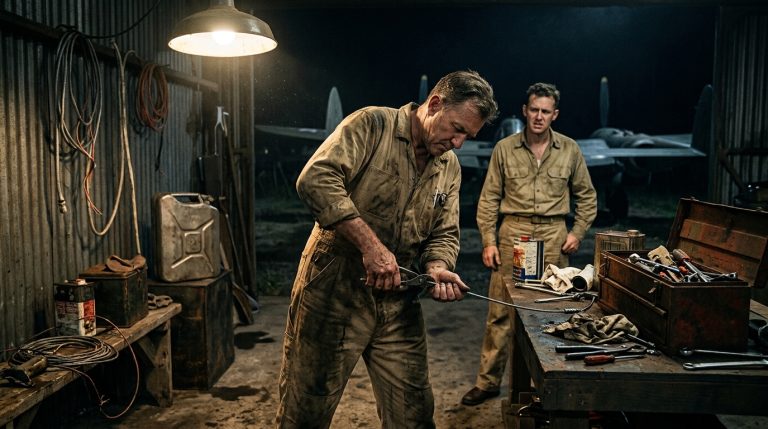
The grease on the hangar floor smelled of burnt castor oil and wet cinders.
Charles McCoral set his canvas kitbag down against the cold concrete pillar, the canvas scraping with a dry rustle.
Around him, the hangar was a cavern of shadows and coughing Merlin engines.
Mechanics in greasy overalls hauled pneumatic hoses across the duckboards, ignoring the new arrival completely.
A corporal with a missing front tooth spat a stream of brown tobacco juice into a drain trench and looked right through McCoral’s face.
“Another child for the meat grinder,” the corporal muttered to a grease-monkey hauling a fresh spark plug tray.
McCoral didn’t flinch or look away.
He reached into his pocket, his gloved thumb finding the heavy brass fuel-mixture key he’d pocketed back in Pennsylvania.
The metal was freezing, carrying the chill of the North Sea wind blowing in through the open hangar doors.
He rolled the brass edge against his calloused palm, feeling the precise notches he’d filed himself.
Over in the corner of the ready room, Captain Donaghue leaned against a scarred oak desk, cleaning a fingernail with a greasy cartridge casing.
Donaghue didn’t look up when McCoral stepped onto the threshold, his leather boots clicking against the splintered floorboards.
“You’re nineteen,” Donaghue said, his voice flat, stripped of any welcome. “You still got milk on your chin, Lieutenant.”
“Fourteen hundred hours in the air, Captain,” McCoral said, his voice level, dry, and entirely devoid of defensive heat. “Cubs, Harvards, and P-38s out in Sacramento.”
“This isn’t California, kid,” Donaghue said, finally lifting his eyes. “Over the Ruhr, the sky doesn’t care about your logbook hours. It eats boys who think flying is an acrobatic show.”
McCoral let go of the brass key in his pocket.
The silence in the ready room was heavy, smelling of stale chicory coffee and cheap pipe tobacco.
Outside, a flight of Mustangs roared down the perimeter track, their exhausts spitting blue flame into the gray mist.
McCoral walked past Donaghue without another word, dropping his kitbag onto the narrow iron cot assigned to him in the corner.
He sat down, testing the sag of the springs, and pulled his flight map from his knee pocket.
The paper was stiff, marked with grease pencil lines tracing the bomber route over Belgium.
He knew what they were doing; they froze out the replacements so they wouldn’t have to memorize the names of boys who wouldn’t return for supper.
The door banged open behind him, letting in a gust of raw wind and the sharp smell of aviation fuel.
“Briefing at zero-six-hundred,” Donaghue called out to the room at large. “Get your gear checked. The Hun isn’t sleeping.”
McCoral stood up, sliding the brass key back into his palm, and walked out into the rain to find his crew chief.
CHAPTER 2: INTO THE FLAK STREAM
The briefing room smelled of wet wool and cheap, scorched chicory.
Thirty men crowded around the trestle table, their breath fogging in the unheated shack while the intelligence officer tapped a long wooden pointer against the map grid.
Red circles overlapped like open wounds across the Belgium border.
“The bombers cross the coast at eighteen thousand,” the captain said, his voice flat, devoid of theatrical drama. “Top cover stays at twenty-five. You don’t chase individual bandits into the soup. You stay on the stream.”
Donaghue didn’t look back at McCoral as they walked out to the hardstand, where the P-51B sat dripping hydraulic fluid onto the asphalt.
The plane was tagged QPM, its nose painted with faded yellow stripes that were peeling at the seams.
McCoral hauled himself up the wing root, his leather flight boots slipping once on the wet aluminum before his heel caught the non-skid pad.
The crew chief, a sergeant with grease embedded so deep in his knuckles it looked like ink, leaned over the cockpit rail.
“Throttle sticks past seventy percent power,” the sergeant said, pointing a calloused finger at the quadrant. “And the oil pressure gauge on the left—glass is cracked. Don’t tap it too hard or the needle drops.”
McCoral looked at the thin hairline fracture running across the glass face. “Guns?”
“Bored at three hundred yards,” the chief grunted. “Four fifty-calibers. They’ll fire if you keep the belt feeds clear, but don’t hold the trigger down like a farmer on an electric fence.”
McCoral nodded once, slid into the narrow bucket seat, and pulled the shoulder harness tight until the canvas straps bit into his collarbones.
The Merlin engine coughed, spat a thick cloud of blue-black exhaust, and roared to life with a mechanical violence that shook his teeth in his jaw.
He didn’t use a notepad; he checked his instruments by touch, memory, and the raw vibration running through his boots.
The line of thirty Mustangs taxied out in single file, their wide three-blade props chewing through the cold Essex drizzle.
When Donaghue lifted off ahead of him, his tailwheel lifting smoothly into the gray haze, McCoral shoved the sticky throttle forward and felt twelve hundred horsepower shove him hard against the armored headrest.
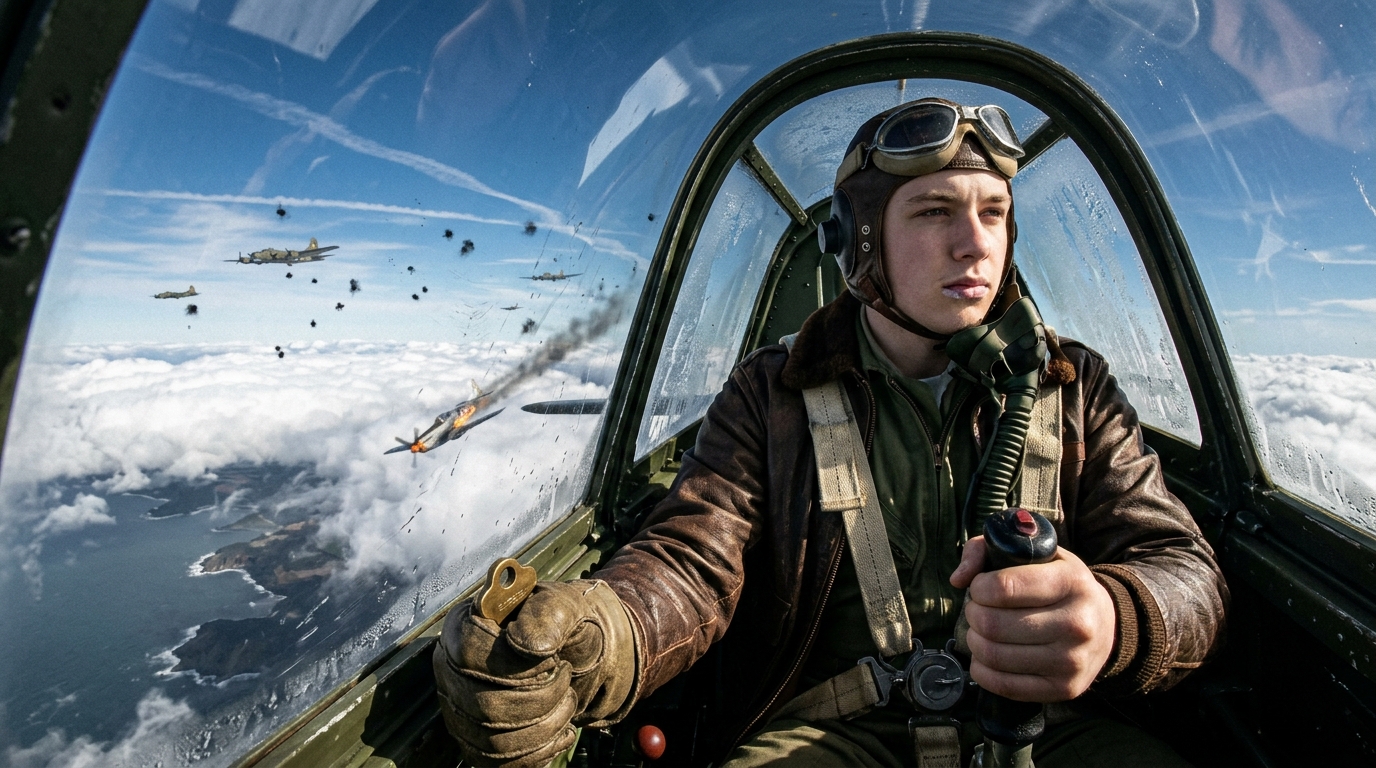
They climbed through ten thousand feet of solid, wet cotton before breaking out into the blinding glare above the cloud floor.
The air up here was minus thirty degrees, freezing the condensation on the inside of the Plexiglas canopy until McCoral had to scrape it clear with his gloved thumb.
Ahead of them, two miles out, the bomber stream stretched across the sky—a long, heavy carpet of B-17s leaving thick white contrails behind them like chalk lines across glass.
Donaghue’s voice crackled through the static-heavy radio, short and blunt. “QPM, keep your section tight. Don’t go hunting.”
McCoral kept his wing tucked five yards off Donaghue’s right tail assembly, his hand steady on the stick, adjusting for the high-altitude turbulence with slight, economic twitches of his wrist.
Below them, the coast of occupied Europe appeared as a dark, jagged edge where the gray sea met the frozen brown dirt.
The air changed immediately; tiny black puffs of flak began bursting three thousand feet below, blossoming silently in the cold sky like dirty wads of wool.
McCoral adjusted his oxygen mask, the rubber smelling of sweat and stale rubber, and checked his six o’clock position every four seconds.
He didn’t feel afraid; he felt the cold, sharp focus of a boy who had flown through crosswinds over farm silos since he was fifteen.
The sky was vast, empty, and lethal, and he was right where he belonged.
CHAPTER 3: THE BROKEN WINGMAN
McCoral’s hand remained locked on the sticky throttle quadrant as his eyes cut to the lead Mustang five yards away.
Donaghue’s P-51 slammed violently against the thin air, a jagged plume of blue-gray smoke spurting from the cowl louvers.
The lead fighter banked hard left, its engine coughing once before settling into an uneven, wet rattle that carried straight through the radio static.
“QPM, I’m dropping out,” Donaghue’s voice came through, strained and clipped. “Piston’s throwing oil. She won’t hold manifold pressure.”
McCoral pressed his throat mic with his gloved thumb. “I’m on your wing, Captain. Turning back with you.”
“Negative, kid—stay with the element,” Donaghue snapped back, his plane sliding out of formation as dark oil smeared across his canopy. “Rejoin the forward flight. Get over the heavies.”
McCoral checked his left mirror.
The secondary flight had already surged ahead into the glare, their silver tails disappearing over the dense clouds toward the Ruhr.
He looked back down at Donaghue’s smoking airframe, which was dipping into a banking descent toward the French coast.
The radio crackled into dead silence.
McCoral was alone in a box of freezing sky, five miles wide and completely empty.
He reached into his flight pocket, his gloved fingers touching the cold brass key to ground his rising pulse.
Turning back meant safety, a warm mess hall, and keeping his skin intact.
It also meant proving every veteran in the briefing room right—that a boy with soft features couldn’t carry his weight when the formation broke.
He didn’t pull back the throttle.
Instead, McCoral hauled the stick to the right, leveling QPM at twenty-five thousand feet, and pushed his engine straight into the path of the bomber stream.
Below him, the black bursts of flak grew thicker, dark smudge marks covering the horizon like iron rust.
Then, three thousand feet below his nose, a tight cluster of nine dark silhouettes swept out from the cloud deck, climbing fast toward the tail of the B-17s.
They weren’t American.
McCoral released the brass key, gripped the spade grip with both hands, and rolled his Mustang upside down into the plunge.
CHAPTER 4: NINE AGAINST ONE
The lead pipper wavered twice against the dark green fuselage before settling squarely over the wing root.
McCoral squeezed the trigger on the spade grip.
The four fifty-caliber machine guns hammered in unison, the violent recoil shuddering through the airframe and filling the cockpit with the sharp stink of cordite smoke.
Bright tracer streams walked straight up the German fighter’s tail assembly, tearing jagged aluminum strips from the control surfaces before smoke erupted from the cowling.
The trailing Fw 190 rolled lazily onto its back, slipping away toward the cloud deck below.
The remaining eight fighters scattered like flushed quail, their silver bellies flashing in the high cold sunlight.
McCoral didn’t track the falling wreck; he hauled back on the stick, the G-forces slamming his torso down into the aluminum bucket seat as his vision narrowed to a gray tunnel.
The Mustang shuddered on the knife-edge of a high-speed stall, its engine screaming as he traded speed for altitude to keep the sun at his back.
Two of the German fighters banked hard into a climbing turn, working as a paired element to flank his right quarter.
He shoved the sticky throttle forward until the casing groaned against the stop, ignoring the cracked oil pressure gauge where the needle vibrated violently against the glass.
Instead of turning away to escape, McCoral pitched his nose directly down the throat of the lead interceptor, locking his eyes on the sparkling wings of the incoming enemy aircraft.
Tracer fire flashed past his canopy in green streaks, missing his left wingtip by inches.
Neither pilot flinched.
At two hundred yards, McCoral held the firing button down for one full, punishing beat, watching the dark canopy glass of the lead fighter shatter before both planes broke in opposite directions with less than twenty feet of clearance.
The German aircraft tumbled sideways into a tight spin, uncontrolled and dead in the air.
McCoral’s muscles burned with the sheer physical effort of hauling the heavy controls against the rushing air, his breath coming in ragged gasps through the rubber mask.
Six remaining enemies reformed below, abandoning their dive on the bombers to box in the solitary Mustang that refused to break.
He checked his fuel gauge; the needle sat right on the quarter mark, barely enough to clear the Channel if he leveled out now.
Below him, the B-17s droned on unmolested toward the target grid, their waist gunners firing short bursts at the retreating stragglers.
McCoral leaned his helmet back against the headrest, feeling the cold brass key in his suit pocket press hard against his ribcage.
He didn’t have gun camera film or radio confirmation to prove what happened at twenty-five thousand feet.
All he had was the sticky throttle, four hundred rounds of ammunition left, and six men who thought a teenager would panic when the odds turned sour.
He reversed his turn, nose diving straight back into the box.
CHAPTER 5: THE SILENT RETURN
McCoral pulled the mixture lever back to auto-lean, nursing the Merlin engine at minimum cruise power to stretch the remaining gallons in the main tank.
The sky around him was eerie, empty, and dead quiet.
Below, the patchwork fields of Normandy slid past under a light coat of spring haze, devoid of moving vehicles or trailing flak bursts.
He pressed his thumb against the radio button on the throttle grip, listening to the crackle of atmospheric static filling his leather headset.
No calls came through.
No wingman flew off his right tip to scan his tail or call out hidden contacts.
He reached into his flight suit pocket, rolling the cool brass key across his knuckles while his left hand kept QPM steady on a compass heading of two-hundred-eighty degrees.
When the blue water of the English Channel finally appeared beneath the nose, the radio crackled with a faint, broken transmission.
“QPM… this is Eagle Leader,” Donaghue’s voice cut through the static, weak and garbled by distance. “Report position… if read.”
McCoral keyed the mic, his tone flat and unhurried. “Ten miles off the coast, Captain. Descending through eight thousand. Engine running smooth.”
A long beat of dead air followed, heavy with the hum of the alternator.
“How many bandits did you see out there, kid?” Donaghue asked, his tone guarded. “Operations says the main group got jumped near the border.”
“Nine,” McCoral said directly into the rubber cup of his mask. “Engaged the formation over the bombers.”
“Claims?”
McCoral looked down at his empty wing guns, where the red canvas tape over the muzzles had been shredded clean by four hundred expended rounds.
Without gun camera film or a second set of eyes in the sky, any number he threw over the air would sound like a frightened boy making up stories to cover his tracks.
“Five,” McCoral said quietly. “Maybe four.”
The radio went dead for three full seconds before Donaghue replied, his voice stripped of its earlier bite. “Get your tail back to Debdon before you’re gliding on fumes, Lieutenant.”
McCoral set his hand back on the sticky throttle, watching the wet green fields of Essex rise up to meet his landing gear.
CHAPTER 6: THE UNSPOKEN WEIGHT
The silence inside the cockpit hit McCoral like a dropped weight.
He unclipped the harness straps, his fingers stiffened from cold adrenaline, and unlatched the canopy rail.
The damp Essex air flooded the cockpit, smelling of wet asphalt, hot engine oil, and scorched lead.
On the perimeter track, the crew chief stepped up to the wing root, holding a metal gauge rod in his hand.
“Tanks are bone dry, kid,” the chief said, looking at the empty tip dipping low. “You ran her clean down to the sediment.”
McCoral swung his legs over the cockpit sill, his boots hitting the mud-streaked aluminum wing before dropping heavy onto the concrete.
In the ready room, the intelligence officer sat behind a wooden desk littered with coffee cups and cigarette butts, a blank casualty log spread out before him.
Donaghue stood near the potbelly stove, a mug balanced in his hands, watching McCoral walk through the door with his flight helmet dangling from his fingers.
“No gun camera tape on this crate,” the intelligence officer said, clicking his pen once against the blotter. “Film housing was jammed before takeoff. Flight logs aren’t tracking solo claims over the sector either.”
Donaghue stepped forward, setting his mug on the edge of the desk with a sharp clatter.
“He doesn’t need a film cartridge,” Donaghue said, his voice quiet, devoid of the earlier dismissal. “Look at the wings. Look at his gun bays.”
The intelligence officer looked up, his pen pausing over the empty lines.
McCoral reached into his suit pocket, pulled out the cold brass fuel-mixture key, and set it down on the center of the wooden desk.
He didn’t make a speech; he didn’t demand a medal or offer excuses for being nineteen years old.
“The bombers got through,” McCoral said simply, his voice steady. “Sector’s clear.”
Donaghue looked at the brass key, then at McCoral’s face, seeing the quiet, unbroken iron beneath the soft features for the first time.
The captain didn’t say another word; he reached out, picked up his coffee mug, and gave a short, firm nod before stepping out into the drizzle.
McCoral sat down on the iron cot in the corner, pulled off his flying boots, and set them flat on the concrete floor.
Outside, a mechanic was already wheeling a fuel cart toward QPM to prep her for the next dawn ascent.
The work was done, the boundary held, and the silence in the shack was absolute.