The Line on the Shore: How One Everyman Fought a Corrupt HOA and Won
CHAPTER 1: THE BOUNDARY LINE
The glossy brochure arrived in a thick cream envelope, tucked beneath a stack of utility bills.
It was printed on heavy cardstock, featuring a crisp map of the neighboring subdivision with a dotted red path winding along the canal. The path didn't stop at the HOA border. It drifted three feet deep into the marsh grass along my property line, sweeping past the dock like an invitation to a town park.
Attached was a yellow sticky note in neat cursive: Hi Neighbor! Excited to coordinate our community walk line! – Karen Whitlock, HOA President.
I stood by the kitchen window, thumbing the heavy brass casing of my pocket measuring tape. The metallic click echoed off the quiet walls. My deed was sixty years old, drafted long before the farmland next door was carved into three hundred identical cookie-cutter houses. My land ran straight to the water’s edge, free of covenants, restrictions, or shared easements.
That single fact should have ended the discussion before it began.
I took a sheet of plain white letter paper, fed it into the typewriter, and struck out one sentence: There is no easement on parcel 402-A. I signed it in blue ink, folded it into a matching envelope, and walked it directly to the postal clerk for certified delivery with a return receipt requested.
Two days later, the neighborhood Facebook group was filled with talk of a "stubborn shoreline owner blocking local families from safety."
I didn't log on to reply. Instead, I drove down to the county clerk's basement archive, paid three dollars for certified land records, and requested the original plat map from 1964.
The parchment smelled of vinegar and old dust. The red ink marking my boundary was clear, stamped with the seal of the municipal land board. No amendments. No public access corridors.
When I returned home, a thick white envelope was wedged in my screen door. The letterhead was embossed with the crest of the Oakridge Community Association.
Notice of Non-Compliance, it read. You are hereby ordered to remove all private property signage within forty-eight hours and submit to daily administrative assessment fees of fifty dollars until the public walking corridor is unblocked.
I didn't flinch. I unclipped the brass tape from my belt, unrolled six feet of stiff steel across the porch floorboards, and measured the distance from my front step to the property line.
They weren't just asking for access. They were trying to stake a claim.
CHAPTER 2: PAPER WEAPONS
The steel tape snapped back into its heavy brass casing with a sharp clack.
I stood on the porch, watching the evening shadows stretch over the marsh grass. The certified plat map from 1964 rested on the outdoor table, held down against the canal breeze by the weight of Karen Whitlock's notice of non-compliance.
Fifty dollars a day in administrative fees. An unrecorded threat printed on official-looking letterhead, designed entirely to make an unrepresented homeowner panic.
I didn't panic. I unclipped my fountain pen, sat down at the table, and opened a fresh legal pad.
The strategy behind an HOA overreach isn't complex. It relies on the assumption that the average person considers a letterhead to be the law. They bank on the fear of a lien, the stress of a lawsuit, and the sheer exhaustion of fighting an institutional voice.
They don't expect someone to trace the paper back to the ink.
I wrote down three specific numbers: my parcel deed registration, the county recorder’s book and page number, and the tracking ID from the certified letter I had mailed Karen two days prior.
At 6:15 a.m. the following Monday, my morning routine was interrupted by a chime from my phone screen. It wasn't a social media notification. It was a formal automated alert from my county title monitoring subscription.
New Document Filed Against Parcel 402-A.
I pulled up the county clerk’s public e-recording portal on my desktop monitor. A document had been submitted at 5:48 a.m. titled Notice of Public Corridor Claim. The filer listed was the Oakridge Community Association, signed by Karen Whitlock as "Authorized Agent."
They had officially attempted to cloud my title.
I didn't reach for a recording app or rage into an email. Instead, I printed the county filing receipt page, ensuring the exact timestamp, instrument number, and electronic filer ID were clearly visible in the header.
Then I reached for my desk phone and dialed my attorney's office.
"Arthur," I said when he picked up, keeping my tone as dry as the paper on my desk. "Karen Whitlock just filed a cloud on my parcel. I'm looking at the e-recording index right now."
"Does she have a recorded board resolution attached?" Arthur asked, his voice gravelly from thirty years of land law.
"No," I replied, running my thumb over the brass edge of the measuring tape. "She attached a generic draft affidavit claiming prescriptive easement rights."
"That's not just an error," Arthur noted quietly. "If she filed that without a board vote or an underlying deed, she’s personally certifying a false instrument to a county clerk."
"I have the 1964 plat, the certified receipt of my initial refusal, and the county audit page," I said. "Draft the cease and desist. Serve it by physical courier directly to her front door and send a copy to their legal counsel via certified mail."
"And if she ignores the courier?"
"She won't ignore the paper," I said. "Because the next page I print goes directly to the county prosecutor."
An hour later, I walked down to the edge of my property near the canal. The yellow survey flags I had set two years ago were still intact, poking out of the damp soil.
Tucked behind a heavy stack of landscaping pavers resting just inside the HOA’s side of the line, a flutter of faded yellow plastic caught my eye.
I knelt, reaching into the brush to pull it free. It was an old municipal surveyor’s flag, weathered and stained with mud. Wrapped around the wire stem was a faded plastic tag bearing a county environmental tracking number from three years ago—a permit reference that had no business being on a residential canal bank.
Karen hadn't just decided to build a walking path on a whim. The paper trail was older than her presidency.
CHAPTER 3: HEAVY MACHINERY ON THE SHORE
Six men in high-visibility vests climbed out of the idling cab, dropping heavy wooden stakes and rolls of green nylon string line directly onto the turf.
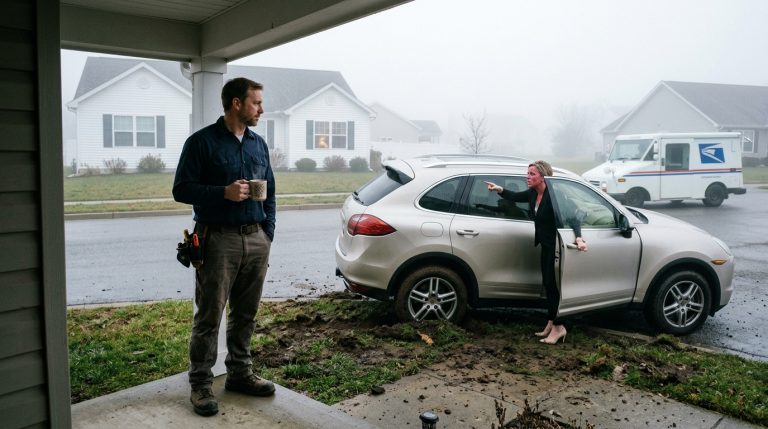
Karen Whitlock stood by the passenger side of a white SUV parked on the public curb, clipboard in hand, sunglasses pushed up into her spray-fixed hair. Beside her stood the contractor foreman, holding a rolled blueprint and looking toward my porch.
I stood up, wiping the mud off the yellow plastic tag against my work pants, and slipped it deep into my pocket alongside my brass measuring tape.
"Hold on," I called out, my voice low and flat as I crossed the yard to the boundary line. "You're stepping over a private property line."
The crew hesitated, two workers dropping a bundle of iron rebar with a loud clatter against the dirt.
The foreman stepped forward, holding out a laminated paper packet. "We're on the HOA contract line. Client authorized immediate ground clearance."
"The client doesn't own this parcel," I said, pointing down at the freshly stamped surveyor stakes I’d driven into the dirt six months ago. "My deed runs to the low-water mark. You're four feet past your boundary."
From the curb, Karen took three fast steps toward us, her leather heels sinking slightly into the soft ditch grass.
"It's a community safety corridor," she said, her voice dropping into that rehearsed, pleasant tone meant for audience management. "We have an administrative easement on file, and we are proceeding with authorized site prep."
"Show me the recorded easement," I said. "Not a draft. A certified copy with a county clerk stamp."
Her jaw tightened, the skin around her mouth going pale. "The county processing takes thirty days. We're acting under board authority in the interim."
"Then you're acting without legal right," I told the foreman, turning my back on Karen entirely. "If you drive one stake past those flags, you're personally committing civil trespass on unrecorded private land."
The foreman looked from my face to Karen’s clipboard, then down at the stamped surveyor pins sticking up through the grass. Working men know what a surveyor’s pin looks like, and they know what happens to independent contractors who ignore them.
"Ma'am," the foreman said, taking half a step back toward his truck. "Is this parcel clear or isn't it?"
"It's being cleared right now," Karen snapped, her polite cadence dropping completely. "Drive the stakes."
Instead of arguing, I pulled a folded white document from my back pocket—the certified police incident request form I’d prepared an hour earlier—along with my land attorney's business card.
I walked straight to my front porch, picked up the landline receiver sitting on the outdoor table, and dialed the non-emergency dispatch number directly in full view of the street.
"Township dispatch," I said, watching Karen through the window frame as she pulled out her phone to call her board members. "I need a deputy at 104 Canal Road. I have a commercial landscaping crew attempting unpermitted excavation across a marked private boundary, and I have certified land plats ready for on-site verification."
The dispatcher took the parcel number, and twenty minutes later, a white county cruiser pulled up behind the landscaping truck.
A tall deputy stepped out, adjusting his duty belt as he took in the scene: six workers standing awkwardly near a pile of rebar, Karen tapping her foot against the asphalt, and a line of string stretched across my grass.
"What's the dispute?" the deputy asked, looking between Karen and me.
Karen stepped up first, presenting her clipboard like a shield. "Officer, we are executing an authorized HOA infrastructure project. This resident is obstructing a public safety improvement."
"Do you have a recorded court order or a stamped municipal easement?" the deputy asked, barely glancing at her plastic binder.
Karen's voice faltered. "It's under administrative review—"
"Then you don't have one," the deputy cut in smoothly. He turned to me. "Sir, your papers?"
I handed him the original 1964 plat map, the current tax parcel printout, and the certified cease-and-desist letter delivered to Karen’s address four hours ago.
The deputy reviewed the red seal on the plat map, walked three paces to inspect the steel surveyor pin, and then looked directly at the contractor foreman.
"Pack your stakes," the deputy said calmly. "This is a civil boundary dispute, but driving iron into marked private soil without a court order is trespass. Take the equipment off the grass."
The foreman didn't wait for Karen to speak. He signaled his crew, and within three minutes, the iron rebar, string lines, and rolls of weed barrier were tossed back into the bed of the truck.
Karen stood on the asphalt, her face rigid, watching her crew pull out onto the main road.
"This isn't over," she said, her voice shaking slightly as she opened her car door. "We have documentation that overrides a sixty-year-old map."
I didn't answer. I stood at my boundary line, my hand resting on the brass tape measure in my pocket, watching her drive away.
As the dust settled, I noticed a fresh white envelope lying on the ground near where her SUV had been parked—a dropped delivery meant for the foreman.
CHAPTER 4: THE FAKE AGREEMENT
The paper inside was a printed PDF titled Temporary Pedestrian Access Agreement – Executed.
I unprinted the folded pages right there on the grass. At the bottom of page three, typed in decorative italic font on the signature line above my printed name, was a fake cursive signature.
Directly below it sat the physical signature of Karen Whitlock, acting as "Granting Agent," along with a seal from a local notary whose name matched an active member of the HOA architectural board.
The document claimed I had voluntarily granted the Oakridge Community Association a temporary construction easement effective immediately, in exchange for "community goodwill."
Attached to the back of the agreement was a internal vendor work order—Work Order #44471—issued to the landscaping contractor. The client billing line didn't list the HOA general fund. It listed a private holding company registered under the name of the HOA board's vice president, the same man who had stood beside Karen at the curb.
The trap was sitting right in my hand. They weren't just trying to bully a neighbor; they were using an unrecorded land grab to funnel association reserves into a private contracting account.
I walked back to my kitchen table, laid the document flat under the overhead light, and pulled out my brass pocket ruler to check the alignment of the notary stamp.
The notary seal date was stamped for three days prior—a day before Karen had even sent her initial brochure email. They had fabricated the agreement before ever making contact.
I didn't call Karen. I didn't send an angry email to the board.
Instead, I took my fountain pen and drafted a formal, physical demand letter for immediate inspection of HOA corporate records under state non-profit statute § 617, requesting all bank disbursements, vendor bid sheets, and board minutes related to Work Order #44471.
I sealed the demand in a heavy manila envelope, attached a certified mail receipt, and drove directly to the main post office downtown to ensure a certified clerk hand-stamped the postmark.
By 8:00 p.m. that evening, an email arrived in my inbox from Karen’s personal address.
Attached is a copy of the executed pedestrian easement on file with our office, the email read. Should you continue to interfere with authorized contractors, we will seek an immediate emergency injunction and hold you personally liable for project delay costs exceeding $15,000.
I opened the attached PDF properties window on my desktop screen.
The file metadata was plain as day: Author: K. Whitlock. Created: 7:42 PM. Application: Word for Windows.
She had typed the "executed agreement" less than twenty minutes before sending the email, using a template to forge my consent after the deputy had already turned her workers away.
I printed the metadata screen, attached it directly behind the dropped work order, and clipped them both into a clean black presentation folder labeled Exhibit A.
Karen thought she was building a public path with paper. She didn't realize every page she printed was becoming another nail in her own coffin.
CHAPTER 5: THE INJUNCTION HEARING
The hardwood benches in Courtroom 3B were cold and polished slick.
Karen Whitlock sat two rows ahead at the defense table, wearing a tailored navy blazer and holding a crisp white binder. Beside her, her attorney riffled through a stack of legal briefs, whispering while Karen adjusted her posture, chin lifted, projecting calm authority.
My attorney, Arthur, sat next to me with my black presentation folder resting flat between us. Beside the folder lay the brass measuring tape, its worn casing catching the overhead fluorescent lights.
"Case 24-CV-0982," the bailiff announced, his voice echoing off the high ceilings. "Oakridge Community Association versus Parcel 402-A, emergency temporary restraining order."
The judge, a grey-haired woman with square spectacles, pulled our file forward and adjusted her microphone.
Karen’s attorney stood up immediately. "Your Honor, my client represents three hundred homeowners seeking to complete a vital safety project along a shared water corridor. The defendant has maliciously delayed access, threatened workers, and ignored community covenants."
Arthur didn't jump up to argue. He waited until the attorney sat down, then stood slowly, smoothing his jacket.
"Your Honor," Arthur said, his voice deep and deliberate. "The defendant is not a member of the Oakridge HOA. His deed carries no covenants, and no recorded easement exists. We have submitted Exhibit A."
Arthur stepped forward and handed the black folder to the bailiff, who passed it up to the bench.
"In that folder," Arthur continued, "you will find the certified 1964 plat map showing zero public access, the physical return receipts for three cease-and-desist notices, and most importantly, an affidavit filed by Ms. Whitlock under penalty of perjury claiming she was authorized agent for my client."
The judge opened the folder. The room fell into absolute silence except for the rustle of turning paper.
She paused at page four—the printed PDF metadata alongside the dropped work order showing the vice president’s private holding company.
The judge looked over her glasses directly at Karen. "Ms. Whitlock. Explain why you filed a claim of interest against this parcel after receiving a formal cease-and-desist."
Karen’s attorney reached over to whisper, but Karen leaned toward the microphone, her face flushing red under the lights.
"Your Honor, we believed we had verbal consent," she said, her voice dropping the smooth charm and sharp edge taking over. "The path benefits everyone. One owner shouldn't be allowed to hold an entire neighborhood hostage over a technicality—"
"Belief is not authorization, Ms. Whitlock," the judge cut in, her gavel resting in her hand. "And typing another person's signature onto a legal document is not a technicality. It is a fraudulent claim filed in a court record."
Karen blinked, her posture instantly sagging as her attorney pulled her back from the microphone.
"The petition for an emergency injunction against the property owner is denied," the judge declared, bringing the gavel down with a sharp thwack. "I am issuing an immediate Stop Work Order against the Oakridge HOA regarding Parcel 402-A, ordering the county clerk to expunge the notice of claim, and referring the fraudulent affidavit to the prosecutor's office for review."
The deputy in the aisle stepped forward, handing a sealed copy of the court order directly to the landscaping contractor foreman who was sitting in the back row.
The foreman took the paper, swallowed hard, and pulled out his two-way radio right in the hallway outside. "Shut it down," he said into the mic. "Pack the trucks and get off the lot now."
Karen rushed out of the courtroom doors, her heels clicking rapidly against the terrazzo floor as her attorney tried to catch up.
She wasn't looking at the crowd of neighbors who had come to watch. She was looking straight ahead, the white binder clutched tightly against her chest as her paper empire collapsed around her feet.
CHAPTER 6: RESTORED EARTH
Two weeks after the hearing, the county title monitoring service pinged my phone one last time.
Corrective Document Recorded: Full Release and Withdrawal of Claim.
The HOA's fraudulent notice was permanently expunged from the county index. The board, facing legal exposure from the vice president's unauthorized contracting deals, held an emergency closed-door vote. Karen Whitlock was stripped of her presidency and barred from holding board service.
Their insurer issued a full settlement, covering every penny of Arthur’s legal fees, the surveyor's invoice, and the environmental site restoration demanded by county compliance.
A restoration crew spent three days along my shoreline. They pulled up the broken turf, laid down erosion matting, and planted native marsh grass along the exact coordinate line stamped on my 1964 plat map.
The contractor foreman personally handed me the certified completion report, signed by the county environmental inspector.
"All squared away, sir," he said, handing over a paid receipt stamped by the HOA treasurer. "No flags. No lines. Just your dirt."
On Saturday evening, the sun dipped low over the canal, casting a warm gold light across the fresh green shoots of marsh grass.
I sat on the porch with two neighbors from down the road. We didn't talk about lawsuits, courtrooms, or board politics. We sat in the quiet air, sipping iced tea, listening to the water lap gently against the dock posts.
One neighbor gestured toward the shoreline with his glass. "To keeping your boundaries," he said.
I pulled the brass tape measure from my pocket, set it flat on the wooden armrest, and took a long drink of tea.
"To paperwork," I replied.
When you stand on clean ground with a clear paper trail, you don't need to shout. The quiet timeline always wins.