The Iron Sight Protocol: How a Frozen Private Broke the Army Rules to Stop a German Panzer Division
CHAPTER 1: THE BROKEN CHOKE POINT
The steel of the Springfield’s receiver bit directly through my wool glove, sticking to the fabric like wet ice.
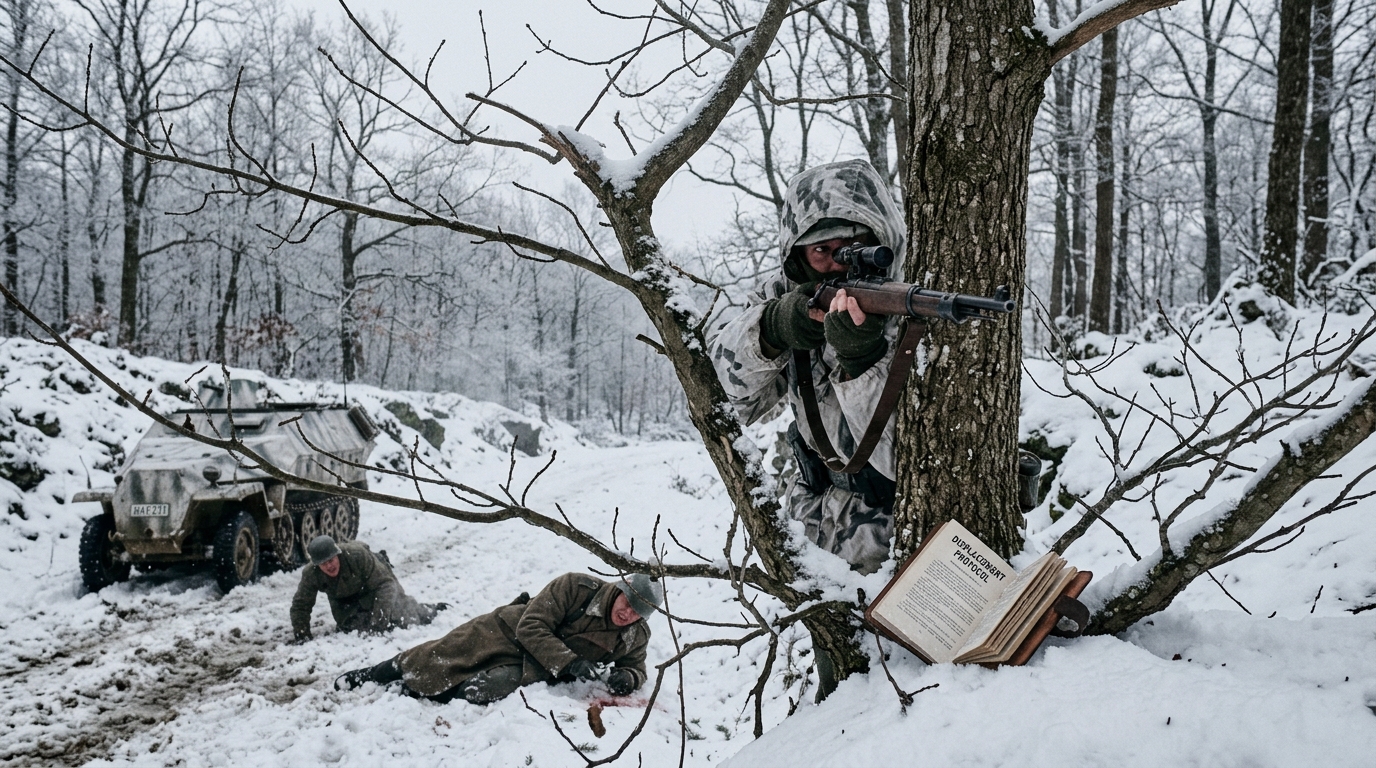
Fifty feet down, three German scouts stepped into the defile. Their boots crunched through the frozen crust of snow with a heavy, predictable rhythm. They were young, their breath plumeing thick and white in the fourteen-below air, heads turning toward the ridgelines on either side of the pass. They were looking at the snowdrifts, the granite outcroppings, the fallen pine logs—every standard piece of cover a trained rifleman was supposed to crawl into.
They didn’t look up. Nobody looks up into a bare, snow-choked oak tree when they’re hunting a sniper.
I rolled the cold, spent brass casing from my morning test-chambering between my thumb and forefinger. The metal felt like a piece of dry glass against my numb skin. Beside my boot, wedged in the fork of the three main branches, lay a discarded leather field manual someone had dropped during the morning panic. Its pages were frozen stiff as a cedar shingle, stuck open to the section on displacement protocol.
Move after three shots or die.
“Pure desk-rider nonsense,” I muttered, my voice barely a dry rasp against the biting wind.
Without a glass scope mounted to the receiver, the lead scout’s wool coat looked small through the front notch sight. Just a dark, square shape moving against the blinding glare of the Ardennes snow. I rested the heavy walnut stock against the rough bark of the cradle, lined up the blade in the center of the rear aperture, and slowly squeezed the trigger.
The rifle cracked, a sharp, metallic slap that bounced off the stone walls of the narrow pass.
The lead scout collapsed forward into the snow, his helmet sliding free and skimming across the ice. The two behind him didn’t run back—they dove straight into the ditch at the base of the ridge, scrambling for cover that only protected them from the ground level.
My hands moved by sheer muscle memory. Lift the bolt handle. Pull back. The hot brass popped out with a dull hiss, tumbling down through the bare oak twigs. Push forward. Lock down.
I didn’t shift my hips. I didn’t reach for a rope to climb down. Moving meant stepping out into forty yards of clear, open snow while two submachine guns waited for a silhouette. The rulebook said I was already dead the second that first shot echoed down the valley.
I settled the front sight blade back on the edge of the ditch, where a grey-green helmet brim peeked out.
“Let’s see what your manual says about this,” I whispered, and squeezed again.
CHAPTER 2: THE FROSTBITE AUDIT
The trigger broke with a dull, frozen snap.
Down in the snow-choked trench of the road, the second German scout lurched sideways, his helmet clipping the sharp granite edge of the drainage ditch before he went still. The third man didn’t try to shoot back. He scrambled backward on his hands and knees, kicking frantically against the icy mud until he slid behind the armored flank of an abandoned half-track.
Silence settled back over the pass, heavy and thick as a wet wool blanket.
I cycled the bolt of the Springfield. The metal clicked loud enough to echo off the frosted stone walls. Another hot brass casing tumbled through the oak leaves, landing with a faint ping in the deep drift below my boots. Two rounds left in the internal magazine. No scope to clear the haze, just forty yards of freezing air between my eyes and the dark tree line.
A hundred yards down the winding road, an engine thudded to life. It wasn’t the clattering roar of a tank, but the high, strained whine of a staff car pulling its front wheels out of a rut.
I didn’t shift my weight on the branch. The oak bark was already stiffening under my thighs, the bark biting through my canvas field trousers like teeth. The rulebook sitting in my kit back at camp said a sniper needed freedom of movement. It said static perches were death traps once the enemy plotted the trajectory.
The rulebook hadn’t accounted for a fourteen-below wind chill that froze oil in the bolt receiver and made men march with their chin tucked so deep into their collars they couldn’t see the sky.
The staff car nose-dived through the snowbank at the bend, escorted by a single motorcycle with a wooden sidecar. Officers. You could tell by the clean, dark cloth of their coats and the way the driver sat upright, convinced that twenty miles behind the spearhead meant safe territory.
They were pushing forward to inspect the delay. They had a schedule to keep, a timetable drawn up on dry paper in a heated office somewhere in Berlin.
I let the motorcycle crawl past the first fallen scout. The sidecar passenger was looking at the ground, pointing a gloved hand at the blood pooling dark and thick in the snow. They were looking for footmarks. They were looking for a white camouflage suit crawling through the brush on the ridgeline.
I took a breath, held the freezing air in my chest until my ribs aching, and brought the front sight blade onto the staff car driver’s chest.
“Rule number two,” I whispered, the frost on my mustache cracking as my lips moved. “Don’t stop on the choke point.”
The Springfield kicked back into my collarbone. The driver slumped forward against the wheel, and the staff car veered hard to the left, slamming into the rock wall with a metallic crunch that killed the engine instantly.
CHAPTER 3: THE COLD RECKONING
I yanked the bolt back. The empty shell casing flew clear, landing with a faint, dry hiss in the deep snow below my perch.
Before the officer crawling from the backseat could plant his boots on the ice, the sky above the eastern ridge cracked open. A sharp, whistling screech cut through the valley air—a sound every foot soldier knew in his marrow.
Mortars.
They weren’t trying to pick me off with rifles anymore. The officers back at the division line were sick of the delay. They had ordered a blanket barrage on the pass, sweeping the ridgelines to clear whatever obstruction was grinding their timetable to a dead halt.
The first shell detonated fifty yards up the western slope. A geyser of frozen mud, crushed pine needles, and shattered granite erupted into the gray sky, raining heavy debris onto the road below.
I pressed my chest flat against the thick oak trunk, wrapping both arms around the rough bark to keep the shockwaves from shaking me loose. My chin dug straight into the snow resting in the crook of the branches.
Another round slammed into the rock wall across the defile. The concussive thud rattled my teeth, sending a shower of pine cones and ice crystals cascading through the leaves overhead.
Through the notch of my iron sight, I watched the mortar adjustments. They were walking the explosions along the ground level cover in a neat, mathematical grid. They hit the stone outcroppings. They pulverized the brush piles. They blasted the deep snowbanks along the drainage ditches.
They were doing exactly what their textbooks told them to do. They were destroying every logical place a sniper would hide.
The oak tree stood dead center in their firing pattern, completely untouched. To a trained battery commander sitting behind a map miles away, a bare seventy-foot tree was too exposed, too ridiculous, and too static to ever hold an enemy rifleman.
“Keep reading your manuals, boys,” I muttered, my frozen lips cracking against the stock.
The whistling stopped. The smoke drifted heavy and white through the narrow gap, smelling of scorched dirt and sulfur. Down on the road, three German mortar crewmen stepped out from behind an armored vehicle, holding binoculars up to scan the newly ruined ridgeline to see if anything moved.
I lined up the front sight blade on the center of the observer’s chest through the drifting gray smoke.
No glass lens to magnify the target. Just a steady hand, a cold piece of iron, and three days of stubborn refusal to climb down.
I squeezed the trigger.
CHAPTER 4: THE FRICTION LINE
My index finger wouldn’t uncurl.
The joint was frozen stiff, locked hard against the curved steel of the trigger guard. I had to use my left hand—slapping my palm against my right knuckles—to force the finger straight so I could grab the bolt handle.
Fifty yards down the defile, the smoke was clearing. The artillery barrage had failed, and the enemy commander on the far side of the bend was done playing by textbook rules.
A whistles blew—short, frantic bursts of sound that cut through the sub-zero quiet.
Thirty men stepped out from behind the armored half-tracks. They didn’t spread out into wide skirmish lines like the training doctrine taught. They packed tight into the narrow sixty-yard choke point, helmets down, bayonets fixed, running in a solid wall of wool and steel. They were going to drown the phantom in the pass with raw numbers.
Thirty men against thirty-six rounds left in my pockets.
I didn’t have a glass sight to measure the gap. I didn’t have a scope to tell me who was an officer or who was a frightened boy from Bavaria. All I had was the iron notch resting on the oak branch and a cold calculation in my head.
One round per target. Cycle. Acquire. Squeeze.
The lead soldier crossed the forty-yard mark. I aligned the front post with his chest button and pulled.
The rifle slammed back into my frozen collarbone. Pain shot down my spine, dull and aching. The man dropped forward, his momentum sliding him across the ice into the ditch.
Up-and-back on the bolt. The brass popped out, steaming against the frozen bark.
Thirty-five rounds.
Another helmet filled the front notch. Squeeze. The bolt handle was slick with frost, ripping the top layer of skin off my thumb every time I worked the action. I didn’t feel the cut. My hands were past feeling anything except the heavy, mechanical rhythm of the Springfield.
Thirty-four.
They kept coming. They shouted in German, their boots pounding a jagged, desperate beat against the hard-packed snow. Twenty yards. Fifteen yards.
They looked straight at the ground. They looked at the rocks. They looked at the snowdrifts where a human being was supposed to be hiding. They ran right under my boots, thirty feet below my perch, their wool coats smelling of wet soot and stale tobacco.
I leaned over the fork of the three branches, aiming straight down through the bare twigs.
Squeeze. Cycle. Squeeze.
The line broke. The front ranks tangled over the fallen, the rear ranks scrambling backward over the icy ruts, convinced they were running headfirst into a hidden machine-gun nest.
I rested my forehead against the cold walnut stock, gasping for air that felt like broken glass in my lungs. Through the bare oak branches, eighteen bodies lay motionless in the narrow pass.
The road to Antwerp was still closed.
CHAPTER 5: THE COLLAPSE OF LEVERAGE
The silence that followed was different. It wasn’t the tactical pause of men preparing another wave. It was the absolute, dead silence of a division giving up on a road.
Down in the defile, the engines backed away. The clatter of iron treads shifted west, rerouting twelve miles around the ridgeline into deep, unmapped drifts that would burn their remaining fuel reserves before sundown.
I tried to unclench my left hand from the oak branch.
Nothing happened.
My wool glove had soaked through with sweat during the mortar barrage, and the temperature had turned the wet fabric into a solid band of ice fused directly to the rough bark. My fingers were locked in a curved claw. When I pulled back, the cloth tore, leaving shreds of green wool stuck to the tree trunk.
I couldn’t feel my boots. I couldn’t feel my knees. My body felt like a heavy, frozen sack wedged in the fork of three branches.
A sharp crunch of footsteps sounded at the base of the tree. Not the cautious, muffled tread of German boots, but the heavy, unhurried march of American leather.
“Check the ridge!” a voice shouted from ground level. It was Corporal Martinez, his throat raw from three days of running. “The radio guy said the whole German column turned south! There’s got to be a company holding this pass!”
I tried to yell, but my tongue was thick and dry as cardboard. All that came out was a soft, ragged rasp against the frosted bark.
“Holy hell,” another voice cut in—a sergeant I didn’t recognize. “Look at the road. Who laid out all these guys?”
“Check the trees!” Martinez shouted, his boots crunching closer to the oak trunk. “He said he was going up! Look up!”
A flashlight beam cut through the gray afternoon gloom, catching the dull steel of my Springfield’s receiver.
“He’s up there!” Martinez yelled, his voice cracking. “Hey! Romano! Drop a rope down! We got a patrol clearing the south ridge!”
I stared down at him through the notch of my front sight, my chin propped up by the oak crotch. I tried to lift my right arm to wave, but the shoulder wouldn’t move. My coat had frozen solid to the trunk.
“He ain’t moving, Sarge,” Martinez said, his tone dropping flat and hard. “Get a saw. Get some boots up here. He’s stuck to the bark.”
CHAPTER 6: THE FOOTNOTE LEGACY
They didn’t give me a hero’s welcome at headquarters. They put me on a wooden cot next to a cast-iron stove that smelled of coal dust and wet canvas, wrapping my legs in heavy wool blankets until the feeling came back in white-hot needles.
Outside the field tent, two staff officers stood beside a folding map table, arguing over a stack of casualty reports.
“The boy violated static engagement protocol,” the taller captain said, tapping his thumb against a leather-bound manual. “Section four, paragraph eight. He fired eighty-seven rounds without displacing. He held a fixed position for seventy-two hours. If we let every rifleman ignore field doctrine because he feels like staying in a tree, the entire command structure falls apart.”
Major Vance—a man with silver hair and mud dried thick on his trouser cuffs—didn’t look at the manual. He reached into his coat pocket and tossed a heavy brass casing onto the captain’s desk. It rolled across the field guide, stopping right over the printed bold text on displacement rules.
“That single tree held up an armored division for three days,” Vance said, his voice flat and dry as chalk. “The Germans didn’t search the branches because your book told them nobody is stupid enough to stay there without a scope. He didn’t break the rule out of spite, Captain. He broke it because your manual was written for an office with a radiator.”
The captain stared at the casing, his lips pressing into a thin line, but he didn’t open his mouth again.
Two years later, when the revised field manual arrived at the training camp in Georgia, the front page still had the three-shot rule printed in bold black lettering across the top.
Right underneath it sat a small, fresh line of type.
Field conditions may require modification of standard displacement protocols at the discretion of the operator in the field.
I sat on the wooden porch of my house, resting my boots against the pine railing. My right foot still throbbed when the damp cold rolled in off the river, missing three toes from the Ardennes frostbite, and my thumbs were scarred hard from cycling cold steel bolts in the ice.
I reached into my pocket, pulled out a single spent brass shell casing, and rolled it slowly between my thumb and forefinger. No glass scope. No grand speeches. Just forty yards of iron sights, a frozen oak tree, and a simple truth that outlived every desk-writer’s book in the country.