The Ridge Above Golden Summit: How One Weary Builder Drew the Line Against Unearned Power
CHAPTER 1: PAPER TRAILS AND COLD IRON
The cream-colored jacket stood out against the pine bark like a signal flare.
I didn't stop the truck. I let the tires grind through the loose shale on the upper spur, rolling past the tailgate of a commercial flatbed until the bumper sat five feet from her polished leather shoes.
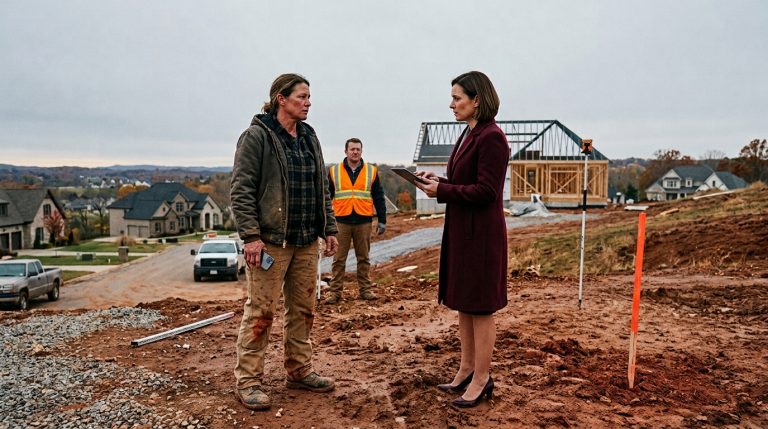
Karen didn't move. She held a rolled blueprint in her left hand, her chin tilted up, watching me step down into the dust. Behind her, two kids in high-vis vests pushed orange fiberglass survey stakes into my topsoil with the heels of their work boots.
I pulled the brass scale from my shirt pocket, turning the cold hexagonal metal once between my thumb and forefinger.
"What are you doing on my parcel?"
The nearest tech stopped driving a stake. He glanced back at Karen first, his eyes sizing up her jacket, then down at his clipboard.
"Staking the view buffer," he said. "Hermes Holloway scenic committee instruction."
Karen took a step forward. The wind off the gap caught the corner of her rolled paper. "You were notified three days ago. Your framing line cuts straight through the subdivision’s western panorama. This is a courtesy outreach to establish the visual boundary."
"You don't have a boundary on this ridge," I said. My voice stayed level, dry as the dirt under my boots. "Your subdivision ends at the drainage line two hundred feet down. Different parcel chain. Different access road."
"That is not your decision," she said, folding her arms over the blueprint.
"It's on the county land map," I said. I pulled my phone from my hip, tapped the screen twice, and held it up at arm's length. I didn't frame her face. I framed her boots, the truck license plate behind her, the subcontractor logo on the door, and the fresh orange stakes split into my soil. "You're trespassing on private property."
"We are preserving community value," she said. She didn't flinch, didn't shift her weight. Her tone had the slick, practiced polish of someone who held monthly meetings to vote on mailbox stains. "Our attorney has already drafted the filing. If you continue framing before the sightline evaluation is complete, your lender will freeze the disbursement."
I tapped the brass scale against my knuckle. The metallic clink was small, but the survey tech in the vest heard it. He took half a step back toward his truck.
"My lender knows how to read a deed," I said. "And so does the sheriff."
I didn't argue. I didn't raise my voice. I walked past her, step by step, keeping the phone camera level as I recorded the disturbed grade, the survey marks, and the flatbed loaded with cedar fencing.
Karen stayed rigid near the rear tire, her sunglasses reflecting the bare wooden studs of my unroofed house. She didn't look like a crook. She looked like a woman who genuinely believed that looking at a mountain gave her the right to own it.
"Call whoever you need to call," she said, her voice dropping into a quiet, icy clip. "Work stops on this ridge today."
I dialed the county non-emergency line, gave the dispatcher the parcel number, and sat down on the tailgate of my truck to wait.
CHAPTER 2: THE STAKING LINE
Deputy Miller didn't hurry out of his cruiser. He let the engine idle for a long five seconds, taking in the scene: the flatbed truck blocking half the spur, the fresh wooden stakes jutting from the dirt, and Karen standing beside her two survey techs like a commander inspecting a frontline trench.
He stepped out, adjusting his duty belt, his boots making a deliberate, heavy sound against the loose stone.
"Afternoon, John," Miller said, giving me a short nod before turning his attention to the group by the flatbed. "Got a call about a dispute on the ridge."
"Not a dispute," I said, sliding off the tailgate. I kept my phone in my pocket, recorded video already backed up to my local drive. "A trespass. They're driving stakes inside my boundary line without a permit or my consent."
Karen stepped forward immediately, her voice taking on that measured, neighborhood-committee pitch designed to project effortless authority. "Deputy, this is an administrative boundary enforcement. Mr. Holloway was formally notified that his framing line violates the established scenic corridor for Golden Summit Estates."
Miller looked at her, then at the orange stakes, then back at me. "Is this parcel inside the HOA, John?"
"No," I said. "Parcel chain 402-B. Unincorporated county land. Free and clear of their covenants."
Karen's jaw tightened slightly, her fingers digging into the edge of her rolled blueprint. "The view corridor is a recorded interest, Deputy. We are simply preserving the status quo while our legal team prepares an injunction against the exterior framing."
I reached into my pocket, pulled out the brass caliper scale, and held it casually between two fingers. "Ask her for the permit number. Or the court order."
Miller looked back at Karen. "You got an injunction in hand, ma'am? Or a county inspector's warrant?"
"We are acting under color of recorded easements," Karen said smoothly, though her eyes flicked to my hands for a fraction of a second. She turned to the survey tech in the vest. "Show him the field instruction sheet."
The tech hesitated, wiping sweat from his forehead with the back of his forearm. He held out the clipboard, his fingers nervous against the metal clip. Miller didn't touch it. He leaned over, squinted at the top page, and frowned.
"This is an HOA internal memo," Miller said. He looked up at the tech, then at Karen. "This isn't a county order. And you're on private land without the owner's sign-off."
"We have a duty to protect home values—" Karen started.
"You have a duty to leave when the property owner tells you to," Miller interrupted, his tone flattening into deadpan law enforcement exhaustion. He took out his notebook and a click-pen. "Ma'am, if Mr. Holloway asks you to vacate this parcel, you and your contractors need to pull those stakes and clear the driveway now."
Karen didn't move. Her posture stayed unyielding, her chin set high against the wind whipping over the ridge. "If we pull those stakes, it prejudices our position for the injunction."
"If you don't pull those stakes," Miller said, clicking his pen once, "I'm writing a citation for criminal trespass right now. Name on the registration for that flatbed, please."
The tech's face went pale. He looked at Karen, then immediately reached down and yanked the nearest orange stake out of the dirt with a harsh snack of splintering wood.
"We're just the contractors, man," the tech muttered, motioning to his partner. "We're just doing what the work order said."
"Pull the rest of them," Miller ordered smoothly. He turned to me, tapping his notebook against his hip. "I'm logging an incident report, John. Trespass warning issued on scene to the HOA representative and the subcontractor crew."
"I need the incident number," I said. "And the exact time stamp on your call sheet."
"I'll write it on a card for you," Miller said.
As the survey crew hurriedly tossed the orange stakes into the back of their flatbed, I stood by Miller's cruiser, watching Karen walk back toward her SUV. She didn't look back at the ridge, and she didn't look at me. But as she pulled her driver's side door open, she turned her head just enough for me to see her side profile.
She wasn't defeated. She was recalculating.
I tapped the brass scale against my palm, taking the white card Miller handed me through his open window. The incident number was scribbled in black ink across the back.
My house was safe for the afternoon. But as the flatbed kicked up a cloud of grey dust on its way down the mountain, I knew this wasn't where she'd stop. People like Karen don't take no for an answer—they just move the fight behind closed doors where they think you can't see them.
CHAPTER 3: DUST AND DEAD DOCUMENTS
The clerk behind the county planning counter didn't look up when I rested my forearms on the laminate surface.
"Parcel 402-B," I said, setting the brass caliper scale down next to my driver's license. "I need certified copies of the recorded access corridors and the full planning history for Golden Summit Estates."
She tapped her keyboard twice, her fingernails clicking against the plastic keys like hail on a metal roof. "You the owner?"
"I am."
"Give it a minute," she muttered, sliding a yellowed index folder across the counter. "Golden Summit's file is thick. They request variances every time someone wants a bigger pool."
I pulled the folder toward me, opening the metal prongs holding thirty years of subdivision history. I skipped past the landscape approvals, the drainage waivers, and the sign permits, looking for one specific thing: the original survey grid from when the ridge was divided.
Halfway down the stack, I found it. A folded blueprint sheet showing a scenic easement along the western crest.
I flattened the sheet with the palm of my hand. The ink was faded, but the recorded stamp at the bottom was clean: Deactivated by Planning Commission Resolution 104—1998.
It was a dead easement. It had been legally dissolved twenty-eight years ago when the lower subdivision dedicated its main access road to the county.
I took out my phone, took a sharp overhead photograph of the resolution stamp, and then pulled up the electronic document Karen’s HOA had attached to their formal demand letter two days prior.
I ran my thumb down the PDF properties page on my phone screen. The creation date listed Tuesday, 4:12 PM—the day after I refused her initial email. The author field wasn't the county surveyor. It was K_HERMES_LAPTOP.
She had taken an inactive, twenty-eight-year-old map sheet from an archived file, stripped the county resolution stamp, and presented it as an active easement to justify her survey crew planting stakes on my soil.
"Can I get a certified clerk's stamp on this 1998 deactivation page?" I asked, looking up at the clerk.
She pulled a heavy steel embossing stamp from under the counter, lined up the paper, and leaned her weight onto the handle. The metal crunch echoed through the quiet office.
"Anything else?" she asked.
"One more thing," I said, leaning in slightly. "Check the portal access log for my framing permit dashboard. I had a hold flagged three days ago, eleven minutes after I got a private email from Karen Hermes."
The clerk frowned, her eyes scanning her monitor as she clicked through the system backend. "Public users can't flag permits. Only inspectors or credentialed design review reps."
"Check the login credential that filed the flag," I said.
She paused, her screen casting a blue glare across her face. Her eyebrows pulled together. "That's odd. The flag was logged under the shared subdivision review login—the one meant for internal Golden Summit architectural approvals. It used your private permit ID."
"And the timestamp?"
"Eleven minutes past nine," she said quietly. "Matches your private email."
I picked up the certified document, feeling the raised seal under my thumb.
She hadn't just used an obsolete map to intimidate me. She had logged into a municipal portal with administrative credentials to freeze a private build she had zero legal right to touch.
CHAPTER 4: PRO SE TACTICS
The fluorescent light overhead hummed with a low, vibrating whine that rattled against my skull.
I smoothed the blue legal backing paper across the table, tapping my brass scale against the corner until the edges aligned perfectly. On the left side sat Karen’s injunction filing—seventeen pages of grand language about "visual intrusion," "community reliance," and "irreparable architectural injury." On the right sat my evidence stack.
No legal jargon. No grand rhetoric. Just three tabbed dividers: 1. Certified County Resolutions, 2. Subcontractor Video & Deputy Incident Log, and 3. IT Portal Audit Metadata.
A heavy rain started tapping against the high, narrow basement windows, sending a sudden draft through the room. I adjusted my jacket, pulling the portal audit page closer to the desk lamp.
Without an attorney to speak for me, the judge wouldn't give me leeway for courtroom drama. Judges in civil court hated pro se litigants who treated the courtroom like an open mic night. I couldn't complain about Karen's tone or her neighborhood committee's arrogance. I had to make the paper do the striking.
I drafted my opposition line by line, cross-referencing state property codes. Every time Karen’s motion asserted a "scenic right," I cited the exact county statue proving view corridors did not exist without a recorded municipal overlay.
Then came the email chain.
I printed the full header log from the survey contractor's message. There it was, buried near the bottom of page four—the contractor asking if they should use the older scenic easement sheet, and Karen’s direct reply: Use the older one for field purposes. We just need enough to pause him.
I marked that line with a yellow highlighter. One clean stroke.
That sentence destroyed any claim of an honest mistake. It proved deliberate, intentional interference using a document she knew was dead.
I clipped the highlighter shut, dropped it into my canvas bag, and bound the three-ring binder. The brass scale went into my front pocket, heavy and cold against my leg.
Karen had an expensive attorney paid for by HOA dues, but she had built her case on quicksand and arrogance. Tomorrow morning, we'd stand before a judge, and I'd let her bring as many fancy words as she wanted. I was bringing the receipts.
CHAPTER 5: THE PATIO FURNITURE RULING
Judge Vance didn't look impressed by the suit Karen’s attorney was wearing. He adjusted his glasses, scanning the petition for a temporary restraining order while the air in the courtroom stayed thick and quiet.
Karen sat at the counsel table, erect as a fence post, her cream jacket perfectly pressed.
Her attorney stood up, smoothing his tie. "Your Honor, Golden Summit Estates seeks a temporary stoppage of exterior construction on Parcel 402-B. The respondent’s structure constitutes a severe visual intrusion into the community’s long-established view corridor—a material occupation of the sightline."
Judge Vance leaned back in his leather chair. "Counsel, are you asking this court to recognize property ownership over what your clients happen to see from patio furniture?"
A muffled rustle went through the back gallery. Karen didn't flinch, but her hands folded tighter over her leather folder.
"Your Honor," the lawyer pushed on, "we rely on recorded community expectations and the scenic impact memo attached to Exhibit B—"
"I’m representing myself, Your Honor," I said, stepping up to the podium. I opened my binder to Tab 1. "And Exhibit B is built on an inactive document."
I handed the clerk three stapled packets.
"Tab 1 contains certified Planning Commission Resolution 104 from 1998, deactivating the scenic easement the petitioner is citing," I said, my voice carrying clean across the quiet room. "Tab 2 contains the email thread between Mrs. Hermes and her survey contractor, explicitly instructing them to use that dead sheet for field staking to 'pause' my project."
Karen’s attorney turned his head toward her. Her face went pale under the gallery lights, her jaw locking tight.
"Furthermore," I continued, flipping to Tab 3, "the county IT portal logs show Mrs. Hermes used a shared municipal design review credential to log into my private permit dashboard eleven minutes after sending me a private demand email—flagging my build without authorization."
Judge Vance’s eyes snapped from the paper up to Karen’s attorney. "Counsel, is this email chain authentic?"
The attorney looked at Karen, then down at the screen of his tablet. He swallowed once, his collar suddenly looking a little tight. "Your Honor… we request a brief recess to consult—"
"Denied," Judge Vance cut in sharply. He didn't raise his voice, but the tone hit the room like a dropping hammer. "The application for an injunction is denied from the bench. Furthermore, I am scheduling a hearing for sanctions regarding false filings and improper portal access."
Karen stood up half an inch from her chair, her voice sharp and trembling with sudden rage. "Your Honor, this man is destroying the visual character of our ridge! You cannot allow—"
"Mrs. Hermes," Judge Vance interrupted, pointing a pen directly at her, "sit down. You do not have a property right to a view over another man's land, and if you or your HOA step foot on Parcel 402-B again, you will be answering to a deputy."
He slammed his gavel down once—a hard, solid crack of oak against wood that ended her authority right where she stood.
CHAPTER 6: THE QUIET RIDGE
The sun dipped low behind the western ridge, casting long, golden shadows across the hand-cut cedar floorboards.
My builder stepped out through the glass slider, set a cold bottle on the railing, and leaned his elbows against the cedar beam.
"County signed off on the final occupancy permit twenty minutes ago," he said, taking a slow sip. "Clean bill. No flags, no holds, no pending reviews."
I reached into my shirt pocket, pulled out the brass caliper scale one last time, and set it on the rail next to my drink. The hexagonal metal caught the last slice of daylight.
In the weeks following the court hearing, the dominoes had fallen with cold, administrative precision.
Without a lawyer to filter the damage, the HOA board panicked under the weight of the judge’s sanctions warning. They voted unanimously to strip Karen of her committee chair role before the next court date even arrived.
Two days later, their interim board president sent certified letters to my bank, my framing contractor, and the county inspector, officially retracting every complaint and confirming Parcel 402-B sat entirely outside Golden Summit Estates' authority.
They even passed a new internal rule—written in plain, unvarnished English—forbidding any board member from attempting enforcement beyond their recorded boundaries without a formal board vote and public legal notice. They had to build a fence inside their own paperwork because Karen had shown them what happened when they didn't.
Down in the valley, a single pair of headlights wound its way down the main subdivision road, disappearing into the manicured driveways with their matching mailboxes and architectural guidelines.
I didn't need Karen ruined or publicly humiliated. I just needed her stopped, cleared off my title trail, and made expensive enough that nobody in that valley would ever try that move again.
"Roof line looks good from up here," my builder said with a dry grin, nodding toward the ridge. "Didn't lower it an inch."
"It's right where the plans put it," I said.
I picked up my drink, taking a slow swallow as the cool mountain air settled over the deck. No speeches, no grand victory lap—just a finished house, a clean record, and a quiet ridge that finally belonged to me.