The Iron Mountain Cut: A Story of High-Country Overreach and Hard-Earned Vindication
CHAPTER 1: PAPER SHADOWS AT THE LOWER GATE
You don't build a mountain road with a checkbook; you cut it out of shale and pine roots with sore shoulders, diesel fuel, and five years of saved receipts. When you earn every yard of grade by hand, you notice when someone else’s boot prints end up where they don't belong.
The morning sun had barely cleared the east ridge of Aspen Vale when the Ford’s headlights caught the glare of fresh laminated plastic.
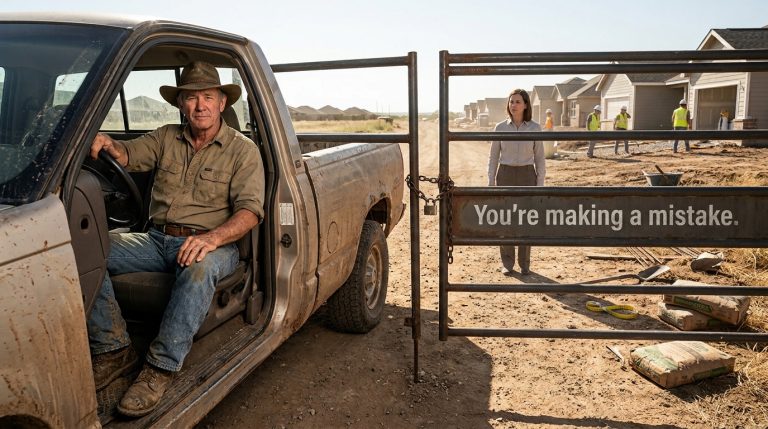
Two men in black tactical vests stood beside my lower gate post. Between them, a heavy steel bar stretched across the gravel, locked into place with a fresh chain. A zip-tied sign hung from the mesh: TEMPORARY SAFETY RESTRICTION — INTERIM COUNTY ACCESS AUTHORITY.
I let the truck idle in the cold air, engine rumbling against the silence of the pines. My hand reached into the console, fingers brushing the heavy, worn brass grading rule I’d kept in my pocket since the day I broke ground on this mountain. I turned the metal over twice, feeling the cold notches against my thumb.
I stepped out into the dust, leaving the driver’s door swinging.
"Road’s closed, boss," the older guard said. He didn't take his hands off his belt line. "HOA safety directive. Emergency corridor evaluation."
"This isn't HOA land," I said. My voice was low, flat, carrying no more heat than the morning frost. "You're forty feet past the subdivision turnoff. You're standing on parcel 404."
"We've got our orders from Ms. Harmon," the younger one chimed in, stepping forward just enough to block the foot path. "Boundary lines are under review. Turn the vehicle around."
I didn't argue. Arguing with hired muscle on a gravel turnout is a city man’s mistake. Instead, I pulled my phone from my canvas jacket, stepped right up to the steel bar, and took three slow, deliberate photographs—one of the lock, one of the sign, and one of the older guard’s plastic name badge.
"Who issued the paper?" I asked.
"Board decision," the older guard grunted, shifting his boots on my rock. "We're here until the route gets finalized."
I hit the record button on the voice memo app and held the screen flat between us. "Say the name again for the log."
He hesitated, his eyes flicking to the phone screen, then back to my face. "Ms. Harmon. Aspen Vale Board President."
"Good." I saved the clip, slipped the phone back into my pocket, and tapped the brass rule twice against the cold steel gate post. Clang.
"You boys enjoy the dust," I said. " Sheriff's non-emergency dispatcher answers on the third ring."
I didn't turn the truck around to leave the mountain. I backed it fifty yards down to the public shoulder, pulled the brake, and grabbed my heavy work boots from the flatbed. If they thought a padlocked chain across the main cut stopped access to eighty acres of pine and granite, they didn't know who built the fence.
I hit the timberline on foot, cutting steep through the brush along my eastern property boundary, tracking the sharp scent of damp earth and crushed pine needles. Ten minutes up the ridge, my boots hit fresh dirt that shouldn't have been there.
A bright orange wooden stake sat jammed into the shale, forty yards deep into my timberline. The paint on top wasn't the standard matte chalk used by county crews. It was high-gloss, fresh, and still sticky enough to catch pine dust.
Beyond the trees, the faint, metallic grind of a mini-excavator began to ring out through the quiet morning.
CHAPTER 2: HIGHRIDGE RECONNAISSANCE
The diesel exhaust drifted up the ridge, thick and sour, clinging to the damp bark of the ponderosa pine under my palm.
Down in the cut, four hundred yards inside my property boundary, three men in high-vis vests were moving with the calm rhythm of people who thought nobody was watching. One worker operated the saw, the blade screaming as it sliced through an old cedar post I’d set six winters ago. Another guided a steel gate pedestal into a fresh wooden form.
Off to the side stood Celeste Harmon. Clean tan boots, pristine denim jacket, a hard-backed clipboard resting against her forearm. She wasn’t holding a hammer or a tape measure. She was pointing, gesturing toward the slope, giving orders with the cool assurance of a supervisor inspecting a long-overdue municipal job.
I pulled the brass grading rule from my pocket and turned it over once, the cold metal edges biting into my knuckles. Without aerial camera views or overhead perspectives to document the scene from above, every piece of proof was going to have to be gathered the hard way—on foot, through the brush, with dirt on my boots.
I started down the slope, taking care to plant my heels firmly in the pine needles, keeping my movement quiet. The grade dropped sharply toward the turnout, the shale loose underfoot.
As I reached the tree line twenty feet above the work site, I pulled out my phone, stepped into the open, and let the camera capture the ground-level reality. I took three crisp photos from the treeline: Celeste with her clipboard, the crew resetting the boundary markers, and the exact point where their trench crossed over the old moss-covered corner pin.
"Who authorized the excavation on Parcel 404?" I called out, my voice cutting cleanly through the drone of the engine.
The excavator operator throttled down the motor. The foreman—a stocky man with graying sideburns and a grease-stained cap—swiveled around, wiping his brow with the back of a gloved hand. He looked at me, then immediately glanced toward Celeste.
That single glance said everything a surveyor needed to know.
"Aspen Vale Road Committee," the foreman said, his voice hesitant as he stepped toward the boundary line. "We're resetting the turnout for emergency clearance."
"Got a county grading permit?" I asked, stepping down onto the fresh gravel of my own road.
Celeste didn't flinch. She adjusted her clipboard, her eyes cool and dismissive as she took two steps toward me, stopping just short of the trench line.
"This is an interim safety assessment," she said, her voice smooth, calibrated for a courtroom or a board room. "We sent you notice. No single owner has the right to obstruct a corridor that materially serves the mountain community."
"You sent a courtesy letter," I said, holding up my phone to record the fresh trenching at her feet. "This is private dirt. You're forty yards over the line, and you're destroying private drainage."
"The boundary lines are subject to historical alignment review," Celeste replied smoothly, turning back toward the foreman as if I were nothing more than a noisy delay. "Continue with the form placement, Carl. We have a county walk scheduled for Tuesday."
I didn't yell. I didn't step across the trench to grab a shovel. Shouting at a hired foreman only gives people like Celeste a reason to call the law on you for disturbing the peace.
Instead, I looked down at the wooden form. Right beside the fresh concrete, jammed half-hidden beneath a pile of cut roots, was a printed scope sheet wrapped in clear plastic to protect it from the mud.
I leaned down, snapped a macro photo of the header before Carl could kick dirt over it. Two words stood out in bold red ink at the top of the contractor's instruction sheet: PRE-EXISTING ROUTE.
I backed away two paces, slipping the phone into my chest pocket.
"Keep digging, Carl," I said softly, looking past him to Celeste, whose calm smile didn't quite reach her eyes. "Every yard of dirt you move is going to cost your board five hundred dollars in restoration fees before this month is out."
I turned my back on them and walked straight down my road toward the lower gate, my thumb running over the worn notches of the brass rule.
CHAPTER 3: THE BOARDROOM AUDIT
The folding chairs in the community center were arranged in neat, orderly rows, filled with thirty homeowners holding ceramic coffee mugs.
At the head table sat Celeste Harmon in her cream blazer. Her hands were folded over a black leather binder, her posture straight, her expression radiating serene authority.
I didn't take a seat. I stood near the back wall beside the fire exit, my work jacket heavy against my shoulders, my thumb resting over the cold brass rule in my pocket.
"Moving to item four on the agenda," Celeste said, her voice clear and measured as it carried through the room’s speakers. "Wildfire preparedness and community access corridors."
She gestured toward a projector screen behind her. A map appeared, showing the lower mountain roads. The private cut I’d built with my own machinery was shaded in light blue, seamlessly blending into the subdivision's common roadways.
"As many of you know," she continued, looking out over the crowd, "unrestricted transit during storm events is a critical safety pillar. No single owner should obstruct a route that materially benefits the greater mountain community."
A quiet hum of agreement rippled through the front rows.
"Point of order," I said from the back wall.
The room went dead quiet. Heads swiveled toward the fire exit.
Celeste didn't lose her smile, but her fingers tightened slightly against the edge of her leather binder. "This is a closed board meeting for Aspen Vale members, Mr. Vance. Non-member input is restricted to the public hearing next week."
"Then keep the map accurate," I said, stepping forward three paces until my boots hit the tile aisle. "Parcel 404 is private property. It isn't common ground, and it isn't an HOA transit lane."
"The board is acting under interim safety guidelines," she replied smoothly, turning her attention back to the microphone to dismiss me. "We are simply protecting neighborhood value and emergency access. Standards preserve order."
Ten minutes later, when a resident in row two asked a question about trash bin placement near the lower drive, Celeste’s tone shifted instantly. She warned the homeowner that visible bins would trigger an immediate fifty-dollar daily fine because rules must be strictly enforced to maintain standards.
I let out a single, dry breath that sounded almost like a laugh in the quiet room.
"So a trash bin behind a hedge is a threat to community order," I said, my voice cutting across her response, "but cutting a drainage ditch on land you don't own is called stewardship?"
Celeste’s eyes narrowed into tiny slits. She leaned into the microphone, dropping her polite tone just enough for the edge to show. "The county review will settle the corridor status, Mr. Vance. I suggest you reserve your arguments for the magistrate."
"I intend to," I said.
I didn't wait for the adjournment. I turned, pushed through the heavy double doors, and walked out into the cool evening air, saving the recording file with a single press of my thumb.
CHAPTER 4: THE TRENCH LINE DISCREPANCY
The surveyor’s overlay line ran in crisp black ink across the topographic grid. Below it, printed in faded red, was the exhibit map Celeste had attached to her county petition.
The two lines didn't match.
It wasn't a glaring shift—just eighteen inches to the west. Exactly enough to tuck my gate, my primary culvert, and three yards of retaining wall into a narrow strip labeled as historically shared access.
My thumb pressed flat against the paper, right over the boundary corner.
"He zoomed in on the export metadata," my attorney had said when he handed me the printout earlier that afternoon. "The digital exhibit wasn't generated by the county GIS office. It came from a private planning consultant firm in Denver."
A firm owned by Celeste Harmon’s brother-in-law.
Up on the turnout, the diesel engine of Carl’s excavator sputtered to a halt. The crew was packing their hand tools into the bed of a white pickup truck, preparing to lock down the site for the night.
I folded the surveyor's map into a tight square, jammed it into my canvas coat, and walked up the gravel incline toward the freshly dug trench.
Carl was standing by the newly set gate post, wiping grease from a wrench with a red rag. When he heard my boots grinding on the shale, his shoulder muscles tensed under his flannel shirt.
"Tools are down for the day, Mr. Vance," he said, not looking me in the eye. "We're done till the county walk."
"I'm not here about the tools, Carl," I said, stopping three feet from the edge of the ditch. I pointed down at the concrete footing. "I'm looking at the scope sheet you left under the forms this morning."
Carl wiped his hands slower, his jaw working silently.
"My lawyer got a copy of the revised work order from your main office an hour ago," I continued quietly, keeping my tone level. "The instruction line didn't say 'assess boundary'. It said 'present as pre-existing route during county walk'."
Carl stopped moving his rag. He looked down at the fresh concrete, then back up toward the upper timberline where the sun was disappearing behind the peaks.
"I just run the crew, mister," he grunted, his voice dropping an octave. "I take the work orders the committee hands me."
"And when a work order tells you to move a private gate uphill and disguise a drainage ditch, you don't ask for a permit?"
He didn't answer. He threw the rag into the back of his truck and slammed the tailgate with a loud, metallic thud that echoed through the trees.
"Ms. Harmon said the paperwork was filed," Carl muttered, looking past me toward the lower gate. "She said you were just stalling."
"She lied to you, Carl," I said, pulling the brass rule from my pocket and tapping it against the fresh wooden form. "And when the county inspector stands right here on Thursday morning, he's going to ask who signed the excavation order without a county seal."
Carl stared at the rule, then at the deep trench his crew had cut into my mountain. The certainty on his face was gone, replaced by the weary realization of a man who realized he'd been handed a shovel to dig someone else's hole.
CHAPTER 5: THE COUNTY HEARING COLLAPSE
The air in the hearing room was thick, smelling of wet wool, cheap coffee, and air conditioning.
At the front desk sat the county commissioners alongside the sheriff. To my left, Celeste Harmon sat beside her attorney, her cream blazer immaculate, her posture as rigid as a fence post.
When my attorney hit the remote, the main screen glowed.
Instead of aerial overhead shots, the high-resolution ground photos snapped from the timberline filled the ten-foot display. Ground-level shots of the orange stakes. High-contrast photos of Carl’s crew cutting through my original cedar posts. Time-stamped screenshots from the county permit portal showing zero grading permits filed for Parcel 404.
"These are baseline physical records," my attorney said, his voice flat and untroubled. "Next slide."
The original quarry invoices from seven years ago appeared—truckloads of crushed rock, culvert delivery receipts, and diesel fuel logs for my skid steer. Every slip stamped, dated, and signed.
Celeste’s lawyer stood up, smoothing his tie. "Mr. Chairman, the HOA acted under emergency safety protocol. Historical corridor usage—"
"Sit down, counselor," the county chair interrupted, not looking up from his paper binder. "Let him finish."
The projector flicked to the GIS overlay. The black surveyor line matched my deed exactly. The red line—Celeste’s official exhibit—swerved eighteen inches onto my land.
"We ran the digital export metadata on the applicant’s exhibit," my attorney continued smoothly. "It didn't originate from county records. It was exported three weeks ago from a Denver land firm registered to the applicant’s brother-in-law."
A low murmur rippled across the rows of seated homeowners.
Celeste’s face lost every drop of its polished color. She didn't look at her lawyer. She didn't look at the crowd. Her eyes remained locked on the digital screen, her fingers digging into the edge of her mahogany notebook until her knuckles turned white.
"And finally," my attorney said, tapping the podium, "the scope sheet issued directly to the contractor on site."
The image clicked over. Ten feet high, bold against the white background: PRESENT AS PRE-EXISTING ROUTE DURING COUNTY WALK.
The sheriff leaned forward, resting his forearms on the bench. He looked directly at Celeste, his eyes cold and unhurried.
"For the record," the sheriff said, his microphone catching the rasp in his voice, "armed contract personnel were posted at the lower gate without county authorization. And any claim built on altered site conditions is not something this office recognizes."
Celeste shifted in her chair, her jaw tightening as she tried to raise her hand to speak. But the floor beneath her position had already vanished.
CHAPTER 6: THE EARNED SILENCE
The unauthorized steel post and forms were gone, pulled from the dirt under county supervision.
In their place, my original heavy cedar gate hung square and level, locked into the bedrock with the same galvanized hardware I’d turned by hand seven years ago. The trench Carl’s crew had cut was backfilled, re-graded, and packed with three fresh truckloads of crushed granite—paid for entirely by the Aspen Vale HOA treasury.
Celeste Harmon didn't show up for the final repair inspection.
Her lawyer made one last desperate push before the judge signed the injunction, claiming the board had been misled by technical consultants and attempting to stall the fee recovery under a settlement clause. But when the county chair frozen her petition and the court issued a bonded compliance order, the board’s unified front shattered.
By the end of the third week, the HOA had cut their losses. They paid the survey fees, the engineering costs, my attorney's bill, and the full site restoration.
Celeste lost her board presidency in a quiet emergency meeting before the month was out. Not because she had suddenly developed a conscience, but because her unearned arrogance had finally become too expensive for her neighbors to finance.
I pulled the brass grading rule from my pocket, turned it over twice in my palm, and let my thumb rest against the cold, notched edge.
Later that evening, I stood on the turnout as the light dropped low behind the western ridge. My attorney, the surveyor, and the old county roads inspector stood nearby with paper plates of takeout barbecue and heavy glasses of bourbon.
Down below, the gravel road curved clean and undisturbed through the pine timber, open only to the land it was built to serve. Nobody made a speech. In the high country, when a job is done right, speechifying is just extra noise.
I took a slow sip, looking down the grade I’d cut out of shale and rock with my own hands. The threat was gone, the paper weapons were shredded, and the peace I’d bought with sweat and receipts was mine again.
Final.
If you didn't build it, don't stand on it and call it yours.