The Prairie Chemist Who Crashed Churchill’s Lunch and Shattered the Atlantic U-Boat Blockade
CHAPTER 1: THE SCRAP YARD TRIAL
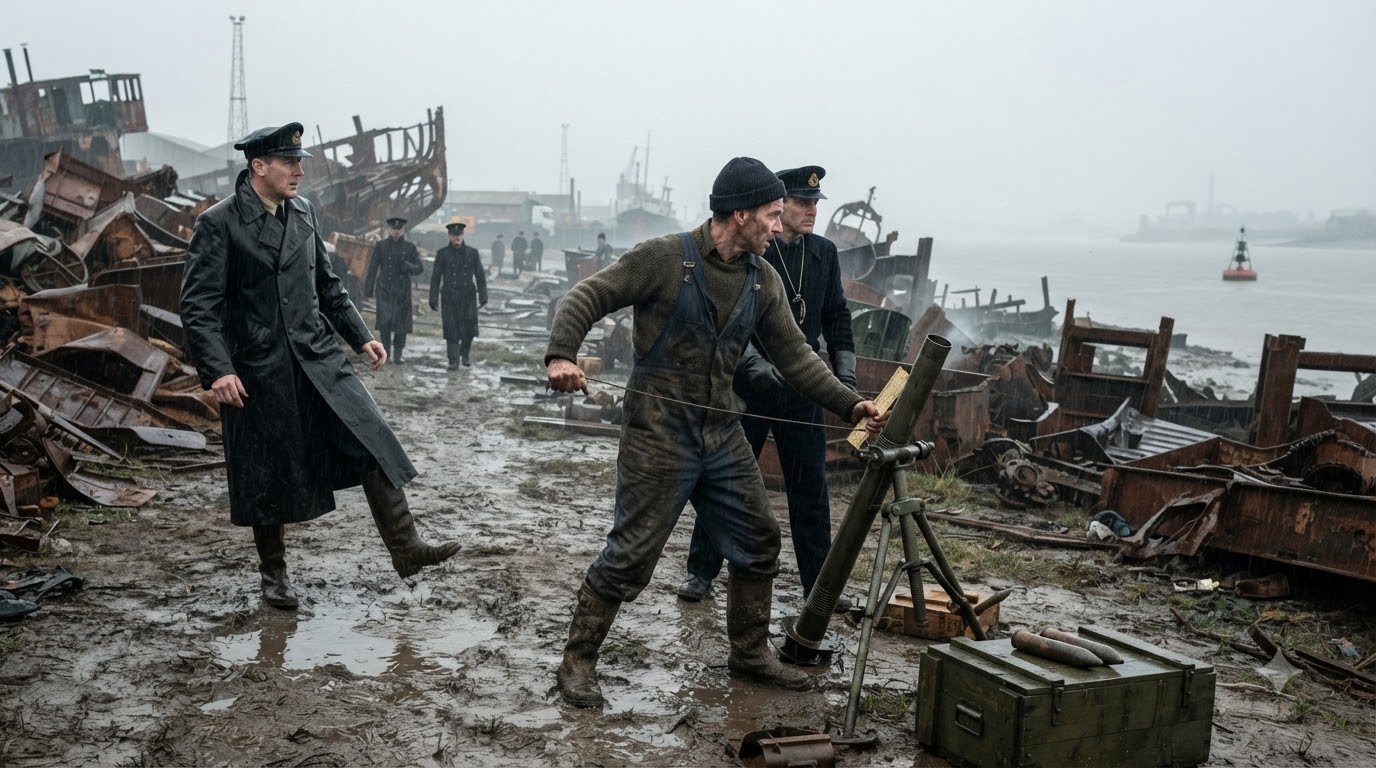
The mud of the Thames estuary clung to my boots like wet cement. Cold March rain dripped off the brim of my wool cap, stinging my eyes as I adjusted the iron clamp on the steel spigot rod.
Commander Jock Davies wiped grease off his knuckles with a rag that was dirtier than the metal. “The Admiralty courier just left the front gate, Charles. They signed the confiscation order. We have twenty minutes before the armed guards roll in.”
“Then we fire in ten,” I said.
I didn’t need their official sonar logs or their polished acoustic charts. I had a scarred brass slide rule in my coat pocket, a pocket notebook filled with handwritten timing observations from merchant sailors, and twenty-four hollow-base steel projectiles sitting in wooden crates behind a stack of rusted scrap iron.
“They called it an illegal ordnance test,” Davies muttered, turning the heavy elevation wheel until the mortar frame locked at forty-five degrees. “If this frame cracks, they won’t just shut us down. They’ll throw us both in the brig at Chatham.”
A black Staff car rattled down the gravel lane past the timber yards, its high-beam headlights cutting through the gray river fog. The doors didn’t open yet, but I could see the stiff brim of an Admiralty inspector’s cap through the glass.
I ignored the car, stepped over a tangle of wet hawser cables, and slid the first sixty-five-pound projectile down over the bare steel spigot. The metal scraped cold and heavy against my palms.
“The fuse is locked,” I said, my voice flat, stripped of the anger that had been burning in my chest since the morning dispatch arrived. “It won’t arm until it sinks twenty feet into the riverbed. No explosions to tear up the mud.”
“They don’t care about the mud, Charles,” Davies said, stepping back with the lanyard tucked into his heavy leather glove. “They care that you didn’t ask for permission.”
I pulled my brass slide rule from my pocket, thumbs tracing the worn grooves along the logarithmic scale. “Sixty attacks per kill with depth charges, Jock. Sixty blind runs while the U-boats turn hard left under the sonar shadow. That isn’t a procedure—it’s a massacre.”
The car doors slammed shut. A tall naval captain in a dry oilskin coat stepped into the slush, two red-capped military policemen trailing three paces behind him.
“Commander Goodeve!” the captain shouted over the wind. “Stand away from that contraption! You are in direct violation of the Ordnance Board’s directive!”
I didn’t turn around. I didn’t glance at his paperwork. I looked past the launcher toward the floating target buoy bobbing two hundred yards out in the gray, choppy current.
“Fire pair one, Jock,” I said quietly.
“Goodeve!” the captain roared, unbuttoning his holster strap. “I have a signed warrant!”
Davies yanked the lanyard.
The spigot mortar didn’t roar like a cannon; it gave a sharp, metallic clack-thud that vibrated straight up through the mud into the soles of my feet. The expanding propellant gas slapped the cold air, launching the first twin projectiles into the sky in a low, tight arc.
They turned lazily over at the apex, slicing through the rain before driving clean into the river surface with two quiet, sharp splashes—right on the edge of the target zone.
The captain froze mid-step, his boot hovering over a puddle of oily water. The silence on the riverbank was immediate, heavy, and absolute.
“No explosion,” the captain said, his voice dropping as he stared at the untouched water. “It failed.”
“It didn’t fail,” I said, wiping a mixture of rain and soot from the brass slide rule before slipping it back into my coat. “It hit. And the sonar screen stays crystal clear.”
CHAPTER 2: COLD TEA AND CLOSED DOORS
The coal stove in the corner of Room 404 hissed with wet steam, filling the narrow office with the smell of sulfur and damp wool. Outside the fogged windowpanes, Whitehall was buried in London’s mid-morning gloom.
Commander Vance didn’t offer a chair. He sat behind a sprawling mahogany desk piled high with red-tape dossiers, slowly stirring a cup of cold tea. His silver hair was clipped to perfection, his gold braid catching the weak yellow light of the desk lamp.
“You brought dirt onto my rug, Goodeve,” Vance said without looking up from his spoon. “And you brought a toy onto the Thames.”
I reached into my coat and pulled out the brass slide rule, laying it on the edge of his immaculate blotter. “The toy placed two dummy casings within four feet of the marker buoy at two hundred yards. Without underwater acoustics. Without an acoustic blind spot.”
“The Ordnance Board has reviewed the spigot mortar three times since 1910,” Vance said, setting the spoon down with a soft clink. “It was rejected under Major X, rejected under Colonel Blacker, and rejected under Major Jeff. The Board’s decisions are final.”
“The Board’s decisions are drowning twelve hundred merchant sailors a week,” Davies said from the door, his wet uniform coat dripping steady circles onto the floorboards.
Vance’s eyes snapped up, cold and flat. “You’re in my office, Davies. You’re an engineer, not a strategist. Leave the tactics to officers who actually command ships.”
I didn’t raise my voice. I leaned over the mahogany desk, picked up a piece of white drafting chalk from his tray, and drew a thick, crude arc directly across the polished wood.
“What do you think you’re doing to my desk?” Vance demanded, half-rising from his leather chair.
“This is your destroyer,” I said, dragging the chalk line three inches forward. “This is your ASDIC beam. At three hundred yards, the angle slips right over the target’s hull. Your operator hears nothing for ninety seconds. What does your captain do?”
“He accelerates,” Vance sneered, settling back with a dismissive wave. “He charges over the contact and rolls a pattern off the stern. Standard procedure. It’s proven.”
“Sixty attacks for one kill isn’t a procedure, Commander,” I said, slamming the chalk down on the edge of his blotter. “It’s arithmetic. The U-boat turns hard left the moment your ping dies. By the time your depth charges hit two hundred feet, the target is three hundred yards away, setting up a torpedo run on the convoy’s fuel tankers.”
Vance reached out, sweeping a gloved hand across the wood to smear the white chalk into dust. “You’re a civilian chemist who studies eye pigment, Goodeve. You don’t know the first thing about naval warfare.”
“I know how to measure distance, and I know how to read a casualty ledger,” I said, my thumb catching the sharp brass edge of the slide rule in my pocket. “Give us twelve escort hulls for a sea trial.”
Vance gave a sharp, bark-like laugh. “Twelve ships? I wouldn’t give you a rowboat in a park pond. The First Sea Lord has already signed the production quotas for depth charges through November. Every factory in Leeds is tooled for them.”
“Because your friends hold the steel contracts,” Davies interjected, stepping deeper into the warm, sulfurous air of the room.
Vance stood up slowly, his knuckles resting heavy on the blotter. “Careful, Davies. The Admiralty doesn’t tolerate insubordination from auxiliary reserves. If you two keep hawking this spigot garbage through back channels, I’ll have your commissions revoked by morning.”
I looked at the smeared chalk dust on his desk, then directly into his eyes. “You can revoke the commission, Vance. But you can’t fix the blind spot.”
CHAPTER 3: THE GATECRASH AT CHEQUERS
The guard’s bayonet caught the yellow reflection of the truck’s single working headlight. Cold rain ran down the barrel, dripping into the gravel at my feet.
“This gate is closed to non-listed transport,” the young sentry said, his voice cracking slightly under the weight of his slicker. “The Prime Minister’s party is already at the house.”
Davies leaned across the passenger side, tapping a thick, oil-stained finger against the steering wheel. “We’ve got a heavy-ordnance dispatch directly from the Department of Miscellaneous Weapons. You want to tell Lord Cherwell why his test assembly is sitting in a ditch two miles back?”
I didn’t offer a polite smile. I reached out and slapped the forged courier folder against the guard’s wet chest—just hard enough to break his rhythm.
“The seal’s on the second page,” I said, my voice cutting flat through the diesel exhaust. “Check it or call the guard house, but do it while the engine’s running. We’ve got five minutes before the firing schedule starts.”
The guard hesitated, his wet thumb slipping across the ink-smudged paper. The stamp was nothing more than an outdated Admiralty transit seal Davies had lifted from a scrap desk, but under a dim lantern in a downpour, it looked official enough to frighten an eighteen-year-old conscript.
“Drive through,” the sentry muttered, stepping back into the mud and waving his lantern twice. “Keep it under ten miles an hour along the gravel.”
The truck lurked forward, its axles groaning under the three-ton weight of the steel spigot frame bolted in the bed.
We swung past the stone stables and cut straight across the manicured lawn, the rear tires tearing deep, black ruts through the turf directly behind the Prime Minister’s personal fleet of staff cars.
“Look at that deck plate,” Davies whispered, nodding toward a flatbed trailer parked near the firing line. “They’ve got Vance’s preferred depth-charge throwers mounted on timber blocks. Look close at the welds.”
I leaned my forehead against the cold, vibrating glass of the cab. Along the seam of the starboard mounting bracket, a faint spiderweb line of rust-colored stress flaked off under the vibration of the idling engine.
“They’re forcing heavy hydraulic mounts onto light hulls,” I said, pulling the brass slide rule from my coat and tapping the metal against the dash. “The recoil from those heavy barrels will shear the rivet lines before a destroyer completes three runs.”
A door slammed near the conservatory. Two armed guards stepped out into the drizzle, followed by a tall, balding man in a dark tailored overcoat—Lord Cherwell, Churchill’s chief scientific advisor. Behind him, a broad-shouldered man in a thick woolen cloak pulled his hat down low against the wind, holding an unlit cigar between two fingers.
“Good God, Goodeve,” Cherwell called out, his shoes squelching through the ruined grass. “What is a civilian truck doing on the Prime Minister’s lawn?”
“Solving your U-boat problem before lunch, my Lord,” I said, stepping out of the cab directly into the mud.
CHAPTER 4: THE THREEMINUTE ULTIMATUM
“I am hungry, Cherwell,” Churchill grumbled, his voice low and raspy as he shifted his unlit cigar from one side of his mouth to the other. “My soup is getting cold, and I have a cabinet meeting at two.”
“Three minutes, Prime Minister,” I said, setting the six-inch nose of the Torpex casing firmly down onto the wet grass at his feet. “Three minutes is half the time it takes a U-boat to dive past an escort ship’s blind zone.”
Churchill stopped, his heavy eyebrows pulling down over his eyes. He looked at the hollow base of the casing, then up at the spigot array mounted on the back of Davies’s truck.
“The Ordnance Board says spigot mortars are unstable,” Churchill growled. “They’ve turned them down four times.”
“The Ordnance Board isn’t standing on the deck of a burning tanker in the Western Approaches,” Davies called out from the truck bed, his gloved hands clamping the firing key into the electrical housing.
Cherwell cleared his throat nervously. “Prime Minister, Commander Vance sent an urgent message twenty minutes ago. He claims this demonstration is completely unauthorized.”
“Vance isn’t here,” I said, pulling my brass slide rule from my coat pocket and sliding the indicator notch to two hundred yards. “And Vance’s depth charges miss ninety-eight percent of their targets because they explode behind the submarine.”
Churchill stared at the brass instrument in my hand, then looked back at the gray, rain-swept field. “Show me.”
Davies yanked the primary breaker.
The launcher didn’t roar; it gave a sequence of twelve rapid, mechanical thud-clacks. Twenty-four steel projectiles rippled into the sky in pairs, arcing gracefully through the drizzle before tumbling in a tight, uniform ellipse two hundred yards downrange.
They hit the sod together, driving five feet into the earth with a single, dull shudder—no high-explosive roar, no geysers of mud, no deafening blast to tear up the ground.
Cherwell blinked, taking a step back. “It didn’t detonate.”
“It’s a contact fuse,” I said, tapping the edge of the brass rule against my thumb. “If there’s no steel hull under the water, it sinks silently. No underwater noise to blind the ship’s detection gear. If it misses, you reload and fire again instantly.”
Churchill didn’t move. Rain pooled in the crease of his wool coat as he stared at the neat, tight pattern of steel tails sticking up out of the grass.
“Do it again,” Churchill demanded, his voice dropping into a sharp growl.
“That was our only live sequence, Prime Minister,” Davies said, wiping water off his forehead.
Churchill turned slowly, his eyes fixing on Cherwell. “Call the First Sea Lord. Tell him I want trial mounts installed on six destroyers before the end of the month.”
“Sir,” Cherwell hesitated, “Commander Vance and the Ordnance Board will demand a formal hearing—”
“They can demand whatever they like over their lunch,” Churchill snapped, turning back toward his car. “Goodeve gets his trial.”
CHAPTER 5: THE SILENT WATERS
Captain Harris wiped salt spray off his chin with the back of his glove, his teeth clenched tight as the destroyer slammed down into another swell.
“Range three hundred yards!” the operator’s voice crackled through the voicepipe from the ASDIC shack below. “Target turning hard port! Contact losing clarity!”
I reached out and unlatched the safety cover on the forward spigot control box, exposing the twin brass firing toggle switches. “Flip it, Captain. You’ve got solid tracking for another six seconds before the sound beam passes over him.”
“No,” Harris growled, his knuckles white against the stern depth-charge release lever. “I’ve run escort duty for eighteen months, Goodeve. I know what happens when I pull this lever—I get forty-ton geysers of water, I get shockwaves that break the U-boat’s hull seams, and my crew knows we’re fighting back. I throw your little spigot darts and miss, and my boys get nothing but dead silence.”
“Your forty-ton geysers are bursting two hundred yards behind him!” Davies yelled from the bridge wing, his hands gripping the spray shield as cold ocean water washed over his boots. “He’s diving under your blind spot right now!”
“The Admiralty sent an operational memo this morning,” Harris snapped, turning his back on the spigot control box. “Commander Vance explicitly stated these forward-firing mounts are experimental and at the commanding officer’s discretion. I am not risking a primary engagement on a toy that makes no noise.”
“Vance wrote that memo to protect his depth-charge quotas, Captain,” I said, stepping between Harris and the stern release lever. I pulled the brass slide rule from my pocket and jammed it flat against the glass of the chart table, right over the destroyer’s speed log. “Look at the rivets along your foredeck. Look at where Vance’s heavy throwers are mounted.”
Harris narrowed his eyes. “What are you talking about?”
“Vance knows the heavy hydraulic throwers he mandated are tearing the deck plates out of these older V-and-W class destroyers,” I said, pointing through the bridge window down to the forward deck where the hedgehog spigot array sat locked at forty-five degrees. “The stress frames are cracking along the rivet lines. He’s hiding the structural failures by forcing you to fire off the stern where the hull is reinforced.”
“That’s a lie,” Harris said, though his hand hesitated on the lever.
“Check the port deck seam yourself!” Davies shouted over the roar of the engines. “We saw the stress fractures at Chequers on the test flatbed! The spigot mortar doesn’t use heavy hydraulic recoil—it uses fixed steel rods. Zero deck strain.”
“Contact lost!” the voicepipe barked from below, the acoustic operator’s voice rising in panic. “Target vanished from screen! Blind time commencing!”
Harris stared at the dead voicepipe, then down at the brass control box on his console.
“He’s turning left, Captain,” I said quietly, keeping my voice steady against the howling wind. “Ninety seconds of free movement. He’s lining up his bow tubes on the convoy’s lead tanker right behind us.”
Harris cursed under his breath, shoved my shoulder aside, and slammed his palm down on the brass spigot toggle switch.
Down on the foredeck, the launcher rippled. Twelve twin thuds echoed through the hull as twenty-four projectiles arced out over the bow, disappearing into the white-capped waves two hundred yards ahead.
Five seconds passed. Then ten. The sea remained flat, gray, and silent.
“Nothing!” Harris spat, turning on me with an enraged glare. “No explosion! A complete miss!”
“Hold your course,” I said, staring at the stopwatch in my hand. “If it misses, it sinks silently. Watch the ASDIC screen.”
Before Harris could reach for the stern lever again, a massive, dull thump vibrated straight through the keel of the ship, followed instantly by two more heavy underwater concussions that rattled the bridge windows in their frames.
A massive slick of thick, black crude oil bubbled up to the surface two hundred yards off the port bow, carrying wooden decking and air tanks with it.
The voicepipe crackled. “Contact destroyed! Sonar picture completely clear!”
Harris stood frozen, his hand still hovering over the depth-charge lever, his mouth open as he stared at the churning oil patch. He looked at me, then down at the quiet, undamaged metal of his forward deck.
“Get on the wireless, Jock,” I told Davies, slipping the slide rule back into my pocket. “Tell the Admiralty that HMS Westcott just confirmed her first kill.”
CHAPTER 6: THE RECORD OF THE USS ENGLAND
Lieutenant Williamson gripped the edge of the forward gun shield, his shirt dark with sweat as the ship vibrated beneath our boots.
“Contact bearing zero-nine-zero,” Williamson called out, his voice crisp and steady over the roar of the diesel exhaust. “Range three hundred yards.”
I reached into my pocket, my fingers brushing the worn brass grooves of my slide rule one last time before leaving it tucked away. I didn’t need to measure the distance anymore. The physics had already won.
“Fire pattern,” Lieutenant Commander Pendleton ordered from the bridge wing above us.
Williamson pulled the firing lanyard.
The twenty-four spigot mortars on the foredeck discharged in pairs, sending a tight, elliptical cloud of contact-fused projectiles screaming through the bright Pacific air. They hit the water two hundred yards ahead of the bow, cutting into the blue swell with barely a ripple.
Four seconds of dead silence passed across the ocean.
Then, six distinct, earth-shaking thuds slammed through the hull plating of the destroyer, lifting the ship’s stern three inches out of the water before dropping it back into the froth. A massive geyser of diesel, shattered timber, and air flasks burst through the surface, spreading across the waves.
Williamson let out a slow, heavy breath, resting his forearm against the warm steel of the launcher frame. “That’s six, Commander. Six in twelve days.”
“The Japanese early warning line is completely severed,” Pendleton said, leaning over the bridge rail with a sheaf of radio dispatches in his hand. “Washington just confirmed it. Admiral King sent a personal fleet message: ‘There will always be an England in the United States Navy.'”
Down in the shade of the forward deck, the weld seams on the spigot mount were untouched. No stress cracks along the deck plates, no sheared rivets, no structural failures—just twenty-four empty steel spigots pointing quietly toward the horizon.
Back in London, the Ordnance Board’s thick dossiers and Vance’s suppressed safety reports were already being swept into filing cabinets, rendered completely irrelevant by six simple numbers written in the USS England’s logbook.
The sixty-to-one ratio of depth charges was gone, replaced by a five-to-one reality born in a prairie attic and forged on the Thames riverbank.
I picked up a piece of dry cotton waste from a tool crate and wiped a smudge of black grease off the launcher’s firing terminal, laying the rag neatly on the frame before stepping back onto the clean deck.