The Rusted Wire That Outsmarted the Enemy and Outlasted the Desk-Bound Generals in the Pacific Sky
CHAPTER 1: THE MIDNIGHT WORKSHOP
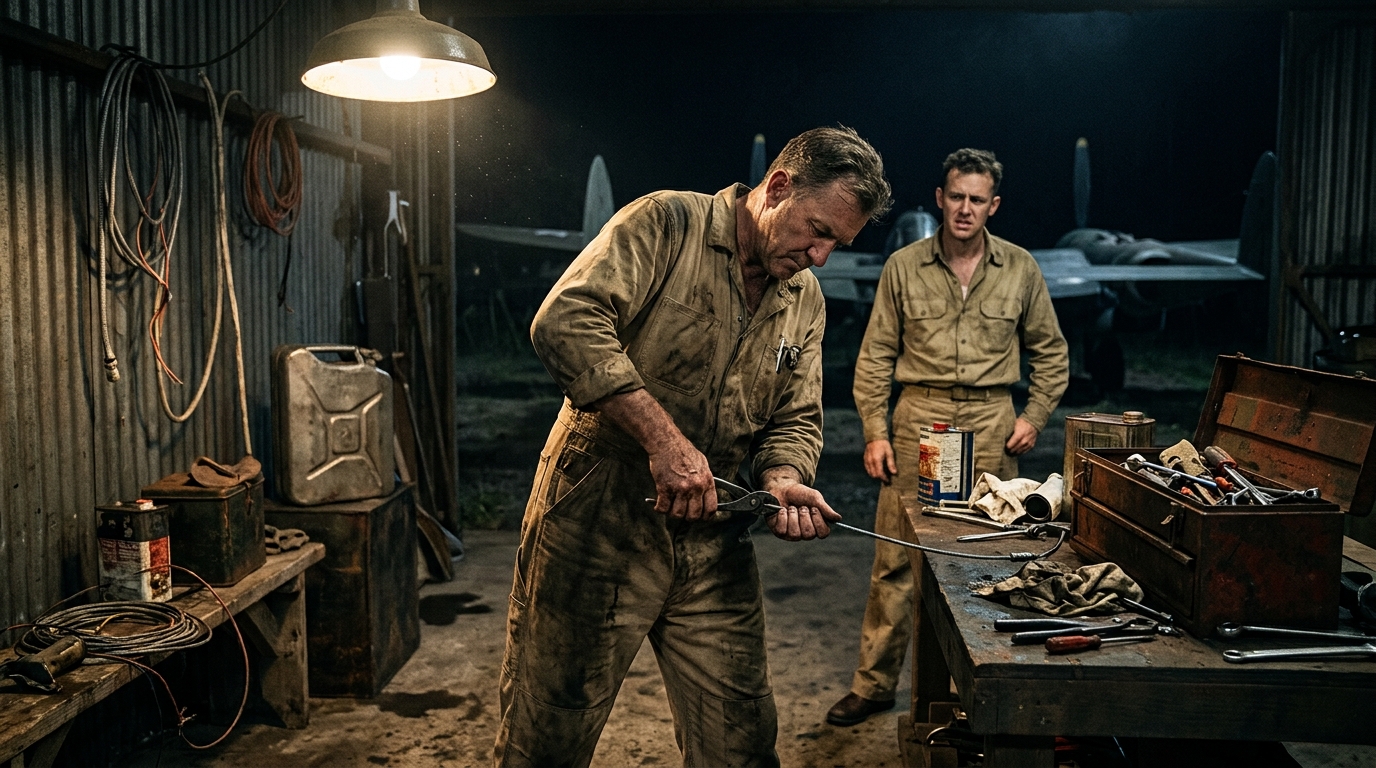
The work lamp hummed, casting a jaundiced circle of light over the grease-stained concrete.
James McKenna wiped his hands on a rag that was too stiff with old hydraulic fluid to absorb anything.
Outside the corrugated iron hangar, the New Guinea night hung heavy, thick with the scent of rotting vegetation and standing water.
In the shadows of the revetment, Lieutenant Robert Hayes stood shifting his weight from one boot to the other, a young face carved out of raw exhaustion.
“I don’t care if it’s regulation,” Hayes said, his voice dropping to a harsh rattle. “I felt it lock up again today. If I roll into a turn and it sticks for another half second, I’m done.”
McKenna didn’t look up from the workbench.
His fingers traced the rough edge of a 6-inch piece of high-tensile piano wire pulled from a wrecked fuselage two weeks ago.
The manual said the cable slack was within acceptable factory tolerances.
The engineering officer two thousand miles away in a climate-controlled office said field modifications were a court-martial offense.
“The book says you’re flying within spec,” McKenna muttered, his thumb pressing hard against the cold steel of the wire.
“The book isn’t sitting in your cockpit when a Zero drops on your tail,” Hayes snapped back.
McKenna set down the rag, picked up a pair of heavy pliers, and gripped the wire.
He didn’t offer comfort or false reassurances; he just squeezed until the metal bit back into his palm.
The hangar was dead quiet except for the distant generator rumble and the clicking of cooling exhaust pipes.
He moved toward the parked P-38, sliding past the wing root where the warm metal radiated the day’s heat.
The inspection panel came off with a sharp scrape of rusted screws.
Inside the twin boom, the control cables lay slack, waiting for a command they always delivered a fraction too late.
CHAPTER 2: INTO THE SUN
The air at 7:42 a.m. smelled of burnt aviation fuel and scorched oil.
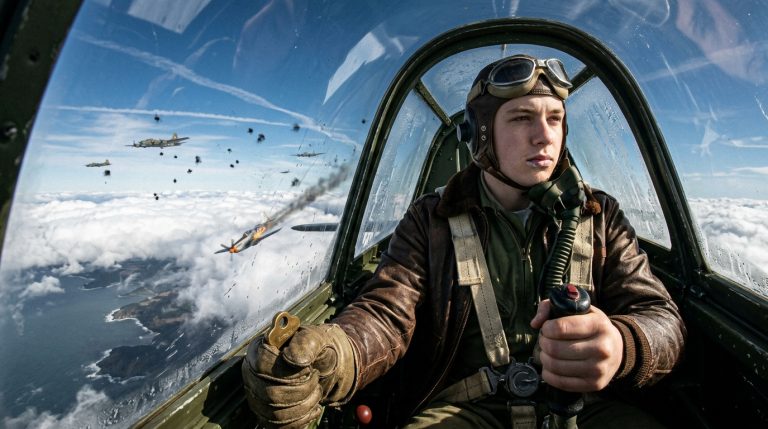
Lieutenant Robert Hayes sat strapped into the cockpit of the Lightning, his knuckles white against the control stick.
The modified left aileron cable sat taut inside the boom, holding four-tenths of a pound of extra tension that no engineering manual authorized.
He taxied down the corrugated steel track, the twin engines rattling his teeth before he shoved the throttles forward.
The aircraft lifted off the runway with a sharp lurch, climbing hard toward the northern cloud bank.
At 13,000 feet over the Huon Gulf, the formation leveled out into the blinding morning glare.
Four P-38s flew in tight echelon, their twin booms cutting clean lines against the cloud cover.
Through the canopy glass, the sky looked empty, wide and cold.
Then the radio crackled with a sharp, static-laced warning from the lead element.
“Bogies at twelve o’clock, high—break left.”
Eighteen Mitsubishi Zeros dropped out of the sun like grey hawks, diving straight down the vertical plane.
Hayes shoved the nose down, his stomach compressing against his ribs as gravity tried to pull him through the floorboards.
The manual flashed in his mind: Never turn with a zero. Dive away. Use your speed.
Instead, the lead Zero snap-rolled and cut across his flight path, baiting him into the classic trap that had killed seventeen men in six weeks.
Hayes pulled hard on the stick, expecting the old, heavy resistance of a sluggish cable system.
The aircraft didn’t lag.
The left wing snapped up instantly, catching the horizon before the zero pilot could complete his reversal.
CHAPTER 3: THE BROKEN RULE
The aluminum skin of the right boom shuddered as the twin engines roared at full throttle.
Hayes squeezed the trigger, his thumb pressing hard against the cold metal switch as 50-caliber tracers stitched across the sky.
The Zero jerked violently, trying to snap-roll out of the deflection angle, expecting the familiar, sluggish roll-rate that had saved Japanese pilots for months.
Instead, the modified P-38 rolled right on top of it without a microsecond of lag.
“I’ve got him,” Hayes muttered through a dry throat, his muscles locked tight against the G-force.
The enemy aircraft fragmented in a burst of black smoke and oil, tumbling downward toward the dense green canopy of New Guinea.
It was a clean kill, executed entirely outside the rigid boundaries of standard Army Air Force doctrine.
Across the formation, lead elements stared in absolute disbelief as Hayes pulled out of the dive and climbed back to altitude without losing a foot of energy.
The mechanical trap McKenna had set in the dark hangar had just rewritten the rules of aerial combat in less than seven minutes.
Hayes banked hard toward base, his hands slick with sweat inside his flight gloves.
CHAPTER 4: WHISPERS ON THE LINE
The news traveled faster than any flight report across the island airfields.
Mechanics from neighboring squadrons crowded around McKenna’s workbench, their faces drawn in the harsh glare of a single overhead bulb.
“Is it true what Hayes did?” asked Rodriguez, his hands blackened with grease and trembling with quiet urgency. “Did the ship really turn without dragging its tail?”
McKenna didn’t answer right away.
He picked up a length of scrap piano wire, turning the steel over and over between his calloused fingers.
“The book says we touch these cables, we face a court-martial,” McKenna said, his voice flat and unyielding.
“The book isn’t burying our kids every week,” Rodriguez fired back, slamming his palm against the workbench edge.
Silence settled over the hangar, broken only by the hum of the distant generators and the steady drip of tropical rain hitting the corrugated roof.
McKenna looked at the ring of tired faces staring back at him—men who had washed too many flight decks and packed too many empty footlockers.
He reached into his canvas tool bag and tossed a pair of pliers across the wood.
“Cut it to six inches,” McKenna muttered. “Bend it twice. And if any inspector asks about the tension, you tell them it’s factory standard.”
CHAPTER 5: THE ACES CONFUSION
Saburo Sakai banked his fighter hard against the blinding glare of the afternoon sun over Wewak.
For two years, the Japanese ace had owned the turning skies, reading American movements like an open book.
He waited for the familiar sluggish roll of the twin-engine lightning, initiating his classic counter-turn to slip inside the enemy’s turning radius.
The American aircraft didn’t lag.
Instead of lumbering through the roll, the silver fuselage snapped around instantly, staring right down four heavy machine gun barrels.
Sakai yanked his control stick hard to the right, his boots slipping on the rudder pedals as hot air rushed past his canopy glass.
“Impossible,” he muttered through clenched teeth, diving away toward the jungle mist.
His timing was perfect, his instincts unblemished, yet the geometry of the fight had fundamentally shattered in mid-air.
Down on the flight line, mechanics wiped grease from their brows while officers stared blindly at inspection logs that showed nothing out of place.
The invisible wire had stripped away the enemy’s ultimate advantage without a single general ever signing a form.
CHAPTER 6: THE PAPER SHIELD
The lead Lockheed engineer stared down at the disassembled control cable assembly on McKenna’s workbench.
He turned the 6-inch scrap of piano wire over in his palm, his expression shifting from corporate irritation to grudging realization.
“This modification violates every factory safety tolerance we certified,” the engineer said, his voice tight with administrative anxiety.
“The ones that were costing us twenty kids a month?” McKenna asked, not bothering to look up from the engine block he was scraping.
The engineer opened his mouth to cite protocol, then closed it as he glanced at the wall ledger listing the squadron’s survival jump.
He set the brass stamp down without marking a reprimand.
By December 1943, the factory line in California quietly integrated the tensioning principle directly into production models, rewriting the manual without ever mentioning the enlisted mechanic who forced their hand.
Back in Long Beach years later, the garage floor stayed stained with oil and old grease.
James McKenna wiped his hands on a rag, looked out at the afternoon traffic rolling down the street, and picked up a wrench.
There were no medals hanging on the back office wall, only a faded photograph of twin booms cutting through a Pacific sunrise.
The engines kept turning, and the work stayed true.