The Mechanics of Honor: A Single Father’s Quiet Stand Against the Rust of Time
CHAPTER 1: THE WEIGHT OF COLD GREASE
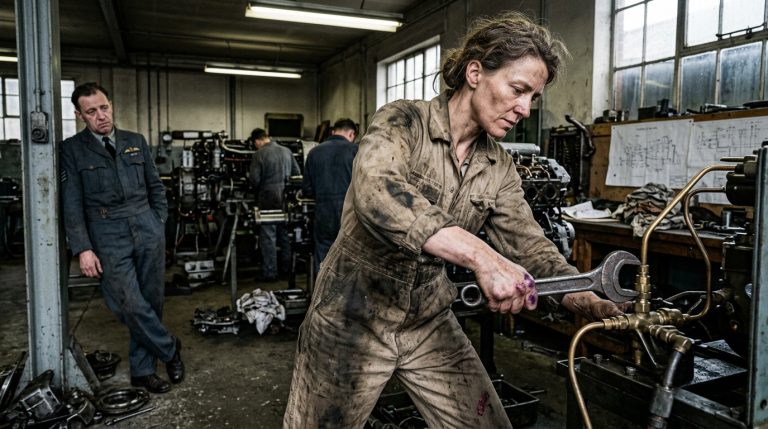
The 9/16-inch socket was cold against my palm. I rolled the heavy steel back and forth across my knuckles, feeling every notch worn into the grip from ten years in the First Armored motorpool.
Under the rusted belly of the '88 Ford, the smell of burnt oil and sun-baked dirt filled my nose. I tightened the starter bolt until the metal creaked, then gave it one final, solid tap.
"Try it now," I called out, wiping my brow with the back of my forearm.
The old engine turned over twice, sputtered a cloud of blue smoke, and settled into a low, steady thrum. Above me, the stranger didn't cheer. He just let the hood drop with a heavy metallic clack that shook dust onto my boots.
"Fixing some old farmer's junk for free?"
Mr. Dobs stood on the shoulder of the highway, his hands jammed deep into his clean windbreaker pockets. He didn't come closer than five feet. He never did when dirty steel was involved.
"Your own roof is still taking on water, Carter," Dobs sneered, squinting past me toward my beaten-up pickup where five-year-old Logan sat in the back seat, quietly sipping his juice box. "A real provider looks after his own house before he goes playing missionary on the county line."
I didn't answer. I stood up slowly, my knees popping in the humid Georgia heat. I tucked the 9/16 socket into my hip pocket, the weight of the metal dragging slightly against my belt.
"She'll get you where you're going," I told the driver, keeping my voice level.
The gray-haired man behind the wheel didn't offer a hand or a name. He simply reached through the open window, handed me a crumpled rag to clean my hands, and shifted into gear. As the truck pulled away into the gravel dust, I noticed a bright, polished glint of brass tucked beneath the heavy corrosion on the battery tray—a clean, official county seal that had no business being on a farm rig.
"Waste of an hour," Dobs muttered, turning on his heel to head down the dirt lane toward his neat, vinyl-sided home. "You can't eat good intentions, Ben."
I walked back to my truck, opened the door, and climbed into the driver's seat. Logan leaned forward from his booster seat, his small, sticky fingers touching the dark grease smear on my shoulder.
"Did you fix it, Daddy?" he whispered.
"We fixed it, buddy," I said, catching his eye in the rearview mirror. "Now let me get you home before the sun goes down."
The drive back to our small, sagging house on the edge of Thomas took six minutes. The front porch steps groaned under my boots as I carried Logan inside, the quiet hum of the house wrapping around us like an old blanket. In the hallway, a plastic bucket sat beneath the ceiling, catching slow, rhythmic drops from last night's rain—drip, thud, drip, thud.
I set Logan down at the small kitchen table, pouring him a glass of milk and placing two graham crackers on a chipped plate. He immediately started driving a plastic yellow tractor across the formica, completely unaware of the notice tucked behind the napkin holder—a third-notice electric bill with a red stamp across the top.
I sat across from him, pulling my toolbox onto the table. I unlatched the heavy steel clasps and began sorting the wrenches by size, letting the rhythmic clatter of cold steel calm the steady pressure in my chest.
As I lifted my socket wrench set to clear out the road grit, my fingers brushed against something thick and stiff jammed beneath the bottom tray. It wasn't mine. It was a heavy leather-bound transit ledger, dark with grease, bearing the official stamp of the Georgia Municipal Infrastructure Bureau.
CHAPTER 2: THE SILENT DISCREPANCY
The low, uneven hum of the refrigerator was the only sound in the house, broken every four seconds by the steady thunk of water hitting the plastic bucket in the hall.
I pulled the single bare bulb's pull-chain, letting the sharp yellow light flood the kitchen table. Across from my cooling mug of black coffee, the leather-bound book lay open. The pages weren't filled with personal notes or mileage logs; they were packed with precise, handwritten columns detailing equipment transfers across four surrounding counties.
My fingers traced a line of dense red ink near the bottom of a ledger page. Unit 402—Water Pressure Regulator Array—Status: Scrapped/Diverted. Right next to it was the destination code for our local municipal maintenance yard in Thomas.
I tapped my 9/16 socket wrench against the edge of the wood, the rhythmic clicking matching my quiet calculation. The truck I’d fixed on Highway 80 wasn't just some old farmer’s rig struggling with a dead starter—it was hauling high-grade municipal hardware that had been officially marked as garbage on paper.
A floorboard creaked in the back hallway, and I closed the ledger with a soft, heavy thud.
Logan stood in the doorway, rubbing his eyes with small fists, his blue pajamas oversized and frayed at the cuffs. He didn't say anything, just dragged his feet across the linoleum until his forehead leaned against my knee.
"Bad dream, buddy?" I asked softly, setting the socket wrench on the table and lifting him onto my lap.
"The house is making noisy water sounds, Dad," he mumbled, his voice thick with sleep as his small hands gripped the fabric of my work shirt.
"It's just the rain catching up with us," I said, resting my chin on top of his head, feeling the warmth of his breath against my chest. "I'll take care of the roof. I promise."
I looked over his small shoulder at the open invoice on the counter—the red-stamped electric bill sitting right beside a handwritten quote from a local roofing contractor that might as well have been a million dollars. Dobs was right about one thing: I was running out of runway, and good intentions didn't patch shingles or keep the lights on.
Through the thin front window, the sudden glare of headlights swept across the kitchen wall, sweeping over the grease-stained ledger before disappearing down the dirt lane. I didn't hear an engine idle, just the low, deliberate roll of heavy tires passing slow enough to count the fence posts.
I held Logan a little tighter, my thumb resting over the cool steel of the socket wrench on the table, watching the shadows settle back into the dark corners of the room.
CHAPTER 3: THE PRESSURE ON THE PORCH
"That roof line is visibly compromised, Inspector," Dobs said, pointing a manicured finger up toward my gutters. He didn't look me in the eye, keeping his focus strictly on the official beside him. "Water pooling like that creates structural hazards for the whole block. Unsafe conditions for a child."
The inspector, a thin man in a starched khaki shirt, tapped his pen against a yellow carbon-copy pad. "Mr. Carter? We received a formal residential safety complaint this morning."
I stood on the top step, my boots resting on the soft spot where the oak had begun to rot through. In my right front pocket, my fingers curled around the cold, familiar weight of the 9/16 socket wrench.
"The roof leaks," I said, keeping my voice flat and even. "I'm patching it this weekend."
"A patch doesn't satisfy a Class-B structural violation," Dobs interrupted, stepping onto the first riser. His shoes were polished, completely free of the red dirt that covered my drive. "County code mandates certified contractor repairs for severe timber degradation. If you can't afford a bonded crew, Ben, the city has condemnation protocols for a reason."
I looked down at Dobs. "You brought a county inspector to my front door at seven in the morning over three loose shingles?"
"It's about standards," Dobs said, a tight, triumphant smile touching the corners of his mouth. "Some people belong in maintained neighborhoods, and some people need to realize when they've run out of options."
The inspector shifted his feet, looking slightly uncomfortable as he scanned the peeling paint on the porch rail. "If a formal notice is issued, Mr. Carter, you'll have forty-eight hours to present a signed contractor agreement, or the structure gets red-tagged for occupancy."
Forty-eight hours. The exact timeframe required to force a quick sale on a distressed property.
I turned my head slightly toward the screen door. Inside, Logan was standing on his tiptoes, his small hands pressed against the mesh, watching the two men with wide, silent eyes.
"Give me the paper," I told the inspector.
Dobs's smile widened as the official handed over the yellow slip. "Just trying to keep the neighborhood safe, Ben. Nothing personal."
"I know exactly what this is, Dobs," I said, folding the paper once and sliding it into my pocket right beside the socket wrench. "And you're going to want to step off my stairs now."
Dobs took a small step back, his heel catching briefly on the uneven bottom board before he caught his balance. He adjusted his collar, cleared his throat, and turned toward the lane without another word.
I watched them reach the pavement. The inspector didn't get into a official city truck; he walked straight to a dark gray civilian sedan parked two houses down—the same sedan listed under the diverted equipment transfer routes in the leather ledger sitting on my kitchen counter.
CHAPTER 4: THE PAPER TRAIL IN THE DIRT
Henderson wiped his thick forearms with a shop rag, his heavy eyebrows pulled tight as his thumb pressed against a red entry code.
"Ben, this isn't just scrap hauling," Henderson said, his voice dropping an octave as an impact wrench rattled in the back bay. "These serial numbers match the state water grid upgrades funded three years ago. The stuff that was supposed to replace the line on South Oak."
I tapped my 9/16 socket wrench against the steel rim of an oil drum sitting beside the counter. "The line that failed last month."
"Failed because it never got installed," Henderson muttered, leaning both hands on the laminate surface. "They logged the hardware as rusted out on arrival, sold the county on double-budget replacements, and then moved the new parts through private contractors."
I leaned in closer, pointing to the bottom line where the inspector's signature sat right above a corporate stamp. "Who owns the regional subcontracting license?"
Henderson didn't answer right away. He walked over to his desk, grabbed a pair of reading glasses, and flipped back two pages in the ledger before looking up at me.
"A holding company out of Macon," Henderson said quietly. "Registered under Dobs's brother-in-law."
The pieces fell into place with the cold, heavy lock of a sliding deadbolt. Dobs wasn't just a bitter neighbor with a neat yard—he was collecting finder's fees on condemned properties after his network choked out the local utility lines and forced code violations on folks who couldn't afford a fight.
"They're using forty-eight-hour compliance notices to push people into panic sales," I said, my knuckles white around the socket wrench. "They did it to the Miller place on the ridge, and now they're standing on my porch."
"You can't take this to the local magistrate, Ben," Henderson warned, wiping his forehead with the back of a grease-stained wrist. "Half those guys sign off on these disposal orders without reading the top page. If Dobs knows you've got this book, he won't just call the inspector back."
"He doesn't know I have it yet," I said, pulling the book off the counter and sliding it deep inside my canvas tool bag. "He thinks he's fighting a broke mechanic with a leaking roof."
"Ben, listen to me," Henderson said, catching my arm before I could turn toward the door. "My shop can spare two hundred bucks to help you clear that code violation fine, but if you poke this nest, they'll tear down everything you've got left."
"They're already trying to take the house, Hen," I said, stepping backward onto the concrete apron. "And I'm done letting people like Dobs decide what my boy gets to keep."
CHAPTER 5: THE CORNERED WORKSHOP
"Give us the bag, Carter," a voice rasped from behind the glare of the left flashlight.
I recognized the steel-toed boots stepping onto my cracked concrete floor. It was the same gray-haired driver from the highway, no longer pretending to be a stranded farmer. The second man stepped inside, shutting the thin aluminum door behind them, cutting off the humid night air.
"Dobs called," the driver said, his flashlight beam pinning me against the back workbench. "He said you were asking Henderson about supply routes. We just need the book you lifted off my seat, and the condemnation order on your house goes away. Clean slate."
"There wasn't a slate to begin with," I said, shifting my weight so my right hip brushed against the edge of the heavy wooden vise. "You're charging the county for new grid hardware, scrapping the old parts, and using the profit to buy up the neighborhoods you intentionally let flood."
The driver didn't smile. He stepped forward, the beam of light blinding me as he reached out with a thick, calloused hand to grab the strap of my canvas bag.
I didn't argue. I didn't warn him. I dropped my left shoulder, using the heavy momentum of his pull to step into his space, driving my right elbow hard into the meat of his forearm.
He grunted, his grip failing instantly as the flashlight hit the concrete with a sharp crack, spinning wildly and throwing jagged shadows across the pegboard walls.
The second man lunged, swinging a heavy iron pipe wrench he'd grabbed from a nearby shelf. I ducked, the heavy iron biting into the wood frame right where my head had been a second before. Wood splinters rained down on my shoulders.
I didn't have room for a clean swing. I shoved my boot hard against the rolling tool cart, slamming the heavy steel drawers directly into the second man's knees. He buckled with a sharp hiss of pain, the heavy wrench clattering to the floor.
The driver recovered, grabbing the collar of my work shirt and slamming me backward into the workbench. The edge of the wood bit sharply into my spine. My lungs seized, the air knocked completely out of me as his heavy forearm pressed against my throat.
"You're a broke mechanic," the driver spat, his face inches from mine, smelling of stale coffee and cheap tobacco. "You don't get to win this. You give me the book, or we walk into that house and talk to your kid."
My hand scrambled blindly across the messy surface of the workbench. My fingers brushed past scattered screws and oily rags until they found the heavy, knurled grip of the 9/16 socket wrench.
I didn't swing for his head. I brought the heavy steel up in a short, brutal arc, driving the solid socket directly into the exposed nerve cluster below his armpit.
He roared, his arm going instantly limp as he stumbled backward into the spinning beam of the dropped flashlight.
I didn't wait for him to recover. I grabbed the heavy iron pipe wrench off the floor, stood over him, and let the heavy metal head rest directly against his chest, the weight of it pressing him flat against the concrete.
"You're going to stay right here," I breathed heavily, sweat stinging my eyes as the second man limped backward toward the door, clutching his knee. "And we're going to make a phone call."
CHAPTER 6: THE UNBROKEN FOUNDATION
"This is an outrage, Deputy!" Dobs shouted, waving a manicured hand toward the front desk. "Ben Carter broke into my associate's transport vehicle, assaulted two independent contractors, and stole private logistics records!"
I sat on the wooden bench against the far wall, my canvas bag resting between my boots. Logan was fast asleep next to me, his head cushioned on my rolled-up jacket, his breath coming in slow, even rhythms.
I didn't yell. I didn't get off the bench. I simply reached into my bag, pulled out the heavy leather transit ledger, and set it squarely on the counter between us.
"The driver's sitting in your holding room, Deputy," I said, my voice quiet in the buzzing room. "And his truck's sitting behind my shed with forty thousand dollars worth of state-stamped municipal pressure valves in the bed."
Dobs froze mid-stride, a single bead of sweat breaking through his hairline and trailing down his temple, ruining his clean, composed look.
"That's—that's proprietary equipment!" Dobs stuttered, his voice jumping an octave as he lunged toward the counter to grab the book. "He has no legal standing to possess those documents!"
Deputy Miller, an older man with graying temples who knew every back road in Thomas, laid a heavy, calloused hand flat over the center of the ledger before Dobs could touch it.
"He doesn't need legal standing to report a felony, Arthur," Miller said, pulling the book toward his side of the counter and flipping open the first page. "Especially when these serial numbers match the state audit notices sitting on my commander's desk."
"He's a broke mechanic!" Dobs spat, pointing a trembling finger at my chest, his composure completely shattering into raw, desperate arrogance. "He can't even keep the rain off his own kid! You're taking the word of a man who lives in a condemned shack over a registered county contractor?"
"The roof's getting fixed tomorrow," I said, reaching down into my pocket and pulling out the cold 9/16 socket wrench, setting it beside the ledger with a solid metallic clack. "Henderson's crew is dropping the lumber off at eight AM. Paid for in full with honest labor."
Dobs stared at the socket wrench, his chest heaving as the side door opened and two state troopers stepped into the lobby, their boots heavy against the floorboards.
"Mr. Dobs," the lead trooper said, taking a step toward him. "We're going to need you to step into the back office and answer a few questions regarding the Georgia Municipal Infrastructure Bureau."
Dobs backed away, his hands flying up to his collar as he looked around the room, desperately looking for an exit or a loophole that wasn't there anymore. "This is a misunderstanding! I have council immunity! You can't do this based on a stolen notebook!"
"It isn't stolen, Arthur," Deputy Miller said softly, closing the ledger with a final, heavy thud. "It was abandoned on a public highway. Right beside a truck that wouldn't start."
The late afternoon sun was warm against my shoulders as I sat on the top step of my front porch.
The old oak steps were solid now, replaced with fresh two-by-eights that smelled of clean pine and sap. Above my head, the brand-new architectural shingles lay flat and tight against the roofline, dry and secure against whatever rain the Georgia sky wanted to bring.
Beside me, Logan sat on his small wooden stool, holding a tiny toy hammer and carefully tapping a plastic peg into a soft block of wood, mimicking every move I made.
I reached into my hip pocket, pulled out the worn 9/16 socket wrench, and rolled the cool steel across my knuckles one last time before dropping it cleanly into the top drawer of my toolbox.
"Dad?" Logan asked, looking up with clear, bright eyes.
"Yeah, buddy?"
"Is the house all fixed now?"
I looked out over the quiet dirt lane, past the gate where Dobs's empty house stood behind a county seizure notice, and down toward the highway where honest folks were driving home after a hard day's work.
"It's all fixed, Logan," I said, resting my hand gently on his shoulder. "Every bit of it."