A Gritty Reckoning in the Dust: How an Arrogant Cop Collapsed Under His Own Weight
CHAPTER 1: Silence on Western Avenue
The neon sign above the door hummed a low, erratic electrical drone. A moth batted its wings against the glass casing, leaving gray smudges in the artificial glow. Marcus kept his eyes fixed on the gray dust near his left front tire.
The boot heel pressed harder against his chest, digging through the worn leather of his vest. It was a heavy, deliberate pressure designed to break rhythm and force a panicked gasp. Marcus did not give it to him. He slowed his breathing, drawing air in through his nose and letting it out steady.
“I said stand up,” the officer muttered. His voice was thick with the flat certainty of a man who had never once encountered a solid wall.
Marcus felt the rough grain of the pavement scraping against his cheek where the skin had split. A thin line of warmth traced down toward his jawline. He shifted his fingers slightly in the dirt, feeling the sharp bite of embedded gravel.
“I’m paralyzed from the waist down, Officer,” Marcus said. His tone was level, devoid of anger or pleading.
The pressure on his ribs didn’t ease. Instead, the boots shifted, adjusting balance for a heavier pull. The fabric of his vest bunched tightly under the officer’s grip, threatening to tear at the seams.
A murmur rippled from the edge of the asphalt near the bar entrance. A few bystanders took half a step forward before freezing in place. The officer snapped his head around, his neck muscles straining inside his stiff collar.
“Back up,” the officer barked, his eyes darting across the small crowd.
Marcus used the momentary distraction to steady his grip against the chrome push rim of his overturned chair. He didn’t waste energy trying to twist free. He calculated the weight above him, the rigid posture, the lack of hesitation. It wasn’t tactical precision. It was raw, unthinking habit.
The grip on his vest tightened again, yanking him upward before dropping him back onto the stones. The dull thud echoed against the brick wall of the building. Dust kicked up around his shoulders.
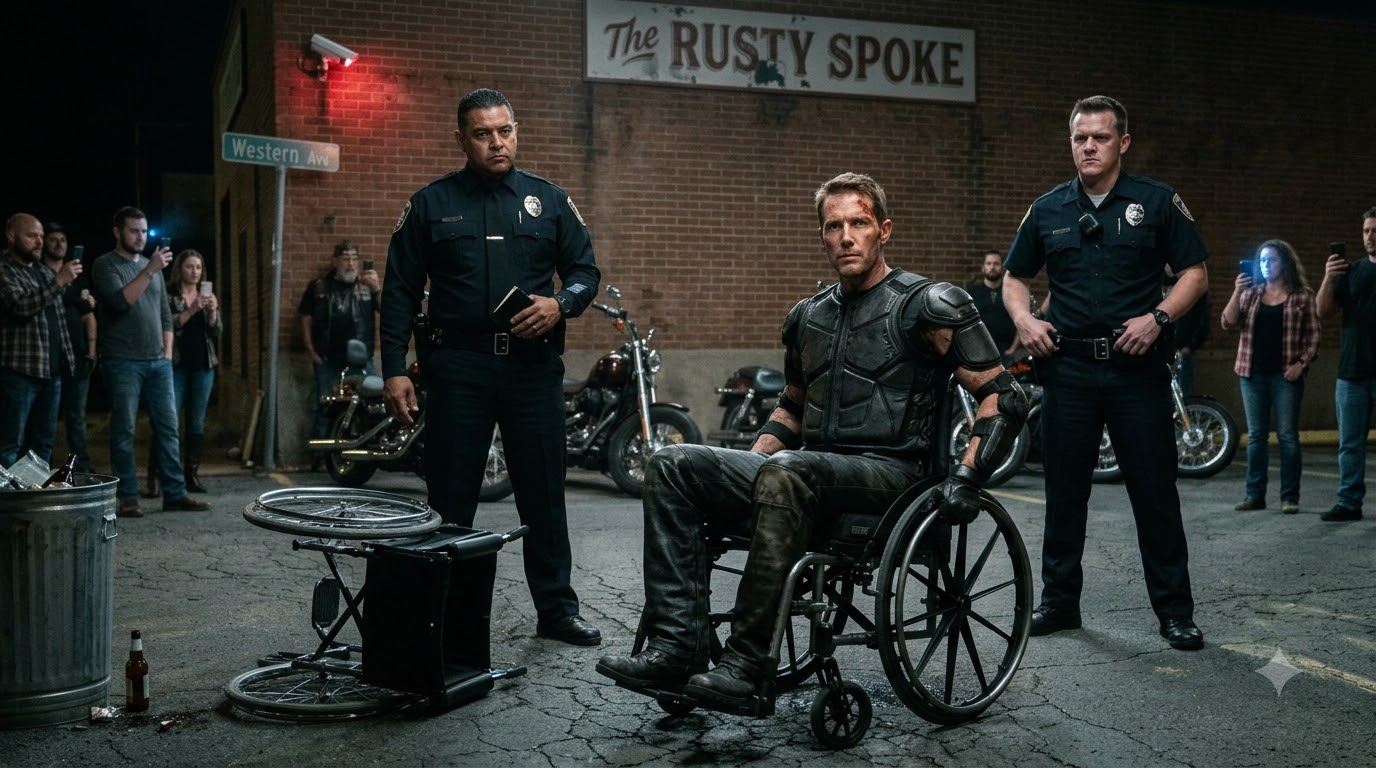
The blinking red light of the security camera mounted above the doorway caught the motion in silent, steady pulses. Marcus stared right at the lens’s rhythmic pulse. He knew the red light didn’t blink for him. It blinked for everyone.
CHAPTER 2: The Weight of Steel
The asphalt hummed beneath the rubber tires of the parked machines. Eleven custom builds formed a rigid, unbroken arc across the rear of the lot, their chrome exhaust pipes ticking softly as they cooled in the night air. Not a single rider raised his voice.
The lead bike settled onto its kickstand with a heavy, deliberate metallic clank. A large man with faded ink running from his thick knuckles up into his shaved neckline stepped down onto the grit. His boots crunched softly against the loose stone as he moved toward the overturned wheelchair.
Marcus remained on his side, his face pressed close to the earth, but his eyes tracked every movement. The bald man dropped to one knee without a word of greeting. A heavy calloused hand rested firmly against Marcus’s uninjured shoulder, checking for the steady rise and fall of his ribs beneath the dusty leather vest.
“You good, brother?” the man asked, his voice low and flat, stripped of theatrical panic.
“I’m on the ground,” Marcus muttered, his breathing controlled and even. “Help me get the frame up.”
Instead of shouting for an ambulance or drawing unwanted attention, two other riders moved in with practiced, mechanical efficiency. One grasped the matte black frame of the wheelchair, righted it with a single smooth pull, and locked the brakes with the toe of his boot. The other reached down, caught Marcus by his uninjured arm and the solid leather of his belt, and hoisted him upright in one unbroken, quiet motion.
Marcus settled back into the custom seat, his hands immediately finding the rubber-coated push rims. He didn’t brush the dirt from his chest or wipe the thin trail of blood from his temple. He simply rolled the chair three inches to the left to square himself up.
The bald man stood up, his jaw tightening until the muscle feathered visibly beneath his skin. He turned away from Marcus, his eyes locking onto the lone figure standing near the black-and-white cruiser.
Officer Cole shifted his weight from one boot to the other, his hand hovering instinctively near his holster. He puffed his chest, narrowing his eyes against the collective weight of twelve patched vests staring him down from across thirty feet of open asphalt.
“Doesn’t matter who he is,” Cole snapped, his voice carrying an abrasive edge designed to mask a sudden spike in adrenaline.
The bald man didn’t blink. He didn’t raise his hands or step forward into an aggressive posture. He simply let five full seconds of heavy, dead silence swallow the space between them.
“It matters,” the bald man said, his voice dropping an octave into a cold, level register. “And you’re about to find out why.”
Near the rear of the formation, another rider pulled a phone from his pocket with smooth, unhurried movements. A blue glow caught the side of his face as his thumb tapped a rapid sequence, pulling up an open line and reciting a badge number read straight from Cole’s chest.
Around the edges of the lot, cellular phones rose into the air like strange, silent flowers blooming in the dark. Every bystander, every customer stepping out of the Rusty Spoke, had a glass screen pointed squarely at the cruiser. The red security light above the door kept blinking its silent pulse against the brick wall.
Marcus rolled his chair forward an inch, the bearings in the chrome wheels spinning with a faint, smooth hum. He reached into his pocket, his fingers sliding past the scarred metal shift-lever, feeling the absolute stillness of a man who knew the math was already solved.
CHAPTER 3: The Digital Echo
The hum of the cruiser engine cut out abruptly as a second door slammed shut on the opposite side of the lot. Sergeant Rivera stepped out into the open space, his boots hitting the gravel with a measured, heavy cadence. He didn’t look at the assembled riders first. His gaze swept over the overturned dirt, the scuff marks on the asphalt, and finally locked onto the rigid posture of Officer Cole.
“What happened here?” Rivera asked, his voice flat and devoid of professional warmth.
Cole didn’t flinch, though his shoulders tightened under his uniform shirt. He raised his chin, defaulting to the familiar script he had memorized over a decade and a half of service.
“Routine disturbance call, Sergeant,” Cole said, stepping half an inch forward. “Subject was entirely non-compliant. Standard procedure was applied to secure the scene.”
Rivera didn’t blink. He looked past Cole’s shoulder at the gathering crowd of onlookers holding up rectangular screens that cast a cold, uniform glow across their faces. Every screen recorded the exact same patch of empty air where Marcus sat upright in his chair.
“Standard procedure,” Rivera repeated, the words tasting like gravel. “Is that what you call a public exhibition under two dozen cameras?”
“There are cameras everywhere these days,” Cole muttered, his jaw working as he tried to anchor his slipping authority. “People see what they want to see. The man wouldn’t cooperate.”
Marcus didn’t say a word. He let his fingers brush against the cold metal shift-lever in his pocket, keeping his breathing steady and slow. He watched the shift in Rivera’s posture—the slight drop of the shoulders, the sudden realization that the narrative couldn’t be stitched back together with a quick departmental report.
Rivera stepped closer to Cole, lowering his voice so that only the immediate circle could catch the edge of it.
“You’re done talking, Cole,” Rivera said, his hand hovering near his own memo book. “Get in your cruiser. Close the door. Do not say another word.”
Cole opened his mouth to object, his instincts screaming for one more defensive pivot, but the sheer wall of silence from the eleven parked bikes cut him short. He looked around the lot, catching the heavy, patient stares of men who weren’t shouting, weren’t threatening, and weren’t going anywhere.
The blue lights flashed against the glass of the Rusty Spoke windows in a slow, rhythmic loop. Marcus turned his wheels slightly toward the center of the pavement, his eyes fixed on the cruiser door as Cole reluctantly climbed back behind the steering wheel.
CHAPTER 4: The Closed Door
The apartment key turned in the deadbolt with a dry, metallic click. Cole pushed the door open, stepping into a narrow hallway that smelled faintly of cold coffee and old paper. The living room was quiet, stripped of the usual evening noise.
He didn’t turn on the overhead lights. Instead, he walked straight to the living room couch and sat down heavily, the cushions sinking beneath his weight.
Across the room, the wall of framed letters, department commendations, and hand-shaking photographs caught the pale sliver of streetlamp light spilling through the blinds. Fifteen years of press clippings and framed certificates stared back at him in the dim stillness.
His phone buzzed against the fabric of his trousers, vibrating with a flat, persistent rhythm. He pulled it out, looking at the glowing screen without registering the name. It was his union representative leaving another careful message about legal counsel and departmental protocol.
Cole silenced the ringer and dropped the phone onto the coffee table. It landed next to an empty coffee mug left unwashed from the morning.
The silence in the apartment felt heavier than the weight of a shift. Across the hall, the sound of a neighbor’s front door closing echoed through the thin walls, followed by the distinct sound of a deadbolt sliding shut. Nobody knocked. Nobody checked in.
He looked back at the wall of framed letters, noticing for the first time how dust had settled along the upper edge of the glass frames. The photographs didn’t look like proof anymore. They looked like paper pinned to a room that had already been locked from the outside.
CHAPTER 5: The Final Review
The hearing room was small, paneled in dark wood that had absorbed decades of closed-door arguments. The table between them was polished oak, reflecting the harsh overhead fluorescents in a blinding white glare.
An internal affairs arbitrator sat opposite Cole, opening a thick manila folder without looking up. The pages inside rustled with dry finality.
“We’ve reviewed the unedited body camera audio and the two separate video angles from Western Avenue,” the arbitrator said, his voice flat and mechanical. “The witness statements have been cross-verified.”
Cole gripped the edge of the wooden table, his knuckles turning white as the blood drained from his skin. “The report reflects a non-compliant subject who refused direct commands. Standard protocol allows for—”
“Protocol doesn’t cover throwing a paralyzed man into gravel,” the arbitrator interrupted, finally lifting his eyes. “And it certainly doesn’t cover steady, calm breathing while you grind your boot into a citizen’s ribs on camera.”
The arbitrator slid a printed transcript across the polished oak toward Cole’s hands. It was a verbatim log of his own voice from the body camera, timestamped second by second.
“Your union representative has already reviewed the findings,” the arbitrator continued, closing the folder with a sharp snap that echoed off the paneled walls. “There is no ground for appeal. The record is complete.”
Cole stared down at the paper, his jaw working as he searched for an angle, a loophole, a final sentence to turn the tide. There was nothing left. The system he had trusted for fifteen years had simply closed its doors and locked him out on the cold side.
CHAPTER 6: The Dusty Gray Normal
The morning sun cut horizontally across the gravel parking lot of the Rusty Spoke, warming the weathered brick wall where the small black-and-white sticker caught the light. Five clean words pressed firmly into the surface.
Iron Saint stood here.
Marcus rolled his chair across the asphalt, his hands moving with smooth, measured authority along the rubber-coated push rims. The faint line above his right eyebrow had healed into a thin white trace, and the elbow scrape was nothing more than a dull memory beneath his long sleeves. He didn’t look back at the empty space where the patrol car used to sit.
Inside the club room, three hundred members sat in absolute, disciplined silence as Marcus rolled through the double doors. The heavy wooden chairs scraped once against the concrete floor as every man rose to his feet.
Marcus didn’t wave. He didn’t offer a dramatic speech or a celebratory smile. He simply rolled to the front of the room, turned his chair around to face his people, and rested his hands flat on the scarred oak table.
“Let’s get to work,” Marcus said.
The room settled immediately into its familiar rhythm. Outside on Western Avenue, the neon sign of the bar buzzed softly in the daylight, untouched by the noise and fury that had come and gone. The world kept turning on common sense and hard-earned boundaries, leaving the unearned entitlement buried beneath the dust.