The Weight of a Single Pager: An Aging Veteran Confronts Street Entitlement in Oakland Without an Army
CHAPTER 1: THE SIDEWALK SHOVE
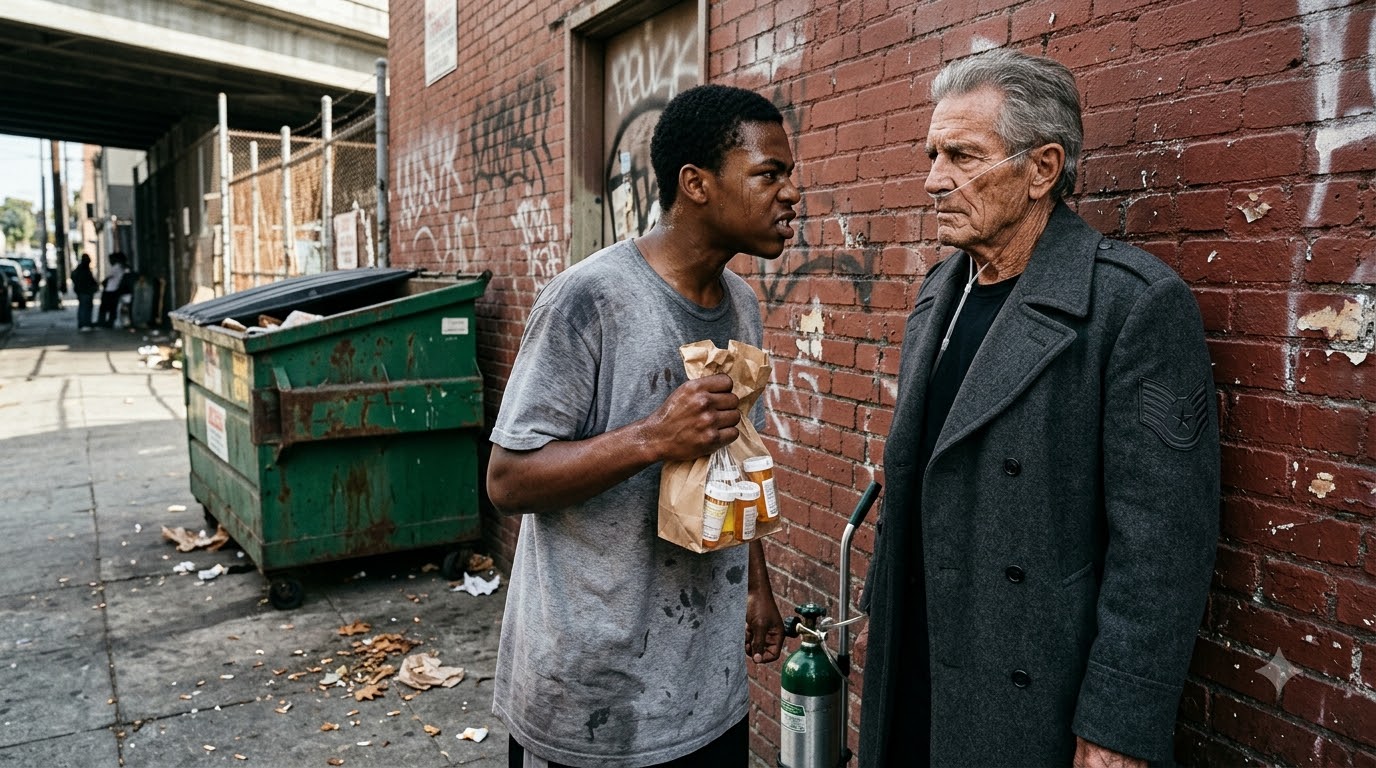
The cold metal of the dumpster bit into Sonny’s shoulder blade as the youngest boy shoved him hard against the brick wall.
His oxygen tank tilted sideways on the pavement, the regulator hissing a steady, sharp stream of air into the dusty afternoon.
His knuckles throbbed with deep, chronic arthritis, stiff and unresponsive inside his oversized coat pockets.
“Hand it over, old man,” Deuce snarled, stepping into his personal space with the stale reek of cheap cigarettes and unearned confidence.
Sonny did not flinch, nor did his expression tighten with panic; his gaze remained entirely steady, anchored by decades of surviving things these boys could not fathom.
He looked down at the paper pharmacy bag clutched in Deuce’s trembling, sweaty fist, noting the way the boy’s jaw twitched under the strain of false bravado.
“You boys have about fifteen minutes,” Sonny said, his voice raspy, low, and completely devoid of fear.
Deuce let out a sharp, barking laugh, turning his back with a dismissive wave of his hand.
“What are you going to do, call your grandkids?”
They walked away down the Oakland sidewalk, counting the pill bottles while the afternoon shadows stretched long and cold across the asphalt.
Sonny stayed against the dumpster, his hand sliding slowly into his coat pocket to brush against the smooth, worn metal of a pager he hadn’t needed to use in decades.
CHAPTER 2: THE EMPTY STREET
The pharmacy door rattled in its frame, the deadbolt thrown with a sharp, echoing snap that cut through the afternoon haze.
Maria watched Sonny through the thick glass, her fingers trembling slightly against the cool metal of the counter.
She did not dial the digits she had already punched into her keypad, her gaze locking instead on the heavy, gray wool of the old man’s coat.
“Sir—you need me to call someone?” Maria’s voice drifted through the narrow gap in the sliding security window.
Sonny did not turn his head immediately, his boots firmly planted on the cracked concrete as he reached down to straighten the tilted frame of his oxygen tank.
A sudden gust of dry wind swept down the Oakland sidewalk, carrying the sharp scent of hot asphalt and distant exhaust.
As he shifted his weight, the heavy fabric of his left sleeve slid back three inches against his forearm, exposing the faded, blue-black ink of a death’s head skull etched deep into wrinkled skin.
Maria’s breath hitched, her eyes widening as she recognized the crude lines drawn long before her parents were even born.
She stepped back from the window without another word, her thumb pressing the power button on her phone to plunge the screen into sudden darkness.
Sonny adjusted the nasal cannula beneath his nose, his breathing steady and measured against the mechanical hiss of the tank.
He didn’t acknowledge her retreat, knowing the street had its own way of teaching people when to look away and keep the door locked tight.
He turned his back to the pharmacy windows, his gaze drifting down the empty block toward the concrete overpass where the three boys had vanished.
The air grew heavy with the dry, baked heat of the afternoon, the silence around him settling like an anchor dropped into deep water.
He started walking toward home, his pace agonizingly slow, rhythmic, and entirely unbothered by the ticking minutes.
Behind him, Maria stood motionless behind the locked glass, watching the lone figure fade into the glare of the descending sun.
CHAPTER 3: THE OVERPASS CORNER
The concrete ribs of the overpass trapped the afternoon heat, turning the patch of shade into a stifling box of dust and stale exhaust fumes.
Deuce knelt in the dirt, his fingers scrambling to scoop up the white pills that had spilled from the stolen bag onto the gritty ground.
“Stop stressing over a couple of dropped ones, man,” Ray muttered, shifting his weight uneasily against the graffiti-scarred pillar.
Jerome stayed back near the edge of the street, his arms locked tight across his chest as he watched the empty intersection for any sign of movement.
“Something ain’t right,” Jerome said, his voice dropping an octave as a distant siren wailed somewhere on the other side of the boulevard.
Deuce shoved the recovered bottles into his pocket, his jaw clenching as he stood up to face the younger boy.
“It’s an old man, Jerome, what is he going to do, call his grandkids?”
The air beneath the bridge felt unnaturally heavy, devoid of the usual city breeze, smelling only of hot tar and stale dampness.
Deuce reached into his pocket to check the weight of the loot, his fingers brushing against the plastic caps while his eyes darted nervously across the empty asphalt.
No bikes rolled past, no sirens grew closer, and yet the absolute stillness of the block felt less like safety and more like a held breath.
Jerome kept his eyes fixed on the corner where the old man had vanished, his chest tightening with a cold, unexplainable dread.
“We need to move,” Jerome whispered, taking a step backward into the deeper shadow of the pillar.
Deuce laughed, though the sound lacked its earlier edge, echoing hollowly against the thick concrete walls above them.
“You’re jumping at shadows, kid,” Deuce snapped, turning his back to check the horizon once more.
The gravel underfoot shifted with a sharp scrape, leaving them isolated in the glaring afternoon sun as the silence closed back in around them.
CHAPTER 4: THE HEAVY SILENCE
Deuce stood frozen against the pillar, his fingers twitching inside his pockets as the expected chaos of the streets completely failed to materialize.
There were no roaring engines, no flashing lights, and no angry crowds backing up his reckless defiance.
Instead, the block was eerily vacant, stripped of every background noise until the only sound left was the ragged breathing of three boys trapped in their own sudden isolation.
“Where are they?” Ray muttered, his eyes darting wildly toward the empty intersection where the big motorcycles should have been pouring through.
“There’s nobody coming,” Jerome said quietly, his voice hollow as he stared down at his own trembling hands.
Deuce scoffed, forcing a harsh, grating laugh that died instantly in the heavy, baking air of the afternoon.
“You’re letting an old man get inside your heads over nothing,” Deuce barked, stepping forward to reassert control over the shrinking space between them.
Yet the silence around them held a deeper, more suffocating weight than any threat of violence could ever achieve.
It was the silence of a community that had drawn its curtains, locking its doors because it knew exactly what kind of line had just been crossed.
No one was coming to rescue them from their own stupidity, and no police report was going to fix the cold realization setting into their bones.
Deuce reached into his coat to pull out a phone, his thumb tapping aggressively against a dark screen that felt heavier than lead.
“We just walk away,” Deuce muttered, though his footing faltered on the loose gravel as he looked around for an escape route that felt safe.
Jerome didn’t move an inch, his shoulders slumped as he realized the street had already judged them without a single punch being thrown.
The weight of what they had done hung in the stagnant air, pressing down on their chests like a physical barrier they couldn’t push past.
CHAPTER 5: THE SPEAKER CALLS
Deuce punched the keypad with a stiff thumb, the electronic hum of the line vibrating against his ear in the heavy silence.
“Answer,” he muttered, his voice cracking slightly as he pressed the speaker button to force the call into the open air between them.
The ringing tone dragged on for agonizing seconds before a sharp, weary click echoed from the small speaker.
“Hello?” his mother’s voice answered, instantly stripping away every layer of manufactured toughness Deuce tried to wear.
“Ma—it’s me,” Deuce stammered, his fingers tightening around the plastic housing of the phone until his knuckles turned bone white.
“Where are you? You said you were coming home an hour ago,” she sighed through the line, her tone carrying the exhausting weight of a thousand identical disappointments.
Deuce looked down at the concrete, his throat tightening as he tried to find the words to explain what happened outside the pharmacy.
“I messed up,” he forced out, the words tasting like ash. “We cornered an old man—shoved him down and took his stuff.”
The line went dead silent, the ambient hum of the street dropping away as a heavy, suffocating stillness filled the space between them.
“Oh, baby… oh, no,” his mother whispered, her voice cracking with a quiet, devastating heartbreak that hit harder than any physical blow.
Ray covered his face with both hands beside him, his shoulders shaking as the sound of weeping bled through the open speaker.
Jerome stared blankly at the glowing screen, his own phone clutched in a white-knuckled grip as he prepared for the inevitable call of his own.
There were no threats left to hide behind, no swagger that could survive the sound of a parent realizing the full measure of their child’s failure.
Deuce stared at the dark pavement, the phone burning in his palm like hot iron as the unbroken weight of accountability crushed his final defense.
CHAPTER 6: THE DUSTY RETURN
The front door clicked shut with a solid, familiar thud that signaled the absolute end of the afternoon’s absurd friction.
Sonny stepped across his threshold, his boots dragging slightly as he set the pharmacy bag down onto the tiled counter.
Duke padded over from the living room couch, his tail flicking lazily as he rubbed against Sonny’s weary shin.
“Longer day than usual, cat,” Sonny muttered, his arthritic fingers gently scratching behind the animal’s warm ears.
The house remained blissfully quiet, untouched by the chaotic noise of the boulevard or the bitter weight of street entitlement.
He moved methodically through his evening routine, lining up the small plastic bottles and taking his pills one by one with a glass of tap water.
There were no crowds cheering on his porch, no dramatic confrontations left to fight, and no army waiting in the shadows.
He didn’t need an army to protect his peace; he only needed the immovable boundary of common sense and the quiet passage of time.
Sonny lowered his frame into his worn recliner, the springs groaning softly under his weight as the television hummed to life across the room.
He picked up the old pager from the side table, turning its smooth, scratched metal surface over in his palm before setting it back down.
Four times in forty-five years was quite enough for any man to ask the world to shift on his behalf.
He closed his eyes against the flickering screen light, letting the profound silence wash over him like a well-earned reward.
Legends didn’t need to shout to make the world listen; they simply outlasted the noise and kept walking at their own steady pace.