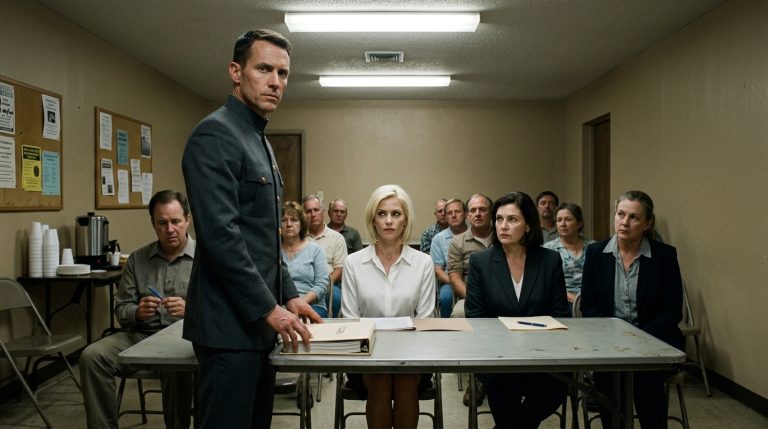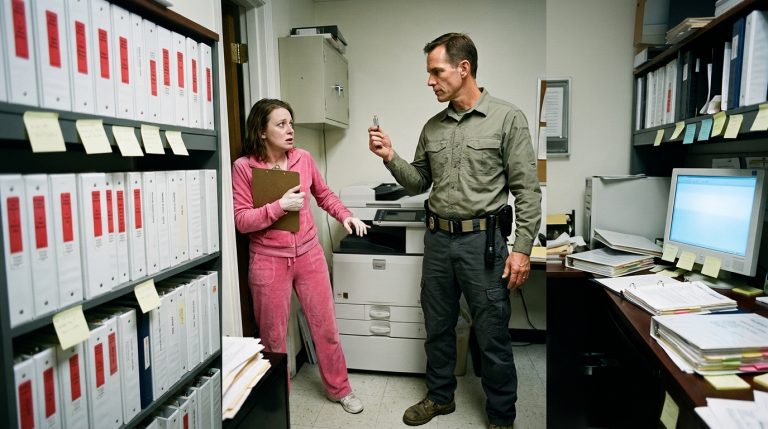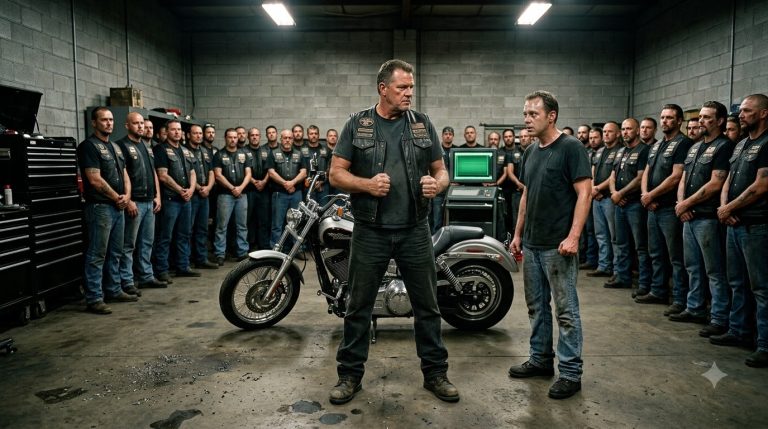
Beneath the Nebraska Dust, a Young Cop Trades His Badge for Common Sense and Confronst a Town’s Cold Prejudice
CHAPTER 1: THE DINER THRESHOLD
The screen door of Mabel’s diner drifted shut on a hinge that needed oil.
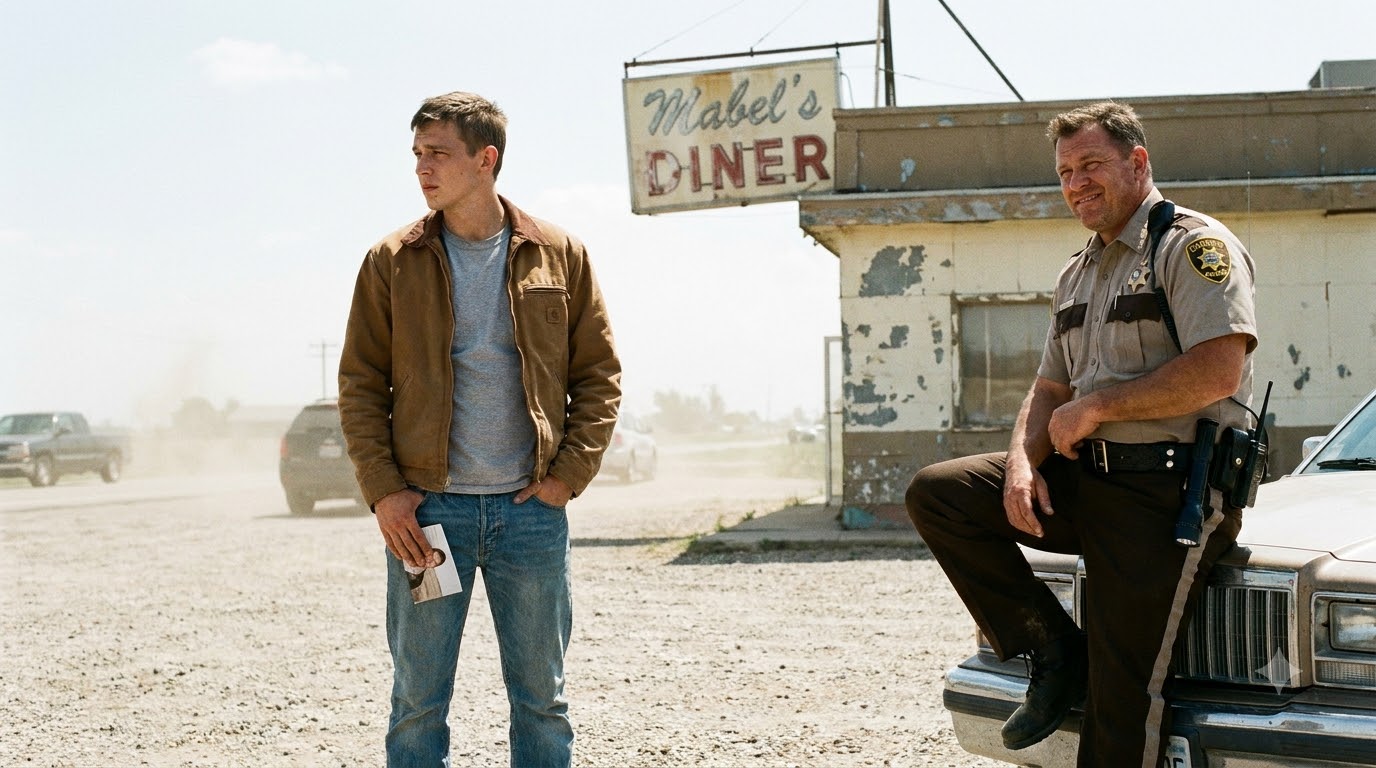
Dale stood on the sun-bleached gravel of the parking lot, his boots sinking a fraction of an inch into the dry soil.
Inside, the smell of burnt coffee and maple syrup clung to his jacket, but the air outside was thin, tasting of dust and exhaust.
He didn’t reach for the cruiser door handle.
His fingers stayed tucked into his pockets, rubbing against the smooth plastic of a folded receipt he didn’t need.
Through the plate glass window, Ray Dalton sat motionless on his stool.
The old man had not turned around to watch him leave.
Ray’s fork moved with steady, unhurried precision, cutting a square of pancake and lifting it toward his mouth.
It was the quiet rhythm of a man who had survived worse than a rookie cop’s hesitation.
A gravel crunch behind Dale broke the stillness.
Another cruiser rolled into the lot, its front bumper sagging slightly on the left shock.
Deputy Miller killed the engine before the tires had even finished rotating, stepping out onto the asphalt with his belt creaking under the weight of a heavy steel flashlight and a sidearm he wore high on his hip.
Miller didn’t look like a lawman keeping the peace; he looked like a bouncer working a bad shift in a dying town.
“Hobbs wants to know why you’re parked out here eating dust, Whitmore,” Miller said, his boots crunching noisily across the lot as he walked up behind Dale’s left shoulder.
“I’m not eating anything,” Dale said, keeping his eyes fixed on the distant line where the asphalt met the pale Nebraska sky.
“You left a call hanging for twelve minutes,” Miller muttered, leaning his weight onto one leg and hitching his belt up with a calloused hand. “The old man inside. You should’ve cuffed him when you had the chance. Sergeant’s got zero patience for hesitation.”
Dale felt the muscles along his jaw tighten, a dull ache blooming behind his molars.
He didn’t turn to face Miller.
He knew the look on the deputy’s face—the smug, small-town certainty that power was something you waved in front of people to make up for an empty bank account and a narrow horizon.
“The man was eating breakfast, Miller,” Dale said, his voice flat, stripped of the nervous polish he usually tried to wear like armor.
Miller let out a short, wet laugh that smelled faintly of stale chewing tobacco.
“Breakfast. Right. Tell that to Hobbes when you sign the logbook tonight.”
Miller spat a stream of dark juice onto the gravel, turned on his heel, and walked back toward his cruiser without waiting for an answer.
Dale listened to the heavy thud of Miller’s door slamming shut, the vibration traveling straight up through the chassis of his own truck.
He waited until Miller’s cruiser had kicked up a cloud of pale dust and disappeared down the state highway before he pulled the door open and climbed behind the steering wheel.
The vinyl seat was cracked across the center, catching the afternoon heat and radiating it straight through his jeans.
He didn’t turn the key.
Instead, he reached into his shirt pocket, pulled out the small, creased photograph he had slipped off the diner counter when Ray wasn’t looking, and laid it flat against his thigh.
Kevin Dalton’s young, unblinking eyes stared back up at him from the faded paper.
There was no badge pinned to Kevin’s chest in the picture, just the clean, dark wool of a Marine dress uniform and a jaw set against something heavier than small-town politics.
Dale stared at the image until the edges blurred in the harsh glare of the windshield.
He could feel the weight of the precinct waiting for him at the other end of that highway—Hobbs sitting behind his metal desk, pen poised over an incident report, ready to write down whatever version of reality kept the gears turning.
Dale slipped the photograph back into his pocket, gripped the steering wheel with both hands, and turned the key.
The engine coughed twice before catching, rattling the rusted dashboard as he shifted into drive and pointed the nose toward Brier.
CHAPTER 2: THE PRECINCT CORRIDOR
Dale stepped down into the precinct basement.
The single overhead bulb flickered, casting long, shifting shadows across rows of green steel filing cabinets that had not seen a fresh coat of paint since the Carter administration.
Sergeant Hobbes was already waiting by the back table, his sleeves rolled up to reveal thick forearms scarred by old engine burns.
Hobbs didn’t look up when the floorboards creaked under Dale’s boots.
Instead, he slapped a manila folder onto the metal table with a sharp crack that rattled a jar of rusted paperclips.
“You’ve been making friends out on Route 9, Whitmore,” Hobbes said, his voice flat and devoid of warmth. “Word travels fast when a rookie forgets his primary function.”
Dale kept his hands at his sides, his fingers curling into his palms to steady an itch of anger he couldn’t afford to scratch.
“I handled the call,” Dale said.
“You choked,” Hobbes snapped, finally lifting his head. His eyes were small, gray, and hard as river stones. “You stood there in Mabel’s place and let an outlaw walk out of your sight while a roomful of locals watched you sweat through your starch.”
Hobbs tapped a thick finger against the corner of the manila folder.
“I pulled the dispatch logs from twelve years ago this morning,” Hobbes continued, his voice dropping an octave, turning dangerous. “Just to see if hesitation runs in the bloodline. Your old man spent half his career second-guessing every order I handed down. Look where it got him.”
Dale’s breath caught in his throat.
The air in the basement suddenly felt thin, tasting faintly of iron and damp concrete.
“My father died in the line of duty, Sergeant,” Dale said, stepping closer to the table.
“Your father died because he lacked stomach for the hard choices,” Hobbes replied, leaning forward into the yellow glare of the bulb. “Just like you’re doing right now. Sign this reprimand, take the midnight shift for a month, and maybe we can keep you from ruining a uniform you haven’t earned.”
Dale looked down at the paper lying between them.
The ink was dark, neat, and entirely final.
He didn’t reach for the pen.
His eyes drifted past Hobbes’s shoulder to the bottom shelf of the open archive cabinet behind the desk, where a row of faded binders sat gathering dust—including one labeled with the year his father died, its spine uncataloged and shoved out of sequence.
CHAPTER 3: THE DUSTY ARCHIVE
Dale pulled the manila folder free from the wedge of cardboard, feeling the gritty texture of old paper against his fingertips.
The tab was blank, but when he flipped the cover open, the date stamped in purple ink read October 14, 2002—the exact week his father’s case was quietly closed without a public inquest.
Footsteps echoed on the concrete stairs above, heavy and deliberate.
“Whitmore,” Hobbes called down into the stairwell, his voice bouncing off the low stone ceiling. “Don’t spend all day digging through trash you aren’t cleared to touch.”
Dale didn’t answer.
He scanned the single typewritten page inside the folder, his eyes catching a discrepancy in the officer-in-charge signature block—not his father’s usual partner, but Hobbes himself, signing off on a weapon discharge report that had never made it to the state registry.
The stairs creaked as Hobbes started descending, step by heavy step.
Dale shoved the folder beneath his beltline, pulling his jacket down over the bulge just as Hobbes’s boots hit the basement floor.
“You’re making a habit of looking at things that don’t concern you,” Hobbes said, stepping into the dim yellow light with his hands resting casually on his heavy utility belt.
“Some things stay buried until someone steps on them,” Dale said, holding his ground against the damp chill of the wall.
CHAPTER 4: THE HIGHWAY SHOULDER
Ray Dalton’s Harley idled with a deep, rhythmic thrum that vibrated through the loose asphalt underfoot.
Ray sat upright in the saddle, his leather vest darkened by a light morning mist, keeping his visor cracked just enough to watch Dale approach from the driver’s side of the dusty Ford.
“You’re tracking shadows again, son,” Ray said, his voice cutting cleanly through the twin-cylinder exhaust note.
“Hobbs isn’t just protecting a town boundary,” Dale said, resting his forearm against the truck’s rusted door frame. “He’s burying files from twelve years ago—including my father’s final dispatch report.”
Ray killed the engine, letting the sudden silence of the open highway settle over the flat fields.
“A man who spends his whole life building walls around his own mistakes eventually forgets there’s a world outside them,” Ray said, resting gloved hands on the handlebars. “If you keep pulling at those loose bricks, he’s not going to argue with you anymore. He’s going to pull the floor right out from under your boots.”
“I didn’t pin on a badge to watch him write the rules,” Dale replied, his jaw tightening as a distant semi-truck wailed down the asphalt.
“Then you better make sure you’ve got solid ground beneath you when he swings back,” Ray said, kicking the kickstand down with a sharp metallic clank.
CHAPTER 5: THE SUNDAY CONVOY
Deputy Miller leaned against the fender of a parked squad car near the church entrance, arms crossed over his chest.
His eyes tracked Dale’s movements as Dale hoisted a carton of children’s books onto his shoulder.
“You’re carrying boxes for out-of-towners now, Whitmore?” Miller asked, his voice carrying easily across the gravel lot. “Sergeant Hobbes has been looking for you all morning. Wants an update on your shift report.”
Dale didn’t stop walking.
He carried the carton toward the rear trailer of Ray Dalton’s lead bike, his boots pressing firmly into the packed dirt.
“Tell Hobbes I’m busy with public relations,” Dale said without turning around.
Miller pushed off the fender, his boots crunching on the gravel as he closed the distance between them.
“You think wearing plain clothes and playing delivery boy clears your slate?” Miller muttered, stepping into Dale’s path just as he reached the trailer hitch. “Hobbs holds every key in this county, Whitmore. You keep digging into old files, and you won’t just lose your patch—you won’t have a town left to walk in.”
Ray Dalton stepped out from between two gleaming Harleys, his face set like carved stone as he moved silently to stand at Dale’s left shoulder.
“The boy’s helping load the trailer, Deputy,” Ray said, his voice flat, steady, and devoid of any threat. “Unless you’ve got a warrant for a box of coloring books, you’re standing in the way of a charity run.”
Miller’s jaw twitched, his eyes darting between Ray’s scarred hands and the quiet line of riders watching from behind their handlebars.
“This isn’t your business, Dalton,” Miller spat.
“Everything in this county is somebody’s business, son,” Ray replied. “Some folks just know how to read the ledger.”
CHAPTER 6: THE FINAL CHOICE
Dale tossed the stolen archive folder directly onto the center of Hobbes’s steel desk, sending a ceramic coffee mug sliding across the blotter.
The papers fluttered open, exposing the forged signatures and the missing weapon discharge report from twelve years prior.
Sergeant Hobbes didn’t look down at the pages; his eyes stayed locked on Dale with a cold, hardened stare.
“You think a pile of damp paper from the basement gives you leverage, Whitmore?” Hobbes growled, his knuckles whitening as he gripped the edge of the metal desk. “Sign the reprimand, or you’re walking out of this town with nothing.”
Dale unclipped his metal badge from his shirt pocket with a deliberate, steady motion.
He laid it flat over the forged signatures on the open report, the silver star catching the harsh fluorescent light above.
“I’m not signing anything, Sergeant,” Dale said, his voice dropping into a quiet, unshakeable register. “And I’m leaving the badge right where my father’s record should have been.”
Hobbs surged to his feet, his chair screeching against the linoleum floor as he opened his mouth to issue a final, furious demand.
The words caught in his throat as the heavy outer door of the station swung open, and two state troopers walked into the lobby, holding a federal audit notice regarding missing county dispatch logs.
Hobbs stared at the troopers, his face draining of color as his authority dissolved into the quiet, heavy air of the room.
Dale turned away from the desk without another word, stepping past the front counter and out into the bright Nebraska sunlight.
He climbed into the cab of his beat-up Ford, turned the key, and let the engine settle into a steady, quiet hum.
He didn’t look back at the precinct.
He shifted into drive, pointed the truck down the empty highway toward Mabel’s diner, and for the first time in twelve years, the road ahead was completely clear.