[A Veteran Detective Returns to His Abandoned Childhood Home, Only to Find a Steaming Cup of Coffee and a Decades-Old Conspiracy Waiting in the Dark]
CHAPTER 1: THRESHOLD OF SHADOWS
The front door of 1,247 Cypress Street groaned open, releasing a damp breath of trapped summer heat that smelled faintly of scorched linoleum and ancient dust. Marcus Delqua didn’t flinch. His thumb brushed instinctively against the checkered polymer grip of the Glock holstered beneath his jacket, feeling the familiar, reassuring bite of cold steel. Beside him, Tommy let out a shallow, shaky exhale that sounded like a dry leaf scraping across concrete.
Ten years. Ten years since they had scrambled out of this suffocating box of a house with their childhoods amputated.
Max’s boots cricked on the warped floorboards as he stepped past the threshold. His detective’s eye cataloged the hallway with cold, ruthless precision. No dust motes drifted in the stale sunbeams. No gray velvet drapes of cobwebs choked the corners of the ceiling. The brass deadbolt turned with an oiled, frictionless slide that defied a decade of municipal neglect. Someone had been oiling these hinges. Someone had been sweeping these floors while the city outside rotted away.
“Max,” Tommy whispered, his fingers clawing at the sleeve of Max’s coat. “We shouldn’t be here. The letter said—”
“The letter said we’d find out who put a hole in our father’s chest,” Max cut him off, his voice flat as a slab of slate.
He rounded the corner into the kitchen, his boots stopping dead on the worn checkerboard floor. There it sat. A ceramic mug with a chipped blue LAPD insignia, throwing a thin, ghostly wisp of steam straight up toward the water-stained acoustic tiles. The dark surface of the coffee flickered under the glare of the noon sun, entirely liquid, entirely fresh. Max reached out with a scarred knuckle and tapped the side of the ceramic. Heat radiated off the glaze, stinging his skin.
Beside the cup lay a folded newspaper with crisp edges, its headline stark and black: CORRUPTION PROBE TARGETS HIGH-RANKING OFFICERS. The date stamped at the top read October 15th, 2013—the exact morning their father, Detective Ray Delqua, had bled out on this very floor.
Max’s jaw tightened, muscles bunching like wire under his skin. The heavy silence of the room pressed against his eardrums, broken only by the distant, hollow wail of a siren somewhere out in the smog-choked sprawl of Los Angeles. He could feel the trap closing before the jaws had even snapped.
“They didn’t just leave a message, Tommy,” Max muttered, his eyes narrowing as he stared at the swirling steam. “They left the coffee warm.”
CHAPTER 2: THE BASEMENT ARCHIVE
The hinges didn’t shriek. That was the first thing that set Max’s teeth on edge. Ten years of abandonment should have welded the iron shut with rust, but the latch yielded to his grip with the smooth, oiled compliance of a vault door.
“Max, don’t,” Tommy hissed behind him, his shoulder blades pressed flat against the floral wallpaper of the hallway as if he could melt right through the plaster. “Whoever left that coffee is still in this house. We smell like targets.”
Max didn’t look back. His boots found the top of the wooden staircase, each tread sinking under his weight with a muffled, familiar creak that instantly dragged ten years of buried memory back to the surface. He dropped his left hand to his hip, his thumb hooking under the leather of his jacket to clear the hem above his holster. The Glock felt solid, heavy, and completely inadequate for whatever was waiting down in the dark.
He reached out blindly into the stairwell, his fingers finding the familiar porcelain pull-chain hanging from the joist. A sharp yank sent a yellowed snap echoing through the space.
The bulb flickered once, twice, then locked into a sickly, buzzing hum that threw harsh amber light down the steps. The air at the bottom was thick with the tang of damp concrete, ozone, and old paper. It tasted like a tomb that had been retrofitted with a modern office.
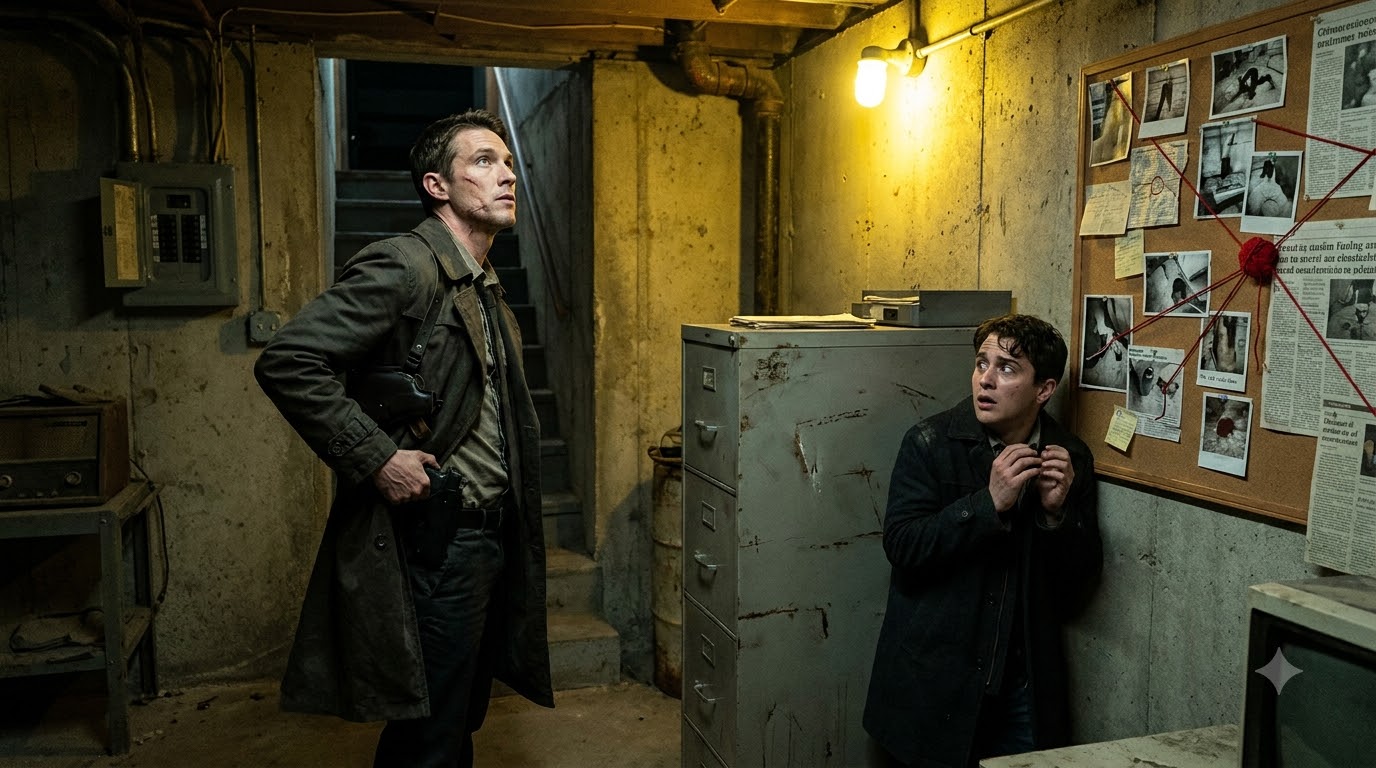
Max descended slowly, keeping his weight balanced on the balls of his feet. The basement was no longer the dusty cellar where their father used to store spare tires and broken lawn chairs. It was a completely organized command post.
Filing cabinets lined the foundation walls, their metal fronts scarred with heavy-duty locks. In the center of the concrete floor sat an old Underwood typewriter, a clean sheet of bond paper rolled halfway into the platen. Fresh black ink smeared across the ribbon guide.
“Jesus,” Tommy muttered, stumbling down the last three steps and grabbing the back of Max’s jacket. “Look at the walls.”
A massive corkboard dominated the far wall, stretching from the water heater to the fuse box. Red yarn crisscrossed between glossy 8×10 photographs, newspaper clippings, and photocopied police reports. Max stepped closer, his jaw setting into a hard, unyielding line as he read the names pinned beneath the yarn.
It wasn’t just a collection of cold cases. It was a detailed, obsessive chronicle of his own life.
There was a snapshot of him leaving his apartment on Spring Street last Tuesday. Another showed him sitting in a corner booth at his favorite diner in Chinatown, talking to Sarah. Every apartment he had rented, every client he had taken on as a private investigator, every single security camera capture of his daily routines over the past decade had been printed, filed, and threaded into the web.
“They didn’t just watch us, Tommy,” Max whispered, his eyes tracking a thick red line that led straight from a photo of his police academy graduation straight to a fresh surveillance printout timestamped three days ago. “They engineered the path.”
A low, heavy thud vibrated through the floorboards directly above their heads. It wasn’t the settling of an old house. It was the deliberate, heavy-heeled tread of someone walking across the kitchen floor.
Max’s hand locked tighter around the grip of his weapon as the front door handle upstairs rattled with sudden, violent authority.
CHAPTER 3: CLOSING THE CIRCLE
The brass handle spun hard against the internal latch, rattling the frame with an impatient, rhythmic violence.
“They’re inside,” Tommy whispered, his voice pitching high and tight as he backed hard against a steel filing cabinet.
Max didn’t waste breath on an answer. He snatched his hand back from the dossier, his thumb sweeping the thumb-break strap off his holster with a quiet, leather-on-steel slide. He moved toward the bottom of the basement stairs, keeping his torso low, utilizing the heavy wooden stringers as makeshift cover. The heavy footsteps overhead shifted from the kitchen linoleum onto the hollow-sounding wood of the front hallway.
“Marcus,” a voice called down the stairwell. It wasn’t a shout. It was smooth, measured, and conversational—the kind of tone used by men who owned the courthouse and wrote the warrants. “You’ve looked at enough paper down there. Time to come upstairs and talk about your inheritance.”
Max didn’t bite. He planted his boots on the concrete floor, his eyes locked on the amber pool of light at the top of the stairs.
“We’re not coming up,” Max called out, his voice scraping against the damp walls like gravel. “And you’re standing in a restricted crime scene.”
“Crime scene?” The voice chuckled softly, the sound dry and humorless. “Detective, nobody remembers what happened here ten years ago except us. And we’re offering you a choice. Bring the files out, or watch your brother spend the rest of his life explaining why he broke into a condemned foundation.”
Beside him, Tommy shook his head frantically, mouthing a silent plea to look for another exit. But Max knew the architecture of this box. There were no back doors out of this basement—only the small, barred coal chute facing the alley, too narrow for a grown man to squeeze through without leaving skin behind.
The perimeter outside chimed with the heavy, muffled thud of car doors slamming shut in unison. Unmarked sedans. Professional tires crunching across the gravel alleyway.
“They’ve boxed us in,” Max muttered, his eyes narrowing as he weighed the tactical weight of the room.
He couldn’t call dispatch. He couldn’t flash a badge to clear the street. Every institutional avenue was locked tight against them.
“We need a lifeline that doesn’t wear a badge,” Max said, his eyes shifting toward the ancient CB radio and emergency band setup tucked into the far corner of the dusty shelves.
Tommy stared at him, horror widening his eyes. “You’re going to broadcast on the pirate bands?”
“I’m going to make some noise,” Max replied, stepping backward toward the equipment without breaking his line of sight on the stairs. “Because the only thing men like that fear more than an honest cop is a spotlight they can’t control.”
CHAPTER 4: THE PIRATE FREQUENCY
The toggle switch snapped down with a sharp, metallic click. The amber dial light flared, bathing Max’s face in a harsh, sickly glow while the old tube amplifier hummed to life, smelling faintly of toasted dust and ozone.
“Unknown Angels Radio,” Max spoke into the wire mesh of the mic, keeping his voice low, steady, and devoid of panic. “This is Detective Marcus Delqua, badge number two-eight-four-seven. Transmitting from an active containment zone in Hell Angeles.”
Beside him, Tommy flinched, his palms slapping flat against the edge of a steel filing cabinet as if he wanted to physically push the sound back down the throat of the transmitter.
“Max, what are you doing?” Tommy hissed, his breath coming in shallow, ragged bursts. “You’re broadcasting our coordinates to half the freaks and mercenaries in the county. They’re already standing on the porch.”
“They’re standing there because they thought we’d crawl out like mice,” Max replied, his eyes locked on the glowing frequency dial. He turned the tuning knob a fraction of an inch, dialing into an encrypted emergency band his father had built into the rig decades ago—a frequency meant for independent journalists and underground watchdogs who refused to play ball with the department. “I’m changing the rules of the board.”
“This is Detective Ray Delqua’s son,” Max continued into the mic, his tone flat, hard, and entirely devoid of theatricality. “If anyone’s monitoring this frequency outside the municipal bubble, I have fifteen years of internal affairs records, bank receipts, and evidence logs pointing straight to high-ranking command. If something happens to us in this house tonight, the servers drop the package.”
It was a bluff. There were no cloud servers, no automated timer scripts waiting in the wings. There was only raw, unfiltered provocation broadcast across a rogue frequency.
A sharp, abrasive squeal cut him off as the speaker shrieked back with heavy feedback. A voice broke through the static—smooth, unhurried, and entirely unbothered.
“nice try, detective,” the voice crackled through the speaker, carrying the unmistakable cadence of the man waiting upstairs. “You think a pirate radio toy saves you from a zoning violation? Step outside. We’re running out of patience.”
The line clicked dead. But across the room, the emergency band scanner suddenly lit up with a blinding cluster of amber lights.
Sirens began to wail in the distance—not the standard, rhythmic drone of neighborhood patrol units, but a chaotic, overlapping chorus of sirens surging inward from multiple directions at once.
Max lowered the microphone back onto its cradle, his jaw tightening into a hard knot as he turned to face the wooden stairs.
“They wanted a reaction,” Max muttered, his hand dropping back to his holster. “Now they’re going to get a crowd.”
CHAPTER 5: HOSTAGE LEVERAGE
The wood groaned under the weight of three men pushing down from the hallway. Max planted his boots wider on the damp concrete, his right hand curling hard around the checkered polymer grip of his weapon.
“They’re coming through,” Tommy breathed, his fingers digging into the edge of a metal filing cabinet until his knuckles turned bloodless.
“Let them try,” Max muttered, his eyes fixed on the bottom of the stairwell where the amber light caught the dust motes dancing in the heavy air.
Before the first shadow hit the landing, Max’s cell phone buzzed violently against his thigh, vibrating with a sharp, insistent hum that cut through the low-frequency drone of the radio equipment. He didn’t look down at the screen. He knew the ringtone—or rather, he knew the digital pulse of an unknown caller ID routing through an encrypted proxy.
His phone buzzed a second time, then a third, demanding attention.
“Answer it,” a muffled voice echoed from the top of the stairs, halting the heavy boots halfway down the wooden treads. “Unless you want to hear your girlfriend’s final dinner order.”
Max’s jaw locked so hard his molars ached. He pulled the phone from his pocket with his left hand, his thumb swiping the screen on speaker without breaking his line of sight on the shadows above.
“Talk,” Max snapped.
“Dr. Sarah Chen is currently enjoying a very quiet table at a restaurant on La Brea,” the smooth, corporate voice drifted through the tiny speaker, entirely devoid of haste. “She ordered the duck. A bit rich for a Tuesday night, but she seems to have an appetite for bad decisions—much like her favorite private investigator.”
Beside him, Tommy let out a choked sound, his eyes wide with horror. “Sarah? They have Sarah?”
“And down in Riverside,” the voice continued smoothly, ignoring Tommy completely, “your brother’s wife is grading history papers at the kitchen table while the local news plays in the background. It’s amazing how fragile normal life is, detective. One phone call, and it all shatters.”
Max felt the cold air of the basement turn to ice in his chest. This wasn’t just a perimeter lockdown anymore. They had mapped every human connection he had spent a decade carefully keeping at arm’s length, weaponizing his own caution against him.
“You want the files,” Max said, his voice dropping into a dangerous, flat register. “You want what’s in this basement.”
“We want you to stop playing amateur historian,” the voice replied, the cadence sharpening with sudden, biting entitlement. “Bring yourself and your brother out the front door right now. Leave the hardware behind. If you stay down there another sixty seconds, we start canceling appointments.”
The line clicked dead, leaving only a hollow, buzzing dial tone echoing in the damp cellar.
Max lowered the phone slowly, his thumb pressing the screen dark. He looked across the concrete floor at Tommy, seeing his own fury mirrored in his brother’s pale, trembling face.
“We can’t stay down here,” Tommy whispered, his voice cracking. “They’re going to hurt them.”
“They’re already counting on us running to save them,” Max said, his eyes narrowing as he calculated the angles of the room. He holstered his weapon with a firm, decisive click. “Which means we don’t go out the front. We use their own arrogance against them.”
CHAPTER 6: THE FEDERAL THEATER
The heavy iron cold of the wrench bit deep into Max’s palm as he hauled it up from the dusty floorboards.
“They’re clearing the hallway,” Tommy whispered, his eyes darting toward the ceiling as the heavy footfalls above retreated toward the front exit with crisp, calculated strides. “They think we’re going to break.”
“They think we’re ordinary civilians,” Max replied, his jaw tight as he hefted the wrench, testing its balance against the dead weight of the room. “They don’t know what it means to be cornered by men who write their own rules.”
Before Max could reach the wooden stairs, the front door upstairs burst open with a resounding crash that rattled the basement rafters. Heavy, synchronized boots pounded across the floorboards—not the creeping footsteps of private muscle, but the heavy, authoritative stamp of official tactical entry.
“Federal agents! Nobody move!” a voice boomed down the stairwell, sharp and clipped.
A wave of tactical flashbeams sliced through the dim amber air of the basement, painting the concrete walls in glaring white stabs of light. Figures in heavy tactical gear spilled onto the landing, their weapons leveled with practiced precision.
“Hands where we can see them!” the lead agent barked, descending the stairs with his service weapon tracking straight toward Max’s chest.
Max didn’t drop the wrench. He planted his boots square against the damp floor, lifting his chin just enough to catch the insignia on the agent’s ballistic vest.
“Agent Rodriguez,” Max called out, his voice cutting through the shouted commands of the entry team. “You took your time getting here.”
The lead agent froze three steps from the bottom, his weapon dipping a fraction of an inch as his eyes locked onto Max. The professional mask slipped for a split second, revealing the haggard, sweat-slicked skin of a man who hadn’t slept in two days.
“Delqua,” Rodriguez hissed, stepping down onto the concrete and lowering his barrel just enough to keep it out of direct sight lines. “You’ve got half the department and a federal task force screaming for your head. What the hell do you think you’re doing down here?”
“I’m finishing a case your task force buried ten years ago,” Max said, stepping forward into the glare of the flashlights, the iron wrench dangling loosely from his right hand. “Or did Captain Morrison forget to mention that part in your briefing?”
Rodriguez’s jaw twitched. He glanced sideways at the two tactical officers flanking him, then back at Max, his voice dropping to a harsh, controlled whisper.
“Morrison isn’t running this scene anymore,” Rodriguez said, his eyes darting toward the basement exit as if expecting a bullet through the window. “The whole command structure is fracturing, Delqua. And they aren’t coming to arrest you. They’re here to sanitize the entire block.”
Max felt the cold weight of the room press in from all sides. The federal cavalry hadn’t come to save them; they had walked straight into a compromised jurisdiction where the executioner wore a federal badge.
“Then we don’t wait for them to finish the sweep,” Max said, his eyes locking onto the agent with cold, unyielding resolve. “We take the fight to where they’re watching.”
CHAPTER 7: THE BRIDGE ULTIMATUM
The cold concrete of the alley hit Max’s face like a physical blow as he ducked through the low clearance of the rear cellar door.
“They’re closing the grid,” Rodriguez muttered, his boots skidding across loose gravel as he waved his tactical squad toward a pair of unmarked sedans idling by the chain-link fence. “Every arterial road leading toward downtown is flagged under municipal emergency protocols. If we take the surface streets, we walk right into an ambush.”
“We don’t take the surface streets,” Max said, his eyes scanning the dark, angular shadows of the concrete drainage channels cutting toward the riverbed. “They want a controlled environment. They want us boxed in where they write the narrative.”
Tommy pulled up short beside the rear fender of the sedan, his chest heaving as he stared down toward the sprawling concrete expanse of the Sixth Street Bridge shimmering under the harsh sodium glow of highway lights.
“They told us to go to the bridge,” Tommy reminded him, his voice tight with raw panic. “They said Sarah and Rebecca are tied to this. If we walk out onto that span, we’re walking straight onto an execution block.”
“We’re walking onto their stage,” Max corrected, his hand dropping to check the weight of his sidearm. “Which means we change the script before they pull the trigger.”
Rodriguez pulled a secure satellite phone from his tactical vest, his face pale under the amber streetlamps. “I’m picking up scrambled traffic on the internal tactical channels. They’ve established a full sector lockdown around the bridge supports. Private security assets mixed with compromised units.”
Max didn’t hesitate. He jerked the rear door of the sedan open, shoving Tommy into the back seat before sliding across the worn leather bench beside him.
“Drive,” Max commanded, locking eyes with the federal agent through the rearview mirror. “And don’t stop for anyone wearing a badge that doesn’t match yours.”
The sedan lurched forward, tires screaming against the cracked asphalt as it tore out of the alley and hurtled toward the concrete arches looming against the smog-choked night sky.
CHAPTER 8: THE DEAD MANS SWITCH
The car door flew open before the rubber had even finished smoking against the pavement.
“Stay inside,” Max barked, catching Rodriguez by the forearm before the federal agent could vault out into the glare of the municipal floodlights. “If we move like a target, they drop the hammer.”
Tommy peered through the windshield, his face stark white against the dark upholstery. “Max, look up there. On the upper tier.”
Three hundred feet above, silhouetted against the smog-tinted glare of the downtown skyline, two figures stood bound near the concrete safety railing. Even from a distance, the sharp slash of amber lighting caught the unmistakable outline of a captive silhouette.
Max didn’t flinch. He reached into his coat pocket, his fingers wrapping around the cold, compact plastic housing of the data-uplink switcher. It wasn’t wired to explosives. It was wired straight to a redundant web of independent servers, media outlets, and oversight databases across three states.
“They wanted a public spectacle,” Max muttered, shoving the passenger door wide and stepping out onto the gritty expanse of the bridge. “Let’s give them an audience.”
He pulled his phone free with his left hand, his thumb pressing the final confirmation sequence that bypassed all encryption blocks. A flashing green indicator light flared on the device screen—DATA STREAM ACTIVE. 100% DISTRIBUTED.
Across the bridge, a bank of hidden speakers crackled to life, screeching feedback before Dr. Elizabeth Chen’s voice echoed off the concrete arches.
“You think a digital file saves them, detective?” Chen’s voice drifted down, cool, clinical, and laced with absolute arrogance. “The public doesn’t care about paper trails. They care about order. And right now, you’re just a frantic man holding a gun in a restricted zone.”
“You built an entire system on the assumption that people only move when you pull the strings,” Max shouted back, his voice steady, carrying cleanly across the echoing expanse of the riverbed. “You forgot what happens when someone stops running.”
He raised his thumb over the override button, his eyes fixed on the sniper shadows shifting along the upper bridge supports.
CHAPTER 9: THE FINAL STANDOFF
The wind whipping off the concrete channel tore at Max’s jacket, carrying the raw, chemical tang of municipal smog and burning rubber.
“Drop the electronics, detective!” Dr. Elizabeth Chen’s voice boomed down from the upper gantry, amplified through directional speakers that made it sound as though she were standing directly behind his shoulder. “You’ve broadcasted your little tantrum. Now look up.”
Max raised his eyes against the glaring white cone of a tactical spotlight. High above on the bridge arch, two bound figures hung suspended in heavy rigging. Even through the harsh glare, Max recognized the set of Sarah’s jaw and the quiet resolve in Rebecca’s face.
“You think you’re executing a rescue,” Chen’s voice echoed, dripping with cold, unyielding entitlement. “You’re just validating the final entry of the study. An unhinged ex-cop staging a violent public collapse.”
Beside him, Tommy let out a guttural cry, stepping past Max with his fists clenched. “Let them go! They don’t have anything to do with this!”
“They have everything to do with it,” Chen snapped back, her tone sharpening into an arrogant snarl. “They are the baseline variables. Just like your father was ten years ago on that kitchen floor.”
Max’s thumb tightened over the hardware casing in his palm. He didn’t yell. He didn’t trade cinematic insults. He took two measured steps forward, his boots crunching against the gritty asphalt of the bridge deck.
“My father didn’t break,” Max called out, his voice cutting through the wail of distant sirens. “And neither do we.”
From the shadows flanking the gantry, three private security operatives stepped forward, their assault rifles tracking downward toward Max and Tommy with cold, professional malice. Chen stood behind them, her hand resting on a master control console, her face twisted in absolute fury as she realized her pristine behavioral model was falling apart under the weight of common human stubbornness.
“Finish it,” Chen hissed to her men. “Clean the slate.”
Before the triggers could compress, Rodriguez and his tactical team surged from the cover of the bridge supports, returning suppressing fire that forced the snipers to scramble for cover. The concrete span erupted into a chaotic storm of flashing muzzle blasts and ricocheting steel.
Max didn’t wait. He lunged toward the vertical access ladder leading up to the upper gantry, his fingers locking onto the cold iron rungs as he hauled himself upward into the smoke.
CHAPTER 10: THE SILVER LAKE MORNING
The iron grating rattled beneath Max’s boots as he hauled his weight over the edge of the platform. Dr. Elizabeth Chen didn’t flinch. She stood beside the master control console, her fingers resting lightly on the cold steel panel while federal sirens wailed far below on the dark riverbed.
“You’re late, detective,” Chen said, her voice dry and brittle as old parchment. “The data stream has already propagated. The experiment is officially compromised.”
Max didn’t raise his voice. He didn’t pull the trigger. He simply stepped forward, planting his boots firmly on the metal deck until the space between them vanished.
“It wasn’t an experiment,” Max said, his breath pluming in the cold night air. “It was just a coward’s way of avoiding a mirror.”
Chen’s composure finally fractured, her eyes narrowing into slits of pure, impotent rage. “You think destroying my files changes anything? The system is built on people who prefer comfort over truth. You’ll go back to your little office, and the machine will keep turning.”
“Maybe,” Max replied, his gaze unblinking. “But it won’t turn on us anymore.”
He reached out, his calloused hand snapping the main circuit lever downward with a heavy, final clank. The amber indicator lights across the gantry flickered once and died, plunging the upper platform into shadow.
Six months later, sunlight streamed cleanly through the large storefront windows of a modest office space in Silver Lake.
Max poured black coffee from a standard stainless-steel pot into a clean ceramic mug, the liquid entirely normal, entirely cool to the touch. Across the room, Sarah sorted through a stack of clean, unclassified property files while soft instrumental music hummed from a small desktop radio.
The brass plate mounted beside the front door read DELQUA & ASSOCIates — Private Investigations.
A low chime rang out as the front door swung open, and Tommy stepped inside, carrying a small cardboard box filled with documentation for their afternoon client review.
“Traffic on the freeway is backed up past the interchange,” Tommy announced, shaking his head with mild, everyday exasperation as he set the box down on the counter. “Some things never change.”
Max took a slow sip of his coffee, feeling the steady, quiet weight of a morning entirely devoid of shadows.
“Let it back up,” Max said, his eyes resting on the clear blue sky stretching out over the street outside. “We aren’t in a hurry anymore.”