The Quiet Woman in the Frayed Blouse Stood Before the Tribunal, and the Entire Military Machine Trembled
CHAPTER 1: THE WEIGHT OF SCORN
The wooden floorboards beneath Marissa’s worn-out shoes offered no comfort.
Up on the raised bench, the judge leaned back, his weathered face set in lines of practiced disdain.
Around him, officers in starched uniforms shifted in their leather chairs, their medals catching the harsh overhead light.
“This is a courtroom, not a diary booth,” the colonel snapped, his voice carrying the rough edge of decades spent barking orders at people he considered beneath him.
Marissa bowed her head slightly.
She did not flinch, nor did she adjust her posture to appease them.
Her fingers brushed the frayed hem of her gray skirt, a quiet, repetitive motion that grounded her against the rising tide of laughter.
In the front row, a clerk with a crooked tie snorted loudly enough to draw approving smirks from the surrounding aides.
“Probably just another logistics girl trying to look important,” he muttered to the woman beside him.
Her sharp red nails tapped a staccato rhythm against her clipboard as she giggled behind her hand.
Marissa kept her gaze fixed straight ahead.
She felt the heat of their contempt, the casual cruelty of people who measured worth by the crispness of a collar and the shine of brass buttons.
A young soldier near the back wall shifted uncomfortably, his eyes darting between the mocking officers and Marissa’s calm, unblinking stance.
“She can barely stand up straight,” the stenographer muttered under her breath, her fingers hovering over her machine like weapons waiting for a target.
The room hummed with a low, ugly vibration of collective judgment.
They expected panic. They expected tears, or stammering denials, or desperate pleas for mercy.
Instead, Marissa reached into the pocket of her worn coat.
Her thumb located the small, tarnished keychain resting inside—a cold, familiar piece of metal with a faded star.
She squeezed it once, feeling the sharp edges press into her skin.
The physical pain was a clean, sharp anchor in a room full of noise.
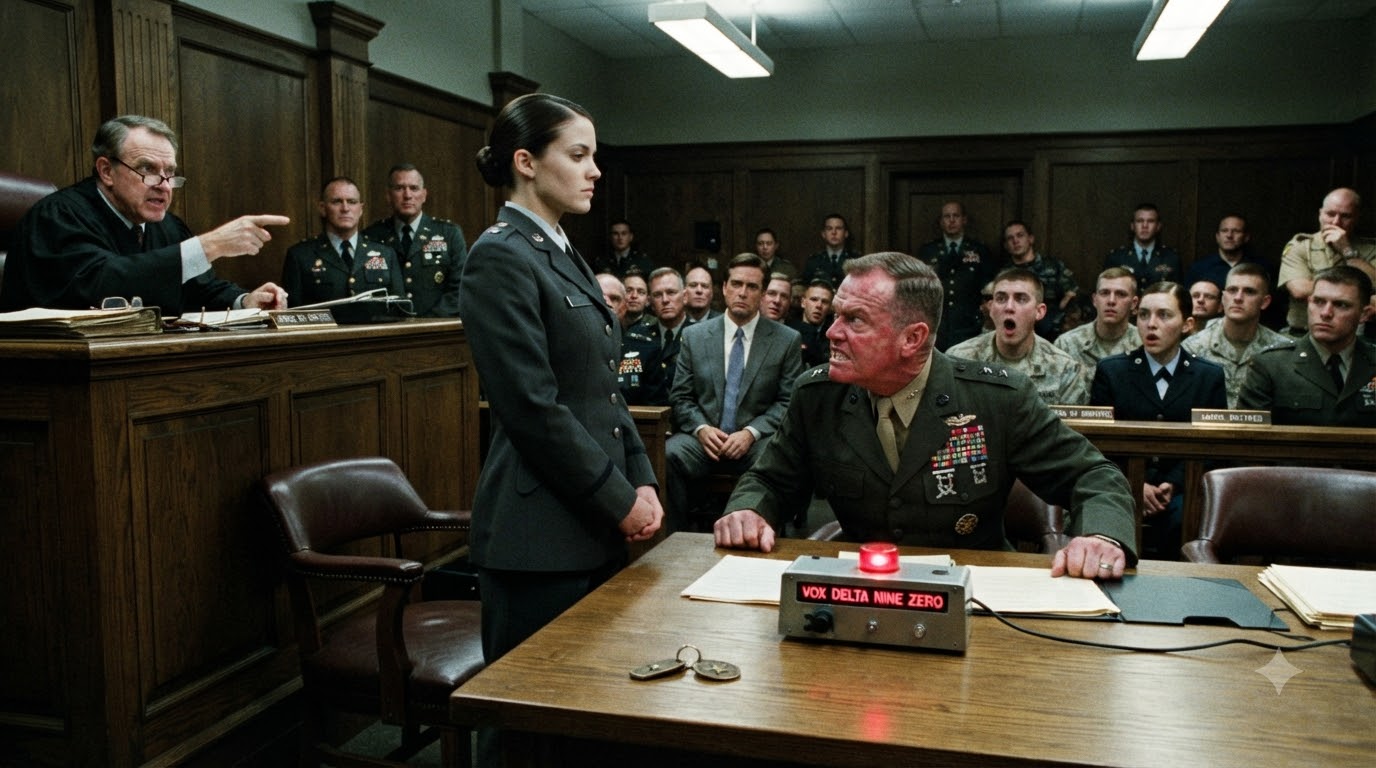
The colonel slammed his palm against the heavy oak table, the sound echoing like a pistol shot.
“Answer the charge,” he demanded, his jaw working in tight, furious spasms. “You think a whisper is enough to shield you from what’s coming?”
Marissa raised her chin.
Her breathing remained slow and measured, entirely unaffected by the rising fury of the men surrounding her.
She did not need to raise her voice to break them.
CHAPTER 2: THE FIRST WHISPER
The laughter in the back row died instantly, cut off as if someone had pulled a main breaker.
Marissa did not raise her voice. She did not need to.
“Vox delta nine zero,” she said.
The words were spoken at a normal conversational volume, yet they hit the hardwood floors with the weight of an anchor dropping into deep water.
A sharp, high-pitched hum vibrated from the wall-mounted communications console behind the judge’s bench.
The red indicator light flickered once, then locked into a steady, blinding crimson glow.
The clerk in the faded blazer dropped his pen, the clatter sounding entirely too loud in the sudden, suffocating vacuum of noise.
“Voice confirmed,” the automated system chimed from the overhead speaker, its synthetic cadence flat and absolute.
Across the aisle, two security officers in crisp uniforms with earpieces dangling exchanged a hard, panicked look.
One fumbled blindly for his encrypted phone, his fingers shaking so violently he nearly dropped the device onto the carpet.
The other stepped back abruptly, his polished boots squeaking a sharp protest against the floor.
The judge gripped the edges of his heavy oak desk, his knuckles turning bloodless and white as his glasses slid half an inch down his weathered nose.
“What did you just say?” the judge demanded, his tone dropping from judicial certainty into something remarkably close to caution.
Marissa kept her hands clasped loosely in front of her gray skirt, her posture steady and unyielding.
She did not flinch under the collective gaze of forty stunned military personnel.
“I just triggered an Alpha Sun trole directive,” she replied, her voice remaining entirely flat, as if she were reading items off a grocery receipt. “The verification system will respond within sixty seconds.”
The young soldier in the back row swallowed hard, his Adam’s apple bobbing sharply in his thin throat.
He leaned toward the lanky private beside him, his whispered words cutting through the eerie quiet.
“What is she talking about?”
The private didn’t answer, his mouth half-open as he stared at the red diagnostic lines cascading down the main display monitor.
The colonel, sitting front and center with a chest full of medals, was no longer sneering.
His jaw was locked so tight a muscle ticked violently near his left ear.
He stared at Marissa as though she were holding the pin of a live grenade.
Marissa felt the shift in the room’s temperature, the sudden drop from arrogant mockery to cold, calculating fear.
She reached down, her thumb brushing the frayed hem of her skirt once more to center herself.
The system sixty-second countdown had begun, and the men who thought they held all the cards were suddenly out of moves.
CHAPTER 3: DOUBLING DOWN
The metal legs of the colonel’s chair screeched against the floor as he forced himself upright, his chest full of medals clinking like loose change.
“You think a handful of numbers and a theatrical pause can save you from charges of destroying classified files?”—the colonel spat out the words, his face flushing a deep, mottled crimson that strained the collar of his uniform.
Around him, the courtroom atmosphere curdled from stunned silence back into aggressive, defensive hostility.
In the observation gallery, a congressman in a tailored suit slammed his fist against the wooden partition.
“We have the full authority to detain anyone obstructing tribunal procedures,”—the congressman barked, pointing a manicured finger directly at Marissa’s unmoving posture.
Marissa didn’t blink.
She let their noise wash over her, recognizing the frantic volume of people realizing they had lost control of the narrative.
The female captain with the tight blonde bun scoffed openly, yanking her headset off the table with a sharp plastic snap.
“She is just playing a part,”—the captain muttered loudly to the legal recorder, whose fingers had frozen over the transcript keys.
An older officer near the front row stood up, his uniform sagging from years of desk service, and pointed a trembling hand.
“You’re a ghost from a forgotten ledger,”—the officer rasped, his voice rough with indignation.
Marissa ignored the noise, her gaze dropping for a fraction of a second to the floorboards.
She reached into her coat pocket, her fingers finding the cold, familiar metal of the star-stamped keychain.
She turned it once between her thumb and forefinger, feeling the sharp points ground her against the theater of their panic.
The screen on the wall continued its relentless red pulse, counting down the final seconds of verification.
The colonel slammed his hands down on the table again, leaning forward until his face was tight with desperate fury.
“You answer to us,”—the colonel snarled, demanding compliance from a machine that had already locked him out.
Marissa raised her chin, her tired eyes locking onto his with absolute, chilling calm.
CHAPTER 4: THE WAX SEALED TRUTH
The wooden floorboards creaked under her steady weight as she approached the heavy oak bench.
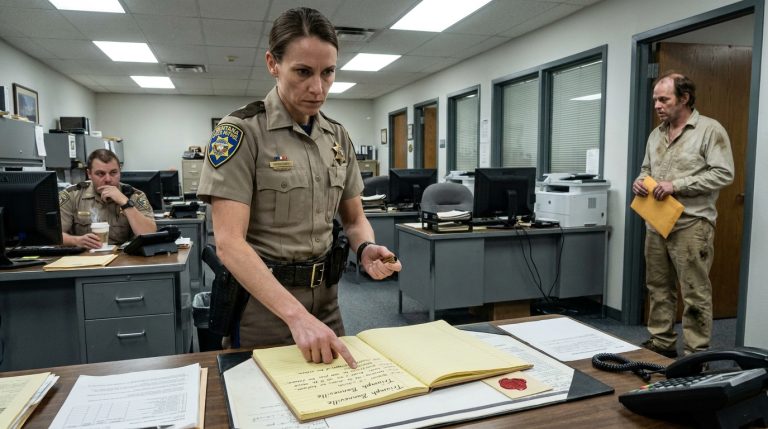
On the evidence table sat a single silver envelope, triple-sealed with dark red wax that caught the overhead light.
The courtroom murmured around her like an unsettled hive, the officers realizing their threats were bouncing off an impenetrable wall of silence.
Marissa reached out with a steady hand, her fingers picking up the envelope by its corner.
“This is completely irregular,”—the judge stammered, half-rising from his leather seat before catching himself and sinking back down.
Marissa ignored him entirely.
She laid the silver envelope flat on the wood directly in front of the judicial bench.
“Level three response code Phoenix Echo Theta,”—she whispered.
The words carried no theatrical anger, only the dry, unyielding weight of absolute finality.
The judge’s hand hovered over the red wax seals, trembling visibly as he stared down at the insignia embossed on the paper.
He reached out, his fingernail catching the edge of the first seal and cracking the wax with a sharp, dry snap.
Inside lay a single sheet of aged paper, its text typed with mechanical precision.
The judge tilted his glasses up, his eyes scanning the first two lines before his breath caught in his throat.
“This directive,”—the judge choked out, his voice losing every ounce of its judicial authority—”can only be issued by the Supreme Commander.”
The colonel shoved his way forward from the front row, his face twisting in desperate disbelief.
“She had the power to suspend an entire operation?”—the colonel shouted, his voice cracking with panic as he stared at the paper.
Marissa stepped back, her face entirely unreadable, leaving the broken wax seals as the only proof of what was coming next.
CHAPTER 5: THE SYSTEMIC COLLAPSE
The shrill, unbroken shriek of outside emergency sirens cut through the heavy air of the courtroom like a razor.
On the main wall monitor, the flashing red diagnostic lines abruptly vanished, replaced by stark black lettering declaring the complete termination of Operation Red Desert.
The colonel slammed his fist against the table, his face draining of color as the reality of the directive sank into his marrow.
“She has hacked the main grid,”—the technician in the corner shouted, his voice cracking into a frantic, high-pitched plea as he slammed his palms down on his laptop keyboard.
Nobody listened to him.
The courtroom was descending into unvarnished panic, with officers scrambling over leather chairs and staff members desperately dropping files.
The congressman grabbed his phone, his tailored suit jacket wrinkling as his fingers fumbled against the glass screen.
“This is an absolute circus,”—the captain snapped, her voice trembling despite her desperate attempt to maintain military composure.
Marissa did not raise her voice, nor did she smile at their collective unraveling.
She simply stepped back from the bench, her worn shoes clicking against the marble floor with quiet, rhythmic authority.
The system they had weaponized against her had been dismantled not with weapons, but with the cold, immovable truth of an old directive.
The judge sank heavily into his high-backed chair, his gavel slipping from his fingers to roll across the desk.
“How do you have this authority?”—the judge whispered, his voice barely audible over the wailing sirens outside.
Marissa didn’t look back as she turned toward the double doors, leaving the broken hierarchy behind to face the music they had written for themselves.
CHAPTER 6: THE UNSHAKABLE EXIT
The heavy oak doors clicked shut behind her, cutting off the frantic shouts of officers and the wailing alarm klaxons.
A black sedan sat idling by the curb, its tinted windows reflecting the pale evening sky.
A tall man in a tailored, unassuming suit stood beside the passenger door, his posture entirely unreadable.
He didn’t speak as Marissa approached.
He simply reached out, opening the door with a smooth, silent motion.
Marissa slid into the worn leather seat, her fingers instinctively brushing against the strap of her bag.
Her husband closed the door softly, walking around to slide into the driver’s seat.
He glanced sideways, his expression calm and grounded, offering a quiet solidarity that required no words.
The car pulled away from the curb, gliding down the empty street as the courthouse faded into the distance.
Back inside that room, the system they had weaponized against her lay in ruins, every name flagged and every career dismantled by its own hubris.
They had demanded she speak louder, assuming her quiet demeanor meant weakness.
Instead, she had let the immutable reality of her service do the talking.
Twenty minutes later, the sedan turned down a quiet residential street lined with tall maples.
The small, unassuming house stood bathed in the warm, fading gold of sunset.
Marissa stepped out onto the paved walkway, the cool evening air carrying the faint scent of cut grass.
She walked up the front steps, her worn shoes clicking softly against the concrete.
Inside the kitchen, the sunlight streamed through the window, catching the fine dust motes dancing above the counter.
Her husband poured a glass of cool water, his movements slow and deliberate, setting it down within reach.
Marissa wrapped her fingers around the condensation-beaded glass, feeling the steady, uncomplicated weight of a normal evening.
There were no hearings left to attend, no uniform codes to decode, and no arrogant voices demanding explanation.
She took a slow sip, her shoulders dropping as the lingering tension of the day evaporated into the quiet room.
She wasn’t a victim of their system, nor a celebrated icon.
She was simply home.