An Overlooked Base Cook Quietly Proves His Deadliest Discipline When Arrogant Recruits Push Too Far
CHAPTER 1: THE COLD MORNING RANGE
The smell of stale grease and powdered eggs clung to my sleeves even out here in the open wind.
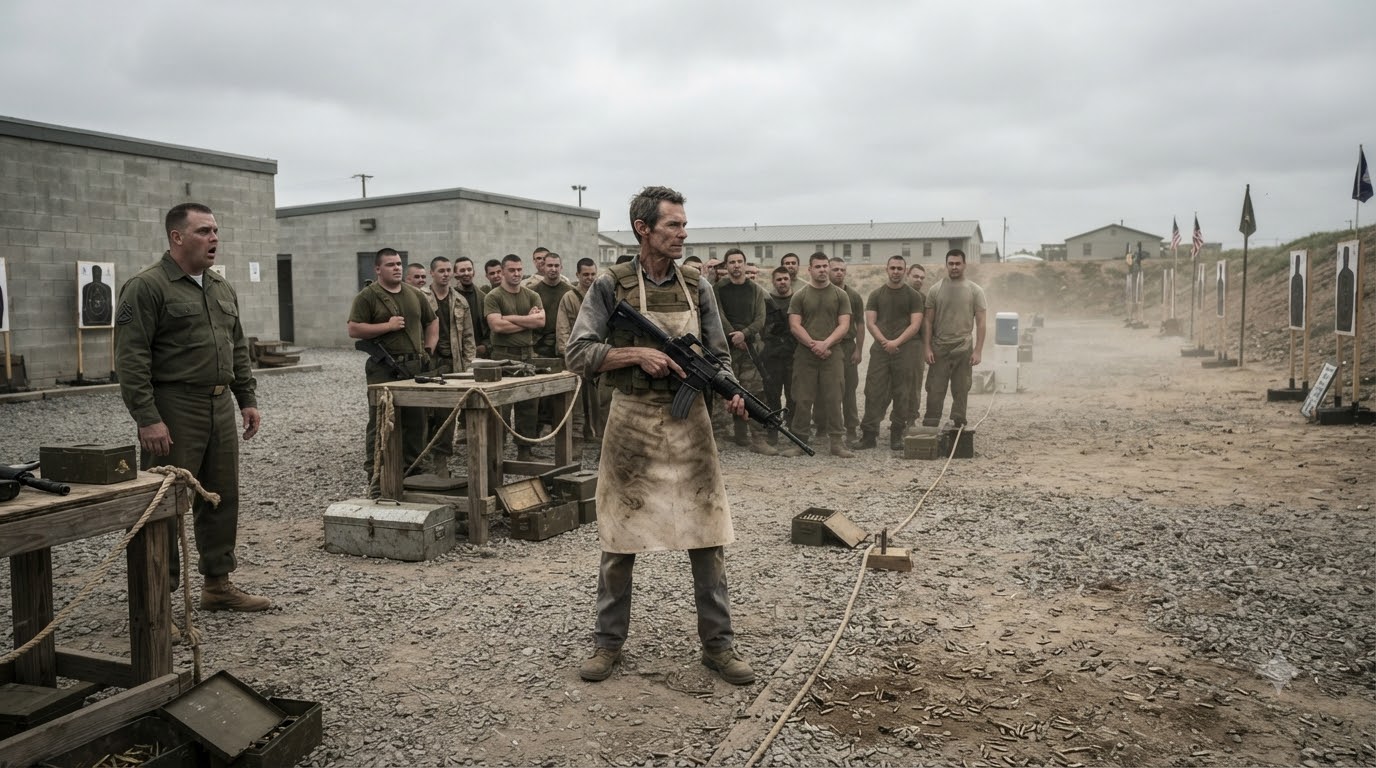
Sergeant Decker’s voice cracked across the gravel like a bullwhip, driving twenty-three fresh recruits into a tighter, stiffer knot of panic.
“Somebody hit that target before I lose my mind!” Decker roared, pacing behind the firing line while veins bulged at his temples. “I have seen children at county fairs shoot better than this with pellet guns!”
Downrange, the fifty-meter silhouettes stood pristine and untouched, white paper mocking the frantic bursts of gunfire.
Brass casings bounced against my worn boots, spinning into the dust as another young private jerked his trigger and sent a round high into the berm.
Decker snatched the clipboard back, his jaw working overtime as he glared down the line of trembling barrels.
“You are wasting government property!” Decker barked, stopping directly in front of a private whose hands were shaking so badly he could barely seat a magazine. “Every missed round comes out of the American taxpayer’s pocket. You are personally bankrupting this base one pulled shot at a time.”
I adjusted the strap of the insulated water cooler resting on my hip, feeling the familiar, dull ache in my left knee where the joint had been stitched back together years ago.
The recruits didn’t look at me when I set the fresh boxes of rations down on the wooden bench.
To them, I was just the sixty-four-year-old civilian who scrambled their eggs at four in the morning and never complained about the burnt toast.
One of the recruits, a broad-shouldered kid with high-and-tight hair who called himself Miller, muttered something under his breath to the private next to him and snickered.
“Hey, Pops,” Miller called out, not even turning his head as he cleared a jammed chamber. “Bring any extra napkins? Some of these boys are about to cry.”
I didn’t answer. I just picked up the empty cooler, my thumb sliding instinctively along the worn metal edge of my watchband, measuring the rhythm of their ragged breathing.
Decker turned sharply, catching sight of me lingering near the edge of the shelter.
“Chow’s delivered, Mackey,” Decker snapped, wiping sweat from his forehead with the back of a bare wrist. “You can head back to your kitchen before the soup gets cold.”
I stood my ground, my weight balanced evenly over both heels, and watched Miller slam his rifle stock into the dirt out of sheer frustration.
Decker opened his mouth to tear into the private, but I stepped forward, my voice cutting through the dry morning air with quiet, deliberate flatness.
“Sergeant,” I said, my gaze locked on the paper targets fifty meters downrange. “Mind if I take a few shots?”
CHAPTER 2: THE UNINVITED STEP
Decker’s eyes narrowed, his breath hitching as he looked down at my grease-stained apron and then at the clean weapon resting in my grip.
“Mackey, I said head back to the kitchen,” Decker repeated, his voice losing its sharp edge and dropping into a confused, guarded register.
“You asked for a demonstration, Sergeant,” I replied, my thumb sliding over the safety selector with a dry, mechanical click that sounded entirely too sharp for a base cook.
The twenty-three recruits fell completely silent, the restless shuffling of boots grinding to a halt across the gravel.
I stepped into lane four, squaring my shoulders against the cold morning wind without looking back at the whispered laughter trying to bubble up from the rear rank.
My left knee flared with a dull ache as I dropped my weight into position, but I tuned out the joint’s protest just like I had tuned out a thousand other distractions in places far worse than Fort Whitmore.
The fifty-meter silhouette downrange stared back at me, white paper framed against the dull dirt berm.
I did not rush the mount; every adjustment of my posture was measured, deliberate, and entirely mechanical.
The first round broke the morning stillness with a violent, flat crack that rattled the tin roofs of the observation benches.
Downrange, the center of the paper target snapped backward before the sound wave even cleared the firing line.
Before the brass casing had finished tumbling through the dust at my feet, my finger reset and dropped the second round into the one-hundred-meter silhouette.
The third shot tore through the two-hundred-meter target with a hollow, echoing thwack that left zero doubt about where the lead landed.
Total elapsed time sat comfortably under five seconds, clean and cold, without a single wasted breath or jittery muscle.
Decker stood frozen a few paces behind my left shoulder, his mouth slightly parted as he stared downrange instead of at his clipboard.
“That’s… that’s impossible offhand,” Decker muttered, his face draining of its angry, ruddy color.
I cleared the chamber, letting the final live round slide smoothly into my palm before setting the carbine flat on the wooden bench.
“Breathing is the whole thing, Sergeant,” I said quietly, untying my apron strings and laying the stained cloth over the stock. “They’re holding their breath when they should be releasing between heartbeats, which is why every single shot pulls left and high.”
Private Miller stared at the targets, his jaw tight, his fingers twitching against the sling of his own rifle as the humiliation began to sink into his chest.
Decker didn’t answer me; he just stared at my hands—hands that spent twelve hours a day peeling potatoes and scrubbing grease traps.
An old, faint pulse hummed in the back of my mind, reminding me of the encrypted radio signal sitting inside the flour tin back at the mess tent.
I turned away from the firing line without waiting for Decker’s dismissal, leaving the silent recruits staring at the targets like they had just seen a ghost.
CHAPTER 3: THE FRACTURED AUTHORITY
The smell of boiling potatoes and scorched broth hung thick in the narrow aisle between the stainless-steel prep tables.
Sergeant Decker’s heavy boots echoed on the concrete outside, stopping just short of the serving window before turning away with a sharp, frustrated grunt.
Private Miller and his squad mates were still out on that range, staring at paper targets that had suddenly become a lot heavier than pieces of cardboard.
I tied my apron strings back around my waist, the coarse fabric scratching against the cotton of my shirt while my thumb located the edge of the flour tin on the back shelf.
The digital tuning dial inside the tin was dark, completely silent for now, but the static hum would return precisely when the base went to sleep at 0400 hours.
A shadow fell across the serving hatch, blocking out the harsh afternoon sun as Decker leaned his forearms against the stainless steel.
“You’ve got a lot of nerve keeping things like that quiet, Mackey,” Decker said, his voice dropped to a rough, private rasp that carried no official rank behind it.
I didn’t stop slicing the root vegetables, the heavy carbon-steel blade hitting the cutting board with a steady, metronomic thud.
“I make breakfast, Sergeant,” I answered, keeping my eyes fixed on the pale wedge of potato beneath my knuckles. “That’s all anyone ever asked me to do on this base.”
Decker’s knuckles whitened against the metal shelf, his pride stinging from the realization that he had spent months barking orders at a ghost from a different era.
“The recruits are asking questions,” Decker muttered, his jaw clenching as he tried to reconcile the old cook with the man who had just painted three center-mass holes in five seconds. “Miller thinks you’re playing some kind of game with them.”
“Tell Miller to focus on his breathing,” I said, sliding the sliced potatoes into a battered aluminum pot with a sharp clatter. “The paper doesn’t care who’s holding the rifle, and neither will the realities waiting out past the wire.”
Decker stared at me for a long, heavy second, searching my face for any sign of a smirk or a boast, but finding only the blank, worn exhaustion of a man who had seen too many mornings start just like this one.
He pushed away from the window without another word, his boots fading down the concrete walkway toward the barracks.
I wiped the blade clean with a rag, listening to the distant rumble of a truck engine shifting gears near the perimeter gate.
The silence inside the kitchen felt brittle now, stretched thin by a secret that couldn’t stay buried much longer.
CHAPTER 4: THE ESCALATION TRAP
The fluorescent light overhead flickered, casting long, jittery shadows across the linoleum floor.
Private Miller stepped out from the shadows near the storage lockers, blocking the narrow corridor with his arms crossed and three other recruits standing heavy behind him.
“Thought you could just slip away after making fools of us on the range today, Pops,” Miller said, his voice dripping with an abrasive, bruised ego.
I didn’t blink or step back, keeping my hands loose at my sides while my fingers brushed the edge of the cotton apron wrapped under my arm.
“The range isn’t about pride, Private,” I said, my voice flat and unyielding against the confined walls of the hallway. “It’s about survival when things go sideways.”
Miller took a step forward, his chest puffing out as he tried to use his youth and size to crowd my personal space.
“You think because you got lucky with a few old rounds that you own this place?” Miller snapped, his face flushing a hot, angry red under the flickering light. “You’re just the cook. You don’t tell us how to shoot, and you don’t make the rules.”
The air between us grew tight, thick with the smell of floor wax and young, unearned arrogance pushing hard against an immovable boundary.
I kept my weight balanced on my heels, watching the twitch in Miller’s right knuckle give away his frustration.
“The rules were written a long time before you got here, son,” I replied quietly, refusing to budge an inch.
Miller jaw clenched tight, his hand twitching toward the fabric of my shirt as the trap of his own temper finally snapped shut around him.
CHAPTER 5: THE SILENT DEFENSE
The other three recruits shifted nervously behind him, their boots scraping the linoleum as they waited for me to lose my temper or swing back.
I didn’t swing. I didn’t even blink.
Instead, my left hand shot out with bone-dry precision, clamping down on Miller’s wrist with a mechanical grip that immediately cut off the leverage in his arm.
Miller’s face flushed a deeper, mottled red as he tried to yank his arm back, but the joint locked fast against my thumb and forefinger like a steel vice.
“You’re making a mess of your posture, son,” I said, my voice dropping into a flat, level register that carried the heavy weight of twenty-six years of unbroken discipline.
“Let go of me, you old fool—” Miller hissed, throwing his shoulder forward to try and break the hold.
I rotated his wrist a fraction of an inch, using his own forward momentum to pivot him off balance until the back of his knees hit the steel lockers with a loud, ringing clatter.
The other recruits stepped back instinctively, their hands hovering uselessly near their sides as they realized how quickly the power dynamic had shifted without a single punch being thrown.
“You think authority comes from shouting on a firing line,” I murmured, leaning in close enough for him to see the cold, flat stillness behind my eyes. “It doesn’t. It comes from knowing exactly where you stand when the ground starts shaking.”
Miller breathed hard through his nose, his chest heaving under the strain as he tried and failed to wrench his wrist free from my grip.
“You can’t do this,” Miller choked out, his arrogance finally cracking under the weight of sheer, crushing exhaustion. “I’ll report you to Decker.”
“Go ahead,” I said, releasing his wrist with a sharp push that sent him stumbling back into his peers. “Tell him the cook taught you your first real lesson about leverage.”
CHAPTER 6: THE UNBROKEN QUIET
The fluorescent hum above my head settled back into a steady, rhythmic drone as I smoothed down the front of my grease-stained apron.
There were no base commanders waiting around the corner to hand out medals, and no dramatic speeches echoing through the barracks to rewrite history.
The encrypted radio signal inside the flour tin would still pulse softly at 0400 hours, keeping its own counsel in the dark.
I walked back into the kitchen, the warmth of the early morning griddle greeting me with the familiar, comforting smell of brewing coffee and baking bread.
Sergeant Decker was already standing by the serving window when the first pale light of dawn crept across the horizon, his coffee cup held firmly in both hands.
He didn’t make a joke about the burnt toast, and he didn’t look at my hands when I set the fresh tray of breakfast rations down on the counter.
“Morning, Mackey,” Decker said, his voice stripped of all its old bluster, carrying instead the heavy, unpretentious respect of a working man who finally understood his surroundings.
“Morning, Sergeant,” I replied, turning back to wipe down the steel prep surface with a clean cloth.
Outside the mess tent, the first group of recruits was already forming up for the morning march, their boots hitting the gravel in a cleaner, more disciplined rhythm than they had managed all week.
I picked up the iron spatula, letting my thumb rest against its worn wooden handle while I watched the sun clear the perimeter wire.
The work didn’t change because of who you used to be, and the kitchen didn’t care about what was hidden behind closed doors.
There was coffee to brew, trays to fill, and a quiet, steady rhythm to maintain before the new day’s noise finally caught up.