The Iron Foundation: How a Retired Engineer and a Century-Old Root Cellar Broke a Suburban Empire
CHAPTER 1: The Iron Foundation
The dry Virginia earth had a habit of clinging to everything—boots, tools, the edges of rusted gates, and the stubborn memories of men who had worked it until their hands split. I stood six paces from the boundary marker, my boots sinking slightly into the sun-baked soil, watching Karen Miller adjust the strap of her clipboard as if touching the air above my land might soil her pristine white sneakers.
She looked like a linebacker shoved into pastel pink, carrying the same unyielding, joyless expression of a high school gym teacher holding a clipboard of failures. Behind her, the uniform beige roofs of the suburban development rolled away like an identical army of molded plastic boxes, pressing right up against the rusted wire fence of my grandfather’s five-acre homestead.
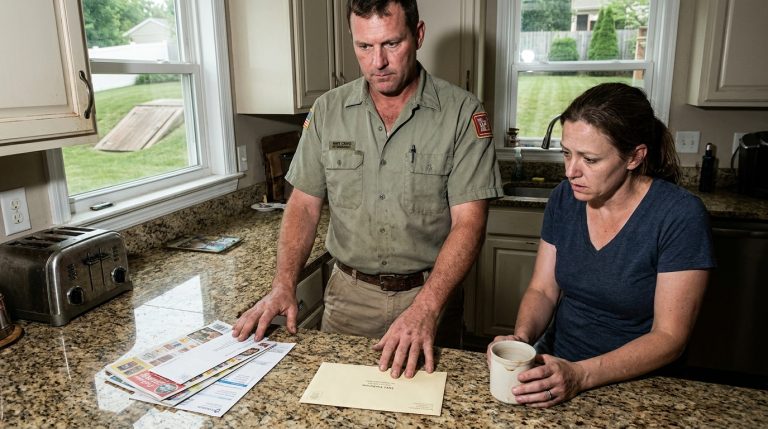
“It’s an eyesore, Thomas,” Karen said, her voice sharp enough to cut tin. She tapped the aluminum clipboard with a manicured fingernail. “That dirt hole. That pile of rotting timber and fieldstone. The committee has inspected the perimeter, and your root cellar violates three separate county aesthetics codes. Not to mention the liability.”
I didn’t blink. My hands were shoved deep into the pockets of my canvas jacket, my fingers curling around a small, square surveyor’s stake I’d pulled out of the brush near the southern fence line thirty minutes before she arrived—a wooden peg stamped with the initials of a commercial land-surveying firm I’d never invited onto my property. It was a small, quiet detail, but it sat heavy in my palm like a coiled spring. Twenty-two years in the Army Corps of Engineers taught me one immutable law: when a civilian starts complaining about aesthetics, look closer at where they want to put the drainage pipes.
“That root cellar has stood for over a hundred years,” I said, keeping my tone level, measured, stripped of any heat. “Built by hand before a single one of those houses down the hill was a blueprint.”
“Things change,” Karen snapped, stepping half an inch closer to the property line before thinking better of the dirt and retreating. “Subdivisions grow. Values require uniformity. The board has assessed the fine at five thousand dollars, payable by Friday afternoon. If the structure isn’t filled in and leveled by then, the county will execute the abatement order at your expense.”
She turned on her heel, her sneakers crunching on the paved asphalt of the subdivision road, leaving me alone with the silent, dry wind rustling through the old oaks. But as I looked down at the surveyor’s stake in my pocket, and then toward the heavy timber doors of the root cellar half-buried in the hillside, the cold realization settled in my bones. This wasn’t just a petty neighborhood dispute over curb appeal.
The concrete truck was scheduled for the end of the week, but Karen Miller had no idea what kind of foundation she was about to strike.
CHAPTER 2: The Weight of the Binder and the First Line of Defense
The gravel in the driveway still hissed faintly as the heat radiated off the crushed stone, but Karen’s pastel pink track jacket had long since vanished beyond the bend of the subdivision access road. I stood on the porch with my fingers curled tight around the cold, stamped wood of the surveyor’s stake. It was a cheap piece of pine, flagged with plastic neon tape that fluttered lazily in the dry afternoon air. Whoever drove it into my southern brushline hadn’t bothered to hide their tracks. They had walked right over the rusted remains of the old stone wall—the boundary line my grandfather had maintained with stacked fieldstone and quiet stubbornness for half a century.
A twenty-two-year career in the Army Corps of Engineers teaches you to read a landscape like a blueprint. When a municipality or a corporate entity wants a parcel of land, they don’t start with a wrecking ball; they start with small, quiet paper cuts. They find an ordinance, they weaponize an HOA board, and they create an administrative emergency. Five thousand dollars for a dirt hole they claimed was a public nuisance. Five grand, payable by Friday, designed to panic a civilian into cutting a check or surrendering the deed out of pure exhaustion.
I walked off the porch, the weathered floorboards groaning under my boots, and headed straight toward the dark, timber-framed doors of the root cellar built into the gentle rise behind the house.
The air dropping down into the stone-lined threshold carried a distinct, cool dampness that smelled of limestone, old damp earth, and decades of silent storage. My grandfather had built this cellar during the fifties, but the core structure—the heavy dry-stacked foundation walls—dated back much further. He had always told me the land held stories people had long since stopped listening to, but back then, when I was just a kid spending summers hauling feed and fixing tractor belts, history sounded like chores.
Now, it sounded like leverage.
I reached into my pocket, pulled out a small tactical flashlight, and flicked it on. The beam cut through the dim interior, catching the rough wooden shelves where my grandfather used to store jars of home-canned preserves, and illuminated the back wall where the stone met the earthen slope. That was where I had found the iron lockbox three years ago when I first moved back after retiring.
I didn’t open the box then. I had no reason to. It was just a heavy steel container rusted shut at the hinges, containing whatever old paperwork my grandfather had deemed worth keeping away from the humidity.
Today, the rules had changed.
I set the surveyor’s stake down on the top of an overturned wooden crate, grabbed a heavy-duty pry bar from the corner tool rack, and knelt in the cool dust of the cellar floor. The metal of the box resisted with a dull, grating screech as I wedged the flat edge of the bar under the rusted lip. A shower of orange flakes rained down onto my boots. I leaned my weight into it, letting my shoulder muscles take the strain, until the latch sheared with a sharp, metallic pop that echoed off the damp stone walls.
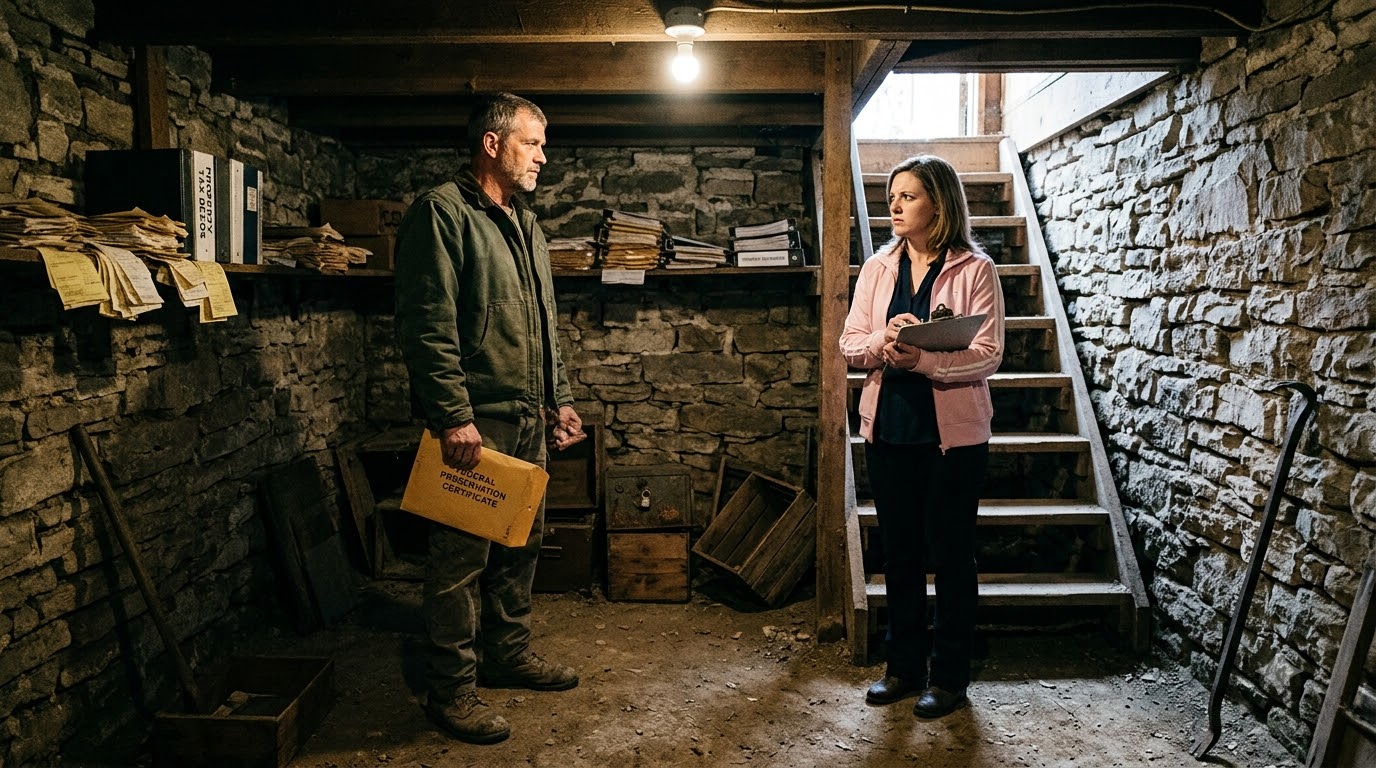
Inside, beneath layers of brittle yellowed receipts and old property tax deeds, lay a thick, heavy manila envelope tied with faded twine. The paper was stiff, almost leather-like with age.
I untied the twine, slid the flap open, and pulled out a single, cream-colored certificate bearing the embossed seal of the Commonwealth of Virginia and the Department of the Interior. The text was typewritten in sharp, fading black ink, dated back to the early nineteen-seventies, signed by a state historian and a university professor who had spent three winters mapping out local historical markers before the modern subdivisions ever carved up the county.
The root cellar wasn’t just a root cellar. According to the document, the subterranean stone chamber had been utilized in the mid-nineteenth century as a waystation for travelers moving north through the Rappahannock corridor. A documented structural link in a network that operated entirely in the dark.
And under federal preservation law, altering, grading, or destroying a documented historical artifact of its classification wasn’t a civil code violation for an HOA committee to arbitrate. It was a federal felony.
I sat back on my heels, the cool cellar air chilling the sweat on the back of my neck. Karen Miller thought she was bringing a bulldozer to a local dispute. She had no idea she had just walked onto a live minefield, and the detonator was sitting right in my hand.
I folded the certificate carefully, slid it back into its envelope, and stood up from the damp floor. The sun was dipping below the tree line, casting long, sharp shadows across the Virginia acreage. Friday was three days away. The concrete truck was scheduled for eight in the morning.
I walked out of the cellar, locked the heavy timber doors behind me, and picked up my phone. It was time to call Dave.
CHAPTER 3: The Boardroom Theater and Weaponized Indifference
The telephone receiver felt heavy and cold against my ear, the coiled cord twisted into tight, stubborn kinks from years of disuse. On the other end, the line clicked twice before a dry, methodical voice answered.
“Vance here,” the retired history professor said, his tone carrying the flat, unhurried cadence of a man who spent four decades correcting footnotes in state archives.
“Arthur, it’s Thomas. Down on the old homestead,” I said, keeping my voice low as I watched the shadows stretch across the yard through the kitchen window. “I found the box. The original certification from seventy-two. It’s sitting right here on my workbench.”
A brief pause rustled through the receiver, the sound of paper shifting against a wooden desk. “72? That would be the Department of the Interior’s regional survey coordinated with Professor Holloway. If that seal is intact, Thomas, you aren’t dealing with a simple county zoning dispute. You’re holding a federal title anchor.”
“Karen Miller and her committee are moving fast,” I replied, my fingers tracing the rusted edge of the counter. “They’ve got a demolition contractor scheduled for Friday morning. Five thousand dollar fine, abatement order, the whole routine.”
“They’re banking on the fact that most people fold when they see an official letterhead,” Arthur said dryly. “The board doesn’t care about aesthetics, Thomas. Follow the perimeter stakes. Look past your fence line.”
I didn’t need to look. The wooden surveyor’s peg stamped with the commercial development firm’s initials was still sitting on my workbench, a silent piece of evidence that fit the broader puzzle. Karen wasn’t acting out of sheer neighborhood vanity; she was clearing a corridor.
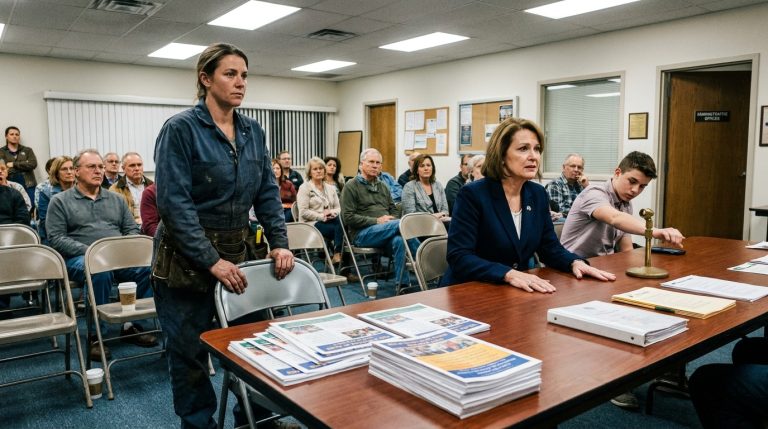
By nine o’clock the following morning, I stood inside the municipal annex building for the scheduled architectural review hearing. The room smelled of industrial floor wax and stale coffee. Fluorescent tubes hummed overhead with a dry, monotonous buzz that grated against my nerves. At the front of the room, seated behind an elevated laminate table, Karen Miller presided over the committee with the rigid posture of a magistrate holding court over a minor infraction. Beside her sat Gary and Brenda, nodding in synchronized agreement before anyone had even spoken a word.
They hadn’t bothered to open the thick, ten-page binder of engineering reports, soil samples, and historical summaries I had dropped off at the front desk forty-eight hours prior. It was still sitting flat and unopened on the edge of their table, used merely as a clumsy paperweight for an empty styrofoam cup.
Karen cleared her throat, adjusting her pastel blazer, and looked down her nose at me where I stood alone by the door.
“Mr. Thomas,” she began, her tone dripping with bureaucratic theater designed for an audience of none. “The committee has reviewed the administrative parameters regarding your property violation. The unauthorized structure—specifically the deteriorating subterranean earth mound—remains a severe liability to the aesthetic and economic stability of our community.”
I didn’t move. My hands stayed planted inside my jacket pockets, my fingers brushing against the cold edge of the manila envelope containing the state preservation certificate.
“Did you review the structural and historical data submitted in the binder?” I asked, my voice cutting through the hum of the fluorescent lights without a single tremor of hesitation.
Karen offered a tight, dismissive smile, waving a hand as if swatting away a gnat. “The committee determines what constitutes an aesthetic violation in this township, Mr. Thomas. We are not interested in amateur architectural theories or irrelevant paperwork. The fine stands, and the abatement order for the dirt hole is final.”
Gary chimed in, leaning forward with a self-satisfied smirk. “You’ve got forty-eight hours to comply, Thomas. After that, heavy machinery moves in, whether you like it or not.”
I held their gaze, letting the silence stretch out until the artificial confidence in their eyes flickered with a sudden, uneasy friction. They wanted a quick surrender. They wanted a civilian to break under the weight of an arbitrary fine. But as I turned and walked out of the sterile boardroom without another word, the iron weight in my pocket felt heavier than ever.
They had the table, the clipboard, and the calendar. But they were marching straight toward a wall of solid stone, and they didn’t even know it yet.
CHAPTER 4: The Attic Archive and the Dust of the Past
The screen door of the farmhouse slammed shut behind me with a dry, metallic rattle that echoed through the empty hallway. I didn’t drop my jacket or stop to pour a cup of coffee. The sterile, dismissive laughter of Karen Miller and her board members still buzzed in my ears like static. They thought the game was over because they had a laminate table and a rubber stamp. They didn’t understand the geography of endurance.
I turned toward the narrow, enclosed staircase tucked behind the kitchen pantry—the steep, wooden steps leading up to the attic.
The air upstairs was thick, smelling of sun-baked cedar shingles, dry insulation, and decades of forgotten paper. My grandfather had been a man who threw nothing away, keeping every ledger, receipt, and tax document inside heavy wooden crates stacked against the eaves. For three days, I had been working my way through those boxes, looking for anything that could anchor my claim to the property against the county’s fast-tracking development permits.
A sudden, sharp pop echoed from the hallway downstairs as the old electrical transformer outside struggled against the afternoon voltage drop, plunging the attic into a deeper, dimmer shade of amber as the overhead bulb flickered out. Left with only the gray, fading twilight filtering through the grimy rectangular windowpane at the gable end, I dropped to my knees on the plank floorboards.
My fingers brushed against the rough grain of a heavy, iron-strapped crate tucked into the far corner under the rafters—a chest my grandfather had explicitly labeled with a grease pencil: South Field & Foundation Survey, 1954.
I unlatched the rusty iron clasp, the metal scraping audibly against the wood, and lifted the lid. Inside lay a dense collection of rolled blue-line engineering maps, handwritten surveyor notebooks, and a series of correspondence letters addressed to my great-grandfather. As I pulled out the top map, a smaller, folded ledger slipped from between its folds, hitting the floorboards with a dull, heavy thud.
I picked it up, flipping open the brittle, yellowed pages. The handwriting was neat, disciplined, and precise—filled with architectural notes, depth measurements, and cross-sections of the root cellar’s foundational walls. But tucked into the back cover was something that stopped my breath entirely: a hand-drawn blueprint overlay showing the exact property boundaries of the surrounding valley, with annotations indicating commercial utility easements filed by an early holding company—the very same holding company that now backed the suburban development pushing against my fence line.
Layer by layer, the puzzle pieces were snapping into alignment. Karen Miller’s HOA wasn’t just a neighborhood nuisance association; it was the front-line collection agency for a corporate land-acquisition pipeline intent on clearing out every legacy homestead along the county corridor. They needed my land—specifically the grade where the root cellar sat—to clear the path for a commercial stormwater runoff basin.
The fine wasn’t about aesthetics. It was an eviction notice disguised as a code violation.
I carefully folded the ledger and slid it into the inner pocket of my jacket. The sun had completely dipped below the horizon now, leaving the attic in near-total darkness, save for the pale glow of the moon cutting across the floorboards. I stood up, my knees aching from the damp chill, and walked down the narrow stairs.
The pieces were on the board. Now it was time to bring in the heavy artillery.
CHAPTER 5: The Discovery of the Federal Certificate
The morning air outside the kitchen window was biting, carrying the sharp scent of frost-touched grass and dry timber. I didn’t waste time on coffee. My boots hit the floorboards with a heavy, deliberate rhythm as I packed the ledger and the commercial easement maps into a durable canvas briefcase. The timeline was tightening. Friday morning was less than forty-eight hours away, and the physical evidence recovered from the attic had shifted the ground entirely beneath Karen Miller’s feet.
Before I could face the board with the final legal shield, I needed to ensure the foundation itself was secure. I walked out the back door, the cold air hitting my face like a dry sheet of tin, and headed down the slope toward the root cellar.
As I stepped past the rusted wire fence line, my gaze caught a fresh, deep impression in the damp dirt near the southern corner of the stone wall—a wide, aggressive tire track left by an all-terrain utility vehicle that hadn’t been there the evening before. Someone had been casing the perimeter under the cover of darkness, measuring the grade, testing the accessibility of the slope where the municipal drainage corridor was intended to cut through.
The corporate developers weren’t just waiting for the HOA’s demolition order; they were preparing to move on the land themselves.
I knelt down beside the tire track, pressing my thumb into the compressed mud, feeling the cold moisture before standing back up and walking over to the heavy timber doors of the cellar. I pulled the master key from my pocket, sliding it into the rusted padlock with a metallic click that echoed hollowly off the stone embankment.
Inside, the subterranean air was thick with the scent of damp limestone and ancient earth. I clicked on my tactical flashlight, sweeping the beam across the dry-stacked stone walls that my great-grandfather had laid by hand a century ago. Tucked safely inside the metal lockbox on the wooden shelf was the ultimate counterweight: the official certification from the Department of the Interior, designating the chamber as a historically protected structure tied directly to the mid-nineteenth-century freedom network.
Alteration, grading, or destruction of this site wasn’t a civil infraction for an architectural review committee to arbitrate. Under federal preservation law, it was a felony offense carrying severe criminal penalties.
I carefully slid the certificate into my briefcase alongside the surveyor’s ledger, sealing the latches with a sharp, reassuring snap. The trap was set, but waiting for them to walk into it meant holding my ground against whatever pressure they brought to bear on Friday morning. I locked the cellar doors behind me, turned my back to the valley, and walked back up the path toward the farmhouse. The real fight was about to begin.