The Farm Boy Who Outsmarted the Panzer Division with Mud and Sunlight
CHAPTER 1: THE GLINT IN THE CANOPY
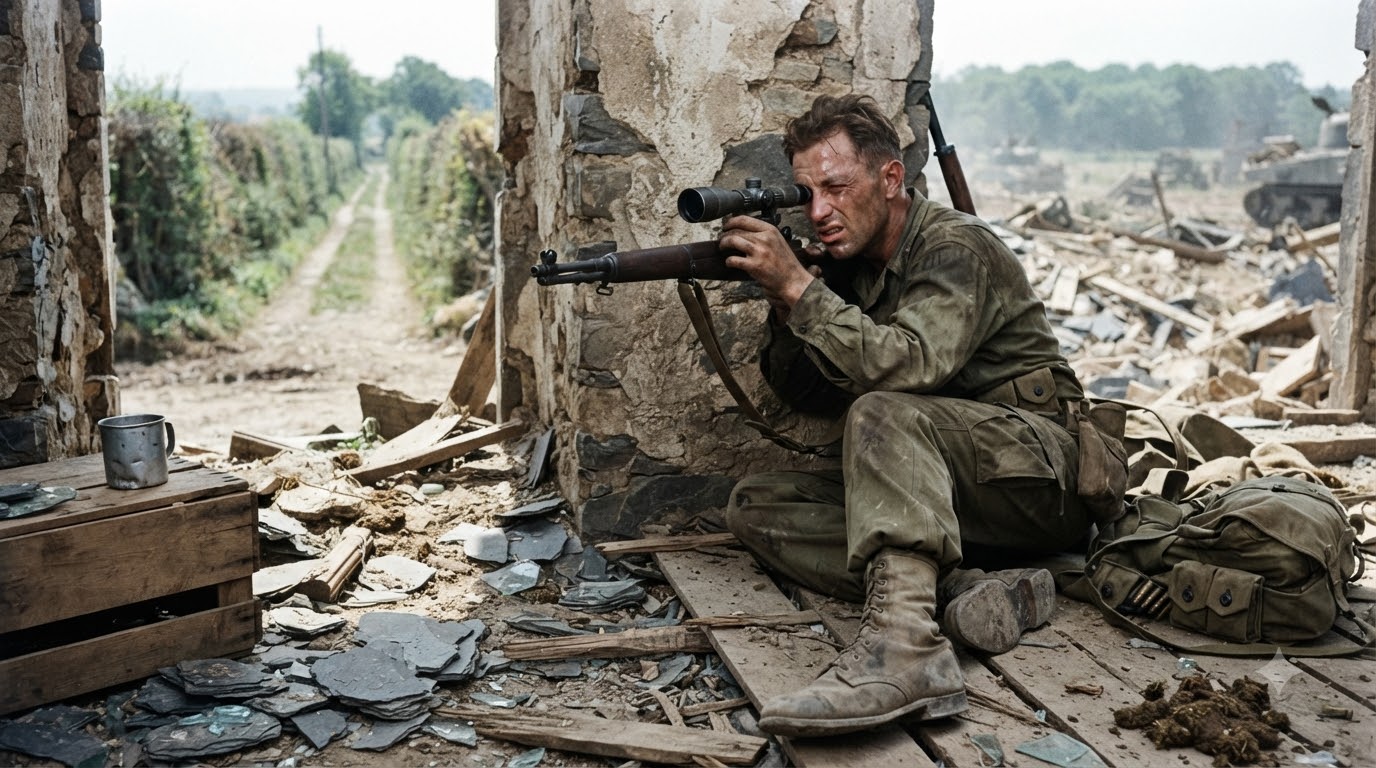
The floorboards under Daniel’s chest smelled of dry rot and old sheep manure. Heat built up fast under the slate tiles of the collapsed attic, baking the air until every breath tasted like hot dust.
Down on the narrow dirt lane, the diesel clatter of three American Sherman tanks rattled the loose mortar near his elbow.
Frank Kowalski pressed his forehead against the stone wall, his face slick with sweat. He dragged a thumb across his spotting scope, wiping away the grime, then glanced back at the dead radio set sitting on an overturned crate.
“Nothing,” Frank muttered. His voice was raw, barely louder than the cicadas buzzing in the brush below. “Wire’s cut or the transmitter blew a tube. We’re on our own.”
Daniel didn’t turn his head. His left cheek remained pressed against the stock of his Springfield rifle, the metal cold against his skin despite the muggy afternoon heat. Through the unertl scope, the world was a tight, magnified circle of green leaves and jagged branches.
Eight hundred yards northeast, where two ancient hedgerows intersected, the oak leaves didn’t move with the wind. The breeze blew from the west, but a dense cluster of hazel branches fluttered backward, pushed by something heavy tucked deep in the embankment.
A shape shifted in the brush. It wasn’t a soldier’s helmet. It was the wide, flat silhouette of a cupola hatch, resting just an inch above the dirt wall.
“They’re not moving,” Daniel said quietly. His voice had the flat, deliberate cadence of a man describing a fence line that needed mending. “They don’t have to.”
“How many?” Frank asked, his fingers twitching against the barrel of his spotting scope.
“One for sure. Panzer IV, hull down in the ditch.” Daniel shifted his weight by a fraction of an inch, his boot leather scraping against a loose floorboard. “And there’s two more set up in the crossfire. They’re waiting for the lead Sherman to hit the stone culvert.”
The lead Sherman surged forward, its tracks throwing up clods of dark Norman clay. The commander in the turret was a kid with bright red hair sticking out from beneath his padded helmet, completely blind to the high-velocity gun waiting behind the leaves.
Daniel reached down with his right hand, his fingers finding the dented lip of a small tin cup resting beside his spare ammunition. The water inside was thick, murky brown, mixed with heavy clay from the driveway.
He didn’t check the radio again. He didn’t look for a runner. He set his jaw, turned the metal cup slightly toward the low afternoon sun, and waited for the heat to hit the water.
CHAPTER 2: THE MUD AND THE MIRROR
A warm breeze blew through the broken roof tiles, carrying the dry stink of diesel exhaust from the dirt lane below. The lead Sherman’s tracks ground over a mound of loose gravel, completely unaware of the three steel barrels waiting behind the foliage eight hundred yards away.
Frank’s shoulder twitched against the stone frame of the window. He didn’t touch the silent radio sitting on the crate behind them. His hand hovered near his spotting scope, his jaw tight as he watched the lead tank approach the stone culvert. “Danny, if you pull that trigger, Hayes will have you in front of a firing squad before the sun sets. Engaged armor is a court-martial offense.”
“I’m not shooting the armor,” Daniel said. His voice was flat, devoid of anger or panic, carrying only the dull weight of a man calculating the work ahead of him. “I’m shooting the man directing it.”
He tilted the tin cup by three millimeters.
The harsh white glare of the sun hit the suspended clay particles in the muddy water. Instead of a sharp, pinpoint mirror flash, the murky liquid caught the light and scattered it into a wide, diffused beam that shot across eight hundred yards of open pasture.
The beam splashed directly across the brush-covered cupola of the lead Panzer.
Through his scope, Daniel saw the German commander react instantly. The officer squinted against the sudden yellow glare, raising a gloved hand to shield his eyes. Confused by the broad, unnatural glow reflecting off the brush, the commander leaned up out of his hatch by three inches to clear his field of view.
His throat and upper chest cleared the steel rim.
Daniel’s lungs emptied naturally. The Springfield’s stock pressed firm against his collarbone, the crosshairs locking onto the center of the dark wool tunic. Between two slow heartbeats, his finger took up the trigger’s slack.
The rifle cracked, the recoil pushing his shoulder back an inch against the rotten floorboards.
Eight hundred yards away, the German officer’s torso jerked backward. His cap flew into the ditch as his body went limp, folding awkwardly over the lip of the open hatch. Inside the turret, sudden panic broke—a pair of gloved hands reached up frantically, trying to drag the weight back down into the steel hull.
“First one’s down!” Frank gasped, his fingers digging into the dust on the windowsill. “The hatch is jammed open with his weight!”
“Eject the brass, Frank,” Daniel said softly, his thumb already cycling the bolt.
The hot shell casing flew out in a short arc, pinging softly against the slate tiles. Below in the lane, the lead American Sherman ground to an abrupt halt, its crew finally catching the visual shock of the dead commander dangling from the hedgerow.
Daniel shifted his elbows on the rough timber, tracking the second panzer twenty yards to the left. The sun was dropping, changing the angle, and the clay in his cup was already settling to the bottom.
CHAPTER 3: BREAKING THE MACHINE
Across the valley, the second Panzer was already in motion. Engine smoke belched from its rear exhaust, a thick gray plume rising over the high embankment as the steel beast attempted to reverse out of the fatal bottleneck.
Its driver was blind to the road behind him. Up in the open turret hatch, a second commander leaned far out over the rim, slapping his gloved hand violently against the armor plate, screaming downward to guide the tread placement.
Frank jammed his knuckles against his mouth, his breath catching in his throat. “He’s backing behind the stone barn, Danny! Once he gets those wall stones between us, he’s clear!”
“He isn’t clear,” Daniel said.
He lifted the tin cup with his right hand, adjusting his posture by half an inch to meet the shifting late-afternoon sun. The beam caught the muddy surface, throwing a wide, shimmering splash of amber light directly across the second commander’s face.
The German officer flinched, his head jerking sideways to avoid the glare. In that split second of disorientation, his hands missed the safety grip on the hatch rim. His footing slipped on the greasy deck plating, forcing him to stand fully upright to catch his balance.
The Springfield’s crosshairs were already anchored on the center of his chest.
Daniel didn’t squeeze the trigger—he let his breath flow out completely, letting his biological rhythm dictate the exact millisecond of release. The rifle barked, sending a heavy crack ringing through the rafters.
Eight hundred yards out, the commander doubled over the steel hatch rim, his arms flailing once before going rigid. Without guidance from above, the panzer’s left tread mounted the steep clay bank, grinding sideways until the engine stalled out with a sharp, metallic screech.
“That’s two!” Frank shouted, his voice cracking under the strain. “The third one’s buttoning up!”
Down in the lane, the hatch of the final vehicle slammed shut with a heavy clank that echoed through the trees. Deprived of their visual spotters, the remaining tank was blind, its turret slewing frantically left and right as the gunner tried to search the dense canopy through a narrow three-inch periscope block.
“They can’t see the road line,” Daniel murmured, cycling the bolt to seat his third round. “A tank in these hedgerows without a man’s eyes up top is just thirty tons of trapped iron.”
The lead American Sherman, realizing the ambush had been broken, swung its main gun toward the stalled column.
Daniel set the dented tin cup down on the dusty crate beside him. The clay was beginning to settle again, leaving a thin layer of clear water at the top, but the work in the attic was done.
CHAPTER 4: THE QUIET ACCOUNTING
The attic door swung open with a sharp creak. Captain Hayes stepped into the muggy heat of the loft, his uniform dark with sweat, his jaw set in a hard, dangerous line.
Behind him, two armed escorts remained on the landing. Hayes didn’t look at the collapsed roof tiles or the broken slate. His eyes locked onto the three spent brass casings resting near Daniel’s boots, then dropped to the dented tin cup sitting on the crate.
Frank straightened up against the stone wall, his hands stiff at his sides. “Sir, the radio went out before the lead tank hit the turn. We had no line to headquarters.”
Hayes cut him off with a sharp flick of his wrist. He stepped closer, his boots crunching on loose plaster, stopping three feet from Daniel. “Private Reeves. I gave an explicit order before Baker Company moved out. Snipers do not engage armored targets. Do you remember that order?”
“I remember it, Captain,” Daniel said. He didn’t blink. He didn’t shift his weight or drop his gaze.
“You fired three rounds directly into an armored position,” Hayes said, his voice dropping into a low, dangerous register. “That is a direct, deliberate violation of command protocol in the middle of an active operation. By rights, I should strip your stripes and put you in a cell until the division board convenes.”
Daniel turned the tin cup between his calloused fingers, the dried mud flaking off under his thumb. “Those three Shermans are sitting at the crossroads right now, sir. All fifteen boys inside them are breathing. If I waited for a radio fix or a runner, we’d be digging fifteen graves before sundown.”
Hayes stared at the quiet farm boy from Nebraska. His eyes darted to the window, taking in the distant lane where the American armor was securing the intersection without a single burn mark on their hulls. The silence in the attic stretched long, heavy with the weight of rigid rules crashing against stubborn common sense.
“You think you’re smarter than the manual, Reeves?” Hayes asked softly.
“No, sir,” Daniel replied, setting the empty cup down on the timber frame. “The manual was written by men who weren’t looking at three hidden barrels through a patch of sunlight. I did what the work called for.”
Hayes let out a slow, heavy breath through his nose. His shoulders dropped half an inch, the rigid posture of military authority giving way to the exhaustion of a man who had seen too many boys die for bad protocol. He reached into his breast pocket, pulled out his notebook, and flipped it shut without writing a name.
“Company’s moving up to secure the ridge,” Hayes said, his voice flat and practical. “Pack your gear. I need a full written breakdown of whatever trick you pulled with that water before morning chow. Headquarters is going to want to know how three Panzer commanders got taken out by a man with no anti-tank gear.”
He turned toward the stairs, then stopped at the threshold, looking back over his shoulder.
“And Reeves—if you ever disobey my voice again, I’ll hang you myself. Now get down to the road.”
Daniel picked up his Springfield, slung it over his shoulder, and wiped the last trace of Norman clay from his palm.