Iron, Rust, and the Long Horizon: One Tank Destroyer Crew Face the Ultimate Test in the Freezing Winter of 1944
CHAPTER 1: THE COLD IRON
The grease on the traverse wheel was cold enough to stick to my skin, smelling faintly of machine oil and wet wool.
I shifted my weight in the cramped turret, my boots scraping against the ribbed metal floor of the M36 Jackson.
Three weeks ago, I wouldn’t have known the difference between a transmission housing and a recoil cylinder.
Now my hands moved across the elevation crank out of sheer habit, searching for a smooth rotation that wasn’t there.
The battalion had lost eleven tank destroyers in November, seventeen crewmen gone into the gray mud of the Rhineland.
Nobody talked about quotas or heroics while we sat up here on the high ground northeast of Beak.
We talked about how fast an 88mm shell could turn this steel box into a crematorium.
The M36 was supposed to fix that problem with its ninety-millimeter main gun.
On paper, it could punch clean through a Panther’s front armor from half a mile away, if you got lucky and the terrain cooperated.
In reality, I had fired four training rounds through the barrel and spent my nights squinting at maintenance manuals that smelled like damp cellars.
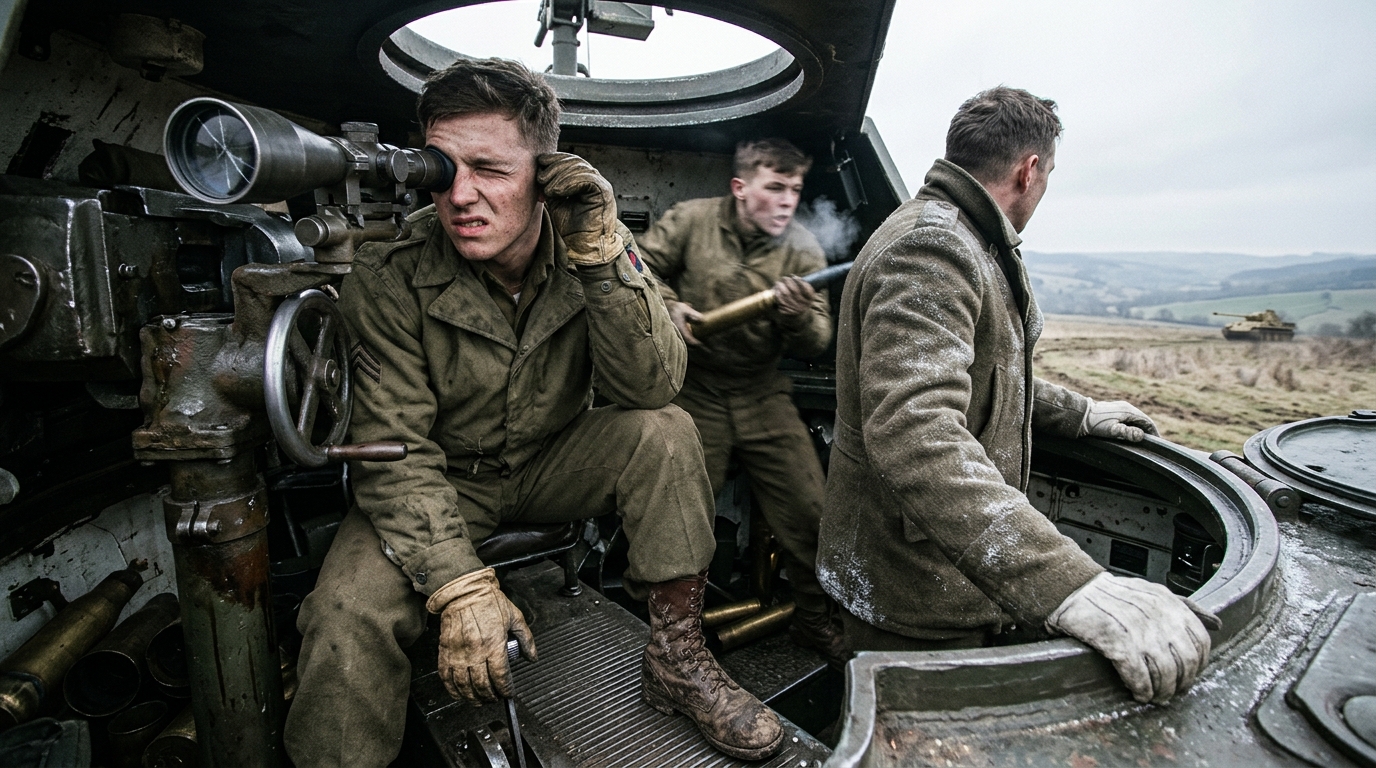
I pressed my face against the rubber eyepiece of the M76F telescopic site, letting the cold sting my cheekbone.
The optics were clear enough, but the reticle markings stretched out to numbers that looked like map coordinates rather than shooting ranges.
Four thousand six hundred yards.
Maximum effective range, according to the book.
Outside the turret, the wind cut across the open fields, rattling the dry brush along the distant tree lines.
I didn’t have a spotter to lean on, and the radio behind my back was hissing with static instead of guidance from command.
It was just me, the cold iron of the breach, and the flat, unforgiving horizon.
CHAPTER 2: THE DISTANT SHAPE
A sharp metallic glint cut across the lower edge of the telescopic lens, warping the frozen field into a distorted arc.
I adjusted my grip on the rubber eyepiece, my thumb catching on a cold steel screw.
The hairline crack across the M76F’s optic wasn’t in the technical manual.
It sat right at the edge of the glass, bending the gray light from the fields below by a fraction of a millimeter.
If I hadn’t been staring through that sight for twenty minutes straight, I would have taken it for a scratch on the glass surface.
Down in the valley, two miles out, a dark shape broke the tree line.
It moved with a heavy, deliberate pace along the ribbon of gray highway running parallel to our ridge.
Low profile. Long barrel extending far past the front hull. Sloped interlocking armor plates.
A Panther.
My commander, Miller, hauled himself up onto the open turret rim, his wool coat stiff with frost.
He raised his binoculars, squinting through the biting wind.
“Range?” he asked, his voice flat, stripped of any real hope.
“Over two miles,” I said, my hand resting on the icy traverse wheel. “Maybe two and a half.”
“Nobody shoots at two miles, Al.”
“Nobody has a ninety-millimeter gun before, either.”
He didn’t answer.
Without radio support to call in artillery, we were an island on this ridge.
If we let that tank roll past, it would be behind our infantry lines before noon.
The Panther wasn’t taking evasive maneuvers.
It didn’t zig-zag or hug the ditch.
Its crew believed what every German tank crew in the Rhineland believed: at this distance, American guns were harmless toys.
I clicked the brass stopwatch in my pocket, the cold metal clacking against my knuckles as I tracked the Panther’s tread marks across the crosshairs.
“It’s moving at eight miles an hour,” I muttered, more to the cold air than to Miller.
“You can’t make that lead,” Miller said quietly. “The ballistic drop alone is fifty feet.”
I didn’t argue.
I just turned the elevation wheel, feeling the fine grit of coal dust grinding inside the gear teeth.
CHAPTER 3: THE BALLISTIC GAMBLE
My finger stayed pressed against the brass stopwatch plunger, my eye glued to the hairline crack in the M76F optic as the Panther crossed the reticle’s second gridline.
The steel under my boots vibrated with the slow, idling thrum of the Chrysler engine down in the hull.
“It’s madness, Al,” Miller growled, his hand gripping the turret ring so tight his wool gloves stretched thin over the knuckles. “You miss, and we throw away the only element of surprise we have on this entire ridge.”
“We don’t have surprise,” I said, my teeth clenched against the cold air flooding through the open top. “We have two miles of open space and a gun nobody’s tested at this distance.”
“The radio’s dead, Rose,” he reminded me, knocking a stiff boot against the silent transmitter housing. “No spotters. No battery support. If you draw attention up here, nobody is coming to tow us out.”
I didn’t answer.
I eased the elevation crank half a notch higher, compensating for the four thousand yards of freezing air between us and that gray hull.
The loader, Miller’s kid brother, slapped the cold casing of an M82 armor-piercing round into the breach.
The heavy steel block slid home with a violent, hollow clack that echoed inside the open turret.
“AP in!” the kid yelled, his breath blooming white in the dark space.
Through the sight, the Panther looked tiny, a metal insect crawling along a dirt seam in the valley.
At four thousand yards, the shell would take over six seconds to travel from the muzzle to the earth.
Six seconds of wind, gravity, and cold air tearing at twenty-four pounds of flying solid shot.
If I led him by fifty yards, the round might land in the same county.
If I didn’t shoot, that Panther would keep rolling until it found our supply trucks near the river.
I let out a slow, ragged breath, letting the frost gather on the rubber ring of the eyepiece.
My right foot hovered over the firing pedal.
“Taking the shot,” I said.
CHAPTER 4: THE RANGING SHOTS
My right foot slammed flat against the firing pedal, ears ringing as the ninety-millimeter gun recoiled with a violent, deafening roar, filling the open turret with a thick wall of white powder smoke.
The whole thirty-ton destroyer rocked back on its suspension, tracks biting into the frozen topsoil.
Hot cordite stung my throat as I coughed, wiping soot from the M76F’s rubber eyepiece with my sleeve.
“Up!” Miller shouted, his voice muffled through the ringing in my ears as his brother slammed another round into the smoking breech block.
I pressed my face back to the glass, counting under my breath while tracking through the settling cloud.
One second. Two seconds. Three. Four. Five. Six.
Nothing.
At four thousand yards, a twenty-four-pound shell simply vanished into the vast gray space of the valley floor.
“Did you overshoot?” Miller demanded, leaning over my shoulder, his coat reeking of burnt propellant.
“Short,” I said, my knuckles white on the elevation wheel. “I set it for four thousand. The Panther’s at four thousand four hundred, minimum.”
I cranked the wheel up, feeling the gears drag against cold grease, lifting the barrel just enough to clear the distant tree line.
“Lead him sixty yards,” I muttered to myself, aligning the hairline fracture on the glass edge with the moving target’s front tread. “Account for six seconds of flight.”
“Rose—”
“Shooting!” I barked, cutting him off, and stomped the pedal a second time.
The blast shoved us back again, the muzzle brake throwing a plume of dirt and dead leaves across the front glacis plate.
I didn’t blink. I kept my left eye open, staring through the distortion of the fractured glass.
Seven seconds bled out on the internal clock in my head.
Then, right beside the highway, a sudden plume of gray dust erupted into the freezing air—maybe twenty yards short of the German tank’s left flank.
Miller let out a sharp, ragged breath. “You walked it right to his doorstep.”
“Not close enough,” I said, my hand moving to the fine-adjustment control. “He didn’t even feel the vibration.”
The Panther kept rolling, smooth and undisturbed, its crew oblivious to the iron falling from two miles away.
I adjusted the reticle to the absolute final notch—four thousand six hundred yards.
CHAPTER 5: THE TERMINAL IMPACT
Hand locked on the fine-adjustment elevation wheel, the reticle rested dead-center on the Panther’s side armor as the target moved into the final intercept mark.
My thumb pressed down on the brass stopwatch, clicking the mechanism into place.
Seven seconds. That was the time it would take for ninety millimeters of solid steel to cross two and a half miles of frozen air.
I stomped the firing pedal.
The recoil slammed through my boots, shaking the turret floor so hard a loose wrench clattered against the hull plates.
A thick plume of burnt propellant blew back into our faces, bitter and sulfurous.
I didn’t back away from the rubber eyepiece. I stared through the hairline fracture in the optic, watching the tiny gray square of the Panther move past a line of bare trees.
One. Two. Three. Four.
Down in the dark hull, the loader was already shoving another casing into the breach, his boots slipping on the spent brass rolling across the floor.
Five. Six.
A flash of sharp white fire erupted against the Panther’s left flank, right behind the drive sprocket.
A split second later, a dark orange fireball erupted upward, lifting the turret off its ring before a dense column of black smoke billowed toward the gray clouds.
Miller let out a rough, ragged whistle, his hands shaking as he gripped the rim. “Direct hit! You got ‘im, Al! You actually hit the bastard!”
“Keep loading,” I said, my voice dead flat, my hand already moving to the elevation crank. “Standard doctrine. A stopped tank isn’t a dead tank.”
“He’s brewing up, Rose! Look at that flame!”
“Load AP,” I repeated, staring through the optic as thick black oil smoke began to obscure the distant highway.
The loader slammed another round home with a wet metallic thud. “Up!”
I didn’t wait for the smoke to clear. I lined up the crosshairs directly on the center of that rising black pillar and pressed the pedal again.
The gun roared, throwing another shell straight into the burning carcass two and a half miles away, ensuring the fire reached every compartment inside.
CHAPTER 6: THE DUSTY GRAY SILENCE
Standing inside the smoking turret, my hands rested on the icy traverse wheel while I stared down at the thick black smoke column rising over the distant valley road.
The black pillar twisted against the pale gray sky, heavy with the smell of burning diesel fuel that the wind carried across two and a half miles of frozen pasture.
Down below, the German armor that had dominated every road in the Rhineland was nothing more than a ruined heap of iron, trapped on an exposed stretch of highway.
Miller leaned against the edge of the open turret, his wool gloves covered in black grease, his gaze fixed on the horizon.
“They’re not going to believe the after-action report,” he said, his voice quiet, almost lost in the steady thrum of the idling motor below our feet. “No command post in Europe is going to sign off on a hit at four thousand six hundred yards.”
“They don’t have to sign off,” I said, pulling my hands away from the wheel and feeling the stinging cold return to my fingers. “The burning steel sits right on the highway coordinates for anyone with a pair of field glasses to see.”
The loader sat down hard on an empty ammo crate inside the hull, letting out a long, ragged breath as he wiped sweat and soot from his eyes.
We didn’t have radio support to report the kill, and no high-ranking officers were standing up here on this ridge to offer handshakes or promises of medals.
We had the M36, a hairline fracture along the optic glass, three spent brass casings rolling across the steel floor, and the cold reality that the war wouldn’t end on this single hill.
I reached into my field jacket pocket, slipping the brass stopwatch back inside, its cold casing resting flat against my chest.
I took a rag from the tool box, stepped up to the optical assembly, and began wiping the thin film of gunpowder grime off the outer glass, preparing the sight for whatever waited past the next tree line.