Echoes in the Steel: A Veteran’s Quiet Crusade to Honor the Fallen and Their Machinery
CHAPTER 1: THE FOUR-YEAR WATCH
William Eugene Cross sat at his kitchen table in Dumfries, the air in the small apartment still and expectant. Before him lay the local paper, folded sharply to a column that felt like a death warrant. Final determination. The bureaucratic ink was dry, cold, and utterly final. To the museum, it meant the end of a project. To Cross, it meant the end of the only thing left of them.
He didn’t move for four minutes. His hands, mapped with the faint, jagged geography of a life spent in close proximity to heavy steel, lay flat against the table’s grain. He could feel the pulse in his palms, a steady rhythm that had kept him upright through thirty-six years of being the last one.
He stood and walked to the doorway of the bedroom. The glasses sat on the shelf, catching the filtered afternoon light—Dorothy’s glasses. They were a fragile, crystalline anchor in a world that insisted on moving forward without him. He looked at them, not with the sharp pang of initial loss, but with the hollow familiarity of long-term absence. She had asked him once why he didn’t just go inside. He had told her about the plan. She had called it kind.
The canvas messenger bag waited by the door, its strap worn smooth by decades of service. He reached for it, testing the weight. The rubber bands holding his notebook were taut, resilient despite their age. This wasn’t nostalgia; it was maintenance. He read the field bulletins like an engineer reading a structural defect. He looked for the gaps. He had spent four years in the parking lot, walking the same eleven-minute loop, listening to the silence emanating from the restoration bay’s ventilation.
He checked his reflection in the hallway mirror. The jacket was field-issue, faded to the color of dry brush. He wasn’t going in to reclaim a ghost. He was going in to fix a machine that was being starved of the truth.
He picked up the bag. The weight of it against his shoulder was a comfort, a counterbalance to the silence of the apartment. He stepped out, closing the door on the quiet, his mind already calculating the distance, the gear ratios, and the exact moment he would finally step over the threshold they had been guarding for so long. He was four years late, and yet, the ticking in his chest told him he was exactly on time.
CHAPTER 2: THE THRESHOLD OF STERILE LIGHT
The commute to the museum grounds was an eleven-minute walk Cross had performed for four years, but today, the rhythm of his own stride felt different. It was less a walk and more a calculated approach. He stepped through the main entrance, his canvas bag pulling slightly at his shoulder—a familiar, grounding weight. He bypassed the public areas, the signs pointing toward the gift shop and the interactive displays, his eyes fixed on the distant, heavy doors that housed the restoration bay.
The moment he stepped into the bay, the air changed. It was not the air of a place where machines were kept, but the air of a laboratory—conditioned, filtered, and devoid of the chaotic, organic scents of grease, burnt fuel, and the humid, rot-sweet smell of the central highlands. It was a sterile, blue-tinted chill that settled in his lungs. This was the first hurdle: the realization that the people currently responsible for the M60A1 were treating the tank as a medical patient rather than a living machine.
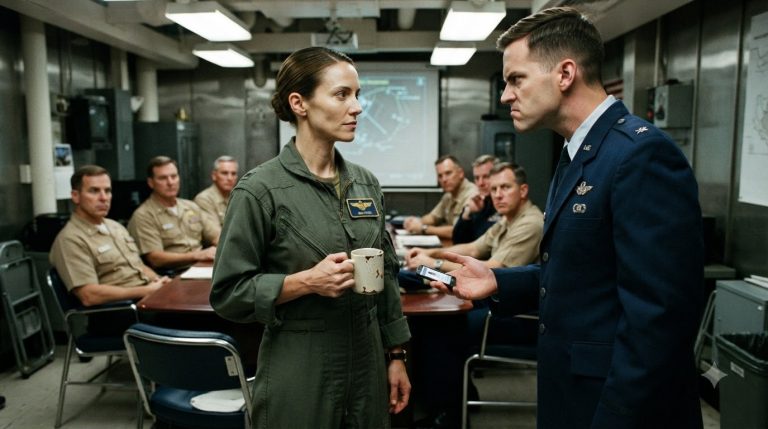
Dr. Whitmore stood at his diagnostic station, his back to the door. The setup was impressive: twelve high-fidelity data cables snaked from the tank’s open hatches like umbilical cords, feeding into a workstation that glowed with the soft, pulsating green of a healthy system. Cross stopped ten paces back. He observed the mechanics—Staff Sergeant Mitchell and others—moving with a careful, almost surgical delicacy. They weren’t wrenching; they were probing.
He watched the way Mitchell’s fingers hovered over a terminal, eyes searching for a fault that the software insisted wasn’t there. It was a performance of precision, but to Cross, it was the sound of a man trying to read a map while standing in the wrong country. The discrepancy between the bay’s artificial smell and the ghost-scent of a monsoon rain rising from a hot engine block made the back of his neck prickle. He felt a phantom heat, the memory of damp cloth and the metallic tang of an auxiliary fuel intake being adjusted in the dark.
Cross moved closer. His boots, sensible and worn, made no sound on the polished concrete floor. He didn’t clear his throat. He didn’t announce his presence with the hollow authority of a civilian visitor. He simply reached the periphery of the workspace and stopped.
Whitmore was midway through a sentence to Colonel Hicks. “The AVDS-1790 compression is within spec. Fuel delivery, electrical, the entire ignition sequence—it all returns a green light. There is no mechanical reason for the engine to remain static.”
Cross watched the screen. The flickering readouts were beautiful, elegant, and entirely useless. He felt a tug of frustration, not toward the men—they were doing exactly what they had been trained to do—but toward the methodology that had blinded them. He reached out with his right hand, not touching the tank yet, but hovering just inches from the hull above the driver’s hatch. The coldness of the steel was jarring. It should have been humming; it should have been vibrating with the latent potential of seven hundred and fifty horses, but instead, it felt dead, a tomb of inert, perfectly ordered components.
He realized then that they were looking at the tank through a layer of glass. They were scientists analyzing a relic, while he was a man staring at a comrade who had simply lost her voice. He saw the way Mitchell’s hand rested on the armor—a gesture of genuine, quiet desperation. The staff sergeant wanted to move, to strip the engine down to its base, but the diagnostic rig held him in check.
Cross knew the truth of it: you couldn’t troubleshoot a heart that had been broken by neglect. He could see the micro-fractures in the bay’s logic. If he spoke now, he would be dismissed as an old man chasing nostalgia. He had to wait for the exact, narrow window where their frustration surpassed their faith in the machine’s readout.
He leaned back, his hand retreating to his side. The canvas bag felt heavy, the notebook inside pressed against his hip, a physical weight of schematics that belonged to a different world. He looked at Colonel Hicks, observing the way she studied the screen, her brow furrowed with the weight of an institutional decision she didn’t want to make. They were close to the edge. They were waiting for a reason to stop, and Cross knew exactly what that reason looked like.
He remained in the periphery, his posture perfectly still, a silent, weathered fixture in a room of high-tech diagnostics. He was the variable they hadn’t counted on, the ghost in their perfectly clean system. He breathed in the filtered air, waiting for the precise moment the machines would finally fail them, and his own, imperfect, field-tested reality could begin.
CHAPTER 3: THE HEART OF THE MACHINE
The silence in the restoration bay was not empty; it was pressurized. Cross felt it against his skin, the collective focus of the room tightening around him as he stepped forward to the M60A1. He didn’t look at Dr. Whitmore or Colonel Hicks. He didn’t need their permission. He only needed the metal. He placed his right hand on the hull above the driver’s hatch, and for a heartbeat, he simply listened.
The tank felt dormant, not dead. It was a subtle distinction, one that the diagnostic rig could never interpret. To the machine’s sensors, it was a collection of static, inert parts. To Cross, it was a slumbering entity waiting for a specific, familiar instruction.
“The restoration bay isn’t part of the museum tour,” Whitmore said. His voice was a flat, clinical interruption that seemed to bounce off the high ceilings, failing to penetrate the bubble of history Cross had wrapped around himself. “I’m happy to have someone walk you over to the public entrance.”
Cross didn’t respond. He didn’t turn. His fingers moved with a phantom memory, sliding left until they caught the familiar, raised ridge of the serial number plate. He didn’t need to look. He felt the cold indentation of the numbers—1969, Lemur, Ohio—and the tactile history of it surged up his arm. It was the same geometry he had touched in the humid, rain-slicked hell of the central highlands.
“She’s not dead,” Cross murmured, the words barely audible, meant more for the steel beneath his palm than the people standing behind him. “She’s just missing something.”
He began to climb. His movements were the deliberate, efficient motions of a younger man, his muscle memory compensating for the slight stiffness in his left knee. He grabbed the side rail, hoisted himself up, and reached the commander’s hatch. The metal was cold—a sharp, stinging contrast to the warmth of his own skin. He swung himself inside.
The world vanished. The high-ceilinged, sterile bay was replaced by the cramped, claustrophobic reality of the interior. The air inside the turret was still, smelling of long-settled dust and the faint, ghostly remnants of oil. It was a space designed for combat, for survival, and for a kind of brutal intimacy that the modern world had forgotten how to measure. He maneuvered into the seat, his body fitting into the space as if he had only just stepped out for a moment of air.
He began the count. It was a rhythmic, precise tapping of his fingertips against the internal components, a diagnostic of his own, based on vibration and resonance. He was searching for the physical discrepancy—the missing link in the chain of function. He moved toward the auxiliary intake housing, his fingers tracing the interior contours. There, in the darkness, he felt it—a vacancy where there should have been a specific, weighted resistance.
He pulled the small canvas bag from his side, the fabric rasping softly in the narrow confines of the turret. He reached in and produced the valve. It was small, no larger than his thumb, oxidized to a deep, earthy green. It was a piece of junk to any modern eye, a failure of metallurgy, but to Cross, it was the key. He held it in his palm, feeling the weight of it, the cold, corroded reality of a solution forged under fire fifty-five years ago.
He didn’t rush. He carefully slotted the valve into the housing, his movements slow and reverent. The fit was perfect. There was a faint, metallic click—a sound that echoed like a thunderclap in the tiny, enclosed space of the turret. It was the sound of a closed circuit finally reconnecting, a bridge between two eras.
He paused, holding his breath. The silence of the turret felt different now; it was waiting. He had done his part. He had restored the missing piece, the artifact of a time when the manuals were wrong and the mechanics were the only ones keeping the world from grinding to a halt. He felt the weight of the years pressing down on the tank’s hull, the four years of watching, of waiting, of feeling the institutional rot of a forgotten legacy.
He scrambled back up toward the hatch, his movements fluid, the urgency rising in his chest. He pushed the commander’s hatch open and emerged back into the sterile light of the bay. He stood on the turret, looking down at the small group gathered below. Mitchell was staring at him, his face a mask of restrained tension. Whitmore looked bewildered, his diagnostic screen now just a collection of useless pixels.
Cross climbed down, his feet hitting the concrete with a soft, decisive thud. He held the remaining parts of his kit in one hand, the canvas bag hanging off his shoulder, its weightless state a strange, liberating sensation. He looked at Mitchell, his eyes steady.
“It’s not in your rig, son,” Cross said, his voice quiet, carrying across the stillness of the bay. “Your equipment only knows how to test what’s there. It can’t account for what’s gone.”
He stepped back, giving the mechanics space. He had done his part of the work. Now, the burden of the engine rested on them. He stood to the side, his hands clasped behind his back, feeling the hum of anticipation beginning to tremble through the very floor beneath his boots. The tank was no longer just an object; it was a ghost starting to breathe again.
CHAPTER 4: THE ENGINES WAKE
The roar was not a sound; it was an impact. The Continental AVDS-1790 V12 diesel engine caught with a violent shudder that traveled up through the treads, into the concrete, and directly into the marrow of everyone standing on the bay floor. It was a rhythmic, guttural thrum—the sound of seventy-five years of design and fifty-five years of survival finally aligning. The air in the maintenance bay, previously thin and sterile, suddenly thickened with the heavy, masculine scent of diesel exhaust and hot oil.
Cross didn’t move. His right hand remained on the hull, fingers splayed over the driver’s hatch. He closed his eyes, not to shut out the world, but to anchor himself within it. Through the vibration in the metal, he could feel the engine’s health—the cadence of the pistons, the steady, rhythmic heartbeat of the fuel pump he had just rehabilitated. He wasn’t just hearing a machine; he was reading a pulse.
Around him, the atmosphere had shifted. The sterile, scientific tension that had governed the room for four days dissolved, replaced by a sudden, heavy reverence. Staff Sergeant Mitchell clambered out of the driver’s compartment, his face smeared with a streak of grease, a look of pure, unadulterated shock etched into his expression. He looked at his phone, then at the engine, then finally at Cross. He didn’t speak. In the face of the roar, words were redundant.
Dr. Whitmore had retreated a few paces, his laptop forgotten on the diagnostic rig. He wasn’t looking at the data anymore. He was looking at the tank. For a man whose entire career had been built on the premise that diagnostic data was the absolute ceiling of truth, the reality of the idling M60A1 was an existential correction. He looked at the valve that had been removed—a small, oxidized piece of metal that had defied his entire digital infrastructure—and then back at Cross. The failure of his methodology was no longer a theory; it was a physical fact, vibrating the very floorboards beneath his feet.
Colonel Hicks stepped into the space beside Cross. She didn’t look like a commander dealing with a logistical problem anymore. She looked like someone witnessing a resurrection. She waited until the initial shockwave of the engine’s ignition settled into a steady, throbbing idle before she spoke.
“Who are you, Master Guns?” she asked. The title slipped out, not as a rank, but as an acknowledgment of the authority Cross held over the machine.
Cross opened his eyes. He reached into his canvas bag—the bag that felt impossibly light now, its secret finally surrendered—and produced a laminated ID card from 1972. It was a relic, the edges frayed, the photograph showing a man with the same unwavering, steady eyes he had now.
“Master Gunnery Sergeant William E. Cross,” he said. The declaration wasn’t a boast; it was a record. “First Tank Battalion, FMF.”
Hicks took the card with both hands. As she read it, the history of the tank seemed to coalesce in the room. Cross began to recount the names—Davis Aken, Roy Tamura, Leon Washington—their names weaving into the mechanical rhythm of the engine. He didn’t rush. He read them as if he were placing them on a roll call, a final accounting for the men who had served in the dirt and the rain when the official manuals were written in a Michigan office thousands of miles away.
The catharsis was not sudden. It was a gradual unpacking of history. The history division representatives arrived, their questions hesitant, then increasingly focused, as they began to document the reality that had been hiding in plain sight. They didn’t just document the valve; they documented the men.
As the day deepened, the initial intensity of the repair began to cool into a profound, atmospheric peace. The bay, once a place of frustration and technical failure, felt like a sanctuary. Mitchell sat on an ammunition crate beside Cross, the two of them watching the engine’s rhythmic, steady pulse.
“The manual doesn’t have the answer for everything, son,” Cross said, his voice quiet against the diesel thrum. “You learn to find the men who were there. And if they aren’t there, you learn to find their notes. Or you leave your own.”
Cross stood to leave, his legs stiff. The long hours of waiting and the short, intense burst of the repair had left him physically drained, but there was a lightness in his chest that hadn’t been there since 2018. He picked up his empty canvas bag. The symbolic closure was complete. He looked at the M60A1 one last time. It was idling perfectly—a tool, yes, but also a monument, a record of human ingenuity in the face of impossible conditions.
He walked toward the exit, the sound of the engine fading slightly behind him, turning into a steady, reassuring backdrop. The repair was finished. The names were accounted for. The institutional erasure had been halted. He reached the bay doorway and paused, looking back. The tank was alive, and for the first time in his life, he didn’t need to be the one watching over it.
He stepped out into the evening, the air cool and clean, and started the long walk toward his apartment in Dumfries. He didn’t look back again. The work was done. The truth had been spoken, and for the first time in fifty-five years, he was carrying nothing but the weight of his own footsteps. He breathed deeply, the silence of the evening air finally matching the quiet, settled rhythm of his own heartbeat.