The Geometry of Silence: A Master Mechanic Finds Respite in the Echoes of Forgotten Wings
CHAPTER 1: THE FREQUENCY OF GHOSTS
The air inside the hangar smelled of dead years. It was a cocktail of warmed aluminum, dry dust, and the sharp, chemical bite of Cosmoline—a scent that Harland Doss hadn’t needed to name in decades because it was woven into the very pores of his skin.
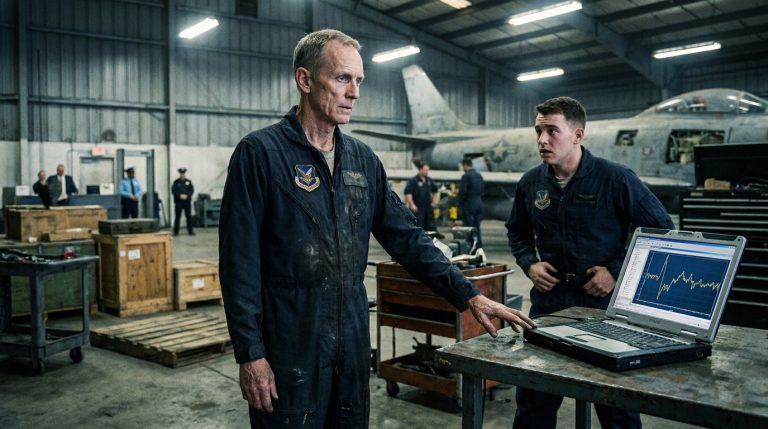
He stood near the rear observation area, his right hand resting on the frame of the doorway. The fourth finger curled inward, the knuckle a stubborn, non-negotiable angle that spoke of a propeller blade’s indifference to human flesh. He didn’t look at the engine. Not yet. He looked at the windsock outside, then the ramp, letting the vast, flat Kansas horizon settle his own internal calibration.
At the far end of the hangar, the young man, Tanner, was posturing for his camera. He was good, yes, but he was performing. Every movement was tailored for the lens—the way he held the torque wrench, the precise, practiced nod of someone who knew the value of a digital “like.”
Harland heard the hum before he looked at the machine. It was a fluorescent tube above the work bench, flickering at a frequency that sat just under the skin of the skull. It was off. Not by much—maybe a cycle or two—but to ears that had spent twenty-two years on flight lines, it was the sound of a structure under stress.
He moved into the room, his boots making no unnecessary sound on the concrete. He wasn’t there to critique; he was there to observe the architecture of the repair.
“Sir,” Tanner didn’t look up from his borescope, his voice echoing with the casual dismissal of someone who owned the room. “The observation areas are through that door. This is a restricted workspace.”
Harland stopped. He looked at the engine—a Pratt & Whitney R-2800. It sat on its stand like a dormant beast, eighteen cylinders of cold iron and potential. He knew this engine. He knew its temperament, its hunger, and the exact way it sighed when it was finally fed oil and spark.
“It’s not a display,” Harland said. His voice was gravelly, the sound of a man who had spent more time listening to engines than human beings. “And that push-rod tube you’re installing? It’s not seated.”
Tanner finally looked up, his brow furrowed, ready to defend his metrics, his channel, his reputation. But he stopped. He looked at Harland’s hands—the grey undertone of old hydraulic fluid, the scarred knuckles—and the words died in his throat.
Harland reached into his canvas roll, his movements slow and economical. He drew out a small flashlight, clicked it on, and aimed it not at the cylinder bank, but at the light fixture above, then back to the engine.
“You’re fighting the rhythm,” Harland said, turning back toward the exit, knowing he hadn’t yet begun to touch the real problem, but feeling the room shift—just two degrees—as the silence became a vacuum that demanded to be filled.
He hadn’t even reached the door when he heard the faint, metallic click of someone leaning on the bench, and the realization hit him: he wasn’t going to be leaving after all.
CHAPTER 2: THE AMBER LEAK
The air in the hangar felt heavier now, as if the oxygen itself had been replaced by a low-grade tension. Harland stood perfectly still, his right hand still resting on the workbench, the fourth finger curled into its familiar, stubborn arch. He watched the light catch the amber residue on his fingernail. It wasn’t just a stain; it was a map. It told the story of an induction system that had been gasping for a breath it couldn’t fully draw for hundreds of hours.
Tanner Briggs had not moved. He was still standing by the magneto crate, his Bluetooth torque wrench hanging from his hand like a dead weight. The GoPro on the corner of his cart was still blinking, but the narrative rhythm of the room had broken. The young man’s face, usually composed in the practiced mask of a modern expert, showed the raw, unrefined fracture of someone realizing their digital tools had missed the mechanical reality right in front of them.
Rudy Speer was the first to break the stillness. He moved with the slow, deliberate pace of a man who didn’t want to disturb the dust motes. He leaned in, his eyes focusing on the cylinder flange Harland had exposed. He didn’t touch it. He just looked, his head tilted at that specific angle common to mechanics who had spent their lives listening to the secret language of reciprocating steel.
“You’re saying that’s the lean,” Rudy whispered. It wasn’t a question. It was a recognition.
Harland didn’t look at him. He kept his gaze on the gasket. “At cruise manifold pressure, the vibration opens that arc. It leans the mixture. You wouldn’t see it on the ground, and you wouldn’t see it in a standard compression check. The engine only tells you when it’s under load.”
He picked up a clean, lint-free shop rag, folded it into a square, and wiped his thumb. The motion was clinical. There was no triumph in his voice, no desire to prove a point. He simply stated a mechanical fact, a piece of physics that had been waiting for someone to observe it.
Across the room, the floor fan Brady had brought in clicked, its oscillating head reaching the end of its track. It shuddered, then pivoted, the change in airflow pushing the scent of warm solvent and old iron directly across the bench. It was a small thing, a minor adjustment in the room’s atmosphere, but it acted as a catalyst. The routine, the measured cadence of their day, had been forcibly detoured by the simple, stubborn reality of a failed part.
Tanner finally moved. He walked toward the bench, his stride less confident than it had been ten minutes prior. He stopped a respectful three feet away. “I’ve gone over that bank with the borescope four times today,” he said, his voice stripped of the narrator’s cadence. “I checked the thermal mapping. Nothing showed.”
“Borescopes look for what they expect to see,” Harland said, finally lifting his eyes to meet Tanner’s. “The engine doesn’t care what you’re expecting. It only cares what’s happening.”
Tanner looked down at the gasket on the workbench. It was small, nondescript, and completely shattered along the inner edge. It looked like nothing—just a piece of aged material—yet it had been the ghost in their machine. He reached out, his hand hovering over the bench, before pulling it back, as if the object itself were too hot to handle.
Lorraine Albright, still standing near the south door, took a step forward. She looked at the restoration log, then back at the engine. The dynamic in the room had shifted from a performance to an autopsy. They weren’t building a video; they were solving a problem, and for the first time, Harland wasn’t an intruder. He was the center of gravity.
“Brady,” Tanner said, his voice tight. “Kill the fans. I want to clear the floor.”
The volunteer moved with a sudden, sharpened sense of purpose. He unplugged the fan, the sudden absence of its low-frequency hum leaving a ringing silence in its wake. The hangar became suddenly, intensely quiet, save for the ticking of the cooling metal stands.
Harland felt the familiar ache in his fourth finger. He didn’t acknowledge it. He simply turned back to the R-2800. He needed to ensure the manifold surface was clean, to make sure no debris had migrated during the extraction. He began the work, his hands moving with the economy of a man who had done this a thousand times. He didn’t ask for tools; Rudy handed him a scraper without being asked. He didn’t ask for a light; Brady held the lamp at the perfect angle.
They were working in a harmony they hadn’t possessed an hour ago. It wasn’t affection; it was a common objective that had surfaced, stripping away the roles of “YouTuber,” “volunteer,” and “stranger.” They were just mechanics, and the engine was a problem that had finally been articulated.
Harland could feel the weight of the moment. It reminded him of long-ago afternoons in Georgia, or the humid, suffocating heat of a tarmac in Bien Hoa. The work was always the same. The engine was always the master. The men were merely the hands.
He worked in silence, cleaning the mating surface until it shone under the fluorescent lights. His focus was total. Every wipe was calculated, every movement serving the singular goal of restoration. He was so deeply inside the task that he almost missed the way the room had gone quiet again. Not the quiet of a room without work, but the quiet of a room anticipating a return.
He glanced up. Rudy was watching him, not with the curiosity of a stranger, but with the steady, grounded appraisal of a peer.
“You’ve been doing this a long time,” Rudy said. It was a statement, but it held the weight of an invitation.
Harland didn’t answer immediately. He smoothed a layer of sealant onto the new gasket with his finger, the texture familiar and cool. “Long enough to know that a machine doesn’t lie,” he said softly. “It just waits for you to be quiet enough to hear it.”
He placed the new gasket into position, aligning the bolt holes with a precision that was absolute. He felt the cold iron of the engine under his palms. It was a sturdy, reliable, and fundamentally honest presence. But as he began to tighten the manifold clamps, his mind drifted—just for a heartbeat—back to a memory he had spent fifty-five years trying to stow away. The name Emmett Dewhurst rippled through his consciousness, not as a thought, but as a physical sensation in his throat, a tightness that no amount of grease or solvent could ever wash clean.
He finished the final clamp, the torque wrench clicking exactly to spec. He stepped back, the work done, the decoy mystery resolved. But the room felt different now. The tension hadn’t vanished; it had transformed into something more profound. He could feel the eyes of the others on him, waiting for something more than a mechanical repair. They were waiting for him to tell them who he was, and in that moment, Harland realized the repair of the engine was only the preamble to the unraveling of the man.
CHAPTER 3: THE UNEXPECTED VISITOR
Harland did not turn around immediately. He felt the shift in the room’s air before he heard the sound—the distinct, uneven clack-drag, clack-drag of a cane’s rubber tip against the hangar floor. It was a rhythm he recognized from a decade ago, or perhaps half a century, a sound that bypassed his conscious mind and vibrated directly in the marrow of his bones.
Tanner, Rudy, and Brady stood frozen, their attention pinned to the south door, which had swung wide to admit the late-afternoon light and a figure that seemed to carry the weight of an entire era. Colonel Warren Buck Craven entered. He was eighty-three, leaning into his cane, his eyes scanning the hangar not with the frantic energy of a content creator, but with the slow, terrifying precision of a man who had spent his life evaluating potential.
Harland wiped his hands on the rag one last time, though they were already clean, and let his shoulders settle into the familiar, protective slump of a man facing an inspection he hadn’t asked for. He didn’t need to see the face to know it was Craven. He felt it in the sudden, sharp contraction of his throat.
“Master Sergeant,” Craven said. The voice was thin but carried with it the absolute authority of a rank that had never truly been shed.
Harland turned. He saw the way the hangar’s light caught the edges of the Colonel’s weathered face, highlighting the map of geography and history etched into his skin. He saw the cane, its rubber tip worn unevenly on the left side, mirroring the way Harland’s own hand had bent to compensate for the years.
Craven didn’t move toward him. He looked at the engine—the now-corrected R-2800—then at the workbench, and finally at the open canvas tool roll. He reached into his coat and produced a manila folder, its edges softened by time and frequent handling. He set it down on the wood, the sound of paper hitting the bench louder than the ambient silence of the room.
“Thirty-six years,” Craven said, his gaze drifting to Rudy and then to Tanner, who looked as if he had been caught playing with a toy he didn’t understand. “And yet, here we are.”
Tanner took a hesitant step forward. “Colonel? I—we were just—”
“You were making a video,” Craven interrupted, his tone devoid of malice but sharp enough to cut. “And you were doing it incorrectly. You were fighting the machine instead of listening to it.” He shifted his gaze back to Harland. “This man wrote the depot overhaul procedure for this engine series. Every word in the manual your team has been butchering for two days is his language. Word for word.”
The hangar was so still that Harland could hear the slow, rhythmic hum of the distant windsock fluttering in the Kansas breeze. He looked at the folder, then at Craven. He saw the unspoken question in the older man’s eyes—the forty years of wondering who had saved his brother-in-law, Emmett Dewhurst, on that morning in 1968.
“I’m just here to look at a Corsair, Colonel,” Harland said. His voice was quiet, steady, yet it sounded like a confession to his own ears.
“You’re here because the work remains,” Craven countered, finally moving closer, his cane clicking against the concrete with a sound like a metronome. He looked at Harland’s fourth finger, noticing the way it bent, the way the joint told the truth even when the man wouldn’t. “Emmett landed at Bien Hoa with a magneto failure that no one else could isolate. He told me the story a hundred times. He said a man in the hangar didn’t say a word, just fixed it and signed the log as if he were just tightening a loose nut.”
Harland looked away, his eyes finding the pegboard above the bench. The photograph—eight men in flight suits in front of an A-1—seemed to be staring at him, judging the distance between the man he was then and the man he was now. He felt the weight of that day in 1968 again: the heat, the smell of burnt hydraulic fluid, the absolute terror of realizing he had sent a man into the sky with a repair he had made in the dark, based solely on the feel of the metal under his thumb.
“I signed the log,” Harland murmured. “I didn’t think it was worth a mention.”
“It saved his life,” Craven said. “That’s worth more than a mention. It’s worth the truth.”
Tanner walked over, his face pale. He looked at the folder, the technical order cover page from 1978, and the engine itself, suddenly seeing it not as a project, but as a bridge to a history he had been trying to commercialize. The reality of Harland’s expertise, combined with the quiet gravity of the Colonel’s presence, forced a change in the room’s atmosphere. It was no longer a workshop; it was a memorial.
“I was wrong,” Tanner said to the room, his voice barely audible. He looked at Harland, then at the engine. “About cylinder 14. About the process. Everything.”
Harland didn’t offer a platitude. He didn’t tell him it was okay. He simply nodded, because acknowledgment was the only currency that mattered. He watched as the others slowly retreated, giving them space, their voices dropping to hushed, respectful tones as they moved to the edges of the room.
Harland placed his hands on the workbench, feeling the grain of the wood. The folder sat between them, a container of secrets he had spent a lifetime burying. He knew the Colonel wasn’t going to demand a formal statement, but the act of being found was, in itself, a form of resolution.
He took a slow breath, the air smelling of paper, old dust, and the lingering, sharp scent of his own history. He didn’t look at the engine. He looked at the space in front of him, the space where the work was finished but the story was still waiting to be reckoned with.
CHAPTER 4: THE WEIGHT OF THE UNWRITTEN
The drive back to Abilene had been a four-hour meditation on friction. Harland had watched the landscape flatten into the familiar, desaturated browns of home, the CB radio on channel 19 silent, save for the occasional static burst that sounded like distant gunfire. He didn’t turn it off. The static was a companion he understood—a sound of something trying to communicate through interference, a fitting soundtrack for the state of his own mind.
When he pulled the 2003 Ford F-250 into the driveway, the house sat low against the evening sky, its silhouette etched in sharp, unforgiving lines. He sat in the cab for a long moment, hands gripping the wheel. His fourth finger throbbed—a phantom sensation triggered, perhaps, by the phantom of his past he’d encountered in that hangar. He didn’t want to go inside. The house was a vessel for a life that had ended nineteen months ago, and he had become nothing more than its caretaker.
He stepped out, the gravel crunching under his boots with a sound that felt too loud in the stillness of the yard. Inside, the kitchen was exactly as he had left it that morning. The coffee mug sat on the counter, a faint ring of residue at the bottom. The curtains, chosen by Vera in 1991, were pulled just enough to let the twilight bleed onto the linoleum.
He moved to the counter and picked up the yellow legal pad. It was sitting between the coffee canister and an empty fruit bowl, looking as fragile as an artifact from an excavation. He hadn’t looked at the last line in nineteen months. He knew what it said: coffee filters. A mundane, practical, and devastatingly human reminder of a routine that had been interrupted by the end of everything.
He sat down at the small table, the chair’s wood groaning under his weight. He didn’t reach for a pen. He just sat, his hands flat on the table, the fourth finger resting in its small, awkward gap. The silence of the house began to work on him. It wasn’t the functional, productive silence of the hangar; it was a hungry, demanding silence. It asked for things he couldn’t give.
A memory surfaced, unbidden and cold. It wasn’t the hangar in Bien Hoa, but a Sunday morning in 1982. Vera had been laughing at something he’d said, her hands busy with the Sunday paper. He had been holding a cup of coffee, feeling entirely, impossibly anchored. The contrast between that memory and the kitchen’s current state was a physical weight—it pressed against his chest until breathing became a conscious, manual effort.
He thought about the folder the Colonel had left behind, now resting on his workbench in the garage. It was filled with documents, a record of a hero he had helped save, a man who had gone on to live a life Harland had been instrumental in preserving. But what of the life Harland had been living in the meantime? He had spent fifty years repairing engines, ensuring they flew, ensuring they returned to earth in one piece. He had been the hands that kept the world running, while his own internal structure had been quietly oxidizing.
He stood up, his legs feeling stiff. He needed to move. He needed to be in the garage, where the metal was real and the problems were solvable. The yellow pad stayed on the counter, its last line a testament to a person who was no longer there to need coffee filters, and a man who hadn’t figured out how to stop buying them.
He walked out to the garage, the fluorescent lights humming to life as he pulled the chain. The air was cool, smelling of oil and the promise of work. On the workbench sat the quarter-scale model of the A-1 Skyraider, a project he had been cutting from aluminum for nearly a year. It was unfinished, its wings stark and skeletal under the flickering light.
He picked up a file, his grip firm, and began to smooth the edge of a wing spar. The friction of the metal—the skritch-skritch of the file—was the only sound in the world. He worked with the intensity of a man trying to file away his own edges. He was searching for the same perfection he had brought to the R-2800 engine, that singular focus that left no room for the ghosts of Emmett Dewhurst or the silence of his kitchen.
But the ghost wasn’t just in the house. It was in the aluminum. As he filed, he found himself thinking of the mechanics he had worked with at Robins—men who were dead now, men who, like him, had never asked for credit, never sought the spotlight, and had simply done the work because that was the only language they spoke. Were they all carrying the same weight? Were their own internal gaskets weeping under the pressure of decades, invisible to the world, slowly depositing the amber residue of a life lived in service to machines that would eventually be scrapped anyway?
He stopped filing. He looked at the model, his thumb tracing the curve of the wing. It was a beautiful, hollow thing. He realized then that he wasn’t just building a replica; he was building a mirror. He was trying to construct a version of the past that he could control, one where he could fix the errors and seal the leaks before they caused a catastrophe.
He looked up at the pegboard. The photograph of the eight men in 1968 seemed sharper, more present. He wasn’t looking at them as a master sergeant anymore; he was looking at them as a man who understood the cost of every hour they had spent in the air. He reached out and touched the photo, his finger hovering over the face of the man who had been the squadron lead.
The garage door rattled, the wind outside picking up, a sudden gust of Kansas air hitting the corrugated metal walls. It was a sharp, biting cold, a reminder that the world was still turning, even if his had stalled. He turned back to the model, his hands steady, the work before him a clear, finite demand. He would finish this wing. Then he would finish the fuselage. He would fix every detail until the model was perfect, until it was a machine that could fly—even if only in his own mind.
He knew he was stalling. He knew the truth about Emmett Dewhurst was just a prelude to the truth about himself, and that the only way to the end was through the very things he had spent his life avoiding. He picked up the file again, his jaw set. There was work to do.
CHAPTER 5: THE GHOST IN THE METAL
Harland didn’t pull his hand away. He remained standing at the workbench, his fingers locked onto the file and the rough-cut edge of the A-1 Skyraider’s wing. The garage hummed with the same off-frequency pitch that had plagued the Kansas hangar, a vibration that seemed to reach into the hollows of his chest.
For a heartbeat, the garage vanished. He wasn’t in Abilene. He was back in the heat of Bien Hoa, the air thick with the smell of JP-4 fuel and the wet, suffocating humidity of the Republic. He could hear the low, throaty rumble of a Double Wasp engine idling on the line, the sound vibrating through his boots. And there, standing in the shadow of the aircraft’s propeller, was Captain Emmett Dewhurst, his flight suit stained with oil, his eyes scanning the horizon for a war he wasn’t sure he could survive.
In the memory, Harland had been invisible—a ghost in a master sergeant’s uniform, carrying a toolbox that felt like it weighed a thousand pounds. He had approached the engine, his heart hammering against his ribs, and reached into the distributor housing. He remembered the feeling—that terrifying, minute difference in the metal, a four-degree differential that meant the difference between a pilot coming home or disappearing into the green canopy of the jungle.
He had signed the log. He had never told Dewhurst how close the morning had been. He had let the pilot climb back into the cockpit, believing the machine was whole, never knowing that the man who had performed the repair was still shaking from the proximity of the failure.
The memory shattered with the sudden, sharp ping of a piece of metal hitting the concrete floor. Harland gasped, his breath hitching in his throat. He was back in the garage. The fluorescent tube flickered overhead, casting long, erratic shadows across the pegboard.
He looked down. He had dropped the file. His hand was trembling—a fine, persistent tremor that he couldn’t suppress, no matter how hard he clenched his fist. The aluminum wing spar sat in the vice, jagged and incomplete.
He was sweating. He wiped his forehead with his sleeve, the fabric rough against his skin. This was the work he had been avoiding. It wasn’t the engine repair—he could do that in his sleep, with his eyes closed, guided by the infallible logic of mechanics. This was the repair of the soul, the agonizing, unspooling process of confronting the fact that his entire life had been defined by the things he hadn’t said, the truths he had buried under fifty years of hard labor.
He took a step back from the bench, his legs feeling unsteady. He needed air. He walked to the garage door and pushed it open, the night air hitting his face—cool, sharp, and indifferent. He looked out at the yard, at the dark, silent trees, and the vast, empty sky above.
He felt a sudden, visceral urge to drive to the Colonel’s, to find Craven and demand to know if the brother-in-law had ever really known, or if he had gone to his grave believing the machine had been perfect. But what would that change? The machine had been perfect enough for that morning, and for eighty-six missions after that. The silence had been a gift, a way of preserving the illusion of invulnerability that a pilot needed to keep flying.
But was it a gift? Or was it a cage?
Harland looked down at his fourth finger, the joint bent in that permanent, non-negotiable angle. He had earned that mark in 1971, a year after the war, in a moment of pure, unadulterated human fallibility—a propeller blade, a lapse in attention, the sheer, crushing reality that even the best mechanics were capable of making a mistake. He had spent the decades since trying to prove, through the sheer volume of his excellence, that such a mistake was impossible.
He realized then that the model he was building wasn’t an homage. It was a barricade. He was trying to construct a version of reality where the metal never broke, where the gaskets never wept, and where the past stayed firmly in the photograph on the wall. But the past was not in the photograph. The past was in the marrow of his bones, in the way he stood, in the way he thought, in the silence he kept.
He turned back to the garage, the interior light spilling out into the darkness of the yard, illuminating the path back to the workbench. He didn’t go back to the model immediately. He went to the pegboard. He took the photo of the eight men down.
He held it under the light, really looking at it for the first time in nineteen months. They were so young. They were all squinting into the sun, none of them knowing that the war would eventually consume them, or that the mechanics who kept their birds in the air would spend the rest of their lives trying to reconcile the work they had done with the lives they had touched.
He felt the tightness in his throat soften, just a little. He wouldn’t finish the model tonight. Maybe he wouldn’t finish it at all. He realized that the repair he needed wasn’t something he could construct from aluminum sheets. It was something he had to sit with, something he had to admit, something he had to finally let breathe.
He set the photograph face up on the workbench, right beside the half-finished wing. He left the fluorescent light on. He walked back toward the house, the night air cooling the sweat on his neck, his stride a little slower, a little less certain, but for the first time in decades, he was no longer walking away from the hangar. He was walking toward the truth of what it meant to have been the man who held the light, who felt the crack, and who kept the secret to keep the pilot whole.
CHAPTER 6: THE SILENT REPAIR
Harland watched from the kitchen window as the familiar sedan rolled to a stop. The morning light was soft, golden, and filtered through the curtains Vera had picked out so long ago. He stood at the counter, his coffee mug in one hand, the other resting flat on the yellow legal pad. He had stopped buying coffee filters, but he had started opening the curtains. It was a small change, a micro-adjustment in the mechanics of his daily life, but it felt like the most significant thing he had ever done.
Colonel Craven emerged from the car, his movements slow and deliberate, the cane finding its rhythm on the concrete walkway. When he reached the door, Harland was already there, holding it open. There was no need for grand introductions or heavy dialogue. The space between them was already filled with the history of 1968, the weight of the engines they had tended, and the quiet understanding of men who had done the work without waiting for the applause.
“Morning, Harland,” Craven said, his voice steady. He stepped inside, the house feeling less like a museum of loss and more like a place where a life was being slowly, carefully reconstructed.
“Morning, Colonel,” Harland replied. He motioned toward the kitchen table, where two mugs were already waiting.
They sat in the silence that had once defined Harland’s existence, but the quality of it had shifted. It was no longer a weight; it was a baseline, the quiet hum of a machine running exactly as it was meant to. Craven looked around the kitchen, his gaze lingering on the photographs, the curtains, and the subtle, fraying edges of a home that had weathered time.
“I found the logs,” Craven said softly, reaching into his pocket and placing a small, weathered notebook on the table. It wasn’t the folder from the hangar; it was a personal record, one he had kept for nearly six decades. He slid it across the table toward Harland. “It’s all here. Every mission, every drop, every time the engine hummed the way it was supposed to. And the day you found that distributor housing—it’s noted.”
Harland opened the notebook, his fingers tracing the entries. There, in faded ink, was the date: the summer of 1968. Beside it, a single, handwritten note: The mechanic saved him.
He looked up at Craven, the man who had been his brother-in-law’s lifeline, the man who had spent forty years looking for a ghost and found a man standing in a hangar in Kansas. Harland’s fourth finger, bent and scarred, rested on the edge of the notebook. He didn’t try to hide it. It was, as he had realized, a receipt. A testament.
“I didn’t do it for the credit,” Harland said, his voice quiet but firm. “I did it because the engine needed to be heard.”
“I know,” Craven replied. “That’s why I came. Not to thank you, Harland. But to tell you that he knew. Emmett knew. He wasn’t a fool. He knew that the engine didn’t fix itself.”
The words landed in the kitchen like the final click of a torque wrench. The secret Harland had carried for fifty-five years—the fear that he had been an impostor, a fraud who had made a lucky guess—vanished. The pilot had known. The repair hadn’t been a miracle; it had been a collaboration between two men who understood the language of metal and gravity.
Harland looked down at his hand, then back at the photograph of the A-1 Skyraider squad he had brought in from the garage. The men in the picture didn’t look like ghosts anymore. They looked like young men who had trusted the work, who had trusted the hands that tended their machines.
“I’ve been building a model,” Harland said, gesturing toward the garage. “A Skyraider. I thought… I thought if I could build it right, I could fix the things I hadn’t.”
“You’re not fixing the past, Harland,” Craven said, his gaze fixed on the window. “You’re just finally allowing it to be finished.”
Harland leaned back in his chair, the weight in his chest finally, completely, subsiding. The silence of the house didn’t demand anything of him. It was just space—the space for him to exist, to work, and to remember. He realized that the repair he had been performing wasn’t on the engine, nor the model, nor even the past. It was on himself.
He stood up and walked to the counter, taking the yellow legal pad. He picked up a pen and, with a steady hand, drew a line through the last, long-lingering item on the list. He didn’t write anything else. He just set the pen down, the house suddenly feeling open and light.
He looked at Craven, who was watching him with a calm, satisfied smile. Harland felt the pull of the garage, but not the frantic, desperate need to be there. He could go out later. For now, he was content to just sit, to drink his coffee, and to listen to the sound of the morning—the birds in the yard, the wind in the trees, and the simple, steady beat of his own heart. The work was finished. The silence was no longer a burden; it was a peace. He reached out and, for the first time in nineteen months, he didn’t worry about the gap in his hand. He just let it be. He was the man who had done the work, he was the man who had heard the engine, and finally, he was the man who was right where he belonged.