A Soldier’s Vigil: Logan Hayes and the Anatomy of a Coordinated Betrayal in the Denver Underworld
CHAPTER 1: THE COLD ARCHITECTURE OF BETRAYAL
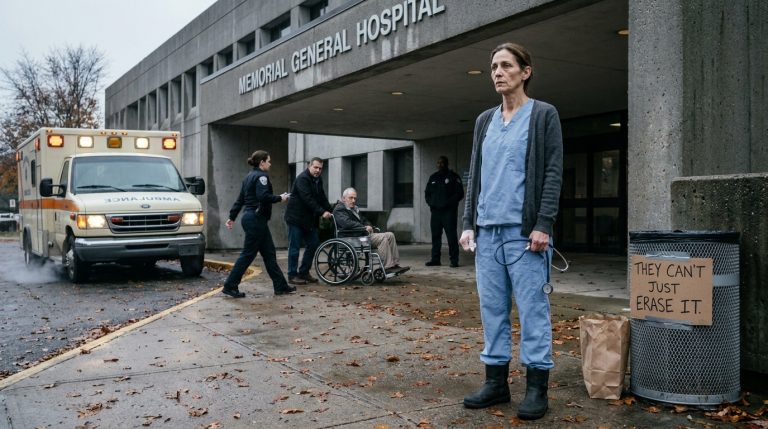
The waiting room smelled of antiseptic and stale coffee, a scent that Logan Hayes had encountered in a dozen different countries, though never in a city as quiet as Denver. He sat in a rigid plastic chair, his shoulders squared, his gaze fixed on the double doors leading to the ICU. Rex was curled against his left boot, a solid, breathing weight that anchored him to the floor. The dog’s ears were flicking rhythmically, tracking the erratic, panicked footsteps of a nurse moving toward the triage desk.
Logan’s phone buzzed in his pocket—a sharp, electric chirp that felt invasive. He didn’t reach for it. He already knew who it was. The notification would be a summary, a timeline, or perhaps an apology that wouldn’t hold a fraction of the truth. He looked down at his hands. They were steady. Too steady. He had been a Marine long enough to know that when the body stops reacting to adrenaline, it has begun the slow, methodical process of tactical calculation.
He thought back to the dessert. The soufflé. It had been perfect—light, airy, smelling of expensive chocolate. He hadn’t touched it, but Claire had. He could still see the way her expression had softened, the way she had leaned into the lie as if it were a sanctuary. She hadn’t been an amateur; she had been a technician of intimacy. She had studied him for two years, cataloging his movements, his triggers, and his weaknesses, all to ensure that when the moment came, he wouldn’t look for a weapon—he would look for a reason to trust her.
Rex let out a soft, low huff, his nose twitching against the synthetic fabric of Logan’s trousers. The dog was tracking the perimeter. He knew the air in this room had changed since they arrived. Logan reached down, his fingers sinking into the thick fur of Rex’s neck. There was a hard, distinct bump beneath the skin—a small, embedded tracking tag the vets had noticed years ago, one that Logan had insisted stay put. It was a relic of a time when everything had to be accounted for.
A silhouette appeared against the frosted glass of the doors. It wasn’t a doctor. The gait was too controlled, the pace too measured for a medical professional in a crisis. It was Detective Cole.
Logan didn’t stand, but he shifted his weight, his muscles ready to pivot. As the door swung open, the clinical light of the hallway bled into the dim waiting room, casting long, sharp shadows across the floor. Cole didn’t look like a cop; he looked like a man who spent his nights reading files that no one else was allowed to see. He held a plastic bag in his hand. Inside, encased in clear evidence film, was Claire’s phone.
“She’s stable, but the neuro-toxin is aggressive,” Cole said, his voice as dry as parchment. He didn’t offer a greeting. He walked straight to the chair beside Logan and sat, placing the bag on the space between them. “We ran a quick diagnostic on the device. It didn’t take long to break the encryption. Whoever trained her was using a high-grade military-coded messaging app.”
Logan stared at the phone. The screen flickered for a second, a ghost notification appearing on the locked display—a name, Mercer, followed by a series of coordinates.
“She was a placeholder, Hayes,” Cole whispered, his eyes scanning the room to ensure they were alone. “This isn’t just about you. Look at the coordinates.”
Logan leaned in. His heart rate didn’t elevate, but his pupils dilated, his vision narrowing into the sharp, predatory focus of a man clearing a room. The coordinates didn’t point to a hideout or a home. They pointed to the local VA regional office.
The information gap was suddenly wider than it had been at the restaurant. If she was a placeholder, who was the architect? And why was the path of this betrayal leading directly to the people who were supposed to protect him?
CHAPTER 2: THE TACTICAL PIVOT
The VA regional office coordinates burned into the screen of the phone like a thermal signature. Logan watched them for three seconds, his thumb hovering over the glass, before the light dimmed and the image locked. He didn’t blink. The silence of the hospital corridor, usually filled with the rhythmic beeping of monitors and the soft squeak of rubber soles, seemed to drop away, replaced by the internal hum of a tactical assessment.
Detective Cole didn’t look at the phone again. He kept his eyes on the ICU double doors, his expression unreadable, though the faint tension at the corner of his mouth suggested that he, too, recognized the implication.
“They don’t use the VA for this kind of work, Cole,” Logan said, his voice low, a flat line of sound that didn’t betray the spike of cold clarity in his chest. “Not unless they’ve turned the administration into a clearinghouse.”
“That’s exactly what I’m thinking,” Cole murmured. He stood up, his movements fluid. “The phone isn’t just a list of victims, Hayes. It’s a ledger. Every name I’ve scanned so far was a veteran, lone-wolf type, no immediate family, decent pension, long history of service but zero history of social integration. People who go dark when they stop answering the mail.”
Logan felt the familiar, unwelcome ghost of his own service crawl up his spine—the “Invisible Man” protocols. He remembered the briefings, the hushed conversations in command tents about soldiers who essentially ceased to exist after the paperwork cleared, effectively becoming ghosts in the machine. He had laughed them off as urban myths at the time, stories told to keep recruits focused on their exit strategies. Now, looking at the coordinates, those myths had the sharp, serrated edges of reality.
“I need access to the data on this device,” Logan stated, not asking.
Cole turned, his dark eyes locking onto Logan’s. There was no hesitation. He slid the plastic bag across the gap between the chairs. “I’m not supposed to do this. If internal affairs gets a wind of me handing evidence to a person of interest—even a victim—I’m done.”
“Then don’t record the exchange,” Logan said, pocketing the bag. His hand touched the cold plastic, a tactical weight he understood. “If the syndicate is using the VA, they have eyes in the system. They’ll know when Claire stopped checking in. You have a window of time before they purge the records. I need to move before that window slams shut.”
Cole didn’t argue. He understood the math of the situation. “I’ll give you a four-hour head start. My captain is meeting with the state oversight committee at dawn. Anything you find, you dump it to the secure server I’ve already flagged in your file.”
Logan nodded once, his movement minimal. He stood, Rex mirroring him instantly, the dog’s posture alert, his amber eyes scanning the hallway with a soldier’s focus. There was no need for a dramatic exit; Logan walked toward the elevator with the deliberate, unhurried stride of a man who had already mapped the exits and identified the obstacles.
As the elevator doors slid open, revealing the sterile, dimly lit interior, Logan’s mind shifted into the [V-2] state. The scent of the floor polish—a sharp, chemically sweet citrus—suddenly triggered a flash of a briefing room five years ago. He saw the faces of men he had served with, men who had sat in rooms just like this, talking about the “pension trap.” He hadn’t listened then. He was too busy surviving the immediate, too focused on the next deployment. He had been a predator in the field, but a mark in the bureaucracy.
The elevator descended, a quiet, mechanical descent that mirrored his own plunge into the center of the trap. Every floor felt like a layer of the onion peeling back. When they reached the lobby, the night air hit him—a sharp, biting Denver chill that acted like a physical blow. It was the smell of asphalt and wet concrete, the raw scent of the city.
He didn’t go to his car. He walked toward the parking garage, keeping to the shadows where the light was fragmented by the concrete pillars. Rex stayed perfectly at his side, his leash slack, his presence an extension of Logan’s own intent. Logan’s mind was calculating. If the syndicate was operating out of the VA, they weren’t just after money; they were after the identity of the assets themselves—their service records, their medical histories, their vulnerabilities.
He stopped near a blacked-out sedan parked in the corner of the lot. He pulled the phone from his pocket, his thumb hovering over the screen. He bypassed the security layer in seconds—the password was the same one Claire had used to access their shared calendar. It was almost arrogant.
The screen opened to a file directory. One folder stood out, labeled ‘Inventory.’ He tapped it. It didn’t contain photos or bank statements. It contained medical scans—specifically, heart rate variability reports and trauma assessments—of people he recognized from his own veteran support group.
The air in the garage suddenly felt heavy, as if the oxygen had been pulled out of the space. Logan stared at the list. These weren’t just victims. They were living, breathing data points in an experiment designed to see how quickly an ‘invisible’ soldier could be processed, liquidated, and erased from the system without triggering a single alert.
He closed the file, his grip on the phone tightening until his knuckles turned white. The betrayal wasn’t just a matter of trust; it was an structural assault. He looked at Rex, who had stopped and was staring intently at the stairwell leading to the office levels above.
“I see them, too,” Logan whispered.
The shadow in the stairwell shifted—a flicker of motion that shouldn’t have been there. It wasn’t the wind, and it wasn’t a random passerby. It was a patrol, a sweep. They were already looking for the phone, and they were already looking for him. Logan didn’t wait for the escalation. He moved into the deep, absolute black of the stairwell, his hand dropping to the small, tactical light on his belt. The transition from observer to combatant was seamless, fluid, and final. He was no longer waiting for the signals. He was going to initiate them.
CHAPTER 3: THE GHOST ASSET
The darkness of the stairwell was not absolute, but it was suffocating. Logan leaned into the corner, his back pressed against the cold, unyielding concrete of the stairwell wall. Rex was a shadow beside him, his breathing so shallow it was almost non-existent. The dog’s tail was tucked, his body rigid, ears swiveled toward the sound of approaching boots. Two men. Heavy-footed, amateurish in their rhythm, but their cadence suggested they were carrying gear—likely light-grade scanners meant to ping the tracking device Logan had suspected was active on the phone.
He moved his thumb off the screen of the stolen device, effectively cutting the signal. The silence that followed was immediate, thick, and heavy. The approaching boots slowed, then stopped.
“Signal lost at the stairwell landing,” one of the men muttered, his voice echoing off the concrete. “Keep the sweep narrow.”
Logan didn’t wait for them to enter the landing. He knew the layout of this specific garage; it was a standard-issue design that relied on blind corners. He didn’t use the tactical light, fearing it would give away his position before he could secure the advantage. Instead, he relied on his internal map of the space, moving with a fluid, predatory grace that bypassed the loose gravel on the floor.
He moved around the inner bend of the stairs, closing the distance to the first man before the guy even cleared the threshold. Logan didn’t engage in a struggle. He didn’t have the time or the inclination for a brawl. He simply moved, hand moving in a swift, controlled arc, placing a firm pressure-point strike against the man’s brachial plexus. The guard went down without a sound, a dead weight hitting the concrete.
The second man turned, his flashlight beam cutting through the gloom, but he was too late. Rex was already in motion, a low-profile surge of muscle and intent that sent the guard stumbling backward. Logan crossed the distance in two strides, his hand closing over the guard’s wrist, neutralizing the weapon—a standard-issue compact pistol—with a swift, bone-crushing twist.
“Don’t,” Logan said. His voice was a calm, low rasp that seemed to vibrate in the confined space.
The man gasped, his face pale in the faint reflected light. He didn’t struggle further. He knew the look in Logan’s eyes—the look of a man who had left the mercy back on the battlefield.
“Who sent you?” Logan asked.
“I don’t know—just a job via the app. Get the phone, wipe the data, walk away,” the man wheezed, his knuckles white with pain.
Logan searched the man’s pockets, finding a handheld scanner and a laminated ID card—a generic security clearance that looked professional but lacked the holographic depth of a true government issue. It was a mask, a cheap piece of theater designed to intimidate the uninformed. Logan pulled the phone back out, his thumb hitting the sub-directory he had noticed earlier—the one labeled with a date from five years ago.
He unlocked the file. It wasn’t just names. It was a logbook, a series of entries detailing the systematic isolation of elderly veterans. The date from five years ago coincided exactly with the time Jason Mercer had disappeared from the public eye.
“This is the ledger,” Logan muttered to himself, the weight of the realization sinking into his gut. This wasn’t just a syndicate; it was a private archive of people who had been written out of the world. He looked at the guard, whose breathing was becoming ragged. “Tell Mercer I’m not playing his game anymore.”
He left the two men unconscious on the landing and exited through the service door, emerging into a narrow alleyway behind the garage. The city lights of Denver flickered like distant, cold stars above, indifferent to the mess he was untangling. He needed a place to process the data, somewhere the syndicate’s scanners couldn’t reach.
He walked for six blocks, his gait steady, his senses tuned to the subtle shifts in the wind—a passing car, a rustle of trash, the distant chime of a bell. He was no longer just a target. He was a variable they hadn’t planned for. He checked the coordinates for his own records, realizing with a chill that the ‘Inventory’ folder had an active location ping on his own apartment.
They weren’t just monitoring the VA; they were inside his perimeter.
He stopped in the shadow of a boarded-up storefront and pulled up the encrypted file again. As he scrolled, he realized the ‘Inventory’ list ended with a signature—not a person’s name, but a department code that linked directly to the state’s pension oversight committee. The syndicate wasn’t operating outside the government; they were an outsourced arm of the bureaucracy itself, tasked with cleaning up the ‘costly’ liabilities that the state no longer wanted to fund.
The betrayal was systemic, a cold, calculated administrative move to optimize the ledger by purging the human components. Logan felt a hollow, sharp anger, a resonance that echoed deep in his chest. He looked at Rex, who had sat down, his amber eyes watching Logan with that unwavering, calm intelligence.
“We go to ground,” Logan said quietly.
He turned into the alleyway, heading toward a storage unit he had kept since his discharge—a place filled with gear, records, and the tools of a trade he thought he had laid to rest. The path forward was clear, but the terrain had become significantly more treacherous. Every shadow now looked like a potential surveillance point, and every electronic signal felt like a tripwire. But Logan Hayes had spent his life surviving in the dark. If they wanted to play with ghosts, he was about to show them exactly how dangerous a ghost could be.
CHAPTER 4: THE SILENT ARCHIVE
The storage facility was a concrete tomb in the industrial outskirts, a place where the humidity felt like a physical weight pressing against the corrugated metal walls. Logan stepped into the unit, his boots crunching softly on the concrete floor, a sound that seemed aggressively loud in the oppressive silence. He didn’t turn on the overhead lights; he kept the space dim, using only the narrow, focused beam of his tactical flashlight to navigate the stacks of crates and dust-covered equipment.
Rex remained at his heel, his presence a quiet, immovable anchor in the gloom. The dog’s ears tracked the distant, muffled sound of a freight train passing somewhere miles away, but his focus remained locked on Logan.
Logan approached the far wall, where a stack of heavy-duty lockers sat bolted to the concrete. He reached into his jacket, pulling out a small, magnetic key-fob—the only thing he had carried away from his final day of active service. He swiped it against the locker door. With a soft, mechanical click, the latch disengaged.
He didn’t pull the items out immediately. He paused, his hand hovering over the cold steel surface. This was the moment where the [V-4] drift set in. He looked at a file folder labeled “Records – Training Protocol 9” and felt a sudden, sharp dissonance. Was the briefing he remembered real, or was it a construct—a paranoid narrative he had stitched together from fragments of rumors, exhaustion, and the isolation of his transition? He remembered a cold room, a faceless officer, a document that detailed the “management of expired human capital.” But as he stared at the folder, the memory seemed to lose its crispness, becoming a blurred smear of shadow and suggestion.
He shook his head, pushing the doubt aside. Paranoia was a survival tool, not a failure of character. He opened the folder.
The documents inside were genuine—or as genuine as anything in his possession. They contained names of men he had known, men who were now listed as deceased, their files marked with the same department code he had found in the syndicate’s inventory ledger. The date on the first entry in his folder predated the syndicate’s ledger by two years.
They hadn’t just discovered a way to harvest assets; they had been perfecting the process for years.
“Rex,” he said softly. The dog looked up. Logan pointed to the back of the facility, toward the secondary service entrance. Rex trotted over, his nose pressed to the crack beneath the door. A low, vibrating growl started in the dog’s throat.
Logan moved instantly, sliding the file back into the locker and drawing his weapon—not with the aggression of an attacker, but with the efficiency of a man securing his life. He didn’t head for the door; he headed for the rafters. The facility was designed with a mezzanine level, a storage loft that had been used for heavy machinery decades ago.
He climbed, his movements silent, calculated. From the vantage point of the loft, he had a clear line of sight over the entire unit. Below, the service door groaned. Two figures stepped inside. They were dressed in black, their gear professional and minimalist—no logos, no tactical patches, just matte-finish nylon and reinforced synthetic fiber. They were using high-output thermal scanners, the faint red glow of the devices reflecting off the concrete floors as they swept the room.
Logan counted them. Two in the entry, one on the roof perimeter—a drone buzzed softly in the air outside, its camera light blinking like a malevolent star through the high, reinforced windows.
This wasn’t just a retrieval operation. It was a termination.
He watched as the two men below moved toward the lockers. They knew exactly where to go. The realization hit him with the force of a physical blow: they hadn’t tracked the phone; they had tracked him. The encrypted ledger he had stolen wasn’t the target. He was.
He shifted his weight, preparing to drop behind the second man, but a sudden flash of movement caught his eye. A third man had already climbed to the mezzanine level on the opposite side, moving with the same practiced efficiency as the others. Logan had been outmaneuvered, a victim of his own expectation of a frontal assault.
He dropped from the rafters a second early, landing in a crouch behind a pallet of industrial parts. The man on the mezzanine fired—not at him, but at the locker, the suppressed round pinging off the steel with a high-pitched, metallic scream.
Logan fired back, the shot precise, catching the man in the shoulder and sending him tumbling back into the shadows. He didn’t hesitate. He grabbed Rex’s collar and sprinted toward the far wall, kicking open a ventilation grate he had noted as an emergency exit years ago.
The cold air of the outside night rushed in as he scrambled through, tumbling into the gravel-filled yard behind the facility. He didn’t look back. He ran, his boots hitting the ground with a rhythmic, pounding intensity that matched the adrenaline surging through his veins. He had reached the edge of his own history, and for the first time, he realized that if he kept looking back for answers, he was never going to make it out of the facility alive. The ghosts weren’t just in the files—they were in the room.
CHAPTER 5: THE SILENT SHADOW
The sky over Denver tore open just as Logan cleared the final chain-link fence of the storage yard. The rain didn’t start as a drizzle; it descended as a solid, grey curtain of freezing water that slammed against the pavement, turning the industrial sector into a blurred landscape of slick surfaces and blinding reflections. Logan hit the wet asphalt, his breath hitching in his chest, his boots sliding momentarily before he regained his balance.
Rex was already a pace ahead, his amber eyes darting between the shadows cast by the rows of abandoned freight containers. The dog was soaked, his fur matted against his frame, but his focus hadn’t wavered. He was the only thing keeping Logan’s tactical awareness from collapsing under the exhaustion of the last few hours.
Logan pressed his back against the rusted hull of a shipping container, the cold iron leaching the heat from his skin. The rain hissed against the metal, creating a chaotic wall of sound that masked his movements but also made it impossible to hear the approach of the syndicate teams. He checked the phone. The device was glowing hot—the encrypted ledger was actively broadcasting a signal burst that was being picked up by every local network tower. They weren’t just looking for him; they were baiting him.
He needed to move, but the rain had turned the alleys into treacherous mud traps. Every footfall was a gamble.
“Stay close,” Logan whispered, his hand hovering over Rex’s shoulder.
They moved out of the alleyway, staying in the blind spots created by the streetlights. His target was the Mercer-front office located three blocks away. He knew that if he could get inside the perimeter, he could hard-wire the phone into their local server and force a data dump—not to delete the evidence, but to propagate it to the public cloud. It was the only way to break the syndicate’s control over the “natural death” ledger.
He reached the perimeter of the office complex, a low-profile brick building surrounded by a high, electric-fenced garden. It was a sterile, unwelcoming structure, designed to look like a private accounting firm while acting as the nexus for the asset seizure operation.
The security was already elevated. He saw the shadows of at least three guards moving along the interior courtyard, their tactical lights cutting through the downpour like searchlights. The drone he had seen earlier was hovering near the roofline, its red indicator blinking.
Logan scanned the perimeter, looking for the physical discrepancy he needed. He found it near the loading dock—a drainage pipe that had been partially obstructed by debris. It was a tight, unpleasant squeeze, but it led directly under the courtyard wall and into the building’s utility basement.
“Down,” Logan commanded.
He crawled into the mud, the cold sludge soaking through his tactical gear, his skin numbing instantly. The smell of oil, rotting organic matter, and stagnant water filled his nose—the raw, industrial stench of the city’s underbelly. He moved with the precision of a man who had trained for this in the claustrophobic tunnels of foreign cities, his muscles pulling him through the dark until the grate of the utility vent appeared above him.
He kicked the grate upward. It groaned, a sharp, metallic screech that sounded like a gunshot in the muffled quiet of the rain.
He froze.
Above, a guard had stopped. The beam of a flashlight swept over the grate, lingering on the dark aperture. Logan pulled himself into the crawlspace, his heart hammering against his ribs, his hand on his weapon. He watched through the slats as the guard paced slowly toward the loading dock.
The man reached the grate and peered down. The light washed over Logan’s face, illuminating the mud-streaked, grim intensity of his expression.
Logan didn’t wait for the trigger pull. He surged upward, driving the edge of the grate into the guard’s chest and vaulting out of the vent. He didn’t use the gun; he used the weight of his own momentum, slamming the man into the brick wall. The guard went limp instantly, his radio clattering to the wet concrete.
Logan grabbed the radio, listening to the static-filled chatter of the other teams. They were converging on the loading dock, realizing the perimeter had been breached. He was inside the walls, but he had lost his window of stealth.
He turned to the service door leading into the main server room, his hand reaching for the digital lock. He realized with a sinking feeling that the system had already been put into lockdown. The building was beginning to pulse—a low, humming vibration signaled that the server banks were being wiped remotely. They weren’t fighting to stop him; they were fighting to erase the proof before he could touch it.
He looked at the keypad. The lights were blinking red, indicating an active override. They were sacrificing the building, and everyone inside it, just to ensure he didn’t get that data. The complexity of the trap was finally clear: the building was a dead end, a diversion meant to keep him occupied while the real ledger was moved to an off-site, inaccessible ghost server.
He had failed to account for the depth of their nihilism. Logan kicked the door, his jaw set in a line of cold, hard resolve. He had to pivot, and he had to do it before the building went completely dark.
CHAPTER 6: THE ARCHITECTS FLAW
The server room remained a red-lit vacuum, the air scrubbers pulsing with a hollow, rhythmic beat that signaled the systemic purge. Logan didn’t waste time on the failed keypad. He pivoted, his movements stripped of all wasted energy, and checked the corridor through the reinforced glass of the service door.
The security team had doubled. They were no longer sweeping; they were pinning. They had blocked the loading dock and the primary stairwells. They were waiting for him to exhaust his options, banking on the fact that he was a soldier who relied on perimeter security, not an insurgent who created his own exits.
“Rex,” Logan whispered. The dog was already crouched, his eyes tracking the reflection in the glass. “On my move.”
Logan didn’t go for the door. He went for the ventilation conduit that ran parallel to the server cooling system. It was a tight, industrial vein that hummed with the vibration of high-voltage cabling. He climbed, his fingers gripping the serrated edges of the cable trays, his body hanging in the dark, suffocating space while the security team flooded the room below.
He stayed there for eight minutes, listening to them dismantle the server racks, their voices tight with the professional urgency of people who knew the building was doomed. They weren’t looking for him anymore; they were looking for the drive.
Then, he heard the voice.
It drifted up through the floor grates—a calm, measured tone that stopped Logan’s heart for a fraction of a second.
“The extraction is complete. The asset is a liability. Flush the perimeter.”
It was a voice from a decade ago. A briefing room in a forward operating base, a commander speaking about collateral damage. It was the voice of the man who had authorized Logan’s first, most devastating mission—the one that had left him with the scar on his jaw and a set of orders that had never sat right in his memory.
The phantom of the past surged forward, a cold, sharp intrusion in Logan’s mind. He realized then that he wasn’t just fighting a financial syndicate; he was fighting the end-state of his own service. They hadn’t just been “managing” him; they had been waiting for him to reach this point of isolation so they could close the file.
He moved, his body turning into a weaponized blur. He dropped through the maintenance hatch directly into the center of the corridor, catching the handler—the man whose voice had triggered the memory—completely off guard.
The security team reacted, but Logan was already inside their formation, his movements dictated by the memory of the handler’s own tactical doctrine. He used the handler as a human shield, pressing the cold barrel of his pistol against the man’s temple.
“Call them off,” Logan commanded. The sound of his own voice surprised him—it was steady, devoid of panic, echoing the same authority he had heard used against him years ago.
The handler stopped. He didn’t look afraid; he looked irritated, a man who had been inconvenienced by a glitch in his own design. He slowly turned his head to face Logan. His face was aged, the lines around his eyes etched deep by years of navigating shadows, but the cold, analytical detachment remained identical.
“You’re a clever piece of hardware, Logan,” the handler said, his tone conversational, as if they were discussing the weather. “But you’re still functioning on the parameters I installed in you. Do you really think you can dismantle a structure you helped build?”
“I’m not dismantling a structure,” Logan said, pressing the weapon harder. “I’m tearing the mask off.”
“And what do you expect to find?” the handler asked. “More ghosts? You are the ghost, Logan. You’re a liability that should have been written off years ago.”
Logan saw the handler’s hand move toward a hidden trigger in his sleeve. It was a pathetic, predictable move—the hallmark of a man who relied on others to do his dirty work. Logan caught the motion, his own hand intercepting the handler’s wrist and driving it into the wall with a sickening crack.
The security team hesitated. They weren’t sure whether to shoot Logan and kill their own handler or wait for the order to retreat. That hesitation was the window Logan needed.
“Order them to stand down,” Logan ordered. “Or I start testing just how ‘expendable’ you really are.”
The handler winced, sweat beading on his forehead, but he kept his composure. He looked at his team, then back at Logan. “Stand down,” he said, the words barely a whisper.
As the security team lowered their weapons, Logan felt the weight of the moment. He had the leverage, he had the man, but he also had the realization that the truth he was looking for wasn’t going to be handed to him. He was going to have to reach into the dark and pull it out, even if it meant destroying the last remnants of his own identity to get there. The handler wasn’t the top of the chain; he was just another component. And the real target was still hiding in the bureaucracy, waiting for the smoke to clear.
CHAPTER 7: THE DOWNFALL
The corridor hummed with the sound of incoming reinforcements—the heavy, rhythmic stomp of tactical boots echoing from both ends of the hall. Logan kept the pressure on the handler’s wrist, pulling the man closer until they were pressed face-to-face, the handler’s pained, sharp inhalation a rhythm of its own.
“You’re not calling them off, are you?” Logan said, his voice a low vibration against the man’s ear. “You’re signaling them to finish the sweep.”
The handler managed a thin, strained smile, despite the sweat soaking his shirt. “You’re a soldier, Logan. You know exactly what a cleanup operation looks like. Once a breach is identified, the protocol is absolute. The data is destroyed, and the ‘anomalies’ are removed.”
Logan didn’t argue. He moved. With a sharp shove, he threw the handler into the lead guard rounding the corner, creating a bottleneck of flailing bodies and shouted orders. He didn’t wait to see who landed where. He turned, sprinted, and threw his weight against the heavy-duty emergency release panel he had identified while pinned in the dark.
He didn’t hit it to open the door. He hit it to trigger the fire suppression system.
A deafening roar erupted as the overhead canisters flooded the hallway with a white, suffocating fog of chemical suppressant. Visibility dropped to near zero in a heartbeat. The guards screamed, their tactical lights cutting uselessly through the haze, turning the corridor into a disorienting, white-out nightmare.
Logan moved through the fog with the instinctual, tactile certainty of a man navigating a live-fire exercise. He wasn’t following the hallway; he was counting the steps to the secondary maintenance hatch he’d memorized from the building schematics. He felt the wall, felt the familiar texture of the metal latch, and ripped it open, dragging Rex inside just as the corridor behind him erupted in frantic, uncontrolled gunfire.
He plunged into the utility darkness, sliding down a spiral chute that spat them out into the underground parking level. He didn’t stop. He navigated toward the exit gate, where the state-oversight vehicles were just pulling in.
He saw the lead sedan—a black, unmarked cruiser with the subtle, distinct insignias of the pension oversight committee he had seen in the ledger.
He didn’t attack them. He stood in the center of the exit path, his hands raised, holding the phone and the handler’s ID card high. As the car braked, screeching against the wet concrete, Logan signaled to the cameras mounted on the vehicle’s roof.
“I’m Hayes,” he shouted, his voice cutting through the rain. “I have the ledger. I have the handler. And I have the code that links the state to the inventory.”
The doors opened. It wasn’t the police. It was a group of suit-clad auditors, their faces pale, their eyes darting to the tactical units now spilling out of the building behind Logan.
One of the auditors stepped forward, holding up a badge. “Hayes, drop the weapon and step away.”
“I’m not dropping anything,” Logan said, his voice calm, ringing with the authority of someone who had nothing left to lose. “Check your server for the internal audit code ‘Ghost-7’. If you don’t find it, my next move is to upload the entire ledger to the federal prosecutor’s office. You have thirty seconds before the auto-upload finishes.”
The auditor froze. He pulled out a tablet, his hands trembling as he typed a command. The silence that followed was total, save for the rhythm of the rain and the distant, confused shouting of the security teams now stumbling out of the fog.
The auditor looked up, his expression shifting from detached authority to sheer, unadulterated fear. He had found it.
“Get him to the car,” the auditor whispered to his team. “Now. Secure him and the evidence.”
As the state auditors surrounded him, pushing the syndicate’s guards back with a sudden, overwhelming show of badge-waving force, Logan felt the tension in his chest slowly unwind. The trap hadn’t been to catch him; it had been to force a collision between the syndicate and the state apparatus that had secretly sanctioned them. He had triggered the collapse by making the secret too loud to ignore. He watched as they tackled the handler, the man’s calm composure finally shattering into a desperate, vocal protest as he was dragged toward the back of the cruiser. Logan had won the battle, but as he sat in the cold, leather seat of the auditor’s vehicle, he knew the war was only just beginning.
CHAPTER 8: THE AFTERMATH
The auditor’s tablet was a glowing, white-hot sliver of light in the dim interior of the cruiser. Logan watched as the screen flickered, the directory tree expanding to reveal not just a syndicate operation, but a sprawling, interconnected web of institutional policy. The “inventory” wasn’t a crime; it was an efficiency mandate. The state had outsourced the termination of long-term veteran benefits to a private entity, using the guise of natural death to balance the pension funds.
It was a cold, mathematical architecture of human disposal.
The auditor, a man whose name tag read Miller, didn’t look at Logan. He kept his gaze fixed on the screen, his face pale, his hands slightly trembling as he scrolled through the final, encrypted signatures of the oversight committee members. He was seeing the names of the people he reported to, the people who had signed off on the liquidation process under the euphemism of “Resource Reclamation.”
“It’s all here,” Miller whispered, his voice cracking. “The directives, the authorization codes, the payout structures to Mercer’s shell companies. This wasn’t just a syndicate, Hayes. This was a department-sanctioned program.”
Logan didn’t speak. He stared out the window as the city of Denver blurred into a streak of amber and grey light. He felt a profound, heavy silence settle over him, the kind that follows an explosion—the ringing in the ears, the sudden lack of sensory input, the disorientation of knowing the world had shifted, but that the architecture of the city remained stubbornly, infuriatingly the same.
The cruiser pulled into the secured lot of the federal courthouse, the tall, imposing stone pillars reflecting the strobe of the police cruisers already waiting. The transition from the chaotic night to the sterile, high-stakes environment of the courthouse was almost jarring.
Miller leaned toward him. “We have to process you. You’re the key witness. Without you, this becomes a narrative about a rogue analyst, not a systemic collapse.”
“I’m not a witness,” Logan said, his voice quiet but absolute. “I’m the endpoint.”
He stepped out of the vehicle, the cold rain still clinging to his tactical gear. Rex followed, his amber eyes calm and vigilant. The dog was the only one in this space who didn’t care about the ledger, the committee, or the betrayal. He was only concerned with the man beside him. Logan reached down, resting his hand on the dog’s neck, feeling the steady, rhythmic beat of his heart. It was a grounding, physical reality that cut through the abstract horror of the paperwork waiting inside.
The legal process was a flurry of motion—depositions, statements, the formal surrender of the stolen device, the bureaucratic machinery finally working to consume itself. By dawn, the story had already hit the news cycle. A “financial scandal” involving pension mismanagement. It was a sanitized, broadcast-friendly version of the truth, but it was enough to trigger the committee hearings and the immediate resignation of the oversight directors.
Poetic justice, Logan reflected as he sat in a quiet, empty room in the back of the courthouse. The men who had spent their careers treating veterans like line items on a ledger were now being scrutinized by the same administrative, forensic glare they had used to purge others.
He didn’t stay for the finale. He didn’t need to see the handcuffs or the news conferences.
He walked out into the early morning air. The rain had stopped, and the clouds were beginning to break, letting through a thin, pale sliver of sunlight that caught on the wet pavement. He walked to the parking garage where he had left his truck, his footsteps ringing against the concrete.
He stopped at the storage locker unit later that day, not to retrieve gear, but to finalize the closure. He pulled out the file folder labeled “Records – Training Protocol 9.” He didn’t read it. He placed it into a heavy-duty shredder he had rented for the occasion. The machine whirred, the sound loud and clinical, as it reduced the paper to fine, indecipherable confetti.
He picked up a small, jagged piece of metal from his gear—the tracking tag he had removed from Rex’s harness earlier that morning. It was a sharp, cold little thing, a souvenir of his own past status as an ‘asset.’ He tossed it into the bin with the rest of the remnants.
He walked out of the facility, his step lighter than it had been in years. The air was cool, smelling of damp earth and the promise of a new day. He stopped by a small, quiet park bench overlooking the city, sitting down as the sun climbed higher. Rex lay at his feet, his head resting on his paws, his eyes fixed on the horizon.
Logan looked at his own hands. The scars were still there, the callouses from the training, the tension that had defined his life. But for the first time, he wasn’t scanning the perimeter. He wasn’t mapping the exits. He was just sitting.
He reached into his bag, pulling out a small, worn piece of equipment—a repair kit for his gear. He had snapped a strap on his harness during the breach, and now, in the quiet light, he took the time to meticulously, slowly stitch it back together. The needle moved with a steady, practiced rhythm—in, out, pull. It was a simple, manual task, a repair of something broken.
He finished the knot, smoothed the fabric, and looked over at Rex. The dog looked up, a soft, content huff escaping him.
Logan leaned back, watching the people moving through the park—families, joggers, children playing. They weren’t targets. They were just people. The world was still broken, still gray, and still dangerous, but for the first time in his life, he felt like he was a part of it, rather than a ghost haunting its edges. He closed his eyes, the warmth of the sun finally settling into his skin. The silence wasn’t a void anymore; it was just space. And finally, he had the time to fill it with something other than survival.